Psychiatric disorders of
children and adolescents:
Relevance in Pediatrics
• Psychiatric disorders in Pediatric populations
• Case vignettes
• Parenting issues
• Early life adversities
• Symptoms that mimic physical illnesses
• Choosing appropriate medications
• Questions & Feedback
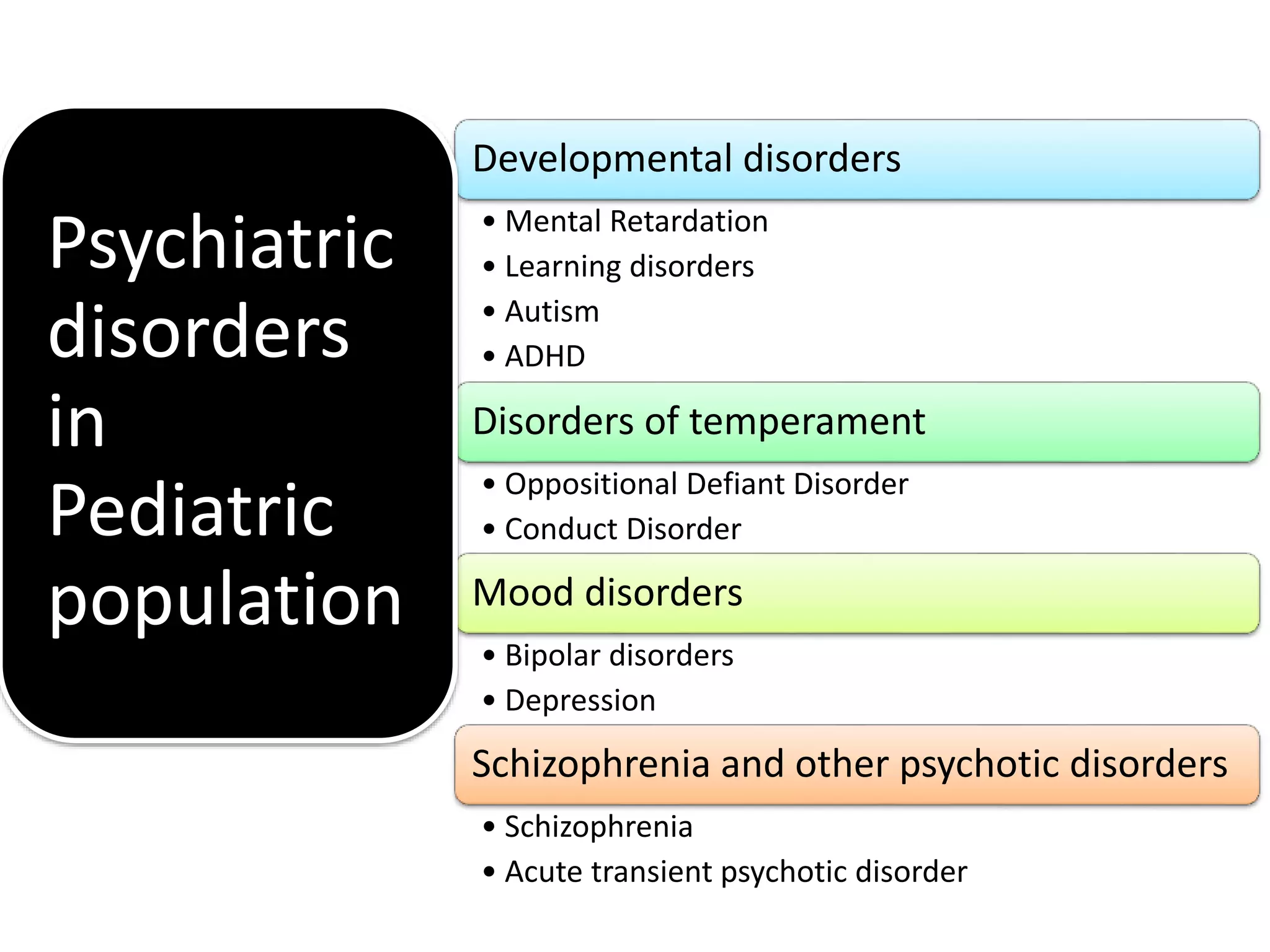
Developmental disorders
• Mental Retardation
• Learning disorders
• Autism
• ADHD
Disorders of temperament
• Oppositional Defiant Disorder
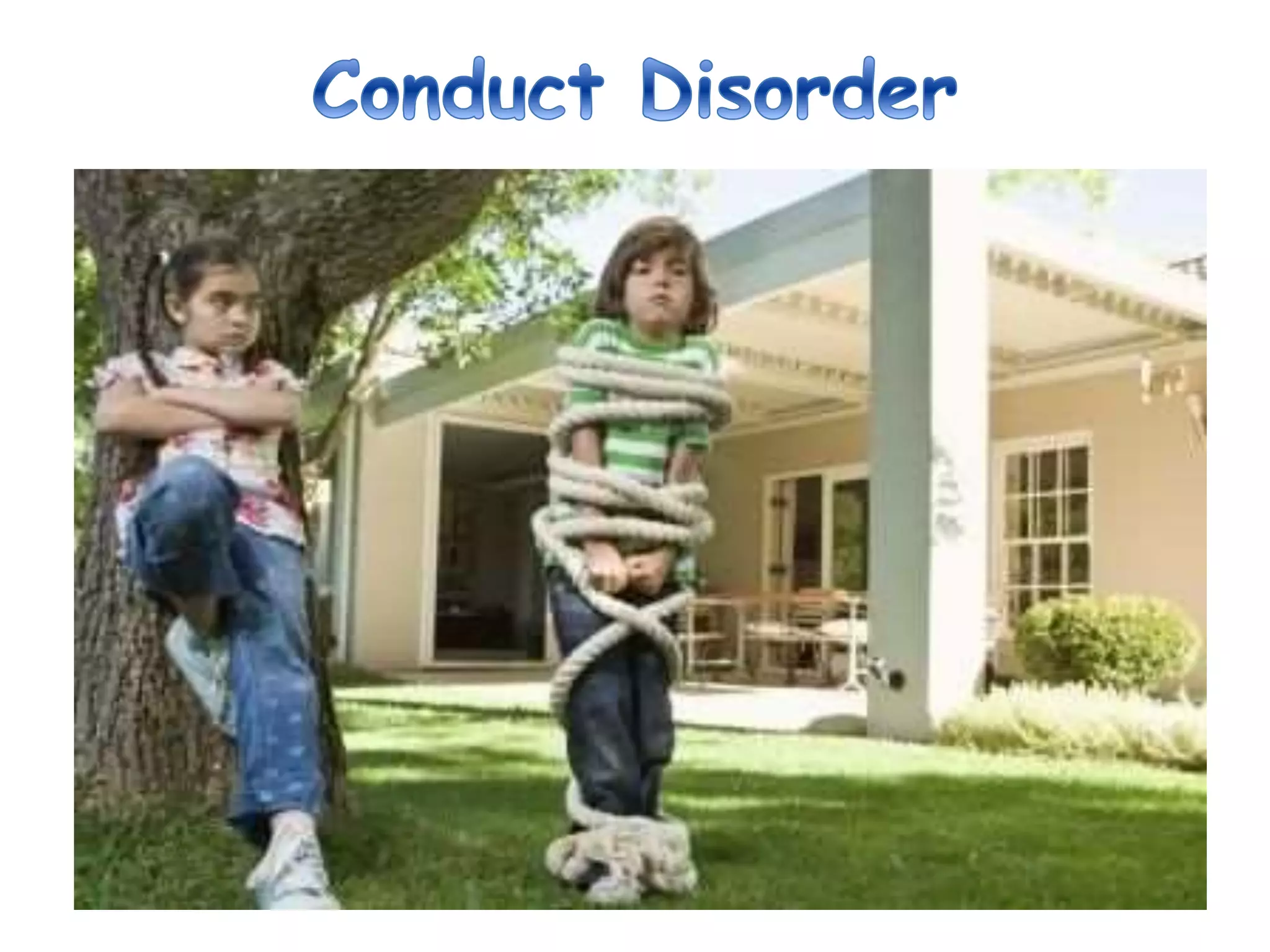
• Conduct Disorder
Mood disorders
• Bipolar disorders
• Depression
Schizophrenia and other psychotic disorders
• Schizophrenia
• Acute transient psychotic disorder
Psychiatric
disorders
in
Pediatric
population
Psychiatric
disorders
in
Pediatric
population
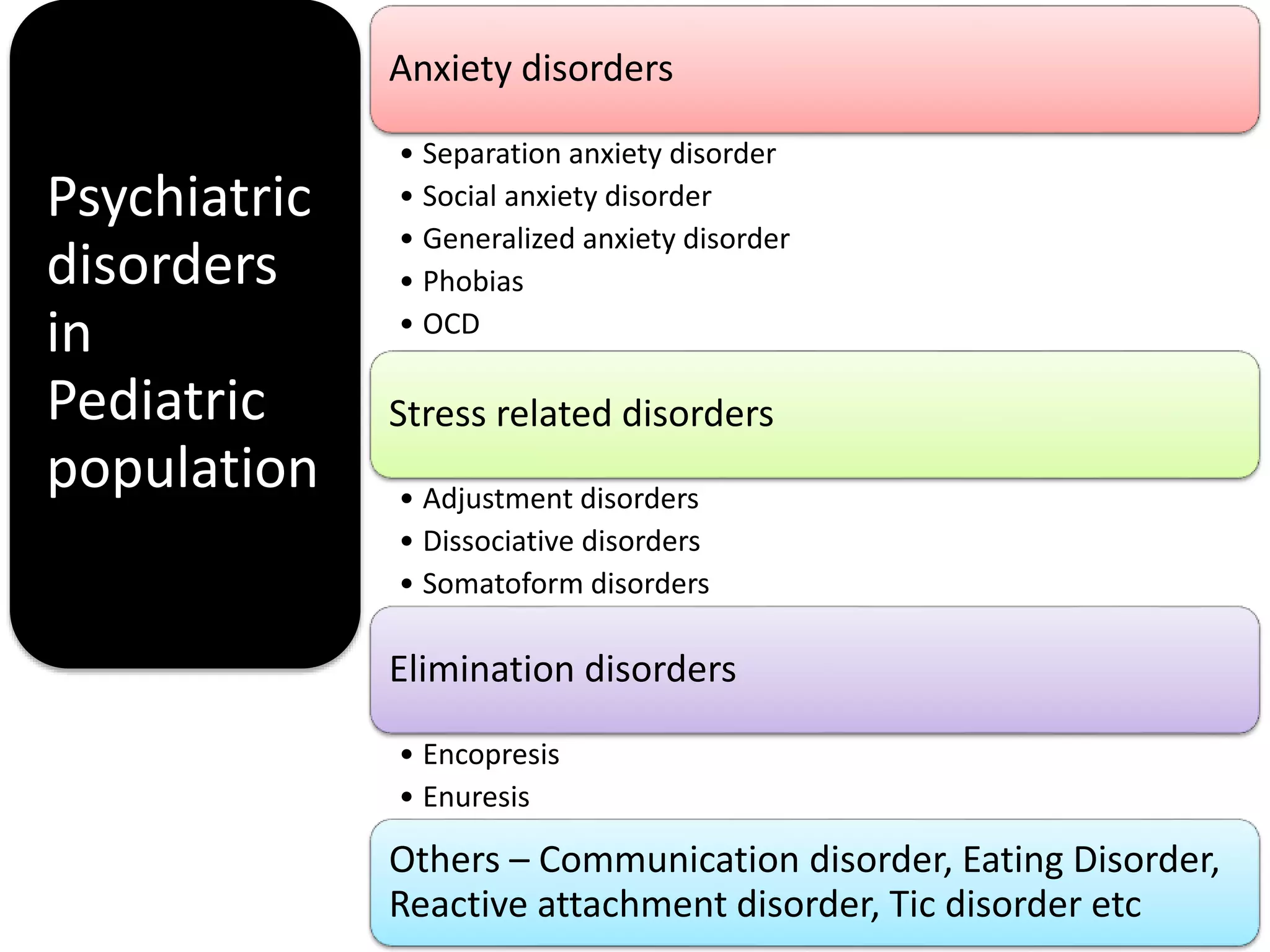
Anxiety disorders
• Separation anxiety disorder
• Social anxiety disorder
• Generalized anxiety disorder
• Phobias
• OCD
Stress related disorders
• Adjustment disorders
• Dissociative disorders
• Somatoform disorders
Elimination disorders
• Encopresis
• Enuresis
Others – Communication disorder, Eating Disorder,
Reactive attachment disorder, Tic disorder etc
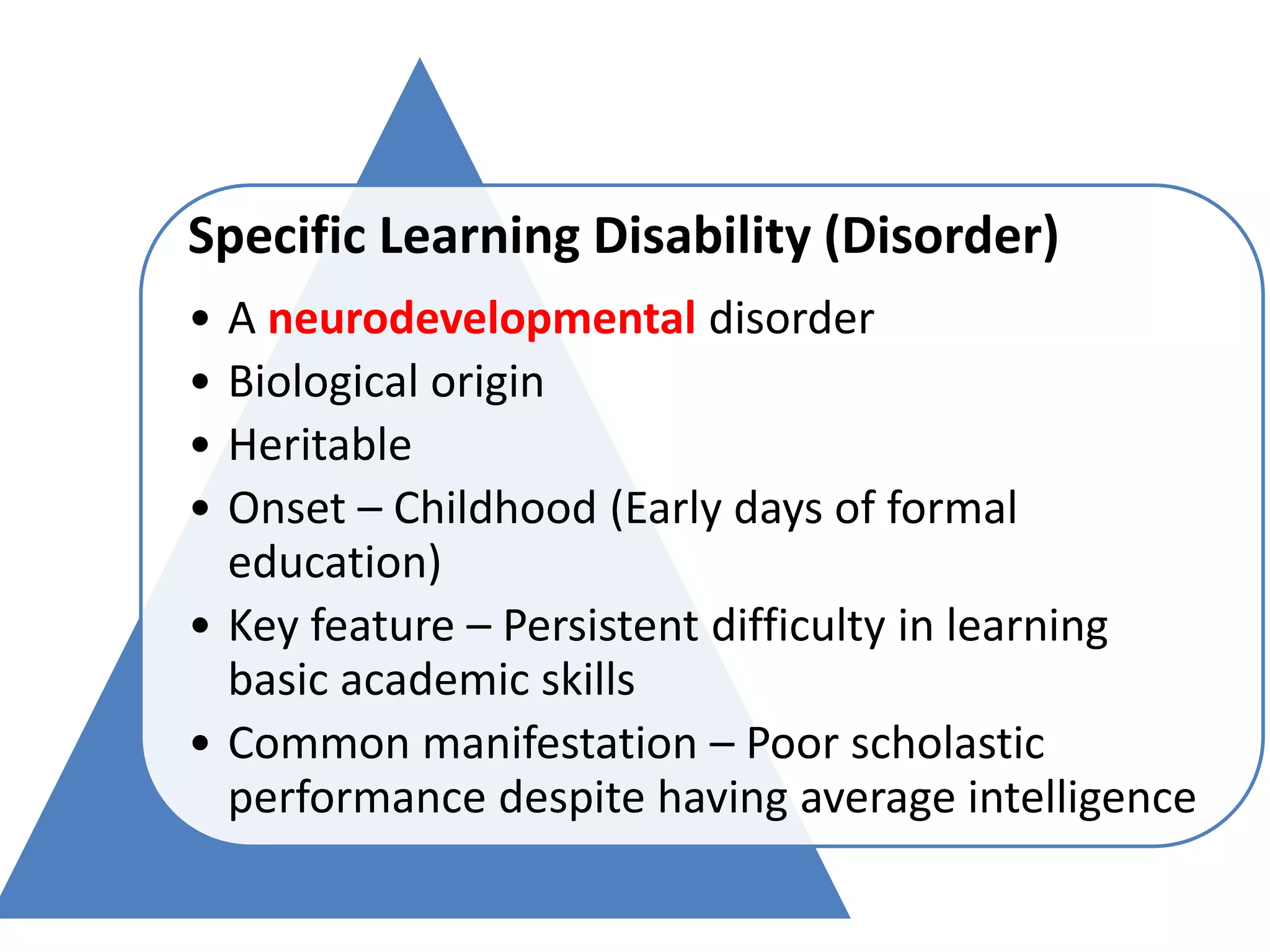
Specific Learning Disability (Disorder)
• A neurodevelopmental disorder
• Biological origin
• Heritable
• Onset – Childhood (Early days of formal
education)
• Key feature – Persistent difficulty in learning
basic academic skills
• Common manifestation – Poor scholastic
performance despite having average intelligence
• CASE :Ten years old Ravi is very good in playing cricket.
He is also very good in painting. His English is not bad. He
performs well in Hindi and Science. He used to score
highest in social studies in his class, however just manage
to score minimum marks in mathematics to qualify the
examination. His parents are very much worried about
his mathematics. He is attending extra classes for
mathematics. He is frequently scolded (Stupid fellow…..)
by his math's teacher for doing careless mistakes. Last
month, he had a very bad performance in exam. He had
managed to score 16 out of 100 marks, in mathematics.
His parents were not talking to him for a couple of days
due to his poor performance in exam. He was quite
depressed and was feeling worthless.
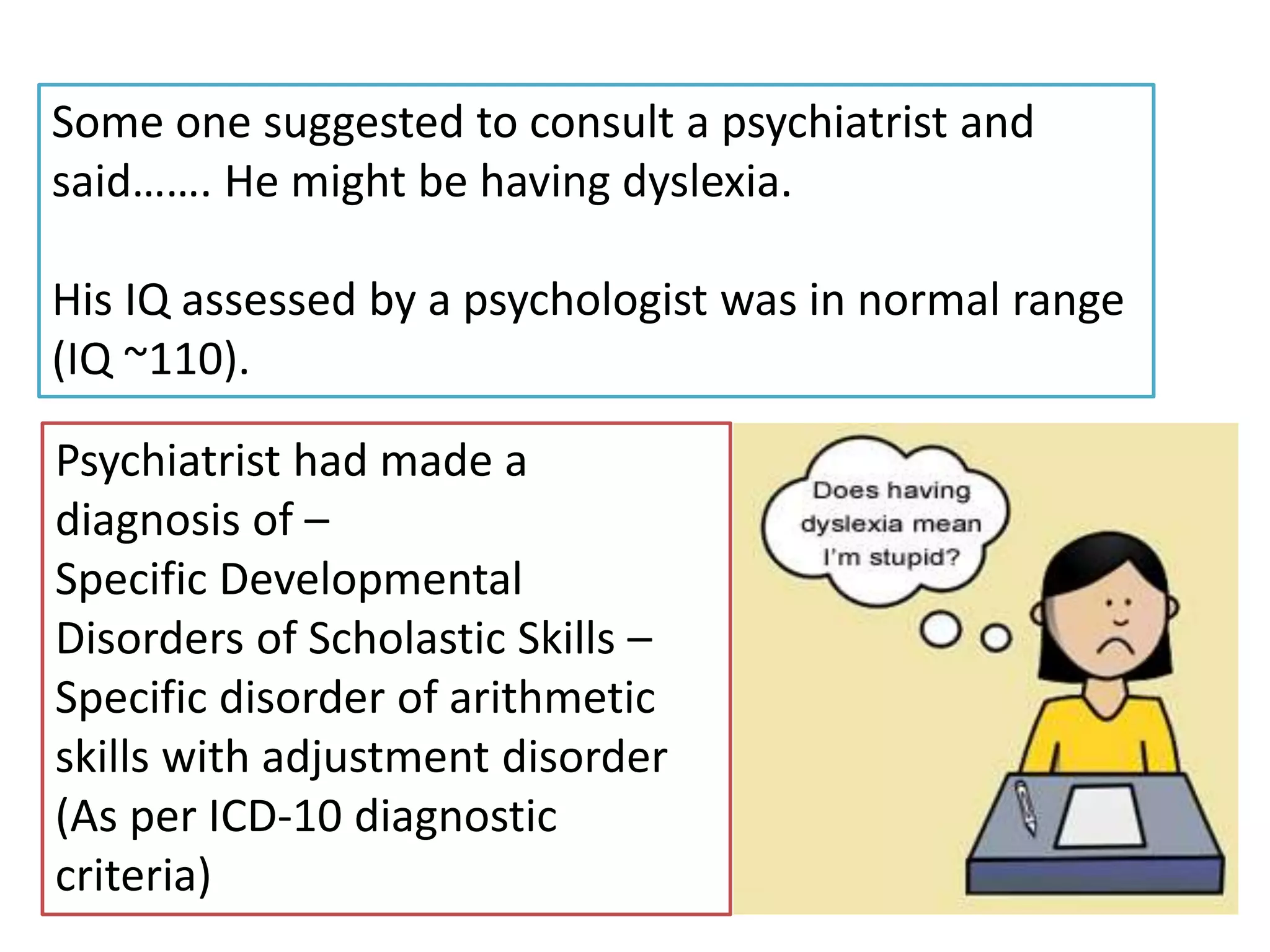
Some one suggested to consult a psychiatrist and
said……. He might be having dyslexia.
His IQ assessed by a psychologist was in normal range
(IQ ~110).
Psychiatrist had made a
diagnosis of –
Specific Developmental
Disorders of Scholastic Skills –
Specific disorder of arithmetic
skills with adjustment disorder
(As per ICD-10 diagnostic
criteria)
Specific issues in this patient
The attitude of teacher / parents
Pressure for performance
Family expectations
Psychiatric co-morbidity
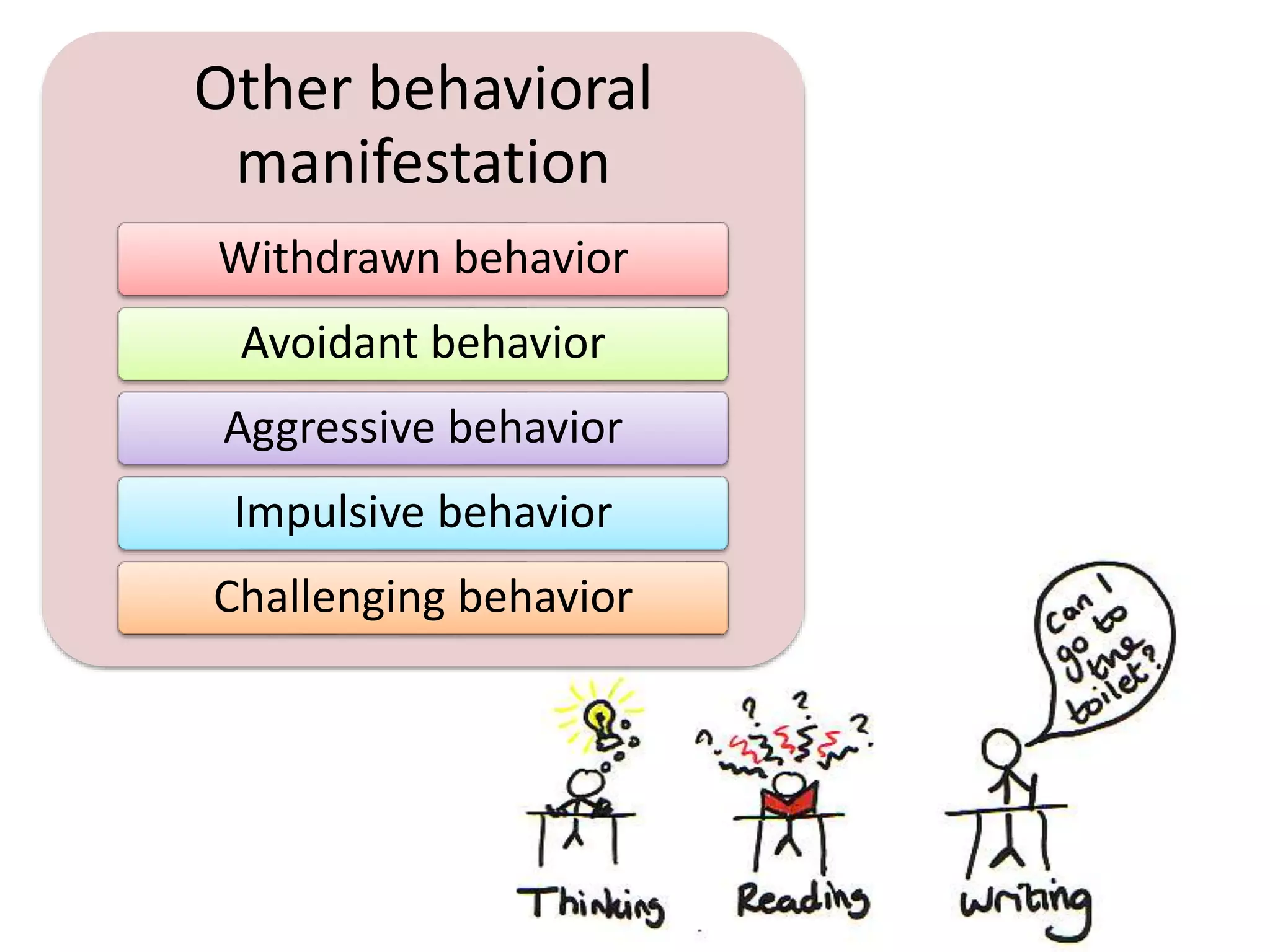
Other behavioral
manifestation
Withdrawn behavior
Avoidant behavior
Aggressive behavior
Impulsive behavior
Challenging behavior
Clinical presentation of
Specific Learning Disability
Inaccurate or slow and effortful word
reading
Difficulty in understanding the meaning
of what is read
Difficulty with spelling
Difficulties in written expression
Difficulties in mastering number sense,
number facts, or calculation
Difficulties in mathematical reasoning
As per DSM-5
• Any one of the
symptom persisting
for at least last 6
months
• With significant
impairment in
academic
performance
• The features are not
attributed by
Intellectual
Disability
Impairment in Reading
Impairment in reading
Word reading accuracy
Reading rate or fluency
Reading comprehension
Impairment in written expression
Impairment in
written expression
Spelling accuracy
Grammar and
punctuation accuracy
Clarity or organization of
written expression
Omission ,
substitution,
distortion ,
addition,
reversal
Impairment in Mathematics
Impairment in mathematics
Number sense
Memorization of arithmetic facts
Accurate or fluent calculation
Accurate math reading
DSM – 5 also grades SLD on
the basis of symptom severity
•Mild
•Moderate
•Severe
Combined
type ADHD is
most
common in
children
CORE SYMPTOMS OF ADHD AS PER DSM-IV-TR
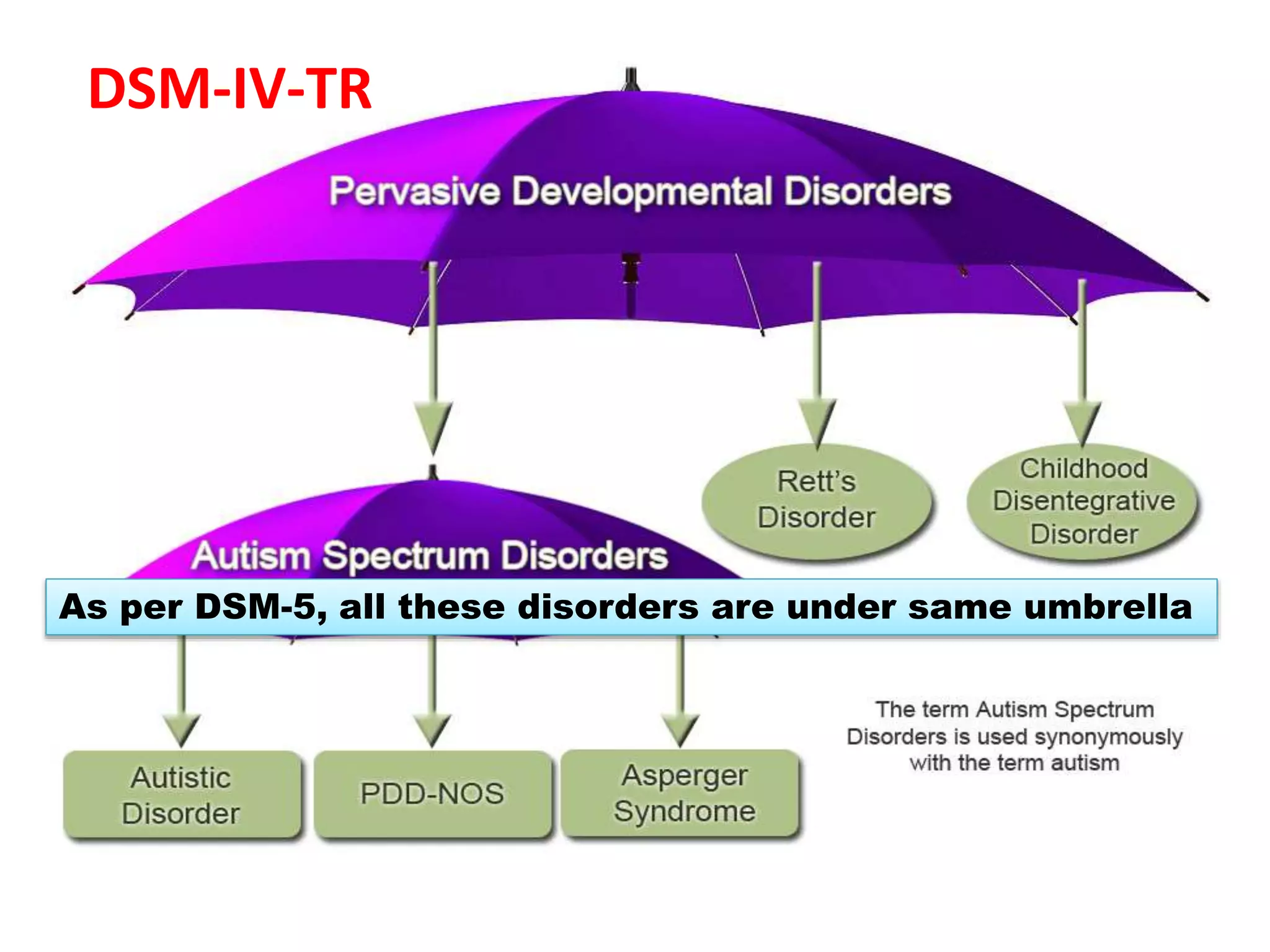
DSM-IV-TR
As per DSM-5, all these disorders are under same umbrella
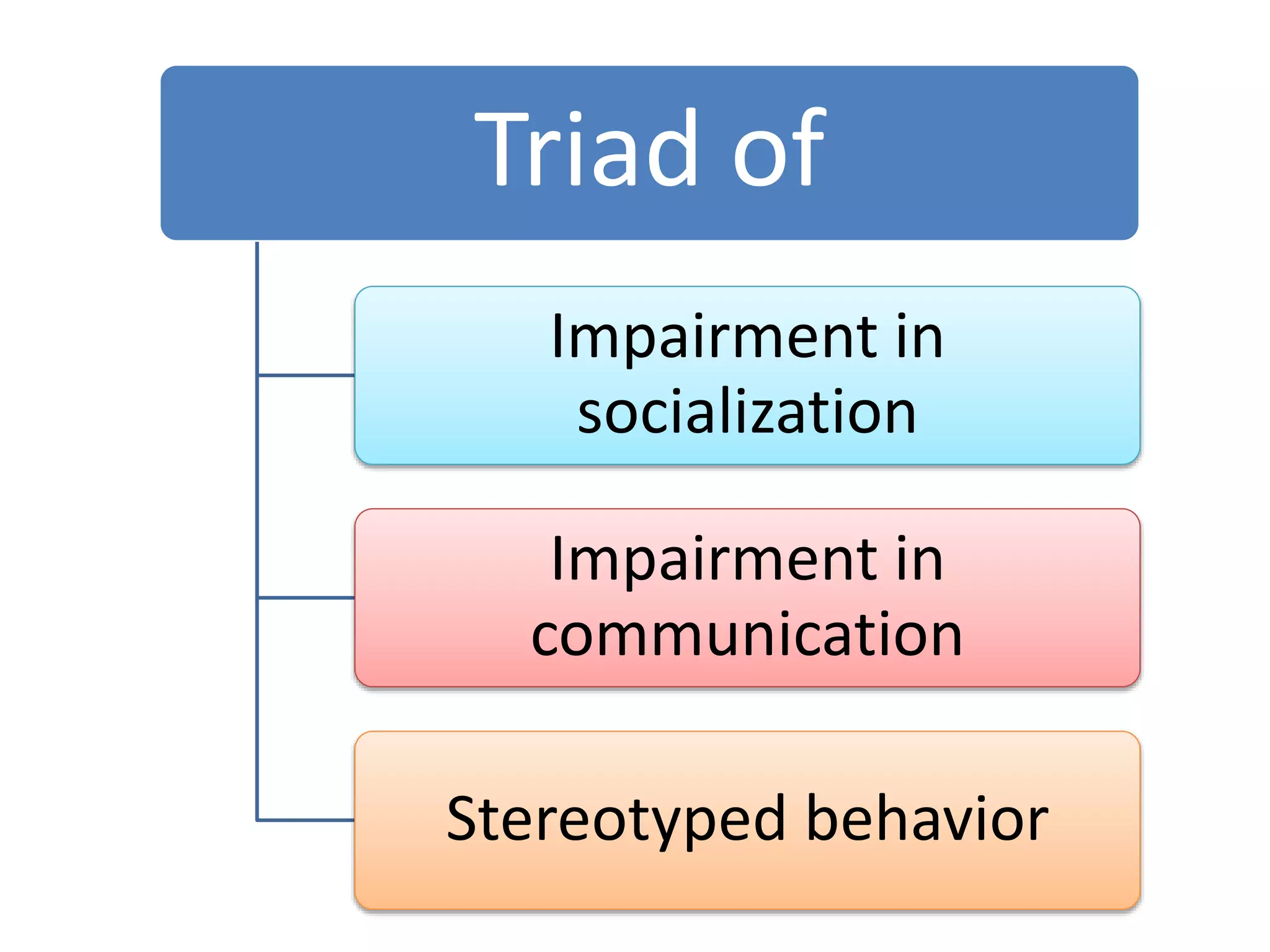
Triad of
Impairment in
socialization
Impairment in
communication
Stereotyped behavior
Case Vignette 1
• A 15 yr old boy reading in 10th standard
presented with episodes of severe headache
followed by abnormal body movements and
unresponsiveness.
• Episodes last 20-30mins, sometimes even a hour
or long & present for approximately 1 year.
• Associated with withdrawn behavior*, school
refusal, poor scholastic performance, occasional
irritability*, fearfulness*, apprehension*,
hopelessness, crying spells, sadness of mood*.
* These symptoms were present for more than 2 years
Case Vignette 1
• Neuro-imaging, EEG, Routine hemogram, Thyroid function
test, ECG – WNL
• Treated with antiepileptics (Valproate, Carbamazepine,
Clobazam, Levetiracetam- alone as well as in combination)
• Treated with antipsychotics (Trifluoperazine, Risperidone+
THP, Quetiapine- alone & in combination), Antidepressants
(Sertraline 50mg/day, Imipramine 25mg/d,
Dothepin25mg/d, Amitryptyline), Benzodiazepines
(Clonazepam, Lorazepam), Anti-migraine drugs (flunarizine,
propranolol) Analgesics, PPIs, Multivitamins.
• Also visited several traditional healers and physicians of
alternative medicine
Case Vignette 1
• Reviewing the diagnosis –
– For more than 2 years, he had recurrent thoughts of-
• Door is not locked properly, thieves will enter the house
• The cooking gas is left open, gas will leak
• Also h/o repeated thoughts of contamination followed by
compulsive washing behavior
– Always preoccupied by these thoughts
– In school- Unable to concentrate on studies
– Always stays at home, to keep a watch on these things
with an apprehension, something wrong may happen
at home
– Symptoms worsened since last one year
Case Vignette 1
• Diagnosis – OCD with Moderate Depressive
Episode With Mixed Dissociative Disorder
• Treated with Fluoxetine alone (increased upto
60mg/day, Clobazam 10mg/d in divided
doses), all other medications were stopped.
• In 2 months, depressive symptoms,
dissociative symptoms, headache resolved
completely. OCD symptoms improved
significantly.
• OCD in pediatric
population
– Varied presentation
(eg.Withdrawn behavior
to marked irritability)
– PANDAS (Pediatric
Autoimmune
Neuropsychiatic
Disorders Associated
with Streptococcal
infections)
– US FDA approved
medications
– Role of CBT
• Dissociation
– A stress response
– Varied clinical presentations
– True seizure Vs Pseudo-seizures
– Relevance of pharmacological management
Case Vignette 2
• A 14 year boy was complaining of weakness,
lethargy, reduced sleep, reduced appetite,
inability to concentrate on studies, disturbed
sleep & withdrawn behavior for 6 months.
• Since last 2 months, he reported about
sadness of mood, hopelessness, feeling of
guilt, suicidal thoughts (twice attempted
suicide during that time).
• He lost 10 kg weight in last 6 months.
• In the initial period, he was treated with
Syrup. Cyproheptidine, Multivitamins &
Benzodiazepine (Clonazepam) for sleep.
• Sleep improved.
• Due to two suicidal attempts and worsening of
symptoms, he was referred for psychiatric
consultation
Case Vignette 2
• History reviewed
– He expressed his worries related to semen loss by
nocturnal emission and masturbation
– Extreme guilt feeling was present
– He attributes all his symptoms to semen loss
• He was prescribe Escitalopram 10mg/day and
Psychosocial intervention has been done. Sexual
myths were addressed.
• His symptoms resolved in 2 weeks.
• Diagnosis: Dhat Syndrome with Severe
Depressive Episode
Case Vignette 2
• Dhat Syndrome
– Culture bound syndrome
– Psychosomatic features
– Common in late adolescence to young adults
• Depression
– Normal emotional response Vs
Depression as a pathological
entity
– FDA black box warnings
– Association with physical
illnesses
Case Vignette 3
• A 14 year girl had brought for psychiatric
consultation for frequent aggressive and hostile
behavior for past 2 years, which has been
significantly impairing since past 4 months.
• Her mother reports about delayed
developmental milestones, Poor scholastic
performance and need of assistance in doing
activities of daily living.
• She had history of seizure for which she was on
Phenobarbitone for last 10 years.
Case Vignette 3
• On IQ assessment – IQ ~ 45 (moderate MR)
• Diagnosis – Moderate MR with Behavioral
Problems with Seizure disorder
• Treatment – Valproate was added and
Phenobarbitone was gradually tapered off.
Behavioral symptoms improved. No relapse of
seizure. Family member were psycho-
educated.
• Behavioral problems
– Impulsive, disruptive behavior
– Pharmacological options
– Behavioral measures
Case Vignette 4
• A primary school going child
with poor scholastic
performance was found
persistently withdrawn,
decreased interest in study,
decreased interaction after
being shifted to a boarding
school.
• He always remembers about
her mother, brother and had
frequent crying spells.
• He had specific learning
disability involving reading,
writing and mathematics.
• Adjustment disorders
– Stress related disorders
– Common in children and adolescents
– Persistence of stressor leads to persistence of
symptoms
– Chronic maladjustment leads to failure to thrive
Parenting styles
• The ways of rearing children
• A difficult task
• Seldom taught or trained
Types of Parenting Style
Neglectful Parenting Style
Permissive Parenting Style
Authoritarian Parenting Style
Authoritative Parenting Style
Early Life Adversities
• Parental Loss
• Abuse
• Neglect
• Chronic illness
Child’s perception about Death
Death & Grief
Death & Grief
Impact of Early Life Adversities
• Physical
– Failure to thrive, Malnutrition
• Psychological
– Internalizing behaviors
– Externalizing behaviors
Scholastic difficulties…
Look for
Intellectual disability
ADHD
Learning disorder
Several other psychiatric
disorders and medical
conditions cause decline in
scholastic performance
Symptoms that mimic physical illnesses
• Panic attack
• Hyperventilation
• Dissociative
stupor/amnesia/seizure
/ sensory or motor
disorder/Possession
• Anorexia nervosa
• Somatoform disorder
Choosing appropriate medications
• Antidepressants
• Antipsychotics
• Benzodiazepines
• Mood stabilizers
• Stimulants
• Other medications –
Propranolol, THP,
Promethazine
Behavioral interventions
• Target
– To promote desired behavior
• Reinforcement (Positive & Negative)
• Modeling
– To reduce undesired behavior
• Punishment
• Time out
Summary
Questions & Feedback
Write to me at –

Problematic behavior in a child

  • 1.
    Psychiatric disorders of childrenand adolescents: Relevance in Pediatrics
  • 2.
    • Psychiatric disordersin Pediatric populations • Case vignettes • Parenting issues • Early life adversities • Symptoms that mimic physical illnesses • Choosing appropriate medications • Questions & Feedback
  • 3.
    Developmental disorders • MentalRetardation • Learning disorders • Autism • ADHD Disorders of temperament • Oppositional Defiant Disorder • Conduct Disorder Mood disorders • Bipolar disorders • Depression Schizophrenia and other psychotic disorders • Schizophrenia • Acute transient psychotic disorder Psychiatric disorders in Pediatric population
  • 4.
    Psychiatric disorders in Pediatric population Anxiety disorders • Separationanxiety disorder • Social anxiety disorder • Generalized anxiety disorder • Phobias • OCD Stress related disorders • Adjustment disorders • Dissociative disorders • Somatoform disorders Elimination disorders • Encopresis • Enuresis Others – Communication disorder, Eating Disorder, Reactive attachment disorder, Tic disorder etc
  • 7.
    Specific Learning Disability(Disorder) • A neurodevelopmental disorder • Biological origin • Heritable • Onset – Childhood (Early days of formal education) • Key feature – Persistent difficulty in learning basic academic skills • Common manifestation – Poor scholastic performance despite having average intelligence
  • 8.
    • CASE :Tenyears old Ravi is very good in playing cricket. He is also very good in painting. His English is not bad. He performs well in Hindi and Science. He used to score highest in social studies in his class, however just manage to score minimum marks in mathematics to qualify the examination. His parents are very much worried about his mathematics. He is attending extra classes for mathematics. He is frequently scolded (Stupid fellow…..) by his math's teacher for doing careless mistakes. Last month, he had a very bad performance in exam. He had managed to score 16 out of 100 marks, in mathematics. His parents were not talking to him for a couple of days due to his poor performance in exam. He was quite depressed and was feeling worthless.
  • 9.
    Some one suggestedto consult a psychiatrist and said……. He might be having dyslexia. His IQ assessed by a psychologist was in normal range (IQ ~110). Psychiatrist had made a diagnosis of – Specific Developmental Disorders of Scholastic Skills – Specific disorder of arithmetic skills with adjustment disorder (As per ICD-10 diagnostic criteria)
  • 10.
    Specific issues inthis patient The attitude of teacher / parents Pressure for performance Family expectations Psychiatric co-morbidity
  • 11.
    Other behavioral manifestation Withdrawn behavior Avoidantbehavior Aggressive behavior Impulsive behavior Challenging behavior
  • 12.
    Clinical presentation of SpecificLearning Disability Inaccurate or slow and effortful word reading Difficulty in understanding the meaning of what is read Difficulty with spelling Difficulties in written expression Difficulties in mastering number sense, number facts, or calculation Difficulties in mathematical reasoning As per DSM-5 • Any one of the symptom persisting for at least last 6 months • With significant impairment in academic performance • The features are not attributed by Intellectual Disability
  • 13.
    Impairment in Reading Impairmentin reading Word reading accuracy Reading rate or fluency Reading comprehension
  • 14.
    Impairment in writtenexpression Impairment in written expression Spelling accuracy Grammar and punctuation accuracy Clarity or organization of written expression Omission , substitution, distortion , addition, reversal
  • 15.
    Impairment in Mathematics Impairmentin mathematics Number sense Memorization of arithmetic facts Accurate or fluent calculation Accurate math reading
  • 16.
    DSM – 5also grades SLD on the basis of symptom severity •Mild •Moderate •Severe
  • 19.
  • 21.
    CORE SYMPTOMS OFADHD AS PER DSM-IV-TR
  • 24.
    DSM-IV-TR As per DSM-5,all these disorders are under same umbrella
  • 26.
    Triad of Impairment in socialization Impairmentin communication Stereotyped behavior
  • 31.
    Case Vignette 1 •A 15 yr old boy reading in 10th standard presented with episodes of severe headache followed by abnormal body movements and unresponsiveness. • Episodes last 20-30mins, sometimes even a hour or long & present for approximately 1 year. • Associated with withdrawn behavior*, school refusal, poor scholastic performance, occasional irritability*, fearfulness*, apprehension*, hopelessness, crying spells, sadness of mood*. * These symptoms were present for more than 2 years
  • 32.
    Case Vignette 1 •Neuro-imaging, EEG, Routine hemogram, Thyroid function test, ECG – WNL • Treated with antiepileptics (Valproate, Carbamazepine, Clobazam, Levetiracetam- alone as well as in combination) • Treated with antipsychotics (Trifluoperazine, Risperidone+ THP, Quetiapine- alone & in combination), Antidepressants (Sertraline 50mg/day, Imipramine 25mg/d, Dothepin25mg/d, Amitryptyline), Benzodiazepines (Clonazepam, Lorazepam), Anti-migraine drugs (flunarizine, propranolol) Analgesics, PPIs, Multivitamins. • Also visited several traditional healers and physicians of alternative medicine
  • 33.
    Case Vignette 1 •Reviewing the diagnosis – – For more than 2 years, he had recurrent thoughts of- • Door is not locked properly, thieves will enter the house • The cooking gas is left open, gas will leak • Also h/o repeated thoughts of contamination followed by compulsive washing behavior – Always preoccupied by these thoughts – In school- Unable to concentrate on studies – Always stays at home, to keep a watch on these things with an apprehension, something wrong may happen at home – Symptoms worsened since last one year
  • 34.
    Case Vignette 1 •Diagnosis – OCD with Moderate Depressive Episode With Mixed Dissociative Disorder • Treated with Fluoxetine alone (increased upto 60mg/day, Clobazam 10mg/d in divided doses), all other medications were stopped. • In 2 months, depressive symptoms, dissociative symptoms, headache resolved completely. OCD symptoms improved significantly.
  • 35.
    • OCD inpediatric population – Varied presentation (eg.Withdrawn behavior to marked irritability) – PANDAS (Pediatric Autoimmune Neuropsychiatic Disorders Associated with Streptococcal infections) – US FDA approved medications – Role of CBT
  • 36.
    • Dissociation – Astress response – Varied clinical presentations – True seizure Vs Pseudo-seizures – Relevance of pharmacological management
  • 37.
    Case Vignette 2 •A 14 year boy was complaining of weakness, lethargy, reduced sleep, reduced appetite, inability to concentrate on studies, disturbed sleep & withdrawn behavior for 6 months. • Since last 2 months, he reported about sadness of mood, hopelessness, feeling of guilt, suicidal thoughts (twice attempted suicide during that time). • He lost 10 kg weight in last 6 months.
  • 38.
    • In theinitial period, he was treated with Syrup. Cyproheptidine, Multivitamins & Benzodiazepine (Clonazepam) for sleep. • Sleep improved. • Due to two suicidal attempts and worsening of symptoms, he was referred for psychiatric consultation Case Vignette 2
  • 39.
    • History reviewed –He expressed his worries related to semen loss by nocturnal emission and masturbation – Extreme guilt feeling was present – He attributes all his symptoms to semen loss • He was prescribe Escitalopram 10mg/day and Psychosocial intervention has been done. Sexual myths were addressed. • His symptoms resolved in 2 weeks. • Diagnosis: Dhat Syndrome with Severe Depressive Episode Case Vignette 2
  • 40.
    • Dhat Syndrome –Culture bound syndrome – Psychosomatic features – Common in late adolescence to young adults
  • 41.
    • Depression – Normalemotional response Vs Depression as a pathological entity – FDA black box warnings – Association with physical illnesses
  • 42.
    Case Vignette 3 •A 14 year girl had brought for psychiatric consultation for frequent aggressive and hostile behavior for past 2 years, which has been significantly impairing since past 4 months. • Her mother reports about delayed developmental milestones, Poor scholastic performance and need of assistance in doing activities of daily living. • She had history of seizure for which she was on Phenobarbitone for last 10 years.
  • 43.
    Case Vignette 3 •On IQ assessment – IQ ~ 45 (moderate MR) • Diagnosis – Moderate MR with Behavioral Problems with Seizure disorder • Treatment – Valproate was added and Phenobarbitone was gradually tapered off. Behavioral symptoms improved. No relapse of seizure. Family member were psycho- educated.
  • 44.
    • Behavioral problems –Impulsive, disruptive behavior – Pharmacological options – Behavioral measures
  • 45.
    Case Vignette 4 •A primary school going child with poor scholastic performance was found persistently withdrawn, decreased interest in study, decreased interaction after being shifted to a boarding school. • He always remembers about her mother, brother and had frequent crying spells. • He had specific learning disability involving reading, writing and mathematics.
  • 46.
    • Adjustment disorders –Stress related disorders – Common in children and adolescents – Persistence of stressor leads to persistence of symptoms – Chronic maladjustment leads to failure to thrive
  • 47.
    Parenting styles • Theways of rearing children • A difficult task • Seldom taught or trained
  • 48.
  • 49.
  • 50.
  • 51.
  • 52.
  • 54.
    Early Life Adversities •Parental Loss • Abuse • Neglect • Chronic illness
  • 55.
  • 56.
  • 57.
  • 58.
    Impact of EarlyLife Adversities • Physical – Failure to thrive, Malnutrition • Psychological – Internalizing behaviors – Externalizing behaviors
  • 59.
    Scholastic difficulties… Look for Intellectualdisability ADHD Learning disorder Several other psychiatric disorders and medical conditions cause decline in scholastic performance
  • 60.
    Symptoms that mimicphysical illnesses • Panic attack • Hyperventilation • Dissociative stupor/amnesia/seizure / sensory or motor disorder/Possession • Anorexia nervosa • Somatoform disorder
  • 61.
    Choosing appropriate medications •Antidepressants • Antipsychotics • Benzodiazepines • Mood stabilizers • Stimulants • Other medications – Propranolol, THP, Promethazine
  • 62.
    Behavioral interventions • Target –To promote desired behavior • Reinforcement (Positive & Negative) • Modeling – To reduce undesired behavior • Punishment • Time out
  • 63.
  • 64.
  • 65.