



Presented by:
Mr. P. Vethadhas M.Sc (N),
Assistant Professor,
Dept.of Mental Health Nursing.
LITHIUM AND OTHER MOOD
STABILIZING DRUGS
Mood stabilizers are used for the treatment of bipolar
affective disorders. Some commonly used mood stabilizers
are:
Lithium
Carbamazepine
Sodium valporate
LITHIUM
Lithium is an element with atomic number 3and atomic
weight 7. It was discovered by FJ Cade in 1949,and is a most
effective and commonly used drug in the treatment of mania.
Indications
Acute mania
Prophylaxis for bipolar and unipolar mood disorder
 Schizoaffective disorder
Cyclothymia
Impulsivity and aggression
Indications
Other disorders:
Premenstrual dysphoric disorder
Bulimia nervosa
Borderline personality disorder
Episodes of binge drinking
Trichotillomania
Cluster headaches
Pharmacokinetics
Lithium is readily absorbed with peak plasma levels occurring 2-
4 hours after a single oral dose of lithium carbonate. Lithium is
distributed rapidly in liver and kidney and more slowly in muscle,
brain and bone. Steady state levels are achieved in about 7 days.
Elimination is predominantly via kidneys. Lithium is reabsorbed in the
proximal tubules and is influenced by sodium balance. Depletion of
sodium can precipitate lithium toxicity.
Mechanism of Action
The probable mechanisms of action can be:
• It accelerates presynaptic re-uptake and destruction of catecholamines,
like norepinephrine
• It inhibits the release of catecholamines at the synapse.
• It decreases postsynaptic serotonin receptor sensitivity.
All these actions result in decreased catecholamine activity, thus
ameliorating mania.
Dosage
Lithium is available in the market in the form of the following
preparations:
Lithium carbonate: 300 mg tablets (e.g. Licab); 400 mg sustained release
tablets (e.g. Lithosun-SR)
Lithium citrate: 300mg/ 5ml liquid.
The usual range of dose per day in acute mania is 900-2100 mg given in 2-3
divided doses. The treatment is started after serial lithium estimation is done
after a loading dose of 600 mg or 900 mg of lithium to determine the
pharmacokinetics.
Blood Lithium Levels
Therapeutic levels = 0.8 - 1.2 mEq/L (for treatment of acute mania)
Prophylactic levels = 0.6 - 1.2 mEq/L (for prevention of relapse in
bipolar disorder)
Toxiclithium levels > 2.0mEq/L
Side Effects
1. Neurological:
Tremors
motor hyperactivity
muscular weakness
cogwheel rigidity
seizures
neurotoxicity (delirium, abnormal involuntary movements,
seizures, coma).
2. Renal:
Polydipsia
Polyuria
Tubular enlargement
Nephrotic syndrome
3. Cardiovascular:
T -wave depression.
4. Gastrointestinal:
Nausea
Vomiting
Diarrhea
Abdominal pain and metallic taste.
5. Endocrine:
Abnormal thyroid function
Goiter and
Weight gain.
6. Dermatological:
Acneiform eruptions,
Papular eruptions and
Exacerbation of psoriasis.
7. Side-effects during pregnancy and
lactation:
Teratogenic possibility,
Increased incidence of Ebstein's anomaly (distortion and
downward displacement of tricuspid value in right
ventricle)when taken in firsttrimester.
Secreted in milk and can cause toxicity in infant.
8. Lithium toxicity :
Toxicity occurs when serum lithium level >2.0 mEq/L)
Signs and symptoms of lithium toxicity
 Ataxia
Coarse tremor (hand)
Nausea and vomiting
Impaired memory
Impaired concentration
Nephrotoxicity
Muscle weakness
Signs and symptoms of lithium toxicity
Convulsions
Muscle twitching
Dysarthria
Lethargy
Confusion
Coma
Hyperreflexia
Nystagmus
Management of Lithium Toxicity
Discontinue the drug immediately.
For significant short-term ingestions, residual gastric content should be
removed by induction of emesis, gastric lavage and adsorption with
activated charcoal.
If possible instruct the patient to ingest fluids.
Assess serum lithium levels, serum electrolytes, renal functions, ECG
as soon as possible.
Management of Lithium Toxicity
Maintenance of fluid and electrolyte balance.
In a patient with serious manifestations of lithium toxicity,
hemodialysis should be initiated.
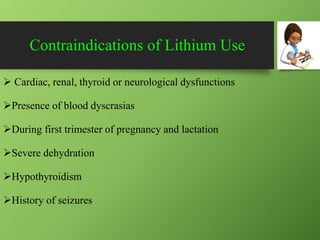
Contraindications of Lithium Use
 Cardiac, renal, thyroid or neurological dysfunctions
Presence of blood dyscrasias
During first trimester of pregnancy and lactation
Severe dehydration
Hypothyroidism
History of seizures
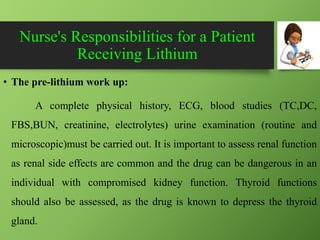
Nurse's Responsibilities for a Patient
Receiving Lithium
• The pre-lithium work up:
A complete physical history, ECG, blood studies (TC,DC,
FBS,BUN, creatinine, electrolytes) urine examination (routine and
microscopic)must be carried out. It is important to assess renal function
as renal side effects are common and the drug can be dangerous in an
individual with compromised kidney function. Thyroid functions
should also be assessed, as the drug is known to depress the thyroid
gland.
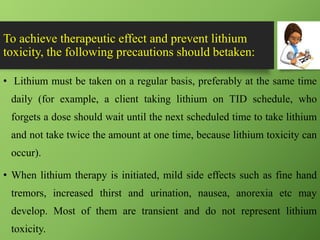
To achieve therapeutic effect and prevent lithium
toxicity, the following precautions should betaken:
• Lithium must be taken on a regular basis, preferably at the same time
daily (for example, a client taking lithium on TID schedule, who
forgets a dose should wait until the next scheduled time to take lithium
and not take twice the amount at one time, because lithium toxicity can
occur).
• When lithium therapy is initiated, mild side effects such as fine hand
tremors, increased thirst and urination, nausea, anorexia etc may
develop. Most of them are transient and do not represent lithium
toxicity.
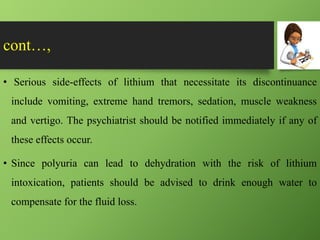
cont…,
• Serious side-effects of lithium that necessitate its discontinuance
include vomiting, extreme hand tremors, sedation, muscle weakness
and vertigo. The psychiatrist should be notified immediately if any of
these effects occur.
• Since polyuria can lead to dehydration with the risk of lithium
intoxication, patients should be advised to drink enough water to
compensate for the fluid loss.
cont…,
• Various situations may require an adjustment in the amount of lithium
administered to a client, such as the addition of a new medicine to the client's
drug regimen, a new diet or an illness with fever or excessive sweating. In
this connection, people involved in heavy outdoor labor are prone to
excessive sodium loss through sweating.
• They must be advised to consume large quantities of water with salt, to
prevent lithium toxicity due to decreased sodium levels. If severe vomiting or
gastroenteritis develops, the patient should be told to report immediately to
the doctor. These are the conditions that have a high potential for causing
lithium toxicity by lowering serum sodium levels..
cont…,
• Frequent serum lithium level evaluation is important. Blood for
determination of lithium levels should be drawn in the morning
approximately 12-14 hours after the last dose was taken.
• The patient should be told about the importance of regular followup. In
every six months, blood sample should be taken for estimation of
electrolytes, urea, creatinine, a full blood count, and thyroid function
test.
Lithium.pptx

Lithium.pptx

  • 1.
    Presented by: Mr. P.Vethadhas M.Sc (N), Assistant Professor, Dept.of Mental Health Nursing.
  • 2.
    LITHIUM AND OTHERMOOD STABILIZING DRUGS Mood stabilizers are used for the treatment of bipolar affective disorders. Some commonly used mood stabilizers are: Lithium Carbamazepine Sodium valporate
  • 4.
    LITHIUM Lithium is anelement with atomic number 3and atomic weight 7. It was discovered by FJ Cade in 1949,and is a most effective and commonly used drug in the treatment of mania.
  • 5.
    Indications Acute mania Prophylaxis forbipolar and unipolar mood disorder  Schizoaffective disorder Cyclothymia Impulsivity and aggression
  • 6.
    Indications Other disorders: Premenstrual dysphoricdisorder Bulimia nervosa Borderline personality disorder Episodes of binge drinking Trichotillomania Cluster headaches
  • 7.
    Pharmacokinetics Lithium is readilyabsorbed with peak plasma levels occurring 2- 4 hours after a single oral dose of lithium carbonate. Lithium is distributed rapidly in liver and kidney and more slowly in muscle, brain and bone. Steady state levels are achieved in about 7 days. Elimination is predominantly via kidneys. Lithium is reabsorbed in the proximal tubules and is influenced by sodium balance. Depletion of sodium can precipitate lithium toxicity.
  • 8.
    Mechanism of Action Theprobable mechanisms of action can be: • It accelerates presynaptic re-uptake and destruction of catecholamines, like norepinephrine • It inhibits the release of catecholamines at the synapse. • It decreases postsynaptic serotonin receptor sensitivity. All these actions result in decreased catecholamine activity, thus ameliorating mania.
  • 9.
    Dosage Lithium is availablein the market in the form of the following preparations: Lithium carbonate: 300 mg tablets (e.g. Licab); 400 mg sustained release tablets (e.g. Lithosun-SR) Lithium citrate: 300mg/ 5ml liquid. The usual range of dose per day in acute mania is 900-2100 mg given in 2-3 divided doses. The treatment is started after serial lithium estimation is done after a loading dose of 600 mg or 900 mg of lithium to determine the pharmacokinetics.
  • 10.
    Blood Lithium Levels Therapeuticlevels = 0.8 - 1.2 mEq/L (for treatment of acute mania) Prophylactic levels = 0.6 - 1.2 mEq/L (for prevention of relapse in bipolar disorder) Toxiclithium levels > 2.0mEq/L
  • 11.
  • 12.
    1. Neurological: Tremors motor hyperactivity muscularweakness cogwheel rigidity seizures neurotoxicity (delirium, abnormal involuntary movements, seizures, coma).
  • 13.
  • 14.
  • 15.
  • 16.
    5. Endocrine: Abnormal thyroidfunction Goiter and Weight gain.
  • 17.
    6. Dermatological: Acneiform eruptions, Papulareruptions and Exacerbation of psoriasis.
  • 18.
    7. Side-effects duringpregnancy and lactation: Teratogenic possibility, Increased incidence of Ebstein's anomaly (distortion and downward displacement of tricuspid value in right ventricle)when taken in firsttrimester. Secreted in milk and can cause toxicity in infant.
  • 19.
    8. Lithium toxicity: Toxicity occurs when serum lithium level >2.0 mEq/L)
  • 20.
    Signs and symptomsof lithium toxicity  Ataxia Coarse tremor (hand) Nausea and vomiting Impaired memory Impaired concentration Nephrotoxicity Muscle weakness
  • 21.
    Signs and symptomsof lithium toxicity Convulsions Muscle twitching Dysarthria Lethargy Confusion Coma Hyperreflexia Nystagmus
  • 22.
    Management of LithiumToxicity Discontinue the drug immediately. For significant short-term ingestions, residual gastric content should be removed by induction of emesis, gastric lavage and adsorption with activated charcoal. If possible instruct the patient to ingest fluids. Assess serum lithium levels, serum electrolytes, renal functions, ECG as soon as possible.
  • 23.
    Management of LithiumToxicity Maintenance of fluid and electrolyte balance. In a patient with serious manifestations of lithium toxicity, hemodialysis should be initiated.
  • 24.
    Contraindications of LithiumUse  Cardiac, renal, thyroid or neurological dysfunctions Presence of blood dyscrasias During first trimester of pregnancy and lactation Severe dehydration Hypothyroidism History of seizures
  • 25.
    Nurse's Responsibilities fora Patient Receiving Lithium • The pre-lithium work up: A complete physical history, ECG, blood studies (TC,DC, FBS,BUN, creatinine, electrolytes) urine examination (routine and microscopic)must be carried out. It is important to assess renal function as renal side effects are common and the drug can be dangerous in an individual with compromised kidney function. Thyroid functions should also be assessed, as the drug is known to depress the thyroid gland.
  • 26.
    To achieve therapeuticeffect and prevent lithium toxicity, the following precautions should betaken: • Lithium must be taken on a regular basis, preferably at the same time daily (for example, a client taking lithium on TID schedule, who forgets a dose should wait until the next scheduled time to take lithium and not take twice the amount at one time, because lithium toxicity can occur). • When lithium therapy is initiated, mild side effects such as fine hand tremors, increased thirst and urination, nausea, anorexia etc may develop. Most of them are transient and do not represent lithium toxicity.
  • 27.
    cont…, • Serious side-effectsof lithium that necessitate its discontinuance include vomiting, extreme hand tremors, sedation, muscle weakness and vertigo. The psychiatrist should be notified immediately if any of these effects occur. • Since polyuria can lead to dehydration with the risk of lithium intoxication, patients should be advised to drink enough water to compensate for the fluid loss.
  • 28.
    cont…, • Various situationsmay require an adjustment in the amount of lithium administered to a client, such as the addition of a new medicine to the client's drug regimen, a new diet or an illness with fever or excessive sweating. In this connection, people involved in heavy outdoor labor are prone to excessive sodium loss through sweating. • They must be advised to consume large quantities of water with salt, to prevent lithium toxicity due to decreased sodium levels. If severe vomiting or gastroenteritis develops, the patient should be told to report immediately to the doctor. These are the conditions that have a high potential for causing lithium toxicity by lowering serum sodium levels..
  • 29.
    cont…, • Frequent serumlithium level evaluation is important. Blood for determination of lithium levels should be drawn in the morning approximately 12-14 hours after the last dose was taken. • The patient should be told about the importance of regular followup. In every six months, blood sample should be taken for estimation of electrolytes, urea, creatinine, a full blood count, and thyroid function test.