Compiled by Col Mukteshwar Prasad(Retd),
MTech(IITD),CE(I),FIE(I),FIETE,FISLE,FInstOD,AMCSI
Contact -9007224278, e-mail –
muktesh_prasad@yahoo.co.in
for book ”Decoding Services Selection Board” and SSB
ON line guidance and training at Shivnandani Edu and
Defence Academy
Problem in Psychology and it’s solution
Problem and Response
 Situation-One or more circumstances, conditions, states, or
entities in the environment that have the potential to exert
causal influences on an individual's behavior.
 What is a problem in psychology?
 In the context of cognitive psychology, a problem is any
situation in which we are trying to reach a goal and we
must find a means to reach that goal.
 In general, situational meaning refers to how a person
appraises ongoing events (e.g. the immediate situation or
one's life in general) in terms of personal relevance and the
ability to cope, and to the options available for coping.
Response and Reaction
 Response(Showing a favorable reaction)
 Responses are typically the outcome of thoughtfulness,
reflection, and consideration of the relevant factors, and
they are often carefully formulated and well-presented.
 Reaction (Acting in opposition to a force or influence.)
 A reaction may occur within the space of seconds being
usually immediate
 Often without any thought or deliberation
 Hence may not be the optimal way to handle a situation.
 Reactions are normal and expected.
 In psychology, reaction formation is a defense mechanism in
which a person unconsciously replaces an unwanted or
anxiety-provoking impulse with its opposite, often
expressed in an exaggerated or showy way.
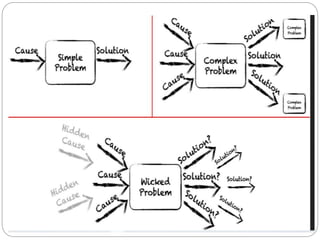
3 Problem Types
 Simple problems -Are ones that have a single cause, are well
defined and have a clear and unambiguous solution.
 Working out a route to travel e.g. from Kolkata to Delhi or
finding lost keys
 SRT Problems in SSB
 Complex problems -Tend to have multiple causes, are difficult
to understand and their solutions can lead to other problems
and unintended consequences.
 E.g. Addressing traffic congestion in a busy town or
organizing picnic for 200 students
 IO’s probing questions / WAT in SSB
 Wicked problems are problems that seem to be so complex it’s
difficult to envision a solution. Climate change is an example of
a wicked problem/Group discussion in GTO/PGT IN GTO /
TAT/IO,s CIQs .
3 Problem Types
 Wicked problems are like a tangled mess of thread – it’s
difficult to know which to pull first. Rittel and Webber, who
formulated the concept of wicked problems, identified them as
having the following characteristics:
 Difficult to define the problem.
 Difficult to know when the problem has been solved.
 No clear right or wrong solutions.
 Difficult to learn from previous success to solve the
problem.
 Each problem is unique.
 There are too many possible solutions to list and
compare.
Problem Solution
 Problems, of all types, can benefit from a systematic approach to
being solved.
 There are many frameworks that can be used for addressing problems
 4S Method proposed by Garrette, Phelps and Sibony is one of them
which can be extended to SSB problems solving in all three techniques viz.
Psychology , GTO and IO
 Works with four, iterative steps: State, Structure, Solve and Sell.
 1.State the Problem.
 Though sounds obvious but unless you understand exactly what
the problem is you are trying to solve it’s going to be very difficult
to come up with a solution.
 The first step is therefore to state exactly what the problem is.
 2.Structure the Problem.
 Having clearly stated the problem you now know how complex, or
even wicked, it is.
 Structure the problem by breaking down into smaller more
manageable parts
 Each of which can hopefully be solved through analysis.
Problem Solution
 4S Method proposed by Garrette, Phelps and Sibony……
 3.Solve the Problem.
 Having broken the problem down each sub problems
can now be solved separately.
 The authors of this method suggest three main
approached:
 Hypothesis-driven problem solving,
 Issue-driven problem solving, or
 Creative path of design thinking.
 4.Sell the Solution.
 Having come up with an innovative solution to the problem,
You must Sell the solution
 Persuade others of its value and feasibility else it will never
be implemented
 While selling focus on the solution

Problem in Psychology and its solution.pptx

  • 1.
    Compiled by ColMukteshwar Prasad(Retd), MTech(IITD),CE(I),FIE(I),FIETE,FISLE,FInstOD,AMCSI Contact -9007224278, e-mail – muktesh_prasad@yahoo.co.in for book ”Decoding Services Selection Board” and SSB ON line guidance and training at Shivnandani Edu and Defence Academy Problem in Psychology and it’s solution
  • 2.
    Problem and Response Situation-One or more circumstances, conditions, states, or entities in the environment that have the potential to exert causal influences on an individual's behavior.  What is a problem in psychology?  In the context of cognitive psychology, a problem is any situation in which we are trying to reach a goal and we must find a means to reach that goal.  In general, situational meaning refers to how a person appraises ongoing events (e.g. the immediate situation or one's life in general) in terms of personal relevance and the ability to cope, and to the options available for coping.
  • 3.
    Response and Reaction Response(Showing a favorable reaction)  Responses are typically the outcome of thoughtfulness, reflection, and consideration of the relevant factors, and they are often carefully formulated and well-presented.  Reaction (Acting in opposition to a force or influence.)  A reaction may occur within the space of seconds being usually immediate  Often without any thought or deliberation  Hence may not be the optimal way to handle a situation.  Reactions are normal and expected.  In psychology, reaction formation is a defense mechanism in which a person unconsciously replaces an unwanted or anxiety-provoking impulse with its opposite, often expressed in an exaggerated or showy way.
  • 5.
    3 Problem Types Simple problems -Are ones that have a single cause, are well defined and have a clear and unambiguous solution.  Working out a route to travel e.g. from Kolkata to Delhi or finding lost keys  SRT Problems in SSB  Complex problems -Tend to have multiple causes, are difficult to understand and their solutions can lead to other problems and unintended consequences.  E.g. Addressing traffic congestion in a busy town or organizing picnic for 200 students  IO’s probing questions / WAT in SSB  Wicked problems are problems that seem to be so complex it’s difficult to envision a solution. Climate change is an example of a wicked problem/Group discussion in GTO/PGT IN GTO / TAT/IO,s CIQs .
  • 6.
    3 Problem Types Wicked problems are like a tangled mess of thread – it’s difficult to know which to pull first. Rittel and Webber, who formulated the concept of wicked problems, identified them as having the following characteristics:  Difficult to define the problem.  Difficult to know when the problem has been solved.  No clear right or wrong solutions.  Difficult to learn from previous success to solve the problem.  Each problem is unique.  There are too many possible solutions to list and compare.
  • 7.
    Problem Solution  Problems,of all types, can benefit from a systematic approach to being solved.  There are many frameworks that can be used for addressing problems  4S Method proposed by Garrette, Phelps and Sibony is one of them which can be extended to SSB problems solving in all three techniques viz. Psychology , GTO and IO  Works with four, iterative steps: State, Structure, Solve and Sell.  1.State the Problem.  Though sounds obvious but unless you understand exactly what the problem is you are trying to solve it’s going to be very difficult to come up with a solution.  The first step is therefore to state exactly what the problem is.  2.Structure the Problem.  Having clearly stated the problem you now know how complex, or even wicked, it is.  Structure the problem by breaking down into smaller more manageable parts  Each of which can hopefully be solved through analysis.
  • 8.
    Problem Solution  4SMethod proposed by Garrette, Phelps and Sibony……  3.Solve the Problem.  Having broken the problem down each sub problems can now be solved separately.  The authors of this method suggest three main approached:  Hypothesis-driven problem solving,  Issue-driven problem solving, or  Creative path of design thinking.  4.Sell the Solution.  Having come up with an innovative solution to the problem, You must Sell the solution  Persuade others of its value and feasibility else it will never be implemented  While selling focus on the solution