Compiled by Col Mukteshwar Prasad(Retd),
MTech(IITD),CE(I),FIE(I),FIETE,FISLE,FInstOD,AMCSI
Contact -9007224278, e-mail –
muktesh_prasad@yahoo.co.in
for book ”Decoding Services Selection Board” and SSB
ON line guidance and training at Shivnandani Edu and
Defence Academy
Person- Situation – Environment 2.0
Ref- The Situation of Situation Research: Knowns and Unknowns
By
John F. Rauthmann &Ryne A Sherman
Introduction
 A situation is a set of fleeting(Lasting for very short time),
dynamic, and momentary circumstances that do not lie within a person
(i.e., they are neither own mental processes nor own behavior), but in their
surroundings.
Rauthmann, 2015
 Three situational information provide a lens to define situation :
 Cues-Something happening in our environment we interpret as in need
of a response.
 Characteristics(are the perceived qualities or attributes of situations)
 Characteristics are psychologically meaningful interpretations of
situations formed from single or multiple cues once they have been
implicitly or explicitly processed.
 Classes are types of situations that are grouped together because they
tend to share similar constellations, or patterns, of characteristics
 A Componential Approach to Situation
 Perceiver, Situation, and Perceiver Situation components situation
Ways to measure Situation
 Cues can be measured
 Objectively (e.g., via cameras, microphones, life-logging systems,
sensors; or
 Subjectively (e.g., inquiring about perceived or remembered cues from
participants).
 Study state-state relations
 Characteristics( perceived attributes of situations) can only be
measured
 By asking participants –Those directly in the situation and affected by it
(in situ raters),- IO
 Merely observing the situation unfold without being directly implicated
(juxta situm raters)-GTO
 Observing recordings or coding verbal descriptions of others’
situations (ex situ raters ) – about how they would describe situations -
Psychologists
 Classes – By asking participants or by classifying cues or characteristics
data
 A “true” situational variable would be best approximated from multiple
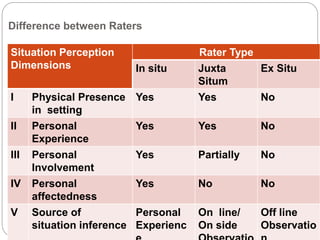
Difference between Raters
Situation Perception
Dimensions
Rater Type
In situ Juxta
Situm
Ex Situ
I Physical Presence
in setting
Yes Yes No
II Personal
Experience
Yes Yes No
III Personal
Involvement
Yes Partially No
IV Personal
affectedness
Yes No No
V Source of
situation inference
Personal
Experienc
On line/
On side
Off line
Observatio
How do situation variables relate to person
variables?
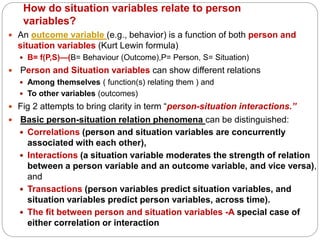
 An outcome variable (e.g., behavior) is a function of both person and
situation variables (Kurt Lewin formula)
 B= f(P,S)—(B= Behaviour (Outcome),P= Person, S= Situation)
 Person and Situation variables can show different relations
 Among themselves ( function(s) relating them ) and
 To other variables (outcomes)
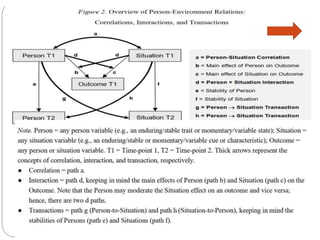
 Fig 2 attempts to bring clarity in term “person-situation interactions.”
 Basic person-situation relation phenomena can be distinguished:
 Correlations (person and situation variables are concurrently
associated with each other),
 Interactions (a situation variable moderates the strength of relation
between a person variable and an outcome variable, and vice versa),
and
 Transactions (person variables predict situation variables, and
situation variables predict person variables, across time).
 The fit between person and situation variables -A special case of
either correlation or interaction
How do situation variables relate to person
variables?
 Single or entire profiles of variables of persons and situations
“match” together (functionally or content wise) may have
consequences for
 Intrapersonal (e.g. , mental health, well-being, life-satisfaction, self-
esteem) and
 Interpersonal adjustment (e.g., status, popularity),
 Thus person-situation fit can be seen as a linchpin(Vital) concept
in psychology
(Kristof-Brown & Guay, 2011; Rauthmann, forthcoming).
How do people transition from one situation to another over time?
 The demarcation of situations (Ending of one and beginning of next)
 Situations change when the physical cues change Or
 When people change their perceptions of the situation
 1.Situations must be thought in terms of cues, characteristics, and
classes as any of these information sources may change
 2.Situation change may be studied
 Within individuals (e.g., ideographically(idea of things) examining
dynamic networks of situation characteristics across time within single
persons) or
 Between individuals (e.g., nomothetically (universal laws) examining
situation change across several persons where inter-individual
differences in change are possible).
 3. Situation change may be examined at the level of
 Single variables or
 Profiles of variables.
How do people transition from one situation to another over time?
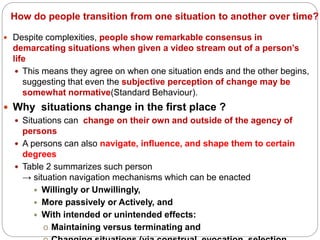
 Despite complexities, people show remarkable consensus in
demarcating situations when given a video stream out of a person’s
life
 This means they agree on when one situation ends and the other begins,
suggesting that even the subjective perception of change may be
somewhat normative(Standard Behaviour).
 Why situations change in the first place ?
 Situations can change on their own and outside of the agency of
persons
 A persons can also navigate, influence, and shape them to certain
degrees
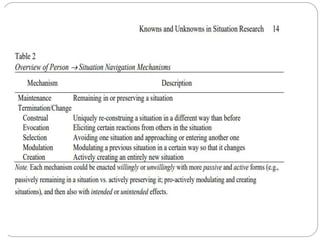
 Table 2 summarizes such person
→ situation navigation mechanisms which can be enacted
 Willingly or Unwillingly,
 More passively or Actively, and
 With intended or unintended effects:
o Maintaining versus terminating and
The Unknowns and Future of Situation Research
 1.Present focus has to shift to all class and all cultural ,all nation study of
taxonomies of situation characteristics
 “Replicable Six” needs to be comprehensively studied
 2. All situation characteristics taxonomies are relatively broad domains
which needs to be multi-faceted and organized in a hierarchy like
personality traits
 3.Replication of existing research on how situation perceptions, traits, and
states are linked
for other samples and countries
 4. Future research should thus try to focus more on situations as
unfolding processes rather than viewing them as static entities.
 Integrating different literatures, perspectives, and theories would make
situation research more synthetic, appealing, and useful across
disciplinary boarders.
 5.Process-focused conceptualization of situations, the person
→situation navigation mechanisms deserve further theoretical and
empirical work.
 6.Longitudinal research tracking cues, characteristics, or classes of
participants’ situations across their lifespan.
 Cumulative empirical evidence will have to be integrated into theories
that will generate new hypotheses and help the field be productive in
the long turn.
Conclusion
 Research on psychological situations has been
gaining traction and thriving, especially in
the last decade.
 It has comprehensively addressed the
conceptualization, measurement,taxonomization, and
usefulness of different kinds of situational information,
most notably situation characteristics.
 Still many more exciting questions await exploring
and answering.

Person Situation and Environment 2.0.pptx

  • 1.
    Compiled by ColMukteshwar Prasad(Retd), MTech(IITD),CE(I),FIE(I),FIETE,FISLE,FInstOD,AMCSI Contact -9007224278, e-mail – muktesh_prasad@yahoo.co.in for book ”Decoding Services Selection Board” and SSB ON line guidance and training at Shivnandani Edu and Defence Academy Person- Situation – Environment 2.0 Ref- The Situation of Situation Research: Knowns and Unknowns By John F. Rauthmann &Ryne A Sherman
  • 2.
    Introduction  A situationis a set of fleeting(Lasting for very short time), dynamic, and momentary circumstances that do not lie within a person (i.e., they are neither own mental processes nor own behavior), but in their surroundings. Rauthmann, 2015  Three situational information provide a lens to define situation :  Cues-Something happening in our environment we interpret as in need of a response.  Characteristics(are the perceived qualities or attributes of situations)  Characteristics are psychologically meaningful interpretations of situations formed from single or multiple cues once they have been implicitly or explicitly processed.  Classes are types of situations that are grouped together because they tend to share similar constellations, or patterns, of characteristics  A Componential Approach to Situation  Perceiver, Situation, and Perceiver Situation components situation
  • 3.
    Ways to measureSituation  Cues can be measured  Objectively (e.g., via cameras, microphones, life-logging systems, sensors; or  Subjectively (e.g., inquiring about perceived or remembered cues from participants).  Study state-state relations  Characteristics( perceived attributes of situations) can only be measured  By asking participants –Those directly in the situation and affected by it (in situ raters),- IO  Merely observing the situation unfold without being directly implicated (juxta situm raters)-GTO  Observing recordings or coding verbal descriptions of others’ situations (ex situ raters ) – about how they would describe situations - Psychologists  Classes – By asking participants or by classifying cues or characteristics data  A “true” situational variable would be best approximated from multiple
  • 4.
    Difference between Raters SituationPerception Dimensions Rater Type In situ Juxta Situm Ex Situ I Physical Presence in setting Yes Yes No II Personal Experience Yes Yes No III Personal Involvement Yes Partially No IV Personal affectedness Yes No No V Source of situation inference Personal Experienc On line/ On side Off line Observatio
  • 6.
    How do situationvariables relate to person variables?  An outcome variable (e.g., behavior) is a function of both person and situation variables (Kurt Lewin formula)  B= f(P,S)—(B= Behaviour (Outcome),P= Person, S= Situation)  Person and Situation variables can show different relations  Among themselves ( function(s) relating them ) and  To other variables (outcomes)  Fig 2 attempts to bring clarity in term “person-situation interactions.”  Basic person-situation relation phenomena can be distinguished:  Correlations (person and situation variables are concurrently associated with each other),  Interactions (a situation variable moderates the strength of relation between a person variable and an outcome variable, and vice versa), and  Transactions (person variables predict situation variables, and situation variables predict person variables, across time).  The fit between person and situation variables -A special case of either correlation or interaction
  • 7.
    How do situationvariables relate to person variables?  Single or entire profiles of variables of persons and situations “match” together (functionally or content wise) may have consequences for  Intrapersonal (e.g. , mental health, well-being, life-satisfaction, self- esteem) and  Interpersonal adjustment (e.g., status, popularity),  Thus person-situation fit can be seen as a linchpin(Vital) concept in psychology (Kristof-Brown & Guay, 2011; Rauthmann, forthcoming).
  • 8.
    How do peopletransition from one situation to another over time?  The demarcation of situations (Ending of one and beginning of next)  Situations change when the physical cues change Or  When people change their perceptions of the situation  1.Situations must be thought in terms of cues, characteristics, and classes as any of these information sources may change  2.Situation change may be studied  Within individuals (e.g., ideographically(idea of things) examining dynamic networks of situation characteristics across time within single persons) or  Between individuals (e.g., nomothetically (universal laws) examining situation change across several persons where inter-individual differences in change are possible).  3. Situation change may be examined at the level of  Single variables or  Profiles of variables.
  • 9.
    How do peopletransition from one situation to another over time?  Despite complexities, people show remarkable consensus in demarcating situations when given a video stream out of a person’s life  This means they agree on when one situation ends and the other begins, suggesting that even the subjective perception of change may be somewhat normative(Standard Behaviour).  Why situations change in the first place ?  Situations can change on their own and outside of the agency of persons  A persons can also navigate, influence, and shape them to certain degrees  Table 2 summarizes such person → situation navigation mechanisms which can be enacted  Willingly or Unwillingly,  More passively or Actively, and  With intended or unintended effects: o Maintaining versus terminating and
  • 11.
    The Unknowns andFuture of Situation Research  1.Present focus has to shift to all class and all cultural ,all nation study of taxonomies of situation characteristics  “Replicable Six” needs to be comprehensively studied  2. All situation characteristics taxonomies are relatively broad domains which needs to be multi-faceted and organized in a hierarchy like personality traits  3.Replication of existing research on how situation perceptions, traits, and states are linked for other samples and countries  4. Future research should thus try to focus more on situations as unfolding processes rather than viewing them as static entities.  Integrating different literatures, perspectives, and theories would make situation research more synthetic, appealing, and useful across disciplinary boarders.  5.Process-focused conceptualization of situations, the person →situation navigation mechanisms deserve further theoretical and empirical work.  6.Longitudinal research tracking cues, characteristics, or classes of participants’ situations across their lifespan.  Cumulative empirical evidence will have to be integrated into theories that will generate new hypotheses and help the field be productive in the long turn.
  • 12.
    Conclusion  Research onpsychological situations has been gaining traction and thriving, especially in the last decade.  It has comprehensively addressed the conceptualization, measurement,taxonomization, and usefulness of different kinds of situational information, most notably situation characteristics.  Still many more exciting questions await exploring and answering.