Compiled by Col Mukteshwar Prasad(Retd),
Mtech(IITD),CE(I),FIE(I),FIETE,FISLE,FInstOD,AMCSI
Contact -9007224278, e-mail –muktesh_prasad@yahoo.co.in
for book ”Decoding Services Selection Board” and SSB
guidance and training at Shivnandani Edu and Defence
Academy
Decoding TAT 7
TAT interpretation based on
SOCIAL COGNITION AND OBJECT RELATIONS
Scale(SCORS)
Ref- SCORS-G Training Manual by Mark J. Hilsenroth, Michelle Stein, & Janet Pinsker
The Derner Institute of Advanced Psychological Studies Adelphi University
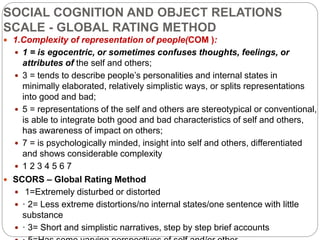
SOCIAL COGNITION AND OBJECT RELATIONS
SCALE - GLOBAL RATING METHOD
 1.Complexity of representation of people(COM ):
 1 = is egocentric, or sometimes confuses thoughts, feelings, or
attributes of the self and others;
 3 = tends to describe people’s personalities and internal states in
minimally elaborated, relatively simplistic ways, or splits representations
into good and bad;
 5 = representations of the self and others are stereotypical or conventional,
is able to integrate both good and bad characteristics of self and others,
has awareness of impact on others;
 7 = is psychologically minded, insight into self and others, differentiated
and shows considerable complexity
 1 2 3 4 5 6 7
 SCORS – Global Rating Method
 1=Extremely disturbed or distorted
 · 2= Less extreme distortions/no internal states/one sentence with little
substance
 · 3= Short and simplistic narratives, step by step brief accounts
SOCIAL COGNITION AND OBJECT RELATIONS
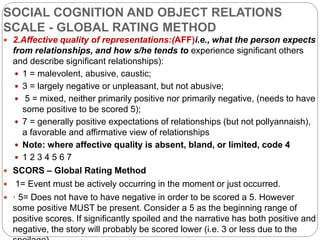
SCALE - GLOBAL RATING METHOD
 2.Affective quality of representations:(AFF)i.e., what the person expects
from relationships, and how s/he tends to experience significant others
and describe significant relationships):
 1 = malevolent, abusive, caustic;
 3 = largely negative or unpleasant, but not abusive;
 5 = mixed, neither primarily positive nor primarily negative, (needs to have
some positive to be scored 5);
 7 = generally positive expectations of relationships (but not pollyannaish),
a favorable and affirmative view of relationships
 Note: where affective quality is absent, bland, or limited, code 4
 1 2 3 4 5 6 7
 SCORS – Global Rating Method
 1= Event must be actively occurring in the moment or just occurred.
 · 5= Does not have to have negative in order to be scored a 5. However
some positive MUST be present. Consider a 5 as the beginning range of
positive scores. If significantly spoiled and the narrative has both positive and
negative, the story will probably be scored lower (i.e. 3 or less due to the
SOCIAL COGNITION AND OBJECT RELATIONS
SCALE - GLOBAL RATING METHOD
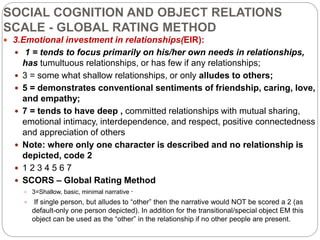
 3.Emotional investment in relationships(EIR):
 1 = tends to focus primarily on his/her own needs in relationships,
has tumultuous relationships, or has few if any relationships;
 3 = some what shallow relationships, or only alludes to others;
 5 = demonstrates conventional sentiments of friendship, caring, love,
and empathy;
 7 = tends to have deep , committed relationships with mutual sharing,
emotional intimacy, interdependence, and respect, positive connectedness
and appreciation of others
 Note: where only one character is described and no relationship is
depicted, code 2
 1 2 3 4 5 6 7
 SCORS – Global Rating Method
 3=Shallow, basic, minimal narrative ·
 If single person, but alludes to “other” then the narrative would NOT be scored a 2 (as
default-only one person depicted). In addition for the transitional/special object EM this
object can be used as the “other” in the relationship if no other people are present.
SOCIAL COGNITION AND OBJECT RELATIONS
SCALE - GLOBAL RATING METHOD
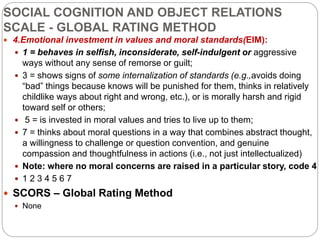
 4.Emotional investment in values and moral standards(EIM):
 1 = behaves in selfish, inconsiderate, self-indulgent or aggressive
ways without any sense of remorse or guilt;
 3 = shows signs of some internalization of standards (e.g.,avoids doing
“bad” things because knows will be punished for them, thinks in relatively
childlike ways about right and wrong, etc.), or is morally harsh and rigid
toward self or others;
 5 = is invested in moral values and tries to live up to them;
 7 = thinks about moral questions in a way that combines abstract thought,
a willingness to challenge or question convention, and genuine
compassion and thoughtfulness in actions (i.e., not just intellectualized)
 Note: where no moral concerns are raised in a particular story, code 4
 1 2 3 4 5 6 7
 SCORS – Global Rating Method
 None
SOCIAL COGNITION AND OBJECT RELATIONS SCALE - GLOBAL
RATING METHOD
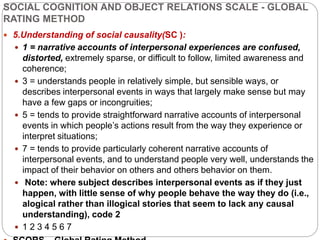
 5.Understanding of social causality(SC ):
 1 = narrative accounts of interpersonal experiences are confused,
distorted, extremely sparse, or difficult to follow, limited awareness and
coherence;
 3 = understands people in relatively simple, but sensible ways, or
describes interpersonal events in ways that largely make sense but may
have a few gaps or incongruities;
 5 = tends to provide straightforward narrative accounts of interpersonal
events in which people’s actions result from the way they experience or
interpret situations;
 7 = tends to provide particularly coherent narrative accounts of
interpersonal events, and to understand people very well, understands the
impact of their behavior on others and others behavior on them.
 Note: where subject describes interpersonal events as if they just
happen, with little sense of why people behave the way they do (i.e.,
alogical rather than illogical stories that seem to lack any causal
understanding), code 2
 1 2 3 4 5 6 7
SOCIAL COGNITION AND OBJECT RELATIONS
SCALE - GLOBAL RATING METHOD
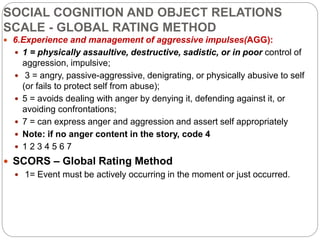
 6.Experience and management of aggressive impulses(AGG):
 1 = physically assaultive, destructive, sadistic, or in poor control of
aggression, impulsive;
 3 = angry, passive-aggressive, denigrating, or physically abusive to self
(or fails to protect self from abuse);
 5 = avoids dealing with anger by denying it, defending against it, or
avoiding confrontations;
 7 = can express anger and aggression and assert self appropriately
 Note: if no anger content in the story, code 4
 1 2 3 4 5 6 7
 SCORS – Global Rating Method
 1= Event must be actively occurring in the moment or just occurred.
SOCIAL COGNITION AND OBJECT RELATIONS
SCALE - GLOBAL RATING METHOD
 7.Self-esteem(SE):
 1 = views self as loathsome, evil, rotten, contaminating, or globally
bad;
 3 = has low self-esteem (e.g., feels inadequate, inferior, self-critical, etc.)
or is unrealistically grandiose;
 5 = displays a range of positive and negative feelings toward the self;
 7 = tends to have realistically positive feelings about him/herself
 Note: needs to have some positive to be scored a 5 or above
 1 2 3 4 5 6 7
 SCORS – Global Rating Method
 4= Where Self-Esteem is bland, absent or limited
 · 5= Does not have to have negative in order to be scored a 5. However
some positive MUST be present . Consider a 5 as the beginning range of
positive scores. If significantly spoiled and the narrative has both positive and
negative, the story will probably be scored lower (i.e. 3 or less due to the
spoilage)
SOCIAL COGNITION AND OBJECT RELATIONS
SCALE - GLOBAL RATING METHOD
 8.Identity and coherence of self( ICS):
 1 = fragmented sense of self, has multiple personalities;
 3 = views of , or feelings about, the self fluctuate widely and
unpredictably; unstable sense of self;
 5 = identity and self-definition are not a major concern or preoccupation;
 7 = feels like an integrated person with long-term ambitions and goals
 Note: ambiguity about a goal is still considered a goal and may be
scored in the higher range
 1 2 3 4 5 6 7
 SCORS – Global Rating Method
 3= Fluctuation of goals and affects/emotions of the self
 · 4= Consider an upward extension of 3 as opposed to a downward extension of 5.
 · 5= Identity related issues are not of concern (not mentioned)
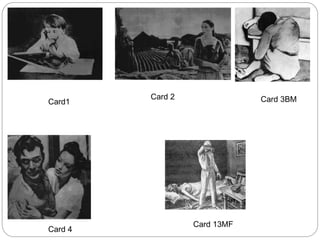
Card1
Card 2 Card 3BM
Card 4
Card 13MF
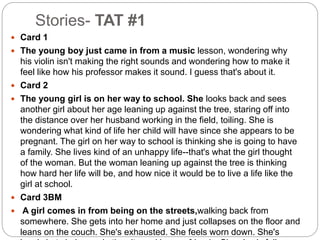
Stories- TAT #1
 Card 1
 The young boy just came in from a music lesson, wondering why
his violin isn't making the right sounds and wondering how to make it
feel like how his professor makes it sound. I guess that's about it.
 Card 2
 The young girl is on her way to school. She looks back and sees
another girl about her age leaning up against the tree, staring off into
the distance over her husband working in the field, toiling. She is
wondering what kind of life her child will have since she appears to be
pregnant. The girl on her way to school is thinking she is going to have
a family. She lives kind of an unhappy life--that's what the girl thought
of the woman. But the woman leaning up against the tree is thinking
how hard her life will be, and how nice it would be to live a life like the
girl at school.
 Card 3BM
 A girl comes in from being on the streets,walking back from
somewhere. She gets into her home and just collapses on the floor and
leans on the couch. She's exhausted. She feels worn down. She's
Stories- TAT #1
 Card 4
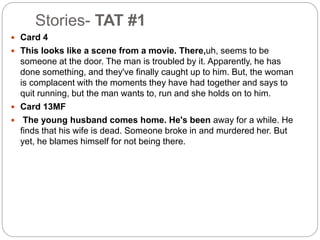
 This looks like a scene from a movie. There,uh, seems to be
someone at the door. The man is troubled by it. Apparently, he has
done something, and they've finally caught up to him. But, the woman
is complacent with the moments they have had together and says to
quit running, but the man wants to, run and she holds on to him.
 Card 13MF
 The young husband comes home. He's been away for a while. He
finds that his wife is dead. Someone broke in and murdered her. But
yet, he blames himself for not being there.
Stories- TAT #1
Card
#
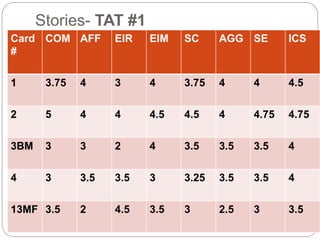
COM AFF EIR EIM SC AGG SE ICS
1 3.75 4 3 4 3.75 4 4 4.5
2 5 4 4 4.5 4.5 4 4.75 4.75
3BM 3 3 2 4 3.5 3.5 3.5 4
4 3 3.5 3.5 3 3.25 3.5 3.5 4
13MF 3.5 2 4.5 3.5 3 2.5 3 3.5

Decoding tat 7 tat interpretation based on scors

  • 1.
    Compiled by ColMukteshwar Prasad(Retd), Mtech(IITD),CE(I),FIE(I),FIETE,FISLE,FInstOD,AMCSI Contact -9007224278, e-mail –muktesh_prasad@yahoo.co.in for book ”Decoding Services Selection Board” and SSB guidance and training at Shivnandani Edu and Defence Academy Decoding TAT 7 TAT interpretation based on SOCIAL COGNITION AND OBJECT RELATIONS Scale(SCORS) Ref- SCORS-G Training Manual by Mark J. Hilsenroth, Michelle Stein, & Janet Pinsker The Derner Institute of Advanced Psychological Studies Adelphi University
  • 2.
    SOCIAL COGNITION ANDOBJECT RELATIONS SCALE - GLOBAL RATING METHOD  1.Complexity of representation of people(COM ):  1 = is egocentric, or sometimes confuses thoughts, feelings, or attributes of the self and others;  3 = tends to describe people’s personalities and internal states in minimally elaborated, relatively simplistic ways, or splits representations into good and bad;  5 = representations of the self and others are stereotypical or conventional, is able to integrate both good and bad characteristics of self and others, has awareness of impact on others;  7 = is psychologically minded, insight into self and others, differentiated and shows considerable complexity  1 2 3 4 5 6 7  SCORS – Global Rating Method  1=Extremely disturbed or distorted  · 2= Less extreme distortions/no internal states/one sentence with little substance  · 3= Short and simplistic narratives, step by step brief accounts
  • 3.
    SOCIAL COGNITION ANDOBJECT RELATIONS SCALE - GLOBAL RATING METHOD  2.Affective quality of representations:(AFF)i.e., what the person expects from relationships, and how s/he tends to experience significant others and describe significant relationships):  1 = malevolent, abusive, caustic;  3 = largely negative or unpleasant, but not abusive;  5 = mixed, neither primarily positive nor primarily negative, (needs to have some positive to be scored 5);  7 = generally positive expectations of relationships (but not pollyannaish), a favorable and affirmative view of relationships  Note: where affective quality is absent, bland, or limited, code 4  1 2 3 4 5 6 7  SCORS – Global Rating Method  1= Event must be actively occurring in the moment or just occurred.  · 5= Does not have to have negative in order to be scored a 5. However some positive MUST be present. Consider a 5 as the beginning range of positive scores. If significantly spoiled and the narrative has both positive and negative, the story will probably be scored lower (i.e. 3 or less due to the
  • 4.
    SOCIAL COGNITION ANDOBJECT RELATIONS SCALE - GLOBAL RATING METHOD  3.Emotional investment in relationships(EIR):  1 = tends to focus primarily on his/her own needs in relationships, has tumultuous relationships, or has few if any relationships;  3 = some what shallow relationships, or only alludes to others;  5 = demonstrates conventional sentiments of friendship, caring, love, and empathy;  7 = tends to have deep , committed relationships with mutual sharing, emotional intimacy, interdependence, and respect, positive connectedness and appreciation of others  Note: where only one character is described and no relationship is depicted, code 2  1 2 3 4 5 6 7  SCORS – Global Rating Method  3=Shallow, basic, minimal narrative ·  If single person, but alludes to “other” then the narrative would NOT be scored a 2 (as default-only one person depicted). In addition for the transitional/special object EM this object can be used as the “other” in the relationship if no other people are present.
  • 5.
    SOCIAL COGNITION ANDOBJECT RELATIONS SCALE - GLOBAL RATING METHOD  4.Emotional investment in values and moral standards(EIM):  1 = behaves in selfish, inconsiderate, self-indulgent or aggressive ways without any sense of remorse or guilt;  3 = shows signs of some internalization of standards (e.g.,avoids doing “bad” things because knows will be punished for them, thinks in relatively childlike ways about right and wrong, etc.), or is morally harsh and rigid toward self or others;  5 = is invested in moral values and tries to live up to them;  7 = thinks about moral questions in a way that combines abstract thought, a willingness to challenge or question convention, and genuine compassion and thoughtfulness in actions (i.e., not just intellectualized)  Note: where no moral concerns are raised in a particular story, code 4  1 2 3 4 5 6 7  SCORS – Global Rating Method  None
  • 6.
    SOCIAL COGNITION ANDOBJECT RELATIONS SCALE - GLOBAL RATING METHOD  5.Understanding of social causality(SC ):  1 = narrative accounts of interpersonal experiences are confused, distorted, extremely sparse, or difficult to follow, limited awareness and coherence;  3 = understands people in relatively simple, but sensible ways, or describes interpersonal events in ways that largely make sense but may have a few gaps or incongruities;  5 = tends to provide straightforward narrative accounts of interpersonal events in which people’s actions result from the way they experience or interpret situations;  7 = tends to provide particularly coherent narrative accounts of interpersonal events, and to understand people very well, understands the impact of their behavior on others and others behavior on them.  Note: where subject describes interpersonal events as if they just happen, with little sense of why people behave the way they do (i.e., alogical rather than illogical stories that seem to lack any causal understanding), code 2  1 2 3 4 5 6 7
  • 7.
    SOCIAL COGNITION ANDOBJECT RELATIONS SCALE - GLOBAL RATING METHOD  6.Experience and management of aggressive impulses(AGG):  1 = physically assaultive, destructive, sadistic, or in poor control of aggression, impulsive;  3 = angry, passive-aggressive, denigrating, or physically abusive to self (or fails to protect self from abuse);  5 = avoids dealing with anger by denying it, defending against it, or avoiding confrontations;  7 = can express anger and aggression and assert self appropriately  Note: if no anger content in the story, code 4  1 2 3 4 5 6 7  SCORS – Global Rating Method  1= Event must be actively occurring in the moment or just occurred.
  • 8.
    SOCIAL COGNITION ANDOBJECT RELATIONS SCALE - GLOBAL RATING METHOD  7.Self-esteem(SE):  1 = views self as loathsome, evil, rotten, contaminating, or globally bad;  3 = has low self-esteem (e.g., feels inadequate, inferior, self-critical, etc.) or is unrealistically grandiose;  5 = displays a range of positive and negative feelings toward the self;  7 = tends to have realistically positive feelings about him/herself  Note: needs to have some positive to be scored a 5 or above  1 2 3 4 5 6 7  SCORS – Global Rating Method  4= Where Self-Esteem is bland, absent or limited  · 5= Does not have to have negative in order to be scored a 5. However some positive MUST be present . Consider a 5 as the beginning range of positive scores. If significantly spoiled and the narrative has both positive and negative, the story will probably be scored lower (i.e. 3 or less due to the spoilage)
  • 9.
    SOCIAL COGNITION ANDOBJECT RELATIONS SCALE - GLOBAL RATING METHOD  8.Identity and coherence of self( ICS):  1 = fragmented sense of self, has multiple personalities;  3 = views of , or feelings about, the self fluctuate widely and unpredictably; unstable sense of self;  5 = identity and self-definition are not a major concern or preoccupation;  7 = feels like an integrated person with long-term ambitions and goals  Note: ambiguity about a goal is still considered a goal and may be scored in the higher range  1 2 3 4 5 6 7  SCORS – Global Rating Method  3= Fluctuation of goals and affects/emotions of the self  · 4= Consider an upward extension of 3 as opposed to a downward extension of 5.  · 5= Identity related issues are not of concern (not mentioned)
  • 10.
    Card1 Card 2 Card3BM Card 4 Card 13MF
  • 11.
    Stories- TAT #1 Card 1  The young boy just came in from a music lesson, wondering why his violin isn't making the right sounds and wondering how to make it feel like how his professor makes it sound. I guess that's about it.  Card 2  The young girl is on her way to school. She looks back and sees another girl about her age leaning up against the tree, staring off into the distance over her husband working in the field, toiling. She is wondering what kind of life her child will have since she appears to be pregnant. The girl on her way to school is thinking she is going to have a family. She lives kind of an unhappy life--that's what the girl thought of the woman. But the woman leaning up against the tree is thinking how hard her life will be, and how nice it would be to live a life like the girl at school.  Card 3BM  A girl comes in from being on the streets,walking back from somewhere. She gets into her home and just collapses on the floor and leans on the couch. She's exhausted. She feels worn down. She's
  • 12.
    Stories- TAT #1 Card 4  This looks like a scene from a movie. There,uh, seems to be someone at the door. The man is troubled by it. Apparently, he has done something, and they've finally caught up to him. But, the woman is complacent with the moments they have had together and says to quit running, but the man wants to, run and she holds on to him.  Card 13MF  The young husband comes home. He's been away for a while. He finds that his wife is dead. Someone broke in and murdered her. But yet, he blames himself for not being there.
  • 13.
    Stories- TAT #1 Card # COMAFF EIR EIM SC AGG SE ICS 1 3.75 4 3 4 3.75 4 4 4.5 2 5 4 4 4.5 4.5 4 4.75 4.75 3BM 3 3 2 4 3.5 3.5 3.5 4 4 3 3.5 3.5 3 3.25 3.5 3.5 4 13MF 3.5 2 4.5 3.5 3 2.5 3 3.5