Compiled by Col Mukteshwar Prasad(Retd),
Mtech(IITD),CE(I),FIE(I),FIETE,FISLE,FInstOD,AMCSI
Contact -9007224278, e-mail –
muktesh_prasad@yahoo.co.in
for book ”Decoding Services Selection Board” and SSB
guidance and training at Shivnandani Edu and Defence
Academy
Decoding Word Association 5-
Word to Three word Association Test
Ref- Affect and its Assessment in Personnel Selection
Nishi Misra*, Apoorva Ghanekar, and Arunima Gupta
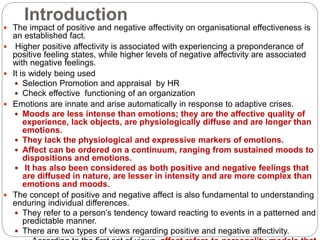
Introduction
 The impact of positive and negative affectivity on organisational effectiveness is
an established fact.
 Higher positive affectivity is associated with experiencing a preponderance of
positive feeling states, while higher levels of negative affectivity are associated
with negative feelings.
 It is widely being used
 Selection Promotion and appraisal by HR
 Check effective functioning of an organization
 Emotions are innate and arise automatically in response to adaptive crises.
 Moods are less intense than emotions; they are the affective quality of
experience, lack objects, are physiologically diffuse and are longer than
emotions.
 They lack the physiological and expressive markers of emotions.
 Affect can be ordered on a continuum, ranging from sustained moods to
dispositions and emotions.
 It has also been considered as both positive and negative feelings that
are diffused in nature, are lesser in intensity and are more complex than
emotions and moods.
 The concept of positive and negative affect is also fundamental to understanding
enduring individual differences.
 They refer to a person’s tendency toward reacting to events in a patterned and
predictable manner.
 There are two types of views regarding positive and negative affectivity.
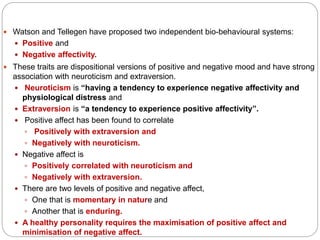
 Watson and Tellegen have proposed two independent bio-behavioural systems:
 Positive and
 Negative affectivity.
 These traits are dispositional versions of positive and negative mood and have strong
association with neuroticism and extraversion.
 Neuroticism is “having a tendency to experience negative affectivity and
physiological distress and
 Extraversion is “a tendency to experience positive affectivity”.
 Positive affect has been found to correlate
 Positively with extraversion and
 Negatively with neuroticism.
 Negative affect is
 Positively correlated with neuroticism and
 Negatively with extraversion.
 There are two levels of positive and negative affect,
 One that is momentary in nature and
 Another that is enduring.
 A healthy personality requires the maximisation of positive affect and
minimisation of negative affect.
The Definition of Word
Association
 Association is one of the basic mechanisms of memory.
 They can be called natural classifiers of the conceptual content
of the vocabulary of the language.
 Ideas and concepts, which are available to the memory of a
man are related.
 This relationship is based on the past experience of a man
and, in the final analysis, more or less accurately
reproduces objectively existing relationship between the
phenomena of the real world.
 Under certain conditions, a revival of one idea or concept is
accompanied by a revival of others ideas correlated with it.
 This phenomenon is called the association (a term proposed in
the XVIII century by Locke).
 Based on the book V. V. Morkovkin «Ideographic Dictionaries»
(1970)
Classification of Associations
 Since Aristotle the people distinguish association by similarity, contrast and
contiguity.
 Association by similarity is based on the fact that the associated
phenomena have some common features.
 It represents a result of generalization of the conditioned connection in
which similar stimuli evoke similar reactions (for example, excitement of
synonymic series with actualization of one of the synonyms: woe -
unhappiness, sorrow, grief, sadness, and so on).
 Origin of Association by contrast is explained by the presence in
phenomena of opposite features.
 The physiological nature of the association by contrast is in the "mutual
induction of neural processes when strong stimuli ... cause great
excitement in the beginning, and then successive inhibition in the
same regions of the cerebral cortex. As a result, in the future one of
the contrasting stimuli can cause immediately after it something that
was caused before by another stimulus (contrast with given one)"
(for example, the phenomenon of antonyms: grief - joy, happiness –
unhappiness, and so on).
Classification of Associations
 Along with them, more complex semantic association is distinguished.
 This is, in particular,
 the association reflecting generic and cause-and-effect relationship
between the objects of the world (for example, a flower - a rose, a disease
- death, and so on).
 Based on the book V. V. Morkovkin «Ideographic Dictionaries» (1970)
The Role of Association
 Since the associations reflect some significant relations between objects and
phenomena of the real world, and thus between the concepts, it is
reasonable to conclude that they play an important role in the structure of the
lexical system of the language.
 This was pointed out as long ago as by N.V. Krushevskiy: "Every word is
linked to other words by ties of association by similarity; this similarity
will not be only external, i.e. sound or structural, morphological, but
also internal, semasiological. Or in other words: every word is capable,
due to a special mental law, to bring in our mind other words with which
it is similar, and is excited by these words ..."
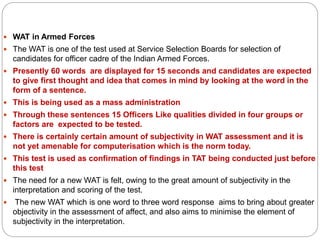
 WAT in Armed Forces
 The WAT is one of the test used at Service Selection Boards for selection of
candidates for officer cadre of the Indian Armed Forces.
 Presently 60 words are displayed for 15 seconds and candidates are expected
to give first thought and idea that comes in mind by looking at the word in the
form of a sentence.
 This is being used as a mass administration
 Through these sentences 15 Officers Like qualities divided in four groups or
factors are expected to be tested.
 There is certainly certain amount of subjectivity in WAT assessment and it is
not yet amenable for computerisation which is the norm today.
 This test is used as confirmation of findings in TAT being conducted just before
this test
 The need for a new WAT is felt, owing to the great amount of subjectivity in the
interpretation and scoring of the test.
 The new WAT which is one word to three word response aims to bring about greater
objectivity in the assessment of affect, and also aims to minimise the element of
subjectivity in the interpretation.
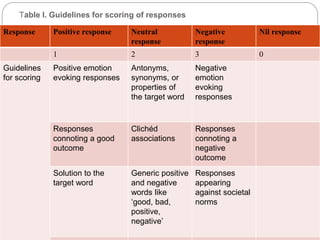
Table I. Guidelines for scoring of responses
Response Positive response Neutral
response
Negative
response
Nil response
1 2 3 0
Guidelines
for scoring
Positive emotion
evoking responses
Antonyms,
synonyms, or
properties of
the target word
Negative
emotion
evoking
responses
Responses
connoting a good
outcome
Clichéd
associations
Responses
connoting a
negative
outcome
Solution to the
target word
Generic positive
and negative
words like
‘good, bad,
positive,
negative’
Responses
appearing
against societal
norms
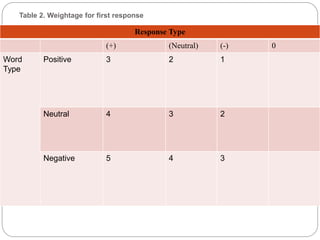
Table 2. Weightage for first response
Response Type
(+) (Neutral) (-) 0
Word
Type
Positive 3 2 1
Neutral 4 3 2
Negative 5 4 3
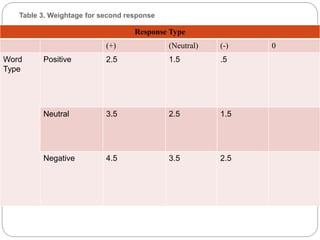
Table 3. Weightage for second response
Response Type
(+) (Neutral) (-) 0
Word
Type
Positive 2.5 1.5 .5
Neutral 3.5 2.5 1.5
Negative 4.5 3.5 2.5
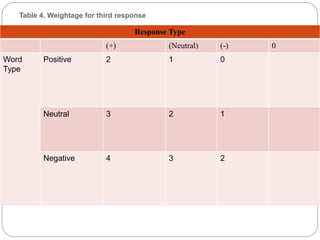
Table 4. Weightage for third response
Response Type
(+) (Neutral) (-) 0
Word
Type
Positive 2 1 0
Neutral 3 2 1
Negative 4 3 2
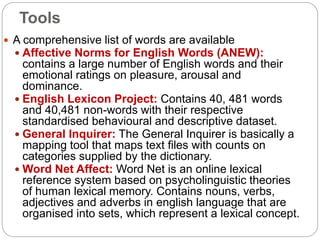
Tools
 A comprehensive list of words are available
 Affective Norms for English Words (ANEW):
contains a large number of English words and their
emotional ratings on pleasure, arousal and
dominance.
 English Lexicon Project: Contains 40, 481 words
and 40,481 non-words with their respective
standardised behavioural and descriptive dataset.
 General Inquirer: The General Inquirer is basically a
mapping tool that maps text files with counts on
categories supplied by the dictionary.
 Word Net Affect: Word Net is an online lexical
reference system based on psycholinguistic theories
of human lexical memory. Contains nouns, verbs,
adjectives and adverbs in english language that are
organised into sets, which represent a lexical concept.
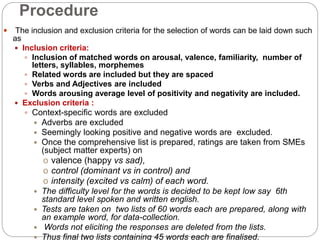
Procedure
 The inclusion and exclusion criteria for the selection of words can be laid down such
as
 Inclusion criteria:
 Inclusion of matched words on arousal, valence, familiarity, number of
letters, syllables, morphemes
 Related words are included but they are spaced
 Verbs and Adjectives are included
 Words arousing average level of positivity and negativity are included.
 Exclusion criteria :
 Context-specific words are excluded
 Adverbs are excluded
 Seemingly looking positive and negative words are excluded.
 Once the comprehensive list is prepared, ratings are taken from SMEs
(subject matter experts) on
o valence (happy vs sad),
o control (dominant vs in control) and
o intensity (excited vs calm) of each word.
 The difficulty level for the words is decided to be kept low say 6th
standard level spoken and written english.
 Tests are taken on two lists of 60 words each are prepared, along with
an example word, for data-collection.
 Words not eliciting the responses are deleted from the lists.
 Thus final two lists containing 45 words each are finalised.
Procedure
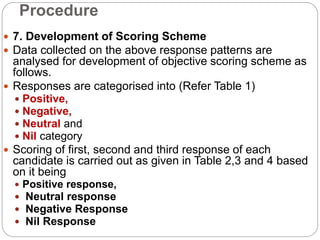
 7. Development of Scoring Scheme
 Data collected on the above response patterns are
analysed for development of objective scoring scheme as
follows.
 Responses are categorised into (Refer Table 1)
 Positive,
 Negative,
 Neutral and
 Nil category
 Scoring of first, second and third response of each
candidate is carried out as given in Table 2,3 and 4 based
on it being
 Positive response,
 Neutral response
 Negative Response
 Nil Response
Scoring
 The scoring of the responses is done in two parts.
 First, the words are scored manually according to the prescribed guidelines as mentioned Table 1.
 Then, these scores are fed into the computer to obtain a total score of the candidate on positive
and negative affectivity. Scoring for 1st,2nd and 3rd word are as given in Table 2,3,4
 This total score is then converted to Grade (ranging from 1 to 5).
 Thereafter, a candidate’s total number of positive, total number of
negative, and total number of neutral responses are calculated by the
computer, and a total positive, a total negative, and a total final score for
each candidate is obtained.
 The candidates are then assigned Grades (from 1 to 5) based on the
table of norms.
 Reliability-for 100 candidates ranged from 0.46 to 0.85
 Validity-
 Concurrent Validity is Determined against PANAS
 Total WAT score is inversely related with negative affectivity scale of
PANAS (-.273**)
 9.2 Eand Nscales of NEOPI- (R)
 Negative affectivity score of WAT is significantly positively correlated with
neuroticism (0.20**).
Conclusion
 Thus this is a novel attempt to assess affect in personnel
selection by means of Word Association Test.
 There are some future additions that need to be carried
out to make the test more efficient by including the
recording of Reaction time of each subject in response to
each word.
 The scoring can also be made fully computerised after
obtaining first three responses of subjects for each word
on a considerable large sample.
 A word bank can be developed after obtaining an
exhaustive list of words.
 From the bank the word lists can be generated by the
computer randomly.
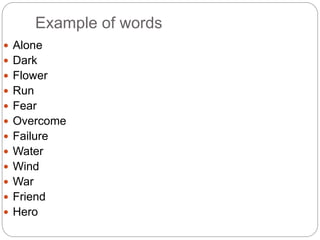
Example of words
 Alone
 Dark
 Flower
 Run
 Fear
 Overcome
 Failure
 Water
 Wind
 War
 Friend
 Hero

Decoding word association 5 word to three word association test

  • 1.
    Compiled by ColMukteshwar Prasad(Retd), Mtech(IITD),CE(I),FIE(I),FIETE,FISLE,FInstOD,AMCSI Contact -9007224278, e-mail – muktesh_prasad@yahoo.co.in for book ”Decoding Services Selection Board” and SSB guidance and training at Shivnandani Edu and Defence Academy Decoding Word Association 5- Word to Three word Association Test Ref- Affect and its Assessment in Personnel Selection Nishi Misra*, Apoorva Ghanekar, and Arunima Gupta
  • 2.
    Introduction  The impactof positive and negative affectivity on organisational effectiveness is an established fact.  Higher positive affectivity is associated with experiencing a preponderance of positive feeling states, while higher levels of negative affectivity are associated with negative feelings.  It is widely being used  Selection Promotion and appraisal by HR  Check effective functioning of an organization  Emotions are innate and arise automatically in response to adaptive crises.  Moods are less intense than emotions; they are the affective quality of experience, lack objects, are physiologically diffuse and are longer than emotions.  They lack the physiological and expressive markers of emotions.  Affect can be ordered on a continuum, ranging from sustained moods to dispositions and emotions.  It has also been considered as both positive and negative feelings that are diffused in nature, are lesser in intensity and are more complex than emotions and moods.  The concept of positive and negative affect is also fundamental to understanding enduring individual differences.  They refer to a person’s tendency toward reacting to events in a patterned and predictable manner.  There are two types of views regarding positive and negative affectivity.
  • 3.
     Watson andTellegen have proposed two independent bio-behavioural systems:  Positive and  Negative affectivity.  These traits are dispositional versions of positive and negative mood and have strong association with neuroticism and extraversion.  Neuroticism is “having a tendency to experience negative affectivity and physiological distress and  Extraversion is “a tendency to experience positive affectivity”.  Positive affect has been found to correlate  Positively with extraversion and  Negatively with neuroticism.  Negative affect is  Positively correlated with neuroticism and  Negatively with extraversion.  There are two levels of positive and negative affect,  One that is momentary in nature and  Another that is enduring.  A healthy personality requires the maximisation of positive affect and minimisation of negative affect.
  • 4.
    The Definition ofWord Association  Association is one of the basic mechanisms of memory.  They can be called natural classifiers of the conceptual content of the vocabulary of the language.  Ideas and concepts, which are available to the memory of a man are related.  This relationship is based on the past experience of a man and, in the final analysis, more or less accurately reproduces objectively existing relationship between the phenomena of the real world.  Under certain conditions, a revival of one idea or concept is accompanied by a revival of others ideas correlated with it.  This phenomenon is called the association (a term proposed in the XVIII century by Locke).  Based on the book V. V. Morkovkin «Ideographic Dictionaries» (1970)
  • 5.
    Classification of Associations Since Aristotle the people distinguish association by similarity, contrast and contiguity.  Association by similarity is based on the fact that the associated phenomena have some common features.  It represents a result of generalization of the conditioned connection in which similar stimuli evoke similar reactions (for example, excitement of synonymic series with actualization of one of the synonyms: woe - unhappiness, sorrow, grief, sadness, and so on).  Origin of Association by contrast is explained by the presence in phenomena of opposite features.  The physiological nature of the association by contrast is in the "mutual induction of neural processes when strong stimuli ... cause great excitement in the beginning, and then successive inhibition in the same regions of the cerebral cortex. As a result, in the future one of the contrasting stimuli can cause immediately after it something that was caused before by another stimulus (contrast with given one)" (for example, the phenomenon of antonyms: grief - joy, happiness – unhappiness, and so on).
  • 6.
    Classification of Associations Along with them, more complex semantic association is distinguished.  This is, in particular,  the association reflecting generic and cause-and-effect relationship between the objects of the world (for example, a flower - a rose, a disease - death, and so on).  Based on the book V. V. Morkovkin «Ideographic Dictionaries» (1970)
  • 7.
    The Role ofAssociation  Since the associations reflect some significant relations between objects and phenomena of the real world, and thus between the concepts, it is reasonable to conclude that they play an important role in the structure of the lexical system of the language.  This was pointed out as long ago as by N.V. Krushevskiy: "Every word is linked to other words by ties of association by similarity; this similarity will not be only external, i.e. sound or structural, morphological, but also internal, semasiological. Or in other words: every word is capable, due to a special mental law, to bring in our mind other words with which it is similar, and is excited by these words ..."
  • 8.
     WAT inArmed Forces  The WAT is one of the test used at Service Selection Boards for selection of candidates for officer cadre of the Indian Armed Forces.  Presently 60 words are displayed for 15 seconds and candidates are expected to give first thought and idea that comes in mind by looking at the word in the form of a sentence.  This is being used as a mass administration  Through these sentences 15 Officers Like qualities divided in four groups or factors are expected to be tested.  There is certainly certain amount of subjectivity in WAT assessment and it is not yet amenable for computerisation which is the norm today.  This test is used as confirmation of findings in TAT being conducted just before this test  The need for a new WAT is felt, owing to the great amount of subjectivity in the interpretation and scoring of the test.  The new WAT which is one word to three word response aims to bring about greater objectivity in the assessment of affect, and also aims to minimise the element of subjectivity in the interpretation.
  • 9.
    Table I. Guidelinesfor scoring of responses Response Positive response Neutral response Negative response Nil response 1 2 3 0 Guidelines for scoring Positive emotion evoking responses Antonyms, synonyms, or properties of the target word Negative emotion evoking responses Responses connoting a good outcome Clichéd associations Responses connoting a negative outcome Solution to the target word Generic positive and negative words like ‘good, bad, positive, negative’ Responses appearing against societal norms
  • 10.
    Table 2. Weightagefor first response Response Type (+) (Neutral) (-) 0 Word Type Positive 3 2 1 Neutral 4 3 2 Negative 5 4 3
  • 11.
    Table 3. Weightagefor second response Response Type (+) (Neutral) (-) 0 Word Type Positive 2.5 1.5 .5 Neutral 3.5 2.5 1.5 Negative 4.5 3.5 2.5
  • 12.
    Table 4. Weightagefor third response Response Type (+) (Neutral) (-) 0 Word Type Positive 2 1 0 Neutral 3 2 1 Negative 4 3 2
  • 13.
    Tools  A comprehensivelist of words are available  Affective Norms for English Words (ANEW): contains a large number of English words and their emotional ratings on pleasure, arousal and dominance.  English Lexicon Project: Contains 40, 481 words and 40,481 non-words with their respective standardised behavioural and descriptive dataset.  General Inquirer: The General Inquirer is basically a mapping tool that maps text files with counts on categories supplied by the dictionary.  Word Net Affect: Word Net is an online lexical reference system based on psycholinguistic theories of human lexical memory. Contains nouns, verbs, adjectives and adverbs in english language that are organised into sets, which represent a lexical concept.
  • 14.
    Procedure  The inclusionand exclusion criteria for the selection of words can be laid down such as  Inclusion criteria:  Inclusion of matched words on arousal, valence, familiarity, number of letters, syllables, morphemes  Related words are included but they are spaced  Verbs and Adjectives are included  Words arousing average level of positivity and negativity are included.  Exclusion criteria :  Context-specific words are excluded  Adverbs are excluded  Seemingly looking positive and negative words are excluded.  Once the comprehensive list is prepared, ratings are taken from SMEs (subject matter experts) on o valence (happy vs sad), o control (dominant vs in control) and o intensity (excited vs calm) of each word.  The difficulty level for the words is decided to be kept low say 6th standard level spoken and written english.  Tests are taken on two lists of 60 words each are prepared, along with an example word, for data-collection.  Words not eliciting the responses are deleted from the lists.  Thus final two lists containing 45 words each are finalised.
  • 15.
    Procedure  7. Developmentof Scoring Scheme  Data collected on the above response patterns are analysed for development of objective scoring scheme as follows.  Responses are categorised into (Refer Table 1)  Positive,  Negative,  Neutral and  Nil category  Scoring of first, second and third response of each candidate is carried out as given in Table 2,3 and 4 based on it being  Positive response,  Neutral response  Negative Response  Nil Response
  • 16.
    Scoring  The scoringof the responses is done in two parts.  First, the words are scored manually according to the prescribed guidelines as mentioned Table 1.  Then, these scores are fed into the computer to obtain a total score of the candidate on positive and negative affectivity. Scoring for 1st,2nd and 3rd word are as given in Table 2,3,4  This total score is then converted to Grade (ranging from 1 to 5).  Thereafter, a candidate’s total number of positive, total number of negative, and total number of neutral responses are calculated by the computer, and a total positive, a total negative, and a total final score for each candidate is obtained.  The candidates are then assigned Grades (from 1 to 5) based on the table of norms.  Reliability-for 100 candidates ranged from 0.46 to 0.85  Validity-  Concurrent Validity is Determined against PANAS  Total WAT score is inversely related with negative affectivity scale of PANAS (-.273**)  9.2 Eand Nscales of NEOPI- (R)  Negative affectivity score of WAT is significantly positively correlated with neuroticism (0.20**).
  • 17.
    Conclusion  Thus thisis a novel attempt to assess affect in personnel selection by means of Word Association Test.  There are some future additions that need to be carried out to make the test more efficient by including the recording of Reaction time of each subject in response to each word.  The scoring can also be made fully computerised after obtaining first three responses of subjects for each word on a considerable large sample.  A word bank can be developed after obtaining an exhaustive list of words.  From the bank the word lists can be generated by the computer randomly.
  • 18.
    Example of words Alone  Dark  Flower  Run  Fear  Overcome  Failure  Water  Wind  War  Friend  Hero