Probiotics and Prebiotics
1/22/2014
H Tripathi, Functional Foods, B.Sc. FST,
AIILSG Ahmedabad
1
History:
o The term “probiotics” was first introduced in 1965 by Lilly and
Stillwell.
o In contrast to antibiotics, probiotics were defined as
microbiologically derived factors that stimulate the growth of other
organisms.
o The concept of probiotics evolved at the end of the 20th century
from a hypothesis first proposed by Nobel Prize winning Russian
scientist Elie Metchnikoff
o (Bibel, 1988: Bibel, D.J. 1988. Elie Metchnikoff’s bacillus of long
life. ASM News 54: 661–665.),
o who suggested that the long, healthy life of Bulgarian small
farmers and laborers resulted from their consumption of
fermented milk products.
o He believed that when consumed, the fermenting bacillus
(Lactobacillus) positively influenced the micro flora of the colon,
decreasing toxic microbial activities.
• Disorders of the intestinal tract
were frequently treated with viable
nonpathogenic bacteria to change
or replace the intestinal micro
flora.
• Thus, replace proteolytic microbes
which produce toxic substances
including phenols, indoles, and
ammonia from the digestion of
proteins— with useful microbes.
1/22/2014
H Tripathi, Functional Foods, B.Sc. FST,
AIILSG Ahmedabad
2
Definitions:
• Probiotics:
Probiotics are Live microorganisms which, when
administered in adequate amounts, confer a health
benefit on the host.
• Prebiotics:
Prebiotics are Non-digestible substances that provide a
beneficial physiological effect for the host by selectively
stimulating the favorable growth or activity of a limited
number of indigenous bacteria.
• Synbiotics :
Synbiotics are appropriate combinations of prebiotics and
probiotics. A synbiotic product exerts both a prebiotic
and probiotic effect.
1/22/2014
H Tripathi, Functional Foods, B.Sc. FST,
AIILSG Ahmedabad
3
What are probiotics?
• Probiotics are live microbes that can be
formulated into many different types of products,
including foods, drugs, and dietary supplements.
• Species of Lactobacillus and Bifidobacterium are
most commonly used as probiotics.
• Lactic acid bacteria(LAB), including Lactobacillus
species, apart from acting as agents for food
fermentation also potentially imparting health
benefits.
1/22/2014
H Tripathi, Functional Foods, B.Sc. FST,
AIILSG Ahmedabad
4
• A Bifidobacterium was first isolated by Henry
Tissier (of the Pasteur Institute) from a breast-fed
infant,
• and he named the bacterium Bacillus bifidus
communis.
• Tissier claimed that bifidobacteria would displace
the proteolytic bacteria that cause diarrhea
• and recommended the administration of
bifidobacteria to infants suffering from this
symptom.
• bifidobacteria is not associated with food
fermentation and is taxonomically distinct from
the other LAB.
1/22/2014
H Tripathi, Functional Foods, B.Sc. FST,
AIILSG Ahmedabad
5
How to use the probiotics?
• Add probiotics to your diet by choosing low-fat
curd with a beneficial probiotic strain,
• Choose from a variety of flavored or plain yogurts
with probiotics for a quick and tasty snack.
• Blend 150- 200 gm of probiotic curd / lassee, 100
ml orange juice, 1 tbsp honey, ½ banana and mix
it for a 30-second to make a smoothie.
• For a healthful breakfast, top rice / pulav /
pancakes with flavored / plain probiotic lassee
and fresh fruits like strawberries and bananas.
1/22/2014
H Tripathi, Functional Foods, B.Sc. FST,
AIILSG Ahmedabad
6
What are prebiotics?
• Prebiotics are dietary substances that nurture a selected
group of microorganisms living in the gut (intestine).
• Prebiotics are food products defined as non-digestible food
ingredients that benefit the host by selectively stimulating
the growth and/or activity of one or a limited number of
bacteria in the colon and thus improve host health.
• Prebiotics favor the growth of beneficial bacteria over that
of harmful or toxic ones.
• Prebiotics affect intestinal bacteria by increasing the
numbers of beneficial anaerobic bacteria and decreasing
the population of potentially pathogenic microorganisms.
1/22/2014
H Tripathi, Functional Foods, B.Sc. FST,
AIILSG Ahmedabad
7
• The Dietary substances are mostly consisting
of non-starch polysaccharides and
oligosaccharides, which are poorly digested by
human enzymes.
• Prebiotics are carbohydrates in food that our
body cannot digest or absorb.
• Food sources include whole grains, some
fruits, onions, garlic, leeks, honey, and
fortified foods and beverages.
• As prebiotics pass through our digestive tract
probiotics feed on them.
1/22/2014
H Tripathi, Functional Foods, B.Sc. FST,
AIILSG Ahmedabad
8
• Prebiotics are the food that keeps beneficial
probiotic populations adequate and healthy.
This in turn may improve intestinal health and
nutrient absorption.
• The most of prebiotics are used as food
ingredients, e.g. in biscuits, cereals, chocolate,
spreads, and dairy products, etc.
• Commonly known prebiotics are: Fructo-
oligosaccharides(FOS),Inulin, Galacto-
oligosaccharides, Lactulose, Poly-dextrose,
Breast milk oligosaccharides, etc.
1/22/2014
H Tripathi, Functional Foods, B.Sc. FST,
AIILSG Ahmedabad
9
• Lactulose is a synthetic disaccharide used as a drug for
the treatment of constipation and hepatic
encephalopathy.
• The prebiotic oligo-fructose is found naturally in many
foods, such as wheat, onions, bananas, honey, garlic,
etc. Oligo-fructose can also be isolated from chicory
root or synthesized enzymatically from sucrose.
• Fermentation of oligo-fructose in the colon results in a
large number of physiological effects, including:
– Increasing the numbers of bifidobacteria in the colon
– Increasing calcium absorption
– Increasing fecal weight
– Shortening gastrointestinal transit time
– Possibly, lowering blood lipid levels
1/22/2014
H Tripathi, Functional Foods, B.Sc. FST,
AIILSG Ahmedabad
10
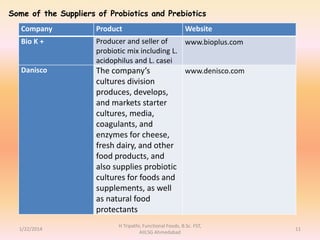
Company Product Website
Bio K + Producer and seller of
probiotic mix including L.
acidophilus and L. casei
www.bioplus.com
Danisco The company’s
cultures division
produces, develops,
and markets starter
cultures, media,
coagulants, and
enzymes for cheese,
fresh dairy, and other
food products, and
also supplies probiotic
cultures for foods and
supplements, as well
as natural food
protectants
www.denisco.com
1/22/2014
H Tripathi, Functional Foods, B.Sc. FST,
AIILSG Ahmedabad
11
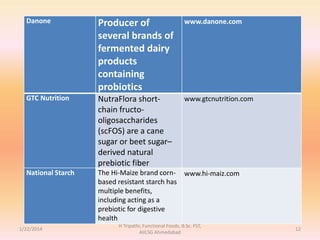
Some of the Suppliers of Probiotics and Prebiotics
Danone Producer of
several brands of
fermented dairy
products
containing
probiotics
www.danone.com
GTC Nutrition NutraFlora short-
chain fructo-
oligosaccharides
(scFOS) are a cane
sugar or beet sugar–
derived natural
prebiotic fiber
www.gtcnutrition.com
National Starch The Hi-Maize brand corn-
based resistant starch has
multiple benefits,
including acting as a
prebiotic for digestive
health
www.hi-maiz.com
1/22/2014
H Tripathi, Functional Foods, B.Sc. FST,
AIILSG Ahmedabad
12
1/22/2014
H Tripathi, Functional Foods, B.Sc. FST,
AIILSG Ahmedabad
13
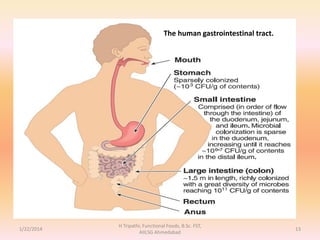
The human gastrointestinal tract.
Health claims
• The intestine contains extensive micro
flora— billions of bacteria, located
mainly in the colon and comprising
hundreds of species of bacteria.
• Prebiotics affect intestinal bacteria by
increasing the numbers of beneficial
anaerobic bacteria and decreasing the
population of potentially pathogenic
microorganisms.
1/22/2014
H Tripathi, Functional Foods, B.Sc. FST,
AIILSG Ahmedabad
14
• The most beneficial effects of probiotics
are the reduction of the incidence and
severity of diarrhea. Probiotics are
intended to assist the body’s naturally
occurring gut micro biota.
• Some probiotic preparations have been
used to prevent diarrhea caused by
antibiotics.
• Studies have documented probiotic
effects on a variety of gastrointestinal
and extra-intestinal disorders, including
inflammatory bowel disease (IBD),
irritable bowel syndrome (IBS), vaginal
infections, and immune enhancement.
1/22/2014
H Tripathi, Functional Foods, B.Sc. FST,
AIILSG Ahmedabad
15
Product safety
• Some species of lactobacilli and bifidobacteria
are normal residents of the human digestive
system and as such do not display infectivity
or toxicity.
• Traditional lactic acid bacteria, long associated
with food fermentation, are generally
considered safe for oral consumption as part
of foods.
1/22/2014
H Tripathi, Functional Foods, B.Sc. FST,
AIILSG Ahmedabad
16
• From a scientific and consumer perspective, the
suitable description of a probiotic product as
reflected on the label should include:
– Genus and species identification
– Strain designation
– Viable count of each strain at the end of shelf-life
– Recommended storage conditions
– Safety in the conditions of recommended use
– Recommended dose, which should be based on
induction of the physiological effect
– An accurate description of the physiological effect, as
far as is allowable by law
– Contact information for post-market surveillance
1/22/2014
H Tripathi, Functional Foods, B.Sc. FST,
AIILSG Ahmedabad
17

Probiotics Prebiotics

  • 1.
    Probiotics and Prebiotics 1/22/2014 HTripathi, Functional Foods, B.Sc. FST, AIILSG Ahmedabad 1 History: o The term “probiotics” was first introduced in 1965 by Lilly and Stillwell. o In contrast to antibiotics, probiotics were defined as microbiologically derived factors that stimulate the growth of other organisms. o The concept of probiotics evolved at the end of the 20th century from a hypothesis first proposed by Nobel Prize winning Russian scientist Elie Metchnikoff o (Bibel, 1988: Bibel, D.J. 1988. Elie Metchnikoff’s bacillus of long life. ASM News 54: 661–665.), o who suggested that the long, healthy life of Bulgarian small farmers and laborers resulted from their consumption of fermented milk products. o He believed that when consumed, the fermenting bacillus (Lactobacillus) positively influenced the micro flora of the colon, decreasing toxic microbial activities.
  • 2.
    • Disorders ofthe intestinal tract were frequently treated with viable nonpathogenic bacteria to change or replace the intestinal micro flora. • Thus, replace proteolytic microbes which produce toxic substances including phenols, indoles, and ammonia from the digestion of proteins— with useful microbes. 1/22/2014 H Tripathi, Functional Foods, B.Sc. FST, AIILSG Ahmedabad 2
  • 3.
    Definitions: • Probiotics: Probiotics areLive microorganisms which, when administered in adequate amounts, confer a health benefit on the host. • Prebiotics: Prebiotics are Non-digestible substances that provide a beneficial physiological effect for the host by selectively stimulating the favorable growth or activity of a limited number of indigenous bacteria. • Synbiotics : Synbiotics are appropriate combinations of prebiotics and probiotics. A synbiotic product exerts both a prebiotic and probiotic effect. 1/22/2014 H Tripathi, Functional Foods, B.Sc. FST, AIILSG Ahmedabad 3
  • 4.
    What are probiotics? •Probiotics are live microbes that can be formulated into many different types of products, including foods, drugs, and dietary supplements. • Species of Lactobacillus and Bifidobacterium are most commonly used as probiotics. • Lactic acid bacteria(LAB), including Lactobacillus species, apart from acting as agents for food fermentation also potentially imparting health benefits. 1/22/2014 H Tripathi, Functional Foods, B.Sc. FST, AIILSG Ahmedabad 4
  • 5.
    • A Bifidobacteriumwas first isolated by Henry Tissier (of the Pasteur Institute) from a breast-fed infant, • and he named the bacterium Bacillus bifidus communis. • Tissier claimed that bifidobacteria would displace the proteolytic bacteria that cause diarrhea • and recommended the administration of bifidobacteria to infants suffering from this symptom. • bifidobacteria is not associated with food fermentation and is taxonomically distinct from the other LAB. 1/22/2014 H Tripathi, Functional Foods, B.Sc. FST, AIILSG Ahmedabad 5
  • 6.
    How to usethe probiotics? • Add probiotics to your diet by choosing low-fat curd with a beneficial probiotic strain, • Choose from a variety of flavored or plain yogurts with probiotics for a quick and tasty snack. • Blend 150- 200 gm of probiotic curd / lassee, 100 ml orange juice, 1 tbsp honey, ½ banana and mix it for a 30-second to make a smoothie. • For a healthful breakfast, top rice / pulav / pancakes with flavored / plain probiotic lassee and fresh fruits like strawberries and bananas. 1/22/2014 H Tripathi, Functional Foods, B.Sc. FST, AIILSG Ahmedabad 6
  • 7.
    What are prebiotics? •Prebiotics are dietary substances that nurture a selected group of microorganisms living in the gut (intestine). • Prebiotics are food products defined as non-digestible food ingredients that benefit the host by selectively stimulating the growth and/or activity of one or a limited number of bacteria in the colon and thus improve host health. • Prebiotics favor the growth of beneficial bacteria over that of harmful or toxic ones. • Prebiotics affect intestinal bacteria by increasing the numbers of beneficial anaerobic bacteria and decreasing the population of potentially pathogenic microorganisms. 1/22/2014 H Tripathi, Functional Foods, B.Sc. FST, AIILSG Ahmedabad 7
  • 8.
    • The Dietarysubstances are mostly consisting of non-starch polysaccharides and oligosaccharides, which are poorly digested by human enzymes. • Prebiotics are carbohydrates in food that our body cannot digest or absorb. • Food sources include whole grains, some fruits, onions, garlic, leeks, honey, and fortified foods and beverages. • As prebiotics pass through our digestive tract probiotics feed on them. 1/22/2014 H Tripathi, Functional Foods, B.Sc. FST, AIILSG Ahmedabad 8
  • 9.
    • Prebiotics arethe food that keeps beneficial probiotic populations adequate and healthy. This in turn may improve intestinal health and nutrient absorption. • The most of prebiotics are used as food ingredients, e.g. in biscuits, cereals, chocolate, spreads, and dairy products, etc. • Commonly known prebiotics are: Fructo- oligosaccharides(FOS),Inulin, Galacto- oligosaccharides, Lactulose, Poly-dextrose, Breast milk oligosaccharides, etc. 1/22/2014 H Tripathi, Functional Foods, B.Sc. FST, AIILSG Ahmedabad 9
  • 10.
    • Lactulose isa synthetic disaccharide used as a drug for the treatment of constipation and hepatic encephalopathy. • The prebiotic oligo-fructose is found naturally in many foods, such as wheat, onions, bananas, honey, garlic, etc. Oligo-fructose can also be isolated from chicory root or synthesized enzymatically from sucrose. • Fermentation of oligo-fructose in the colon results in a large number of physiological effects, including: – Increasing the numbers of bifidobacteria in the colon – Increasing calcium absorption – Increasing fecal weight – Shortening gastrointestinal transit time – Possibly, lowering blood lipid levels 1/22/2014 H Tripathi, Functional Foods, B.Sc. FST, AIILSG Ahmedabad 10
  • 11.
    Company Product Website BioK + Producer and seller of probiotic mix including L. acidophilus and L. casei www.bioplus.com Danisco The company’s cultures division produces, develops, and markets starter cultures, media, coagulants, and enzymes for cheese, fresh dairy, and other food products, and also supplies probiotic cultures for foods and supplements, as well as natural food protectants www.denisco.com 1/22/2014 H Tripathi, Functional Foods, B.Sc. FST, AIILSG Ahmedabad 11 Some of the Suppliers of Probiotics and Prebiotics
  • 12.
    Danone Producer of severalbrands of fermented dairy products containing probiotics www.danone.com GTC Nutrition NutraFlora short- chain fructo- oligosaccharides (scFOS) are a cane sugar or beet sugar– derived natural prebiotic fiber www.gtcnutrition.com National Starch The Hi-Maize brand corn- based resistant starch has multiple benefits, including acting as a prebiotic for digestive health www.hi-maiz.com 1/22/2014 H Tripathi, Functional Foods, B.Sc. FST, AIILSG Ahmedabad 12
  • 13.
    1/22/2014 H Tripathi, FunctionalFoods, B.Sc. FST, AIILSG Ahmedabad 13 The human gastrointestinal tract.
  • 14.
    Health claims • Theintestine contains extensive micro flora— billions of bacteria, located mainly in the colon and comprising hundreds of species of bacteria. • Prebiotics affect intestinal bacteria by increasing the numbers of beneficial anaerobic bacteria and decreasing the population of potentially pathogenic microorganisms. 1/22/2014 H Tripathi, Functional Foods, B.Sc. FST, AIILSG Ahmedabad 14
  • 15.
    • The mostbeneficial effects of probiotics are the reduction of the incidence and severity of diarrhea. Probiotics are intended to assist the body’s naturally occurring gut micro biota. • Some probiotic preparations have been used to prevent diarrhea caused by antibiotics. • Studies have documented probiotic effects on a variety of gastrointestinal and extra-intestinal disorders, including inflammatory bowel disease (IBD), irritable bowel syndrome (IBS), vaginal infections, and immune enhancement. 1/22/2014 H Tripathi, Functional Foods, B.Sc. FST, AIILSG Ahmedabad 15
  • 16.
    Product safety • Somespecies of lactobacilli and bifidobacteria are normal residents of the human digestive system and as such do not display infectivity or toxicity. • Traditional lactic acid bacteria, long associated with food fermentation, are generally considered safe for oral consumption as part of foods. 1/22/2014 H Tripathi, Functional Foods, B.Sc. FST, AIILSG Ahmedabad 16
  • 17.
    • From ascientific and consumer perspective, the suitable description of a probiotic product as reflected on the label should include: – Genus and species identification – Strain designation – Viable count of each strain at the end of shelf-life – Recommended storage conditions – Safety in the conditions of recommended use – Recommended dose, which should be based on induction of the physiological effect – An accurate description of the physiological effect, as far as is allowable by law – Contact information for post-market surveillance 1/22/2014 H Tripathi, Functional Foods, B.Sc. FST, AIILSG Ahmedabad 17