Basic concepts: Probability, Population & Sample
Dr. S. A. Rizwan, M.D.
Public	Health	Specialist
SBCM,	Joint	Program	– Riyadh
Ministry	of	Health,	Kingdom	of	Saudi	Arabia
Learning	objectives
Demystifying statistics! – Lecture 1 SBCM, Joint Program – RiyadhSBCM, Joint Program – Riyadh
• Familiarise	with	terms	used	in	probability
• Define	probability
• Describe	the	3	approaches	of	probability
• Understand	the	basic	laws	of	probability
• Solve	problems	based	on	above	laws
• Describe	the	concepts	of	Population	and	Sample
2
Section	1:	
Probability	basics
Demystifying statistics! – Lecture 1 SBCM, Joint Program – RiyadhSBCM, Joint Program – Riyadh 3
A	few	important	terms
Demystifying statistics! – Lecture 1 SBCM, Joint Program – RiyadhSBCM, Joint Program – Riyadh
• Random	experiment
• Sample	space
• Event
• exhaustive,	impossible,	elementary,	composite,	
certain,	mutually	exclusive,	independent,	
dependent,	favourable,	equally	likely
4
A	few	important	terms
Demystifying statistics! – Lecture 1 SBCM, Joint Program – RiyadhSBCM, Joint Program – Riyadh
Event	type Example
Independent	 Two	seeds	are	sown,	germination	of	one	is	
not	affected	by	the	other.
Dependent If	we	draw	a	card	from	a	pack	of	well	
shuffled	cards,	if	the	first	card	drawn	is	not	
replaced	then	the	second	draw	is	
dependent	on	the	first	draw.
Mutually	
exclusive
In	observation	of	seed	germination	the	
seed	may	either	germinate	or	it	will	not	
germinate.
5
Probability	– what	is	it?
Demystifying statistics! – Lecture 1 SBCM, Joint Program – RiyadhSBCM, Joint Program – Riyadh
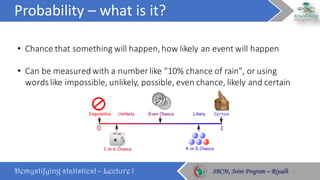
• Chance	that	something	will	happen,	how	likely	an	event	will	happen
• Can	be	measured	with	a	number	like	"10%	chance	of	rain",	or	using	
words	like	impossible,	unlikely,	possible,	even	chance,	likely	and	certain
6
Probability	– what	is	it?
Demystifying statistics! – Lecture 1 SBCM, Joint Program – RiyadhSBCM, Joint Program – Riyadh
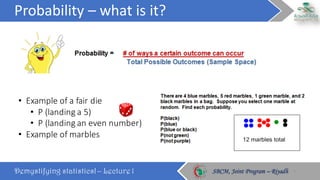
• Example	of	a	fair	die
• P	(landing	a	5)
• P	(landing	an	even	number)
• Example	of	marbles
7
Probability	– approaches	to	calculate
Demystifying statistics! – Lecture 1 SBCM, Joint Program – RiyadhSBCM, Joint Program – Riyadh
• Theoreticalprobability
• Relative	frequency
• Subjective	probability	
8
Laws	of	Probability	– Set	analogy
Demystifying statistics! – Lecture 1 SBCM, Joint Program – RiyadhSBCM, Joint Program – Riyadh
• Union
• Intersection
• Complement
9
Thought	exercises:
Demystifying statistics! – Lecture 1 SBCM, Joint Program – RiyadhSBCM, Joint Program – Riyadh
Example	1.	A	bag	contains	5	red	marbles,	3	blue	marbles,	and	2	green	
marbles.		
Q1.	pr (red)	+	pr (blue)	+	pr (green)
Q2.	pr (red)	+	pr (not	red)
Q3.	pr (red	or	green)
10
Thought	exercises:
Demystifying statistics! – Lecture 1 SBCM, Joint Program – RiyadhSBCM, Joint Program – Riyadh
Example	2.	Roll	a	die	and	flip	a	coin.
Q1.	pr (heads	and	roll	a	3)
11
Thought	exercises:
Demystifying statistics! – Lecture 1 SBCM, Joint Program – RiyadhSBCM, Joint Program – Riyadh
Example	3.	There	are	20	people	in	the	room:	12	girls	(5	with	blond	hair	and	
7	with	brown	hair)	and	8	boys	(4	with	blond	hair	and	4	with	brown	hair).		
There	are	a	total	of	9	blonds	and	11	with	brown	hair.
Q1.	pr (girl	or	blond)
Q2.	pr (girl	with	brown	hair)	and	pr (girl)
12
Thought	exercises:
Demystifying statistics! – Lecture 1 SBCM, Joint Program – RiyadhSBCM, Joint Program – Riyadh
Example	4.	toss	a	coin	4	times	
Q1.	What	is	the	probability	of	getting	at	least	one	head	on	the	4	tosses	
pr (at	least	one	H)
13
Thought	exercises:
Demystifying statistics! – Lecture 1 SBCM, Joint Program – RiyadhSBCM, Joint Program – Riyadh
Example	5.	An	individual	applying	to	a	college	determines	that	he	has	an	
80%	chance	of	being	accepted,	and	he	knows	that	dormitory	housing	will	
only	be	provided	for	60%	of	accepted	students.
Q1.	What	is	the	chance	of	the	student	being	accepted	and	receiving	
dormitory	housing?
14
Thought	exercises:
Demystifying statistics! – Lecture 1 SBCM, Joint Program – RiyadhSBCM, Joint Program – Riyadh
Example	6.	A =	“Patient	has	liver	disease.”	Past	data	tells	you	that	10%	of	
patients	entering	your	clinic	have	liver	disease.	B =	“Patient	is	an	alcoholic.”	
Five	percent	of	the	clinic’s	patients	are	alcoholics.	Among	patients	
diagnosed	with	liver	disease,	7%	are	alcoholics.	
Q1.	Find	out	a	patient’s	probability	of	having	liver	disease	if	they	are	an	
alcoholic.
15
Laws	of	Probability	- 1
Demystifying statistics! – Lecture 1 SBCM, Joint Program – RiyadhSBCM, Joint Program – Riyadh
• The	probability	of	an	event	is	
between	0	and	1
• A	probability	of	1	is	equivalent	
to	100%	certainty
• Probabilities	can	be	expressed	
at	fractions,	decimals,	or	
percentage
16
Laws	of	Probability	- 2
Demystifying statistics! – Lecture 1 SBCM, Joint Program – RiyadhSBCM, Joint Program – Riyadh
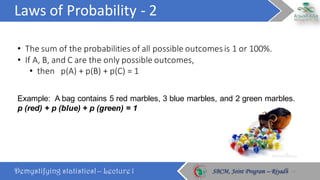
• The	sum	of	the	probabilities	of	all	possible	outcomes	is	1	or	100%.		
• If	A,	B,	and	C	are	the	only	possible	outcomes,	
• then			p(A)	+	p(B)	+	p(C)	=	1
Example: A bag contains 5 red marbles, 3 blue marbles, and 2 green marbles.
p (red) + p (blue) + p (green) = 1
17
Laws	of	Probability	- 3
Demystifying statistics! – Lecture 1 SBCM, Joint Program – RiyadhSBCM, Joint Program – Riyadh
• The	sum	of	the	probability	of	an	event	occurring	and	it	not	occurring	is	1.		
• p(A)	+	p(not	A)	=	1		
• p(not	A)	=	1	- p(A)
Example: A bag contains 5 red marbles, 3 blue marbles, and 2 green marbles.
p (red) + p (not red) = 1
18
Laws	of	Probability	- 4
Demystifying statistics! – Lecture 1 SBCM, Joint Program – RiyadhSBCM, Joint Program – Riyadh
• If	two	events	A	and	B	are	independent
• then	the	probability	of	A	and	B	occurring	is	the	product	of	their	
individual	probabilities.
• p	(A	and	B)	=	p	(A)	X	p	(B)
Example: roll a die and flip a coin. p (heads and roll a 3) = p (H) X p (3)
*Multiplicative	Theorem
19
Laws	of	Probability	- 4a
Demystifying statistics! – Lecture 1 SBCM, Joint Program – RiyadhSBCM, Joint Program – Riyadh
• If	two	events	A	and	B	are	dependent
• then	the	probability	of	A	and	B	occurring	is
• p	(A	and	B)	=	p	(B|A)	X	p	(A)	=	p	(A|B)	X	p	(B)
• An	individual	applying	to	a	college	determines	that	he	has	an	80%	chance	of	being	
accepted,	and	he	knows	that	dormitory	housing	will	only	be	provided	for	60%	of	
accepted	students.
• What	is	the	chance	of	the	student	being	accepted	and	receiving	dormitory	housing?
• P(Accepted	and	Dormitory	Housing)
• =	P(Dormitory	Housing	|	Accepted)	*	P(Accepted)	
• =	(0.60)*(0.80)	=	0.48
*Multiplicative	Theorem
20
Laws	of	Probability	- 5
Demystifying statistics! – Lecture 1 SBCM, Joint Program – RiyadhSBCM, Joint Program – Riyadh
• If	two	events	A	and	B	are	mutually	exclusive	
• then	the	probability	of	A	or	B	occurring	is	the	sum	of	their	individual	
probabilities.
• p	(A	or	B)	=	p	(A)	+	p	(B)
Example: A bag contains 5 red marbles, 3 blue marbles, and 2 green marbles.
p (red or green) = p (red) + p (green)
*Addition	Theorem
21
Laws	of	Probability	- 6
Demystifying statistics! – Lecture 1 SBCM, Joint Program – RiyadhSBCM, Joint Program – Riyadh
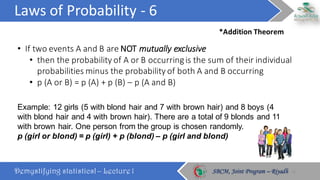
• If	two	events	A	and	B	are	NOT mutually	exclusive	
• then	the	probability	of	A	or	B	occurring	is	the	sum	of	their	individual	
probabilities	minus	the	probability	of	both	A	and	B	occurring
• p	(A	or	B)	=	p	(A)	+	p	(B)	– p	(A	and	B)
Example: 12 girls (5 with blond hair and 7 with brown hair) and 8 boys (4
with blond hair and 4 with brown hair). There are a total of 9 blonds and 11
with brown hair. One person from the group is chosen randomly.
p (girl or blond) = p (girl) + p (blond) – p (girl and blond)
*Addition	Theorem
22
Laws	of	Probability	- 7
Demystifying statistics! – Lecture 1 SBCM, Joint Program – RiyadhSBCM, Joint Program – Riyadh
• The	probability	of	at	least	one	event	occurring	out	of	multiple	events	is	
equal	to	one	minus	the	probability	of	none	of	the	events	occurring.		
• p	(at	least	one)	=	1	– p	(none)
Example: What is the probability of getting at least one head on the 4 throw
of a coin?
p (at least one H) = 1 – p (no H) = 1 – p (TTTT)
23
Laws	of	Probability	- 8
Demystifying statistics! – Lecture 1 SBCM, Joint Program – RiyadhSBCM, Joint Program – Riyadh
• If	event	B	is	a	subset	of	event	A,	
• then	the	probability	of	B	is	less	than	or	equal	to	the	probability	of	A.		
• p	(B)	≤	p	(A)
Example: There are 20 people in the room: 12 girls (5 with blond hair and 7
with brown hair) and 8 boys (4 with blond hair and 4 with brown hair).
p (girl with brown hair) ≤ p (girl)
24
Conditional	Probability
Demystifying statistics! – Lecture 1 SBCM, Joint Program – RiyadhSBCM, Joint Program – Riyadh
• Two	events	A	and	B	are	said	to	be	dependent,	when	B	can	occur	only	
when	A	is	known	to	have	occurred	(or	vice	versa)
• The	probability	attached	to	such	an	event	is	called	the	conditional	
probability	and	is	denoted	by	P	(A/B)
*Bayes	Theorem
25
Conditional	Probability
Demystifying statistics! – Lecture 1 SBCM, Joint Program – RiyadhSBCM, Joint Program – Riyadh
*Bayes	Theorem
26
Conditional	Probability	- Example
Demystifying statistics! – Lecture 1 SBCM, Joint Program – RiyadhSBCM, Joint Program – Riyadh
• A =	“Patient	has	liver	disease.”	Past	data	tells	you	that	10%	of	patients	
entering	your	clinic	have	liver	disease.	P(A)	=	0.10.
• B =	“Patient	is	an	alcoholic.”	Five	percent	of	the	clinic’s	patients	are	
alcoholics.	P(B)	=	0.05.
• Among	patients	diagnosed	with	liver	disease,	7%	are	alcoholics.	This	is	
your B|A.
• Finding	out	a	patient’s	probability	of	having	liver	disease	if	they	are	an	
alcoholic.
• P(A|B)	=	(0.07	*	0.1) / 0.05	=	0.14
*Bayes	Theorem
27
Section	2:	
Population	&	Sample
Demystifying statistics! – Lecture 1 SBCM, Joint Program – RiyadhSBCM, Joint Program – Riyadh 28
Population
Demystifying statistics! – Lecture 1 SBCM, Joint Program – RiyadhSBCM, Joint Program – Riyadh 29
• The	population	is	the	set	of	entities	under	study
• A	population	includes	all	of	the	elements	from	a	set	of	data.	
• A	measurable	characteristic	of	a	population	- parameter
Sample
Demystifying statistics! – Lecture 1 SBCM, Joint Program – RiyadhSBCM, Joint Program – Riyadh 30
• A	sample	consists	of	one	or	more	observations	from	the	population
• A	measurable	characteristic	of	a	sample	is	called	a	statistic.
Sample
Demystifying statistics! – Lecture 1 SBCM, Joint Program – RiyadhSBCM, Joint Program – Riyadh 31
Descriptive	statistics
Demystifying statistics! – Lecture 1 SBCM, Joint Program – RiyadhSBCM, Joint Program – Riyadh 32
• Descriptive	statistics	provide	a	concise	summary	of	data.	
• You	can	summarize	data	numerically	or	graphically
Descriptive	statistics
Demystifying statistics! – Lecture 1 SBCM, Joint Program – RiyadhSBCM, Joint Program – Riyadh 33
Inferential	statistics
Demystifying statistics! – Lecture 1 SBCM, Joint Program – RiyadhSBCM, Joint Program – Riyadh 34
• Inferential	statistics	use	a	random	sample	of	data	taken	from	a	population	
to	describe	and	make	inferences	about	the	population.
Inferential	statistics
Demystifying statistics! – Lecture 1 SBCM, Joint Program – RiyadhSBCM, Joint Program – Riyadh 35
Take	home	messages
Demystifying statistics! – Lecture 1 SBCM, Joint Program – RiyadhSBCM, Joint Program – Riyadh
• Understanding	probability	and	its	laws	
are	important	to	understanding	
biostatistics
• The	concepts	of	population	and	sample	
are	essential	for	understanding	inferential	
statistics
36
Thank	you!
Email	your	queries	to	sarizwan1986@outlook.com	
37

Probability, population and sample

  • 1.
    Basic concepts: Probability,Population & Sample Dr. S. A. Rizwan, M.D. Public Health Specialist SBCM, Joint Program – Riyadh Ministry of Health, Kingdom of Saudi Arabia
  • 2.
    Learning objectives Demystifying statistics! –Lecture 1 SBCM, Joint Program – RiyadhSBCM, Joint Program – Riyadh • Familiarise with terms used in probability • Define probability • Describe the 3 approaches of probability • Understand the basic laws of probability • Solve problems based on above laws • Describe the concepts of Population and Sample 2
  • 3.
    Section 1: Probability basics Demystifying statistics! –Lecture 1 SBCM, Joint Program – RiyadhSBCM, Joint Program – Riyadh 3
  • 4.
    A few important terms Demystifying statistics! –Lecture 1 SBCM, Joint Program – RiyadhSBCM, Joint Program – Riyadh • Random experiment • Sample space • Event • exhaustive, impossible, elementary, composite, certain, mutually exclusive, independent, dependent, favourable, equally likely 4
  • 5.
    A few important terms Demystifying statistics! –Lecture 1 SBCM, Joint Program – RiyadhSBCM, Joint Program – Riyadh Event type Example Independent Two seeds are sown, germination of one is not affected by the other. Dependent If we draw a card from a pack of well shuffled cards, if the first card drawn is not replaced then the second draw is dependent on the first draw. Mutually exclusive In observation of seed germination the seed may either germinate or it will not germinate. 5
  • 6.
    Probability – what is it? Demystifying statistics!– Lecture 1 SBCM, Joint Program – RiyadhSBCM, Joint Program – Riyadh • Chance that something will happen, how likely an event will happen • Can be measured with a number like "10% chance of rain", or using words like impossible, unlikely, possible, even chance, likely and certain 6
  • 7.
    Probability – what is it? Demystifying statistics!– Lecture 1 SBCM, Joint Program – RiyadhSBCM, Joint Program – Riyadh • Example of a fair die • P (landing a 5) • P (landing an even number) • Example of marbles 7
  • 8.
    Probability – approaches to calculate Demystifying statistics!– Lecture 1 SBCM, Joint Program – RiyadhSBCM, Joint Program – Riyadh • Theoreticalprobability • Relative frequency • Subjective probability 8
  • 9.
    Laws of Probability – Set analogy Demystifying statistics!– Lecture 1 SBCM, Joint Program – RiyadhSBCM, Joint Program – Riyadh • Union • Intersection • Complement 9
  • 10.
    Thought exercises: Demystifying statistics! –Lecture 1 SBCM, Joint Program – RiyadhSBCM, Joint Program – Riyadh Example 1. A bag contains 5 red marbles, 3 blue marbles, and 2 green marbles. Q1. pr (red) + pr (blue) + pr (green) Q2. pr (red) + pr (not red) Q3. pr (red or green) 10
  • 11.
    Thought exercises: Demystifying statistics! –Lecture 1 SBCM, Joint Program – RiyadhSBCM, Joint Program – Riyadh Example 2. Roll a die and flip a coin. Q1. pr (heads and roll a 3) 11
  • 12.
    Thought exercises: Demystifying statistics! –Lecture 1 SBCM, Joint Program – RiyadhSBCM, Joint Program – Riyadh Example 3. There are 20 people in the room: 12 girls (5 with blond hair and 7 with brown hair) and 8 boys (4 with blond hair and 4 with brown hair). There are a total of 9 blonds and 11 with brown hair. Q1. pr (girl or blond) Q2. pr (girl with brown hair) and pr (girl) 12
  • 13.
    Thought exercises: Demystifying statistics! –Lecture 1 SBCM, Joint Program – RiyadhSBCM, Joint Program – Riyadh Example 4. toss a coin 4 times Q1. What is the probability of getting at least one head on the 4 tosses pr (at least one H) 13
  • 14.
    Thought exercises: Demystifying statistics! –Lecture 1 SBCM, Joint Program – RiyadhSBCM, Joint Program – Riyadh Example 5. An individual applying to a college determines that he has an 80% chance of being accepted, and he knows that dormitory housing will only be provided for 60% of accepted students. Q1. What is the chance of the student being accepted and receiving dormitory housing? 14
  • 15.
    Thought exercises: Demystifying statistics! –Lecture 1 SBCM, Joint Program – RiyadhSBCM, Joint Program – Riyadh Example 6. A = “Patient has liver disease.” Past data tells you that 10% of patients entering your clinic have liver disease. B = “Patient is an alcoholic.” Five percent of the clinic’s patients are alcoholics. Among patients diagnosed with liver disease, 7% are alcoholics. Q1. Find out a patient’s probability of having liver disease if they are an alcoholic. 15
  • 16.
    Laws of Probability - 1 Demystifying statistics!– Lecture 1 SBCM, Joint Program – RiyadhSBCM, Joint Program – Riyadh • The probability of an event is between 0 and 1 • A probability of 1 is equivalent to 100% certainty • Probabilities can be expressed at fractions, decimals, or percentage 16
  • 17.
    Laws of Probability - 2 Demystifying statistics!– Lecture 1 SBCM, Joint Program – RiyadhSBCM, Joint Program – Riyadh • The sum of the probabilities of all possible outcomes is 1 or 100%. • If A, B, and C are the only possible outcomes, • then p(A) + p(B) + p(C) = 1 Example: A bag contains 5 red marbles, 3 blue marbles, and 2 green marbles. p (red) + p (blue) + p (green) = 1 17
  • 18.
    Laws of Probability - 3 Demystifying statistics!– Lecture 1 SBCM, Joint Program – RiyadhSBCM, Joint Program – Riyadh • The sum of the probability of an event occurring and it not occurring is 1. • p(A) + p(not A) = 1 • p(not A) = 1 - p(A) Example: A bag contains 5 red marbles, 3 blue marbles, and 2 green marbles. p (red) + p (not red) = 1 18
  • 19.
    Laws of Probability - 4 Demystifying statistics!– Lecture 1 SBCM, Joint Program – RiyadhSBCM, Joint Program – Riyadh • If two events A and B are independent • then the probability of A and B occurring is the product of their individual probabilities. • p (A and B) = p (A) X p (B) Example: roll a die and flip a coin. p (heads and roll a 3) = p (H) X p (3) *Multiplicative Theorem 19
  • 20.
    Laws of Probability - 4a Demystifying statistics!– Lecture 1 SBCM, Joint Program – RiyadhSBCM, Joint Program – Riyadh • If two events A and B are dependent • then the probability of A and B occurring is • p (A and B) = p (B|A) X p (A) = p (A|B) X p (B) • An individual applying to a college determines that he has an 80% chance of being accepted, and he knows that dormitory housing will only be provided for 60% of accepted students. • What is the chance of the student being accepted and receiving dormitory housing? • P(Accepted and Dormitory Housing) • = P(Dormitory Housing | Accepted) * P(Accepted) • = (0.60)*(0.80) = 0.48 *Multiplicative Theorem 20
  • 21.
    Laws of Probability - 5 Demystifying statistics!– Lecture 1 SBCM, Joint Program – RiyadhSBCM, Joint Program – Riyadh • If two events A and B are mutually exclusive • then the probability of A or B occurring is the sum of their individual probabilities. • p (A or B) = p (A) + p (B) Example: A bag contains 5 red marbles, 3 blue marbles, and 2 green marbles. p (red or green) = p (red) + p (green) *Addition Theorem 21
  • 22.
    Laws of Probability - 6 Demystifying statistics!– Lecture 1 SBCM, Joint Program – RiyadhSBCM, Joint Program – Riyadh • If two events A and B are NOT mutually exclusive • then the probability of A or B occurring is the sum of their individual probabilities minus the probability of both A and B occurring • p (A or B) = p (A) + p (B) – p (A and B) Example: 12 girls (5 with blond hair and 7 with brown hair) and 8 boys (4 with blond hair and 4 with brown hair). There are a total of 9 blonds and 11 with brown hair. One person from the group is chosen randomly. p (girl or blond) = p (girl) + p (blond) – p (girl and blond) *Addition Theorem 22
  • 23.
    Laws of Probability - 7 Demystifying statistics!– Lecture 1 SBCM, Joint Program – RiyadhSBCM, Joint Program – Riyadh • The probability of at least one event occurring out of multiple events is equal to one minus the probability of none of the events occurring. • p (at least one) = 1 – p (none) Example: What is the probability of getting at least one head on the 4 throw of a coin? p (at least one H) = 1 – p (no H) = 1 – p (TTTT) 23
  • 24.
    Laws of Probability - 8 Demystifying statistics!– Lecture 1 SBCM, Joint Program – RiyadhSBCM, Joint Program – Riyadh • If event B is a subset of event A, • then the probability of B is less than or equal to the probability of A. • p (B) ≤ p (A) Example: There are 20 people in the room: 12 girls (5 with blond hair and 7 with brown hair) and 8 boys (4 with blond hair and 4 with brown hair). p (girl with brown hair) ≤ p (girl) 24
  • 25.
    Conditional Probability Demystifying statistics! –Lecture 1 SBCM, Joint Program – RiyadhSBCM, Joint Program – Riyadh • Two events A and B are said to be dependent, when B can occur only when A is known to have occurred (or vice versa) • The probability attached to such an event is called the conditional probability and is denoted by P (A/B) *Bayes Theorem 25
  • 26.
    Conditional Probability Demystifying statistics! –Lecture 1 SBCM, Joint Program – RiyadhSBCM, Joint Program – Riyadh *Bayes Theorem 26
  • 27.
    Conditional Probability - Example Demystifying statistics!– Lecture 1 SBCM, Joint Program – RiyadhSBCM, Joint Program – Riyadh • A = “Patient has liver disease.” Past data tells you that 10% of patients entering your clinic have liver disease. P(A) = 0.10. • B = “Patient is an alcoholic.” Five percent of the clinic’s patients are alcoholics. P(B) = 0.05. • Among patients diagnosed with liver disease, 7% are alcoholics. This is your B|A. • Finding out a patient’s probability of having liver disease if they are an alcoholic. • P(A|B) = (0.07 * 0.1) / 0.05 = 0.14 *Bayes Theorem 27
  • 28.
    Section 2: Population & Sample Demystifying statistics! –Lecture 1 SBCM, Joint Program – RiyadhSBCM, Joint Program – Riyadh 28
  • 29.
    Population Demystifying statistics! –Lecture 1 SBCM, Joint Program – RiyadhSBCM, Joint Program – Riyadh 29 • The population is the set of entities under study • A population includes all of the elements from a set of data. • A measurable characteristic of a population - parameter
  • 30.
    Sample Demystifying statistics! –Lecture 1 SBCM, Joint Program – RiyadhSBCM, Joint Program – Riyadh 30 • A sample consists of one or more observations from the population • A measurable characteristic of a sample is called a statistic.
  • 31.
    Sample Demystifying statistics! –Lecture 1 SBCM, Joint Program – RiyadhSBCM, Joint Program – Riyadh 31
  • 32.
    Descriptive statistics Demystifying statistics! –Lecture 1 SBCM, Joint Program – RiyadhSBCM, Joint Program – Riyadh 32 • Descriptive statistics provide a concise summary of data. • You can summarize data numerically or graphically
  • 33.
    Descriptive statistics Demystifying statistics! –Lecture 1 SBCM, Joint Program – RiyadhSBCM, Joint Program – Riyadh 33
  • 34.
    Inferential statistics Demystifying statistics! –Lecture 1 SBCM, Joint Program – RiyadhSBCM, Joint Program – Riyadh 34 • Inferential statistics use a random sample of data taken from a population to describe and make inferences about the population.
  • 35.
    Inferential statistics Demystifying statistics! –Lecture 1 SBCM, Joint Program – RiyadhSBCM, Joint Program – Riyadh 35
  • 36.
    Take home messages Demystifying statistics! –Lecture 1 SBCM, Joint Program – RiyadhSBCM, Joint Program – Riyadh • Understanding probability and its laws are important to understanding biostatistics • The concepts of population and sample are essential for understanding inferential statistics 36
  • 37.