UNIVERSITY OF MYSORE
TYPES OF PROBABILITY
PRESENTED TO:
D. JAYAPRASAD.
FACULTY OF
COMMERCE DEPT.
UNIVERSITY OF MYSORE
Contents:
 Introduction
 Concept

of various terms
 Approaches or types of probability
 Theorems of probability
 Discursion of problems
 Conclusion
Introduction
Probability theory is a very fascinating subject which
can be studied at various mathematical levels. Probability
is the foundation of statistical theory and applications.
Several mathematicians like Pascal, James Bernoulli,
De-Moivre, Bayes applied the theory of permutations and
combinations to quantify or calculate probability. Today
the probability theory has become one of the fundamental
technique in the development of Statistics.
The term “probability” in Statistics refers to the
chances of occurrence of an event among a large number of
possibilities.
TERMINOLOGIES


Random Experiment:
If an experiment or trial is repeated under the same
conditions for any number of times and it is possible to
count the total number of outcomes is called as “Random
Experiment”.



Sample Space:
The set of all possible outcomes of a random
experiment is known as “Sample Space” and denoted by
set S. [this is similar to Universal set in Set Theory] The
outcomes of the random experiment are called sample
points or outcomes.
Event:
An ‘event’ is an outcome of a trial meeting a
specified set of conditions other words, event is
a subset of the sample space S.
Events are usually denoted by capital letters.
There are different types of events.
1.
Null or impossible event is an event which
contains no outcomes.
2.
Elementary event is an event which contains
only one outcomes.
3.
Composite event is an event which contains
two or more outcomes.
4.
Sure or certain event is an event which
contains all the outcomes of a sample space.
• Exhaustive Events:
The total number of all possible elementary outcomes
in a random experiment is known as ‘exhaustive events’. In
other words, a set is said to be exhaustive, when no other
possibilities exists.
• Favourable

Events:

The elementary outcomes which entail or favour the
happening of an event is known as ‘favourable events’ i.e.,
the outcomes which help in the occurrence of that event.

• Mutually Exclusive Events:
Events are said to be ‘mutually exclusive’ if the
occurrence of an event totally prevents occurrence of all
other events in a trial. In other words, two events A and B
cannot occur simultaneously.
• Equally likely or Equi-probable Events:
Outcomes are said to be ‘equally likely’ if there is no reason
to expect one outcome to occur in preference to another. i.e.,
among all exhaustive outcomes, each of them has equal chance
of occurrence.

• Complementary Events:
Let E denote occurrence of event. The complement of E
denotes the non occurrence of event E. Complement of E is
denoted by ‘Ē’.

• Independent Events:
Two or more events are said to be ‘independent’, in a
series of a trials if the outcome of one event is does not affect the
outcome of the other event or vise versa.
In other words, several events are said to be
‘dependents’ if the occurrence of an event is affected by the
occurrence of any number of remaining events, in a series of
trials.

Measurement of Probability:
There are three approaches to construct a
measure of probability of occurrence of an event.
They are:
 Classical Approach,
 Frequency Approach and
 Axiomatic Approach.
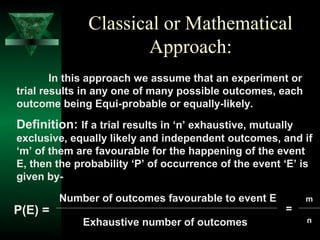
Classical or Mathematical
Approach:
In this approach we assume that an experiment or
trial results in any one of many possible outcomes, each
outcome being Equi-probable or equally-likely.

Definition: If a trial results in ‘n’ exhaustive, mutually
exclusive, equally likely and independent outcomes, and if
‘m’ of them are favourable for the happening of the event
E, then the probability ‘P’ of occurrence of the event ‘E’ is
given by-

P(E) =

Number of outcomes favourable to event E
Exhaustive number of outcomes

=

m
n
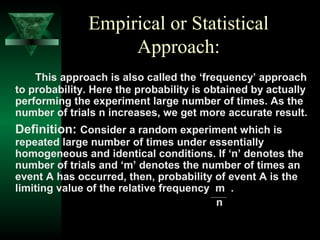
Empirical or Statistical
Approach:
This approach is also called the ‘frequency’ approach
to probability. Here the probability is obtained by actually
performing the experiment large number of times. As the
number of trials n increases, we get more accurate result.

Definition: Consider a random experiment which is

repeated large number of times under essentially
homogeneous and identical conditions. If ‘n’ denotes the
number of trials and ‘m’ denotes the number of times an
event A has occurred, then, probability of event A is the
limiting value of the relative frequency m .
n
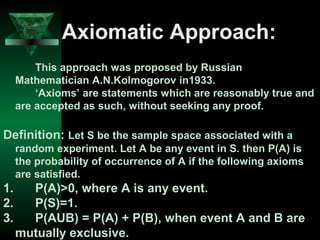
Axiomatic Approach:
This approach was proposed by Russian
Mathematician A.N.Kolmogorov in1933.
‘Axioms’ are statements which are reasonably true and
are accepted as such, without seeking any proof.

Definition: Let S be the sample space associated with a
random experiment. Let A be any event in S. then P(A) is
the probability of occurrence of A if the following axioms
are satisfied.

1.
2.
3.

P(A)>0, where A is any event.
P(S)=1.
P(AUB) = P(A) + P(B), when event A and B are
mutually exclusive.
– HRIS system is able to provide us various
benefits like speedy retrieval and
processing of data, its easy classification.
– It helps in better analysis and more
effective decisions making .
– Provides us with accurate information,
quality reports and overall better work
culture.
– Eliminates personal biasness, brings
What are the problems faced
by HR people while using the
system? the system is efficient, but
Although
sometimes they face the problems
like system slowdown or higher
downtimes and if there is some
particular limitation in module than
work suffers, some HR people are
not comfortable in using system
efficiently so time is to be given in
What are the uses of HRIS in different
functions of HR?
 HRIS system is helping out in all the functions
and activities related to HR like payroll processing,
training and development , job evaluation process
and appraisals, recruitments etc. by providing
accurate and timely information and helping in better
analysis of information.
HRIS - Development
CONCIEVE & PLAN
ANALYSE
DESIGN
TEST
IMPLIMENT
MAINTAIN
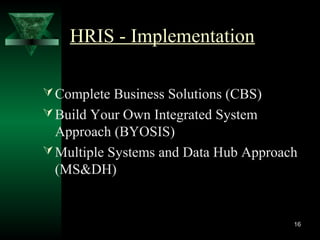
HRIS - Implementation
 Complete Business Solutions (CBS)
 Build Your Own Integrated System

Approach (BYOSIS)
 Multiple Systems and Data Hub Approach
(MS&DH)

16
HRIS – Example
Oracle/PeopleSoft HRMS (ver.
12)
 Automates the entire recruit-to-retire process.
 A single integrated application includes the
following HR activities:
 Recruitment
 Performance management
 Learning
 Compensation and benefits
 Payroll
 Workforce scheduling
 Time management and real time
analytics.
HRIS - Benefits












Higher Speed of retrieval and processing of data.
Reduction in duplication of efforts leading to reduced cost.
Ease in classifying and reclassifying data.
Better analysis leading to more effective decision making.
Higher accuracy of information/report generated.
Fast response to answer queries.
Improved quality of reports.
Better work culture.
Establishing of streamlined and systematic procedure.
More transparency in the system.
Employee – Self Management
HRIS - Disadvantages
 It can be expensive in terms of finance and

manpower.
 It can be threatening and inconvenient.
 Thorough understanding of what constitutes
quality information for the user.
 Computer cannot substitute human beings.
Conclusion
“We are becoming
the servants in
thought, as in
action, of the
machines.
Evidently, we
actually have
created them to
serve us”.
References
 Management Information Systems: New

Approaches to Organization and Technology –
Upper Saddle River
 Integrated HR Systems – Linda Stroh
 Web References:
www.google.com
www.wekipedia.com
PRESENTED BY

•
•
•
•

BHARGAVI.B.
III B. Com.
M.M.W.A.C.C.
Mysore University.
THANK
YOU

HUMAN RESOURCE INFORMATION SYSTEM

  • 1.
    UNIVERSITY OF MYSORE TYPESOF PROBABILITY PRESENTED TO: D. JAYAPRASAD. FACULTY OF COMMERCE DEPT. UNIVERSITY OF MYSORE
  • 2.
    Contents:  Introduction  Concept ofvarious terms  Approaches or types of probability  Theorems of probability  Discursion of problems  Conclusion
  • 3.
    Introduction Probability theory isa very fascinating subject which can be studied at various mathematical levels. Probability is the foundation of statistical theory and applications. Several mathematicians like Pascal, James Bernoulli, De-Moivre, Bayes applied the theory of permutations and combinations to quantify or calculate probability. Today the probability theory has become one of the fundamental technique in the development of Statistics. The term “probability” in Statistics refers to the chances of occurrence of an event among a large number of possibilities.
  • 4.
    TERMINOLOGIES  Random Experiment: If anexperiment or trial is repeated under the same conditions for any number of times and it is possible to count the total number of outcomes is called as “Random Experiment”.  Sample Space: The set of all possible outcomes of a random experiment is known as “Sample Space” and denoted by set S. [this is similar to Universal set in Set Theory] The outcomes of the random experiment are called sample points or outcomes.
  • 5.
    Event: An ‘event’ isan outcome of a trial meeting a specified set of conditions other words, event is a subset of the sample space S. Events are usually denoted by capital letters. There are different types of events. 1. Null or impossible event is an event which contains no outcomes. 2. Elementary event is an event which contains only one outcomes. 3. Composite event is an event which contains two or more outcomes. 4. Sure or certain event is an event which contains all the outcomes of a sample space.
  • 6.
    • Exhaustive Events: Thetotal number of all possible elementary outcomes in a random experiment is known as ‘exhaustive events’. In other words, a set is said to be exhaustive, when no other possibilities exists. • Favourable Events: The elementary outcomes which entail or favour the happening of an event is known as ‘favourable events’ i.e., the outcomes which help in the occurrence of that event. • Mutually Exclusive Events: Events are said to be ‘mutually exclusive’ if the occurrence of an event totally prevents occurrence of all other events in a trial. In other words, two events A and B cannot occur simultaneously.
  • 7.
    • Equally likelyor Equi-probable Events: Outcomes are said to be ‘equally likely’ if there is no reason to expect one outcome to occur in preference to another. i.e., among all exhaustive outcomes, each of them has equal chance of occurrence. • Complementary Events: Let E denote occurrence of event. The complement of E denotes the non occurrence of event E. Complement of E is denoted by ‘Ē’. • Independent Events: Two or more events are said to be ‘independent’, in a series of a trials if the outcome of one event is does not affect the outcome of the other event or vise versa.
  • 8.
    In other words,several events are said to be ‘dependents’ if the occurrence of an event is affected by the occurrence of any number of remaining events, in a series of trials. Measurement of Probability: There are three approaches to construct a measure of probability of occurrence of an event. They are:  Classical Approach,  Frequency Approach and  Axiomatic Approach.
  • 9.
    Classical or Mathematical Approach: Inthis approach we assume that an experiment or trial results in any one of many possible outcomes, each outcome being Equi-probable or equally-likely. Definition: If a trial results in ‘n’ exhaustive, mutually exclusive, equally likely and independent outcomes, and if ‘m’ of them are favourable for the happening of the event E, then the probability ‘P’ of occurrence of the event ‘E’ is given by- P(E) = Number of outcomes favourable to event E Exhaustive number of outcomes = m n
  • 10.
    Empirical or Statistical Approach: Thisapproach is also called the ‘frequency’ approach to probability. Here the probability is obtained by actually performing the experiment large number of times. As the number of trials n increases, we get more accurate result. Definition: Consider a random experiment which is repeated large number of times under essentially homogeneous and identical conditions. If ‘n’ denotes the number of trials and ‘m’ denotes the number of times an event A has occurred, then, probability of event A is the limiting value of the relative frequency m . n
  • 11.
    Axiomatic Approach: This approachwas proposed by Russian Mathematician A.N.Kolmogorov in1933. ‘Axioms’ are statements which are reasonably true and are accepted as such, without seeking any proof. Definition: Let S be the sample space associated with a random experiment. Let A be any event in S. then P(A) is the probability of occurrence of A if the following axioms are satisfied. 1. 2. 3. P(A)>0, where A is any event. P(S)=1. P(AUB) = P(A) + P(B), when event A and B are mutually exclusive.
  • 12.
    – HRIS systemis able to provide us various benefits like speedy retrieval and processing of data, its easy classification. – It helps in better analysis and more effective decisions making . – Provides us with accurate information, quality reports and overall better work culture. – Eliminates personal biasness, brings
  • 13.
    What are theproblems faced by HR people while using the system? the system is efficient, but Although sometimes they face the problems like system slowdown or higher downtimes and if there is some particular limitation in module than work suffers, some HR people are not comfortable in using system efficiently so time is to be given in
  • 14.
    What are theuses of HRIS in different functions of HR?  HRIS system is helping out in all the functions and activities related to HR like payroll processing, training and development , job evaluation process and appraisals, recruitments etc. by providing accurate and timely information and helping in better analysis of information.
  • 15.
    HRIS - Development CONCIEVE& PLAN ANALYSE DESIGN TEST IMPLIMENT MAINTAIN
  • 16.
    HRIS - Implementation Complete Business Solutions (CBS)  Build Your Own Integrated System Approach (BYOSIS)  Multiple Systems and Data Hub Approach (MS&DH) 16
  • 17.
    HRIS – Example Oracle/PeopleSoftHRMS (ver. 12)  Automates the entire recruit-to-retire process.  A single integrated application includes the following HR activities:  Recruitment  Performance management  Learning  Compensation and benefits  Payroll  Workforce scheduling  Time management and real time analytics.
  • 18.
    HRIS - Benefits            HigherSpeed of retrieval and processing of data. Reduction in duplication of efforts leading to reduced cost. Ease in classifying and reclassifying data. Better analysis leading to more effective decision making. Higher accuracy of information/report generated. Fast response to answer queries. Improved quality of reports. Better work culture. Establishing of streamlined and systematic procedure. More transparency in the system. Employee – Self Management
  • 19.
    HRIS - Disadvantages It can be expensive in terms of finance and manpower.  It can be threatening and inconvenient.  Thorough understanding of what constitutes quality information for the user.  Computer cannot substitute human beings.
  • 20.
    Conclusion “We are becoming theservants in thought, as in action, of the machines. Evidently, we actually have created them to serve us”.
  • 21.
    References  Management InformationSystems: New Approaches to Organization and Technology – Upper Saddle River  Integrated HR Systems – Linda Stroh  Web References: www.google.com www.wekipedia.com
  • 22.
    PRESENTED BY • • • • BHARGAVI.B. III B.Com. M.M.W.A.C.C. Mysore University.
  • 23.