PRESENTED BY: AAKANKSHA JAIN
MTECH SCHOLAR
MDS UNIVERISTY
• Introduction
• Fingerprint Image
• Matching the ridges
• Evaluation of results
• Advantages
• References
CONTENT
What is Fingerprint Matching using Ridges?
Fingerprint matching using ridge count is a method with
which two fingerprint skeleton images are matched
directly using association tables.
Association Table: Association table describes relation
between ridges in neighborhood ,to handle whole pattern
of ridge.
• For matching purpose there are 2 similarity measures
(1) Matching ridge curves
(2) Matching ridge patterns
Introduction
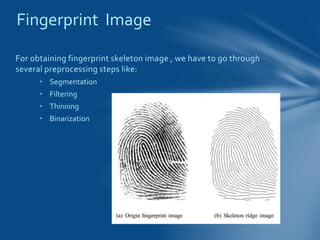
For obtaining fingerprint skeleton image , we have to go through
several preprocessing steps like:
• Segmentation
• Filtering
• Thinning
• Binarization
Fingerprint Image
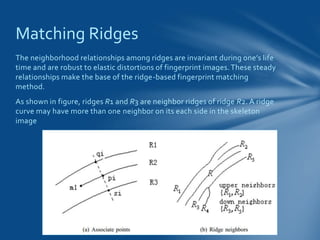
The neighborhood relationships among ridges are invariant during one’s life
time and are robust to elastic distortions of fingerprint images.These steady
relationships make the base of the ridge-based fingerprint matching
method.
As shown in figure, ridges R1 and R3 are neighbor ridges of ridge R2. A ridge
curve may have more than one neighbor on its each side in the skeleton
image
Matching Ridges
A. Similarity measure of two ridge curves :
Suppose Pm and Pn are respectively the starting point and the ending point of
ridge f , and Pm and Pn could be ridge end, ridge bifurcation or ridge broken
points. The curvature γ of curve f is defined as:
γ describes a curve’s winding degree, and it’s an invariant to image rotation and
translation
B. Associate table :
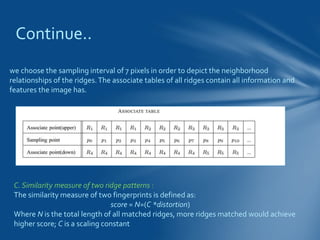
The associate table is constructed by sampling ridge R with interval d from its
starting point to end point, and obtain one sampling point-set £ and its associate
point-sets “up and “down. All the points in “up and “down are labeled by their
corresponding ridges (NULL for empty).
The labels and the sampling point set G make up of ridge R’s associate table.
Continue..
Continue..
we choose the sampling interval of 7 pixels in order to depict the neighborhood
relationships of the ridges.The associate tables of all ridges contain all information and
features the image has.
C. Similarity measure of two ridge patterns :
The similarity measure of two fingerprints is defined as:
score = N=(C *distortion)
Where N is the total length of all matched ridges, more ridges matched would achieve
higher score; C is a scaling constant
The distortion describes the distortion between the ridge structures formed
by matched ridge pairs, wrong matched ridge pair always leads to higher
distortion value and lower score.
Continue..
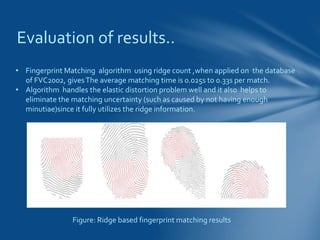
Figure: Ridge based fingerprint matching results
Evaluation of results..
• Fingerprint Matching algorithm using ridge count ,when applied on the database
of FVC2002, givesThe average matching time is 0.025s to 0.33s per match.
• Algorithm handles the elastic distortion problem well and it also helps to
eliminate the matching uncertainty (such as caused by not having enough
minutiae)since it fully utilizes the ridge information.
 Algorithm matches fingerprint skeleton images directly .
 Concept of Associate tables describe the neighborhood relations
among ridge curves.
 Similarity measures Matching ridge curves and Matching ridge
patterns properly handle the elastic distortion.
 Better performance is achieved by this method compared to minutiae-
based matching method.
Advantage
1. A.K.Jain, L.Hong, and R.M.Bolle. On-line Fingerprint Verification. IEEE
Trans. on Pattern Analysis and Machine Intelligence. 19 (4): 302-313, April
1997.
2. Xiaohui Xie, Fei Su, Anni Cai and Jing’ao Sun, ”A Robust Fingerprint
Matching Algorithm Based on the Support Model”. Proc. International
Conference on Biometric Authentication (ICBA), Hong Kong, China, July
15-17, 2004 .
3. D.Maio, D.Maltoni, R.Cappelli, J.L.Wayman, A.K.Jain. FVC2002: Second
Fingerprint Verification Competition. Pattern Recognition, 2002,
Proceedings.
16th International Conference on., 11-15 Aug. 2002 Page(s): 811-814 vol.3
4. Chen PH and Chen XG, A New Approach to Healing the Broken Lines in
the Thinned Fingerprint Image. Journal of China Institute of
Communications.
25(6):115-119, June 2004
References

Fingerprint matching using ridge count

  • 1.
    PRESENTED BY: AAKANKSHAJAIN MTECH SCHOLAR MDS UNIVERISTY
  • 2.
    • Introduction • FingerprintImage • Matching the ridges • Evaluation of results • Advantages • References CONTENT
  • 3.
    What is FingerprintMatching using Ridges? Fingerprint matching using ridge count is a method with which two fingerprint skeleton images are matched directly using association tables. Association Table: Association table describes relation between ridges in neighborhood ,to handle whole pattern of ridge. • For matching purpose there are 2 similarity measures (1) Matching ridge curves (2) Matching ridge patterns Introduction
  • 4.
    For obtaining fingerprintskeleton image , we have to go through several preprocessing steps like: • Segmentation • Filtering • Thinning • Binarization Fingerprint Image
  • 5.
    The neighborhood relationshipsamong ridges are invariant during one’s life time and are robust to elastic distortions of fingerprint images.These steady relationships make the base of the ridge-based fingerprint matching method. As shown in figure, ridges R1 and R3 are neighbor ridges of ridge R2. A ridge curve may have more than one neighbor on its each side in the skeleton image Matching Ridges
  • 6.
    A. Similarity measureof two ridge curves : Suppose Pm and Pn are respectively the starting point and the ending point of ridge f , and Pm and Pn could be ridge end, ridge bifurcation or ridge broken points. The curvature γ of curve f is defined as: γ describes a curve’s winding degree, and it’s an invariant to image rotation and translation B. Associate table : The associate table is constructed by sampling ridge R with interval d from its starting point to end point, and obtain one sampling point-set £ and its associate point-sets “up and “down. All the points in “up and “down are labeled by their corresponding ridges (NULL for empty). The labels and the sampling point set G make up of ridge R’s associate table. Continue..
  • 7.
    Continue.. we choose thesampling interval of 7 pixels in order to depict the neighborhood relationships of the ridges.The associate tables of all ridges contain all information and features the image has. C. Similarity measure of two ridge patterns : The similarity measure of two fingerprints is defined as: score = N=(C *distortion) Where N is the total length of all matched ridges, more ridges matched would achieve higher score; C is a scaling constant
  • 8.
    The distortion describesthe distortion between the ridge structures formed by matched ridge pairs, wrong matched ridge pair always leads to higher distortion value and lower score. Continue..
  • 9.
    Figure: Ridge basedfingerprint matching results Evaluation of results.. • Fingerprint Matching algorithm using ridge count ,when applied on the database of FVC2002, givesThe average matching time is 0.025s to 0.33s per match. • Algorithm handles the elastic distortion problem well and it also helps to eliminate the matching uncertainty (such as caused by not having enough minutiae)since it fully utilizes the ridge information.
  • 10.
     Algorithm matchesfingerprint skeleton images directly .  Concept of Associate tables describe the neighborhood relations among ridge curves.  Similarity measures Matching ridge curves and Matching ridge patterns properly handle the elastic distortion.  Better performance is achieved by this method compared to minutiae- based matching method. Advantage
  • 11.
    1. A.K.Jain, L.Hong,and R.M.Bolle. On-line Fingerprint Verification. IEEE Trans. on Pattern Analysis and Machine Intelligence. 19 (4): 302-313, April 1997. 2. Xiaohui Xie, Fei Su, Anni Cai and Jing’ao Sun, ”A Robust Fingerprint Matching Algorithm Based on the Support Model”. Proc. International Conference on Biometric Authentication (ICBA), Hong Kong, China, July 15-17, 2004 . 3. D.Maio, D.Maltoni, R.Cappelli, J.L.Wayman, A.K.Jain. FVC2002: Second Fingerprint Verification Competition. Pattern Recognition, 2002, Proceedings. 16th International Conference on., 11-15 Aug. 2002 Page(s): 811-814 vol.3 4. Chen PH and Chen XG, A New Approach to Healing the Broken Lines in the Thinned Fingerprint Image. Journal of China Institute of Communications. 25(6):115-119, June 2004 References