Naming parts of a Circle
Naming parts of a circle is practically
and technically important in such a
way that it systematically allows us
to compute areas, linear measure of
arcs and circumference, and lengths
of segments in a circle.
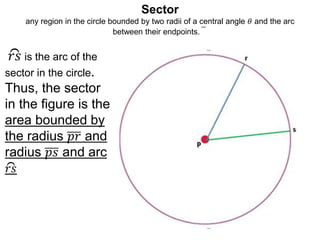
Sector
any region in the circle bounded by two radii of a central angle 𝜃 and the arc
between their endpoints.
𝑟𝑠 is the arc of the
sector in the circle.
Thus, the sector
in the figure is the
area bounded by
the radius 𝑝𝑟 and
radius 𝑝𝑠 and arc
𝑟𝑠
Arc
a portion of the circle’s circumference.
Example:
• The curve line
connecting
points A and B
is an example
of an arc. This
is 𝐴𝐵.
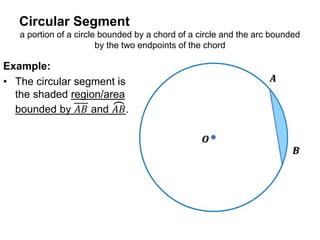
Circular Segment
a portion of a circle bounded by a chord of a circle and the arc bounded
by the two endpoints of the chord
Example:
• The circular segment is
the shaded region/area
bounded by 𝐴𝐵 and 𝐴𝐵.
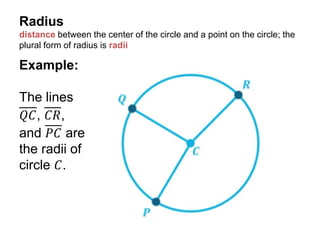
Radius
distance between the center of the circle and a point on the circle; the
plural form of radius is radii
Example:
The lines
𝑄𝐶, 𝐶𝑅,
and 𝑃𝐶 are
the radii of
circle 𝐶.
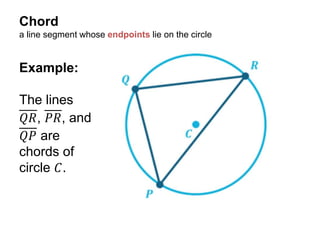
Chord
a line segment whose endpoints lie on the circle
Example:
The lines
𝑄𝑅, 𝑃𝑅, and
𝑄𝑃 are
chords of
circle 𝐶.
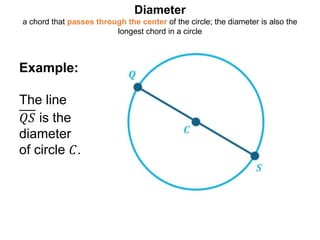
Diameter
a chord that passes through the center of the circle; the diameter is also the
longest chord in a circle
Example:
The line
𝑄𝑆 is the
diameter
of circle 𝐶.
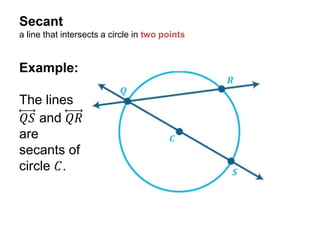
Secant
a line that intersects a circle in two points
Example:
The lines
𝑄𝑆 and 𝑄𝑅
are
secants of
circle 𝐶.
Tangent
a line that intersects a circle at only one point; the point where it
intersects the circle is called the point of tangency
Example:
The line 𝑈𝑉
is tangent to
circle 𝐶, and
the point of
tangency is
point 𝑇.
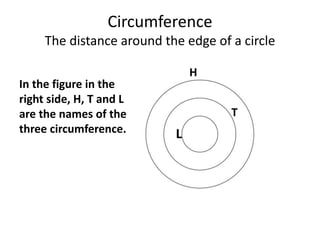
Circumference
The distance around the edge of a circle
H
T
L
In the figure in the
right side, H, T and L
are the names of the
three circumference.
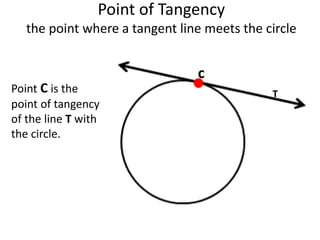
Point of Tangency
the point where a tangent line meets the circle
c
Point C is the
point of tangency
of the line T with
the circle.
T
Circle
a set of all points equidistant from a fixed point called
the center of the circle
P
P is the name
of the circle
How many degrees is there in the
Circle?
There is a total of
360°within a circle.
Therefore, if in figure
, the minor sector CAB
is 145°, the remaining
major sector is 360° -
145° = 215°
A
C
B
145°
?
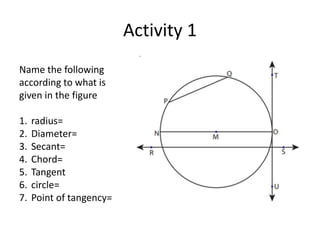
Activity 1
Name the following
according to what is
given in the figure
1. radius=
2. Diameter=
3. Secant=
4. Chord=
5. Tangent
6. circle=
7. Point of tangency=
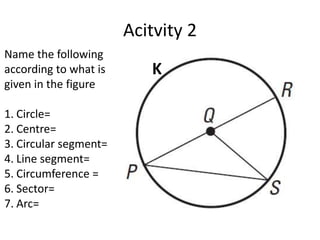
Acitvity 2
Name the following
according to what is
given in the figure
1. Circle=
2. Centre=
3. Circular segment=
4. Line segment=
5. Circumference =
6. Sector=
7. Arc=
K
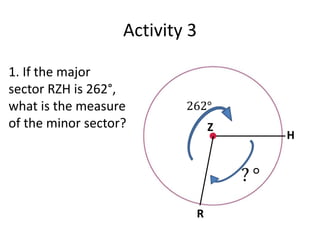
Activity 3
Z
R
H
262°
? °
1. If the major
sector RZH is 262°,
what is the measure
of the minor sector?
2. If the total area
of the circle is 350
sq. cm and the
major Circular
Segment AB is
330, what is the
area of the minor
Circular Segment
AB?
Activity 3

grade 10 Math lesson

  • 1.
    Naming parts ofa Circle Naming parts of a circle is practically and technically important in such a way that it systematically allows us to compute areas, linear measure of arcs and circumference, and lengths of segments in a circle.
  • 3.
    Sector any region inthe circle bounded by two radii of a central angle 𝜃 and the arc between their endpoints. 𝑟𝑠 is the arc of the sector in the circle. Thus, the sector in the figure is the area bounded by the radius 𝑝𝑟 and radius 𝑝𝑠 and arc 𝑟𝑠
  • 4.
    Arc a portion ofthe circle’s circumference. Example: • The curve line connecting points A and B is an example of an arc. This is 𝐴𝐵.
  • 5.
    Circular Segment a portionof a circle bounded by a chord of a circle and the arc bounded by the two endpoints of the chord Example: • The circular segment is the shaded region/area bounded by 𝐴𝐵 and 𝐴𝐵.
  • 6.
    Radius distance between thecenter of the circle and a point on the circle; the plural form of radius is radii Example: The lines 𝑄𝐶, 𝐶𝑅, and 𝑃𝐶 are the radii of circle 𝐶.
  • 7.
    Chord a line segmentwhose endpoints lie on the circle Example: The lines 𝑄𝑅, 𝑃𝑅, and 𝑄𝑃 are chords of circle 𝐶.
  • 8.
    Diameter a chord thatpasses through the center of the circle; the diameter is also the longest chord in a circle Example: The line 𝑄𝑆 is the diameter of circle 𝐶.
  • 9.
    Secant a line thatintersects a circle in two points Example: The lines 𝑄𝑆 and 𝑄𝑅 are secants of circle 𝐶.
  • 10.
    Tangent a line thatintersects a circle at only one point; the point where it intersects the circle is called the point of tangency Example: The line 𝑈𝑉 is tangent to circle 𝐶, and the point of tangency is point 𝑇.
  • 11.
    Circumference The distance aroundthe edge of a circle H T L In the figure in the right side, H, T and L are the names of the three circumference.
  • 12.
    Point of Tangency thepoint where a tangent line meets the circle c Point C is the point of tangency of the line T with the circle. T
  • 13.
    Circle a set ofall points equidistant from a fixed point called the center of the circle P P is the name of the circle
  • 14.
    How many degreesis there in the Circle? There is a total of 360°within a circle. Therefore, if in figure , the minor sector CAB is 145°, the remaining major sector is 360° - 145° = 215° A C B 145° ?
  • 15.
    Activity 1 Name thefollowing according to what is given in the figure 1. radius= 2. Diameter= 3. Secant= 4. Chord= 5. Tangent 6. circle= 7. Point of tangency=
  • 16.
    Acitvity 2 Name thefollowing according to what is given in the figure 1. Circle= 2. Centre= 3. Circular segment= 4. Line segment= 5. Circumference = 6. Sector= 7. Arc= K
  • 17.
    Activity 3 Z R H 262° ? ° 1.If the major sector RZH is 262°, what is the measure of the minor sector?
  • 18.
    2. If thetotal area of the circle is 350 sq. cm and the major Circular Segment AB is 330, what is the area of the minor Circular Segment AB? Activity 3