Prioritizing For Profit Luke Hohmann CEO, Enthiosys http://www.enthiosys.com/insights-tools/prioritizeforprofit1of3/ http://www.enthiosys.com/insights-tools/prioritizeforprofit2of3/ http://www.enthiosys.com/insights-tools/prioritizeforprofit3of3/
Founder/CEO of Enthiosys Agile Product Management consulting  Customer needs, roadmaps, business model Product management mentoring and training Agile product guy VP Bus Dev (Aladdin), VP Eng &Product Dev’t  (Aurigin), VP Systems Eng (EDS Fleet Services) Board of Agile Alliance Author, speaker, blogger “ Innovation Games” “ Beyond Software Architecture” “ Journey of the Software Professional” agile PM blog at  www.Enthiosys.com   About Luke Hohmann
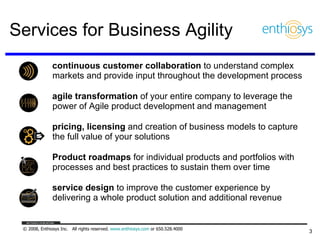
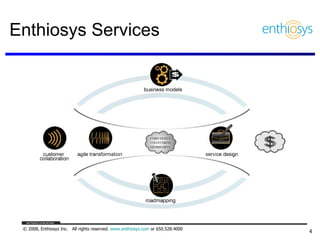
Services for Business Agility continuous customer collaboration  to understand complex markets and provide input throughout the development process agile transformation  of your entire company to leverage the power of Agile product development and management  pricing, licensing  and creation of business models to capture the full value of your solutions Product roadmaps  for individual products and portfolios with processes and best practices to sustain them over time service design  to improve the customer experience by delivering a whole product solution and additional revenue
Enthiosys Services
Agenda Creating Your Backlog Prioritizing it Challenges with ROI Managing stakeholders Aligning to strategy Driving profit Acceptance Tests
Why Worry About Prioritization? We’ve got 2 ½ hours planned on the topic of prioritization of the backlog. Is it worth it?
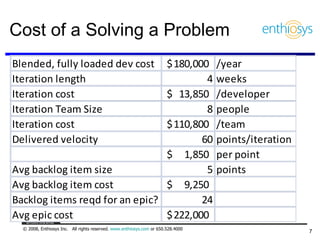
Cost of a Solving a Problem
Creating Your Backlog The first step is figuring  out what your market wants!
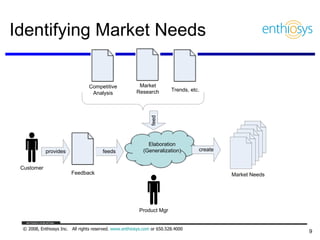
Identifying Market Needs
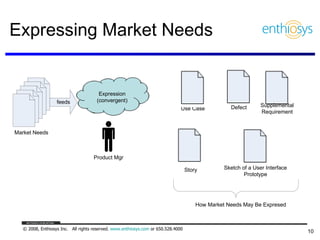
Expressing Market Needs
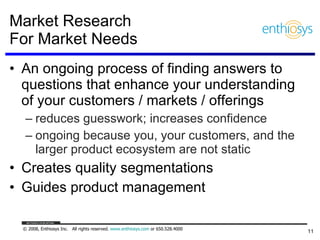
Market Research  For Market Needs An ongoing process of finding answers to questions that enhance your understanding of your customers / markets / offerings  reduces guesswork; increases confidence ongoing because you, your customers, and the larger product ecosystem are not static Creates quality segmentations Guides product management
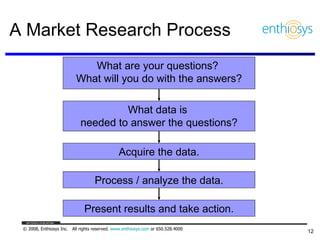
A Market Research Process What are your questions?  What will you do with the answers? What data is  needed to answer the questions? Acquire the data. Process / analyze the data. Present results and take action.
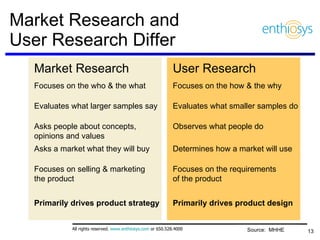
Market Research and  User Research Differ Source:  MHHE Market Research User Research Focuses on the who & the what Focuses on the how & the why Evaluates what larger samples say Evaluates what smaller samples do Asks people about concepts, opinions and values Observes what people do Asks a market what they will buy Determines how a market will use Focuses on selling & marketing  the product Focuses on the requirements  of the product Primarily drives product strategy Primarily drives product design
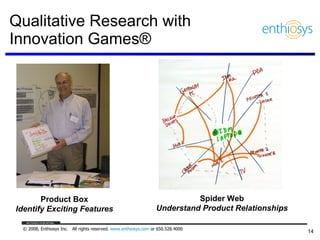
Qualitative Research with Innovation Games® Product Box Identify Exciting Features Spider Web Understand Product Relationships
Before the Backlog… Roadmaps!
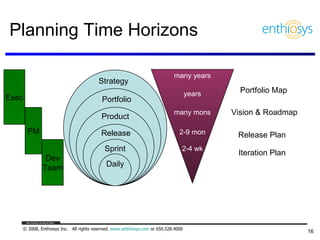
Planning Time Horizons Daily Sprint Strategy Portfolio Product Release Exec PM Dev Team 2-4 wk 2-9 mon many mons years many years Iteration Plan Portfolio Map Release Plan Vision & Roadmap
Agile Roadmap A living document designed to answer  key strategic questions: Who are my desirable markets/market segments?  What do they care about? When / how often should I serve them? What technologies can I leverage?  How must my current product change to deal with the answers to these questions? What are the external factors that I must address to deal with these issues?
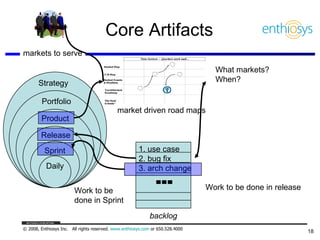
Core Artifacts What markets? When? Work to be done in release Work to be done in Sprint markets to serve Daily Sprint Strategy Portfolio Product Release backlog 1. use case 2. bug fix 3. arch change market driven road maps
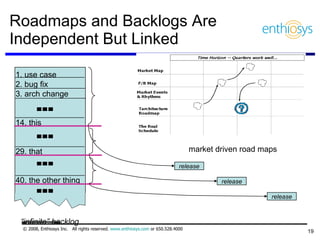
Roadmaps and Backlogs Are Independent But Linked “ infinite” backlog 1. use case 2. bug fix 3. arch change 14. this 29. that 40. the other thing market driven road maps release release release
Organizing Your Backlog
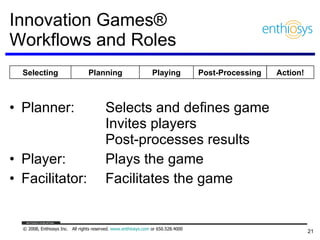
Innovation Games®  Workflows and Roles Planner: Selects and defines game Invites players Post-processes results Player: Plays the game Facilitator: Facilitates the game Planning Post-Processing Playing Action! Selecting
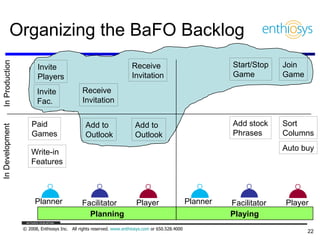
Organizing the BaFO Backlog Planning Playing In Development In Production Invite Players Receive Invitation Add to  Outlook Add to  Outlook Invite Fac. Receive Invitation Add stock Phrases Sort Columns Start/Stop Game Join  Game Auto buy Write-in Features Paid  Games Planner Facilitator Player Planner Facilitator Player
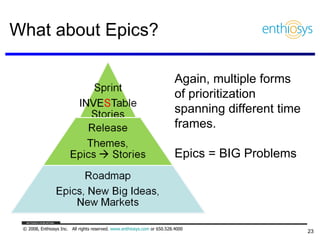
What about Epics? Again, multiple forms of prioritization spanning different time frames. Epics = BIG Problems
Prioritizing Your Backlog Whether problems, stories, or epics,  you need to prioritize the backlog
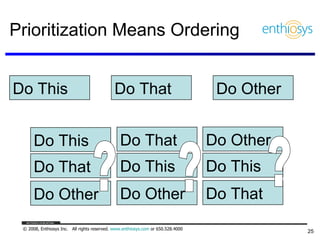
Prioritization Means Ordering Do This Do Other Do That Do This Do Other Do That Do That Do Other Do This Do Other Do That Do This ? ? ?
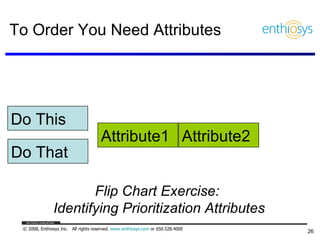
To Order You Need Attributes Do This Do That Flip Chart Exercise:  Identifying Prioritization Attributes Attribute1 Attribute2
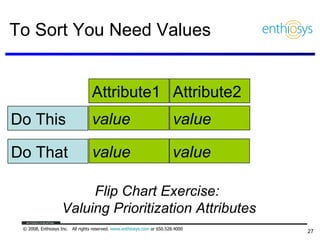
To Sort You Need Values Do This value Do That value value value Flip Chart Exercise:  Valuing Prioritization Attributes Attribute1 Attribute2
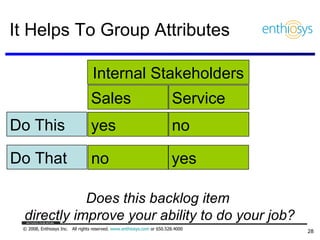
It Helps To Group Attributes Do This yes Do That no no yes Sales Service Internal Stakeholders Does this backlog item  directly improve your ability to do your job?
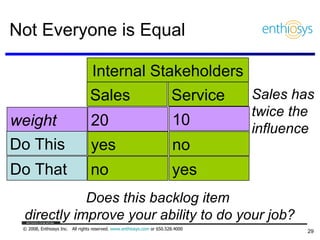
Not Everyone is Equal Do This Do That no yes Sales Service Internal Stakeholders Does this backlog item  directly improve your ability to do your job? yes no weight 20 10 Sales has twice the  influence
Problems with ROI-Based Prioritization Don’t be misled…
ROI =  (Gain – Cost) ------------------ Cost But most people can’t tell you the gain!
Determining ROI requires market research. But most backlog items are not what you research. (Market != Customer)
Comprehensive market and customer research takes too much time and costs too much money.
Agilists like small, independent backlog items.  Customers like large,  interdependent backlog “groups”.
Prioritizing For Profit The groups of attributes that matter the most!
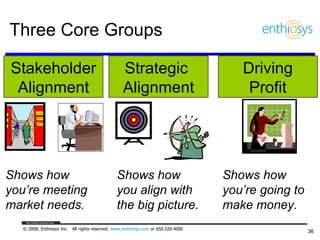
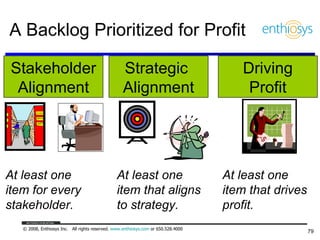
Three Core Groups Stakeholder Alignment Strategic  Alignment Driving Profit Shows how  you’re meeting market needs. Shows how  you align with the big picture. Shows how  you’re going to make money.
Stakeholders Who?
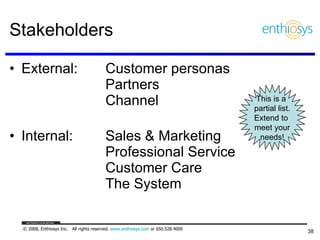
Stakeholders External: Customer personas Partners Channel Internal: Sales & Marketing Professional Service Customer Care The System This is a  partial list. Extend to  meet your needs!
Customers    Personas M arket segments  are  groups  of customers that we use for marketing/selling “ Market Segment” is too impersonal Personas  are fictitious people for whom you are designing More human/humane than “soccer moms” Provides rich, contextual information (photographs, family stories, jobs, etc.)
Organizational Structure How to get the team consistently involved
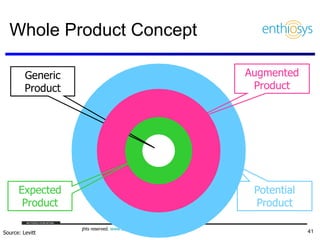
Whole Product Concept Source: Levitt Generic Product Augmented Product Expected Product Potential Product
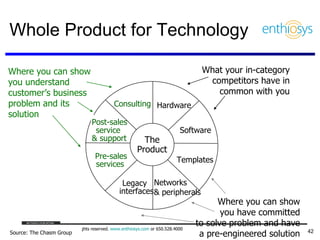
Whole Product for Technology The Product Hardware Software Networks & peripherals Templates Consulting Where you can show you understand customer’s business problem and its solution Where you can show you have committed to solve problem and have a pre-engineered solution What your in-category competitors have in common with you Source: The Chasm Group Legacy interfaces Pre-sales services Post-sales service & support
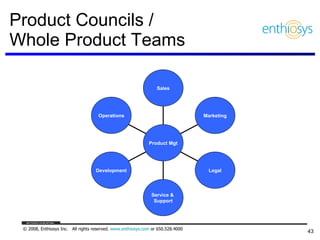
Product Councils /  Whole Product Teams Operations Development Service &  Support Legal Marketing Sales Product Mgt
Product Council Responsibilities Remain aware of roadmap and backlog Come prepared to represent your organization during prioritization meetings Sales: Critical deals that might influence roadmap Cust Support: Pareto chart of key problems Prof Serv: Field marketing research Legal: Regulatory or license agreement Finance: Analysis of business models
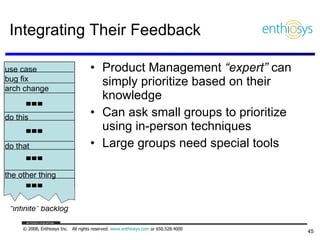
Integrating Their Feedback Product Management  “expert”  can simply prioritize based on their knowledge Can ask small groups to prioritize using in-person techniques Large groups need special tools “ infinite” backlog use case bug fix arch change do this do that the other thing
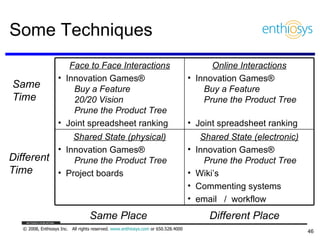
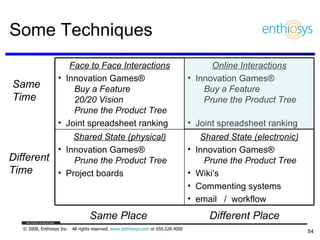
Some Techniques Same Time Different Time Same Place Different Place Face to Face Interactions Innovation Games® Buy a Feature 20/20 Vision Prune the Product Tree Joint spreadsheet ranking Online Interactions Innovation Games® Buy a Feature Prune the Product Tree Joint spreadsheet ranking Shared State (physical) Innovation Games® Prune the Product Tree Project boards Shared State (electronic) Innovation Games® Prune the Product Tree Wiki’s Commenting systems email  /  workflow
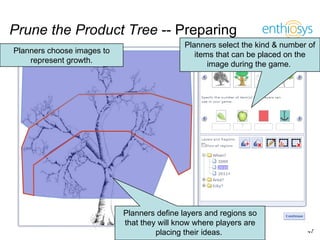
Prune the Product Tree  -- Preparing Planners define layers and regions so that they will know where players are placing their ideas.  Planners choose images to represent growth. Planners select the kind & number of items that can be placed on the image during the game.
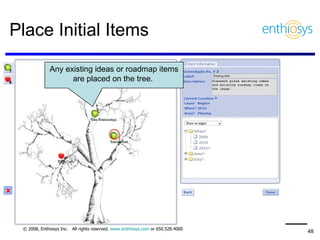
Place Initial Items Any existing ideas or roadmap items are placed on the tree.
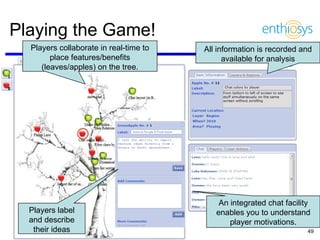
Playing the Game! Players collaborate in real-time to place features/benefits (leaves/apples) on the tree. An integrated chat facility enables you to understand player motivations. Players label and describe their ideas All information is recorded and available for analysis
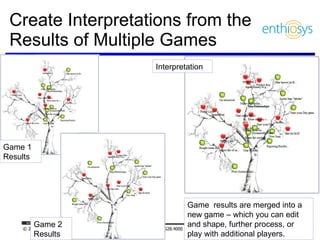
Create Interpretations from the Results of Multiple Games Game 1 Results Game 2 Results Interpretation Game  results are merged into a new game – which you can edit and shape, further process, or play with additional players.
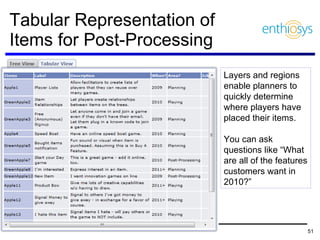
Tabular Representation of Items for Post-Processing Layers and regions enable planners to quickly determine where players have placed their items.  You can ask questions like “What are all of the features customers want in 2010?”
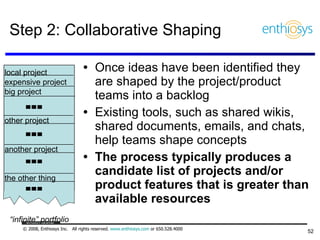
Step 2: Collaborative Shaping Once ideas have been identified they are shaped by the project/product teams into a backlog Existing tools, such as shared wikis, shared documents, emails, and chats, help teams shape concepts The process typically produces a candidate list of projects and/or product features that is greater than available resources “ infinite” portfolio local project expensive project big project other project another project the other thing
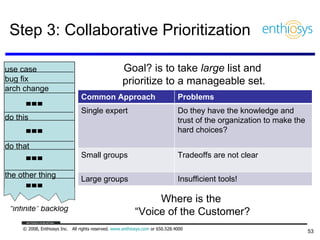
Step 3: Collaborative Prioritization Where is the  “ Voice of the Customer? “ infinite” backlog use case bug fix arch change do this do that the other thing Goal? is to take  large  list and  prioritize to a manageable set. Common Approach Problems Single expert  Do they have the knowledge and trust of the organization to make the hard choices? Small groups Tradeoffs are not clear Large groups Insufficient tools!
Some Techniques Same Time Different Time Same Place Different Place Face to Face Interactions Innovation Games® Buy a Feature 20/20 Vision Prune the Product Tree Joint spreadsheet ranking Online Interactions Innovation Games® Buy a Feature Prune the Product Tree Joint spreadsheet ranking Shared State (physical) Innovation Games® Prune the Product Tree Project boards Shared State (electronic) Innovation Games® Prune the Product Tree Wiki’s Commenting systems email  /  workflow
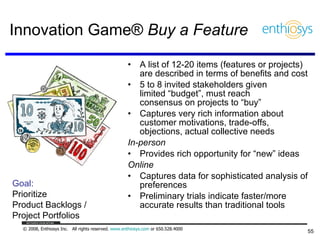
Innovation Game®  Buy a Feature A list of 12-20 items (features or projects) are described in terms of benefits and cost 5 to 8 invited stakeholders given  limited “budget”, must reach  consensus on projects to “buy” Captures very rich information about customer motivations, trade-offs, objections, actual collective needs In-person Provides rich opportunity for “new” ideas Online Captures data for sophisticated analysis of preferences Preliminary trials indicate faster/more accurate results than traditional tools Goal: Prioritize  Product Backlogs / Project Portfolios
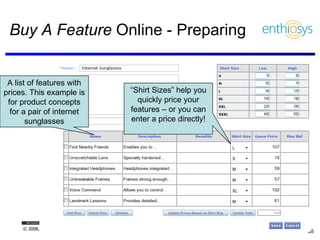
Buy A Feature  Online - Preparing A list of features with prices. This example is for product concepts for a pair of internet sunglasses “ Shirt Sizes” help you quickly price your features – or you can enter a price directly!
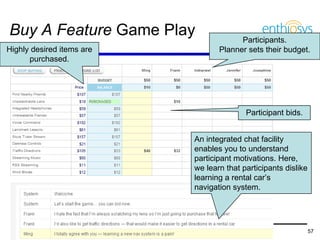
Buy A Feature  Game Play Participants. Planner sets their budget. An integrated chat facility enables you to understand participant motivations. Here, we learn that participants dislike learning a rental car’s navigation system.  Participant bids. Highly desired items are purchased.
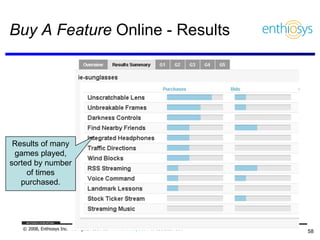
Buy A Feature  Online - Results Results of many games played, sorted by number of times purchased.
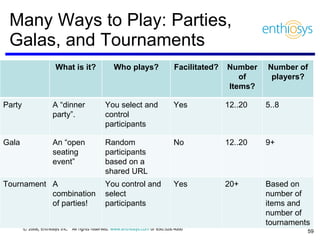
Many Ways to Play: Parties, Galas, and Tournaments What is it? Who plays? Facilitated? Number of Items? Number of players? Party A “dinner party”. You select and control participants Yes 12..20 5..8 Gala An “open seating event” Random participants based on a shared URL No 12..20 9+ Tournament A combination of parties! You control and select participants Yes 20+ Based on number of items and number of tournaments
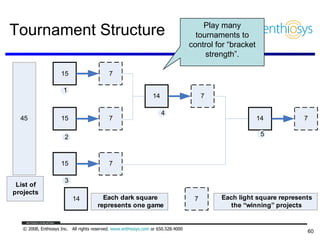
Tournament Structure Play many tournaments to control for “bracket strength”.
Strategic Alignment Why?
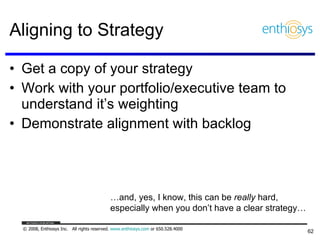
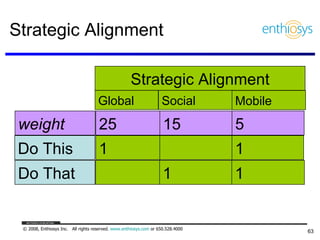
Aligning to Strategy Get a copy of your strategy Work with your portfolio/executive team to understand it’s weighting Demonstrate alignment with backlog … and, yes, I know, this can be  really  hard,  especially when you don’t have a clear strategy…
Strategic Alignment Do This Do That 1 Global Social Strategic Alignment 1 weight 25 15 Mobile 1 1 5
Driving Profit Money?
Flip-Chart Exercise What are the primary drivers of profit? How could you reflect that you’re  driving profit  in your backlog?
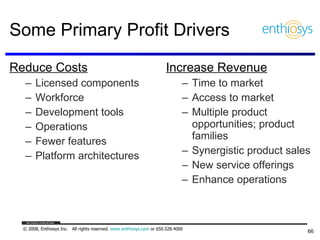
Some Primary Profit Drivers Reduce Costs Licensed components Workforce Development tools Operations Fewer features Platform architectures Increase Revenue Time to market Access to market Multiple product opportunities; product families Synergistic product sales  New service offerings Enhance operations
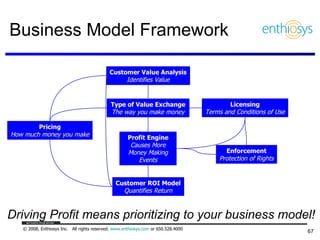
Business Model Framework Driving Profit means prioritizing to your business model! Customer ROI Model Quantifies Return Enforcement Protection of Rights Licensing Terms and Conditions of Use Type of Value Exchange The way you make money Profit Engine Causes More Money Making Events Customer Value Analysis Identifies Value Pricing How much money you make
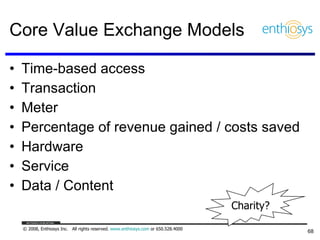
Core Value Exchange Models Time-based access Transaction Meter Percentage of revenue gained / costs saved Hardware Service Data / Content Charity?
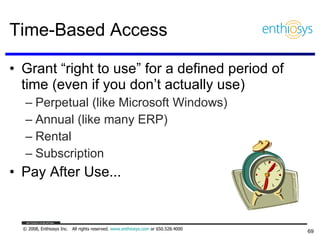
Time-Based Access Grant “right to use” for a defined period of time (even if you don’t actually use) Perpetual (like Microsoft Windows) Annual (like many ERP) Rental Subscription Pay After Use...
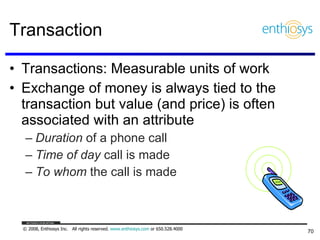
Transaction Transactions: Measurable units of work Exchange of money is always tied to the transaction but value (and price) is often associated with an attribute Duration  of a phone call Time of day  call is made To whom  the call is made
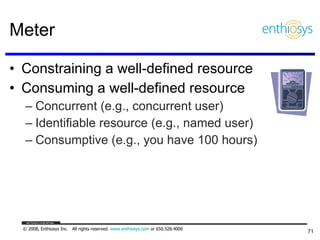
Meter Constraining a well-defined resource Consuming a well-defined resource Concurrent (e.g., concurrent user) Identifiable resource (e.g., named user) Consumptive (e.g., you have 100 hours)
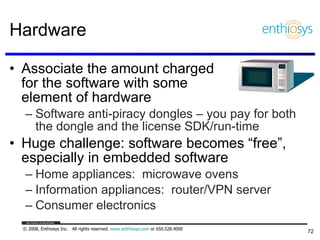
Hardware Associate the amount charged  for the software with some  element of hardware Software anti-piracy dongles – you pay for both the dongle and the license SDK/run-time Huge challenge: software becomes “free”, especially in embedded software Home appliances:  microwave ovens Information appliances:  router/VPN server Consumer electronics
Service The exchange of money is tied to a service; software is required to provide the service or is intimately related to the service Symantec: anti-virus updates AOL: email  Red Hat: Linux-related  services   such as support or upgrades Often associated with  subscription pricing
Revenue Obtained /  Cost Saved Charge based on revenue obtained or costs saved, often in terms of percentages Retail yield management ServiceSource, with annual revenue between $25M - $50M, says it receives compensation  based on the revenue it generates for its  clients and charges no consulting, training or implementation fees, or ongoing  management costs.  - June 29, 2005, San Jose Mercury News
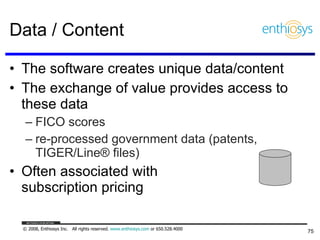
Data / Content  The software creates unique data/content The exchange of value provides access to these data FICO scores re-processed government data (patents, TIGER/Line® files) Often associated with  subscription pricing
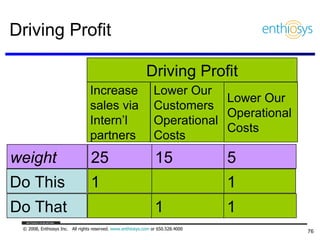
Driving Profit Do This Do That 1 Increase sales via Intern’l partners  Lower Our Customers Operational Costs Driving Profit 1 weight 25 15 Lower Our Operational Costs 1 1 5
Putting It All Together
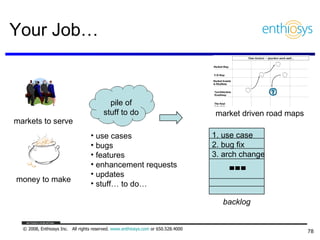
Your Job… use cases bugs features enhancement requests updates stuff… to do… markets to serve money to make market driven road maps pile of stuff to do backlog 1. use case 2. bug fix 3. arch change
A Backlog Prioritized for Profit Stakeholder Alignment Strategic  Alignment Driving Profit At least one item for every  stakeholder. At least one  item that aligns  to strategy. At least one  item that drives profit.
Contact and Content Reach me at  [email_address]   More about agile and business models: agilePM blog and Product Bytes newsletter at  http://www.enthiosys.com/insights-tools/   www.innovationgames.com

Prioritizing for Profit from AgilePalooza

  • 1.
    Prioritizing For ProfitLuke Hohmann CEO, Enthiosys http://www.enthiosys.com/insights-tools/prioritizeforprofit1of3/ http://www.enthiosys.com/insights-tools/prioritizeforprofit2of3/ http://www.enthiosys.com/insights-tools/prioritizeforprofit3of3/
  • 2.
    Founder/CEO of EnthiosysAgile Product Management consulting Customer needs, roadmaps, business model Product management mentoring and training Agile product guy VP Bus Dev (Aladdin), VP Eng &Product Dev’t (Aurigin), VP Systems Eng (EDS Fleet Services) Board of Agile Alliance Author, speaker, blogger “ Innovation Games” “ Beyond Software Architecture” “ Journey of the Software Professional” agile PM blog at www.Enthiosys.com About Luke Hohmann
  • 3.
    Services for BusinessAgility continuous customer collaboration to understand complex markets and provide input throughout the development process agile transformation of your entire company to leverage the power of Agile product development and management pricing, licensing and creation of business models to capture the full value of your solutions Product roadmaps for individual products and portfolios with processes and best practices to sustain them over time service design to improve the customer experience by delivering a whole product solution and additional revenue
  • 4.
  • 5.
    Agenda Creating YourBacklog Prioritizing it Challenges with ROI Managing stakeholders Aligning to strategy Driving profit Acceptance Tests
  • 6.
    Why Worry AboutPrioritization? We’ve got 2 ½ hours planned on the topic of prioritization of the backlog. Is it worth it?
  • 7.
    Cost of aSolving a Problem
  • 8.
    Creating Your BacklogThe first step is figuring out what your market wants!
  • 9.
  • 10.
  • 11.
    Market Research For Market Needs An ongoing process of finding answers to questions that enhance your understanding of your customers / markets / offerings  reduces guesswork; increases confidence ongoing because you, your customers, and the larger product ecosystem are not static Creates quality segmentations Guides product management
  • 12.
    A Market ResearchProcess What are your questions? What will you do with the answers? What data is needed to answer the questions? Acquire the data. Process / analyze the data. Present results and take action.
  • 13.
    Market Research and User Research Differ Source: MHHE Market Research User Research Focuses on the who & the what Focuses on the how & the why Evaluates what larger samples say Evaluates what smaller samples do Asks people about concepts, opinions and values Observes what people do Asks a market what they will buy Determines how a market will use Focuses on selling & marketing the product Focuses on the requirements of the product Primarily drives product strategy Primarily drives product design
  • 14.
    Qualitative Research withInnovation Games® Product Box Identify Exciting Features Spider Web Understand Product Relationships
  • 15.
  • 16.
    Planning Time HorizonsDaily Sprint Strategy Portfolio Product Release Exec PM Dev Team 2-4 wk 2-9 mon many mons years many years Iteration Plan Portfolio Map Release Plan Vision & Roadmap
  • 17.
    Agile Roadmap Aliving document designed to answer key strategic questions: Who are my desirable markets/market segments? What do they care about? When / how often should I serve them? What technologies can I leverage? How must my current product change to deal with the answers to these questions? What are the external factors that I must address to deal with these issues?
  • 18.
    Core Artifacts Whatmarkets? When? Work to be done in release Work to be done in Sprint markets to serve Daily Sprint Strategy Portfolio Product Release backlog 1. use case 2. bug fix 3. arch change market driven road maps
  • 19.
    Roadmaps and BacklogsAre Independent But Linked “ infinite” backlog 1. use case 2. bug fix 3. arch change 14. this 29. that 40. the other thing market driven road maps release release release
  • 20.
  • 21.
    Innovation Games® Workflows and Roles Planner: Selects and defines game Invites players Post-processes results Player: Plays the game Facilitator: Facilitates the game Planning Post-Processing Playing Action! Selecting
  • 22.
    Organizing the BaFOBacklog Planning Playing In Development In Production Invite Players Receive Invitation Add to Outlook Add to Outlook Invite Fac. Receive Invitation Add stock Phrases Sort Columns Start/Stop Game Join Game Auto buy Write-in Features Paid Games Planner Facilitator Player Planner Facilitator Player
  • 23.
    What about Epics?Again, multiple forms of prioritization spanning different time frames. Epics = BIG Problems
  • 24.
    Prioritizing Your BacklogWhether problems, stories, or epics, you need to prioritize the backlog
  • 25.
    Prioritization Means OrderingDo This Do Other Do That Do This Do Other Do That Do That Do Other Do This Do Other Do That Do This ? ? ?
  • 26.
    To Order YouNeed Attributes Do This Do That Flip Chart Exercise: Identifying Prioritization Attributes Attribute1 Attribute2
  • 27.
    To Sort YouNeed Values Do This value Do That value value value Flip Chart Exercise: Valuing Prioritization Attributes Attribute1 Attribute2
  • 28.
    It Helps ToGroup Attributes Do This yes Do That no no yes Sales Service Internal Stakeholders Does this backlog item directly improve your ability to do your job?
  • 29.
    Not Everyone isEqual Do This Do That no yes Sales Service Internal Stakeholders Does this backlog item directly improve your ability to do your job? yes no weight 20 10 Sales has twice the influence
  • 30.
    Problems with ROI-BasedPrioritization Don’t be misled…
  • 31.
    ROI = (Gain – Cost) ------------------ Cost But most people can’t tell you the gain!
  • 32.
    Determining ROI requiresmarket research. But most backlog items are not what you research. (Market != Customer)
  • 33.
    Comprehensive market andcustomer research takes too much time and costs too much money.
  • 34.
    Agilists like small,independent backlog items. Customers like large, interdependent backlog “groups”.
  • 35.
    Prioritizing For ProfitThe groups of attributes that matter the most!
  • 36.
    Three Core GroupsStakeholder Alignment Strategic Alignment Driving Profit Shows how you’re meeting market needs. Shows how you align with the big picture. Shows how you’re going to make money.
  • 37.
  • 38.
    Stakeholders External: Customerpersonas Partners Channel Internal: Sales & Marketing Professional Service Customer Care The System This is a partial list. Extend to meet your needs!
  • 39.
    Customers  Personas M arket segments are groups of customers that we use for marketing/selling “ Market Segment” is too impersonal Personas are fictitious people for whom you are designing More human/humane than “soccer moms” Provides rich, contextual information (photographs, family stories, jobs, etc.)
  • 40.
    Organizational Structure Howto get the team consistently involved
  • 41.
    Whole Product ConceptSource: Levitt Generic Product Augmented Product Expected Product Potential Product
  • 42.
    Whole Product forTechnology The Product Hardware Software Networks & peripherals Templates Consulting Where you can show you understand customer’s business problem and its solution Where you can show you have committed to solve problem and have a pre-engineered solution What your in-category competitors have in common with you Source: The Chasm Group Legacy interfaces Pre-sales services Post-sales service & support
  • 43.
    Product Councils / Whole Product Teams Operations Development Service & Support Legal Marketing Sales Product Mgt
  • 44.
    Product Council ResponsibilitiesRemain aware of roadmap and backlog Come prepared to represent your organization during prioritization meetings Sales: Critical deals that might influence roadmap Cust Support: Pareto chart of key problems Prof Serv: Field marketing research Legal: Regulatory or license agreement Finance: Analysis of business models
  • 45.
    Integrating Their FeedbackProduct Management “expert” can simply prioritize based on their knowledge Can ask small groups to prioritize using in-person techniques Large groups need special tools “ infinite” backlog use case bug fix arch change do this do that the other thing
  • 46.
    Some Techniques SameTime Different Time Same Place Different Place Face to Face Interactions Innovation Games® Buy a Feature 20/20 Vision Prune the Product Tree Joint spreadsheet ranking Online Interactions Innovation Games® Buy a Feature Prune the Product Tree Joint spreadsheet ranking Shared State (physical) Innovation Games® Prune the Product Tree Project boards Shared State (electronic) Innovation Games® Prune the Product Tree Wiki’s Commenting systems email / workflow
  • 47.
    Prune the ProductTree -- Preparing Planners define layers and regions so that they will know where players are placing their ideas. Planners choose images to represent growth. Planners select the kind & number of items that can be placed on the image during the game.
  • 48.
    Place Initial ItemsAny existing ideas or roadmap items are placed on the tree.
  • 49.
    Playing the Game!Players collaborate in real-time to place features/benefits (leaves/apples) on the tree. An integrated chat facility enables you to understand player motivations. Players label and describe their ideas All information is recorded and available for analysis
  • 50.
    Create Interpretations fromthe Results of Multiple Games Game 1 Results Game 2 Results Interpretation Game results are merged into a new game – which you can edit and shape, further process, or play with additional players.
  • 51.
    Tabular Representation ofItems for Post-Processing Layers and regions enable planners to quickly determine where players have placed their items. You can ask questions like “What are all of the features customers want in 2010?”
  • 52.
    Step 2: CollaborativeShaping Once ideas have been identified they are shaped by the project/product teams into a backlog Existing tools, such as shared wikis, shared documents, emails, and chats, help teams shape concepts The process typically produces a candidate list of projects and/or product features that is greater than available resources “ infinite” portfolio local project expensive project big project other project another project the other thing
  • 53.
    Step 3: CollaborativePrioritization Where is the “ Voice of the Customer? “ infinite” backlog use case bug fix arch change do this do that the other thing Goal? is to take large list and prioritize to a manageable set. Common Approach Problems Single expert Do they have the knowledge and trust of the organization to make the hard choices? Small groups Tradeoffs are not clear Large groups Insufficient tools!
  • 54.
    Some Techniques SameTime Different Time Same Place Different Place Face to Face Interactions Innovation Games® Buy a Feature 20/20 Vision Prune the Product Tree Joint spreadsheet ranking Online Interactions Innovation Games® Buy a Feature Prune the Product Tree Joint spreadsheet ranking Shared State (physical) Innovation Games® Prune the Product Tree Project boards Shared State (electronic) Innovation Games® Prune the Product Tree Wiki’s Commenting systems email / workflow
  • 55.
    Innovation Game® Buy a Feature A list of 12-20 items (features or projects) are described in terms of benefits and cost 5 to 8 invited stakeholders given limited “budget”, must reach consensus on projects to “buy” Captures very rich information about customer motivations, trade-offs, objections, actual collective needs In-person Provides rich opportunity for “new” ideas Online Captures data for sophisticated analysis of preferences Preliminary trials indicate faster/more accurate results than traditional tools Goal: Prioritize Product Backlogs / Project Portfolios
  • 56.
    Buy A Feature Online - Preparing A list of features with prices. This example is for product concepts for a pair of internet sunglasses “ Shirt Sizes” help you quickly price your features – or you can enter a price directly!
  • 57.
    Buy A Feature Game Play Participants. Planner sets their budget. An integrated chat facility enables you to understand participant motivations. Here, we learn that participants dislike learning a rental car’s navigation system. Participant bids. Highly desired items are purchased.
  • 58.
    Buy A Feature Online - Results Results of many games played, sorted by number of times purchased.
  • 59.
    Many Ways toPlay: Parties, Galas, and Tournaments What is it? Who plays? Facilitated? Number of Items? Number of players? Party A “dinner party”. You select and control participants Yes 12..20 5..8 Gala An “open seating event” Random participants based on a shared URL No 12..20 9+ Tournament A combination of parties! You control and select participants Yes 20+ Based on number of items and number of tournaments
  • 60.
    Tournament Structure Playmany tournaments to control for “bracket strength”.
  • 61.
  • 62.
    Aligning to StrategyGet a copy of your strategy Work with your portfolio/executive team to understand it’s weighting Demonstrate alignment with backlog … and, yes, I know, this can be really hard, especially when you don’t have a clear strategy…
  • 63.
    Strategic Alignment DoThis Do That 1 Global Social Strategic Alignment 1 weight 25 15 Mobile 1 1 5
  • 64.
  • 65.
    Flip-Chart Exercise Whatare the primary drivers of profit? How could you reflect that you’re driving profit in your backlog?
  • 66.
    Some Primary ProfitDrivers Reduce Costs Licensed components Workforce Development tools Operations Fewer features Platform architectures Increase Revenue Time to market Access to market Multiple product opportunities; product families Synergistic product sales New service offerings Enhance operations
  • 67.
    Business Model FrameworkDriving Profit means prioritizing to your business model! Customer ROI Model Quantifies Return Enforcement Protection of Rights Licensing Terms and Conditions of Use Type of Value Exchange The way you make money Profit Engine Causes More Money Making Events Customer Value Analysis Identifies Value Pricing How much money you make
  • 68.
    Core Value ExchangeModels Time-based access Transaction Meter Percentage of revenue gained / costs saved Hardware Service Data / Content Charity?
  • 69.
    Time-Based Access Grant“right to use” for a defined period of time (even if you don’t actually use) Perpetual (like Microsoft Windows) Annual (like many ERP) Rental Subscription Pay After Use...
  • 70.
    Transaction Transactions: Measurableunits of work Exchange of money is always tied to the transaction but value (and price) is often associated with an attribute Duration of a phone call Time of day call is made To whom the call is made
  • 71.
    Meter Constraining awell-defined resource Consuming a well-defined resource Concurrent (e.g., concurrent user) Identifiable resource (e.g., named user) Consumptive (e.g., you have 100 hours)
  • 72.
    Hardware Associate theamount charged for the software with some element of hardware Software anti-piracy dongles – you pay for both the dongle and the license SDK/run-time Huge challenge: software becomes “free”, especially in embedded software Home appliances: microwave ovens Information appliances: router/VPN server Consumer electronics
  • 73.
    Service The exchangeof money is tied to a service; software is required to provide the service or is intimately related to the service Symantec: anti-virus updates AOL: email Red Hat: Linux-related services such as support or upgrades Often associated with subscription pricing
  • 74.
    Revenue Obtained / Cost Saved Charge based on revenue obtained or costs saved, often in terms of percentages Retail yield management ServiceSource, with annual revenue between $25M - $50M, says it receives compensation based on the revenue it generates for its clients and charges no consulting, training or implementation fees, or ongoing management costs. - June 29, 2005, San Jose Mercury News
  • 75.
    Data / Content The software creates unique data/content The exchange of value provides access to these data FICO scores re-processed government data (patents, TIGER/Line® files) Often associated with subscription pricing
  • 76.
    Driving Profit DoThis Do That 1 Increase sales via Intern’l partners Lower Our Customers Operational Costs Driving Profit 1 weight 25 15 Lower Our Operational Costs 1 1 5
  • 77.
  • 78.
    Your Job… usecases bugs features enhancement requests updates stuff… to do… markets to serve money to make market driven road maps pile of stuff to do backlog 1. use case 2. bug fix 3. arch change
  • 79.
    A Backlog Prioritizedfor Profit Stakeholder Alignment Strategic Alignment Driving Profit At least one item for every stakeholder. At least one item that aligns to strategy. At least one item that drives profit.
  • 80.
    Contact and ContentReach me at [email_address] More about agile and business models: agilePM blog and Product Bytes newsletter at http://www.enthiosys.com/insights-tools/ www.innovationgames.com

Editor's Notes

  • #2 www.enthiosys.com Copyright (c) 2001-2008 by Luke Hohmann