

What Customers Want
How to turn insights about your customers into products they love
Kent Rahman | Product Design and Strategy
Customers want to achieve their goals
Products and services are the interface
between a customer and their goals
They facilitate a customer’s ability to
achieve their goals
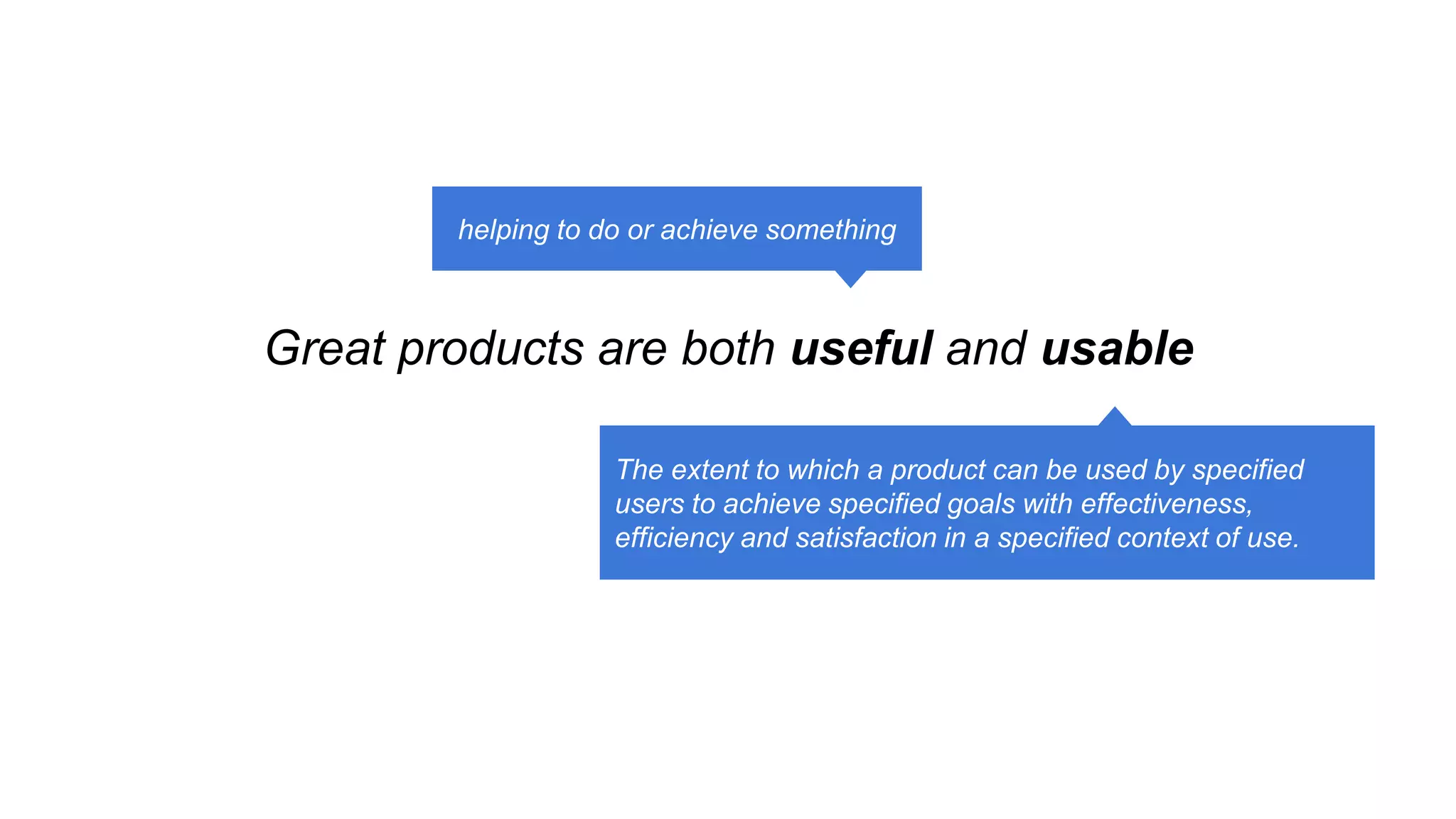
Great products are both useful and usable
helping to do or achieve something
The extent to which a product can be used by specified
users to achieve specified goals with effectiveness,
efficiency and satisfaction in a specified context of use.
If I had an hour to solve a problem
I’d spend 55 minutes thinking about
solutions and 5 minutes thinking
about the problem...
If I had an hour to solve a problem
I’d spend 55 minutes thinking about
the problem and 5 minutes thinking
about solutions
- Einstein
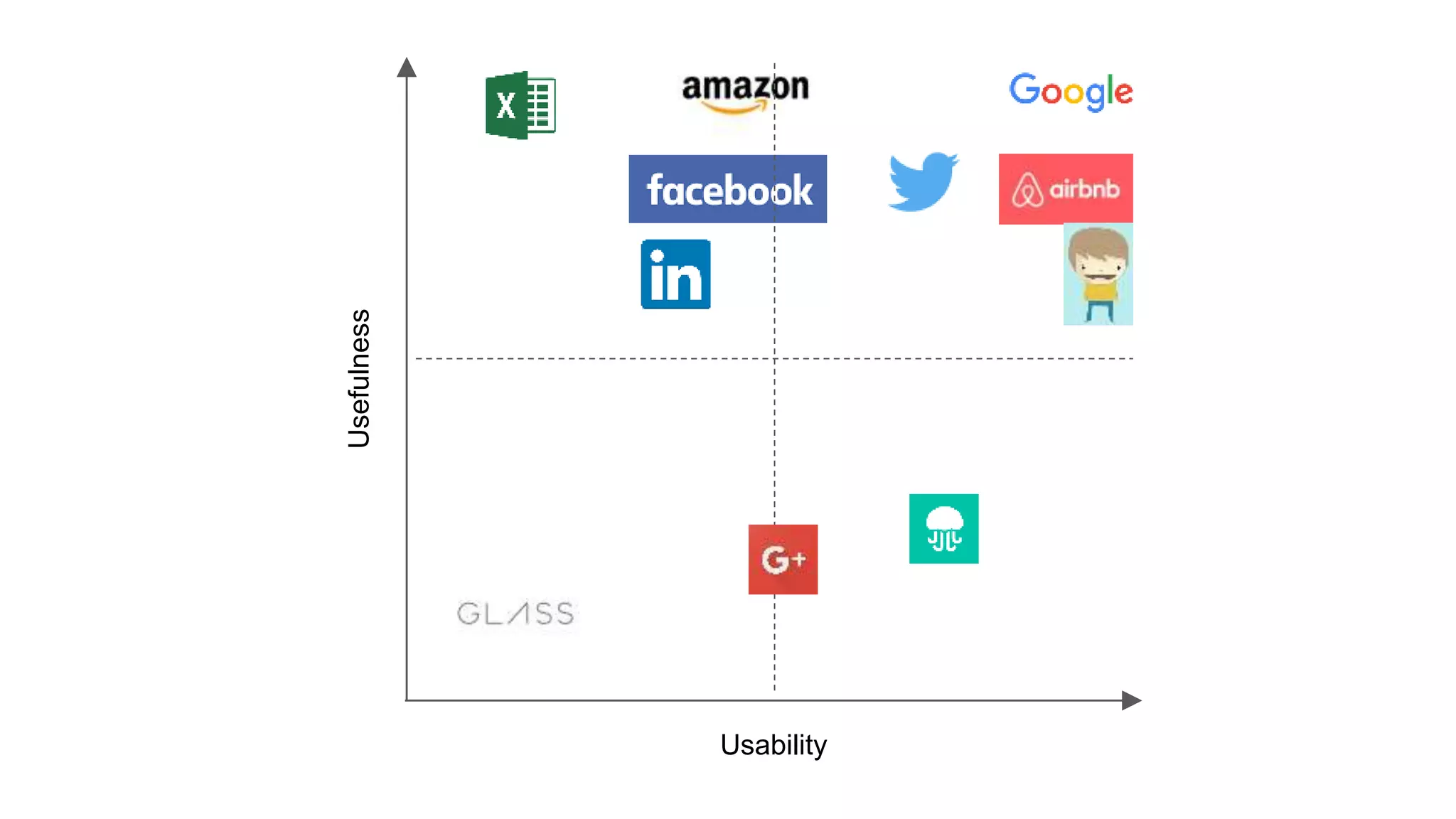
Usability
Usefulness
1
Identify the problem
Collect information
Form a hypothesis
Experiment
Analyze the data
Draw a conclusion 2
3
4
5
6
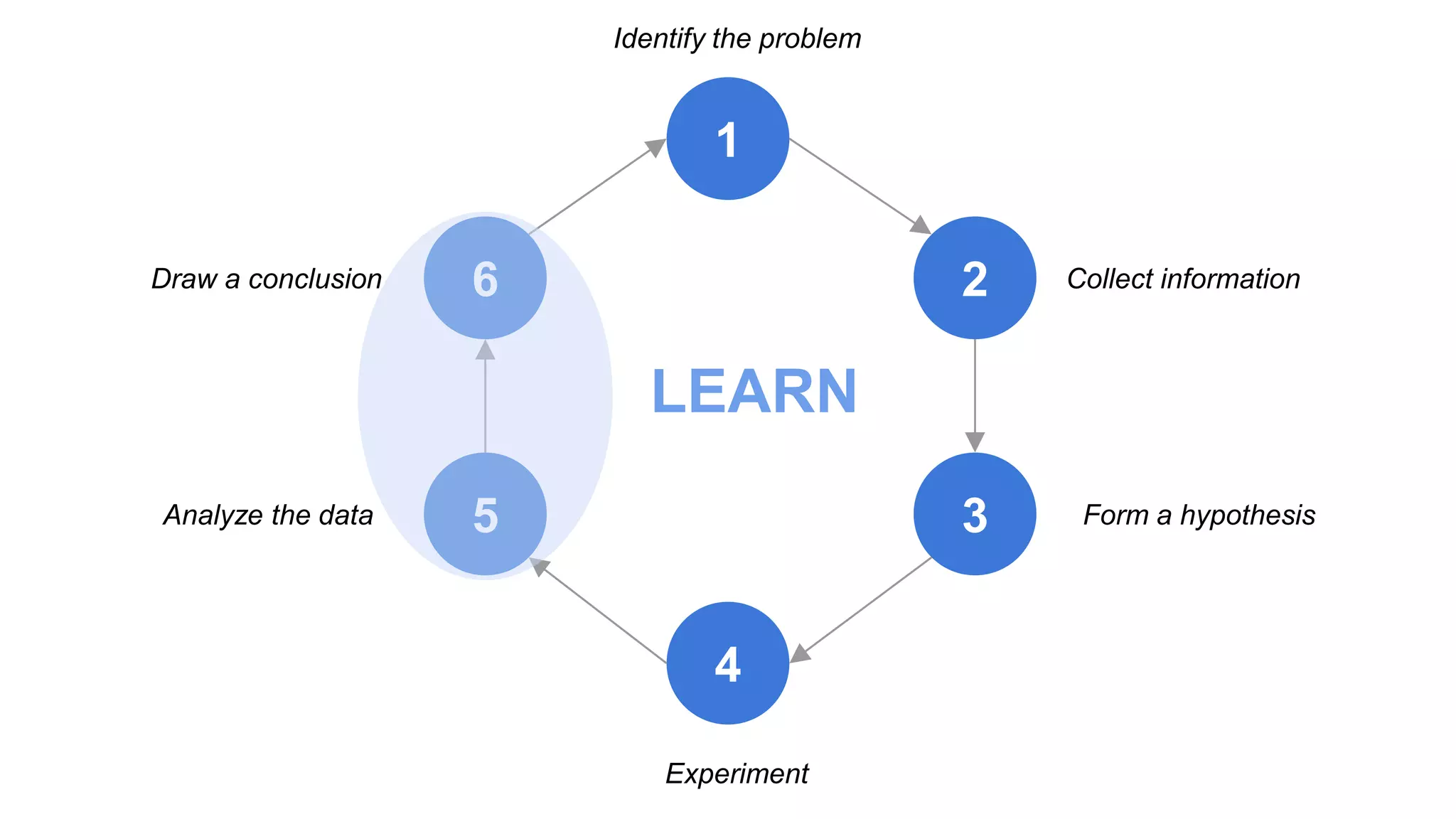
1
Identify the problem
Collect information
Experiment
Analyze the data
Draw a conclusion 2
3
4
5
6
Form a hypothesis
BUILD
1
Identify the problem
Collect information
Experiment
Analyze the data
Draw a conclusion 2
3
4
5
6
Form a hypothesis
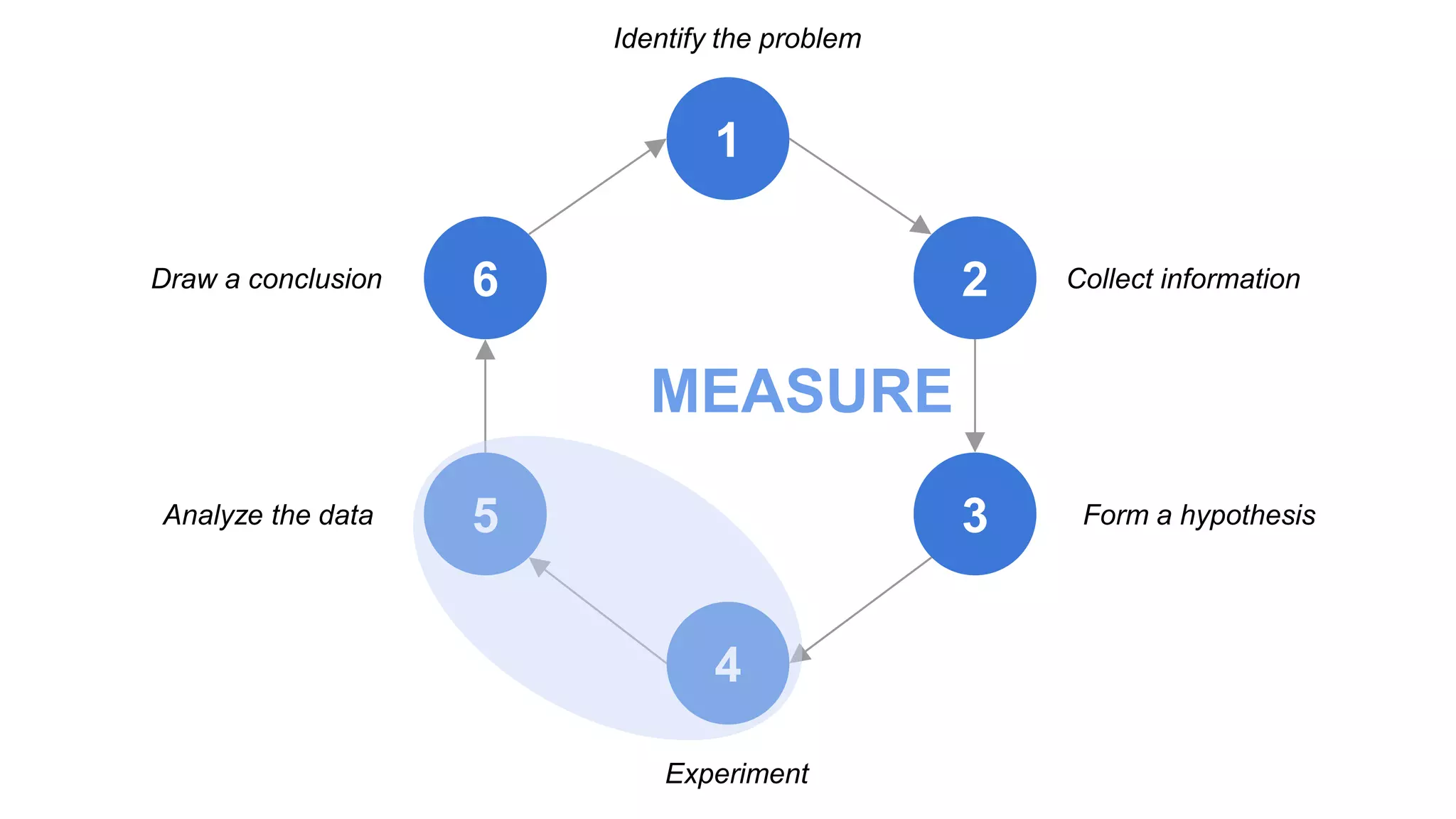
MEASURE
1
Identify the problem
Collect information
Experiment
Analyze the data
Draw a conclusion 2
3
4
5
6
Form a hypothesis
LEARN
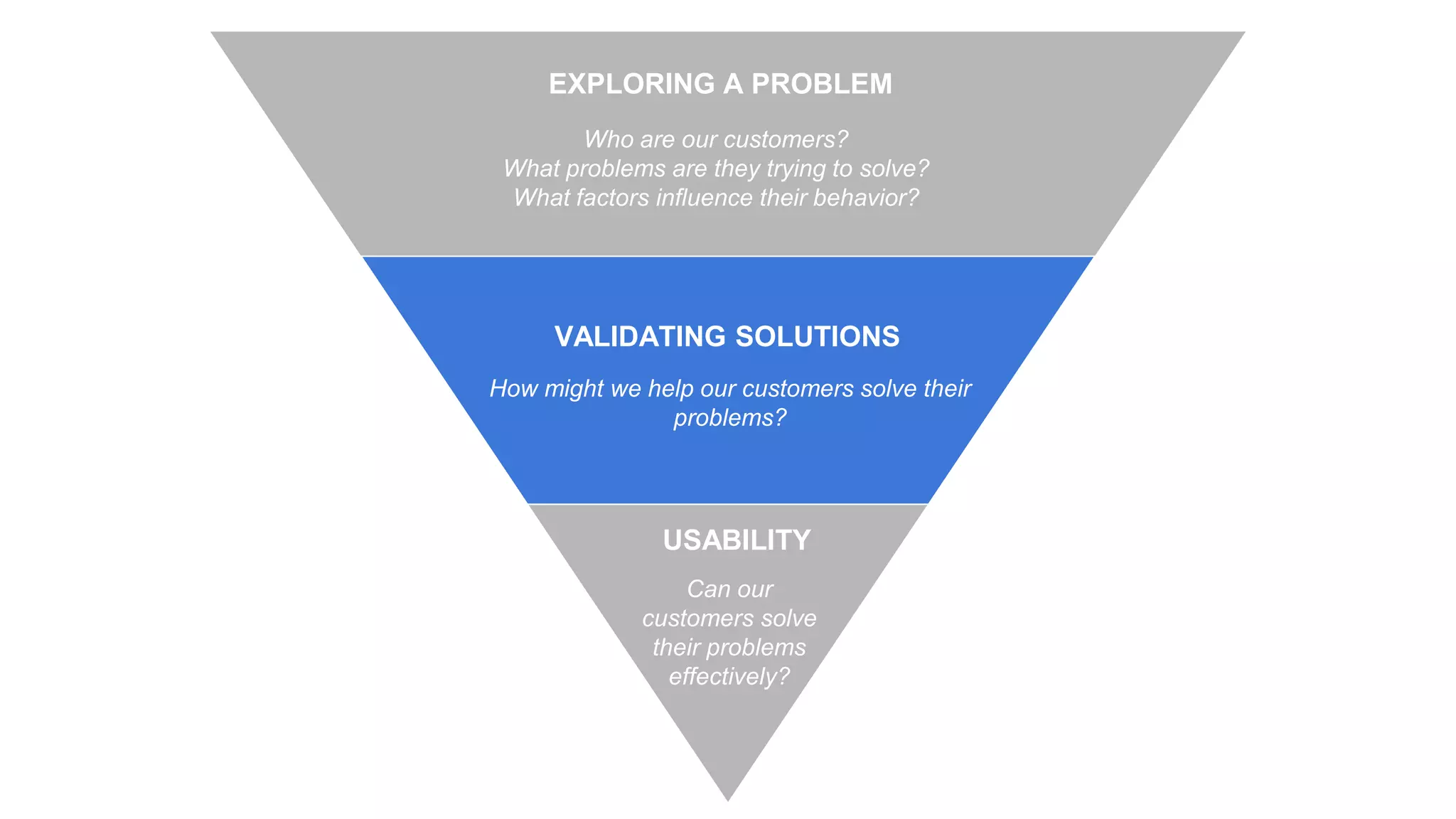
Who are our customers?
What problems are they trying to solve?
What factors influence their behavior?
How might we help our customers solve their
problems?
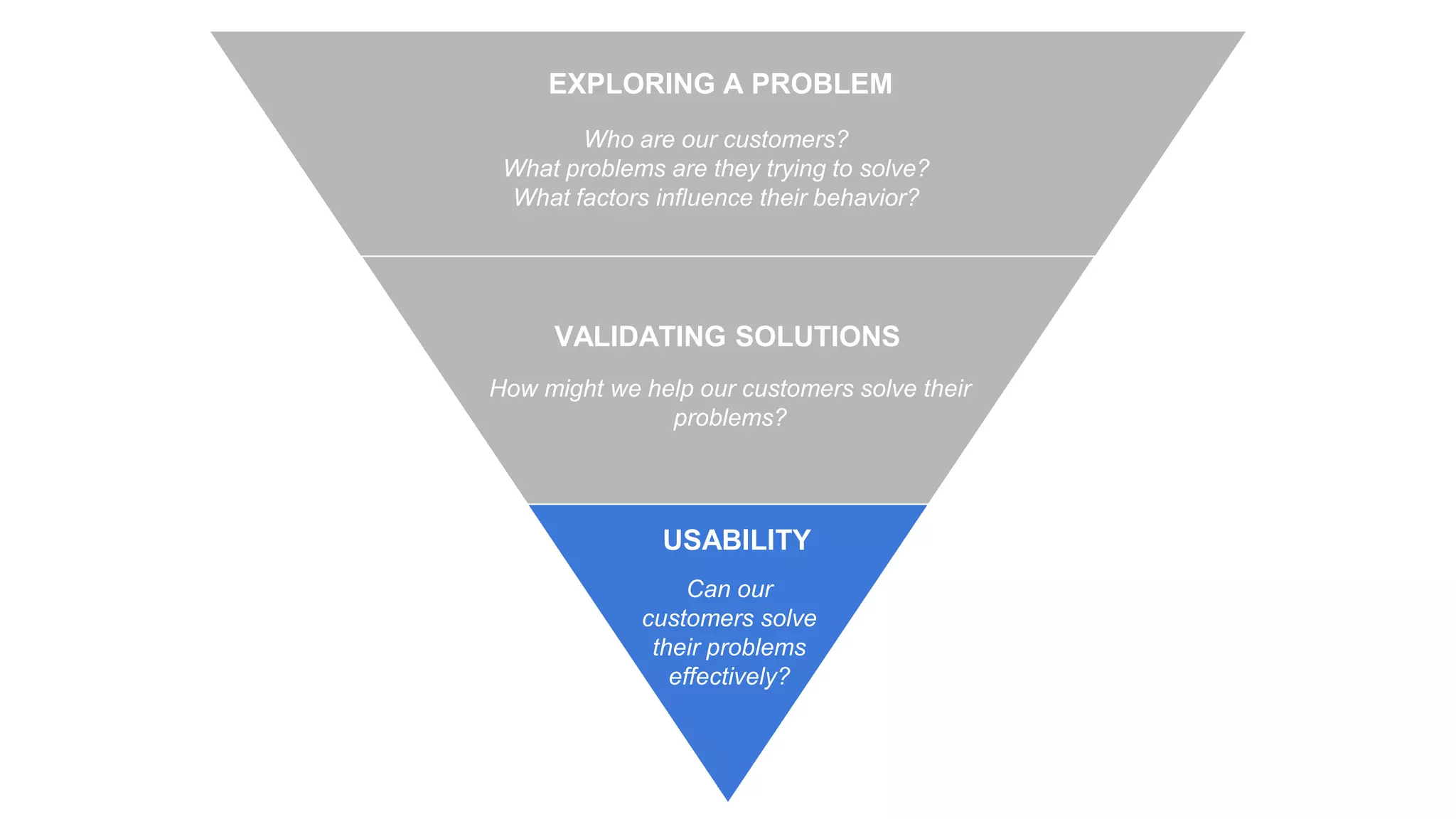
Can our
customers solve
their problems
effectively?
EXPLORING A PROBLEM
VALIDATING SOLUTIONS
USABILITY
Ex - Large financial institution - lots of tools - all the feedback was that their sales people hated the
tools, it was difficult to use, etc. Their users (Sales) gave them feedback by recommending
improvements within the context of existing solutions. Improvements to existing systems still did little to
increase adoption. So what to do?
The challenge
● Large Wall Street firm
● Sales team frustrated with software
● Antagonistic relationship with Marketing
● Internal attempts to improve technology
were going nowhere
Ex - Large financial institution - lots of tools - all the feedback was that their sales people hated the
tools, it was difficult to use, etc. Their users (Sales) gave them feedback by recommending
improvements within the context of existing solutions. Improvements to existing systems still did little to
increase adoption. So what to do?
What we did
● Small cross functional team
● 5 prototypes in 6 weeks
● Re-imagined the way their Sales teams use
technology
● Radically changed the way Marketing thinks about
internal product development
1
Identify the problem
Collect information
Experiment
Analyze the data
Draw a conclusion 2
3
4
5
6
Form a hypothesis
Who are our customers?
What problems are they trying to solve?
What factors influence their behavior?
How might we help our customers solve their
problems?
Can our
customers solve
their problems
effectively?
EXPLORING A PROBLEM
VALIDATING SOLUTIONS
USABILITY
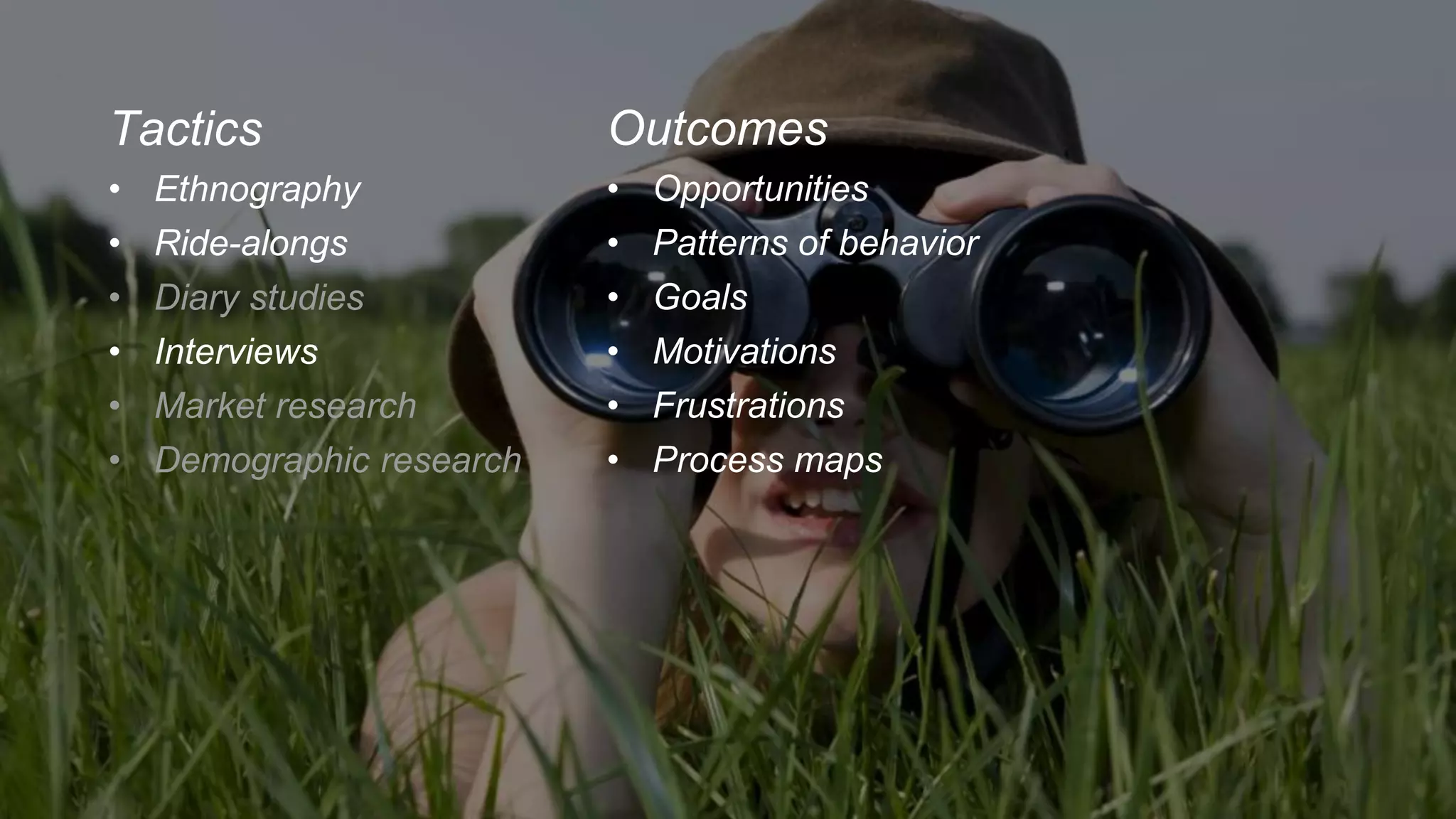
Tactics
• Ethnography
• Ride-alongs
• Diary studies
• Interviews
• Market research
• Demographic research
Outcomes
• Opportunities
• Patterns of behavior
• Goals
• Motivations
• Frustrations
• Process maps
Goal #1 - Ensure the team has all the necessary
information regarding this client
Weeks before a meeting
Create and curate a detailed, comprehensive view of the Client
and the information needed for the meeting with that client.
Goal # 2 - Ensure that all the client information
is accurate and up to date before client meeting
Days before a meeting
Do an in-depth review of a Client the day before before a meeting.
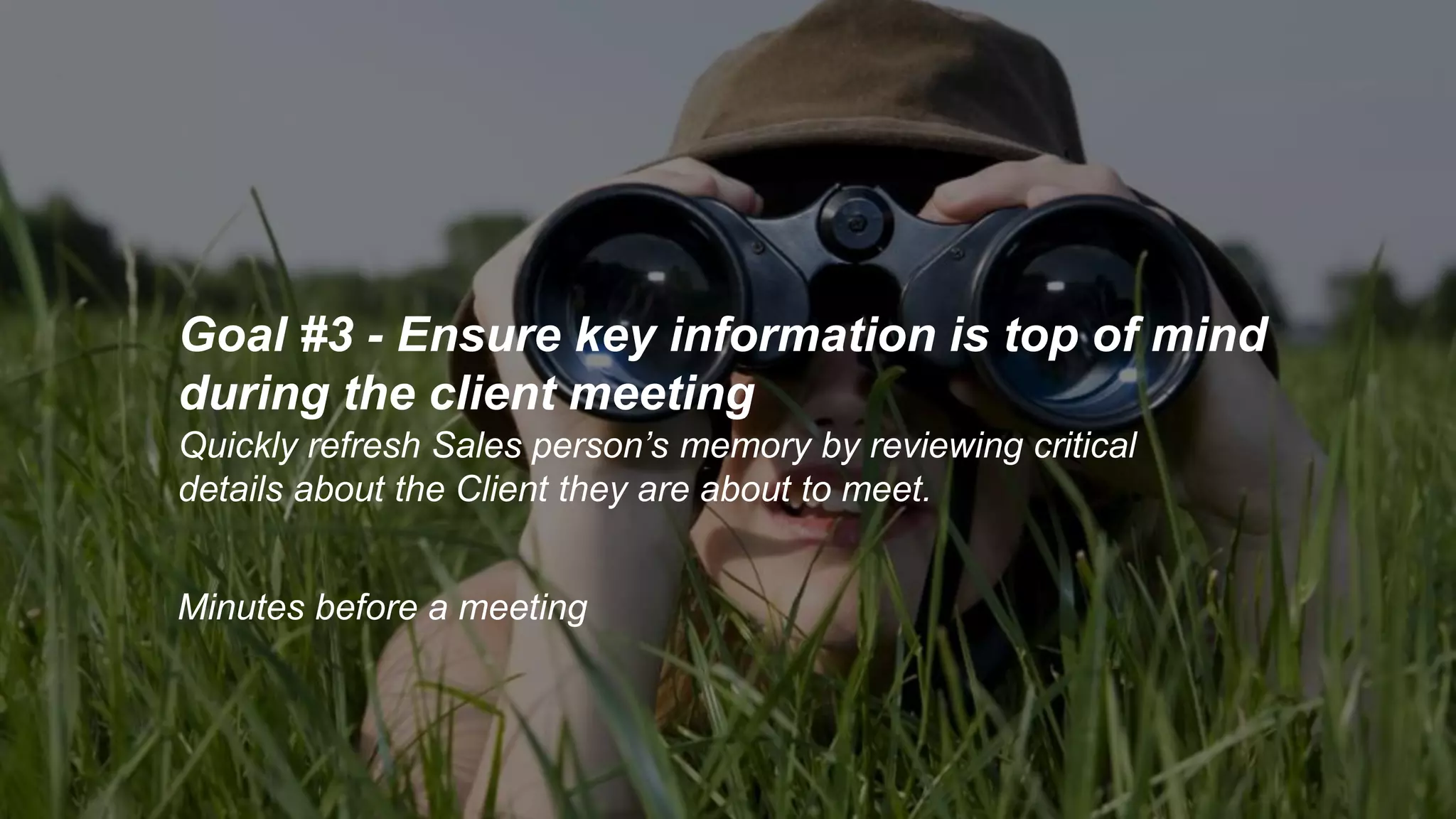
Goal #3 - Ensure key information is top of mind
during the client meeting
Minutes before a meeting
Quickly refresh Sales person’s memory by reviewing critical
details about the Client they are about to meet.
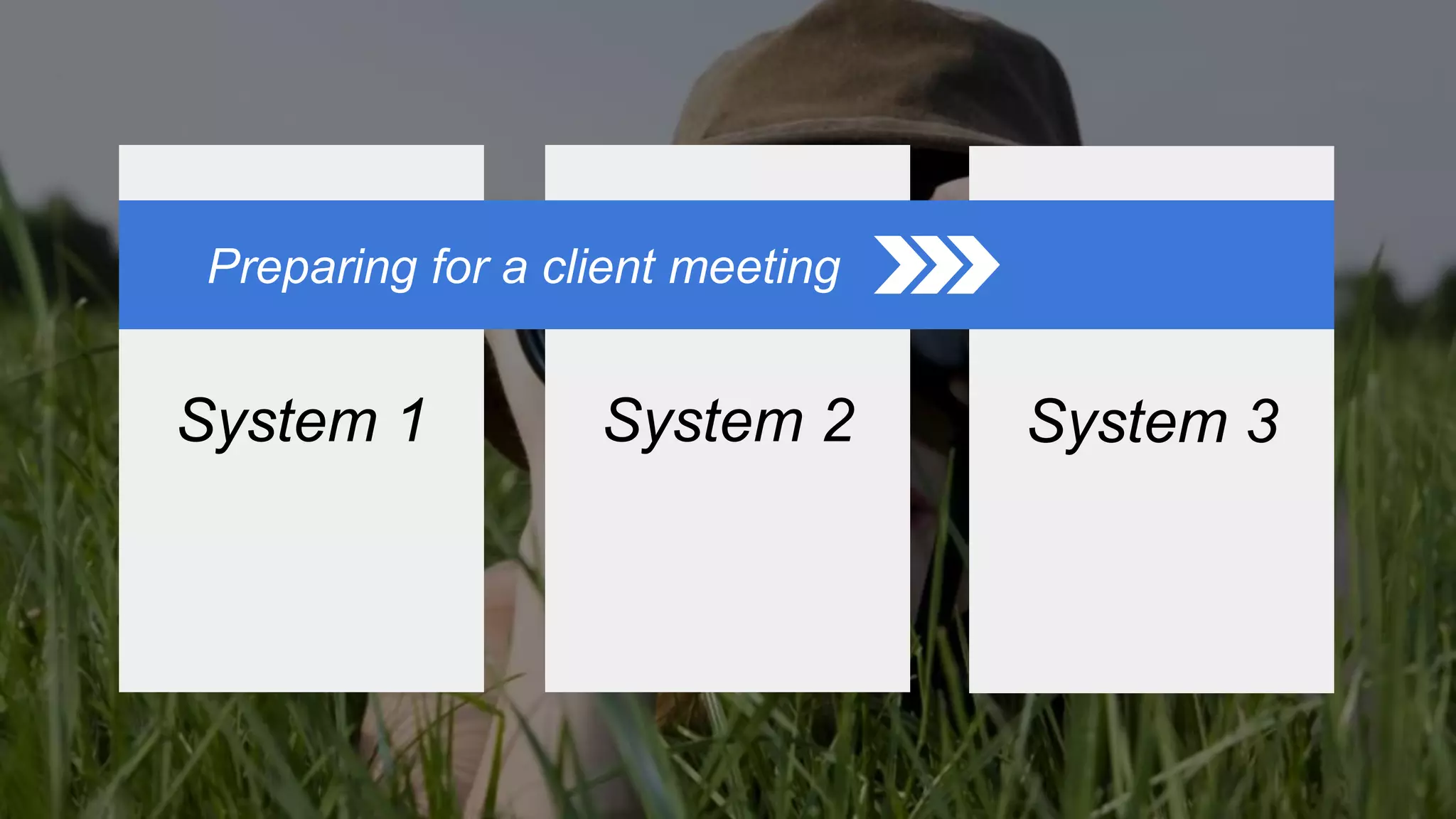
System 1 System 2 System 3
Preparing for a client meeting
Opportunity #1
Time consuming and difficult to see the full client context
Opportunity #2
Information on funds is out of date, stored in various sources
Opportunity #3
Information requirements are time and context sensitive
Opportunities
1
Identify the problem
Collect information
Experiment
Analyze the data
Draw a conclusion 2
3
4
5
6
Form a hypothesis
Who are our customers?
What problems are they trying to solve?
What factors influence their behavior?
How might we help our customers solve their
problems?
Can our
customers solve
their problems
effectively?
EXPLORING A PROBLEM
VALIDATING SOLUTIONS
USABILITY
Tactics
• Hypothesis generation
• Lo-fi prototyping
• Iterative
experimentation
• Collaborative sketching
Outcomes
● Validated value propositions
● Hi - fi prototypes
● User stories (sometimes)
Hypothesis
We believe that by providing a holistic, context specific client view,
the sales team will be better able to prepare and conduct client
meetings. We will know this is true when we see an increase in
usage of these tools by the sales team.
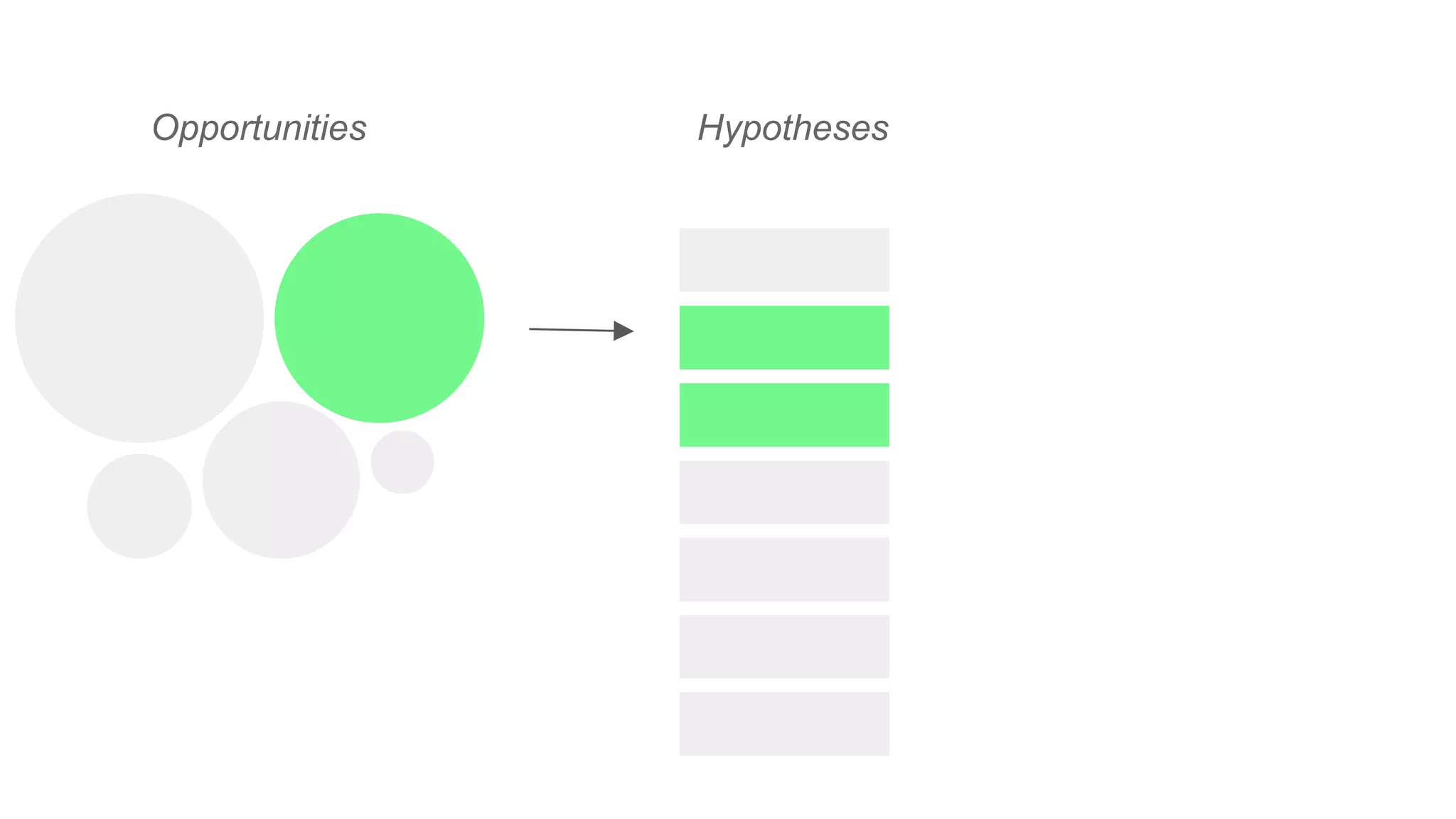
Opportunities Hypotheses
Who are our customers?
What problems are they trying to solve?
What factors influence their behavior?
How might we help our customers solve their
problems?
Can our
customers solve
their problems
effectively?
EXPLORING A PROBLEM
VALIDATING SOLUTIONS
USABILITY
Tactics
• Hi-fi prototyping
• A/B testing
Outcomes
● User stories
Ex - Large financial institution - lots of tools - all the feedback was that their sales people hated the
tools, it was difficult to use, etc. Their users (Sales) gave them feedback by recommending
improvements within the context of existing solutions. Improvements to existing systems still did little to
increase adoption. So what to do?
“This is definitely helpful. . . . Succinct and tight.”
“This is cool – I’ve never seen anything like this.”
“You really helped us think outside the box”
“Your team brought a totally unique
perspective”
“This is exactly what I need - you guys are way ahead of me”
Opportunities Hypotheses Stories
You can take it from here :)
What Customers Want

What Customers Want

  • 1.
    What Customers Want Howto turn insights about your customers into products they love Kent Rahman | Product Design and Strategy
  • 5.
    Customers want toachieve their goals
  • 6.
    Products and servicesare the interface between a customer and their goals
  • 7.
    They facilitate acustomer’s ability to achieve their goals
  • 8.
    Great products areboth useful and usable helping to do or achieve something The extent to which a product can be used by specified users to achieve specified goals with effectiveness, efficiency and satisfaction in a specified context of use.
  • 9.
    If I hadan hour to solve a problem I’d spend 55 minutes thinking about solutions and 5 minutes thinking about the problem...
  • 10.
    If I hadan hour to solve a problem I’d spend 55 minutes thinking about the problem and 5 minutes thinking about solutions - Einstein
  • 13.
  • 15.
    1 Identify the problem Collectinformation Form a hypothesis Experiment Analyze the data Draw a conclusion 2 3 4 5 6
  • 16.
    1 Identify the problem Collectinformation Experiment Analyze the data Draw a conclusion 2 3 4 5 6 Form a hypothesis BUILD
  • 17.
    1 Identify the problem Collectinformation Experiment Analyze the data Draw a conclusion 2 3 4 5 6 Form a hypothesis MEASURE
  • 18.
    1 Identify the problem Collectinformation Experiment Analyze the data Draw a conclusion 2 3 4 5 6 Form a hypothesis LEARN
  • 19.
    Who are ourcustomers? What problems are they trying to solve? What factors influence their behavior? How might we help our customers solve their problems? Can our customers solve their problems effectively? EXPLORING A PROBLEM VALIDATING SOLUTIONS USABILITY
  • 20.
    Ex - Largefinancial institution - lots of tools - all the feedback was that their sales people hated the tools, it was difficult to use, etc. Their users (Sales) gave them feedback by recommending improvements within the context of existing solutions. Improvements to existing systems still did little to increase adoption. So what to do? The challenge ● Large Wall Street firm ● Sales team frustrated with software ● Antagonistic relationship with Marketing ● Internal attempts to improve technology were going nowhere
  • 21.
    Ex - Largefinancial institution - lots of tools - all the feedback was that their sales people hated the tools, it was difficult to use, etc. Their users (Sales) gave them feedback by recommending improvements within the context of existing solutions. Improvements to existing systems still did little to increase adoption. So what to do? What we did ● Small cross functional team ● 5 prototypes in 6 weeks ● Re-imagined the way their Sales teams use technology ● Radically changed the way Marketing thinks about internal product development
  • 22.
    1 Identify the problem Collectinformation Experiment Analyze the data Draw a conclusion 2 3 4 5 6 Form a hypothesis
  • 23.
    Who are ourcustomers? What problems are they trying to solve? What factors influence their behavior? How might we help our customers solve their problems? Can our customers solve their problems effectively? EXPLORING A PROBLEM VALIDATING SOLUTIONS USABILITY
  • 24.
    Tactics • Ethnography • Ride-alongs •Diary studies • Interviews • Market research • Demographic research Outcomes • Opportunities • Patterns of behavior • Goals • Motivations • Frustrations • Process maps
  • 25.
    Goal #1 -Ensure the team has all the necessary information regarding this client Weeks before a meeting Create and curate a detailed, comprehensive view of the Client and the information needed for the meeting with that client.
  • 26.
    Goal # 2- Ensure that all the client information is accurate and up to date before client meeting Days before a meeting Do an in-depth review of a Client the day before before a meeting.
  • 27.
    Goal #3 -Ensure key information is top of mind during the client meeting Minutes before a meeting Quickly refresh Sales person’s memory by reviewing critical details about the Client they are about to meet.
  • 28.
    System 1 System2 System 3 Preparing for a client meeting
  • 29.
    Opportunity #1 Time consumingand difficult to see the full client context Opportunity #2 Information on funds is out of date, stored in various sources Opportunity #3 Information requirements are time and context sensitive
  • 30.
  • 31.
    1 Identify the problem Collectinformation Experiment Analyze the data Draw a conclusion 2 3 4 5 6 Form a hypothesis
  • 32.
    Who are ourcustomers? What problems are they trying to solve? What factors influence their behavior? How might we help our customers solve their problems? Can our customers solve their problems effectively? EXPLORING A PROBLEM VALIDATING SOLUTIONS USABILITY
  • 33.
    Tactics • Hypothesis generation •Lo-fi prototyping • Iterative experimentation • Collaborative sketching Outcomes ● Validated value propositions ● Hi - fi prototypes ● User stories (sometimes)
  • 35.
    Hypothesis We believe thatby providing a holistic, context specific client view, the sales team will be better able to prepare and conduct client meetings. We will know this is true when we see an increase in usage of these tools by the sales team.
  • 36.
  • 38.
    Who are ourcustomers? What problems are they trying to solve? What factors influence their behavior? How might we help our customers solve their problems? Can our customers solve their problems effectively? EXPLORING A PROBLEM VALIDATING SOLUTIONS USABILITY
  • 39.
    Tactics • Hi-fi prototyping •A/B testing Outcomes ● User stories
  • 40.
    Ex - Largefinancial institution - lots of tools - all the feedback was that their sales people hated the tools, it was difficult to use, etc. Their users (Sales) gave them feedback by recommending improvements within the context of existing solutions. Improvements to existing systems still did little to increase adoption. So what to do? “This is definitely helpful. . . . Succinct and tight.” “This is cool – I’ve never seen anything like this.” “You really helped us think outside the box” “Your team brought a totally unique perspective” “This is exactly what I need - you guys are way ahead of me”
  • 41.
  • 42.
    You can takeit from here :)