PRODUCT STRATEGY
OVERVIEW
1
PRODUCT STRATEGY OVERVIEW
2
● What do we mean by product?
● What needs to be considered in product strategy?
● What are the implications if we don’t have a lean/agile product
strategy?
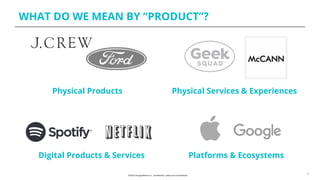
WHAT DO WE MEAN BY “PRODUCT”?
3
Physical Products Physical Services & Experiences
Digital Products & Services Platforms & Ecosystems
WHAT IS PRODUCT STRATEGY?
4
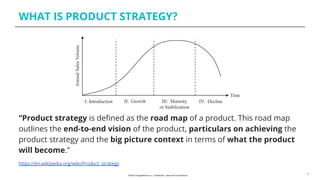
“Product strategy is defined as the road map of a product. This road map
outlines the end-to-end vision of the product, particulars on achieving the
product strategy and the big picture context in terms of what the product
will become.”
https://en.wikipedia.org/wiki/Product_strategy
THE ROLE OF PRODUCT STRATEGY
5
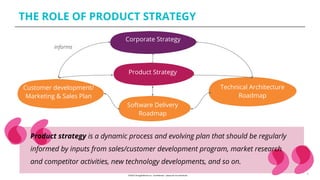
Product Strategy
Customer development/
Marketing & Sales Plan
Technical Architecture
Roadmap
Software Delivery
Roadmap
Corporate Strategy
informs
Product strategy is a dynamic process and evolving plan that should be regularly
informed by inputs from sales/customer development program, market research
and competitor activities, new technology developments, and so on.
PRODUCT STRATEGY CONSIDERATIONS
6
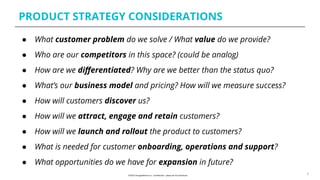
● What customer problem do we solve / What value do we provide?
● Who are our competitors in this space? (could be analog)
● How are we differentiated? Why are we better than the status quo?
● What’s our business model and pricing? How will we measure success?
● How will customers discover us?
● How will we attract, engage and retain customers?
● How will we launch and rollout the product to customers?
● What is needed for customer onboarding, operations and support?
● What opportunities do we have for expansion in future?
ROLE OF THE PRODUCT OWNER
7
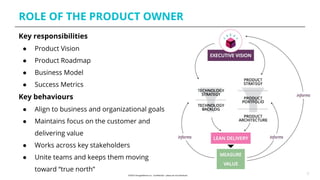
Key responsibilities
● Product Vision
● Product Roadmap
● Business Model
● Success Metrics
Key behaviours
● Align to business and organizational goals
● Maintains focus on the customer and
delivering value
● Works across key stakeholders
● Unite teams and keeps them moving
toward “true north”
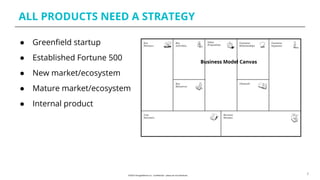
ALL PRODUCTS NEED A STRATEGY
8
● Greenfield startup
● Established Fortune 500
● New market/ecosystem
● Mature market/ecosystem
● Internal product
Business Model Canvas
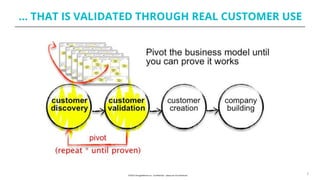
… THAT IS VALIDATED THROUGH REAL CUSTOMER USE
9
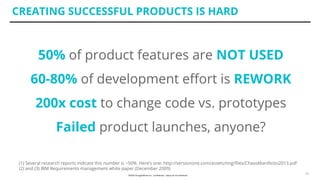
CREATING SUCCESSFUL PRODUCTS IS HARD
10
50% of product features are NOT USED
60-80% of development effort is REWORK
200x cost to change code vs. prototypes
Failed product launches, anyone?
(1) Several research reports indicate this number is ~50%. Here’s one: http://versionone.com/assets/img/files/ChaosManifesto2013.pdf
(2) and (3) IBM Requirements management white paper (December 2009)
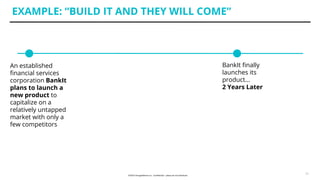
EXAMPLE: “BUILD IT AND THEY WILL COME”
11
An established
financial services
corporation BankIt
plans to launch a
new product to
capitalize on a
relatively untapped
market with only a
few competitors
BankIt finally
launches its
product…
2 Years Later
BUILD IT AND THEY WILL COME?
12
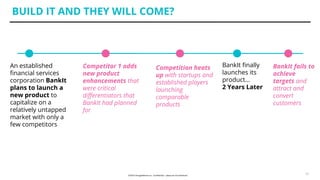
An established
financial services
corporation BankIt
plans to launch a
new product to
capitalize on a
relatively untapped
market with only a
few competitors
BankIt finally
launches its
product…
2 Years Later
Competitor 1 adds
new product
enhancements that
were critical
differentiators that
BankIt had planned
for
BankIt fails to
achieve
targets and
attract and
convert
customers
Competition heats
up with startups and
established players
launching
comparable
products
RISKS OF “BIG BANG” APPROACH
13
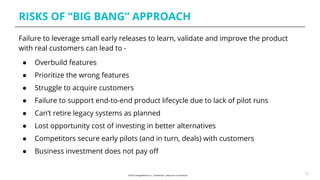
Failure to leverage small early releases to learn, validate and improve the product
with real customers can lead to -
● Overbuild features
● Prioritize the wrong features
● Struggle to acquire customers
● Failure to support end-to-end product lifecycle due to lack of pilot runs
● Can’t retire legacy systems as planned
● Lost opportunity cost of investing in better alternatives
● Competitors secure early pilots (and in turn, deals) with customers
● Business investment does not pay off
THERE MUST BE A BETTER WAY
● Learn about customer needs early and often
● Prototype, test and get real market feedback
● Pivot your product and features based on learnings
EXAMPLE: UBER PRODUCT STRATEGY ROADMAP
15
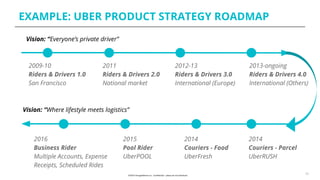
2009-10
Riders & Drivers 1.0
San Francisco
2011
Riders & Drivers 2.0
National market
2012-13
Riders & Drivers 3.0
International (Europe)
Vision: “Everyone’s private driver”
Vision: “Where lifestyle meets logistics”
2014
Couriers - Food
UberFresh
2013-ongoing
Riders & Drivers 4.0
International (Others)
2014
Couriers - Parcel
UberRUSH
2016
Business Rider
Multiple Accounts, Expense
Receipts, Scheduled Rides
2015
Pool Rider
UberPOOL
COIN GAME
16
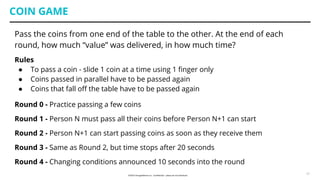
COIN GAME
17
Pass the coins from one end of the table to the other. At the end of each
round, how much “value” was delivered, in how much time?
Rules
● To pass a coin - slide 1 coin at a time using 1 finger only
● Coins passed in parallel have to be passed again
● Coins that fall off the table have to be passed again
Round 0 - Practice passing a few coins
Round 1 - Person N must pass all their coins before Person N+1 can start
Round 2 - Person N+1 can start passing coins as soon as they receive them
Round 3 - Same as Round 2, but time stops after 20 seconds
Round 4 - Changing conditions announced 10 seconds into the round
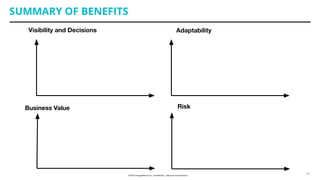
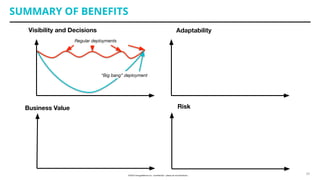
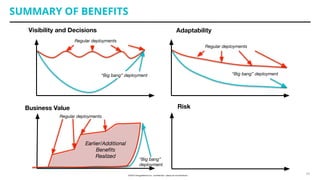
SUMMARY OF BENEFITS
Visibility and Decisions
Business Value
Adaptability
Risk
18
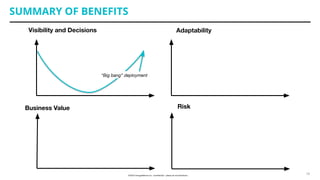
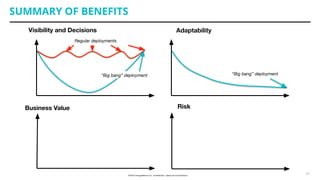
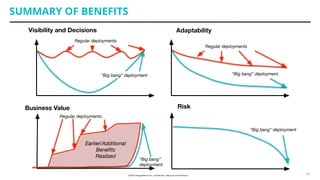
SUMMARY OF BENEFITS
Visibility and Decisions
Business Value
Adaptability
Risk
19
“Big bang” deployment
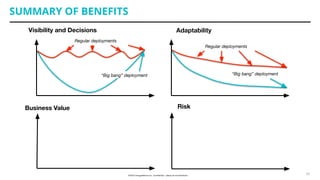
SUMMARY OF BENEFITS
Visibility and Decisions
Business Value
Adaptability
Risk
Regular deployments
20
“Big bang” deployment
SUMMARY OF BENEFITS
Visibility and Decisions
Business Value
Adaptability
Risk
Regular deployments
“Big bang” deployment
21
“Big bang” deployment
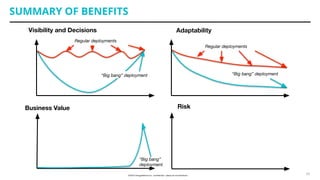
SUMMARY OF BENEFITS
Visibility and Decisions
Business Value
Adaptability
Risk
Regular deployments
“Big bang” deployment
Regular deployments
“Big bang” deployment
22
SUMMARY OF BENEFITS
Visibility and Decisions
Business Value
Adaptability
Risk
Regular deployments
“Big bang” deployment
Regular deployments
“Big bang” deployment
23
“Big bang”
deployment
“Big bang”
deployment
SUMMARY OF BENEFITS
Visibility and Decisions
Business Value
Adaptability
Risk
Regular deployments
“Big bang” deployment
Regular deployments
“Big bang” deployment
Regular deployments
Earlier/Additional
Benefits
Realized
24
“Big bang”
deployment
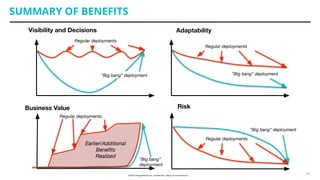
SUMMARY OF BENEFITS
Visibility and Decisions
Business Value
Adaptability
Risk
Regular deployments
“Big bang” deployment
Regular deployments
“Big bang” deployment
Regular deployments
Earlier/Additional
Benefits
Realized
25
“Big bang” deployment
“Big bang”
deployment
SUMMARY OF BENEFITS
Visibility and Decisions
Business Value
Adaptability
Risk
Regular deployments
“Big bang” deployment
Regular deployments
“Big bang” deployment
Regular deployments
Regular deployments
Earlier/Additional
Benefits
Realized
26
“Big bang” deployment
“The only thing
CONSTANT
is change”
- Heraclitus, Greek philosopher
27
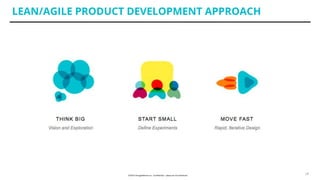
LEAN/AGILE PRODUCT DEVELOPMENT APPROACH
28
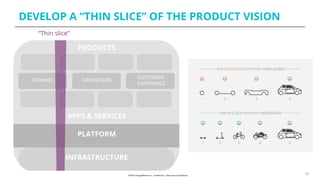
DEVELOP A “THIN SLICE” OF THE PRODUCT VISION
29
PRODUCTS
PLATFORM
INFRASTRUCTURE
CHANNEL DASHBOARD
CUSTOMER
EXPERIENCE
APPS & SERVICES
“Thin slice”
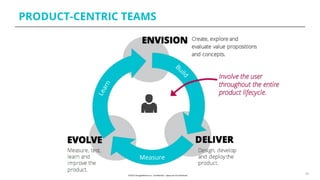
PRODUCT-CENTRIC TEAMS
30Build
Learn
Measure
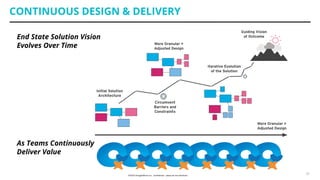
CONTINUOUS DESIGN & DELIVERY
31
As Teams Continuously
Deliver Value
End State Solution Vision
Evolves Over Time
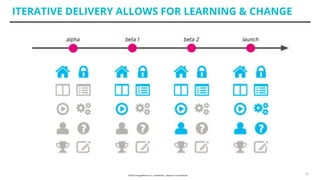
ITERATIVE DELIVERY ALLOWS FOR LEARNING & CHANGE
32
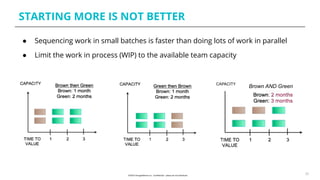
STARTING MORE IS NOT BETTER
33
● Sequencing work in small batches is faster than doing lots of work in parallel
● Limit the work in process (WIP) to the available team capacity
Brown AND GreenCAPACITY
TAKEAWAYS
34
● A product or service is anything that provides value to customers (buyers)
● It may be a single product/service, but more often is a broader product
suite/platform/ecosystem with many sub-products & services
● Product strategy needs to consider the entire business model and operations in
support of providing that customer value
● Product strategy is dynamic and continuous; it evolves over time as new
opportunities and challenges emerge, and competitor threats arise
● Product strategy is not the same as the product vision or product features. The
strategy must include the steps along the road to achieving the overall vision
THANKS!
Natalie Hollier - nhollier@thoughtworks.com
Teresa Lee - tlee@thoughtworks.com
35

What is Product Strategy? Overview

  • 1.
  • 2.
    PRODUCT STRATEGY OVERVIEW 2 ●What do we mean by product? ● What needs to be considered in product strategy? ● What are the implications if we don’t have a lean/agile product strategy?
  • 3.
    WHAT DO WEMEAN BY “PRODUCT”? 3 Physical Products Physical Services & Experiences Digital Products & Services Platforms & Ecosystems
  • 4.
    WHAT IS PRODUCTSTRATEGY? 4 “Product strategy is defined as the road map of a product. This road map outlines the end-to-end vision of the product, particulars on achieving the product strategy and the big picture context in terms of what the product will become.” https://en.wikipedia.org/wiki/Product_strategy
  • 5.
    THE ROLE OFPRODUCT STRATEGY 5 Product Strategy Customer development/ Marketing & Sales Plan Technical Architecture Roadmap Software Delivery Roadmap Corporate Strategy informs Product strategy is a dynamic process and evolving plan that should be regularly informed by inputs from sales/customer development program, market research and competitor activities, new technology developments, and so on.
  • 6.
    PRODUCT STRATEGY CONSIDERATIONS 6 ●What customer problem do we solve / What value do we provide? ● Who are our competitors in this space? (could be analog) ● How are we differentiated? Why are we better than the status quo? ● What’s our business model and pricing? How will we measure success? ● How will customers discover us? ● How will we attract, engage and retain customers? ● How will we launch and rollout the product to customers? ● What is needed for customer onboarding, operations and support? ● What opportunities do we have for expansion in future?
  • 7.
    ROLE OF THEPRODUCT OWNER 7 Key responsibilities ● Product Vision ● Product Roadmap ● Business Model ● Success Metrics Key behaviours ● Align to business and organizational goals ● Maintains focus on the customer and delivering value ● Works across key stakeholders ● Unite teams and keeps them moving toward “true north”
  • 8.
    ALL PRODUCTS NEEDA STRATEGY 8 ● Greenfield startup ● Established Fortune 500 ● New market/ecosystem ● Mature market/ecosystem ● Internal product Business Model Canvas
  • 9.
    … THAT ISVALIDATED THROUGH REAL CUSTOMER USE 9
  • 10.
    CREATING SUCCESSFUL PRODUCTSIS HARD 10 50% of product features are NOT USED 60-80% of development effort is REWORK 200x cost to change code vs. prototypes Failed product launches, anyone? (1) Several research reports indicate this number is ~50%. Here’s one: http://versionone.com/assets/img/files/ChaosManifesto2013.pdf (2) and (3) IBM Requirements management white paper (December 2009)
  • 11.
    EXAMPLE: “BUILD ITAND THEY WILL COME” 11 An established financial services corporation BankIt plans to launch a new product to capitalize on a relatively untapped market with only a few competitors BankIt finally launches its product… 2 Years Later
  • 12.
    BUILD IT ANDTHEY WILL COME? 12 An established financial services corporation BankIt plans to launch a new product to capitalize on a relatively untapped market with only a few competitors BankIt finally launches its product… 2 Years Later Competitor 1 adds new product enhancements that were critical differentiators that BankIt had planned for BankIt fails to achieve targets and attract and convert customers Competition heats up with startups and established players launching comparable products
  • 13.
    RISKS OF “BIGBANG” APPROACH 13 Failure to leverage small early releases to learn, validate and improve the product with real customers can lead to - ● Overbuild features ● Prioritize the wrong features ● Struggle to acquire customers ● Failure to support end-to-end product lifecycle due to lack of pilot runs ● Can’t retire legacy systems as planned ● Lost opportunity cost of investing in better alternatives ● Competitors secure early pilots (and in turn, deals) with customers ● Business investment does not pay off
  • 14.
    THERE MUST BEA BETTER WAY ● Learn about customer needs early and often ● Prototype, test and get real market feedback ● Pivot your product and features based on learnings
  • 15.
    EXAMPLE: UBER PRODUCTSTRATEGY ROADMAP 15 2009-10 Riders & Drivers 1.0 San Francisco 2011 Riders & Drivers 2.0 National market 2012-13 Riders & Drivers 3.0 International (Europe) Vision: “Everyone’s private driver” Vision: “Where lifestyle meets logistics” 2014 Couriers - Food UberFresh 2013-ongoing Riders & Drivers 4.0 International (Others) 2014 Couriers - Parcel UberRUSH 2016 Business Rider Multiple Accounts, Expense Receipts, Scheduled Rides 2015 Pool Rider UberPOOL
  • 16.
  • 17.
    COIN GAME 17 Pass thecoins from one end of the table to the other. At the end of each round, how much “value” was delivered, in how much time? Rules ● To pass a coin - slide 1 coin at a time using 1 finger only ● Coins passed in parallel have to be passed again ● Coins that fall off the table have to be passed again Round 0 - Practice passing a few coins Round 1 - Person N must pass all their coins before Person N+1 can start Round 2 - Person N+1 can start passing coins as soon as they receive them Round 3 - Same as Round 2, but time stops after 20 seconds Round 4 - Changing conditions announced 10 seconds into the round
  • 18.
    SUMMARY OF BENEFITS Visibilityand Decisions Business Value Adaptability Risk 18
  • 19.
    SUMMARY OF BENEFITS Visibilityand Decisions Business Value Adaptability Risk 19 “Big bang” deployment
  • 20.
    SUMMARY OF BENEFITS Visibilityand Decisions Business Value Adaptability Risk Regular deployments 20 “Big bang” deployment
  • 21.
    SUMMARY OF BENEFITS Visibilityand Decisions Business Value Adaptability Risk Regular deployments “Big bang” deployment 21 “Big bang” deployment
  • 22.
    SUMMARY OF BENEFITS Visibilityand Decisions Business Value Adaptability Risk Regular deployments “Big bang” deployment Regular deployments “Big bang” deployment 22
  • 23.
    SUMMARY OF BENEFITS Visibilityand Decisions Business Value Adaptability Risk Regular deployments “Big bang” deployment Regular deployments “Big bang” deployment 23 “Big bang” deployment
  • 24.
    “Big bang” deployment SUMMARY OFBENEFITS Visibility and Decisions Business Value Adaptability Risk Regular deployments “Big bang” deployment Regular deployments “Big bang” deployment Regular deployments Earlier/Additional Benefits Realized 24
  • 25.
    “Big bang” deployment SUMMARY OFBENEFITS Visibility and Decisions Business Value Adaptability Risk Regular deployments “Big bang” deployment Regular deployments “Big bang” deployment Regular deployments Earlier/Additional Benefits Realized 25 “Big bang” deployment
  • 26.
    “Big bang” deployment SUMMARY OFBENEFITS Visibility and Decisions Business Value Adaptability Risk Regular deployments “Big bang” deployment Regular deployments “Big bang” deployment Regular deployments Regular deployments Earlier/Additional Benefits Realized 26 “Big bang” deployment
  • 27.
    “The only thing CONSTANT ischange” - Heraclitus, Greek philosopher 27
  • 28.
  • 29.
    DEVELOP A “THINSLICE” OF THE PRODUCT VISION 29 PRODUCTS PLATFORM INFRASTRUCTURE CHANNEL DASHBOARD CUSTOMER EXPERIENCE APPS & SERVICES “Thin slice”
  • 30.
  • 31.
    CONTINUOUS DESIGN &DELIVERY 31 As Teams Continuously Deliver Value End State Solution Vision Evolves Over Time
  • 32.
    ITERATIVE DELIVERY ALLOWSFOR LEARNING & CHANGE 32
  • 33.
    STARTING MORE ISNOT BETTER 33 ● Sequencing work in small batches is faster than doing lots of work in parallel ● Limit the work in process (WIP) to the available team capacity Brown AND GreenCAPACITY
  • 34.
    TAKEAWAYS 34 ● A productor service is anything that provides value to customers (buyers) ● It may be a single product/service, but more often is a broader product suite/platform/ecosystem with many sub-products & services ● Product strategy needs to consider the entire business model and operations in support of providing that customer value ● Product strategy is dynamic and continuous; it evolves over time as new opportunities and challenges emerge, and competitor threats arise ● Product strategy is not the same as the product vision or product features. The strategy must include the steps along the road to achieving the overall vision
  • 35.
    THANKS! Natalie Hollier -nhollier@thoughtworks.com Teresa Lee - tlee@thoughtworks.com 35