Agile Comes To YouPresented by AccuRev, Coverity, Enthiosys, Electric Cloud, Rally and Agile JournalJuly 28, 2009Bellevue, WA
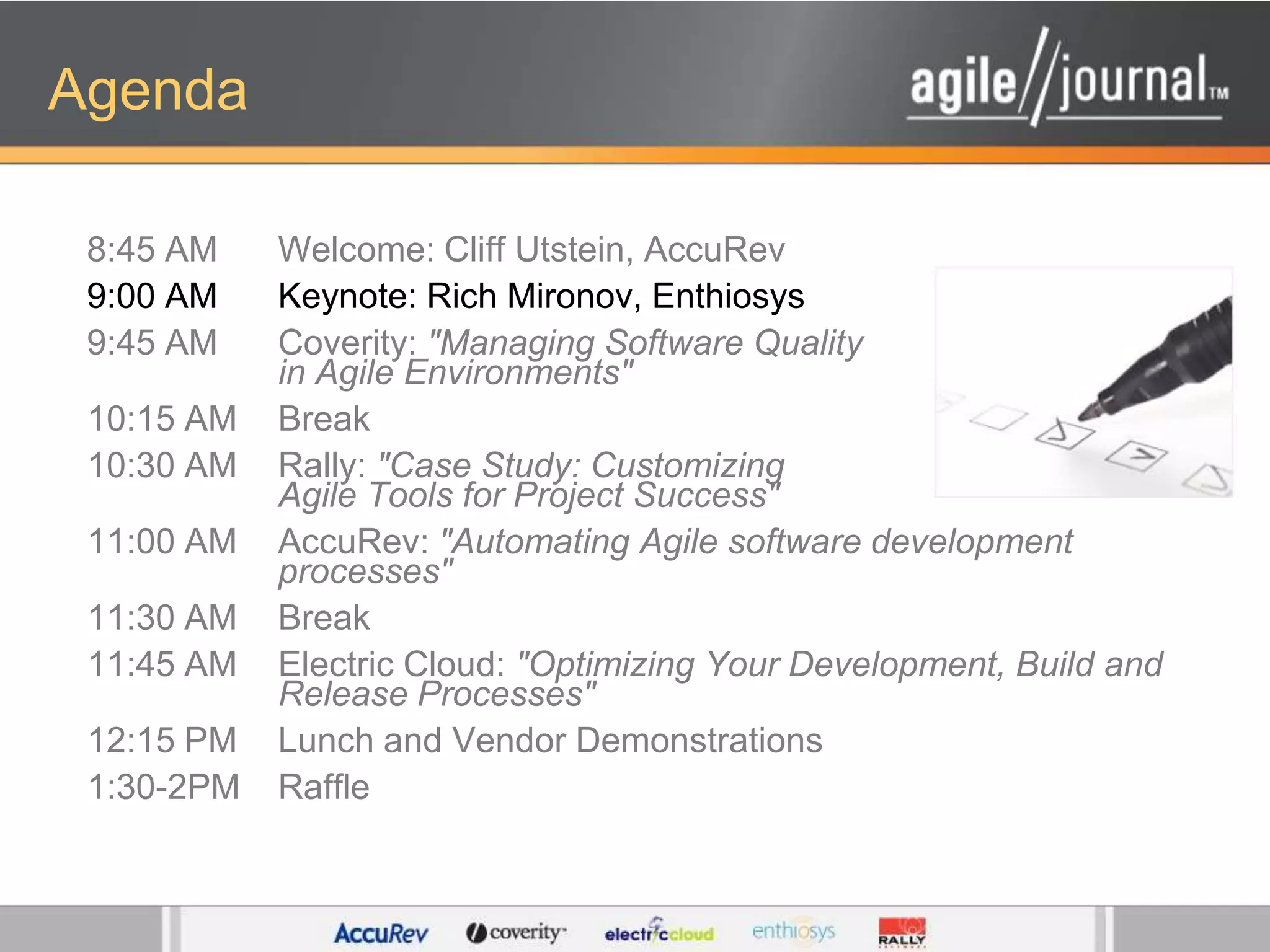
Agenda 8:45 AM	Welcome: Cliff Utstein, AccuRev9:00 AM	Keynote: Rich Mironov, Enthiosys9:45 AM	Coverity: "Managing Software Quality in Agile Environments"10:15 AM	Break10:30 AM	Rally: "Case Study: Customizing Agile Tools for Project Success" 11:00 AM	AccuRev: "Automating Agile software development processes"11:30 AM	Break11:45 AM	Electric Cloud: "Optimizing Your Development, Build and Release Processes"12:15 PM	Lunch and Vendor Demonstrations1:30-2PM	Raffle
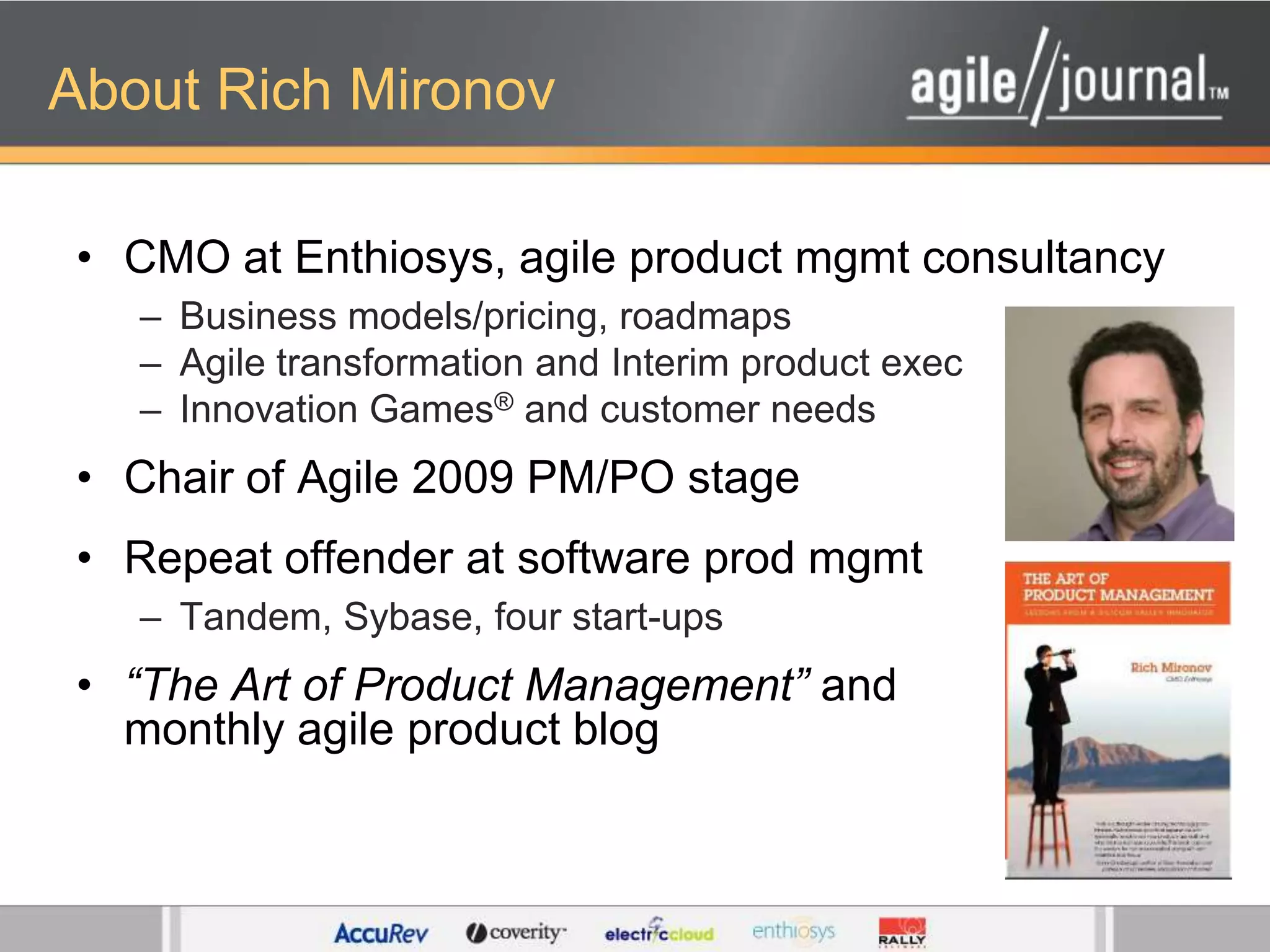
About Rich MironovCMO at Enthiosys, agile product mgmt consultancyBusiness models/pricing, roadmapsAgile transformation and Interim product execInnovation Games® and customer needsChair of Agile 2009 PM/PO stageRepeat offender at software prod mgmtTandem, Sybase, four start-ups“The Art of Product Management” and monthly agile product blog
What is Agile?Umbrella term describing sets of software project management and engineering methods/practicesIncremental, iterative and collaborative, rather than distinct stages More frequent delivery of smaller, valuable incrementsBuilding quality in, not adding it at the endGoal of potentially shippable at every iterationActive user involvement (or customer proxy)Agile teams must be empowered and self-motivating
Discussions about Agile…Part philosophy and religionPart process, tools, techniques, methodsPart organizational design
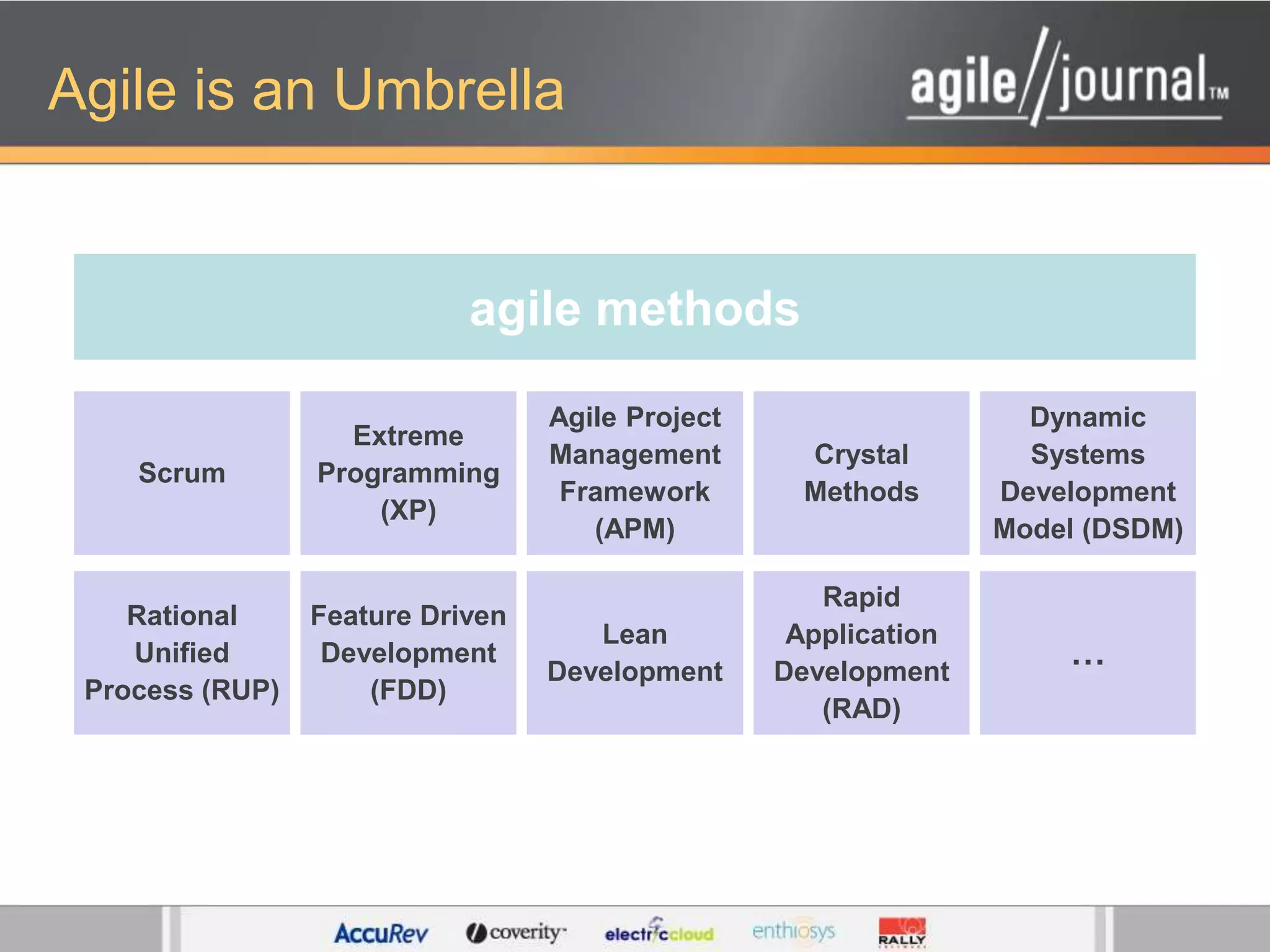
Agile is an Umbrellaagile methodsScrumExtreme Programming (XP)Agile Project Management Framework (APM)Crystal MethodsDynamic Systems Development Model (DSDM)Rational Unified Process (RUP)Feature Driven Development (FDD)Lean DevelopmentRapid Application Development (RAD)…
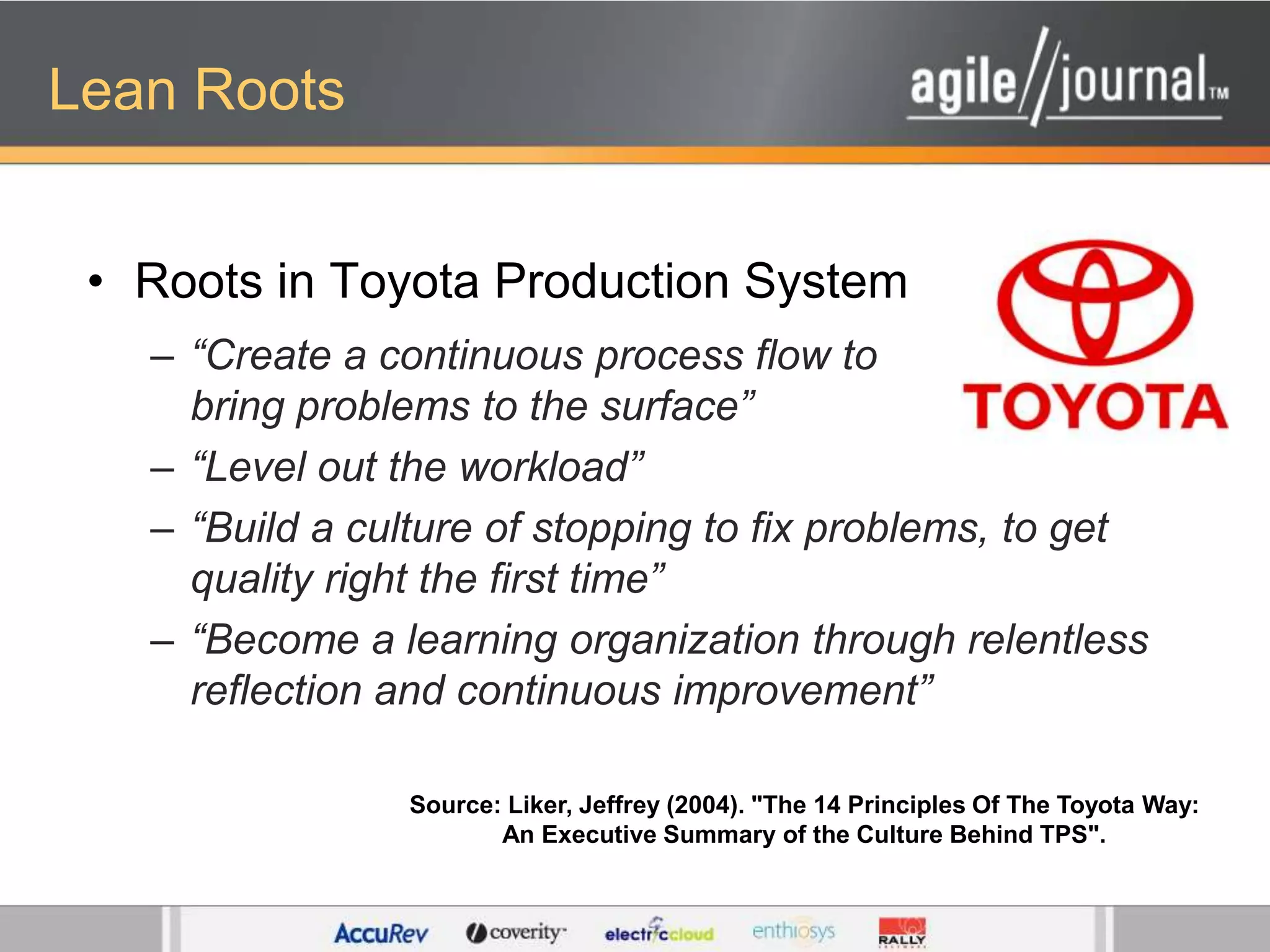
Lean RootsRoots in Toyota Production System“Create a continuous process flow to bring problems to the surface”“Level out the workload”“Build a culture of stopping to fix problems, to get quality right the first time”“Become a learning organization through relentless reflection and continuous improvement”Source: Liker, Jeffrey (2004). "The 14 Principles Of The Toyota Way: An Executive Summary of the Culture Behind TPS".
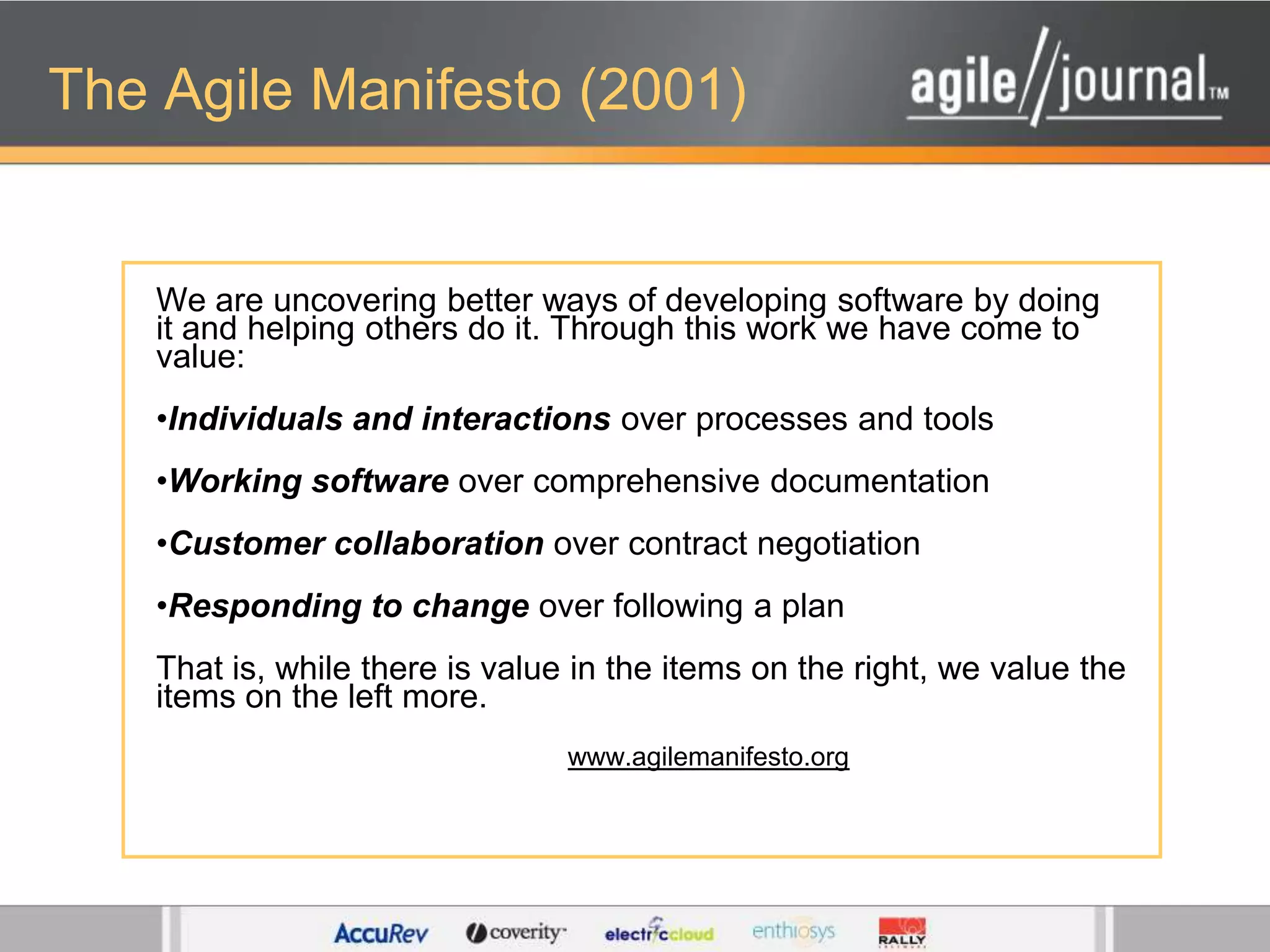
The Agile Manifesto (2001)We are uncovering better ways of developing software by doing it and helping others do it. Through this work we have come to value: Individuals and interactions over processes and toolsWorking software over comprehensive documentation Customer collaboration over contract negotiationResponding to change over following a plan That is, while there is value in the items on the right, we value the items on the left more. www.agilemanifesto.org
12 Agile PrinciplesOur highest priority is to satisfy the customer through early and continuous delivery of valuable software. Welcome changing requirements, even late in development. Agile processes harness change for the customer's competitive advantage. Deliver working software frequently, from a couple of weeks to a couple of months, with a preference to the shorter time scale. Business people and developers must work together daily throughout the project.
12 Agile PrinciplesBuild projects around motivated individuals. Give them the environment and support they need, and trust them to get the job done. The most efficient and effective method of conveying information to and within a development team is face-to-face conversation. Working software is the primary measure of progress. Agile processes promote sustainable development. The sponsors, developers, and users should be able to maintain a constant pace indefinitely.
12 Agile PrinciplesContinuous attention to technical excellence and good design enhances agility. Simplicity - the art of maximizing the amount of work not done - is essential. The best architectures, requirements and designs emerge from self-organizing teams. At regular intervals, the team reflects on how to become more effective, then tunes and adjusts its behavior accordingly.
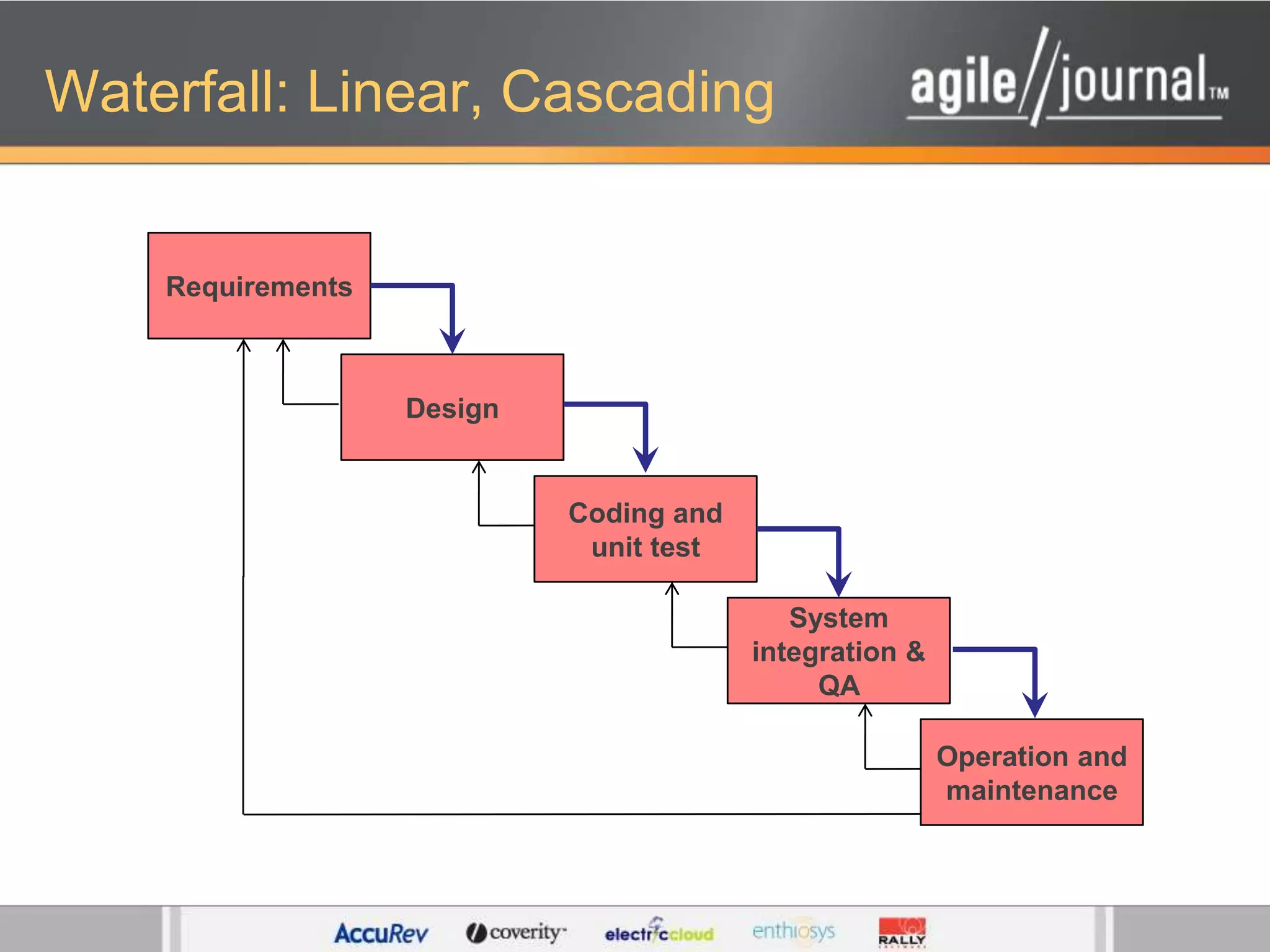
RequirementsDesignCoding and unit testSystem integration & QAOperation and maintenanceWaterfall: Linear, Cascading
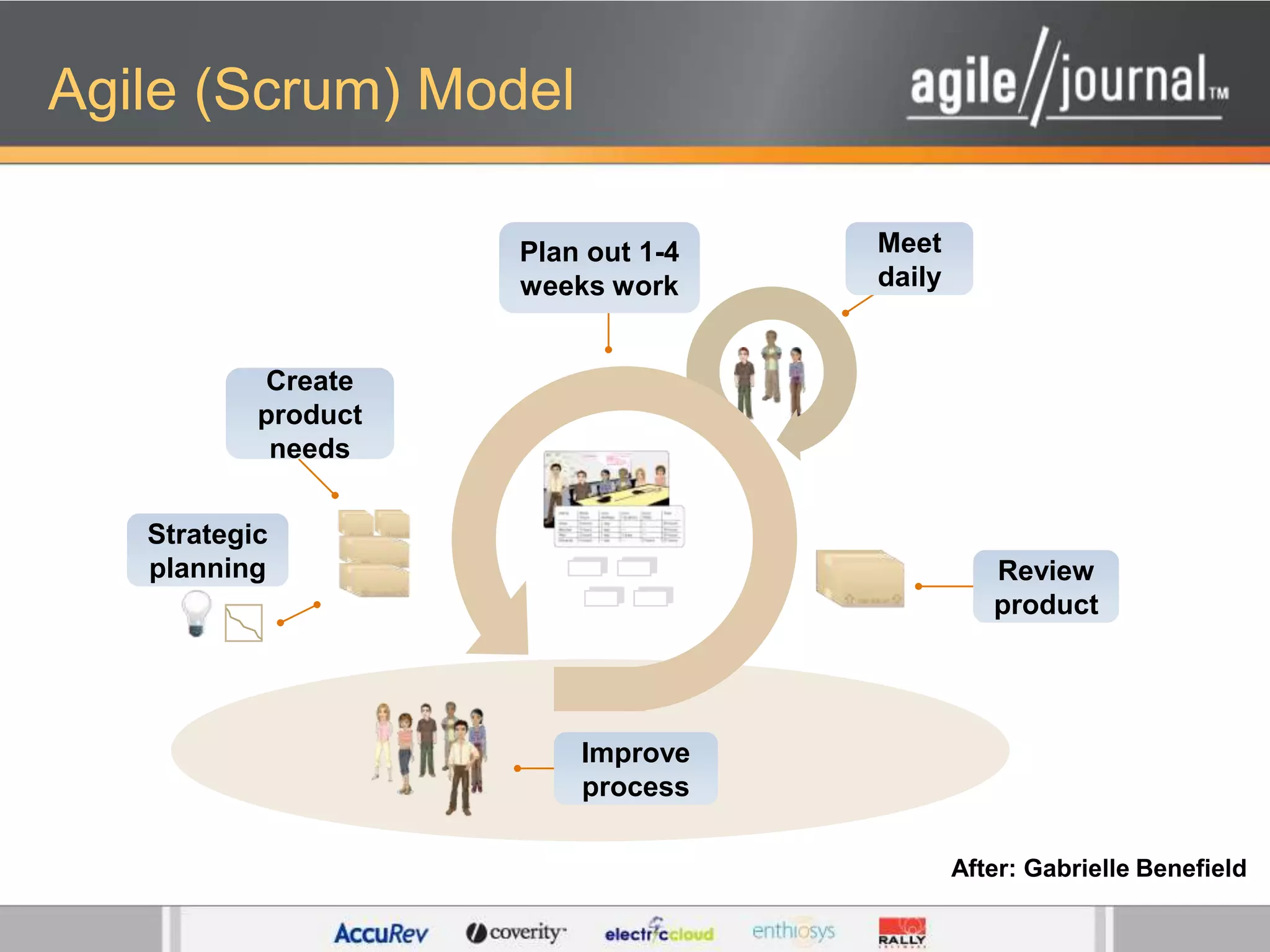
Agile (Scrum) ModelPlan out 1-4 weeks workMeet dailyCreate product needs Review productStrategic planningImprove processAfter: Gabrielle Benefield
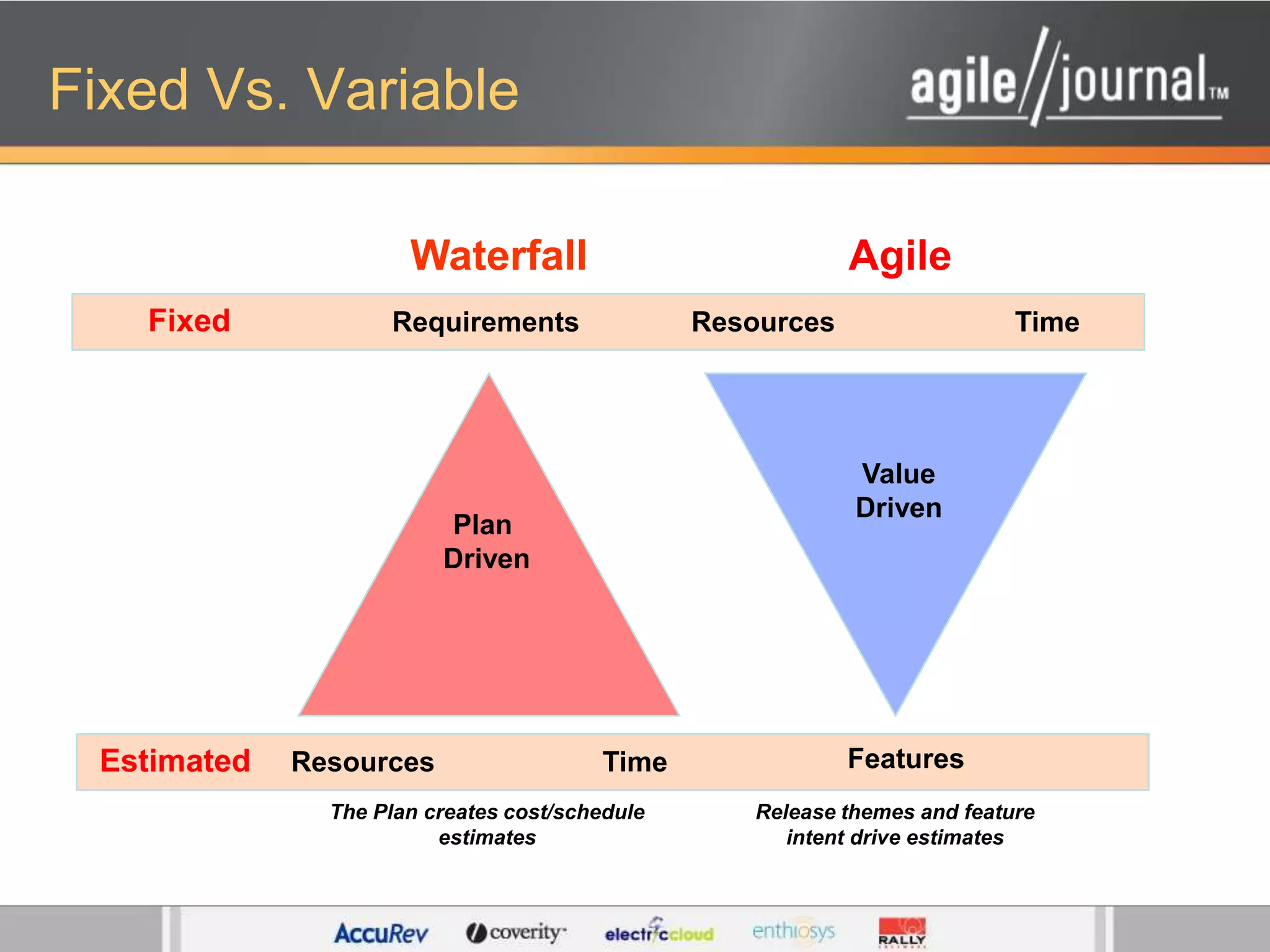
Fixed Vs. VariableWaterfallAgileFixedRequirementsTimeResourcesValueDrivenPlan DrivenEstimatedFeaturesTimeResourcesThe Plan creates cost/schedule estimatesRelease themes and feature intent drive estimates
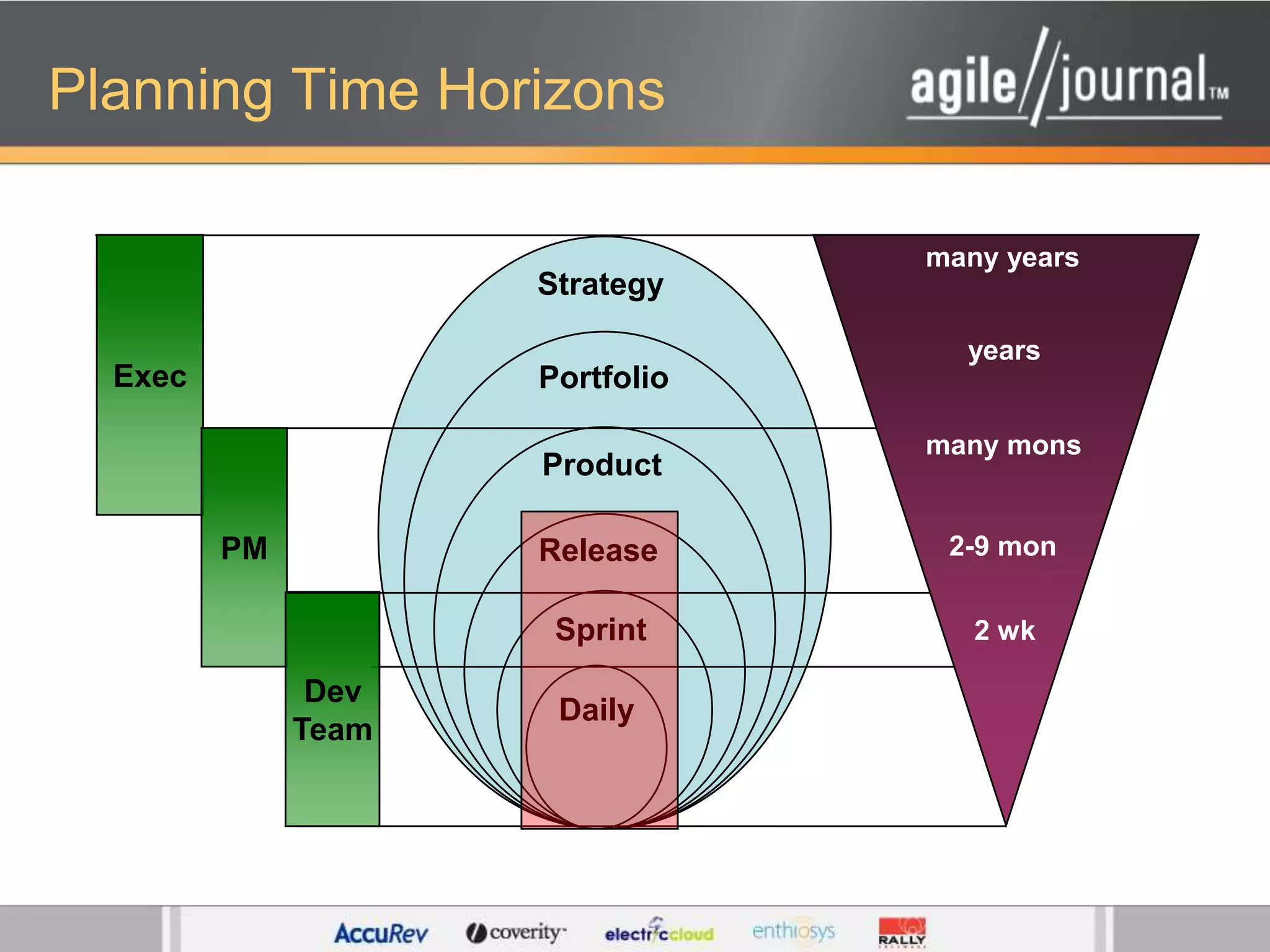
Planning Time Horizonsmany yearsExecStrategyyearsPortfoliomany monsPMProduct2-9 monReleaseDevTeamSprint2 wkDaily
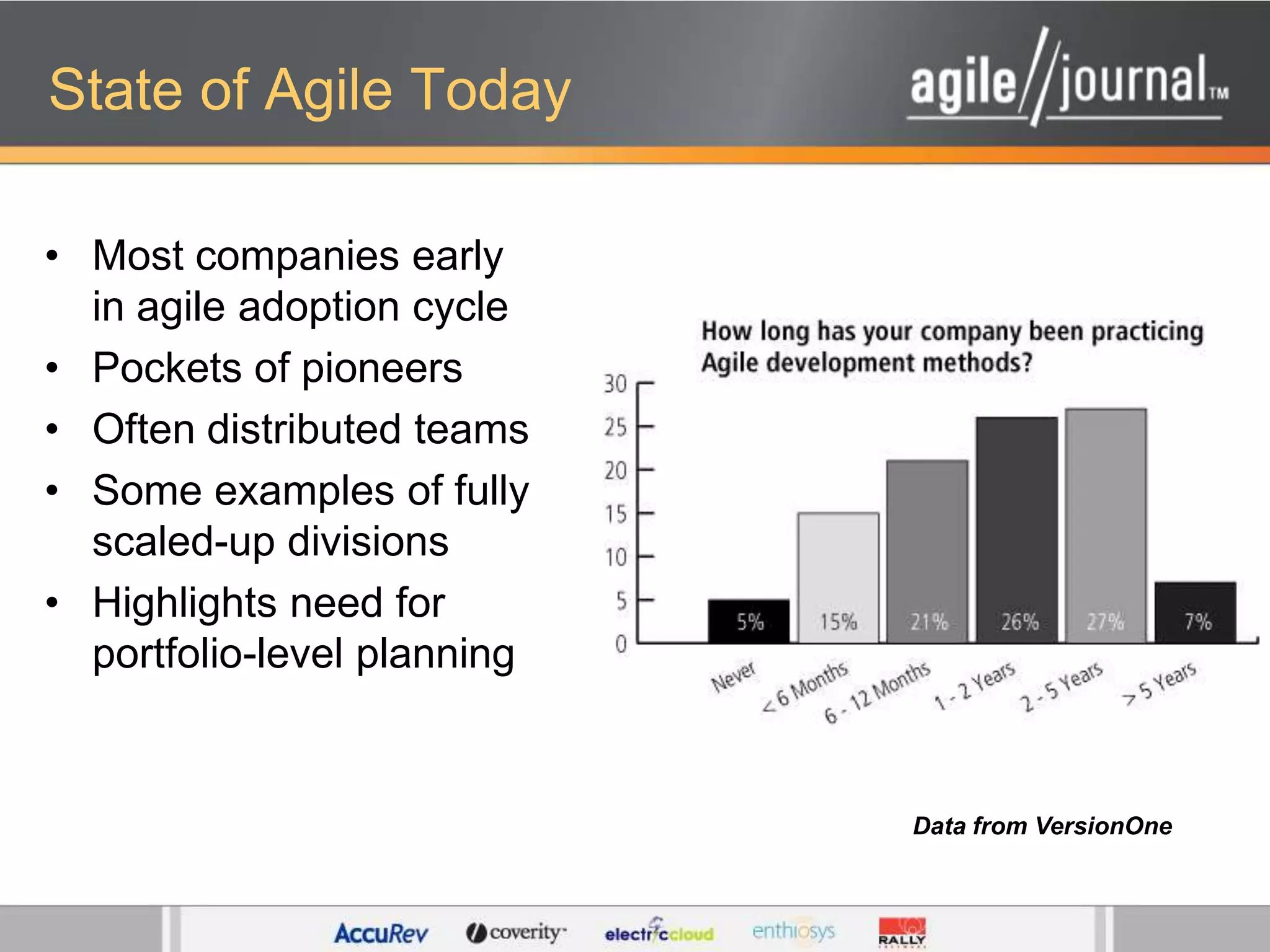
State of Agile TodayMost companies early in agile adoption cyclePockets of pioneersOften distributed teamsSome examples of fully scaled-up divisionsHighlights need for portfolio-level planningData from VersionOne
Business Benefits of AgileShorter development cyclesStrategic flexibilityDeeper connection and alignment with marketsImproved team moraleGreater profitabilityBut requires investment, leadership and patience
Agile TransformationAgile is about changing the way people workNot just the tools they useNot just units of work or development sequenceOrganizational change takes timeA successful 300-person Eng team took 18+ monthsExecutives need to drive organizational issues and expectationsLet teams handle their own detailsPlan for outside experts, coaches, instructorsSome of your team won’t fit with Agile
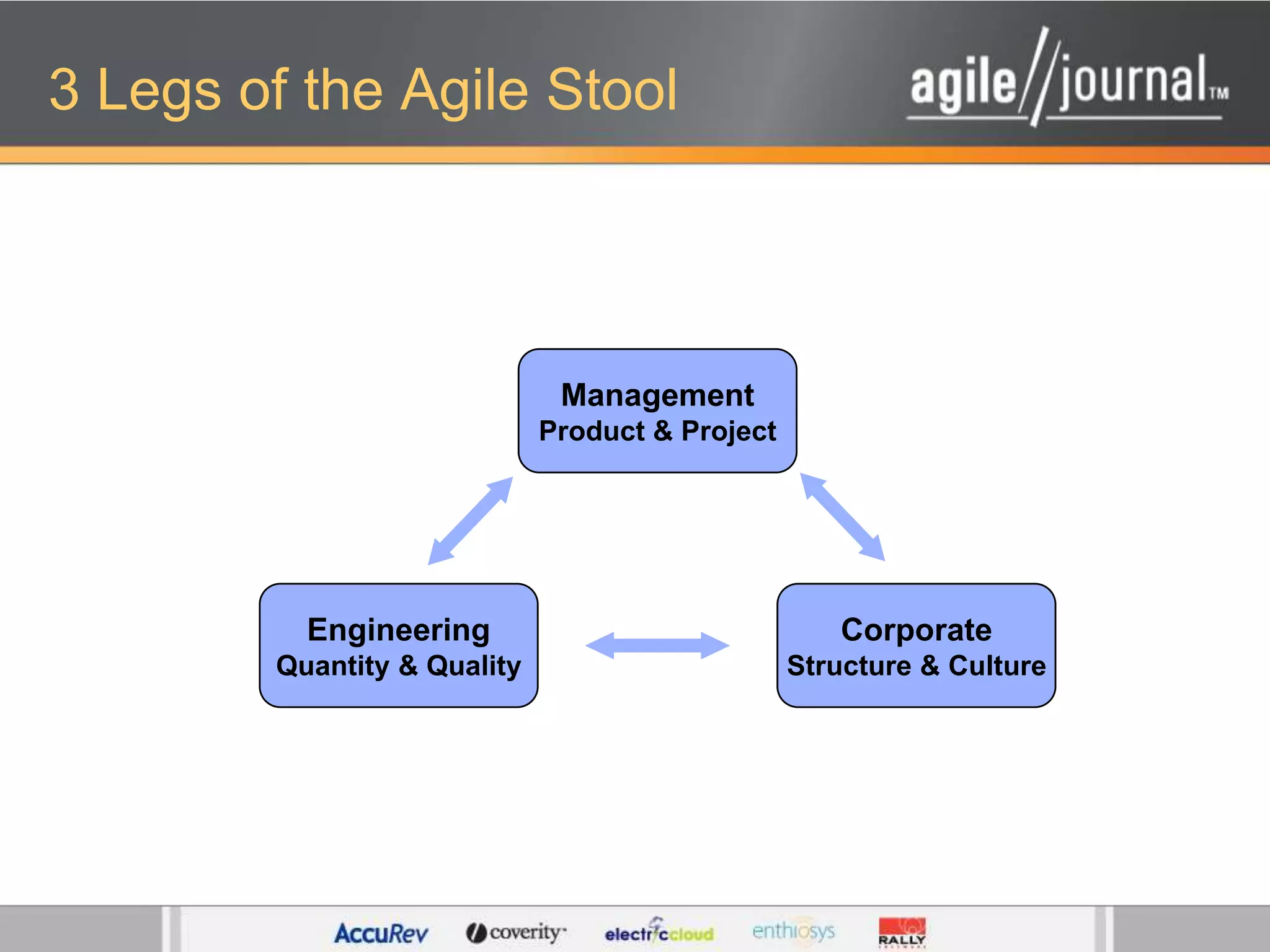
3 Legs of the Agile StoolManagementProduct & ProjectCorporateStructure & CultureEngineeringQuantity & Quality
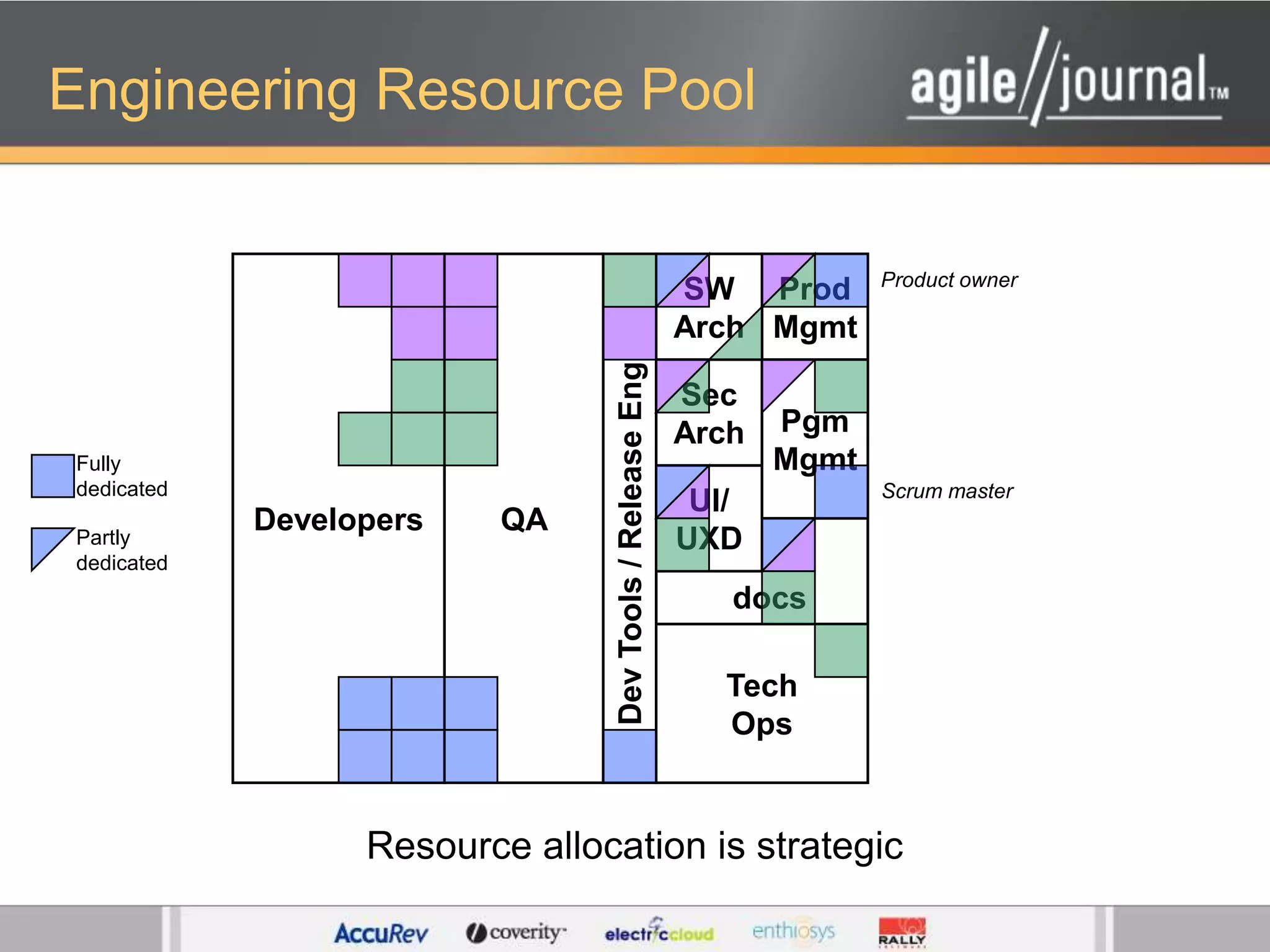
Staffing & Resources AllocationExecutive’s key tasks: build teams, set prioritiesAgile wants stable teams, fewer projects/person5-7 core technical members (dev, QA, Ops)Strong intra-team leadership (product, program, requirements) may be sharedPool of technical experts (architect, UI)At your company, how many projects is each developer assigned to?  Each architect?
Engineering Resource PoolDevelopersQAProdMgmtSWArchSecArchPgmMgmtUI/UXDDev Tools / Release Eng  docsTechOpsProduct ownerFully dedicatedScrum masterPartlydedicatedResource allocation is strategic
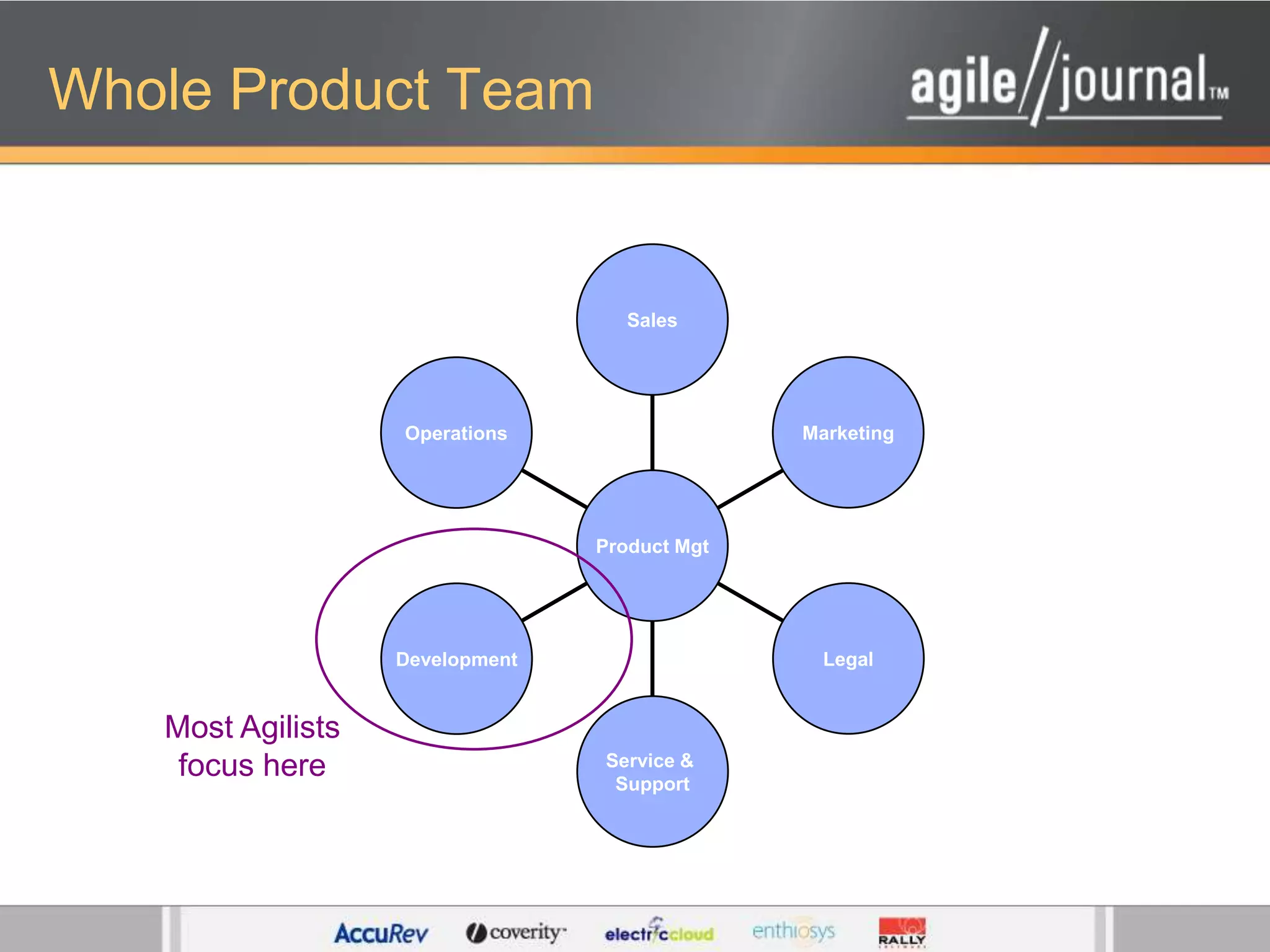
Whole Product TeamMost Agilists focus here
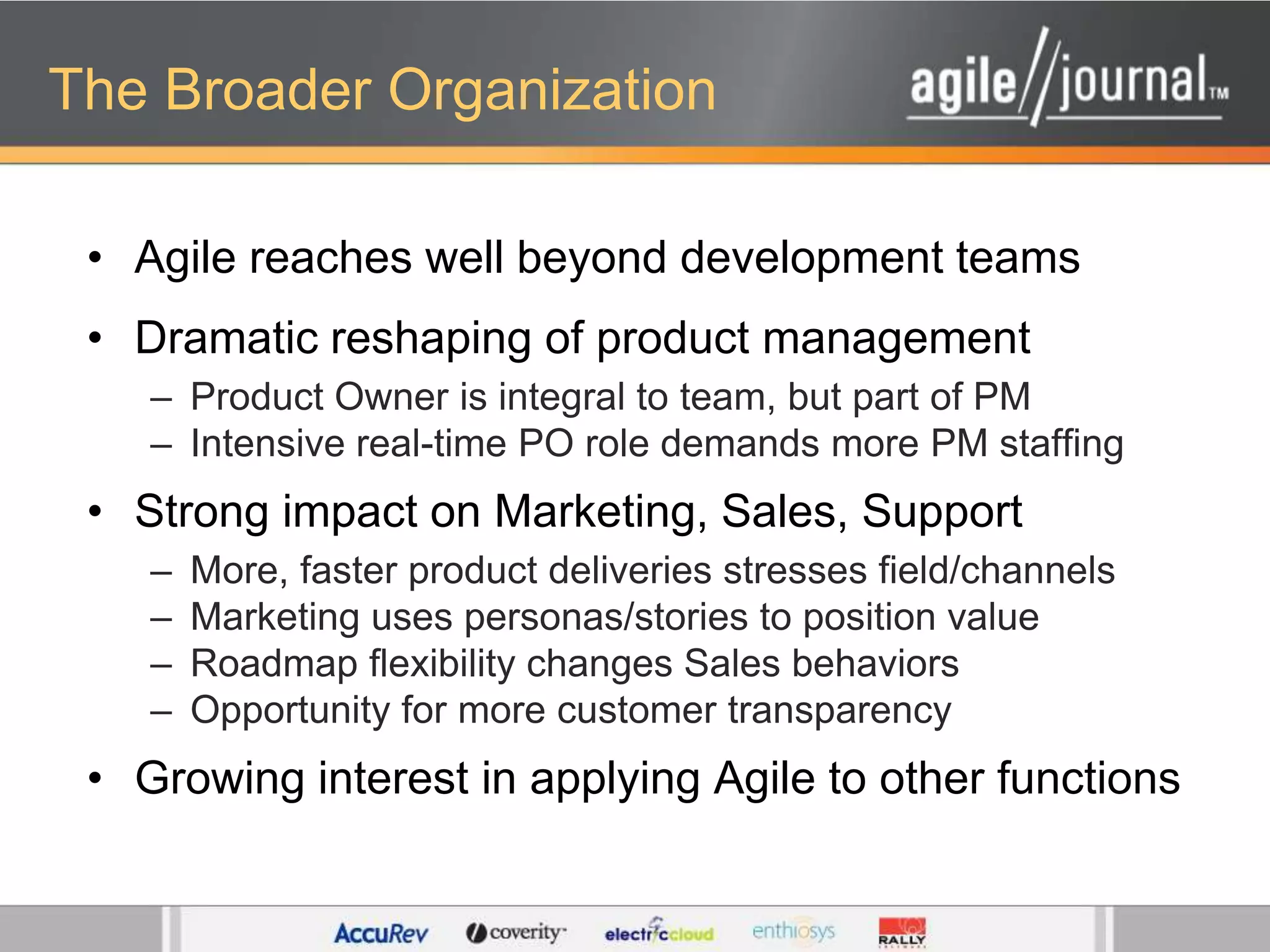
The Broader OrganizationAgile reaches well beyond development teamsDramatic reshaping of product managementProduct Owner is integral to team, but part of PMIntensive real-time PO role demands more PM staffingStrong impact on Marketing, Sales, SupportMore, faster product deliveries stresses field/channelsMarketing uses personas/stories to position valueRoadmap flexibility changes Sales behaviorsOpportunity for more customer transparencyGrowing interest in applying Agile to other functions
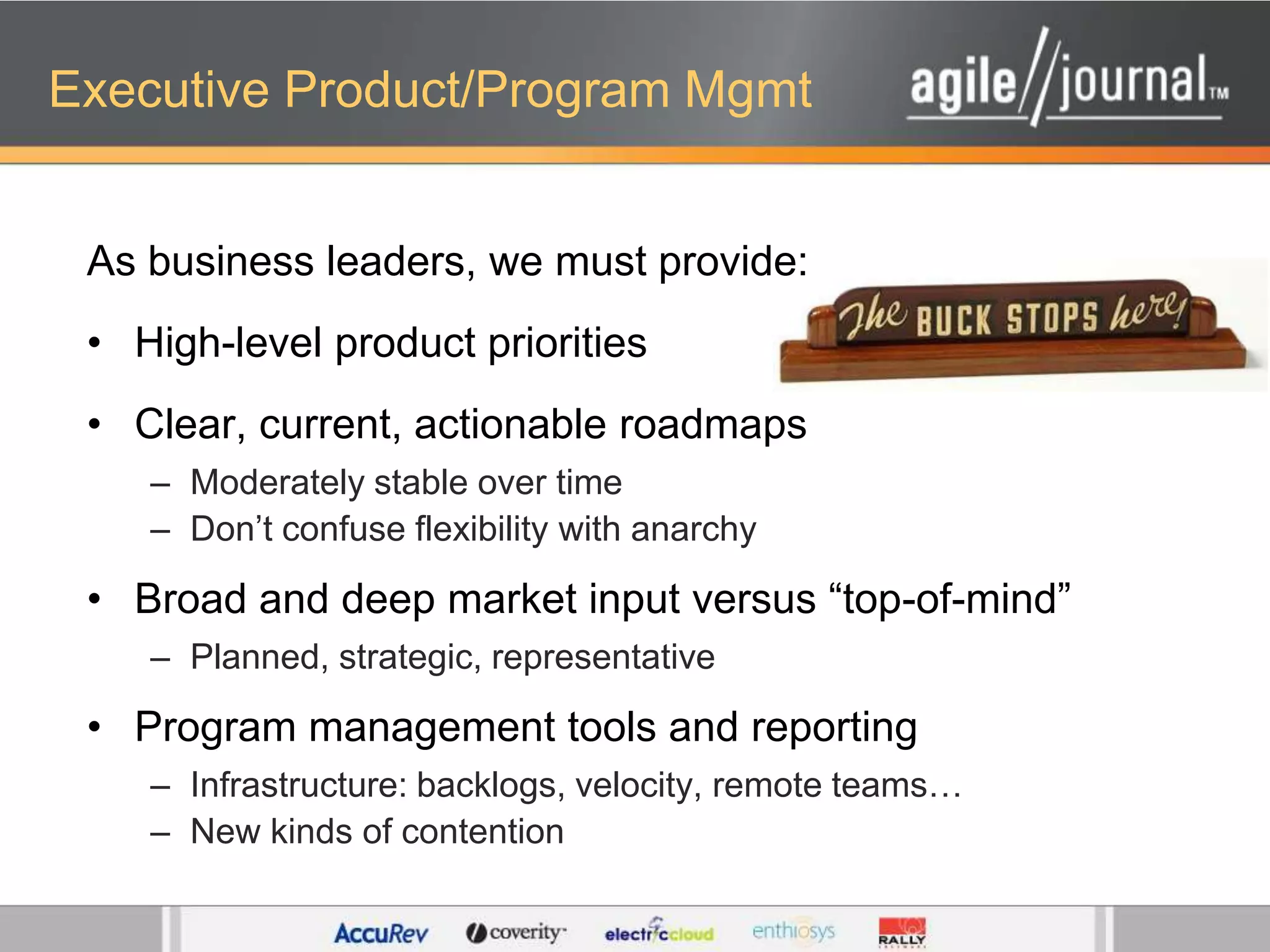
Executive Product/Program MgmtAs business leaders, we must provide:High-level product prioritiesClear, current, actionable roadmapsModerately stable over timeDon’t confuse flexibility with anarchyBroad and deep market input versus “top-of-mind”Planned, strategic, representativeProgram management tools and reportingInfrastructure: backlogs, velocity, remote teams…New kinds of contention
Take-AwaysThe best software organizations using Agile to improve results and internal satisfactionBlends methodology, skills, tooling, coaching and company-wide collaborative attitudeTransformation takes time and resourcesMost impact on Engineering and Product ManagementKeep management attention on roadmap, strategic priorities, high-level goals and metricsEmpower teams to find their way to success

Agile Comes to You (Mironov, Bellevue)

  • 1.
    Agile Comes ToYouPresented by AccuRev, Coverity, Enthiosys, Electric Cloud, Rally and Agile JournalJuly 28, 2009Bellevue, WA
  • 2.
    Agenda 8:45 AM Welcome:Cliff Utstein, AccuRev9:00 AM Keynote: Rich Mironov, Enthiosys9:45 AM Coverity: "Managing Software Quality in Agile Environments"10:15 AM Break10:30 AM Rally: "Case Study: Customizing Agile Tools for Project Success" 11:00 AM AccuRev: "Automating Agile software development processes"11:30 AM Break11:45 AM Electric Cloud: "Optimizing Your Development, Build and Release Processes"12:15 PM Lunch and Vendor Demonstrations1:30-2PM Raffle
  • 3.
    About Rich MironovCMOat Enthiosys, agile product mgmt consultancyBusiness models/pricing, roadmapsAgile transformation and Interim product execInnovation Games® and customer needsChair of Agile 2009 PM/PO stageRepeat offender at software prod mgmtTandem, Sybase, four start-ups“The Art of Product Management” and monthly agile product blog
  • 4.
    What is Agile?Umbrellaterm describing sets of software project management and engineering methods/practicesIncremental, iterative and collaborative, rather than distinct stages More frequent delivery of smaller, valuable incrementsBuilding quality in, not adding it at the endGoal of potentially shippable at every iterationActive user involvement (or customer proxy)Agile teams must be empowered and self-motivating
  • 5.
    Discussions about Agile…Partphilosophy and religionPart process, tools, techniques, methodsPart organizational design
  • 6.
    Agile is anUmbrellaagile methodsScrumExtreme Programming (XP)Agile Project Management Framework (APM)Crystal MethodsDynamic Systems Development Model (DSDM)Rational Unified Process (RUP)Feature Driven Development (FDD)Lean DevelopmentRapid Application Development (RAD)…
  • 7.
    Lean RootsRoots inToyota Production System“Create a continuous process flow to bring problems to the surface”“Level out the workload”“Build a culture of stopping to fix problems, to get quality right the first time”“Become a learning organization through relentless reflection and continuous improvement”Source: Liker, Jeffrey (2004). "The 14 Principles Of The Toyota Way: An Executive Summary of the Culture Behind TPS".
  • 8.
    The Agile Manifesto(2001)We are uncovering better ways of developing software by doing it and helping others do it. Through this work we have come to value: Individuals and interactions over processes and toolsWorking software over comprehensive documentation Customer collaboration over contract negotiationResponding to change over following a plan That is, while there is value in the items on the right, we value the items on the left more. www.agilemanifesto.org
  • 9.
    12 Agile PrinciplesOurhighest priority is to satisfy the customer through early and continuous delivery of valuable software. Welcome changing requirements, even late in development. Agile processes harness change for the customer's competitive advantage. Deliver working software frequently, from a couple of weeks to a couple of months, with a preference to the shorter time scale. Business people and developers must work together daily throughout the project.
  • 10.
    12 Agile PrinciplesBuildprojects around motivated individuals. Give them the environment and support they need, and trust them to get the job done. The most efficient and effective method of conveying information to and within a development team is face-to-face conversation. Working software is the primary measure of progress. Agile processes promote sustainable development. The sponsors, developers, and users should be able to maintain a constant pace indefinitely.
  • 11.
    12 Agile PrinciplesContinuousattention to technical excellence and good design enhances agility. Simplicity - the art of maximizing the amount of work not done - is essential. The best architectures, requirements and designs emerge from self-organizing teams. At regular intervals, the team reflects on how to become more effective, then tunes and adjusts its behavior accordingly.
  • 12.
    RequirementsDesignCoding and unittestSystem integration & QAOperation and maintenanceWaterfall: Linear, Cascading
  • 13.
    Agile (Scrum) ModelPlanout 1-4 weeks workMeet dailyCreate product needs Review productStrategic planningImprove processAfter: Gabrielle Benefield
  • 14.
    Fixed Vs. VariableWaterfallAgileFixedRequirementsTimeResourcesValueDrivenPlanDrivenEstimatedFeaturesTimeResourcesThe Plan creates cost/schedule estimatesRelease themes and feature intent drive estimates
  • 15.
    Planning Time HorizonsmanyyearsExecStrategyyearsPortfoliomany monsPMProduct2-9 monReleaseDevTeamSprint2 wkDaily
  • 16.
    State of AgileTodayMost companies early in agile adoption cyclePockets of pioneersOften distributed teamsSome examples of fully scaled-up divisionsHighlights need for portfolio-level planningData from VersionOne
  • 17.
    Business Benefits ofAgileShorter development cyclesStrategic flexibilityDeeper connection and alignment with marketsImproved team moraleGreater profitabilityBut requires investment, leadership and patience
  • 18.
    Agile TransformationAgile isabout changing the way people workNot just the tools they useNot just units of work or development sequenceOrganizational change takes timeA successful 300-person Eng team took 18+ monthsExecutives need to drive organizational issues and expectationsLet teams handle their own detailsPlan for outside experts, coaches, instructorsSome of your team won’t fit with Agile
  • 19.
    3 Legs ofthe Agile StoolManagementProduct & ProjectCorporateStructure & CultureEngineeringQuantity & Quality
  • 20.
    Staffing & ResourcesAllocationExecutive’s key tasks: build teams, set prioritiesAgile wants stable teams, fewer projects/person5-7 core technical members (dev, QA, Ops)Strong intra-team leadership (product, program, requirements) may be sharedPool of technical experts (architect, UI)At your company, how many projects is each developer assigned to? Each architect?
  • 21.
    Engineering Resource PoolDevelopersQAProdMgmtSWArchSecArchPgmMgmtUI/UXDDevTools / Release Eng docsTechOpsProduct ownerFully dedicatedScrum masterPartlydedicatedResource allocation is strategic
  • 22.
    Whole Product TeamMostAgilists focus here
  • 23.
    The Broader OrganizationAgilereaches well beyond development teamsDramatic reshaping of product managementProduct Owner is integral to team, but part of PMIntensive real-time PO role demands more PM staffingStrong impact on Marketing, Sales, SupportMore, faster product deliveries stresses field/channelsMarketing uses personas/stories to position valueRoadmap flexibility changes Sales behaviorsOpportunity for more customer transparencyGrowing interest in applying Agile to other functions
  • 24.
    Executive Product/Program MgmtAsbusiness leaders, we must provide:High-level product prioritiesClear, current, actionable roadmapsModerately stable over timeDon’t confuse flexibility with anarchyBroad and deep market input versus “top-of-mind”Planned, strategic, representativeProgram management tools and reportingInfrastructure: backlogs, velocity, remote teams…New kinds of contention
  • 25.
    Take-AwaysThe best softwareorganizations using Agile to improve results and internal satisfactionBlends methodology, skills, tooling, coaching and company-wide collaborative attitudeTransformation takes time and resourcesMost impact on Engineering and Product ManagementKeep management attention on roadmap, strategic priorities, high-level goals and metricsEmpower teams to find their way to success

Editor's Notes

  • #5 Include “continuous integration” and transparency and surfacing deadwood.