Prioritization 301
   Advanced Roadmapping Class


         Bruce McCarthy
   Chief Product Person, Reqqs
         bruce@reqqs.com
          www.reqqs.com
           @d8a_driven
Why roadmaps matter
R
“Did [Previous PM] send you his
 spreadsheet of [5 trillion un-
 prioritized] feature requests?”
          - VP Product Management
“We need this to close
[big deal] this quarter!”
             - Key Sales Person
“37% of our Support calls are about
 [oldest, hairiest part of the code].
           Can’t we fix it?”
                   - Support Manager
“[Shiny tech thing] will make
[your top priority] much easier!”
                       - Tech Lead
“[Previously irrelevant competitor]
just shipped [shiny feature]. How are
     we going to leapfrog them?”
                        - VP Marketing
“We gotta drop everything and work
  on [meaningless buzzword]. It’s
         gonna be huge!”
                         - VP Sales
“If you don’t support [obscure
platform] I can’t buy your stuff.”
               - Key Customer CTO
“Why would anybody schedule [easy
feature] before [hard feature]? Who
  approved that [expletive] idea?”
                               - CEO
“What’s your business case for [CEO’s
  pet project]? When do we make
              money?”
                               - CFO
“You can’t add work without
subtracting something? What, is your
         whole team lazy?”
                               - CEO
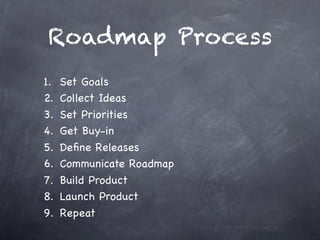
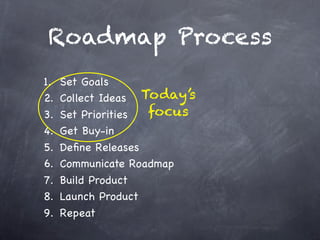
Roadmap Process
1.   Set Goals
2.   Collect Ideas
3.   Set Priorities
4.   Get Buy-in
5.   Define Releases
6.   Communicate Roadmap
7.   Build Product
8.   Launch Product
9.   Repeat
Roadmap Process
1.   Set Goals
2.   Collect Ideas Today’s
3.   Set Priorities focus
4.   Get Buy-in
5.   Define Releases
6.   Communicate Roadmap
7.   Build Product
8.   Launch Product
9.   Repeat
Prioritization
Prioritization
Important
 Basis of your roadmap

 Can determine success

 Inspires confidence

 Grooms your backlog

 Key PM skill
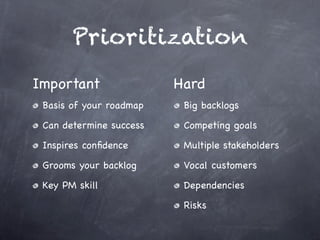
Prioritization
Important                Hard
 Basis of your roadmap    Big backlogs

 Can determine success    Competing goals

 Inspires confidence       Multiple stakeholders

 Grooms your backlog      Vocal customers

 Key PM skill             Dependencies

                          Risks
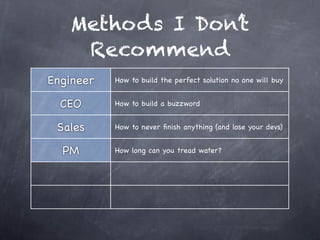
Methods I Don’t
 Recommend
Methods I Don’t
 Recommend
Methods I Don’t
    Recommend
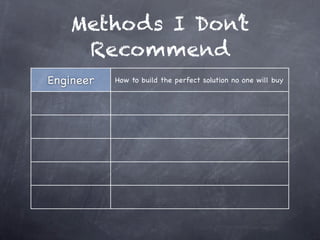
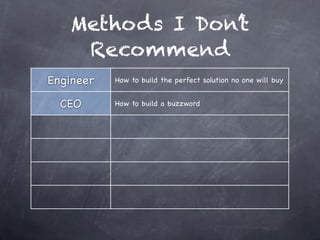
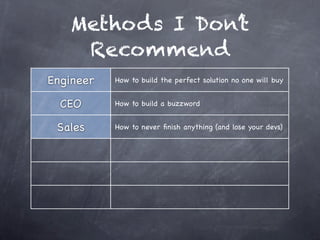
Engineer   How to build the perfect solution no one will buy
Methods I Don’t
    Recommend
Engineer   How to build the perfect solution no one will buy


  CEO      How to build a buzzword
Methods I Don’t
    Recommend
Engineer   How to build the perfect solution no one will buy


  CEO      How to build a buzzword


 Sales     How to never finish anything (and lose your devs)
Methods I Don’t
    Recommend
Engineer   How to build the perfect solution no one will buy


  CEO      How to build a buzzword


 Sales     How to never finish anything (and lose your devs)


  PM       How long can you tread water?
Methods I Don’t
    Recommend
Engineer   How to build the perfect solution no one will buy


  CEO      How to build a buzzword


 Sales     How to never finish anything (and lose your devs)


  PM       How long can you tread water?


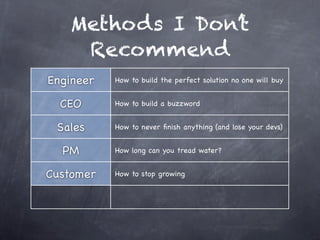
Customer   How to stop growing
Methods I Don’t
    Recommend
Engineer   How to build the perfect solution no one will buy


  CEO      How to build a buzzword


 Sales     How to never finish anything (and lose your devs)


  PM       How long can you tread water?


Customer   How to stop growing


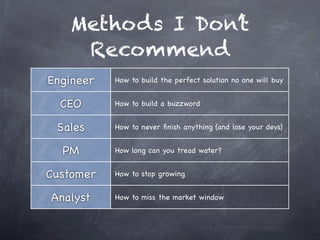
Analyst    How to miss the market window
Math makes (almost)
 everything better
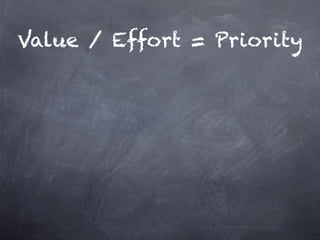
Value / Effort = Priority
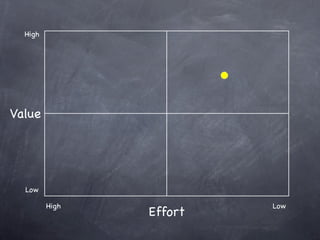
High


Value


  Low

         High            Low
                Effort
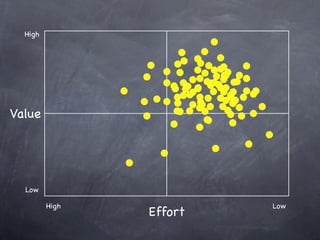
High


Value


  Low

         High            Low
                Effort
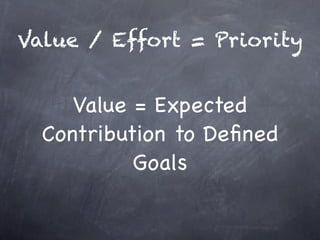
Value / Effort = Priority


     Value = Expected
  Contribution to Defined
           Goals
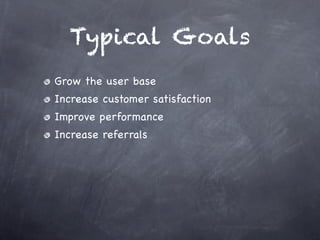
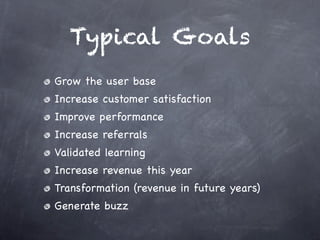
Typical Goals
Typical Goals
Grow the user base
Typical Goals
Grow the user base
Increase customer satisfaction
Typical Goals
Grow the user base
Increase customer satisfaction
Improve performance
Typical Goals
Grow the user base
Increase customer satisfaction
Improve performance
Increase referrals
Typical Goals
Grow the user base
Increase customer satisfaction
Improve performance
Increase referrals
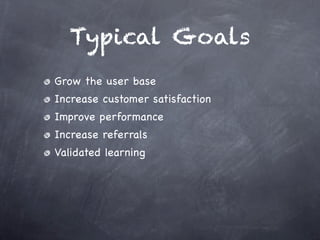
Validated learning
Typical Goals
Grow the user base
Increase customer satisfaction
Improve performance
Increase referrals
Validated learning
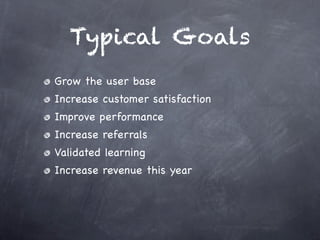
Increase revenue this year
Typical Goals
Grow the user base
Increase customer satisfaction
Improve performance
Increase referrals
Validated learning
Increase revenue this year
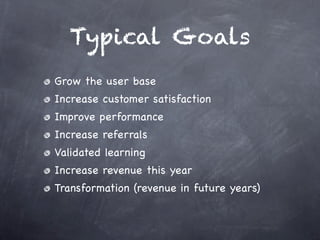
Transformation (revenue in future years)
Typical Goals
Grow the user base
Increase customer satisfaction
Improve performance
Increase referrals
Validated learning
Increase revenue this year
Transformation (revenue in future years)
Generate buzz
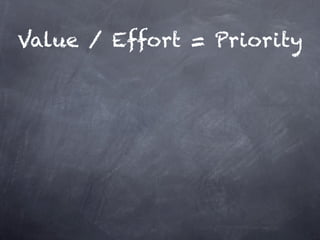
Value / Effort = Priority


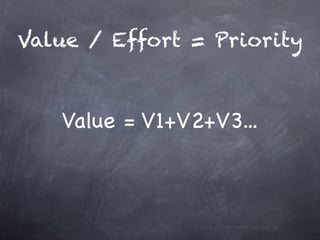
   Value = V1+V2+V3...
Value / Effort = Priority


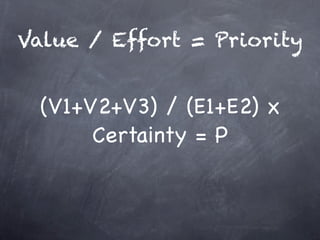
 (V1+V2+V3) / (E1+E2) x
      Certainty = P
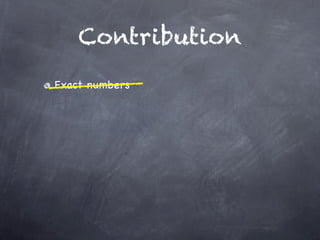
Contribution
Contribution
Exact numbers
Contribution
Exact numbers
Contribution
Exact numbers

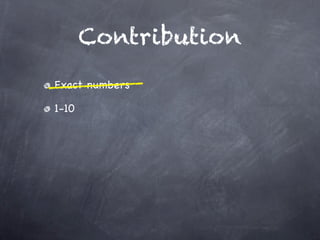
1-10
Contribution
Exact numbers

1-10

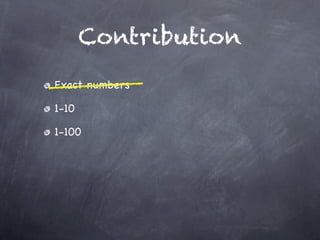
1-100
Contribution
Exact numbers

1-10

1-100

Fibonacci
Contribution
Exact numbers

1-10

1-100

Fibonacci

1 to 5 stars
Contribution
Exact numbers

1-10

1-100

Fibonacci

1 to 5 stars

0,1,2
Contribution
Exact numbers

1-10

1-100

Fibonacci

1 to 5 stars

0,1,2
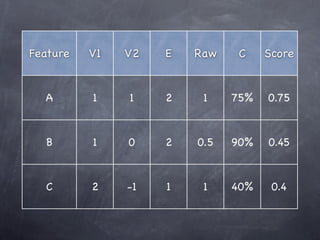
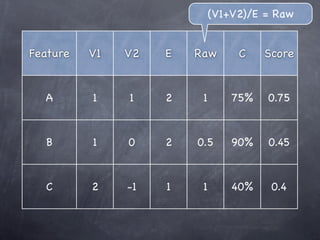
Feature   V1   V2   E   Raw    C    Score


  A       1    1    2    1    75%   0.75


  B       1    0    2   0.5   90%   0.45


  C       2    -1   1    1    40%    0.4
(V1+V2)/E = Raw


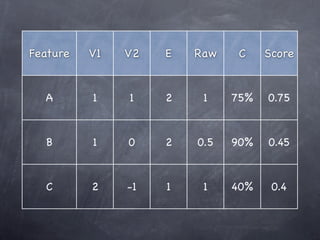
Feature   V1   V2   E   Raw       C    Score


  A       1    1    2    1       75%   0.75


  B       1    0    2   0.5      90%   0.45


  C       2    -1   1    1       40%    0.4
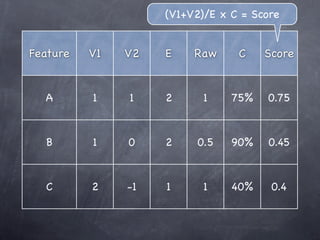
Feature   V1   V2   E   Raw    C    Score


  A       1    1    2    1    75%   0.75


  B       1    0    2   0.5   90%   0.45


  C       2    -1   1    1    40%    0.4
(V1+V2)/E x C = Score


Feature   V1   V2   E    Raw     C    Score


  A       1    1    2      1    75%   0.75


  B       1    0    2    0.5    90%    0.45


  C       2    -1   1      1    40%    0.4
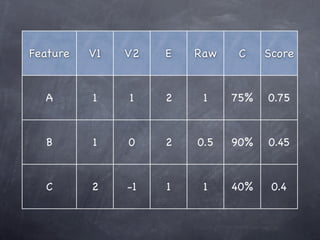
Feature   V1   V2   E   Raw    C    Score


  A       1    1    2    1    75%   0.75


  B       1    0    2   0.5   90%   0.45


  C       2    -1   1    1    40%    0.4
Are We There Yet?
Roadmap Process
1.   Set Goals
2.   Collect Ideas
3.   Set Priorities
4.   Get Buy-in
5.   Define Releases
6.   Communicate Roadmap
7.   Build Product
8.   Launch Product
9.   Repeat
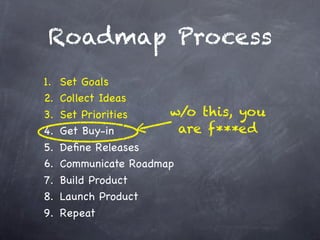
Roadmap Process
1.   Set Goals
2.   Collect Ideas
3.   Set Priorities    w/o this, you
4.   Get Buy-in          are f***ed
5.   Define Releases
6.   Communicate Roadmap
7.   Build Product
8.   Launch Product
9.   Repeat
Shuttle Diplomacy

 “I’ve got a draft set of
priorities. Would you help
       me refine it?”
Collaboration

“I’ll present our priorities
to the executive team on
           Friday”
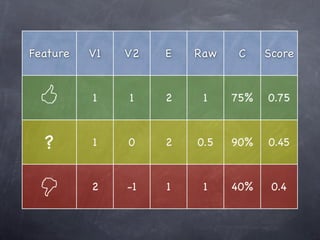
Feature   V1   V2   E   Raw    C    Score


         1    1    2    1    75%   0.75


  ?       1    0    2   0.5   90%   0.45


         2    -1   1    1    40%    0.4
Use Tools
(Don’t let them use you.)
Discussion
For Slides & Excel
     Template

         Bruce McCarthy
   Chief Product Person, Reqqs
         bruce@reqqs.com
    www.reqqs.com/resources
           @d8a_driven

Prioritization 301 - Advanced Roadmapping Class, Bruce McCarthy

Editor's Notes

  • #2 I’m Bruce McCarthy, CPP of Reqqs - the smart roadmap tool for product people. I’ve been in product management for 16 years at companies like iMarket (bought by Dun & Bradstreet) and ATG (bought by Oracle). My day job currently is VP of Product at NetProspex in Waltham. \n\nI’m here to talk about how to do prioritization in an objective and collaborative way so that you can get the buy-in you need to put together a roadmap that will stick. This is the advanced class because you guys are well beyond the basics of H-M-L.\n\nI developed this methodology over time in various jobs. I’ve seen it work over and over again where gut instinct or endless meetings fail. In talking with other product people, I’ve found the good ones usually develop something similar. I’ve really just tried to standardize it and genericize it a bit so everyone can benefit.\n
  • #3 In today’s agile world, do roadmaps still matter? Aren’t we allowed to change direction after each sprint? Actually, I think roadmaps are needed even more in an agile world. Yes, you can correct course after each sprint, but you should be correcting course toward something - toward a vision of where you want your product or your company to be in a year or 2 or 3. You need to stake out that vision and then you need to work out what you think is the best path to get there. That’s your roadmap.\n
  • #4 Your roadmap is also a shield against the constant onslaught of potentially diverting requests from all quarters.\n
  • #5 \n
  • #6 \n
  • #7 \n
  • #8 \n
  • #9 \n
  • #10 \n
  • #11 \n
  • #12 \n
  • #13 \n
  • #14 This is my favorite - actually heard - CEO quote.\n
  • #15 Your roadmap isn’t much of a shield unless you have buy-in from your stakeholders on it. Before you can get that, though, you need priorities. To set priorities you need ideas, and you need goals to test those ideas against. I want to talk about priorities first because your roadmap is really a reflection - a timeline view - of your priorities.\n
  • #16 Your roadmap isn’t much of a shield unless you have buy-in from your stakeholders on it. Before you can get that, though, you need priorities. To set priorities you need ideas, and you need goals to test those ideas against. I want to talk about priorities first because your roadmap is really a reflection - a timeline view - of your priorities.\n
  • #17 \n
  • #18 \n
  • #19 The PM’s gut is near and dear to my heart, of course, but it can only take you so far. Sooner or later you need data. Even more, though, you need consensus from all of these stakeholders.\n
  • #20 The PM’s gut is near and dear to my heart, of course, but it can only take you so far. Sooner or later you need data. Even more, though, you need consensus from all of these stakeholders.\n
  • #21 The PM’s gut is near and dear to my heart, of course, but it can only take you so far. Sooner or later you need data. Even more, though, you need consensus from all of these stakeholders.\n
  • #22 The PM’s gut is near and dear to my heart, of course, but it can only take you so far. Sooner or later you need data. Even more, though, you need consensus from all of these stakeholders.\n
  • #23 The PM’s gut is near and dear to my heart, of course, but it can only take you so far. Sooner or later you need data. Even more, though, you need consensus from all of these stakeholders.\n
  • #24 The PM’s gut is near and dear to my heart, of course, but it can only take you so far. Sooner or later you need data. Even more, though, you need consensus from all of these stakeholders.\n
  • #25 The PM’s gut is near and dear to my heart, of course, but it can only take you so far. Sooner or later you need data. Even more, though, you need consensus from all of these stakeholders.\n
  • #26 There is a better way.\n
  • #27 A simple equation. It’s really the familiar ROI calculation. Effort is the investment you make to generate value in return. The items in your backlog that have the highest ROI are the ones you should do first, right?\n
  • #28 Analysts and some requirements tools like to plot value vs. effort on the classic 2x2 grid. You do the things that fall in the upper right quadrant, right? That works fine when you have 5 or 10 things to prioritize, but most of us are dealing with hundreds. How do you figure out which is closest to the corner here? And don’t most of us have several projects running in parallel?\n
  • #29 Analysts and some requirements tools like to plot value vs. effort on the classic 2x2 grid. You do the things that fall in the upper right quadrant, right? That works fine when you have 5 or 10 things to prioritize, but most of us are dealing with hundreds. How do you figure out which is closest to the corner here? And don’t most of us have several projects running in parallel?\n
  • #30 Analysts and some requirements tools like to plot value vs. effort on the classic 2x2 grid. You do the things that fall in the upper right quadrant, right? That works fine when you have 5 or 10 things to prioritize, but most of us are dealing with hundreds. How do you figure out which is closest to the corner here? And don’t most of us have several projects running in parallel?\n
  • #31 Analysts and some requirements tools like to plot value vs. effort on the classic 2x2 grid. You do the things that fall in the upper right quadrant, right? That works fine when you have 5 or 10 things to prioritize, but most of us are dealing with hundreds. How do you figure out which is closest to the corner here? And don’t most of us have several projects running in parallel?\n
  • #32 Analysts and some requirements tools like to plot value vs. effort on the classic 2x2 grid. You do the things that fall in the upper right quadrant, right? That works fine when you have 5 or 10 things to prioritize, but most of us are dealing with hundreds. How do you figure out which is closest to the corner here? And don’t most of us have several projects running in parallel?\n
  • #33 Analysts and some requirements tools like to plot value vs. effort on the classic 2x2 grid. You do the things that fall in the upper right quadrant, right? That works fine when you have 5 or 10 things to prioritize, but most of us are dealing with hundreds. How do you figure out which is closest to the corner here? And don’t most of us have several projects running in parallel?\n
  • #34 Analysts and some requirements tools like to plot value vs. effort on the classic 2x2 grid. You do the things that fall in the upper right quadrant, right? That works fine when you have 5 or 10 things to prioritize, but most of us are dealing with hundreds. How do you figure out which is closest to the corner here? And don’t most of us have several projects running in parallel?\n
  • #35 Analysts and some requirements tools like to plot value vs. effort on the classic 2x2 grid. You do the things that fall in the upper right quadrant, right? That works fine when you have 5 or 10 things to prioritize, but most of us are dealing with hundreds. How do you figure out which is closest to the corner here? And don’t most of us have several projects running in parallel?\n
  • #36 Analysts and some requirements tools like to plot value vs. effort on the classic 2x2 grid. You do the things that fall in the upper right quadrant, right? That works fine when you have 5 or 10 things to prioritize, but most of us are dealing with hundreds. How do you figure out which is closest to the corner here? And don’t most of us have several projects running in parallel?\n
  • #37 Analysts and some requirements tools like to plot value vs. effort on the classic 2x2 grid. You do the things that fall in the upper right quadrant, right? That works fine when you have 5 or 10 things to prioritize, but most of us are dealing with hundreds. How do you figure out which is closest to the corner here? And don’t most of us have several projects running in parallel?\n
  • #38 Analysts and some requirements tools like to plot value vs. effort on the classic 2x2 grid. You do the things that fall in the upper right quadrant, right? That works fine when you have 5 or 10 things to prioritize, but most of us are dealing with hundreds. How do you figure out which is closest to the corner here? And don’t most of us have several projects running in parallel?\n
  • #39 Analysts and some requirements tools like to plot value vs. effort on the classic 2x2 grid. You do the things that fall in the upper right quadrant, right? That works fine when you have 5 or 10 things to prioritize, but most of us are dealing with hundreds. How do you figure out which is closest to the corner here? And don’t most of us have several projects running in parallel?\n
  • #40 Analysts and some requirements tools like to plot value vs. effort on the classic 2x2 grid. You do the things that fall in the upper right quadrant, right? That works fine when you have 5 or 10 things to prioritize, but most of us are dealing with hundreds. How do you figure out which is closest to the corner here? And don’t most of us have several projects running in parallel?\n
  • #41 Analysts and some requirements tools like to plot value vs. effort on the classic 2x2 grid. You do the things that fall in the upper right quadrant, right? That works fine when you have 5 or 10 things to prioritize, but most of us are dealing with hundreds. How do you figure out which is closest to the corner here? And don’t most of us have several projects running in parallel?\n
  • #42 Analysts and some requirements tools like to plot value vs. effort on the classic 2x2 grid. You do the things that fall in the upper right quadrant, right? That works fine when you have 5 or 10 things to prioritize, but most of us are dealing with hundreds. How do you figure out which is closest to the corner here? And don’t most of us have several projects running in parallel?\n
  • #43 Analysts and some requirements tools like to plot value vs. effort on the classic 2x2 grid. You do the things that fall in the upper right quadrant, right? That works fine when you have 5 or 10 things to prioritize, but most of us are dealing with hundreds. How do you figure out which is closest to the corner here? And don’t most of us have several projects running in parallel?\n
  • #44 Analysts and some requirements tools like to plot value vs. effort on the classic 2x2 grid. You do the things that fall in the upper right quadrant, right? That works fine when you have 5 or 10 things to prioritize, but most of us are dealing with hundreds. How do you figure out which is closest to the corner here? And don’t most of us have several projects running in parallel?\n
  • #45 Analysts and some requirements tools like to plot value vs. effort on the classic 2x2 grid. You do the things that fall in the upper right quadrant, right? That works fine when you have 5 or 10 things to prioritize, but most of us are dealing with hundreds. How do you figure out which is closest to the corner here? And don’t most of us have several projects running in parallel?\n
  • #46 Analysts and some requirements tools like to plot value vs. effort on the classic 2x2 grid. You do the things that fall in the upper right quadrant, right? That works fine when you have 5 or 10 things to prioritize, but most of us are dealing with hundreds. How do you figure out which is closest to the corner here? And don’t most of us have several projects running in parallel?\n
  • #47 Analysts and some requirements tools like to plot value vs. effort on the classic 2x2 grid. You do the things that fall in the upper right quadrant, right? That works fine when you have 5 or 10 things to prioritize, but most of us are dealing with hundreds. How do you figure out which is closest to the corner here? And don’t most of us have several projects running in parallel?\n
  • #48 Analysts and some requirements tools like to plot value vs. effort on the classic 2x2 grid. You do the things that fall in the upper right quadrant, right? That works fine when you have 5 or 10 things to prioritize, but most of us are dealing with hundreds. How do you figure out which is closest to the corner here? And don’t most of us have several projects running in parallel?\n
  • #49 Analysts and some requirements tools like to plot value vs. effort on the classic 2x2 grid. You do the things that fall in the upper right quadrant, right? That works fine when you have 5 or 10 things to prioritize, but most of us are dealing with hundreds. How do you figure out which is closest to the corner here? And don’t most of us have several projects running in parallel?\n
  • #50 Analysts and some requirements tools like to plot value vs. effort on the classic 2x2 grid. You do the things that fall in the upper right quadrant, right? That works fine when you have 5 or 10 things to prioritize, but most of us are dealing with hundreds. How do you figure out which is closest to the corner here? And don’t most of us have several projects running in parallel?\n
  • #51 Analysts and some requirements tools like to plot value vs. effort on the classic 2x2 grid. You do the things that fall in the upper right quadrant, right? That works fine when you have 5 or 10 things to prioritize, but most of us are dealing with hundreds. How do you figure out which is closest to the corner here? And don’t most of us have several projects running in parallel?\n
  • #52 Analysts and some requirements tools like to plot value vs. effort on the classic 2x2 grid. You do the things that fall in the upper right quadrant, right? That works fine when you have 5 or 10 things to prioritize, but most of us are dealing with hundreds. How do you figure out which is closest to the corner here? And don’t most of us have several projects running in parallel?\n
  • #53 Analysts and some requirements tools like to plot value vs. effort on the classic 2x2 grid. You do the things that fall in the upper right quadrant, right? That works fine when you have 5 or 10 things to prioritize, but most of us are dealing with hundreds. How do you figure out which is closest to the corner here? And don’t most of us have several projects running in parallel?\n
  • #54 Analysts and some requirements tools like to plot value vs. effort on the classic 2x2 grid. You do the things that fall in the upper right quadrant, right? That works fine when you have 5 or 10 things to prioritize, but most of us are dealing with hundreds. How do you figure out which is closest to the corner here? And don’t most of us have several projects running in parallel?\n
  • #55 Analysts and some requirements tools like to plot value vs. effort on the classic 2x2 grid. You do the things that fall in the upper right quadrant, right? That works fine when you have 5 or 10 things to prioritize, but most of us are dealing with hundreds. How do you figure out which is closest to the corner here? And don’t most of us have several projects running in parallel?\n
  • #56 Analysts and some requirements tools like to plot value vs. effort on the classic 2x2 grid. You do the things that fall in the upper right quadrant, right? That works fine when you have 5 or 10 things to prioritize, but most of us are dealing with hundreds. How do you figure out which is closest to the corner here? And don’t most of us have several projects running in parallel?\n
  • #57 Analysts and some requirements tools like to plot value vs. effort on the classic 2x2 grid. You do the things that fall in the upper right quadrant, right? That works fine when you have 5 or 10 things to prioritize, but most of us are dealing with hundreds. How do you figure out which is closest to the corner here? And don’t most of us have several projects running in parallel?\n
  • #58 Analysts and some requirements tools like to plot value vs. effort on the classic 2x2 grid. You do the things that fall in the upper right quadrant, right? That works fine when you have 5 or 10 things to prioritize, but most of us are dealing with hundreds. How do you figure out which is closest to the corner here? And don’t most of us have several projects running in parallel?\n
  • #59 Analysts and some requirements tools like to plot value vs. effort on the classic 2x2 grid. You do the things that fall in the upper right quadrant, right? That works fine when you have 5 or 10 things to prioritize, but most of us are dealing with hundreds. How do you figure out which is closest to the corner here? And don’t most of us have several projects running in parallel?\n
  • #60 Analysts and some requirements tools like to plot value vs. effort on the classic 2x2 grid. You do the things that fall in the upper right quadrant, right? That works fine when you have 5 or 10 things to prioritize, but most of us are dealing with hundreds. How do you figure out which is closest to the corner here? And don’t most of us have several projects running in parallel?\n
  • #61 Analysts and some requirements tools like to plot value vs. effort on the classic 2x2 grid. You do the things that fall in the upper right quadrant, right? That works fine when you have 5 or 10 things to prioritize, but most of us are dealing with hundreds. How do you figure out which is closest to the corner here? And don’t most of us have several projects running in parallel?\n
  • #62 Analysts and some requirements tools like to plot value vs. effort on the classic 2x2 grid. You do the things that fall in the upper right quadrant, right? That works fine when you have 5 or 10 things to prioritize, but most of us are dealing with hundreds. How do you figure out which is closest to the corner here? And don’t most of us have several projects running in parallel?\n
  • #63 Analysts and some requirements tools like to plot value vs. effort on the classic 2x2 grid. You do the things that fall in the upper right quadrant, right? That works fine when you have 5 or 10 things to prioritize, but most of us are dealing with hundreds. How do you figure out which is closest to the corner here? And don’t most of us have several projects running in parallel?\n
  • #64 Analysts and some requirements tools like to plot value vs. effort on the classic 2x2 grid. You do the things that fall in the upper right quadrant, right? That works fine when you have 5 or 10 things to prioritize, but most of us are dealing with hundreds. How do you figure out which is closest to the corner here? And don’t most of us have several projects running in parallel?\n
  • #65 Analysts and some requirements tools like to plot value vs. effort on the classic 2x2 grid. You do the things that fall in the upper right quadrant, right? That works fine when you have 5 or 10 things to prioritize, but most of us are dealing with hundreds. How do you figure out which is closest to the corner here? And don’t most of us have several projects running in parallel?\n
  • #66 Analysts and some requirements tools like to plot value vs. effort on the classic 2x2 grid. You do the things that fall in the upper right quadrant, right? That works fine when you have 5 or 10 things to prioritize, but most of us are dealing with hundreds. How do you figure out which is closest to the corner here? And don’t most of us have several projects running in parallel?\n
  • #67 Analysts and some requirements tools like to plot value vs. effort on the classic 2x2 grid. You do the things that fall in the upper right quadrant, right? That works fine when you have 5 or 10 things to prioritize, but most of us are dealing with hundreds. How do you figure out which is closest to the corner here? And don’t most of us have several projects running in parallel?\n
  • #68 Analysts and some requirements tools like to plot value vs. effort on the classic 2x2 grid. You do the things that fall in the upper right quadrant, right? That works fine when you have 5 or 10 things to prioritize, but most of us are dealing with hundreds. How do you figure out which is closest to the corner here? And don’t most of us have several projects running in parallel?\n
  • #69 Analysts and some requirements tools like to plot value vs. effort on the classic 2x2 grid. You do the things that fall in the upper right quadrant, right? That works fine when you have 5 or 10 things to prioritize, but most of us are dealing with hundreds. How do you figure out which is closest to the corner here? And don’t most of us have several projects running in parallel?\n
  • #70 Analysts and some requirements tools like to plot value vs. effort on the classic 2x2 grid. You do the things that fall in the upper right quadrant, right? That works fine when you have 5 or 10 things to prioritize, but most of us are dealing with hundreds. How do you figure out which is closest to the corner here? And don’t most of us have several projects running in parallel?\n
  • #71 Analysts and some requirements tools like to plot value vs. effort on the classic 2x2 grid. You do the things that fall in the upper right quadrant, right? That works fine when you have 5 or 10 things to prioritize, but most of us are dealing with hundreds. How do you figure out which is closest to the corner here? And don’t most of us have several projects running in parallel?\n
  • #72 Analysts and some requirements tools like to plot value vs. effort on the classic 2x2 grid. You do the things that fall in the upper right quadrant, right? That works fine when you have 5 or 10 things to prioritize, but most of us are dealing with hundreds. How do you figure out which is closest to the corner here? And don’t most of us have several projects running in parallel?\n
  • #73 Analysts and some requirements tools like to plot value vs. effort on the classic 2x2 grid. You do the things that fall in the upper right quadrant, right? That works fine when you have 5 or 10 things to prioritize, but most of us are dealing with hundreds. How do you figure out which is closest to the corner here? And don’t most of us have several projects running in parallel?\n
  • #74 Analysts and some requirements tools like to plot value vs. effort on the classic 2x2 grid. You do the things that fall in the upper right quadrant, right? That works fine when you have 5 or 10 things to prioritize, but most of us are dealing with hundreds. How do you figure out which is closest to the corner here? And don’t most of us have several projects running in parallel?\n
  • #75 Analysts and some requirements tools like to plot value vs. effort on the classic 2x2 grid. You do the things that fall in the upper right quadrant, right? That works fine when you have 5 or 10 things to prioritize, but most of us are dealing with hundreds. How do you figure out which is closest to the corner here? And don’t most of us have several projects running in parallel?\n
  • #76 Analysts and some requirements tools like to plot value vs. effort on the classic 2x2 grid. You do the things that fall in the upper right quadrant, right? That works fine when you have 5 or 10 things to prioritize, but most of us are dealing with hundreds. How do you figure out which is closest to the corner here? And don’t most of us have several projects running in parallel?\n
  • #77 Analysts and some requirements tools like to plot value vs. effort on the classic 2x2 grid. You do the things that fall in the upper right quadrant, right? That works fine when you have 5 or 10 things to prioritize, but most of us are dealing with hundreds. How do you figure out which is closest to the corner here? And don’t most of us have several projects running in parallel?\n
  • #78 Analysts and some requirements tools like to plot value vs. effort on the classic 2x2 grid. You do the things that fall in the upper right quadrant, right? That works fine when you have 5 or 10 things to prioritize, but most of us are dealing with hundreds. How do you figure out which is closest to the corner here? And don’t most of us have several projects running in parallel?\n
  • #79 Analysts and some requirements tools like to plot value vs. effort on the classic 2x2 grid. You do the things that fall in the upper right quadrant, right? That works fine when you have 5 or 10 things to prioritize, but most of us are dealing with hundreds. How do you figure out which is closest to the corner here? And don’t most of us have several projects running in parallel?\n
  • #80 Analysts and some requirements tools like to plot value vs. effort on the classic 2x2 grid. You do the things that fall in the upper right quadrant, right? That works fine when you have 5 or 10 things to prioritize, but most of us are dealing with hundreds. How do you figure out which is closest to the corner here? And don’t most of us have several projects running in parallel?\n
  • #81 Analysts and some requirements tools like to plot value vs. effort on the classic 2x2 grid. You do the things that fall in the upper right quadrant, right? That works fine when you have 5 or 10 things to prioritize, but most of us are dealing with hundreds. How do you figure out which is closest to the corner here? And don’t most of us have several projects running in parallel?\n
  • #82 Analysts and some requirements tools like to plot value vs. effort on the classic 2x2 grid. You do the things that fall in the upper right quadrant, right? That works fine when you have 5 or 10 things to prioritize, but most of us are dealing with hundreds. How do you figure out which is closest to the corner here? And don’t most of us have several projects running in parallel?\n
  • #83 Analysts and some requirements tools like to plot value vs. effort on the classic 2x2 grid. You do the things that fall in the upper right quadrant, right? That works fine when you have 5 or 10 things to prioritize, but most of us are dealing with hundreds. How do you figure out which is closest to the corner here? And don’t most of us have several projects running in parallel?\n
  • #84 Analysts and some requirements tools like to plot value vs. effort on the classic 2x2 grid. You do the things that fall in the upper right quadrant, right? That works fine when you have 5 or 10 things to prioritize, but most of us are dealing with hundreds. How do you figure out which is closest to the corner here? And don’t most of us have several projects running in parallel?\n
  • #85 Analysts and some requirements tools like to plot value vs. effort on the classic 2x2 grid. You do the things that fall in the upper right quadrant, right? That works fine when you have 5 or 10 things to prioritize, but most of us are dealing with hundreds. How do you figure out which is closest to the corner here? And don’t most of us have several projects running in parallel?\n
  • #86 Analysts and some requirements tools like to plot value vs. effort on the classic 2x2 grid. You do the things that fall in the upper right quadrant, right? That works fine when you have 5 or 10 things to prioritize, but most of us are dealing with hundreds. How do you figure out which is closest to the corner here? And don’t most of us have several projects running in parallel?\n
  • #87 Analysts and some requirements tools like to plot value vs. effort on the classic 2x2 grid. You do the things that fall in the upper right quadrant, right? That works fine when you have 5 or 10 things to prioritize, but most of us are dealing with hundreds. How do you figure out which is closest to the corner here? And don’t most of us have several projects running in parallel?\n
  • #88 Analysts and some requirements tools like to plot value vs. effort on the classic 2x2 grid. You do the things that fall in the upper right quadrant, right? That works fine when you have 5 or 10 things to prioritize, but most of us are dealing with hundreds. How do you figure out which is closest to the corner here? And don’t most of us have several projects running in parallel?\n
  • #89 Analysts and some requirements tools like to plot value vs. effort on the classic 2x2 grid. You do the things that fall in the upper right quadrant, right? That works fine when you have 5 or 10 things to prioritize, but most of us are dealing with hundreds. How do you figure out which is closest to the corner here? And don’t most of us have several projects running in parallel?\n
  • #90 Analysts and some requirements tools like to plot value vs. effort on the classic 2x2 grid. You do the things that fall in the upper right quadrant, right? That works fine when you have 5 or 10 things to prioritize, but most of us are dealing with hundreds. How do you figure out which is closest to the corner here? And don’t most of us have several projects running in parallel?\n
  • #91 Analysts and some requirements tools like to plot value vs. effort on the classic 2x2 grid. You do the things that fall in the upper right quadrant, right? That works fine when you have 5 or 10 things to prioritize, but most of us are dealing with hundreds. How do you figure out which is closest to the corner here? And don’t most of us have several projects running in parallel?\n
  • #92 Analysts and some requirements tools like to plot value vs. effort on the classic 2x2 grid. You do the things that fall in the upper right quadrant, right? That works fine when you have 5 or 10 things to prioritize, but most of us are dealing with hundreds. How do you figure out which is closest to the corner here? And don’t most of us have several projects running in parallel?\n
  • #93 Analysts and some requirements tools like to plot value vs. effort on the classic 2x2 grid. You do the things that fall in the upper right quadrant, right? That works fine when you have 5 or 10 things to prioritize, but most of us are dealing with hundreds. How do you figure out which is closest to the corner here? And don’t most of us have several projects running in parallel?\n
  • #94 Analysts and some requirements tools like to plot value vs. effort on the classic 2x2 grid. You do the things that fall in the upper right quadrant, right? That works fine when you have 5 or 10 things to prioritize, but most of us are dealing with hundreds. How do you figure out which is closest to the corner here? And don’t most of us have several projects running in parallel?\n
  • #95 Analysts and some requirements tools like to plot value vs. effort on the classic 2x2 grid. You do the things that fall in the upper right quadrant, right? That works fine when you have 5 or 10 things to prioritize, but most of us are dealing with hundreds. How do you figure out which is closest to the corner here? And don’t most of us have several projects running in parallel?\n
  • #96 Analysts and some requirements tools like to plot value vs. effort on the classic 2x2 grid. You do the things that fall in the upper right quadrant, right? That works fine when you have 5 or 10 things to prioritize, but most of us are dealing with hundreds. How do you figure out which is closest to the corner here? And don’t most of us have several projects running in parallel?\n
  • #97 Analysts and some requirements tools like to plot value vs. effort on the classic 2x2 grid. You do the things that fall in the upper right quadrant, right? That works fine when you have 5 or 10 things to prioritize, but most of us are dealing with hundreds. How do you figure out which is closest to the corner here? And don’t most of us have several projects running in parallel?\n
  • #98 Analysts and some requirements tools like to plot value vs. effort on the classic 2x2 grid. You do the things that fall in the upper right quadrant, right? That works fine when you have 5 or 10 things to prioritize, but most of us are dealing with hundreds. How do you figure out which is closest to the corner here? And don’t most of us have several projects running in parallel?\n
  • #99 Analysts and some requirements tools like to plot value vs. effort on the classic 2x2 grid. You do the things that fall in the upper right quadrant, right? That works fine when you have 5 or 10 things to prioritize, but most of us are dealing with hundreds. How do you figure out which is closest to the corner here? And don’t most of us have several projects running in parallel?\n
  • #100 Analysts and some requirements tools like to plot value vs. effort on the classic 2x2 grid. You do the things that fall in the upper right quadrant, right? That works fine when you have 5 or 10 things to prioritize, but most of us are dealing with hundreds. How do you figure out which is closest to the corner here? And don’t most of us have several projects running in parallel?\n
  • #101 Analysts and some requirements tools like to plot value vs. effort on the classic 2x2 grid. You do the things that fall in the upper right quadrant, right? That works fine when you have 5 or 10 things to prioritize, but most of us are dealing with hundreds. How do you figure out which is closest to the corner here? And don’t most of us have several projects running in parallel?\n
  • #102 Analysts and some requirements tools like to plot value vs. effort on the classic 2x2 grid. You do the things that fall in the upper right quadrant, right? That works fine when you have 5 or 10 things to prioritize, but most of us are dealing with hundreds. How do you figure out which is closest to the corner here? And don’t most of us have several projects running in parallel?\n
  • #103 Analysts and some requirements tools like to plot value vs. effort on the classic 2x2 grid. You do the things that fall in the upper right quadrant, right? That works fine when you have 5 or 10 things to prioritize, but most of us are dealing with hundreds. How do you figure out which is closest to the corner here? And don’t most of us have several projects running in parallel?\n
  • #104 Analysts and some requirements tools like to plot value vs. effort on the classic 2x2 grid. You do the things that fall in the upper right quadrant, right? That works fine when you have 5 or 10 things to prioritize, but most of us are dealing with hundreds. How do you figure out which is closest to the corner here? And don’t most of us have several projects running in parallel?\n
  • #105 Analysts and some requirements tools like to plot value vs. effort on the classic 2x2 grid. You do the things that fall in the upper right quadrant, right? That works fine when you have 5 or 10 things to prioritize, but most of us are dealing with hundreds. How do you figure out which is closest to the corner here? And don’t most of us have several projects running in parallel?\n
  • #106 Analysts and some requirements tools like to plot value vs. effort on the classic 2x2 grid. You do the things that fall in the upper right quadrant, right? That works fine when you have 5 or 10 things to prioritize, but most of us are dealing with hundreds. How do you figure out which is closest to the corner here? And don’t most of us have several projects running in parallel?\n
  • #107 Analysts and some requirements tools like to plot value vs. effort on the classic 2x2 grid. You do the things that fall in the upper right quadrant, right? That works fine when you have 5 or 10 things to prioritize, but most of us are dealing with hundreds. How do you figure out which is closest to the corner here? And don’t most of us have several projects running in parallel?\n
  • #108 Analysts and some requirements tools like to plot value vs. effort on the classic 2x2 grid. You do the things that fall in the upper right quadrant, right? That works fine when you have 5 or 10 things to prioritize, but most of us are dealing with hundreds. How do you figure out which is closest to the corner here? And don’t most of us have several projects running in parallel?\n
  • #109 Analysts and some requirements tools like to plot value vs. effort on the classic 2x2 grid. You do the things that fall in the upper right quadrant, right? That works fine when you have 5 or 10 things to prioritize, but most of us are dealing with hundreds. How do you figure out which is closest to the corner here? And don’t most of us have several projects running in parallel?\n
  • #110 Analysts and some requirements tools like to plot value vs. effort on the classic 2x2 grid. You do the things that fall in the upper right quadrant, right? That works fine when you have 5 or 10 things to prioritize, but most of us are dealing with hundreds. How do you figure out which is closest to the corner here? And don’t most of us have several projects running in parallel?\n
  • #111 Analysts and some requirements tools like to plot value vs. effort on the classic 2x2 grid. You do the things that fall in the upper right quadrant, right? That works fine when you have 5 or 10 things to prioritize, but most of us are dealing with hundreds. How do you figure out which is closest to the corner here? And don’t most of us have several projects running in parallel?\n
  • #112 Analysts and some requirements tools like to plot value vs. effort on the classic 2x2 grid. You do the things that fall in the upper right quadrant, right? That works fine when you have 5 or 10 things to prioritize, but most of us are dealing with hundreds. How do you figure out which is closest to the corner here? And don’t most of us have several projects running in parallel?\n
  • #113 Analysts and some requirements tools like to plot value vs. effort on the classic 2x2 grid. You do the things that fall in the upper right quadrant, right? That works fine when you have 5 or 10 things to prioritize, but most of us are dealing with hundreds. How do you figure out which is closest to the corner here? And don’t most of us have several projects running in parallel?\n
  • #114 Analysts and some requirements tools like to plot value vs. effort on the classic 2x2 grid. You do the things that fall in the upper right quadrant, right? That works fine when you have 5 or 10 things to prioritize, but most of us are dealing with hundreds. How do you figure out which is closest to the corner here? And don’t most of us have several projects running in parallel?\n
  • #115 Analysts and some requirements tools like to plot value vs. effort on the classic 2x2 grid. You do the things that fall in the upper right quadrant, right? That works fine when you have 5 or 10 things to prioritize, but most of us are dealing with hundreds. How do you figure out which is closest to the corner here? And don’t most of us have several projects running in parallel?\n
  • #116 Analysts and some requirements tools like to plot value vs. effort on the classic 2x2 grid. You do the things that fall in the upper right quadrant, right? That works fine when you have 5 or 10 things to prioritize, but most of us are dealing with hundreds. How do you figure out which is closest to the corner here? And don’t most of us have several projects running in parallel?\n
  • #117 Analysts and some requirements tools like to plot value vs. effort on the classic 2x2 grid. You do the things that fall in the upper right quadrant, right? That works fine when you have 5 or 10 things to prioritize, but most of us are dealing with hundreds. How do you figure out which is closest to the corner here? And don’t most of us have several projects running in parallel?\n
  • #118 Analysts and some requirements tools like to plot value vs. effort on the classic 2x2 grid. You do the things that fall in the upper right quadrant, right? That works fine when you have 5 or 10 things to prioritize, but most of us are dealing with hundreds. How do you figure out which is closest to the corner here? And don’t most of us have several projects running in parallel?\n
  • #119 Analysts and some requirements tools like to plot value vs. effort on the classic 2x2 grid. You do the things that fall in the upper right quadrant, right? That works fine when you have 5 or 10 things to prioritize, but most of us are dealing with hundreds. How do you figure out which is closest to the corner here? And don’t most of us have several projects running in parallel?\n
  • #120 Analysts and some requirements tools like to plot value vs. effort on the classic 2x2 grid. You do the things that fall in the upper right quadrant, right? That works fine when you have 5 or 10 things to prioritize, but most of us are dealing with hundreds. How do you figure out which is closest to the corner here? And don’t most of us have several projects running in parallel?\n
  • #121 Analysts and some requirements tools like to plot value vs. effort on the classic 2x2 grid. You do the things that fall in the upper right quadrant, right? That works fine when you have 5 or 10 things to prioritize, but most of us are dealing with hundreds. How do you figure out which is closest to the corner here? And don’t most of us have several projects running in parallel?\n
  • #122 Analysts and some requirements tools like to plot value vs. effort on the classic 2x2 grid. You do the things that fall in the upper right quadrant, right? That works fine when you have 5 or 10 things to prioritize, but most of us are dealing with hundreds. How do you figure out which is closest to the corner here? And don’t most of us have several projects running in parallel?\n
  • #123 \n
  • #124 Your goals usually come down from your CEO or your executive team. Strategic goals help you prioritize projects. More tactical goals are what gets your project approved. Revenue is nearly always on the list. \n\nA tip for when your CEO asks what you are doing that’s “transformative” or “paradigm-shifting” is to think of it as things that won’t generate significant revenue this year but have a chance to grow it a lot in future years by entering new markets or serving new needs.\n\nI’ve never been able to get away without including some kind of “coolness” or “buzz factor” goal for anything but internal projects. If you skip that, someone always complains that we’re not taking into account that we need to generate excitement in the market to be successful.\n
  • #125 Your goals usually come down from your CEO or your executive team. Strategic goals help you prioritize projects. More tactical goals are what gets your project approved. Revenue is nearly always on the list. \n\nA tip for when your CEO asks what you are doing that’s “transformative” or “paradigm-shifting” is to think of it as things that won’t generate significant revenue this year but have a chance to grow it a lot in future years by entering new markets or serving new needs.\n\nI’ve never been able to get away without including some kind of “coolness” or “buzz factor” goal for anything but internal projects. If you skip that, someone always complains that we’re not taking into account that we need to generate excitement in the market to be successful.\n
  • #126 Your goals usually come down from your CEO or your executive team. Strategic goals help you prioritize projects. More tactical goals are what gets your project approved. Revenue is nearly always on the list. \n\nA tip for when your CEO asks what you are doing that’s “transformative” or “paradigm-shifting” is to think of it as things that won’t generate significant revenue this year but have a chance to grow it a lot in future years by entering new markets or serving new needs.\n\nI’ve never been able to get away without including some kind of “coolness” or “buzz factor” goal for anything but internal projects. If you skip that, someone always complains that we’re not taking into account that we need to generate excitement in the market to be successful.\n
  • #127 Your goals usually come down from your CEO or your executive team. Strategic goals help you prioritize projects. More tactical goals are what gets your project approved. Revenue is nearly always on the list. \n\nA tip for when your CEO asks what you are doing that’s “transformative” or “paradigm-shifting” is to think of it as things that won’t generate significant revenue this year but have a chance to grow it a lot in future years by entering new markets or serving new needs.\n\nI’ve never been able to get away without including some kind of “coolness” or “buzz factor” goal for anything but internal projects. If you skip that, someone always complains that we’re not taking into account that we need to generate excitement in the market to be successful.\n
  • #128 Your goals usually come down from your CEO or your executive team. Strategic goals help you prioritize projects. More tactical goals are what gets your project approved. Revenue is nearly always on the list. \n\nA tip for when your CEO asks what you are doing that’s “transformative” or “paradigm-shifting” is to think of it as things that won’t generate significant revenue this year but have a chance to grow it a lot in future years by entering new markets or serving new needs.\n\nI’ve never been able to get away without including some kind of “coolness” or “buzz factor” goal for anything but internal projects. If you skip that, someone always complains that we’re not taking into account that we need to generate excitement in the market to be successful.\n
  • #129 Your goals usually come down from your CEO or your executive team. Strategic goals help you prioritize projects. More tactical goals are what gets your project approved. Revenue is nearly always on the list. \n\nA tip for when your CEO asks what you are doing that’s “transformative” or “paradigm-shifting” is to think of it as things that won’t generate significant revenue this year but have a chance to grow it a lot in future years by entering new markets or serving new needs.\n\nI’ve never been able to get away without including some kind of “coolness” or “buzz factor” goal for anything but internal projects. If you skip that, someone always complains that we’re not taking into account that we need to generate excitement in the market to be successful.\n
  • #130 Your goals usually come down from your CEO or your executive team. Strategic goals help you prioritize projects. More tactical goals are what gets your project approved. Revenue is nearly always on the list. \n\nA tip for when your CEO asks what you are doing that’s “transformative” or “paradigm-shifting” is to think of it as things that won’t generate significant revenue this year but have a chance to grow it a lot in future years by entering new markets or serving new needs.\n\nI’ve never been able to get away without including some kind of “coolness” or “buzz factor” goal for anything but internal projects. If you skip that, someone always complains that we’re not taking into account that we need to generate excitement in the market to be successful.\n
  • #131 Your goals usually come down from your CEO or your executive team. Strategic goals help you prioritize projects. More tactical goals are what gets your project approved. Revenue is nearly always on the list. \n\nA tip for when your CEO asks what you are doing that’s “transformative” or “paradigm-shifting” is to think of it as things that won’t generate significant revenue this year but have a chance to grow it a lot in future years by entering new markets or serving new needs.\n\nI’ve never been able to get away without including some kind of “coolness” or “buzz factor” goal for anything but internal projects. If you skip that, someone always complains that we’re not taking into account that we need to generate excitement in the market to be successful.\n
  • #132 \n
  • #133 \n
  • #134 \n
  • #135 \n
  • #136 \n
  • #137 \n
  • #138 \n
  • #139 \n
  • #140 \n
  • #141 \n
  • #142 Removing the QA step to ship early means negative numbers for quality (V2)\n
  • #143 Removing the QA step to ship early means negative numbers for quality (V2)\n
  • #144 Removing the QA step to ship early means negative numbers for quality (V2)\n
  • #145 Removing the QA step to ship early means negative numbers for quality (V2)\n
  • #146 No. Maybe halfway.\n
  • #147 \n
  • #148 \n
  • #149 \n
  • #150 Henry Kissinger was Nixon’s Secretary of State and famously settled things down in the Middle East after the 1967 war using shuttle diplomacy.\n
  • #151 \n
  • #152 \n
  • #153 \n
  • #154 A long-time PM of a company I had just joined saw the way this methodology drove consensus among his executive team as “magical.”\n
  • #155 A PM I met recently told me he had a friend who developed a spreadsheet like this but could not get buy-in on it. Turns out he made two critical mistakes. First, he had about 20 different goals he scored everything against and so couldn’t get anyone to review it with him. Second, he insisted the team adopt the spreadsheet’s recommendations exactly without further discussion.\n
  • #156 \n
  • #157 \n