Modeling Competition-Driven Business Strategy for Business IT Alignment Busital 2011 Constantinos Giannoulis Michael Petit Jelena Zdravkovic
Overview Business-IT alignment; links to RE Problem? Our Goal & Purpose; towards  a Unified Business Strategy Meta-Model (UBSMM) Where we are today: Value Configuration Future work
Business-IT Alignment Business-IT Alignment Business strategy & IT strategy Fit between business needs and IS priorities Long time commitment & planning with impact on IT planning focused use of IT: improved performance Strategy links to RE Context Rationale for decisions Resources Decision making
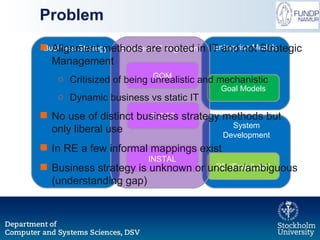
Problem System Development RE (Early/Late) Enterprise Models Business Strategy Goal Models Business-IT Alignment INSTAL B-SCP GQM Alignment methods are rooted in IT and not Strategic Management Critisized of being unrealistic and mechanistic Dynamic business vs static IT No use of distinct business strategy methods but only liberal use In RE a few informal mappings exist Business strategy is unknown or unclear/ambiguous (understanding gap)
Our Goal Build a unified  meta-model  for business strategy models (UBSM M ) to support existing business strategy approaches  towards Business-IT alignment; Analyz e  the capabilities for linking UBSM M  with languages for modeling system requirements  to support alignment
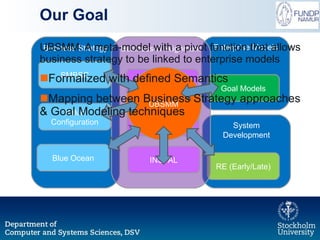
Our Goal UBSMM: A meta-model with a pivot function that allows business strategy to be linked to enterprise models Formalized with defined Semantics Mapping between Business Strategy approaches & Goal Modeling techniques System Development RE (Early/Late) Enterprise Models Business Strategy Goal Models Business-IT Alignment INSTAL SMBSC B-SCP GQM Value Configuration Blue Ocean UBSMM
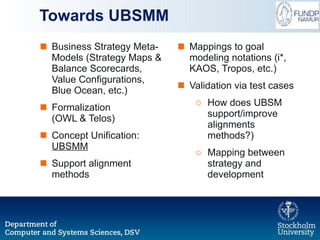
Towards UBSMM Business Strategy Meta-Models (Strategy Maps & Balance Scorecards, Value Configurations, Blue Ocean, etc.) Formalization  (OWL & Telos) Concept Unification:  UBSMM Support alignment methods Mappings to goal modeling notations (i*, KAOS, Tropos, etc.) Validation via test cases How does UBSM support/improve alignments methods?) Mapping between strategy and development
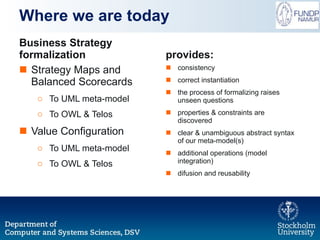
Where we are today Business Strategy formalization Strategy Maps and Balanced Scorecards To UML meta-model To OWL & Telos Value Configuration To UML meta-model To OWL & Telos provides: consistency correct instantiation the process of formalizing raises unseen questions properties & constraints are discovered  clear & unambiguous abstract syntax of our meta-model(s) additional operations (model integration) difusion and reusability
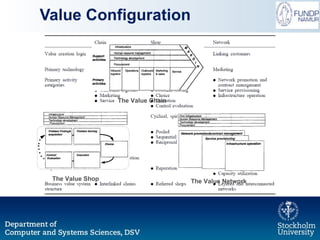
Value Configuration The Value Chain The Value Shop The Value Network
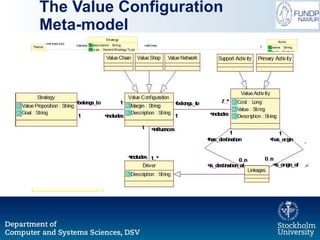
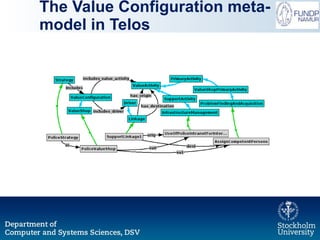
The Value Configuration  Meta-model
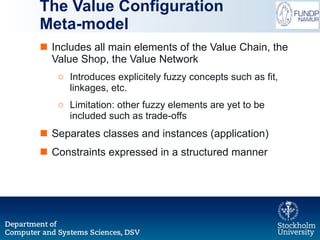
The Value Configuration  Meta-model Includes all main elements of the Value Chain, the Value Shop, the Value Network Introduces explicitely fuzzy concepts such as fit, linkages, etc. Limitation: other fuzzy elements are yet to be included such as trade-offs Separates classes and instances (application) Constraints expressed in a structured manner
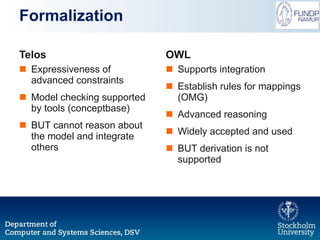
Formalization Telos Expressiveness of advanced constraints Model checking supported by tools (conceptbase) BUT cannot reason about the model and integrate others OWL Supports integration Establish rules for mappings (OMG) Advanced reasoning Widely accepted and used BUT derivation is not supported
The Value Configuration meta-model in Telos
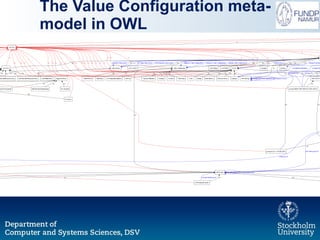
The Value Configuration meta-model in OWL
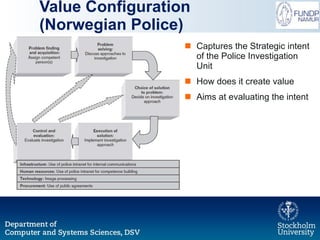
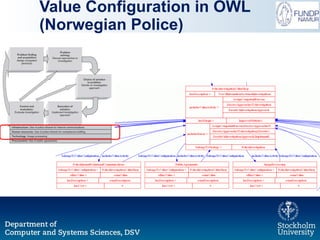
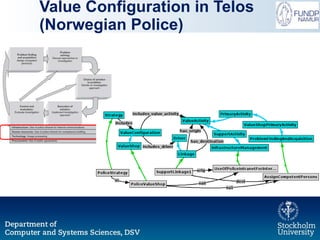
Value Configuration (Norwegian Police) Captures the Strategic intent of the Police Investigation Unit How does it create value Aims at evaluating the intent
Value Configuration in OWL (Norwegian Police)
Value Configuration in Telos (Norwegian Police)
Future Work Conceptualize & Formalize more business strategy approaches Unify the existing models for UBSMM Integrate more business strategy methods Validate UBSMM with cases Map and evaluate how UBSMM can support/complement alignement methods Map and evaluate how goal modeling languages (i*, KAOS, BMM, etc.) can express business strategy using UBSMM
Questions? Constantinos Giannoulis [email_address] http://constantinos.blogs.dsv.su.se / Jelena Zdravkovic [email_address] http://jelena.blogs.dsv.su.se/ Micha ë l  Petit [email_address] http://www.fundp.ac.be/universite/personnes/page_view/01002983/

Modeling Competition-driven Business Strategy for Business IT Alignment

  • 1.
    Modeling Competition-Driven BusinessStrategy for Business IT Alignment Busital 2011 Constantinos Giannoulis Michael Petit Jelena Zdravkovic
  • 2.
    Overview Business-IT alignment;links to RE Problem? Our Goal & Purpose; towards a Unified Business Strategy Meta-Model (UBSMM) Where we are today: Value Configuration Future work
  • 3.
    Business-IT Alignment Business-ITAlignment Business strategy & IT strategy Fit between business needs and IS priorities Long time commitment & planning with impact on IT planning focused use of IT: improved performance Strategy links to RE Context Rationale for decisions Resources Decision making
  • 4.
    Problem System DevelopmentRE (Early/Late) Enterprise Models Business Strategy Goal Models Business-IT Alignment INSTAL B-SCP GQM Alignment methods are rooted in IT and not Strategic Management Critisized of being unrealistic and mechanistic Dynamic business vs static IT No use of distinct business strategy methods but only liberal use In RE a few informal mappings exist Business strategy is unknown or unclear/ambiguous (understanding gap)
  • 5.
    Our Goal Builda unified meta-model for business strategy models (UBSM M ) to support existing business strategy approaches towards Business-IT alignment; Analyz e the capabilities for linking UBSM M with languages for modeling system requirements to support alignment
  • 6.
    Our Goal UBSMM:A meta-model with a pivot function that allows business strategy to be linked to enterprise models Formalized with defined Semantics Mapping between Business Strategy approaches & Goal Modeling techniques System Development RE (Early/Late) Enterprise Models Business Strategy Goal Models Business-IT Alignment INSTAL SMBSC B-SCP GQM Value Configuration Blue Ocean UBSMM
  • 7.
    Towards UBSMM BusinessStrategy Meta-Models (Strategy Maps & Balance Scorecards, Value Configurations, Blue Ocean, etc.) Formalization (OWL & Telos) Concept Unification: UBSMM Support alignment methods Mappings to goal modeling notations (i*, KAOS, Tropos, etc.) Validation via test cases How does UBSM support/improve alignments methods?) Mapping between strategy and development
  • 8.
    Where we aretoday Business Strategy formalization Strategy Maps and Balanced Scorecards To UML meta-model To OWL & Telos Value Configuration To UML meta-model To OWL & Telos provides: consistency correct instantiation the process of formalizing raises unseen questions properties & constraints are discovered clear & unambiguous abstract syntax of our meta-model(s) additional operations (model integration) difusion and reusability
  • 9.
    Value Configuration TheValue Chain The Value Shop The Value Network
  • 10.
  • 11.
    The Value Configuration Meta-model Includes all main elements of the Value Chain, the Value Shop, the Value Network Introduces explicitely fuzzy concepts such as fit, linkages, etc. Limitation: other fuzzy elements are yet to be included such as trade-offs Separates classes and instances (application) Constraints expressed in a structured manner
  • 12.
    Formalization Telos Expressivenessof advanced constraints Model checking supported by tools (conceptbase) BUT cannot reason about the model and integrate others OWL Supports integration Establish rules for mappings (OMG) Advanced reasoning Widely accepted and used BUT derivation is not supported
  • 13.
    The Value Configurationmeta-model in Telos
  • 14.
    The Value Configurationmeta-model in OWL
  • 15.
    Value Configuration (NorwegianPolice) Captures the Strategic intent of the Police Investigation Unit How does it create value Aims at evaluating the intent
  • 16.
    Value Configuration inOWL (Norwegian Police)
  • 17.
    Value Configuration inTelos (Norwegian Police)
  • 18.
    Future Work Conceptualize& Formalize more business strategy approaches Unify the existing models for UBSMM Integrate more business strategy methods Validate UBSMM with cases Map and evaluate how UBSMM can support/complement alignement methods Map and evaluate how goal modeling languages (i*, KAOS, BMM, etc.) can express business strategy using UBSMM
  • 19.
    Questions? Constantinos Giannoulis[email_address] http://constantinos.blogs.dsv.su.se / Jelena Zdravkovic [email_address] http://jelena.blogs.dsv.su.se/ Micha ë l Petit [email_address] http://www.fundp.ac.be/universite/personnes/page_view/01002983/

Editor's Notes

  • #3 [Title of the course] Jun 23, 2011 Copyright © 2004-2005 NameOfTheOrganization. All rights reserved.
  • #5 [Title of the course] Jun 23, 2011 Copyright © 2004-2005 NameOfTheOrganization. All rights reserved.
  • #7 Purpose: Facilitate modeling of strategies providing formal artifacts that currently are not existing Req. Analysts (less ambiguity, V&V) Enable mapping of business strategies to enterprise models (e.g. goal models, value models, process models) Req. Analysts and all involved in development (less ambiguity, method and notation independence, V&V) Improve IT alignment by linking business strategies to evolving system models Make strategy more concrete for alignment purposes Provide means of business strategy dissemination from top management across the enterprise and the opposite Supports Alignment Provide traceability that supports the identification of discrepancies between business strategy and everyday operations down to task level Also supports the dynamic needs of alignment Provide insight information to top management of the business performance Decision Makers (improved capability understanding [Title of the course] Jun 23, 2011 Copyright © 2004-2005 NameOfTheOrganization. All rights reserved.
  • #9 the Strategy Map template provides the main concepts Applications from literature provide conceptual variations emboddied through constrains Cardinality restrictions between classes both from the template and literature
  • #11 [Title of the course] Jun 23, 2011 Copyright © 2004-2005 NameOfTheOrganization. All rights reserved.
  • #12 [Title of the course] Jun 23, 2011 Copyright © 2004-2005 NameOfTheOrganization. All rights reserved.
  • #16 [Title of the course] Jun 23, 2011 Copyright © 2004-2005 NameOfTheOrganization. All rights reserved.
  • #17 [Title of the course] Jun 23, 2011 Copyright © 2004-2005 NameOfTheOrganization. All rights reserved.
  • #18 [Title of the course] Jun 23, 2011 Copyright © 2004-2005 NameOfTheOrganization. All rights reserved.
  • #19 [Title of the course] Jun 23, 2011 Copyright © 2004-2005 NameOfTheOrganization. All rights reserved.
  • #20 [Title of the course] Jun 23, 2011 Copyright © 2004-2005 NameOfTheOrganization. All rights reserved.