Printing technologies
      compared


              Source :
              Frank Dieckhoff
              fd@digi-com.org

              The digital universe of paper and printing knowledge
                                          www.sappi.com/houston
Analogous printing processes
• Silk screen printing

• Planography (offset printing)

• Letterpress printing (flexo, typesetting)

• Gravure printing
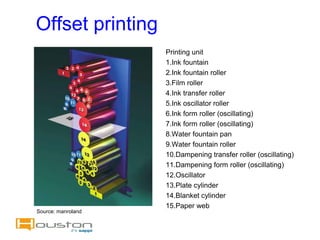
Offset printing
                    Printing unit
                    1.Ink fountain
                    2.Ink fountain roller
                    3.Film roller
                    4.Ink transfer roller
                    5.Ink oscillator roller
                    6.Ink form roller (oscillating)
                    7.Ink form roller (oscillating)
                    8.Water fountain pan
                    9.Water fountain roller
                    10.Dampening transfer roller (oscillating)
                    11.Dampening form roller (oscillating)
                    12.Oscillator
                    13.Plate cylinder
                    14.Blanket cylinder
                    15.Paper web
Source: manroland
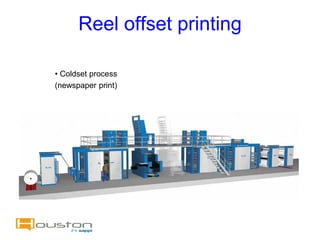
Reel offset printing

• Coldset process
(newspaper print)
Reel offset printing - History


 • Offset replaces lead typesetting (1970)

 • Increasing use of colour in newspaper offset print
   (1980)

 • 8-Couple printing towers and satellites replace
   arch type and 6-cylinder units
Reel offset printing - History

 • Speed increase:

       – 20.000 Rev./hour in 1980
       – 35.000 Rev./hour in 1995
       – 50.000 Rev./hour in 2010
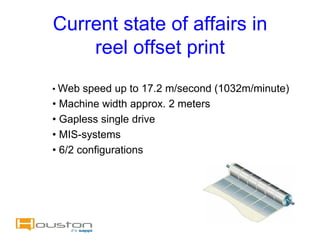
Current state of affairs in
    reel offset print
• Web speed up to 17.2 m/second (1032m/minute)
• Machine width approx. 2 meters
• Gapless single drive
• MIS-systems
• 6/2 configurations
Digital printing processes

• Electrophotography
• Ionography
• Inkjet
• Magnetography
• Nanography
• Thermoprocessing
– Thermotransfer
– Thermosublimation
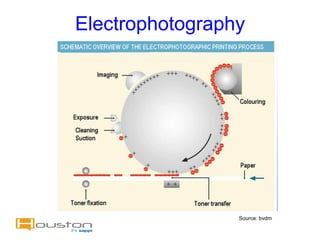
Electrophotography


                 Source: bvdm
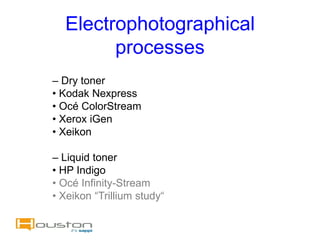
Electrophotographical
        processes
– Dry toner
• Kodak Nexpress
• Océ ColorStream
• Xerox iGen
• Xeikon

– Liquid toner
• HP Indigo
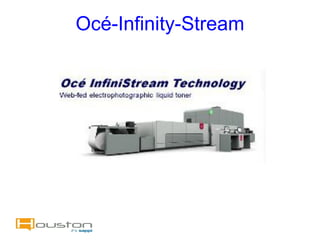
• Océ Infinity-Stream
• Xeikon “Trillium study“
Electrophotography

High-speed digital printing presses based on the
electrophotographical principles:
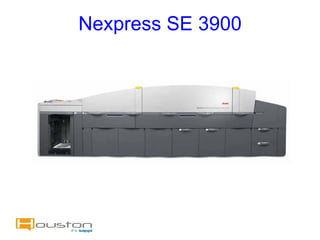
- Nexpress SE 3900
- Océ-Infinity-Stream
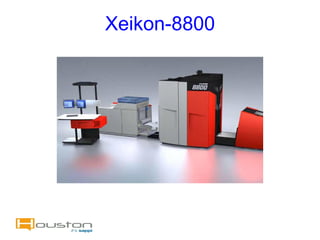
- Xeikon-8800
Nexpress SE 3900
Toner sheet presses
Kodak
- Nexpress SE 3600
- 5c printer
- Printable surface 340 x 510 mm
- Speed
   3600 sheets/hour (A3)
   131 sheets/minute (A4)
- Resolution 600 dpi

- Optional: reels instead of sheets;
  gold, silver and safety colours
Océ-Infinity-Stream
Toner web presses

Océ
- InfinityStream
- High-viscosity liquid toner
- Machine width 710 mm
- Speed
   up to 120 meters/minute
   (approx. 7200 B1 sheets/hour)
Xeikon-8800
Toner web presses

Xeikon
- Xeikon-8800
- 5/5c printer
- Machine width 512 mm
  (print range 504 mm)
- Speed
   up to 260 sheets/minute
   (A4, depending on substrate)
- Resolution 1200 x 3600 dpi (240 lpi)
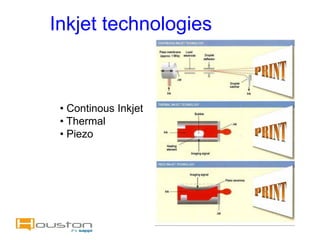
Inkjet technologies


 • Continous Inkjet
 • Thermal
 • Piezo
Inkjet processes
– Drop on Demand
  • Thermo
    – Dye/pigment
      » HP Txxx
  • Piezo
    – Mostly dye/pigment
      » InfoPrint 5000
      » Océ JetStream
      » Kodak VL

– Continuous
  – Dye/pigment
    » Kodak Prosper
Short history of inkjet
        technology
• First continuous inkjet printhead
  (Mead Printhead, 1970)

• Versamark printhead (1982-1986)
  – 1600 jets, 120 dpi

• Scitex printhead (1992-1996)
  – 1024 jets, 240 dpi
Current state of affairs
  in inkjet technology

• Machine widths 0.5 to 0.8 meters
• Resolution 600 to 1200 dpi
• 4 Grey shades (sometimes)
• Pigment and colourant inks
• Infrared dryers
• Speed up to 220 meters/minute
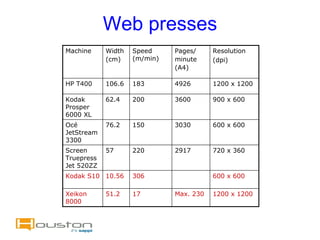
Web presses
Machine     Width   Speed     Pages/     Resolution
            (cm)    (m/min)   minute     (dpi)
                              (A4)

HP T400     106.6   183       4926       1200 x 1200

Kodak       62.4    200       3600       900 x 600
Prosper
6000 XL
Océ         76.2    150       3030       600 x 600
JetStream
3300
Screen      57      220       2917       720 x 360
Truepress
Jet 520ZZ
Kodak S10 10.56     306                  600 x 600

Xeikon      51.2    17        Max. 230   1200 x 1200
8000
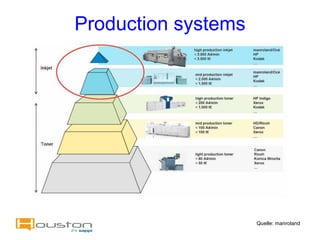
Production systems


                     Quelle: manroland
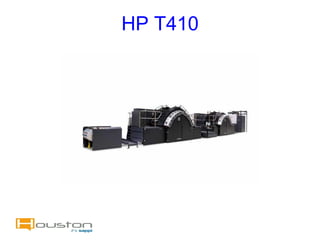
HP T410
Inkjet web presses
HP
- T410
- 4c printer
- Machine width 106 cm
- Speed
  183 meters/minute (4C)
  244 meters/minute (B/W)
- Speed 1200 x 600 dpi
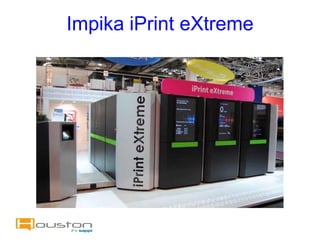
Impika iPrint eXtreme
Inkjet web presses

Impika Inkjet Solutions
- iPrint eXtreme
- 4c printer
- Machine width 71.1 cm
- Up to 375 m/min
- Resolution 600 x 600 dpi
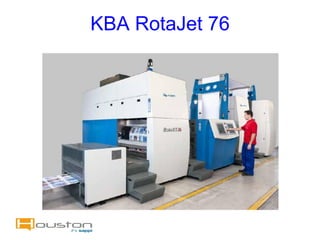
KBA RotaJet 76
Inkjet web presses

KBA
- RotaJet 76
- 4c printer
- Machine width 78.1 cm
- Up to 150 m/min
  approx. 3000 pages/minute (A4)
- Resolution 600 x 600 dpi variable drop size
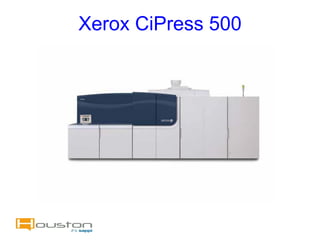
Xerox CiPress 500
Inkjet web presses
Xerox
- CiPress 500
- 4c/4c printer
- 152 m/min
  Up to 2050 pages/minute (A4)
- Resolution 600 x 400 dpi

- Granular resin ink
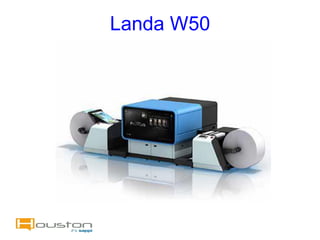
Landa W50
Inkjet web presses

Landa
- W50
- 4c printer
- Machine width 56 cm
- Up to 200 m/min
- 40-300 g/m2
- Resolution 600 x 600 dpi
Nanography


http://www.youtube.com/watch?v=EVrCvocyC2o&feature=endscreen&NR=1
Nanography
Advantages and disadvantages

–   Thin ink layers/low ink consumption
–   Suitable for most substrates
–   Fast print runs (?)
–   High quality (??)

–   Possible health hazards (???)
The 4 elements of nanography

•   Nano ink

•   Printing process

•   Printing presses

•   Partnerships
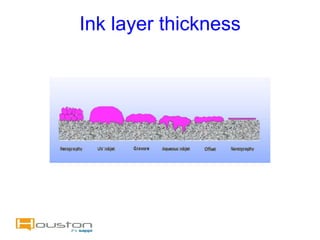
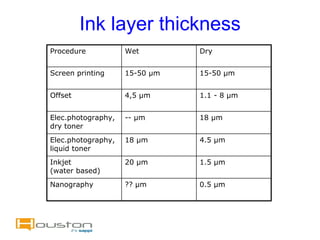
Ink layer thickness
Procedure           Wet        Dry


Screen printing     15-50 µm   15-50 µm


Offset              4,5 µm     1.1 - 8 µm


Elec.photography,   -- µm      18 µm
dry toner
Elec.photography,   18 µm      4.5 µm
liquid toner
Inkjet              20 µm      1.5 µm
(water based)
Nanography          ?? µm      0.5 µm
Ink layer thickness
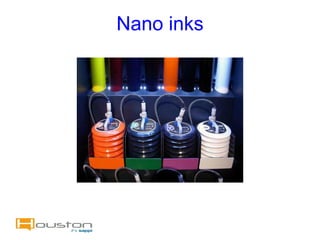
Nano inks
• Colour pigments (10 nanometer)
• Water based inkjet print
• Good light reflection
• Brilliant colours
• Dry ink film
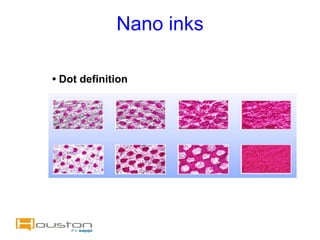
• Good dot definition
• Gloss depending on substrate
Nano inks

• Dot definition


         • Dot definition
Nanography

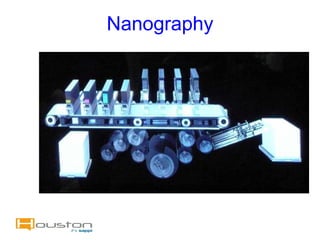
• Kyocera piezo inkjet printheads „ink ejectors“

• 600 dpi

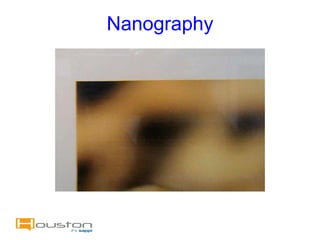
• Striped print samples

• Sheet presses have Komori paper transport
  mechanisms
Nanography
Nanography

• Partners:

       • Komori
       • Manroland sheetfed
       • Heidelberg
Nano inks
Thank you for your attention !

Printing technologies compared

  • 1.
    Printing technologies compared Source : Frank Dieckhoff fd@digi-com.org The digital universe of paper and printing knowledge www.sappi.com/houston
  • 2.
    Analogous printing processes •Silk screen printing • Planography (offset printing) • Letterpress printing (flexo, typesetting) • Gravure printing
  • 3.
    Offset printing Printing unit 1.Ink fountain 2.Ink fountain roller 3.Film roller 4.Ink transfer roller 5.Ink oscillator roller 6.Ink form roller (oscillating) 7.Ink form roller (oscillating) 8.Water fountain pan 9.Water fountain roller 10.Dampening transfer roller (oscillating) 11.Dampening form roller (oscillating) 12.Oscillator 13.Plate cylinder 14.Blanket cylinder 15.Paper web Source: manroland
  • 4.
    Reel offset printing •Coldset process (newspaper print)
  • 5.
    Reel offset printing- History • Offset replaces lead typesetting (1970) • Increasing use of colour in newspaper offset print (1980) • 8-Couple printing towers and satellites replace arch type and 6-cylinder units
  • 6.
    Reel offset printing- History • Speed increase: – 20.000 Rev./hour in 1980 – 35.000 Rev./hour in 1995 – 50.000 Rev./hour in 2010
  • 7.
    Current state ofaffairs in reel offset print • Web speed up to 17.2 m/second (1032m/minute) • Machine width approx. 2 meters • Gapless single drive • MIS-systems • 6/2 configurations
  • 8.
    Digital printing processes •Electrophotography • Ionography • Inkjet • Magnetography • Nanography • Thermoprocessing – Thermotransfer – Thermosublimation
  • 9.
    Electrophotography Source: bvdm
  • 10.
    Electrophotographical processes – Dry toner • Kodak Nexpress • Océ ColorStream • Xerox iGen • Xeikon – Liquid toner • HP Indigo • Océ Infinity-Stream • Xeikon “Trillium study“
  • 11.
    Electrophotography High-speed digital printingpresses based on the electrophotographical principles: - Nexpress SE 3900 - Océ-Infinity-Stream - Xeikon-8800
  • 12.
  • 13.
    Toner sheet presses Kodak -Nexpress SE 3600 - 5c printer - Printable surface 340 x 510 mm - Speed 3600 sheets/hour (A3) 131 sheets/minute (A4) - Resolution 600 dpi - Optional: reels instead of sheets; gold, silver and safety colours
  • 14.
  • 15.
    Toner web presses Océ -InfinityStream - High-viscosity liquid toner - Machine width 710 mm - Speed up to 120 meters/minute (approx. 7200 B1 sheets/hour)
  • 16.
  • 17.
    Toner web presses Xeikon -Xeikon-8800 - 5/5c printer - Machine width 512 mm (print range 504 mm) - Speed up to 260 sheets/minute (A4, depending on substrate) - Resolution 1200 x 3600 dpi (240 lpi)
  • 18.
    Inkjet technologies •Continous Inkjet • Thermal • Piezo
  • 19.
    Inkjet processes – Dropon Demand • Thermo – Dye/pigment » HP Txxx • Piezo – Mostly dye/pigment » InfoPrint 5000 » Océ JetStream » Kodak VL – Continuous – Dye/pigment » Kodak Prosper
  • 20.
    Short history ofinkjet technology • First continuous inkjet printhead (Mead Printhead, 1970) • Versamark printhead (1982-1986) – 1600 jets, 120 dpi • Scitex printhead (1992-1996) – 1024 jets, 240 dpi
  • 21.
    Current state ofaffairs in inkjet technology • Machine widths 0.5 to 0.8 meters • Resolution 600 to 1200 dpi • 4 Grey shades (sometimes) • Pigment and colourant inks • Infrared dryers • Speed up to 220 meters/minute
  • 22.
    Web presses Machine Width Speed Pages/ Resolution (cm) (m/min) minute (dpi) (A4) HP T400 106.6 183 4926 1200 x 1200 Kodak 62.4 200 3600 900 x 600 Prosper 6000 XL Océ 76.2 150 3030 600 x 600 JetStream 3300 Screen 57 220 2917 720 x 360 Truepress Jet 520ZZ Kodak S10 10.56 306 600 x 600 Xeikon 51.2 17 Max. 230 1200 x 1200 8000
  • 23.
    Production systems Quelle: manroland
  • 24.
  • 25.
    Inkjet web presses HP -T410 - 4c printer - Machine width 106 cm - Speed 183 meters/minute (4C) 244 meters/minute (B/W) - Speed 1200 x 600 dpi
  • 26.
  • 27.
    Inkjet web presses ImpikaInkjet Solutions - iPrint eXtreme - 4c printer - Machine width 71.1 cm - Up to 375 m/min - Resolution 600 x 600 dpi
  • 28.
  • 29.
    Inkjet web presses KBA -RotaJet 76 - 4c printer - Machine width 78.1 cm - Up to 150 m/min approx. 3000 pages/minute (A4) - Resolution 600 x 600 dpi variable drop size
  • 30.
  • 31.
    Inkjet web presses Xerox -CiPress 500 - 4c/4c printer - 152 m/min Up to 2050 pages/minute (A4) - Resolution 600 x 400 dpi - Granular resin ink
  • 32.
  • 33.
    Inkjet web presses Landa -W50 - 4c printer - Machine width 56 cm - Up to 200 m/min - 40-300 g/m2 - Resolution 600 x 600 dpi
  • 34.
  • 35.
  • 36.
    Advantages and disadvantages – Thin ink layers/low ink consumption – Suitable for most substrates – Fast print runs (?) – High quality (??) – Possible health hazards (???)
  • 37.
    The 4 elementsof nanography • Nano ink • Printing process • Printing presses • Partnerships
  • 38.
    Ink layer thickness Procedure Wet Dry Screen printing 15-50 µm 15-50 µm Offset 4,5 µm 1.1 - 8 µm Elec.photography, -- µm 18 µm dry toner Elec.photography, 18 µm 4.5 µm liquid toner Inkjet 20 µm 1.5 µm (water based) Nanography ?? µm 0.5 µm
  • 39.
  • 40.
    Nano inks • Colourpigments (10 nanometer) • Water based inkjet print • Good light reflection • Brilliant colours • Dry ink film • Good dot definition • Gloss depending on substrate
  • 41.
    Nano inks • Dotdefinition • Dot definition
  • 42.
    Nanography • Kyocera piezoinkjet printheads „ink ejectors“ • 600 dpi • Striped print samples • Sheet presses have Komori paper transport mechanisms
  • 43.
  • 44.
    Nanography • Partners: • Komori • Manroland sheetfed • Heidelberg
  • 45.
  • 46.
    Thank you foryour attention !