1
Present ed By:
Zeeshan Zafar
2
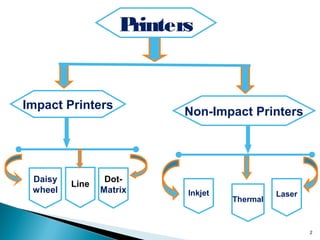
Printers
Impact Printers
Non-Impact Printers
Daisy
wheel
Dot-
Matrix Inkjet
Thermal
Laser
Line
 An external hardware device responsible for
taking computer data and generating a hard copy
of that data. Printers are one of the most
commonly used peripherals and they print text
and still images on the paper.
3
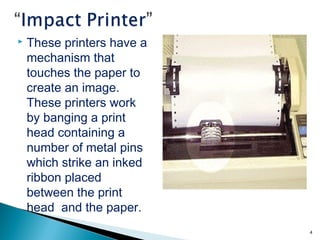
 These printers have a
mechanism that
touches the paper to
create an image.
These printers work
by banging a print
head containing a
number of metal pins
which strike an inked
ribbon placed
between the print
head and the paper.
4
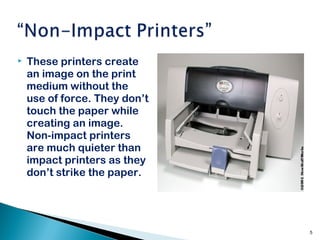
 These printers create
an image on the print
medium without the
use of force. They don’t
touch the paper while
creating an image.
Non-impact printers
are much quieter than
impact printers as they
don’t strike the paper.
5
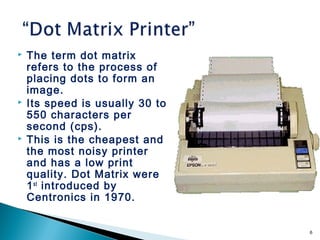
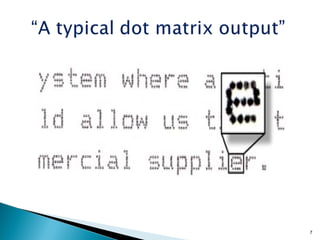
 The term dot matrix
refers to the process of
placing dots to form an
image.
 Its speed is usually 30 to
550 characters per
second (cps).
 This is the cheapest and
the most noisy printer
and has a low print
quality. Dot Matrix were
1st
introduced by
Centronics in 1970.
6
7
 Advantages:
 (1) In-expensive.
 (2) Low per page cost.
 (3) Energy efficient.
 Dis-advantages:
 (1) Noisy
 (2) Low resolution
 (3) Limited fonts flexibility
 (4) Poor quality graphics output.
8
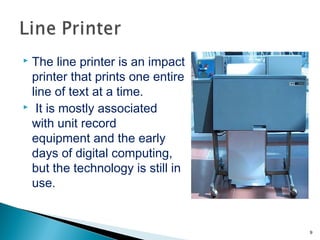
 The line printer is an impact
printer that prints one entire
line of text at a time.
 It is mostly associated
with unit record
equipment and the early
days of digital computing,
but the technology is still in
use.
9
10
 Print speeds of 600 lines-per-minute (approximately 10
pages per minute) were achieved in the 1950s, later
increasing to as much as 1200 lpm.
 Print speeds of 600 lines-per-minute (approximately 10
pages per minute) were achieved in the 1950s, later
increasing to as much as 1200 lpm.
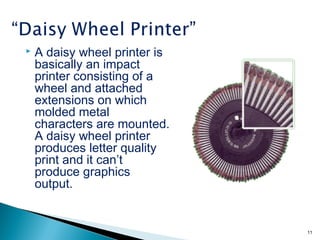
 A daisy wheel printer is
basically an impact
printer consisting of a
wheel and attached
extensions on which
molded metal
characters are mounted.
A daisy wheel printer
produces letter quality
print and it can’t
produce graphics
output.
11
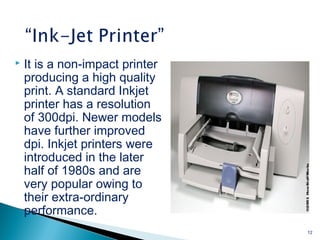
 It is a non-impact printer
producing a high quality
print. A standard Inkjet
printer has a resolution
of 300dpi. Newer models
have further improved
dpi. Inkjet printers were
introduced in the later
half of 1980s and are
very popular owing to
their extra-ordinary
performance.
12
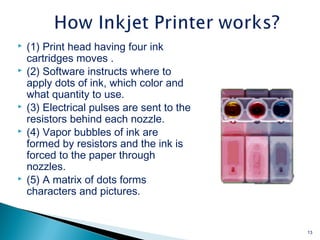
 (1) Print head having four ink
cartridges moves .
 (2) Software instructs where to
apply dots of ink, which color and
what quantity to use.
 (3) Electrical pulses are sent to the
resistors behind each nozzle.
 (4) Vapor bubbles of ink are
formed by resistors and the ink is
forced to the paper through
nozzles.
 (5) A matrix of dots forms
characters and pictures.
13
 Advantages:
 (1) High resolution output.
 (2) Energy efficient.
 (3) Many options to select.
 Dis-advantages:
 (1) Expensive.
 (2) Special paper required for higher resolution
output.
 (3) Time consuming in case of graphics printing.
14
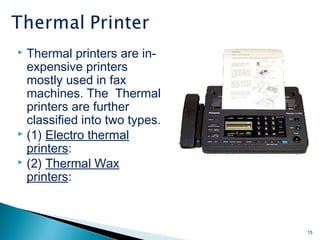
 Thermal printers are in-
expensive printers
mostly used in fax
machines. The Thermal
printers are further
classified into two types.
 (1) Electro thermal
printers:
 (2) Thermal Wax
printers:
15
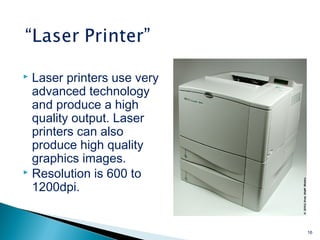
 Laser printers use very
advanced technology
and produce a high
quality output. Laser
printers can also
produce high quality
graphics images.
 Resolution is 600 to
1200dpi.
16
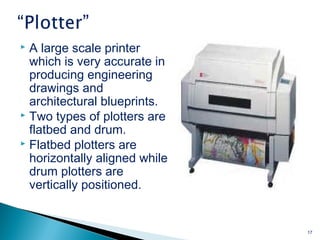
 A large scale printer
which is very accurate in
producing engineering
drawings and
architectural blueprints.
 Two types of plotters are
flatbed and drum.
 Flatbed plotters are
horizontally aligned while
drum plotters are
vertically positioned.
17
 In fact computer world is incomplete withoutIn fact computer world is incomplete without
printers in the modern age of technology. A printerprinters in the modern age of technology. A printer
is one of the basic needs of every computer useris one of the basic needs of every computer user
and one can not utilize computer resourcesand one can not utilize computer resources
properly in the absence of a quality printer.properly in the absence of a quality printer.
1818

Printers and its types

  • 1.
  • 2.
  • 3.
     An externalhardware device responsible for taking computer data and generating a hard copy of that data. Printers are one of the most commonly used peripherals and they print text and still images on the paper. 3
  • 4.
     These printershave a mechanism that touches the paper to create an image. These printers work by banging a print head containing a number of metal pins which strike an inked ribbon placed between the print head and the paper. 4
  • 5.
     These printerscreate an image on the print medium without the use of force. They don’t touch the paper while creating an image. Non-impact printers are much quieter than impact printers as they don’t strike the paper. 5
  • 6.
     The termdot matrix refers to the process of placing dots to form an image.  Its speed is usually 30 to 550 characters per second (cps).  This is the cheapest and the most noisy printer and has a low print quality. Dot Matrix were 1st introduced by Centronics in 1970. 6
  • 7.
  • 8.
     Advantages:  (1)In-expensive.  (2) Low per page cost.  (3) Energy efficient.  Dis-advantages:  (1) Noisy  (2) Low resolution  (3) Limited fonts flexibility  (4) Poor quality graphics output. 8
  • 9.
     The line printer isan impact printer that prints one entire line of text at a time.  It is mostly associated with unit record equipment and the early days of digital computing, but the technology is still in use. 9
  • 10.
    10  Print speedsof 600 lines-per-minute (approximately 10 pages per minute) were achieved in the 1950s, later increasing to as much as 1200 lpm.  Print speeds of 600 lines-per-minute (approximately 10 pages per minute) were achieved in the 1950s, later increasing to as much as 1200 lpm.
  • 11.
     A daisywheel printer is basically an impact printer consisting of a wheel and attached extensions on which molded metal characters are mounted. A daisy wheel printer produces letter quality print and it can’t produce graphics output. 11
  • 12.
     It isa non-impact printer producing a high quality print. A standard Inkjet printer has a resolution of 300dpi. Newer models have further improved dpi. Inkjet printers were introduced in the later half of 1980s and are very popular owing to their extra-ordinary performance. 12
  • 13.
     (1) Printhead having four ink cartridges moves .  (2) Software instructs where to apply dots of ink, which color and what quantity to use.  (3) Electrical pulses are sent to the resistors behind each nozzle.  (4) Vapor bubbles of ink are formed by resistors and the ink is forced to the paper through nozzles.  (5) A matrix of dots forms characters and pictures. 13
  • 14.
     Advantages:  (1)High resolution output.  (2) Energy efficient.  (3) Many options to select.  Dis-advantages:  (1) Expensive.  (2) Special paper required for higher resolution output.  (3) Time consuming in case of graphics printing. 14
  • 15.
     Thermal printersare in- expensive printers mostly used in fax machines. The Thermal printers are further classified into two types.  (1) Electro thermal printers:  (2) Thermal Wax printers: 15
  • 16.
     Laser printersuse very advanced technology and produce a high quality output. Laser printers can also produce high quality graphics images.  Resolution is 600 to 1200dpi. 16
  • 17.
     A largescale printer which is very accurate in producing engineering drawings and architectural blueprints.  Two types of plotters are flatbed and drum.  Flatbed plotters are horizontally aligned while drum plotters are vertically positioned. 17
  • 18.
     In factcomputer world is incomplete withoutIn fact computer world is incomplete without printers in the modern age of technology. A printerprinters in the modern age of technology. A printer is one of the basic needs of every computer useris one of the basic needs of every computer user and one can not utilize computer resourcesand one can not utilize computer resources properly in the absence of a quality printer.properly in the absence of a quality printer. 1818