Printers
Prepared by: Mihir Bhavsar (196170307008)
Naimish Bhuva (196170307068)
What is Printers ?
• An external hardware device responsible for taking computer data and
generating a hard copy of that data.
• Printers are one of the most commonly used peripherals and they print text
and still images on the paper.
Introduction
• In 1938, Chester Carlson invented a dry printing process called
electrophotography commonly called a Xerox.
• In 1953, the first high-speed printer was developed by Remington-Rand for
use on the Univac computer.
• In 1992, Hewlett-Packard released the popular LaserJet 4, the first 600 by
600 dots per inch resolution laser printer.
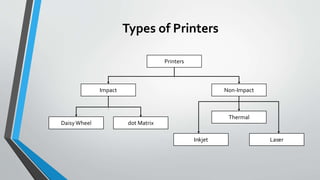
Types of Printers
Printers
Impact Non-Impact
dot Matrix
DaisyWheel
Laser
Inkjet
Thermal
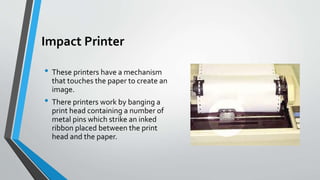
Impact Printer
• These printers have a mechanism
that touches the paper to create an
image.
• There printers work by banging a
print head containing a number of
metal pins which strike an inked
ribbon placed between the print
head and the paper.
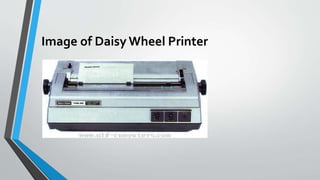
Daisy Wheel Printer
• A daisy wheel printer is basically an impact printer consisting of a wheel and
attached extensions on which molded metal characters are mounted.
• A daisy wheel printer produces letter quality print and it can’t produce
graphics output.
• In a daisy wheel printer, a hammer presses the wheel against a ribbon which
in turn makes an ink stain on the paper in the form of a character mounted
on the wheel extensions.
• Its printing speed is also very slow ,i.e. less than 90cps
Image of Daisy Wheel Printer
Dot Matrix Printer
• The term dot matrix refers to the process of placing dots to form an image.
• Its speed is usually 30 to 550 characters per second (cps).
• This is the cheapest and the most noisy printer and has a low print quality.
• Dot Matrix were 1st introduced by Centronics in 1970.
• The dot matrix forms images one character at a time as the print head
moves across the paper.
• Uses tiny pins to hit an ink ribbon and the paper much as a typewriter does.
Image of Dot Matrix Printer
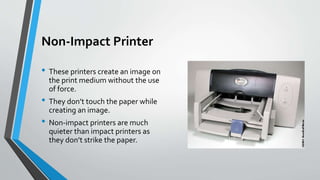
Non-Impact Printer
• These printers create an image on
the print medium without the use
of force.
• They don’t touch the paper while
creating an image.
• Non-impact printers are much
quieter than impact printers as
they don’t strike the paper.
Ink-jet Printer
• It is a non-impact printer producing a high quality print.
• A standard Inkjet printer has a resolution of 300dpi (dots per inch).
• Inkjet printers were introduced in the later half of 1980s and are very
popular owing to their extra-ordinary performance.
• Print head having four ink cartridges moves.
• Software instructs where to apply dots of ink, which color and what
quantity to use.
Image of Ink-jet Printer
Color cartridge showing Inkjet nozzles
Thermal Printer
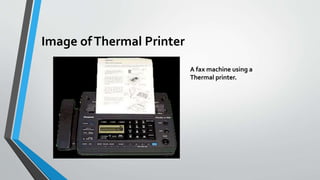
• Thermal printers are in-expensive printers mostly used in fax machines.
• TheThermal printers are further classified into two types.
(1) Electro thermal printers
(2)ThermalWax printers
• Thermal printers use heated pins and ribbons with different color bands.
• These printers contain a stick of wax like ink.The ribbon passes in front of a
print head that has a series of tiny heated pins.
• The pins cause the wax to melt and adhere to the paper and when
temperature reaches to a certain level, it is hardened.
Image ofThermal Printer
A fax machine using a
Thermal printer.
Laser Printer
• Laser printing is an electrostatic digital printing process.
• It produces high-quality text and graphics by repeatedly passing a laser
beam back and forth over a negatively charged cylinder called a "drum" to
define a differentially charged image.
• Laser printers can print much faster than inkjet printers can.
• Most are equipped with high-capacity paper trays, so they can print more
pages at a given time.They're also built to handle the printing of thousands
of pages per month without succumbing to wear-and-tear.
• Laser printers use microscopic ink particles in a powdered form known as
toner. Once heated by the fuser unit, the toner melts allowing it to be fused
to the paper fiber under pressure.
Images of Laser Printer
ThankYou 

Printers

  • 1.
    Printers Prepared by: MihirBhavsar (196170307008) Naimish Bhuva (196170307068)
  • 2.
    What is Printers? • An external hardware device responsible for taking computer data and generating a hard copy of that data. • Printers are one of the most commonly used peripherals and they print text and still images on the paper.
  • 3.
    Introduction • In 1938,Chester Carlson invented a dry printing process called electrophotography commonly called a Xerox. • In 1953, the first high-speed printer was developed by Remington-Rand for use on the Univac computer. • In 1992, Hewlett-Packard released the popular LaserJet 4, the first 600 by 600 dots per inch resolution laser printer.
  • 4.
    Types of Printers Printers ImpactNon-Impact dot Matrix DaisyWheel Laser Inkjet Thermal
  • 5.
    Impact Printer • Theseprinters have a mechanism that touches the paper to create an image. • There printers work by banging a print head containing a number of metal pins which strike an inked ribbon placed between the print head and the paper.
  • 6.
    Daisy Wheel Printer •A daisy wheel printer is basically an impact printer consisting of a wheel and attached extensions on which molded metal characters are mounted. • A daisy wheel printer produces letter quality print and it can’t produce graphics output. • In a daisy wheel printer, a hammer presses the wheel against a ribbon which in turn makes an ink stain on the paper in the form of a character mounted on the wheel extensions. • Its printing speed is also very slow ,i.e. less than 90cps
  • 7.
    Image of DaisyWheel Printer
  • 8.
    Dot Matrix Printer •The term dot matrix refers to the process of placing dots to form an image. • Its speed is usually 30 to 550 characters per second (cps). • This is the cheapest and the most noisy printer and has a low print quality. • Dot Matrix were 1st introduced by Centronics in 1970. • The dot matrix forms images one character at a time as the print head moves across the paper. • Uses tiny pins to hit an ink ribbon and the paper much as a typewriter does.
  • 9.
    Image of DotMatrix Printer
  • 10.
    Non-Impact Printer • Theseprinters create an image on the print medium without the use of force. • They don’t touch the paper while creating an image. • Non-impact printers are much quieter than impact printers as they don’t strike the paper.
  • 11.
    Ink-jet Printer • Itis a non-impact printer producing a high quality print. • A standard Inkjet printer has a resolution of 300dpi (dots per inch). • Inkjet printers were introduced in the later half of 1980s and are very popular owing to their extra-ordinary performance. • Print head having four ink cartridges moves. • Software instructs where to apply dots of ink, which color and what quantity to use.
  • 12.
    Image of Ink-jetPrinter Color cartridge showing Inkjet nozzles
  • 13.
    Thermal Printer • Thermalprinters are in-expensive printers mostly used in fax machines. • TheThermal printers are further classified into two types. (1) Electro thermal printers (2)ThermalWax printers • Thermal printers use heated pins and ribbons with different color bands. • These printers contain a stick of wax like ink.The ribbon passes in front of a print head that has a series of tiny heated pins. • The pins cause the wax to melt and adhere to the paper and when temperature reaches to a certain level, it is hardened.
  • 14.
    Image ofThermal Printer Afax machine using a Thermal printer.
  • 15.
    Laser Printer • Laserprinting is an electrostatic digital printing process. • It produces high-quality text and graphics by repeatedly passing a laser beam back and forth over a negatively charged cylinder called a "drum" to define a differentially charged image. • Laser printers can print much faster than inkjet printers can. • Most are equipped with high-capacity paper trays, so they can print more pages at a given time.They're also built to handle the printing of thousands of pages per month without succumbing to wear-and-tear. • Laser printers use microscopic ink particles in a powdered form known as toner. Once heated by the fuser unit, the toner melts allowing it to be fused to the paper fiber under pressure.
  • 16.
  • 17.