

Applications of
Computers
Zeeshan Zafar
Application of Computers
 Applications in Business
 Applications in Banking
 Application in Stock Exchange
 Applications in Retailing
 Applications in Education
o Computer Assisted Instruction(CAI)
o Computer Managed Instruction(CMI)
o Computer Based Simulations
o Computer Aided Problem Solving
o Computer as a Subject of Instruction
 Applications in Medical Field
 Applications in Science
Applications in Business
 Computers are being used by all businesses. Some of
computer uses in business are as under:-
To record stocks
To make customer bills
To analyze sales
To calculate employee's pay
 Computers are being used heavily by the following businesses
and persons:-
Businessmen
Importers
Banks
Income Tax Departments etc.
Applications in Banking
 Banks are the largest users of computer. Some of
computer uses in banking
are as under:-
To record day to day processing of customer's account
To facilitate customers in using their credit cards for
purchasing a product
To make automatic debit form
To update customer's accounts
 Computers are being used heavily in banks by the
following persons:-
Managers
Accountants
Cashiers
Clerks etc.
Applications in Stock Exchange
 Computers update efficiently each day before the beginning of the next day.
 This helps traders to open their accounts without waiting for brokers to
update previous day's processing.
 It keeps record of any change in the share rates.
 It updates the number of share available for sale and purchase for current
day.
Applications in Retailing
 Computers are also being used by stores and shops / markets of
all types. Following are some of the computer uses at stores
and markets:-
To write sales reports
To write financial statements
To calculate product cost
Profit analysis
To keep record of damaged or sold items
 The black and white bar-code printed on most of the products
in supermarkets in called Universal Production Code (UPC).
 UPC is a key to computer controlled supermarket checkout.
Computers use this UPC to determine product's number, price
name, description and price.
Applications in Education
 Computer Assisted Instructions(CAI)
 Computer Managed Instructions (CMI)
 Computer Based Simulation
 Computer Aided Problem Solving
 Computer as a Subject of Instruction
Applications in Education
 Computer Managed Instructions (CMI)
In this systems, the computer assigns a student to read
certain book, listen certain tape or attend certain lecture.
On completing the assignment the student returns the
assignment to the computer for testing and further
assignments.
 Computer Based Simulation
Simulation is the process of designing a model for a real
system and conducting experiments. It is used to
understand such a system whose direct experimentation is
impossible, slow, or too expensive.
Applications in Education
 Computer Aided Problem Solving
Students use computers as problem solving tools.
Students can explore and organize material from
a course by using computer as an aid.
 Computer as a Subject of Instruction
In this system, computer is taught as a subject.
Universities and colleges offer many courses in
Computer Science disciplines. Software
Engineering and Hardware Engineering is also
being taught at almost all universities in Pakistan.
Applications in Medical Field
 Keep track of patients appointments
 Diagnosis and treatment
 Assign medicine to certain patient depending on the
patient data
 Keep track of the history of patients
 In medical researches
 Automatic operation and laboratory machine.
Applications in Science
 Computers are vastly used in sciences such as physics, biology, chemistry,
mathematics, agricultural sciences, computer science and nuclear physics
etc.
 It helps in scientific researches.
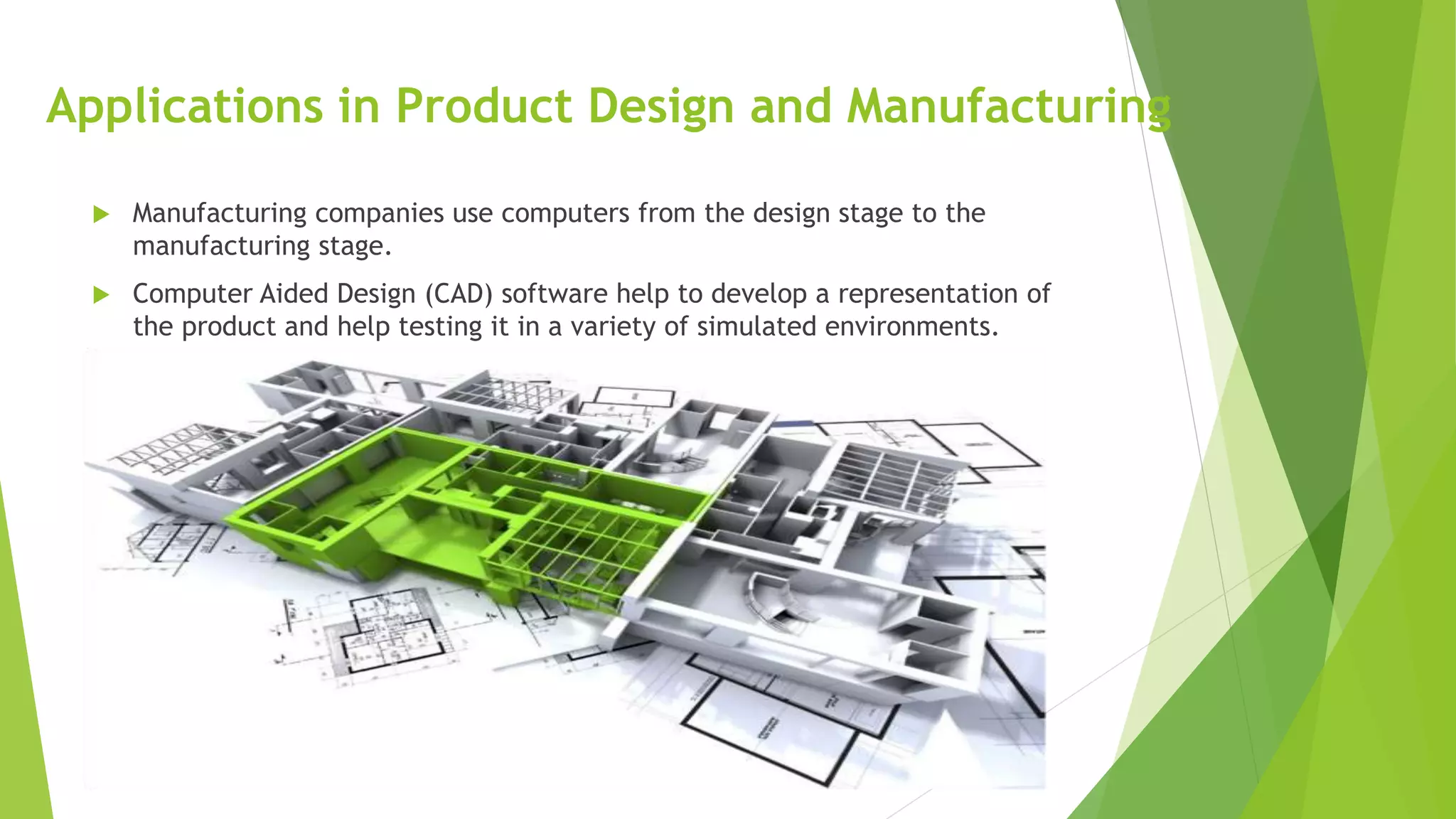
Applications in Product Design and Manufacturing
 Manufacturing companies use computers from the design stage to the
manufacturing stage.
 Computer Aided Design (CAD) software help to develop a representation of
the product and help testing it in a variety of simulated environments.

Applications of computers

  • 1.
  • 2.
    Application of Computers Applications in Business  Applications in Banking  Application in Stock Exchange  Applications in Retailing  Applications in Education o Computer Assisted Instruction(CAI) o Computer Managed Instruction(CMI) o Computer Based Simulations o Computer Aided Problem Solving o Computer as a Subject of Instruction  Applications in Medical Field  Applications in Science
  • 3.
    Applications in Business Computers are being used by all businesses. Some of computer uses in business are as under:- To record stocks To make customer bills To analyze sales To calculate employee's pay  Computers are being used heavily by the following businesses and persons:- Businessmen Importers Banks Income Tax Departments etc.
  • 4.
    Applications in Banking Banks are the largest users of computer. Some of computer uses in banking are as under:- To record day to day processing of customer's account To facilitate customers in using their credit cards for purchasing a product To make automatic debit form To update customer's accounts  Computers are being used heavily in banks by the following persons:- Managers Accountants Cashiers Clerks etc.
  • 5.
    Applications in StockExchange  Computers update efficiently each day before the beginning of the next day.  This helps traders to open their accounts without waiting for brokers to update previous day's processing.  It keeps record of any change in the share rates.  It updates the number of share available for sale and purchase for current day.
  • 6.
    Applications in Retailing Computers are also being used by stores and shops / markets of all types. Following are some of the computer uses at stores and markets:- To write sales reports To write financial statements To calculate product cost Profit analysis To keep record of damaged or sold items  The black and white bar-code printed on most of the products in supermarkets in called Universal Production Code (UPC).  UPC is a key to computer controlled supermarket checkout. Computers use this UPC to determine product's number, price name, description and price.
  • 7.
    Applications in Education Computer Assisted Instructions(CAI)  Computer Managed Instructions (CMI)  Computer Based Simulation  Computer Aided Problem Solving  Computer as a Subject of Instruction
  • 8.
    Applications in Education Computer Managed Instructions (CMI) In this systems, the computer assigns a student to read certain book, listen certain tape or attend certain lecture. On completing the assignment the student returns the assignment to the computer for testing and further assignments.  Computer Based Simulation Simulation is the process of designing a model for a real system and conducting experiments. It is used to understand such a system whose direct experimentation is impossible, slow, or too expensive.
  • 9.
    Applications in Education Computer Aided Problem Solving Students use computers as problem solving tools. Students can explore and organize material from a course by using computer as an aid.  Computer as a Subject of Instruction In this system, computer is taught as a subject. Universities and colleges offer many courses in Computer Science disciplines. Software Engineering and Hardware Engineering is also being taught at almost all universities in Pakistan.
  • 10.
    Applications in MedicalField  Keep track of patients appointments  Diagnosis and treatment  Assign medicine to certain patient depending on the patient data  Keep track of the history of patients  In medical researches  Automatic operation and laboratory machine.
  • 11.
    Applications in Science Computers are vastly used in sciences such as physics, biology, chemistry, mathematics, agricultural sciences, computer science and nuclear physics etc.  It helps in scientific researches.
  • 12.
    Applications in ProductDesign and Manufacturing  Manufacturing companies use computers from the design stage to the manufacturing stage.  Computer Aided Design (CAD) software help to develop a representation of the product and help testing it in a variety of simulated environments.