1
2
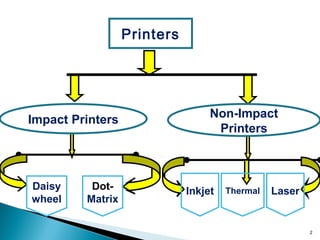
Daisy
wheel
Dot-
Matrix
Inkjet Thermal Laser
Printers
Impact Printers Non-Impact
Printers
 An external hardware device responsible for
taking computer data and generating a hard copy
of that data. Printers are one of the most
commonly used peripherals and they print text
and still images on the paper.
3
 These printers have a
mechanism that
touches the paper to
create an image.
These printers work
by banging a print
head containing a
number of metal pins
which strike an inked
ribbon placed
between the print
head and the paper.
An impact printer showing details
of print head.sss
4
 These printers create
an image on the print
medium without the
use of force. They don’t
touch the paper while
creating an image.
Non-impact printers
are much quieter than
impact printers as they
don’t strike the paper. A non-impact printer
5
 The term dot matrix
refers to the process of
placing dots to form an
image.
 Its speed is usually 30 to
550 characters per
second (cps).
 This is the cheapest and
the most noisy printer
and has a low print
quality. Dot Matrix were
1st
introduced by
Centronics in 1970. 6
 The dot matrix forms images one character at a
time as the print head moves across the paper.
 Uses tiny pins to hit an ink ribbon and the paper
much as a typewriter does.
 This printer arranges dots to form characters
and all kinds of images.
 When print head moves across the paper, pins
are activated to form a dotted character image.
These printers can produce carbon copies along
with the originals.
7
8
 Advantages:
 (1) less expensive.
 (2) Low per page cost.
Dis-advantages:
 (1) Noisy
 (2) Low resolution
 (3) Poor quality graphics output.
9
 A daisy wheel printer is
basically an impact
printer consisting of a
wheel and attached
extensions on which
molded metal characters
are mounted. A daisy
wheel printer produces
letter quality print and it
can’t produce graphics
output.
10
 In a daisy wheel printer, a hammer presses the
wheel against a ribbon which in turn makes an ink
stain on the paper in the form of a character
mounted on the wheel extensions.
 These printers are very noisy as there occur great
movement during the printing. Its printing speed is
also very slow ,i.e. less than 90cps.
11
 It is a non-impact printer
producing a high quality
print. A standard Inkjet
printer has a good
resolution. Newer
models have further
improved resolution.
Inkjet printers were
introduced in the later
half of 1980s.
12
 (1) Print head having four ink
cartridges moves .
 (2) Software instructs where
to apply dots of ink, which
color and what quantity to
use.
 (3) The ink is forced to the
paper through nozzles.
 (4) A matrix of dots forms
characters and pictures.
Color cartridge showing inkjet nozzles..
13
 (6) Paper tray/feeder:
 It enables the user to load the paper
into the printer.
 (7) Rollers:
 Control the movement of the paper.
 (8) Control circuitry:
 control all the mechanical aspects of
the operation as well as decode the
information sent to the printer from
the computer.
14
 Advantages:
 (1) High resolution output.
 (2) Many options to select.
 Dis-advantages:
 (1) Expensive.
 (2) Special paper required for higher resolution
output.
 (3) Time consuming in case of graphics printing.
15
 Thermal printers are in-
expensive printers
mostly used in fax
machines. The Thermal
printers are further
classified into two types.
 (1) Electro thermal
printers:
 (2) Thermal Wax
printers:
A fax machine using a thermal printer
16
 Thermal printers use heated pins and ribbons with
different color bands. These printers contain a
stick of wax like ink. The ribbon passes in front of
a print head that has a series of tiny heated pins.
The pins cause the wax to melt and adhere to the
paper and when temperature reaches to a certain
level, it is hardened.
17
 Laser printers use very
advanced technology
and produce a high
quality output. Laser
printers can also
produce high quality
graphics images.
18
 (1) Paper is fed and the drum rotates.
 (2) A laser beam conveys information from the
computer to a rotating mirror and thus an image
is created on the drum.
 (3)The charges on the drum are ionized and the
toner sticks to the drum.
 (4)Toner is transferred from drum to paper.
 (5)Heat is applied to fuse the toner on the paper.
19
 A multi function printer
abbreviated as MFP is an
all purpose device that
prints, faxes, copies and
scans. A single multi
function printer can
replace several bulky
devices. A multi function
printer is also known as
AIO. These printers use
inkjet technology and
provide high quality print
but at slow speed.
20
 A large scale printer
which is very accurate in
producing engineering
drawings and
architectural blueprints.
 Two types of plotters are
flatbed and drum.
 Flatbed plotters are
horizontally aligned while
drum plotters are
vertically positioned.
21

Printers

  • 1.
  • 2.
  • 3.
     An externalhardware device responsible for taking computer data and generating a hard copy of that data. Printers are one of the most commonly used peripherals and they print text and still images on the paper. 3
  • 4.
     These printershave a mechanism that touches the paper to create an image. These printers work by banging a print head containing a number of metal pins which strike an inked ribbon placed between the print head and the paper. An impact printer showing details of print head.sss 4
  • 5.
     These printerscreate an image on the print medium without the use of force. They don’t touch the paper while creating an image. Non-impact printers are much quieter than impact printers as they don’t strike the paper. A non-impact printer 5
  • 6.
     The termdot matrix refers to the process of placing dots to form an image.  Its speed is usually 30 to 550 characters per second (cps).  This is the cheapest and the most noisy printer and has a low print quality. Dot Matrix were 1st introduced by Centronics in 1970. 6
  • 7.
     The dotmatrix forms images one character at a time as the print head moves across the paper.  Uses tiny pins to hit an ink ribbon and the paper much as a typewriter does.  This printer arranges dots to form characters and all kinds of images.  When print head moves across the paper, pins are activated to form a dotted character image. These printers can produce carbon copies along with the originals. 7
  • 8.
  • 9.
     Advantages:  (1)less expensive.  (2) Low per page cost. Dis-advantages:  (1) Noisy  (2) Low resolution  (3) Poor quality graphics output. 9
  • 10.
     A daisywheel printer is basically an impact printer consisting of a wheel and attached extensions on which molded metal characters are mounted. A daisy wheel printer produces letter quality print and it can’t produce graphics output. 10
  • 11.
     In adaisy wheel printer, a hammer presses the wheel against a ribbon which in turn makes an ink stain on the paper in the form of a character mounted on the wheel extensions.  These printers are very noisy as there occur great movement during the printing. Its printing speed is also very slow ,i.e. less than 90cps. 11
  • 12.
     It isa non-impact printer producing a high quality print. A standard Inkjet printer has a good resolution. Newer models have further improved resolution. Inkjet printers were introduced in the later half of 1980s. 12
  • 13.
     (1) Printhead having four ink cartridges moves .  (2) Software instructs where to apply dots of ink, which color and what quantity to use.  (3) The ink is forced to the paper through nozzles.  (4) A matrix of dots forms characters and pictures. Color cartridge showing inkjet nozzles.. 13
  • 14.
     (6) Papertray/feeder:  It enables the user to load the paper into the printer.  (7) Rollers:  Control the movement of the paper.  (8) Control circuitry:  control all the mechanical aspects of the operation as well as decode the information sent to the printer from the computer. 14
  • 15.
     Advantages:  (1)High resolution output.  (2) Many options to select.  Dis-advantages:  (1) Expensive.  (2) Special paper required for higher resolution output.  (3) Time consuming in case of graphics printing. 15
  • 16.
     Thermal printersare in- expensive printers mostly used in fax machines. The Thermal printers are further classified into two types.  (1) Electro thermal printers:  (2) Thermal Wax printers: A fax machine using a thermal printer 16
  • 17.
     Thermal printersuse heated pins and ribbons with different color bands. These printers contain a stick of wax like ink. The ribbon passes in front of a print head that has a series of tiny heated pins. The pins cause the wax to melt and adhere to the paper and when temperature reaches to a certain level, it is hardened. 17
  • 18.
     Laser printersuse very advanced technology and produce a high quality output. Laser printers can also produce high quality graphics images. 18
  • 19.
     (1) Paperis fed and the drum rotates.  (2) A laser beam conveys information from the computer to a rotating mirror and thus an image is created on the drum.  (3)The charges on the drum are ionized and the toner sticks to the drum.  (4)Toner is transferred from drum to paper.  (5)Heat is applied to fuse the toner on the paper. 19
  • 20.
     A multifunction printer abbreviated as MFP is an all purpose device that prints, faxes, copies and scans. A single multi function printer can replace several bulky devices. A multi function printer is also known as AIO. These printers use inkjet technology and provide high quality print but at slow speed. 20
  • 21.
     A largescale printer which is very accurate in producing engineering drawings and architectural blueprints.  Two types of plotters are flatbed and drum.  Flatbed plotters are horizontally aligned while drum plotters are vertically positioned. 21