Fanzine Research
Allan Godin
Existing Product
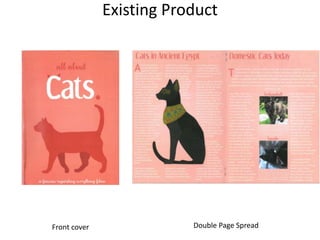
Front cover Double Page Spread
Existing Product
The type of content that is used is a mixture between articles, which are being used to provide the
information about the product. Drawings, used to show something in a more creative way or to
show something which wouldn’t of been able to have a picture taken of it. And finally,
photography to show details that some drawings couldn’t provide. These three elements come
together to form an interesting page with information about the topic. Having the mixture
between drawing and photo gives a variety to the audience making it less bland.
Design
The colour scheme used for the background is a light peach, Which is colour that is easy on the
eyes. There might not be a reason behind the colour selection but it makes the fanzine better to
read unlike black on white. The images used for the fanzine are either hand drawn to show
something that wouldn’t be able to be photographed or a photo of a cat to show difference
between breeds. The text to image ratio is good since you’re not overwhelmed by either or. As
well, the font choice is easy to read unlike quite a few fonts out the there.
Context
The subject that the fanzine covers is the topic of cats, this includes history, breeds, and facts
about them. The writing style used within can be viewed as simple and just spouting facts onto a
page. But looking closer you can see the passion the person has on the topic, they want you to
know about these marvelous creatures which they’re so fascinated about. This can also be linked
to the mode of address of it, as it gives heart breaking facts as if shouting to the audience that they
should help. It was a student who made this fanzine which means they’d of had access to modern
technology and would also have access to all the information they needed in the world with
google.
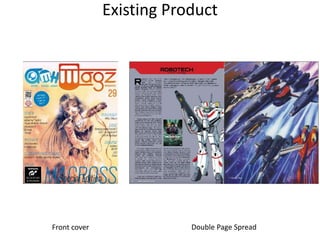
Existing Product
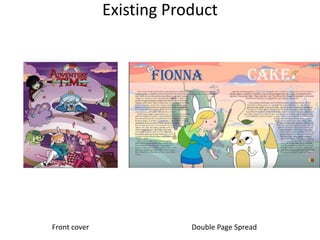
Front cover Double Page Spread
Existing Product
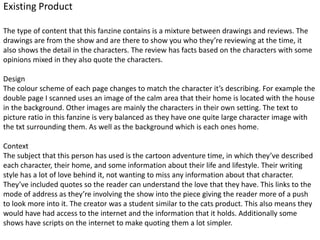
The type of content that this fanzine contains is a mixture between drawings and reviews. The
drawings are from the show and are there to show you who they’re reviewing at the time, it
also shows the detail in the characters. The review has facts based on the characters with some
opinions mixed in they also quote the characters.
Design
The colour scheme of each page changes to match the character it’s describing. For example the
double page I scanned uses an image of the calm area that their home is located with the house
in the background. Other images are mainly the characters in their own setting. The text to
picture ratio in this fanzine is very balanced as they have one quite large character image with
the txt surrounding them. As well as the background which is each ones home.
Context
The subject that this person has used is the cartoon adventure time, in which they’ve described
each character, their home, and some information about their life and lifestyle. Their writing
style has a lot of love behind it, not wanting to miss any information about that character.
They’ve included quotes so the reader can understand the love that they have. This links to the
mode of address as they’re involving the show into the piece giving the reader more of a push
to look more into it. The creator was a student similar to the cats product. This also means they
would have had access to the internet and the information that it holds. Additionally some
shows have scripts on the internet to make quoting them a lot simpler.
Existing Product
Front cover Double Page Spread
Existing Product
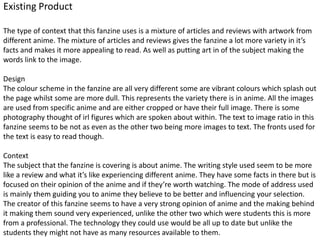
The type of context that this fanzine uses is a mixture of articles and reviews with artwork from
different anime. The mixture of articles and reviews gives the fanzine a lot more variety in it’s
facts and makes it more appealing to read. As well as putting art in of the subject making the
words link to the image.
Design
The colour scheme in the fanzine are all very different some are vibrant colours which splash out
the page whilst some are more dull. This represents the variety there is in anime. All the images
are used from specific anime and are either cropped or have their full image. There is some
photography thought of irl figures which are spoken about within. The text to image ratio in this
fanzine seems to be not as even as the other two being more images to text. The fronts used for
the text is easy to read though.
Context
The subject that the fanzine is covering is about anime. The writing style used seem to be more
like a review and what it’s like experiencing different anime. They have some facts in there but is
focused on their opinion of the anime and if they’re worth watching. The mode of address used
is mainly them guiding you to anime they believe to be better and influencing your selection.
The creator of this fanzine seems to have a very strong opinion of anime and the making behind
it making them sound very experienced, unlike the other two which were students this is more
from a professional. The technology they could use would be all up to date but unlike the
students they might not have as many resources available to them.
Research summary
• What I’ve learnt from the fanzines is that it’s important to
keep the facts entertaining by either adding little bits from the
subject in or by adding images that relate to the subject.
• Additionally, the front cover doesn’t need to be overly
complicated and can just be an image with a title and as small
overview of what’s inside or can be similar to a normal
magazine having information about the inside on the cover.
Initial Ideas
Idea
• The subject I’m going to work with is anime as it’s a passion of mine and also
has many different styles behind it. This means I could try and do a different
style for each page and push myself further with my character creation.
Potentially to keep my broad outlook on the subject I could add editions in and
make this the first one with a more specialised one “edition 2” advertised on
the back.
• The different written elements I’d include would be: articles that give detailed
facts about the pages theme, An interview showing peoples views on anime a
potential interview with a creator, a guide on 1 page on how to draw certain
body parts. On the visual side of the fanzine things I could include would be:
Small images of characters to fill gaps in between writing, larger images which
link to the theme of the page where the writing goes around it, or a full page
dedicated to the image which would include character/’s and a background.
Idea Development
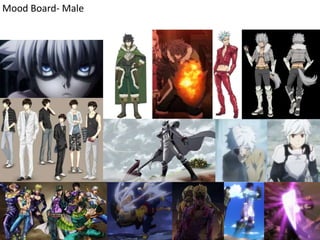
Mood Board- Male
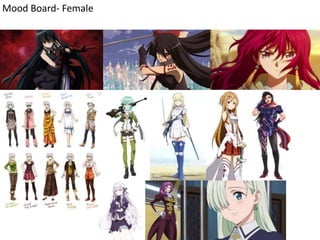
Mood Board- Female
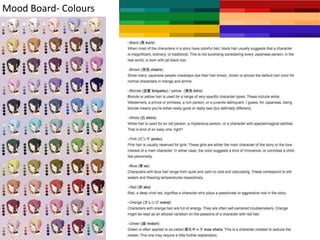
Mood Board- Colours
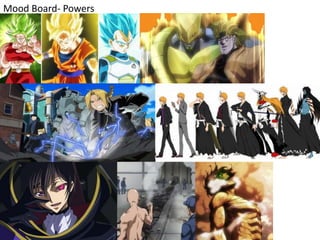
Mood Board- Powers
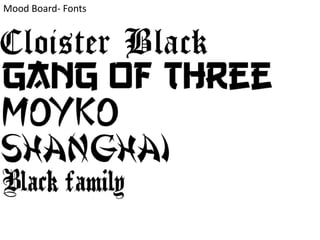
Mood Board- Fonts
Pagination
Pagination:
A plan for the pages of your book. What will be the cover? What will be the running order? What will go in it? How many
pages for each item? This is important to get right if you want it to print correctly later on. It will also help you plan the space
you have.
Pagination:
A plan for the pages of your book. What will be the cover? What will be the running order? What will go in it? How many
pages for each item? This is important to get right if you want it to print correctly later on. It will also help you plan the space
you have.
Pagination:
A plan for the pages of your book. What will be the cover? What will be the running order? What will go in it? How many
pages for each item? This is important to get right if you want it to print correctly later on. It will also help you plan the space
you have.
Pagination:
A plan for the pages of your book. What will be the cover? What will be the running order? What will go in it? How many
pages for each item? This is important to get right if you want it to print correctly later on. It will also help you plan the space
you have.
Pagination:
A plan for the pages of your book. What will be the cover? What will be the running order? What will go in it? How many
pages for each item? This is important to get right if you want it to print correctly later on. It will also help you plan the space
you have.
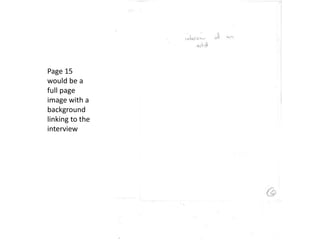
Page 15
would be a
full page
image with a
background
linking to the
interview
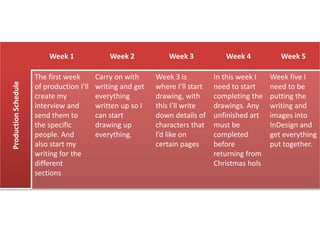
ProductionSchedule
Week 1 Week 2 Week 3 Week 4 Week 5
The first week
of production I’ll
create my
interview and
send them to
the specific
people. And
also start my
writing for the
different
sections
Carry on with
writing and get
everything
written up so I
can start
drawing up
everything.
Week 3 is
where I’ll start
drawing, with
this I’ll write
down details of
characters that
I’d like on
certain pages
In this week I
need to start
completing the
drawings. Any
unfinished art
must be
completed
before
returning from
Christmas hols
Week five I
need to be
putting the
writing and
images into
InDesign and
get everything
put together.
3. Copy
Interview:
You should document the process of getting your interview. You should produce a range of questions and also a list of
interviewees.
You should provide an unedited transcript of the interview as well as at least one draft of it.
Interviews can be written in whatever style you prefer.
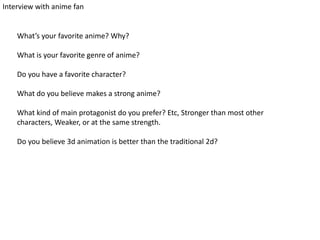
Interview with anime fan
What’s your favorite anime? Why?
What is your favorite genre of anime?
Do you have a favorite character?
What do you believe makes a strong anime?
What kind of main protagonist do you prefer? Etc, Stronger than most other
characters, Weaker, or at the same strength.
Do you believe 3d animation is better than the traditional 2d?
Interview with manga artist
What inspired you to start drawing manga?
What do you think is the best way to start learning how to draw?
What do you believe makes a good story?

Print pro forma

  • 1.
  • 2.
    Existing Product Front coverDouble Page Spread
  • 3.
    Existing Product The typeof content that is used is a mixture between articles, which are being used to provide the information about the product. Drawings, used to show something in a more creative way or to show something which wouldn’t of been able to have a picture taken of it. And finally, photography to show details that some drawings couldn’t provide. These three elements come together to form an interesting page with information about the topic. Having the mixture between drawing and photo gives a variety to the audience making it less bland. Design The colour scheme used for the background is a light peach, Which is colour that is easy on the eyes. There might not be a reason behind the colour selection but it makes the fanzine better to read unlike black on white. The images used for the fanzine are either hand drawn to show something that wouldn’t be able to be photographed or a photo of a cat to show difference between breeds. The text to image ratio is good since you’re not overwhelmed by either or. As well, the font choice is easy to read unlike quite a few fonts out the there. Context The subject that the fanzine covers is the topic of cats, this includes history, breeds, and facts about them. The writing style used within can be viewed as simple and just spouting facts onto a page. But looking closer you can see the passion the person has on the topic, they want you to know about these marvelous creatures which they’re so fascinated about. This can also be linked to the mode of address of it, as it gives heart breaking facts as if shouting to the audience that they should help. It was a student who made this fanzine which means they’d of had access to modern technology and would also have access to all the information they needed in the world with google.
  • 4.
    Existing Product Front coverDouble Page Spread
  • 5.
    Existing Product The typeof content that this fanzine contains is a mixture between drawings and reviews. The drawings are from the show and are there to show you who they’re reviewing at the time, it also shows the detail in the characters. The review has facts based on the characters with some opinions mixed in they also quote the characters. Design The colour scheme of each page changes to match the character it’s describing. For example the double page I scanned uses an image of the calm area that their home is located with the house in the background. Other images are mainly the characters in their own setting. The text to picture ratio in this fanzine is very balanced as they have one quite large character image with the txt surrounding them. As well as the background which is each ones home. Context The subject that this person has used is the cartoon adventure time, in which they’ve described each character, their home, and some information about their life and lifestyle. Their writing style has a lot of love behind it, not wanting to miss any information about that character. They’ve included quotes so the reader can understand the love that they have. This links to the mode of address as they’re involving the show into the piece giving the reader more of a push to look more into it. The creator was a student similar to the cats product. This also means they would have had access to the internet and the information that it holds. Additionally some shows have scripts on the internet to make quoting them a lot simpler.
  • 6.
    Existing Product Front coverDouble Page Spread
  • 7.
    Existing Product The typeof context that this fanzine uses is a mixture of articles and reviews with artwork from different anime. The mixture of articles and reviews gives the fanzine a lot more variety in it’s facts and makes it more appealing to read. As well as putting art in of the subject making the words link to the image. Design The colour scheme in the fanzine are all very different some are vibrant colours which splash out the page whilst some are more dull. This represents the variety there is in anime. All the images are used from specific anime and are either cropped or have their full image. There is some photography thought of irl figures which are spoken about within. The text to image ratio in this fanzine seems to be not as even as the other two being more images to text. The fronts used for the text is easy to read though. Context The subject that the fanzine is covering is about anime. The writing style used seem to be more like a review and what it’s like experiencing different anime. They have some facts in there but is focused on their opinion of the anime and if they’re worth watching. The mode of address used is mainly them guiding you to anime they believe to be better and influencing your selection. The creator of this fanzine seems to have a very strong opinion of anime and the making behind it making them sound very experienced, unlike the other two which were students this is more from a professional. The technology they could use would be all up to date but unlike the students they might not have as many resources available to them.
  • 8.
    Research summary • WhatI’ve learnt from the fanzines is that it’s important to keep the facts entertaining by either adding little bits from the subject in or by adding images that relate to the subject. • Additionally, the front cover doesn’t need to be overly complicated and can just be an image with a title and as small overview of what’s inside or can be similar to a normal magazine having information about the inside on the cover.
  • 9.
  • 10.
    Idea • The subjectI’m going to work with is anime as it’s a passion of mine and also has many different styles behind it. This means I could try and do a different style for each page and push myself further with my character creation. Potentially to keep my broad outlook on the subject I could add editions in and make this the first one with a more specialised one “edition 2” advertised on the back. • The different written elements I’d include would be: articles that give detailed facts about the pages theme, An interview showing peoples views on anime a potential interview with a creator, a guide on 1 page on how to draw certain body parts. On the visual side of the fanzine things I could include would be: Small images of characters to fill gaps in between writing, larger images which link to the theme of the page where the writing goes around it, or a full page dedicated to the image which would include character/’s and a background.
  • 11.
  • 12.
  • 13.
  • 14.
  • 15.
  • 16.
  • 17.
  • 20.
    Pagination: A plan forthe pages of your book. What will be the cover? What will be the running order? What will go in it? How many pages for each item? This is important to get right if you want it to print correctly later on. It will also help you plan the space you have.
  • 21.
    Pagination: A plan forthe pages of your book. What will be the cover? What will be the running order? What will go in it? How many pages for each item? This is important to get right if you want it to print correctly later on. It will also help you plan the space you have.
  • 22.
    Pagination: A plan forthe pages of your book. What will be the cover? What will be the running order? What will go in it? How many pages for each item? This is important to get right if you want it to print correctly later on. It will also help you plan the space you have.
  • 23.
    Pagination: A plan forthe pages of your book. What will be the cover? What will be the running order? What will go in it? How many pages for each item? This is important to get right if you want it to print correctly later on. It will also help you plan the space you have.
  • 24.
    Pagination: A plan forthe pages of your book. What will be the cover? What will be the running order? What will go in it? How many pages for each item? This is important to get right if you want it to print correctly later on. It will also help you plan the space you have.
  • 25.
    Page 15 would bea full page image with a background linking to the interview
  • 27.
    ProductionSchedule Week 1 Week2 Week 3 Week 4 Week 5 The first week of production I’ll create my interview and send them to the specific people. And also start my writing for the different sections Carry on with writing and get everything written up so I can start drawing up everything. Week 3 is where I’ll start drawing, with this I’ll write down details of characters that I’d like on certain pages In this week I need to start completing the drawings. Any unfinished art must be completed before returning from Christmas hols Week five I need to be putting the writing and images into InDesign and get everything put together.
  • 28.
  • 29.
    Interview: You should documentthe process of getting your interview. You should produce a range of questions and also a list of interviewees. You should provide an unedited transcript of the interview as well as at least one draft of it. Interviews can be written in whatever style you prefer.
  • 30.
    Interview with animefan What’s your favorite anime? Why? What is your favorite genre of anime? Do you have a favorite character? What do you believe makes a strong anime? What kind of main protagonist do you prefer? Etc, Stronger than most other characters, Weaker, or at the same strength. Do you believe 3d animation is better than the traditional 2d?
  • 31.
    Interview with mangaartist What inspired you to start drawing manga? What do you think is the best way to start learning how to draw? What do you believe makes a good story?

Editor's Notes

  • #4 Look at different types of content, design elements, the subject and context. Type of content- studio/location photography, articles, reviews, adverts, sketches, drawings and other artwork Design – colour schemes, photography and images, text/picture ratio, font choices Subject and context – What subject(s) is the fanzine covering? What is the writing style? What is the mode of address? In what context was the fanzine produced? Context is the environment in which something was produced. Think about the time this was made.
  • #6 Look at different types of content, design elements, the subject and context. Type of content- studio/location photography, articles, reviews, adverts, sketches, drawings and other artwork Design – colour schemes, photography and images, text/picture ratio, font choices Subject and context – What subject(s) is the fanzine covering? What is the writing style? What is the mode of address? In what context was the fanzine produced? Context is the environment in which something was produced. Think about the time this was made.
  • #8 Look at different types of content, design elements, the subject and context. Type of content- studio/location photography, articles, reviews, adverts, sketches, drawings and other artwork Design – colour schemes, photography and images, text/picture ratio, font choices Subject and context – What subject(s) is the fanzine covering? What is the writing style? What is the mode of address? In what context was the fanzine produced? Context is the environment in which something was produced. Think about the time this was made.
  • #9 You don’t need to find links between different fanzines because, often there are not any.
  • #11 Think about a subject you could write about, a design style could work in and why you would want to do it. Think about content. What different visual and written elements would you include? Initial ideas can be documented in any way that you would like. Mind maps are ok, but they don’t work for everyone. If you prefer to simply write your idea, do that. If you want to combine text and images, do that. As long as you communicate a potential idea, the method is up to you. Present you idea and also some justification for your choices. You can link this back to your research.