Experiments
Daniel Morland
Front Cover Process
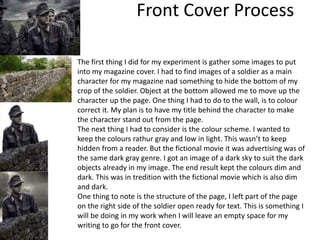
The first thing I did for my experiment is gather some images to put
into my magazine cover. I had to find images of a soldier as a main
character for my magazine nad something to hide the bottom of my
crop of the soldier. Object at the bottom allowed me to move up the
character up the page. One thing I had to do to the wall, is to colour
correct it. My plan is to have my title behind the character to make
the character stand out from the page.
The next thing I had to consider is the colour scheme. I wanted to
keep the colours rathur gray and low in light. This wasn’t to keep
hidden from a reader. But the fictional movie it was advertising was of
the same dark gray genre. I got an image of a dark sky to suit the dark
objects already in my image. The end result kept the colours dim and
dark. This was in tredition with the fictional movie which is also dim
and dark.
One thing to note is the structure of the page, I left part of the page
on the right side of the soldier open ready for text. This is something I
will be doing in my work when I will leave an empty space for my
writing to go for the front cover.
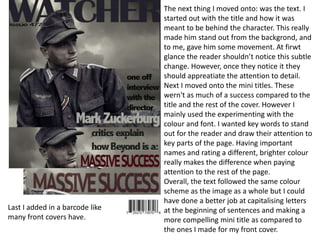
The next thing I moved onto: was the text. I
started out with the title and how it was
meant to be behind the character. This really
made him stand out from the backgrond, and
to me, gave him some movement. At firwt
glance the reader shouldn’t notice this subtle
change. However, once they notice it they
should appreatiate the attention to detail.
Next I moved onto the mini titles. These
wern't as much of a success compared to the
title and the rest of the cover. However I
mainly used the experimenting with the
colour and font. I wanted key words to stand
out for the reader and draw their attention to
key parts of the page. Having important
names and rating a different, brighter colour
really makes the difference when paying
attention to the rest of the page.
Overall, the text followed the same colour
scheme as the image as a whole but I could
have done a better job at capitalising letters
at the beginning of sentences and making a
more compelling mini title as compared to
the ones I made for my front cover.
Last I added in a barcode like
many front covers have.
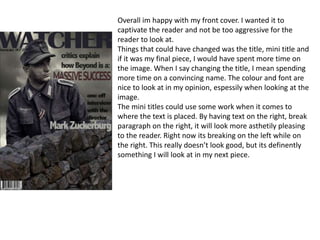
Overall im happy with my front cover. I wanted it to
captivate the reader and not be too aggressive for the
reader to look at.
Things that could have changed was the title, mini title and
if it was my final piece, I would have spent more time on
the image. When I say changing the title, I mean spending
more time on a convincing name. The colour and font are
nice to look at in my opinion, espessily when looking at the
image.
The mini titles could use some work when it comes to
where the text is placed. By having text on the right, break
paragraph on the right, it will look more asthetily pleasing
to the reader. Right now its breaking on the left while on
the right. This really doesn’t look good, but its definently
something I will look at in my next piece.
Reflection
• Text isnt lined up
• Make sure there is an invisable line to line up text
• Astheticly pleasing text
• Colour correcting
• What elements of your experiments will you
include in your final product?
• Large title
• Bold and bright colour
• Colours should contrast each other
Double Page Process
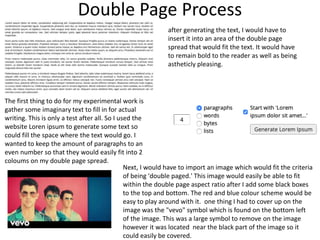
The first thing to do for my experimental work is
gather some imaginary text to fill in for actual
writing. This is only a test after all. So I used the
website Loren ipsum to generate some text so
could fill the space where the text would go. I
wanted to keep the amount of paragraphs to an
even number so that they would easily fit into 2
coloums on my double page spread.
after generating the text, I would have to
insert it into an area of the double page
spread that would fit the text. It would have
to remain bold to the reader as well as being
astheticly pleasing.
Next, I would have to import an image which would fit the criteria
of being 'double paged.' This image would easily be able to fit
within the double page aspect ratio after I add some black boxes
to the top and bottom. The red and blue colour scheme would be
easy to play around with it. one thing I had to cover up on the
image was the "vevo" symbol which is found on the bottom left
of the image. This was a large symbol to remove on the image
however it was located near the black part of the image so it
could easily be covered.
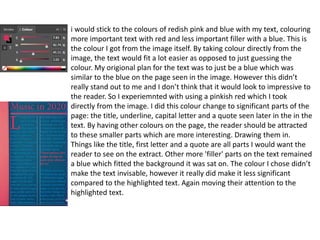
i would stick to the colours of redish pink and blue with my text, colouring
more important text with red and less important filler with a blue. This is
the colour I got from the image itself. By taking colour directly from the
image, the text would fit a lot easier as opposed to just guessing the
colour. My origional plan for the text was to just be a blue which was
similar to the blue on the page seen in the image. However this didn’t
really stand out to me and I don’t think that it would look to impressive to
the reader. So I experiemnted with using a pinkish red which I took
directly from the image. I did this colour change to significant parts of the
page: the title, underline, capital letter and a quote seen later in the in the
text. By having other colours on the page, the reader should be attracted
to these smaller parts which are more interesting. Drawing them in.
Things like the title, first letter and a quote are all parts I would want the
reader to see on the extract. Other more 'filler' parts on the text remained
a blue which fitted the background it was sat on. The colour I chose didn’t
make the text invisable, however it really did make it less significant
compared to the highlighted text. Again moving their attention to the
highlighted text.
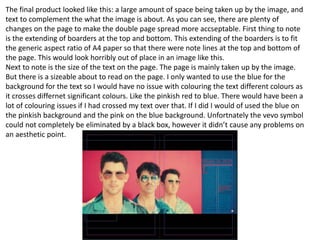
The final product looked like this: a large amount of space being taken up by the image, and
text to complement the what the image is about. As you can see, there are plenty of
changes on the page to make the double page spread more accseptable. First thing to note
is the extending of boarders at the top and bottom. This extending of the boarders is to fit
the generic aspect ratio of A4 paper so that there were note lines at the top and bottom of
the page. This would look horribly out of place in an image like this.
Next to note is the size of the text on the page. The page is mainly taken up by the image.
But there is a sizeable about to read on the page. I only wanted to use the blue for the
background for the text so I would have no issue with colouring the text different colours as
it crosses differnet significant colours. Like the pinkish red to blue. There would have been a
lot of colouring issues if I had crossed my text over that. If I did I would of used the blue on
the pinkish background and the pink on the blue background. Unfortnately the vevo symbol
could not completely be eliminated by a black box, however it didn’t cause any problems on
an aesthetic point.
Reflection
• Different colours depending on backgrounds
• Sticking to 2 colours. One primary and one
secondary
• Text in specific parts of the page
• Title in different font
• Bold title depending on font

production experiments for magazine

  • 1.
  • 2.
    Front Cover Process Thefirst thing I did for my experiment is gather some images to put into my magazine cover. I had to find images of a soldier as a main character for my magazine nad something to hide the bottom of my crop of the soldier. Object at the bottom allowed me to move up the character up the page. One thing I had to do to the wall, is to colour correct it. My plan is to have my title behind the character to make the character stand out from the page. The next thing I had to consider is the colour scheme. I wanted to keep the colours rathur gray and low in light. This wasn’t to keep hidden from a reader. But the fictional movie it was advertising was of the same dark gray genre. I got an image of a dark sky to suit the dark objects already in my image. The end result kept the colours dim and dark. This was in tredition with the fictional movie which is also dim and dark. One thing to note is the structure of the page, I left part of the page on the right side of the soldier open ready for text. This is something I will be doing in my work when I will leave an empty space for my writing to go for the front cover.
  • 3.
    The next thingI moved onto: was the text. I started out with the title and how it was meant to be behind the character. This really made him stand out from the backgrond, and to me, gave him some movement. At firwt glance the reader shouldn’t notice this subtle change. However, once they notice it they should appreatiate the attention to detail. Next I moved onto the mini titles. These wern't as much of a success compared to the title and the rest of the cover. However I mainly used the experimenting with the colour and font. I wanted key words to stand out for the reader and draw their attention to key parts of the page. Having important names and rating a different, brighter colour really makes the difference when paying attention to the rest of the page. Overall, the text followed the same colour scheme as the image as a whole but I could have done a better job at capitalising letters at the beginning of sentences and making a more compelling mini title as compared to the ones I made for my front cover. Last I added in a barcode like many front covers have.
  • 4.
    Overall im happywith my front cover. I wanted it to captivate the reader and not be too aggressive for the reader to look at. Things that could have changed was the title, mini title and if it was my final piece, I would have spent more time on the image. When I say changing the title, I mean spending more time on a convincing name. The colour and font are nice to look at in my opinion, espessily when looking at the image. The mini titles could use some work when it comes to where the text is placed. By having text on the right, break paragraph on the right, it will look more asthetily pleasing to the reader. Right now its breaking on the left while on the right. This really doesn’t look good, but its definently something I will look at in my next piece.
  • 5.
    Reflection • Text isntlined up • Make sure there is an invisable line to line up text • Astheticly pleasing text • Colour correcting • What elements of your experiments will you include in your final product? • Large title • Bold and bright colour • Colours should contrast each other
  • 6.
    Double Page Process Thefirst thing to do for my experimental work is gather some imaginary text to fill in for actual writing. This is only a test after all. So I used the website Loren ipsum to generate some text so could fill the space where the text would go. I wanted to keep the amount of paragraphs to an even number so that they would easily fit into 2 coloums on my double page spread. after generating the text, I would have to insert it into an area of the double page spread that would fit the text. It would have to remain bold to the reader as well as being astheticly pleasing. Next, I would have to import an image which would fit the criteria of being 'double paged.' This image would easily be able to fit within the double page aspect ratio after I add some black boxes to the top and bottom. The red and blue colour scheme would be easy to play around with it. one thing I had to cover up on the image was the "vevo" symbol which is found on the bottom left of the image. This was a large symbol to remove on the image however it was located near the black part of the image so it could easily be covered.
  • 7.
    i would stickto the colours of redish pink and blue with my text, colouring more important text with red and less important filler with a blue. This is the colour I got from the image itself. By taking colour directly from the image, the text would fit a lot easier as opposed to just guessing the colour. My origional plan for the text was to just be a blue which was similar to the blue on the page seen in the image. However this didn’t really stand out to me and I don’t think that it would look to impressive to the reader. So I experiemnted with using a pinkish red which I took directly from the image. I did this colour change to significant parts of the page: the title, underline, capital letter and a quote seen later in the in the text. By having other colours on the page, the reader should be attracted to these smaller parts which are more interesting. Drawing them in. Things like the title, first letter and a quote are all parts I would want the reader to see on the extract. Other more 'filler' parts on the text remained a blue which fitted the background it was sat on. The colour I chose didn’t make the text invisable, however it really did make it less significant compared to the highlighted text. Again moving their attention to the highlighted text.
  • 8.
    The final productlooked like this: a large amount of space being taken up by the image, and text to complement the what the image is about. As you can see, there are plenty of changes on the page to make the double page spread more accseptable. First thing to note is the extending of boarders at the top and bottom. This extending of the boarders is to fit the generic aspect ratio of A4 paper so that there were note lines at the top and bottom of the page. This would look horribly out of place in an image like this. Next to note is the size of the text on the page. The page is mainly taken up by the image. But there is a sizeable about to read on the page. I only wanted to use the blue for the background for the text so I would have no issue with colouring the text different colours as it crosses differnet significant colours. Like the pinkish red to blue. There would have been a lot of colouring issues if I had crossed my text over that. If I did I would of used the blue on the pinkish background and the pink on the blue background. Unfortnately the vevo symbol could not completely be eliminated by a black box, however it didn’t cause any problems on an aesthetic point.
  • 9.
    Reflection • Different coloursdepending on backgrounds • Sticking to 2 colours. One primary and one secondary • Text in specific parts of the page • Title in different font • Bold title depending on font

Editor's Notes

  • #3 Discuss the tools and processes used in your experiments
  • #7 Discuss the tools and processes used in your experiments