BIOASSAYS
PRESENTED BY
HEENA PARVEEN ,
PHARMACOLOGY DEPT.
ASSISTANT PROFESSOR.
BIOASSAY
BIO= LIFE ; ASSAY= TO TEST
The technique involved in estimation of potency of an active constituent in a unit quantity
of preparation from the magnitude of its main biological effect is called
Bioassay/Biological standardization.
Aim : To determine the amount of active ingredient present in a preparation .
Example : Parasympathomimetic action of unknown drug is determined comparing its
contractility with the standard solution of Acetylcholine {parasympathomimetic}.
FACTORS INFLUENCING ACCURACY & RELIABILITYARE:
Selection of Animals,
Selection of Test procedure,
Details of test procedure,
Trained staff performing bioassay.
Applications:
 For screening pharmacological activity of new/chemically undefined substances.
 To measure potency/concentration of substance in tissue / body fluids.
 To estimate LD50 &ED50 of drug.
 For biological standardization of drugs of natural origin which cannot be derived
in pure form.
Example: Insulin ,Heparin ,Oxytocin.
 For the following categories Bioassay is to be indicated :
For drugs of unknown chemical composition,
Drugs for which chemical assay is complex. Example: Adrenaline & Histamine.
Drugs which have same pharmacological activity but different chemical
composition. Example : Digitalis glycosides obtained from different plant
sources.
Drugs that do not have an adequate chemical assay Example : Insulin
Principles of Bioassay
These principles of Bioassay is constituted by BURN & DALE.
Basic Principle underlying bioassay __ To compare the test substance with the
international standard preparation of same & to estimate how much test substance
is needed to produce same biological effect as produced by standard.
Other principles as follows are:
Biological response produced by active principle to be measured in bioassay should
be same in all species.
The Method selected should be Reliable, Sensitive & Reproducible.
Animals of same species, sex, weight should be used.
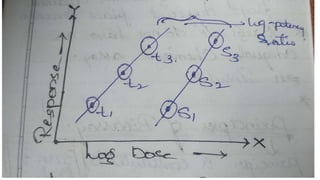
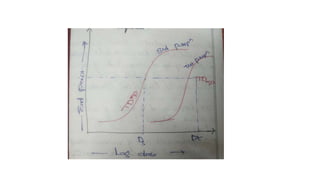
Mode of action & pharmacological effects of both test & standard should be same
so that their log DRC’S are parallel & their log-potency ratios can be easily
compared.
TYPES OF BIOASSAYS
1. All/None Phenomenon /Quantal Bioassay/Direct end-point Bioassay.
2. Graded Response Bioassay.
All/None Phenomenon /Quantal Bioassay/Direct end-point Bioassay:
Response in the form of All/None[Either No response or maximum response
produced]
Example: Cardiac Arrest due to Digitalis in Guinea pig ileum.
 Hypoglycemic convulsions by Insulin in Mice.
 Head drop in Rabbits coz of paralysis of neck muscles by d-tb.
 LD50 Determination in mice / rats.
 Dose of the test & standard which gives All/None effect is estimated
& then their potency ratios are calculated & compared.
Graded Response Bioassay
It involves measurement & grading of responses of drug at different doses.
Hence, method is known as “Graded Response Bioassay”.
Example: Bioassay of Acetylcholine on Frog Rectus Abdominis muscle ,Where
contraction of muscle at different doses is measured & graded.
Methods of Graded Response Bioassay:
a] Matching Bioassay
b] Bracketing Bioassay
c] Interpolation Bioassay
d] Multiple point Bioassay (i) Three-point Bioassay (ii) For-point Bioassay
(iii) Six-point Bioassay
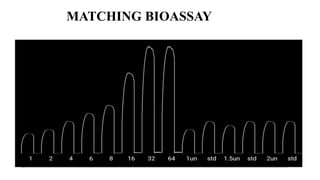
Matching Bioassay
In cases , where sample size is very small.
Test response is matched against standard response if drug by Trial & Error method.
Potency ratio of Test & standard are calculated ,
Concentration of test sample are calculated from concentration of standard.
Example : Bioassay of Histamine ,Adrenaline , Acetylcholine.
Demerit: DRC is not recorded. Hence, Precision & Reliability of this method is
poor.
MATCHING BIOASSAY
BRACKETING BIOASSAY
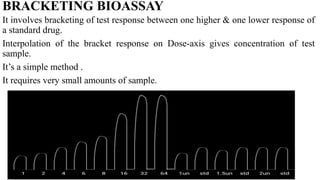
It involves bracketing of test response between one higher & one lower response of
a standard drug.
Interpolation of the bracket response on Dose-axis gives concentration of test
sample.
It’s a simple method .
It requires very small amounts of sample.
INTERPOLATION BIOASSAY
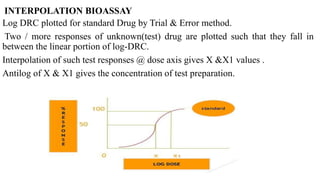
Log DRC plotted for standard Drug by Trial & Error method.
Two / more responses of unknown(test) drug are plotted such that they fall in
between the linear portion of log-DRC.
Interpolation of such test responses @ dose axis gives X &X1 values .
Antilog of X & X1 gives the concentration of test preparation.
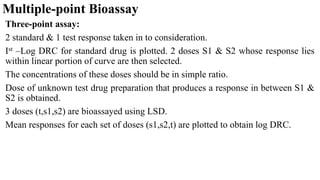
Demerits :
These graded interpolation bioassays are not reliable.
The changes in tissue sensitivity overtime, dose timing, differences in mode of
drugs application (T & S ) are not considered during assay.
Statistical Evaluation is not possible.
Multiple-point Bioassay
Three-point assay:
2 standard & 1 test response taken in to consideration.
Ist –Log DRC for standard drug is plotted. 2 doses S1 & S2 whose response lies
within linear portion of curve are then selected.
The concentrations of these doses should be in simple ratio.
Dose of unknown test drug preparation that produces a response in between S1 &
S2 is obtained.
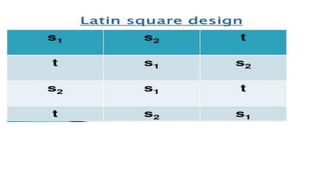
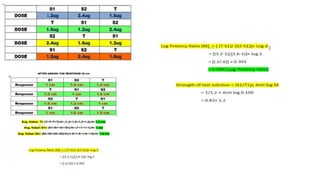
3 doses (t,s1,s2) are bioassayed using LSD.
Mean responses for each set of doses (s1,s2,t) are plotted to obtain log DRC.
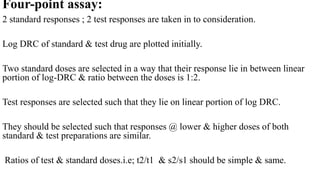
Four-point assay:
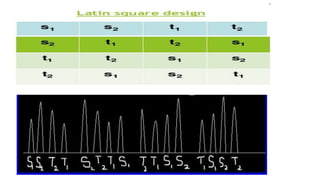
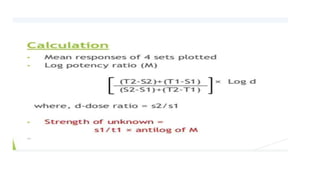
2 standard responses ; 2 test responses are taken in to consideration.
Log DRC of standard & test drug are plotted initially.
Two standard doses are selected in a way that their response lie in between linear
portion of log-DRC & ratio between the doses is 1:2.
Test responses are selected such that they lie on linear portion of log DRC.
They should be selected such that responses @ lower & higher doses of both
standard & test preparations are similar.
Ratios of test & standard doses.i.e; t2/t1 & s2/s1 should be simple & same.
TH9X

Bioassay ,its types for theory & practical

  • 1.
    BIOASSAYS PRESENTED BY HEENA PARVEEN, PHARMACOLOGY DEPT. ASSISTANT PROFESSOR.
  • 2.
    BIOASSAY BIO= LIFE ;ASSAY= TO TEST The technique involved in estimation of potency of an active constituent in a unit quantity of preparation from the magnitude of its main biological effect is called Bioassay/Biological standardization. Aim : To determine the amount of active ingredient present in a preparation . Example : Parasympathomimetic action of unknown drug is determined comparing its contractility with the standard solution of Acetylcholine {parasympathomimetic}. FACTORS INFLUENCING ACCURACY & RELIABILITYARE: Selection of Animals, Selection of Test procedure, Details of test procedure, Trained staff performing bioassay.
  • 3.
    Applications:  For screeningpharmacological activity of new/chemically undefined substances.  To measure potency/concentration of substance in tissue / body fluids.  To estimate LD50 &ED50 of drug.  For biological standardization of drugs of natural origin which cannot be derived in pure form. Example: Insulin ,Heparin ,Oxytocin.  For the following categories Bioassay is to be indicated : For drugs of unknown chemical composition, Drugs for which chemical assay is complex. Example: Adrenaline & Histamine. Drugs which have same pharmacological activity but different chemical composition. Example : Digitalis glycosides obtained from different plant sources. Drugs that do not have an adequate chemical assay Example : Insulin
  • 4.
    Principles of Bioassay Theseprinciples of Bioassay is constituted by BURN & DALE. Basic Principle underlying bioassay __ To compare the test substance with the international standard preparation of same & to estimate how much test substance is needed to produce same biological effect as produced by standard. Other principles as follows are: Biological response produced by active principle to be measured in bioassay should be same in all species. The Method selected should be Reliable, Sensitive & Reproducible. Animals of same species, sex, weight should be used. Mode of action & pharmacological effects of both test & standard should be same so that their log DRC’S are parallel & their log-potency ratios can be easily compared.
  • 6.
    TYPES OF BIOASSAYS 1.All/None Phenomenon /Quantal Bioassay/Direct end-point Bioassay. 2. Graded Response Bioassay. All/None Phenomenon /Quantal Bioassay/Direct end-point Bioassay: Response in the form of All/None[Either No response or maximum response produced] Example: Cardiac Arrest due to Digitalis in Guinea pig ileum.  Hypoglycemic convulsions by Insulin in Mice.  Head drop in Rabbits coz of paralysis of neck muscles by d-tb.  LD50 Determination in mice / rats.  Dose of the test & standard which gives All/None effect is estimated & then their potency ratios are calculated & compared.
  • 8.
    Graded Response Bioassay Itinvolves measurement & grading of responses of drug at different doses. Hence, method is known as “Graded Response Bioassay”. Example: Bioassay of Acetylcholine on Frog Rectus Abdominis muscle ,Where contraction of muscle at different doses is measured & graded.
  • 9.
    Methods of GradedResponse Bioassay: a] Matching Bioassay b] Bracketing Bioassay c] Interpolation Bioassay d] Multiple point Bioassay (i) Three-point Bioassay (ii) For-point Bioassay (iii) Six-point Bioassay Matching Bioassay In cases , where sample size is very small. Test response is matched against standard response if drug by Trial & Error method. Potency ratio of Test & standard are calculated , Concentration of test sample are calculated from concentration of standard. Example : Bioassay of Histamine ,Adrenaline , Acetylcholine. Demerit: DRC is not recorded. Hence, Precision & Reliability of this method is poor.
  • 10.
  • 11.
    BRACKETING BIOASSAY It involvesbracketing of test response between one higher & one lower response of a standard drug. Interpolation of the bracket response on Dose-axis gives concentration of test sample. It’s a simple method . It requires very small amounts of sample.
  • 12.
    INTERPOLATION BIOASSAY Log DRCplotted for standard Drug by Trial & Error method. Two / more responses of unknown(test) drug are plotted such that they fall in between the linear portion of log-DRC. Interpolation of such test responses @ dose axis gives X &X1 values . Antilog of X & X1 gives the concentration of test preparation.
  • 13.
    Demerits : These gradedinterpolation bioassays are not reliable. The changes in tissue sensitivity overtime, dose timing, differences in mode of drugs application (T & S ) are not considered during assay. Statistical Evaluation is not possible.
  • 14.
    Multiple-point Bioassay Three-point assay: 2standard & 1 test response taken in to consideration. Ist –Log DRC for standard drug is plotted. 2 doses S1 & S2 whose response lies within linear portion of curve are then selected. The concentrations of these doses should be in simple ratio. Dose of unknown test drug preparation that produces a response in between S1 & S2 is obtained. 3 doses (t,s1,s2) are bioassayed using LSD. Mean responses for each set of doses (s1,s2,t) are plotted to obtain log DRC.
  • 18.
    Four-point assay: 2 standardresponses ; 2 test responses are taken in to consideration. Log DRC of standard & test drug are plotted initially. Two standard doses are selected in a way that their response lie in between linear portion of log-DRC & ratio between the doses is 1:2. Test responses are selected such that they lie on linear portion of log DRC. They should be selected such that responses @ lower & higher doses of both standard & test preparations are similar. Ratios of test & standard doses.i.e; t2/t1 & s2/s1 should be simple & same.
  • 21.