Principles of
Emergency Response Planning
Jae S. Brown,MPA,MBA
Principle Consultant
Shared EMC
Principles of an Emergency Response Plan
 How to develop a good Emergency Response Plan?
 What are the marks of a good plan?
 How do you test the plan?
What is an Emergency Response Plan
When to develop a plan?
Include in
the Plan
(Fire in
Lab)
Do you have
to respond?
911, inform
authorities,
take action
Could it affect
the facility’s
area?
Threat/Hazard
Does it affect?
The facility’s
assets and
people
How to Develop a Plan
 What is an Emergency Response Plan?
 Checklist on what should be in a plan
• Good starting and ending point
• Lacks tips and tools on how to create a plan
 Emergency Response Guidance Plan (IRP)
Ingredients
1 cup butter, softened
2 cups packed brown sugar
2 eggs
2 teaspoons vanilla extract
2 1/3 cups all-purpose flour
1 teaspoon baking soda
1 teaspoon salt
2 cups rolled oats
Directions
How to Develop a Plan
 The 5 Keys
 Form a team
 Determine the potential hazards
 Analyze capabilities
 Develop a plan
 Exercise a plan
 Emergency response planning
cycle
How to Develop a Plan:The Five Keys
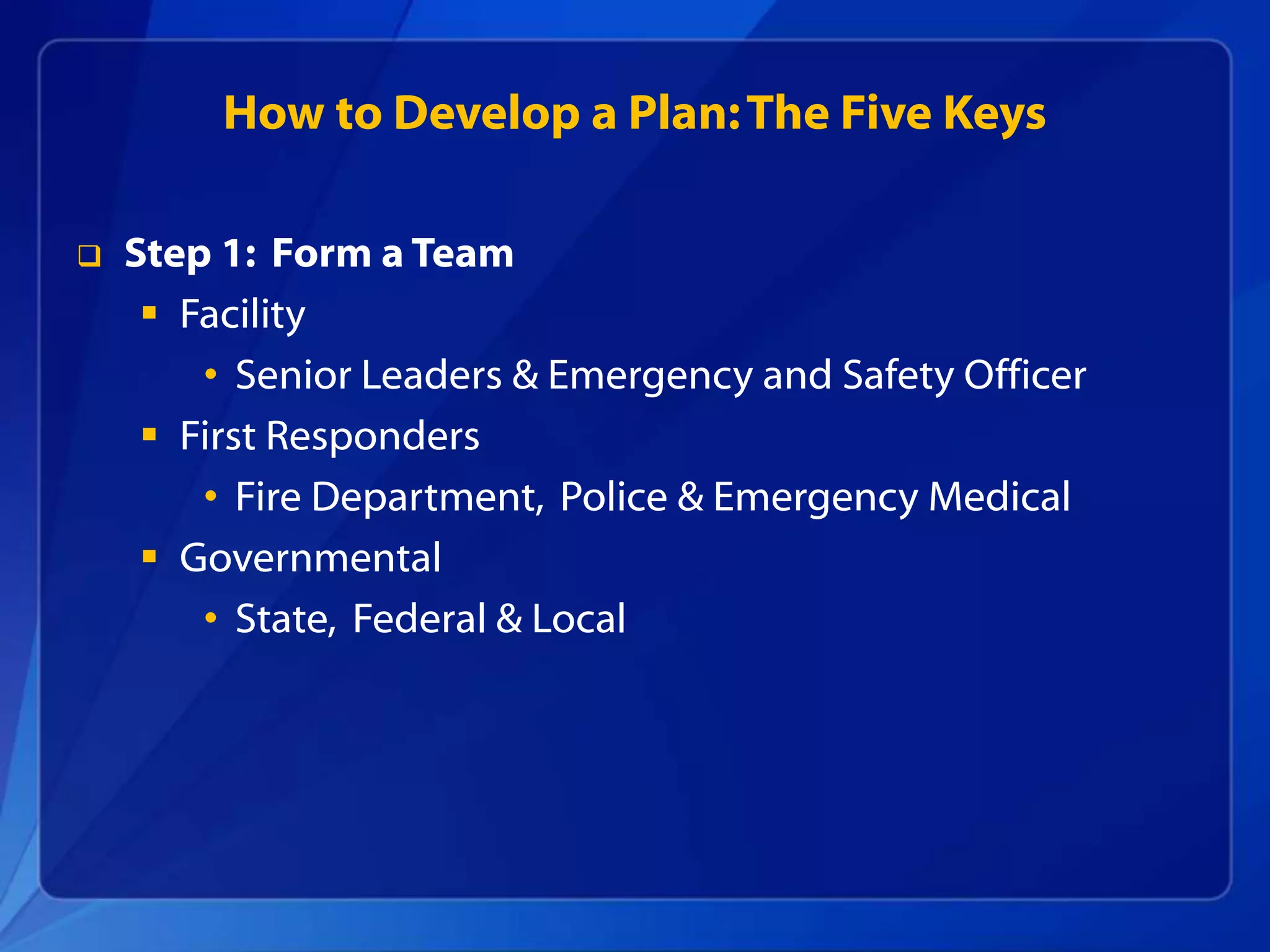
 Step 1: Form a Team
 Facility
• Senior Leaders & Emergency and Safety Officer
 First Responders
• Fire Department, Police & Emergency Medical
 Governmental
• State, Federal & Local
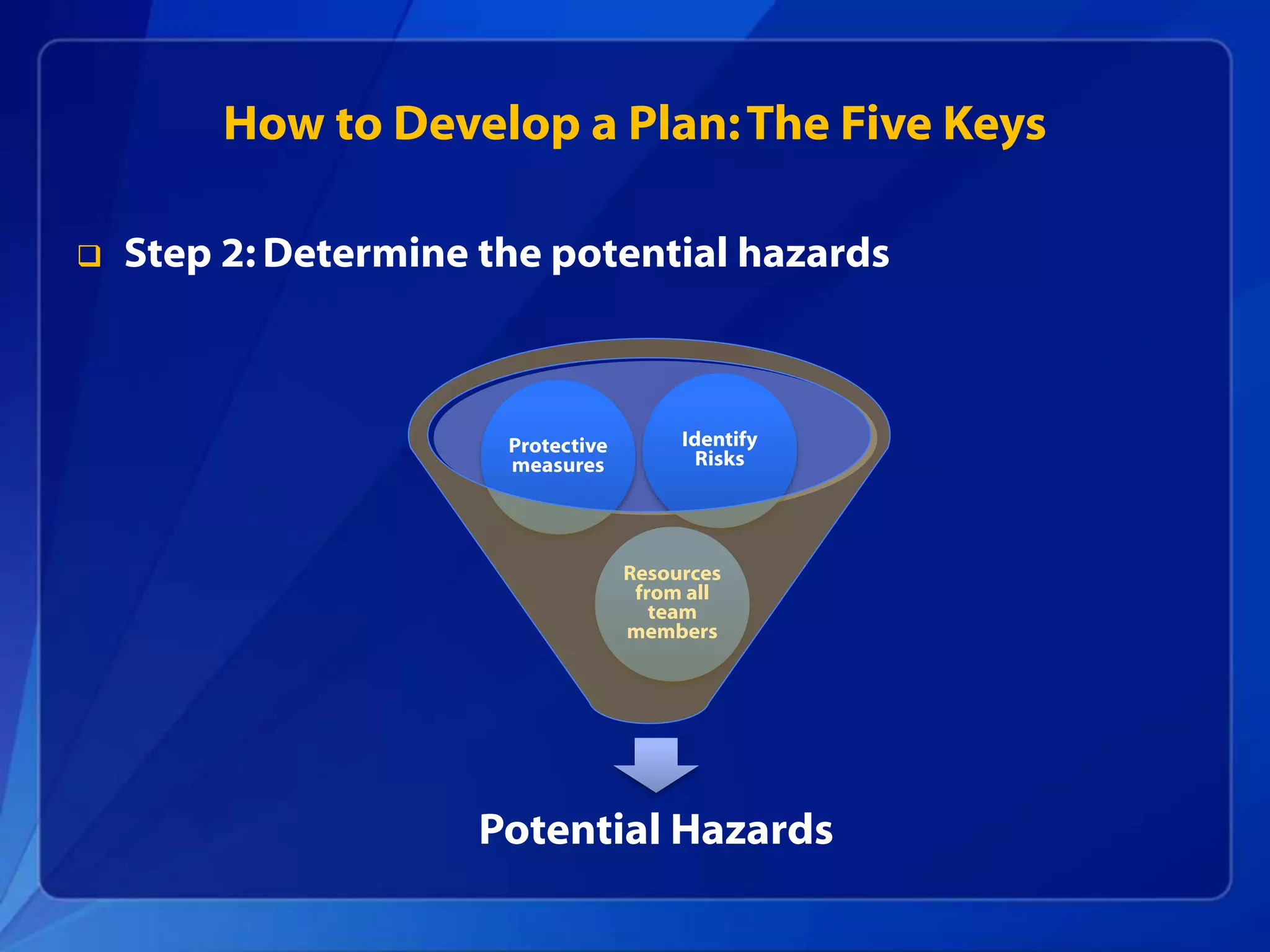
 Step 2: Determine the potential hazards
Potential Hazards
Resources
from all
team
members
Protective
measures
Identify
Risks
How to Develop a Plan:The Five Keys
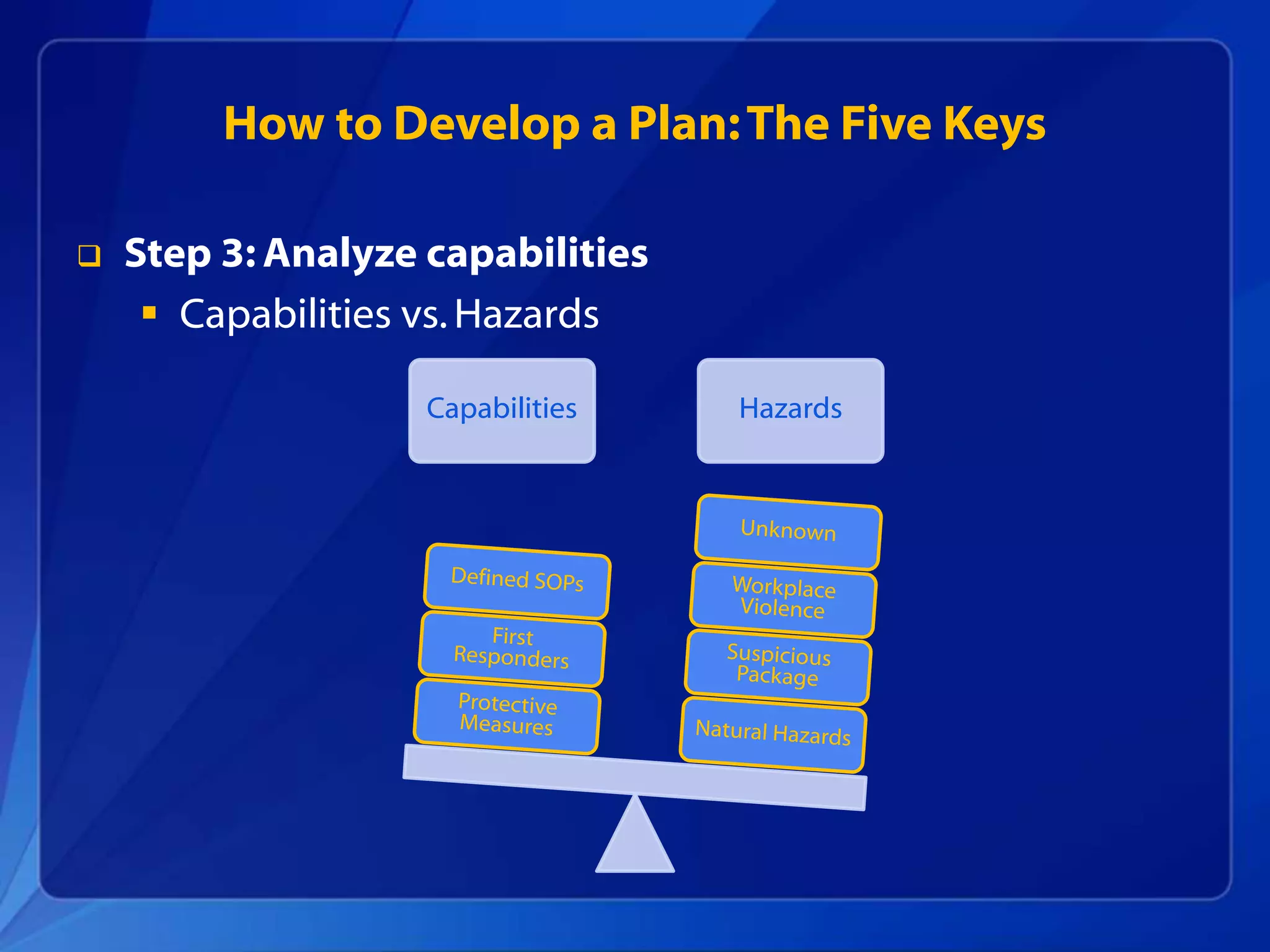
 Step 3: Analyze capabilities
 Capabilities vs.Hazards
Capabilities Hazards
How to Develop a Plan:The Five Keys
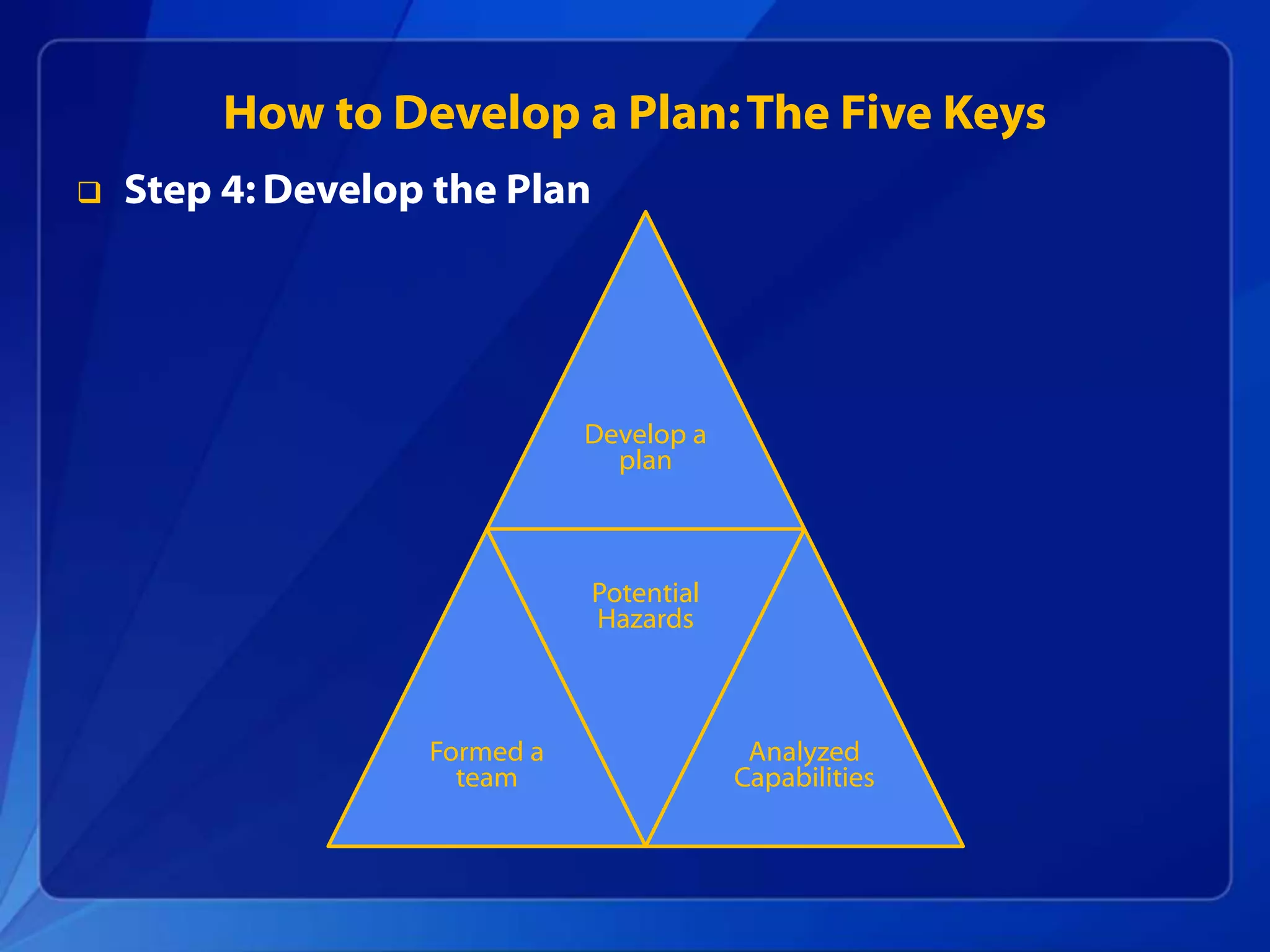
Develop a
plan
Formed a
team
Potential
Hazards
Analyzed
Capabilities
 Step 4: Develop the Plan
How to Develop a Plan:The Five Keys
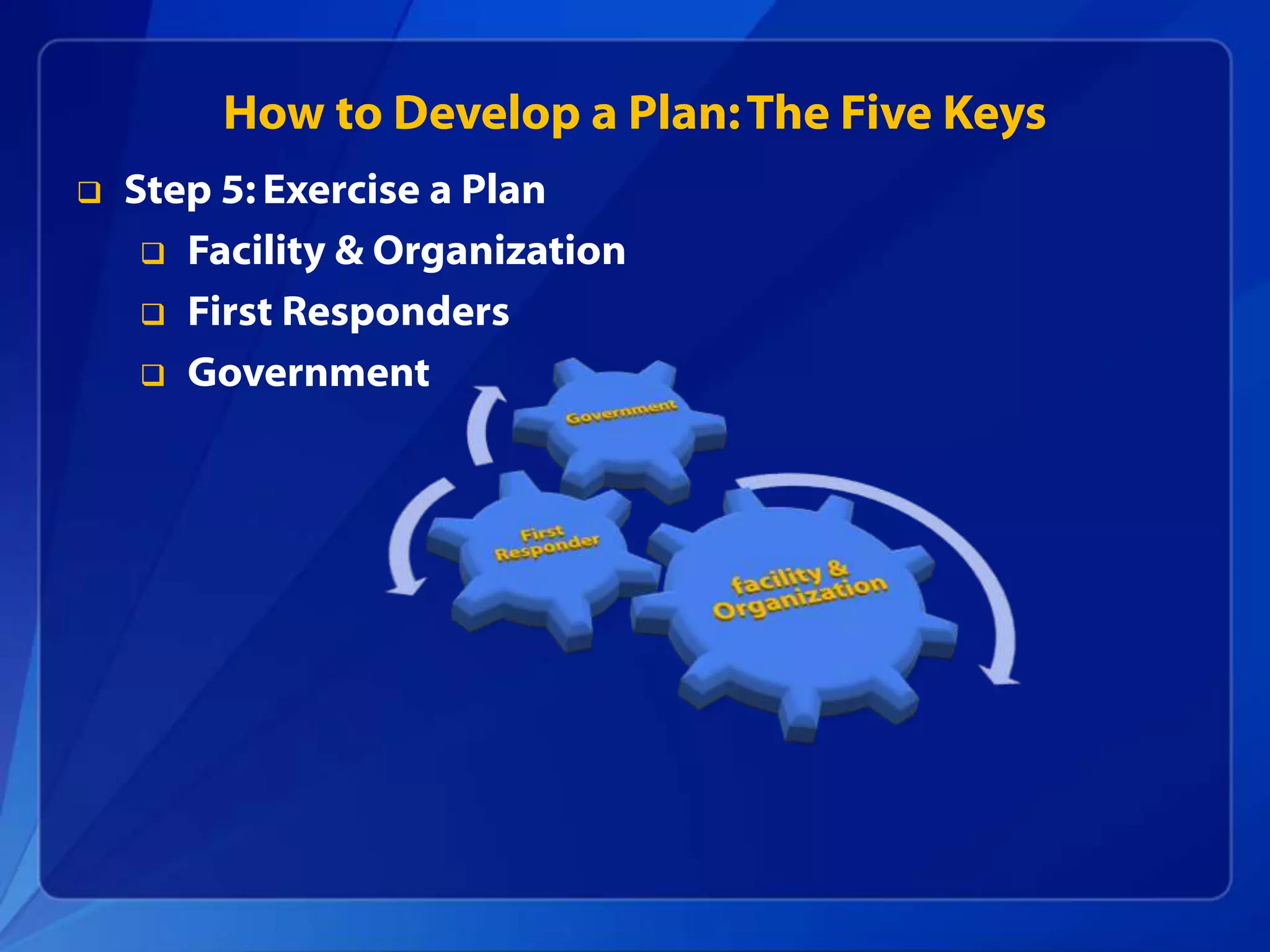
 Step 5: Exercise a Plan
 Facility & Organization
 First Responders
 Government
 Form a team
 Determine potential hazards
 Analyze capabilities
 Develop a plan
 Exercise a plan
How to Develop a Plan: Review
Characteristics of a Good Plan
 Identifies risks
 Unique
 Common
 Helps mitigate the risks
 Incorporates all partners
 Develops common tasks
 Incorporates unique tasks
Characteristics of a Good Plan
Characteristics Employee
Actions
Who to Call
Caller warns or
threatens of a
bomb,explosive,
or other
hazardous device
or material in the
workplace
If possible,get a
co-worker to
listen to the call
Keep talking to
the caller and
note the
following:
Who are you?
Who placed the
bomb?
Where is the
bomb?
Stay on the
telephone with
the caller!
Have a co-
worker call
building control
or facilities.
Ask your co-
worker to call
emergency
services
If a bomb threat is
received by phone they
must immediately
contact emergency
services. In the event
of any bomb threat,
regardless of source or
recipient, immediately
notify the proper
officials and institute
evacuation procedures.
Characteristics of a Good Plan: Common Threat
Meets Requirement Protect the facilityVS.
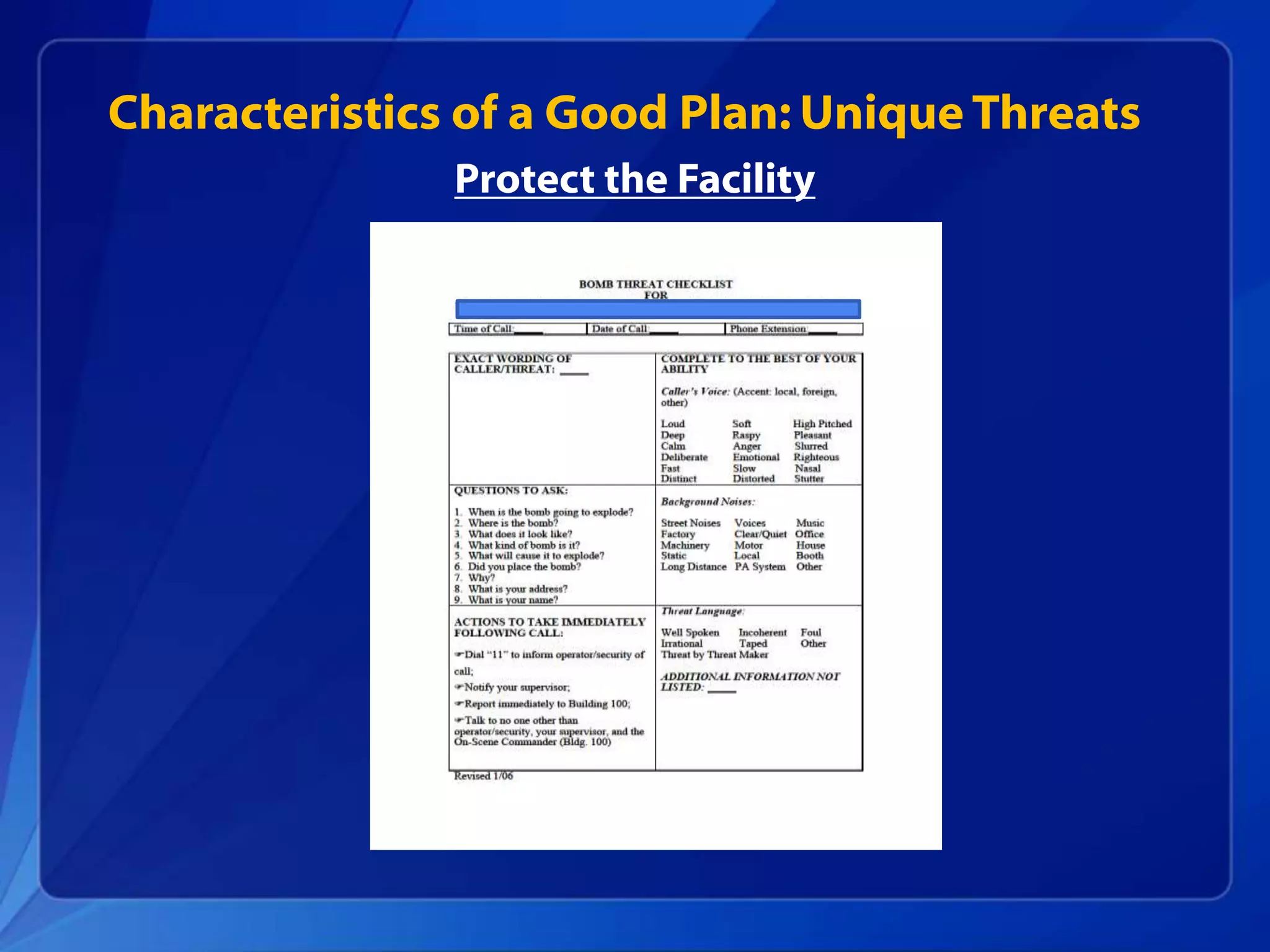
Characteristics of a Good Plan: Unique Threats
Protect the Facility
Natural Disaster Plan:
In the event of a natural disaster (e.g.,earthquake,wind storms,
volcano,etc.) every effort must be made to maintain the security and
containment in areas containing select agents and toxins...
If an alarm sounds,or if there are other indicators of a natural
disaster that may impact an area,all personnel must leave the area
as quickly as possible;taking care to secure the agents and follow
established disinfection procedures as much as possible…
Public Safety Officers dispatched to an emergency incident involving
select agents and toxins will be aware of the specific locations of
select agent storage/work areas…
Characteristics of a Good Plan: Unique Threats
Meets the Requirement
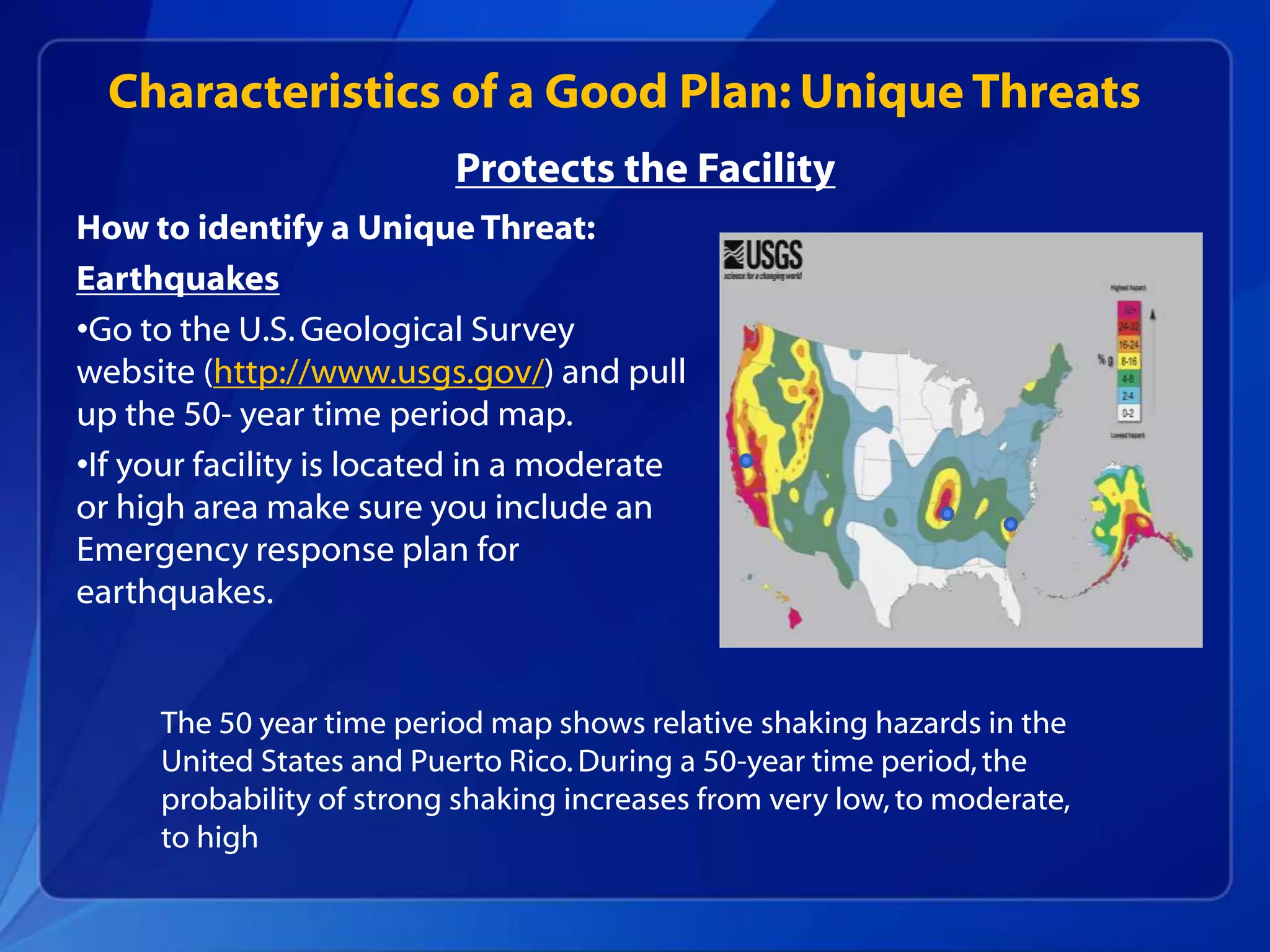
How to identify a Unique Threat:
Earthquakes
•Go to the U.S.Geological Survey
website (http://www.usgs.gov/) and pull
up the 50- year time period map.
•If your facility is located in a moderate
or high area make sure you include an
Emergency response plan for
earthquakes.
Characteristics of a Good Plan: Unique Threats
The 50 year time period map shows relative shaking hazards in the
United States and Puerto Rico.During a 50-year time period,the
probability of strong shaking increases from very low, to moderate,
to high
Protects the Facility
How to identify a Unique Threat:
Tornado
Go to the U.S.Geological Survey website
(http://www.nssl.noaa.gov/primer/torna
do/tor_climatology.html) and pull up
Tornado Alley map
Characteristics of a Good Plan: Unique Threats
The Tornado Alley map displays the areas most susceptible to
tornadoes. In addition to the areas highlighted on the Tornado
Alley map,all entities within the following states are expected to
include tornadoes in their Emergency response plan:Texas,
Oklahoma, Kansas,Nebraska,and Iowa
Protects the Facility
 Identifies risks
 Unique
 Common
 Helps mitigate the risks
 Incorporates all partners
 Develops common tasks
 Incorporates unique tasks
Characteristics of a Good Plan: Review
Exercise the Plan
Exercise the Plan: Bomb Threat
Event
• Telephone
Bomb Threat
Task
• If Possible get a
co-worker to
listen in on the
call
• Keep talking to
the caller
• If possible
complete
Bomb Threat
datasheet
• Have co-worker
call building
security and
911
Conditions
• It’s 10 am on a
Monday
morning
• Four
individuals are
in the lab
Under the current conditions can we perform all of the tasks
If yes – Determine who will do what task
If no – Determine what task will have to be adjusted or eliminated
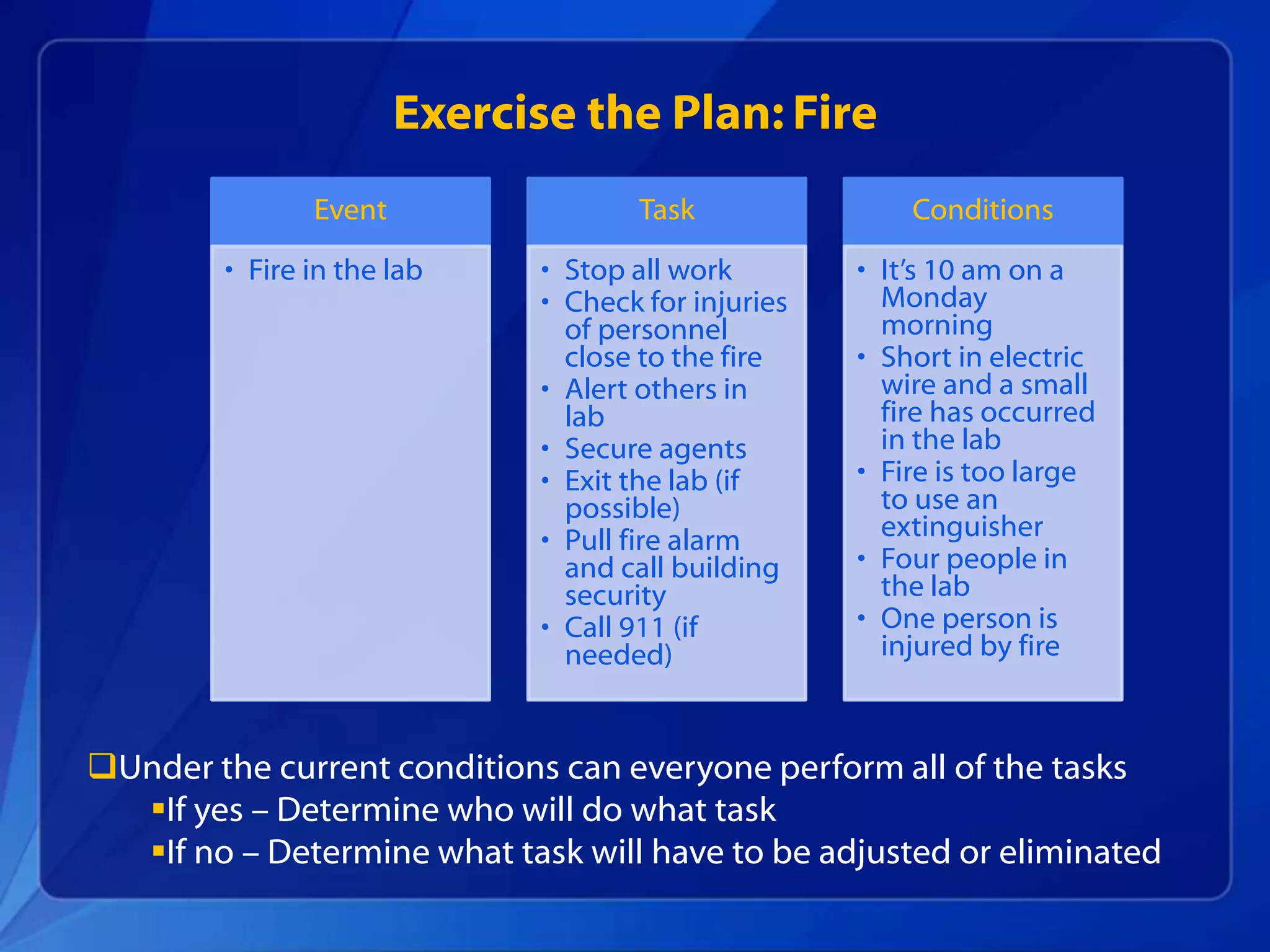
Exercise the Plan: Fire
Event
• Fire in the lab
Task
• Stop all work
• Check for injuries
of personnel
close to the fire
• Alert others in
lab
• Secure agents
• Exit the lab (if
possible)
• Pull fire alarm
and call building
security
• Call 911 (if
needed)
Conditions
• It’s 10 am on a
Monday
morning
• Short in electric
wire and a small
fire has occurred
in the lab
• Fire is too large
to use an
extinguisher
• Four people in
the lab
• One person is
injured by fire
Under the current conditions can everyone perform all of the tasks
If yes – Determine who will do what task
If no – Determine what task will have to be adjusted or eliminated
Exercise the Plan: Evaluation
Task Steps and Performance Measures GO NO GO
1. Task # 1
a. Actions of the task
b. Actions of the task
c. Actions of the task
2. Task # 2
a. Actions of the task
b. Actions of the task
c. Actions of the task
3. Task # 3
a. Actions of the task
b. Actions of the task
c. Actions of the task
Example of how to evaluate a task
Can be done during or after task
Seek input from all participants and observers
Make a list of lessons learned and adjust the plan accordingly
Principle of Emergency Response - Summary
 How to develop a good Emergency Response Plan?
 5 Keys
 What are the marks of a good plan?
 Identifies risks
 Unique
 Common
 Helps mitigate the risks
 Incorporates all partners
 Develops common tasks
 Incorporates unique tasks
 How do you test the plan?
 Exercises
Discussion

Principles of Emergency Response

  • 1.
    Principles of Emergency ResponsePlanning Jae S. Brown,MPA,MBA Principle Consultant Shared EMC
  • 2.
    Principles of anEmergency Response Plan  How to develop a good Emergency Response Plan?  What are the marks of a good plan?  How do you test the plan?
  • 3.
    What is anEmergency Response Plan When to develop a plan? Include in the Plan (Fire in Lab) Do you have to respond? 911, inform authorities, take action Could it affect the facility’s area? Threat/Hazard Does it affect? The facility’s assets and people
  • 4.
    How to Developa Plan  What is an Emergency Response Plan?  Checklist on what should be in a plan • Good starting and ending point • Lacks tips and tools on how to create a plan  Emergency Response Guidance Plan (IRP) Ingredients 1 cup butter, softened 2 cups packed brown sugar 2 eggs 2 teaspoons vanilla extract 2 1/3 cups all-purpose flour 1 teaspoon baking soda 1 teaspoon salt 2 cups rolled oats Directions
  • 5.
    How to Developa Plan  The 5 Keys  Form a team  Determine the potential hazards  Analyze capabilities  Develop a plan  Exercise a plan  Emergency response planning cycle
  • 6.
    How to Developa Plan:The Five Keys  Step 1: Form a Team  Facility • Senior Leaders & Emergency and Safety Officer  First Responders • Fire Department, Police & Emergency Medical  Governmental • State, Federal & Local
  • 7.
     Step 2:Determine the potential hazards Potential Hazards Resources from all team members Protective measures Identify Risks How to Develop a Plan:The Five Keys
  • 8.
     Step 3:Analyze capabilities  Capabilities vs.Hazards Capabilities Hazards How to Develop a Plan:The Five Keys
  • 9.
    Develop a plan Formed a team Potential Hazards Analyzed Capabilities Step 4: Develop the Plan How to Develop a Plan:The Five Keys
  • 10.
    How to Developa Plan:The Five Keys  Step 5: Exercise a Plan  Facility & Organization  First Responders  Government
  • 11.
     Form ateam  Determine potential hazards  Analyze capabilities  Develop a plan  Exercise a plan How to Develop a Plan: Review
  • 12.
  • 13.
     Identifies risks Unique  Common  Helps mitigate the risks  Incorporates all partners  Develops common tasks  Incorporates unique tasks Characteristics of a Good Plan
  • 14.
    Characteristics Employee Actions Who toCall Caller warns or threatens of a bomb,explosive, or other hazardous device or material in the workplace If possible,get a co-worker to listen to the call Keep talking to the caller and note the following: Who are you? Who placed the bomb? Where is the bomb? Stay on the telephone with the caller! Have a co- worker call building control or facilities. Ask your co- worker to call emergency services If a bomb threat is received by phone they must immediately contact emergency services. In the event of any bomb threat, regardless of source or recipient, immediately notify the proper officials and institute evacuation procedures. Characteristics of a Good Plan: Common Threat Meets Requirement Protect the facilityVS.
  • 15.
    Characteristics of aGood Plan: Unique Threats Protect the Facility
  • 16.
    Natural Disaster Plan: Inthe event of a natural disaster (e.g.,earthquake,wind storms, volcano,etc.) every effort must be made to maintain the security and containment in areas containing select agents and toxins... If an alarm sounds,or if there are other indicators of a natural disaster that may impact an area,all personnel must leave the area as quickly as possible;taking care to secure the agents and follow established disinfection procedures as much as possible… Public Safety Officers dispatched to an emergency incident involving select agents and toxins will be aware of the specific locations of select agent storage/work areas… Characteristics of a Good Plan: Unique Threats Meets the Requirement
  • 17.
    How to identifya Unique Threat: Earthquakes •Go to the U.S.Geological Survey website (http://www.usgs.gov/) and pull up the 50- year time period map. •If your facility is located in a moderate or high area make sure you include an Emergency response plan for earthquakes. Characteristics of a Good Plan: Unique Threats The 50 year time period map shows relative shaking hazards in the United States and Puerto Rico.During a 50-year time period,the probability of strong shaking increases from very low, to moderate, to high Protects the Facility
  • 18.
    How to identifya Unique Threat: Tornado Go to the U.S.Geological Survey website (http://www.nssl.noaa.gov/primer/torna do/tor_climatology.html) and pull up Tornado Alley map Characteristics of a Good Plan: Unique Threats The Tornado Alley map displays the areas most susceptible to tornadoes. In addition to the areas highlighted on the Tornado Alley map,all entities within the following states are expected to include tornadoes in their Emergency response plan:Texas, Oklahoma, Kansas,Nebraska,and Iowa Protects the Facility
  • 19.
     Identifies risks Unique  Common  Helps mitigate the risks  Incorporates all partners  Develops common tasks  Incorporates unique tasks Characteristics of a Good Plan: Review
  • 20.
  • 21.
    Exercise the Plan:Bomb Threat Event • Telephone Bomb Threat Task • If Possible get a co-worker to listen in on the call • Keep talking to the caller • If possible complete Bomb Threat datasheet • Have co-worker call building security and 911 Conditions • It’s 10 am on a Monday morning • Four individuals are in the lab Under the current conditions can we perform all of the tasks If yes – Determine who will do what task If no – Determine what task will have to be adjusted or eliminated
  • 22.
    Exercise the Plan:Fire Event • Fire in the lab Task • Stop all work • Check for injuries of personnel close to the fire • Alert others in lab • Secure agents • Exit the lab (if possible) • Pull fire alarm and call building security • Call 911 (if needed) Conditions • It’s 10 am on a Monday morning • Short in electric wire and a small fire has occurred in the lab • Fire is too large to use an extinguisher • Four people in the lab • One person is injured by fire Under the current conditions can everyone perform all of the tasks If yes – Determine who will do what task If no – Determine what task will have to be adjusted or eliminated
  • 23.
    Exercise the Plan:Evaluation Task Steps and Performance Measures GO NO GO 1. Task # 1 a. Actions of the task b. Actions of the task c. Actions of the task 2. Task # 2 a. Actions of the task b. Actions of the task c. Actions of the task 3. Task # 3 a. Actions of the task b. Actions of the task c. Actions of the task Example of how to evaluate a task Can be done during or after task Seek input from all participants and observers Make a list of lessons learned and adjust the plan accordingly
  • 24.
    Principle of EmergencyResponse - Summary  How to develop a good Emergency Response Plan?  5 Keys  What are the marks of a good plan?  Identifies risks  Unique  Common  Helps mitigate the risks  Incorporates all partners  Develops common tasks  Incorporates unique tasks  How do you test the plan?  Exercises
  • 25.

Editor's Notes