Emergency Response Plan
ready.gov/business
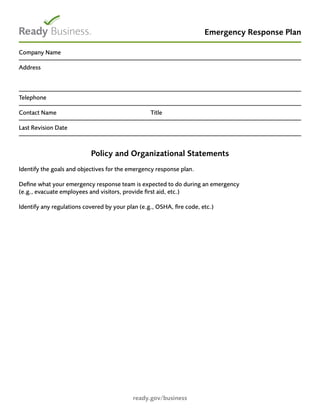
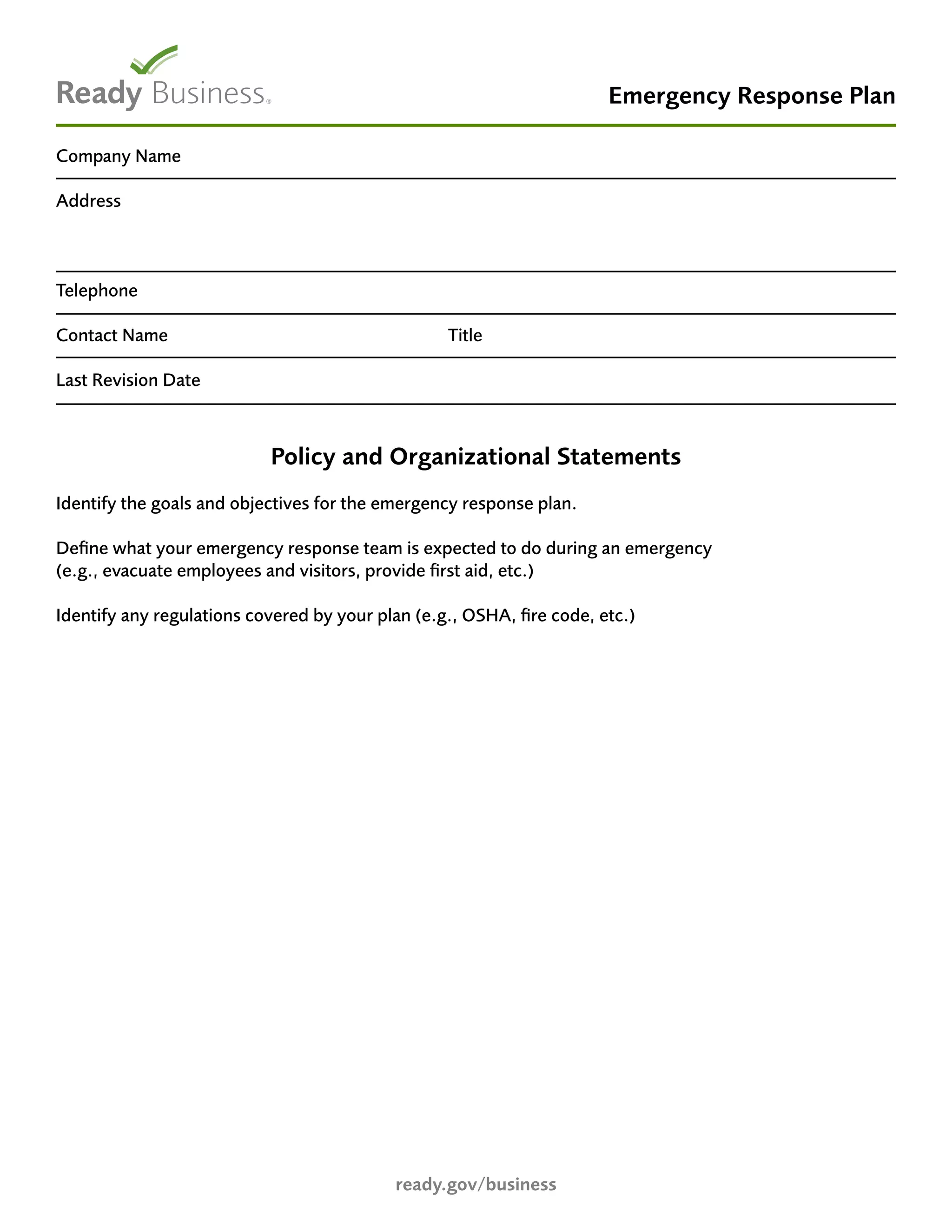
Company Name
Address
Telephone
Contact Name Title
Last Revision Date
Policy and Organizational Statements
Identify the goals and objectives for the emergency response plan.
Define what your emergency response team is expected to do during an emergency
(e.g., evacuate employees and visitors, provide first aid, etc.)
Identify any regulations covered by your plan (e.g., OSHA, fire code, etc.)
Emergency Response Plan
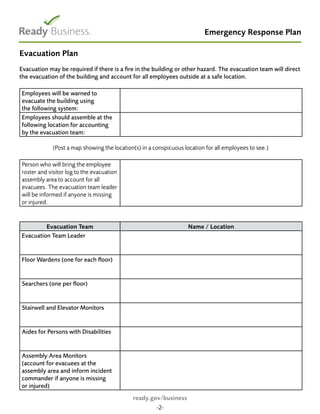
Evacuation Plan
Evacuation may be required if there is a fire in the building or other hazard. The evacuation team will direct
the evacuation of the building and account for all employees outside at a safe location.
Employees will be warned to
evacuate the building using
the following system:
Employees should assemble at the
following location for accounting
by the evacuation team:
(Post a map showing the location(s) in a conspicuous location for all employees to see.)
Person who will bring the employee
roster and visitor log to the evacuation
assembly area to account for all
evacuees. The evacuation team leader
will be informed if anyone is missing
or injured.
Evacuation Team Name / Location
Evacuation Team Leader
Floor Wardens (one for each floor)
Searchers (one per floor)
Stairwell and Elevator Monitors
Aides for Persons with Disabilities
Assembly Area Monitors
(account for evacuees at the
assembly area and inform incident
commander if anyone is missing
or injured)
ready.gov/business
-2-
Emergency Response Plan
ready.gov/business
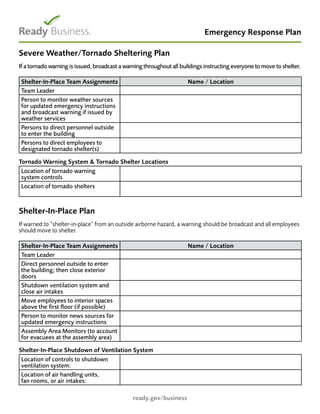
Severe Weather/Tornado Sheltering Plan
If a tornado warning is issued, broadcast a warning throughout all buildings instructing everyone to move to shelter.
Shelter-In-Place Team Assignments Name / Location
Team Leader
Person to monitor weather sources
for updated emergency instructions
and broadcast warning if issued by
weather services
Persons to direct personnel outside
to enter the building
Persons to direct employees to
designated tornado shelter(s)
Tornado Warning System & Tornado Shelter Locations
Location of tornado warning
system controls
Location of tornado shelters
Shelter-In-Place Plan
If warned to “shelter-in-place“ from an outside airborne hazard, a warning should be broadcast and all employees
should move to shelter.
Shelter-In-Place Team Assignments Name / Location
Team Leader
Direct personnel outside to enter
the building; then close exterior
doors
Shutdown ventilation system and
close air intakes
Move employees to interior spaces
above the first floor (if possible)
Person to monitor news sources for
updated emergency instructions
Assembly Area Monitors (to account
for evacuees at the assembly area)
Shelter-In-Place Shutdown of Ventilation System
Location of controls to shutdown
ventilation system:
Location of air handling units,
fan rooms, or air intakes:
Emergency Response Plan
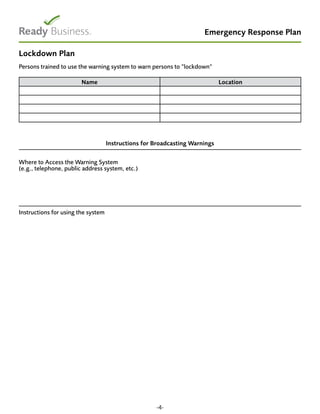
Lockdown Plan
Persons trained to use the warning system to warn persons to “lockdown“
Name Location
Instructions for Broadcasting Warnings
Where to Access the Warning System
(e.g., telephone, public address system, etc.)
Instructions for using the system
-4-
Emergency Response Plan
ready.gov/business
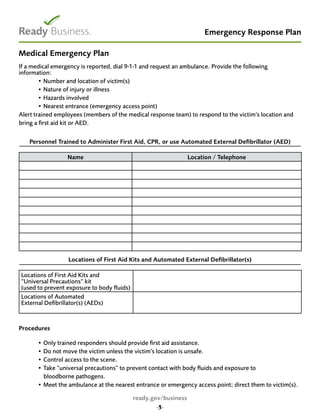
Medical Emergency Plan
If a medical emergency is reported, dial 9-1-1 and request an ambulance. Provide the following
information:
• Number and location of victim(s)
• Nature of injury or illness
• Hazards involved
• Nearest entrance (emergency access point)
Alert trained employees (members of the medical response team) to respond to the victim’s location and
bring a first aid kit or AED.
Personnel Trained to Administer First Aid, CPR, or use Automated External Defibrillator (AED)
Name Location / Telephone
Locations of First Aid Kits and Automated External Defibrillator(s)
Locations of First Aid Kits and
“Universal Precautions“ kit
(used to prevent exposure to body fluids)
Locations of Automated
External Defibrillator(s) (AEDs)
		
Procedures
	
• Only trained responders should provide first aid assistance.
• Do not move the victim unless the victim’s location is unsafe.
• Control access to the scene.
• Take “universal precautions” to prevent contact with body fluids and exposure to
bloodborne pathogens.
• Meet the ambulance at the nearest entrance or emergency access point; direct them to victim(s).
-5--1--3-
Emergency Response Plan
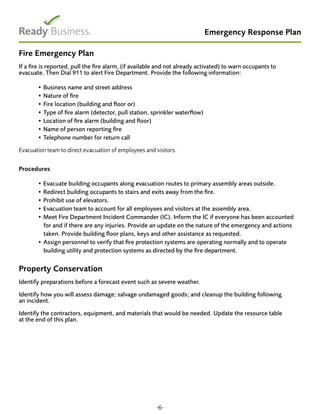
Fire Emergency Plan
If a fire is reported, pull the fire alarm, (if available and not already activated) to warn occupants to
evacuate. Then Dial 911 to alert Fire Department. Provide the following information:
• Business name and street address
• Nature of fire
• Fire location (building and floor or)
• Type of fire alarm (detector, pull station, sprinkler waterflow)
• Location of fire alarm (building and floor)
• Name of person reporting fire
• Telephone number for return call
Evacuation team to direct evacuation of employees and visitors.
Procedures
	
• Evacuate building occupants along evacuation routes to primary assembly areas outside.
• Redirect building occupants to stairs and exits away from the fire.
• Prohibit use of elevators.
• Evacuation team to account for all employees and visitors at the assembly area.
• Meet Fire Department Incident Commander (IC). Inform the IC if everyone has been accounted
for and if there are any injuries. Provide an update on the nature of the emergency and actions
taken. Provide building floor plans, keys and other assistance as requested.
• Assign personnel to verify that fire protection systems are operating normally and to operate
building utility and protection systems as directed by the fire department.
Property Conservation
Identify preparations before a forecast event such as severe weather.
Identify how you will assess damage; salvage undamaged goods; and cleanup the building following
an incident.
Identify the contractors, equipment, and materials that would be needed. Update the resource table
at the end of this plan.
-6-
Emergency Response Plan
ready.gov/business
Annexes
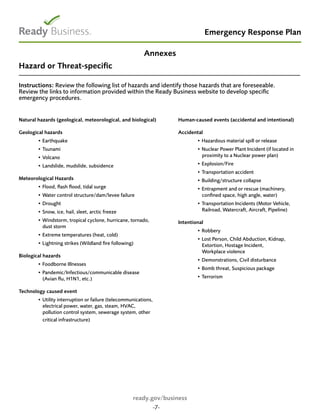
Hazard or Threat-specific
Instructions: Review the following list of hazards and identify those hazards that are foreseeable.
Review the links to information provided within the Ready Business website to develop specific
emergency procedures.
Natural hazards (geological, meteorological, and biological)
Geological hazards
• Earthquake
• Tsunami
• Volcano
• Landslide, mudslide, subsidence
Meteorological Hazards
• Flood, flash flood, tidal surge
• Water control structure/dam/levee failure
• Drought
• Snow, ice, hail, sleet, arctic freeze
• Windstorm, tropical cyclone, hurricane, tornado,
dust storm
• Extreme temperatures (heat, cold)
• Lightning strikes (Wildland fire following)
Biological hazards
• Foodborne Illnesses
• Pandemic/Infectious/communicable disease
(Avian flu, H1N1, etc.)
Technology caused event
• Utility interruption or failure (telecommunications,
electrical power, water, gas, steam, HVAC,
pollution control system, sewerage system, other
critical infrastructure)
Human-caused events (accidental and intentional)
Accidental
• Hazardous material spill or release
• Nuclear Power Plant Incident (if located in
proximity to a Nuclear power plan)
• Explosion/Fire
• Transportation accident
• Building/structure collapse
• Entrapment and or rescue (machinery,
confined space, high angle, water)
• Transportation Incidents (Motor Vehicle,
Railroad, Watercraft, Aircraft, Pipeline)
Intentional
• Robbery
• Lost Person, Child Abduction, Kidnap,
Extortion, Hostage Incident,
Workplace violence
• Demonstrations, Civil disturbance
• Bomb threat, Suspicious package
• Terrorism
-7-
Emergency Response Plan
Appendices
Emergency Response Teams
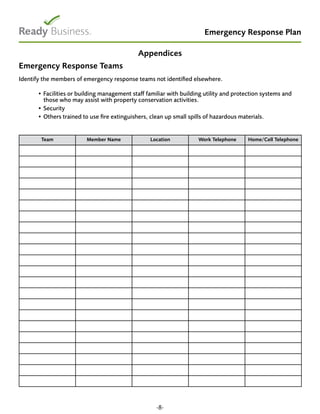
Identify the members of emergency response teams not identified elsewhere.
• Facilities or building management staff familiar with building utility and protection systems and
those who may assist with property conservation activities.
• Security
• Others trained to use fire extinguishers, clean up small spills of hazardous materials.
Team Member Name Location Work Telephone Home/Cell Telephone
-8-
Emergency Response Plan
ready.gov/business
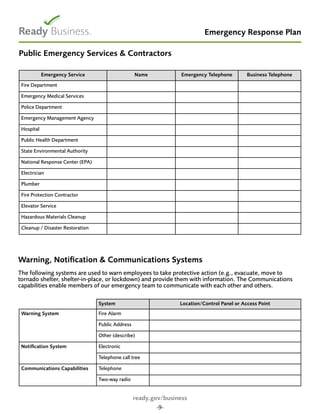
Public Emergency Services & Contractors
Emergency Service Name Emergency Telephone Business Telephone
Fire Department
Emergency Medical Services
Police Department
Emergency Management Agency
Hospital
Public Health Department
State Environmental Authority
National Response Center (EPA)
Electrician
Plumber
Fire Protection Contractor
Elevator Service
Hazardous Materials Cleanup
Cleanup / Disaster Restoration
Warning, Notification & Communications Systems
The following systems are used to warn employees to take protective action (e.g., evacuate, move to
tornado shelter, shelter-in-place, or lockdown) and provide them with information. The Communications
capabilities enable members of our emergency team to communicate with each other and others.
System Location/Control Panel or Access Point
Warning System Fire Alarm
Public Address
Other (describe)
Notification System Electronic
Telephone call tree
Communications Capabilities Telephone
Two-way radio
-9-
Emergency Response Plan
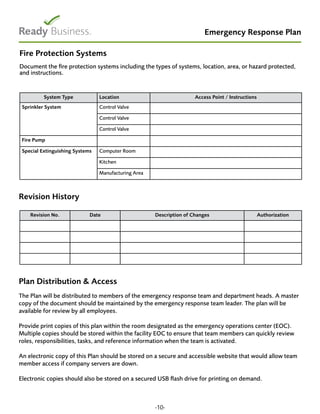
Fire Protection Systems
Document the fire protection systems including the types of systems, location, area, or hazard protected,
and instructions.
System Type Location Access Point / Instructions
Sprinkler System Control Valve
Control Valve
Control Valve
Fire Pump
Special Extinguishing Systems Computer Room
Kitchen
Manufacturing Area
Revision History
Plan Distribution & Access
The Plan will be distributed to members of the emergency response team and department heads. A master
copy of the document should be maintained by the emergency response team leader. The plan will be
available for review by all employees.
Provide print copies of this plan within the room designated as the emergency operations center (EOC).
Multiple copies should be stored within the facility EOC to ensure that team members can quickly review
roles, responsibilities, tasks, and reference information when the team is activated.
An electronic copy of this Plan should be stored on a secure and accessible website that would allow team
member access if company servers are down.
Electronic copies should also be stored on a secured USB flash drive for printing on demand.
-10-
Revision No. Date Description of Changes Authorization

Business Emergency Response Plans

  • 1.
    Emergency Response Plan ready.gov/business CompanyName Address Telephone Contact Name Title Last Revision Date Policy and Organizational Statements Identify the goals and objectives for the emergency response plan. Define what your emergency response team is expected to do during an emergency (e.g., evacuate employees and visitors, provide first aid, etc.) Identify any regulations covered by your plan (e.g., OSHA, fire code, etc.)
  • 2.
    Emergency Response Plan EvacuationPlan Evacuation may be required if there is a fire in the building or other hazard. The evacuation team will direct the evacuation of the building and account for all employees outside at a safe location. Employees will be warned to evacuate the building using the following system: Employees should assemble at the following location for accounting by the evacuation team: (Post a map showing the location(s) in a conspicuous location for all employees to see.) Person who will bring the employee roster and visitor log to the evacuation assembly area to account for all evacuees. The evacuation team leader will be informed if anyone is missing or injured. Evacuation Team Name / Location Evacuation Team Leader Floor Wardens (one for each floor) Searchers (one per floor) Stairwell and Elevator Monitors Aides for Persons with Disabilities Assembly Area Monitors (account for evacuees at the assembly area and inform incident commander if anyone is missing or injured) ready.gov/business -2-
  • 3.
    Emergency Response Plan ready.gov/business SevereWeather/Tornado Sheltering Plan If a tornado warning is issued, broadcast a warning throughout all buildings instructing everyone to move to shelter. Shelter-In-Place Team Assignments Name / Location Team Leader Person to monitor weather sources for updated emergency instructions and broadcast warning if issued by weather services Persons to direct personnel outside to enter the building Persons to direct employees to designated tornado shelter(s) Tornado Warning System & Tornado Shelter Locations Location of tornado warning system controls Location of tornado shelters Shelter-In-Place Plan If warned to “shelter-in-place“ from an outside airborne hazard, a warning should be broadcast and all employees should move to shelter. Shelter-In-Place Team Assignments Name / Location Team Leader Direct personnel outside to enter the building; then close exterior doors Shutdown ventilation system and close air intakes Move employees to interior spaces above the first floor (if possible) Person to monitor news sources for updated emergency instructions Assembly Area Monitors (to account for evacuees at the assembly area) Shelter-In-Place Shutdown of Ventilation System Location of controls to shutdown ventilation system: Location of air handling units, fan rooms, or air intakes:
  • 4.
    Emergency Response Plan LockdownPlan Persons trained to use the warning system to warn persons to “lockdown“ Name Location Instructions for Broadcasting Warnings Where to Access the Warning System (e.g., telephone, public address system, etc.) Instructions for using the system -4-
  • 5.
    Emergency Response Plan ready.gov/business MedicalEmergency Plan If a medical emergency is reported, dial 9-1-1 and request an ambulance. Provide the following information: • Number and location of victim(s) • Nature of injury or illness • Hazards involved • Nearest entrance (emergency access point) Alert trained employees (members of the medical response team) to respond to the victim’s location and bring a first aid kit or AED. Personnel Trained to Administer First Aid, CPR, or use Automated External Defibrillator (AED) Name Location / Telephone Locations of First Aid Kits and Automated External Defibrillator(s) Locations of First Aid Kits and “Universal Precautions“ kit (used to prevent exposure to body fluids) Locations of Automated External Defibrillator(s) (AEDs) Procedures • Only trained responders should provide first aid assistance. • Do not move the victim unless the victim’s location is unsafe. • Control access to the scene. • Take “universal precautions” to prevent contact with body fluids and exposure to bloodborne pathogens. • Meet the ambulance at the nearest entrance or emergency access point; direct them to victim(s). -5--1--3-
  • 6.
    Emergency Response Plan FireEmergency Plan If a fire is reported, pull the fire alarm, (if available and not already activated) to warn occupants to evacuate. Then Dial 911 to alert Fire Department. Provide the following information: • Business name and street address • Nature of fire • Fire location (building and floor or) • Type of fire alarm (detector, pull station, sprinkler waterflow) • Location of fire alarm (building and floor) • Name of person reporting fire • Telephone number for return call Evacuation team to direct evacuation of employees and visitors. Procedures • Evacuate building occupants along evacuation routes to primary assembly areas outside. • Redirect building occupants to stairs and exits away from the fire. • Prohibit use of elevators. • Evacuation team to account for all employees and visitors at the assembly area. • Meet Fire Department Incident Commander (IC). Inform the IC if everyone has been accounted for and if there are any injuries. Provide an update on the nature of the emergency and actions taken. Provide building floor plans, keys and other assistance as requested. • Assign personnel to verify that fire protection systems are operating normally and to operate building utility and protection systems as directed by the fire department. Property Conservation Identify preparations before a forecast event such as severe weather. Identify how you will assess damage; salvage undamaged goods; and cleanup the building following an incident. Identify the contractors, equipment, and materials that would be needed. Update the resource table at the end of this plan. -6-
  • 7.
    Emergency Response Plan ready.gov/business Annexes Hazardor Threat-specific Instructions: Review the following list of hazards and identify those hazards that are foreseeable. Review the links to information provided within the Ready Business website to develop specific emergency procedures. Natural hazards (geological, meteorological, and biological) Geological hazards • Earthquake • Tsunami • Volcano • Landslide, mudslide, subsidence Meteorological Hazards • Flood, flash flood, tidal surge • Water control structure/dam/levee failure • Drought • Snow, ice, hail, sleet, arctic freeze • Windstorm, tropical cyclone, hurricane, tornado, dust storm • Extreme temperatures (heat, cold) • Lightning strikes (Wildland fire following) Biological hazards • Foodborne Illnesses • Pandemic/Infectious/communicable disease (Avian flu, H1N1, etc.) Technology caused event • Utility interruption or failure (telecommunications, electrical power, water, gas, steam, HVAC, pollution control system, sewerage system, other critical infrastructure) Human-caused events (accidental and intentional) Accidental • Hazardous material spill or release • Nuclear Power Plant Incident (if located in proximity to a Nuclear power plan) • Explosion/Fire • Transportation accident • Building/structure collapse • Entrapment and or rescue (machinery, confined space, high angle, water) • Transportation Incidents (Motor Vehicle, Railroad, Watercraft, Aircraft, Pipeline) Intentional • Robbery • Lost Person, Child Abduction, Kidnap, Extortion, Hostage Incident, Workplace violence • Demonstrations, Civil disturbance • Bomb threat, Suspicious package • Terrorism -7-
  • 8.
    Emergency Response Plan Appendices EmergencyResponse Teams Identify the members of emergency response teams not identified elsewhere. • Facilities or building management staff familiar with building utility and protection systems and those who may assist with property conservation activities. • Security • Others trained to use fire extinguishers, clean up small spills of hazardous materials. Team Member Name Location Work Telephone Home/Cell Telephone -8-
  • 9.
    Emergency Response Plan ready.gov/business PublicEmergency Services & Contractors Emergency Service Name Emergency Telephone Business Telephone Fire Department Emergency Medical Services Police Department Emergency Management Agency Hospital Public Health Department State Environmental Authority National Response Center (EPA) Electrician Plumber Fire Protection Contractor Elevator Service Hazardous Materials Cleanup Cleanup / Disaster Restoration Warning, Notification & Communications Systems The following systems are used to warn employees to take protective action (e.g., evacuate, move to tornado shelter, shelter-in-place, or lockdown) and provide them with information. The Communications capabilities enable members of our emergency team to communicate with each other and others. System Location/Control Panel or Access Point Warning System Fire Alarm Public Address Other (describe) Notification System Electronic Telephone call tree Communications Capabilities Telephone Two-way radio -9-
  • 10.
    Emergency Response Plan FireProtection Systems Document the fire protection systems including the types of systems, location, area, or hazard protected, and instructions. System Type Location Access Point / Instructions Sprinkler System Control Valve Control Valve Control Valve Fire Pump Special Extinguishing Systems Computer Room Kitchen Manufacturing Area Revision History Plan Distribution & Access The Plan will be distributed to members of the emergency response team and department heads. A master copy of the document should be maintained by the emergency response team leader. The plan will be available for review by all employees. Provide print copies of this plan within the room designated as the emergency operations center (EOC). Multiple copies should be stored within the facility EOC to ensure that team members can quickly review roles, responsibilities, tasks, and reference information when the team is activated. An electronic copy of this Plan should be stored on a secure and accessible website that would allow team member access if company servers are down. Electronic copies should also be stored on a secured USB flash drive for printing on demand. -10- Revision No. Date Description of Changes Authorization