1
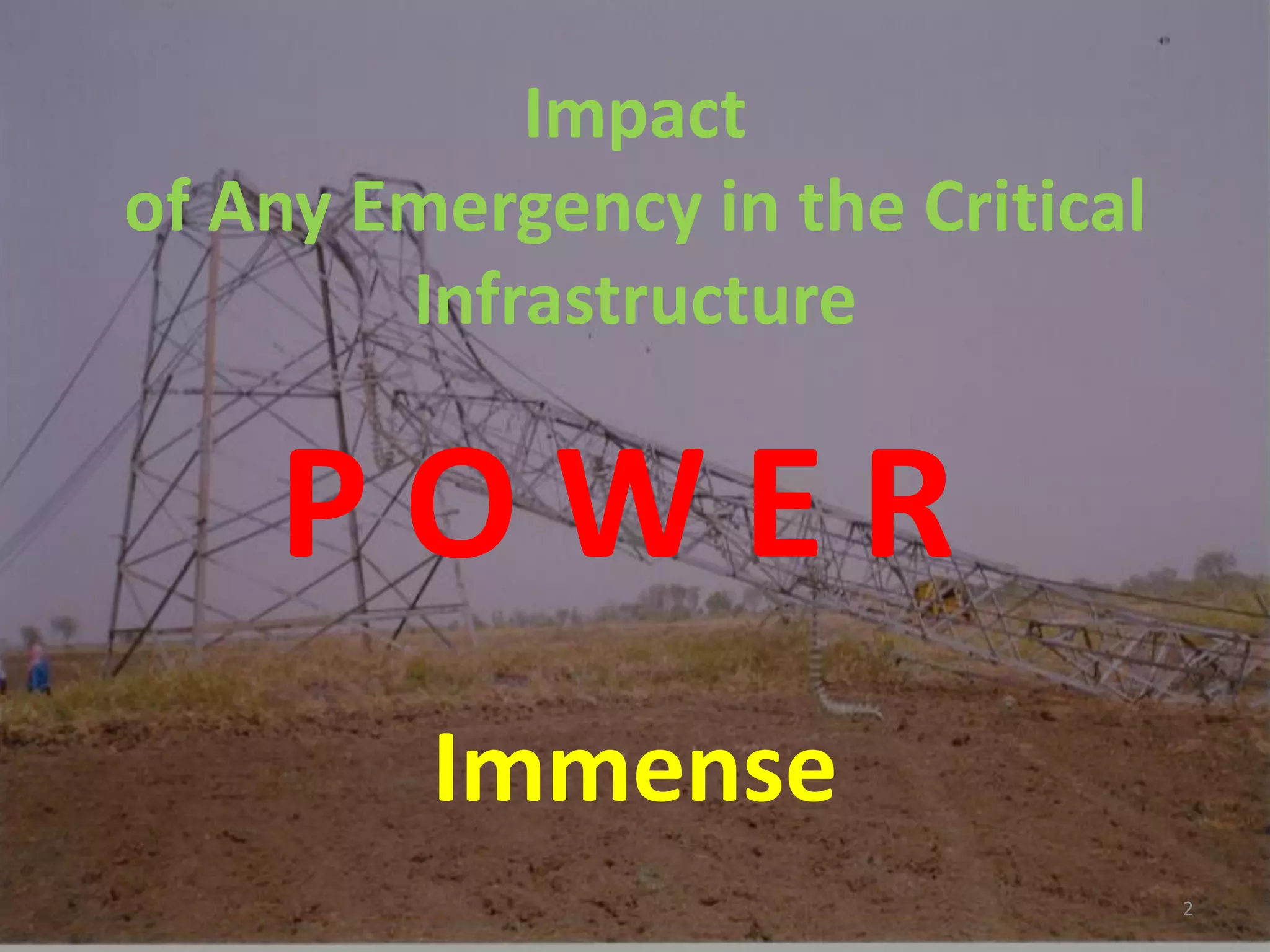
Impact
of Any Emergency in the Critical
        Infrastructure


    POWER
         Immense
                                   2
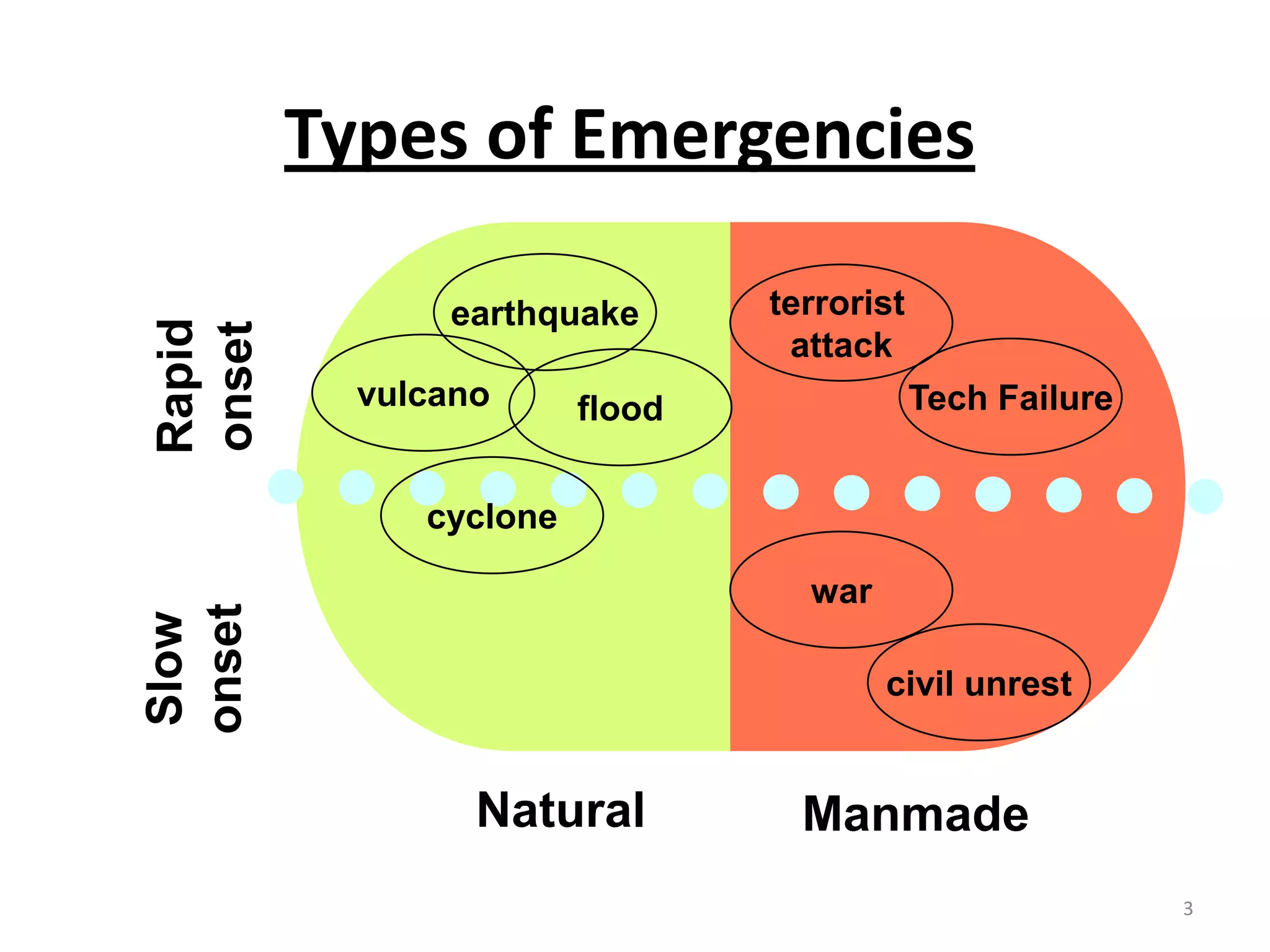
Types of Emergencies

              earthquake       terrorist
Rapid
onset

                                attack
          vulcano      flood               Tech Failure


             cyclone

                                 war
onset
Slow


                                       civil unrest


                Natural          Manmade
                                                          3
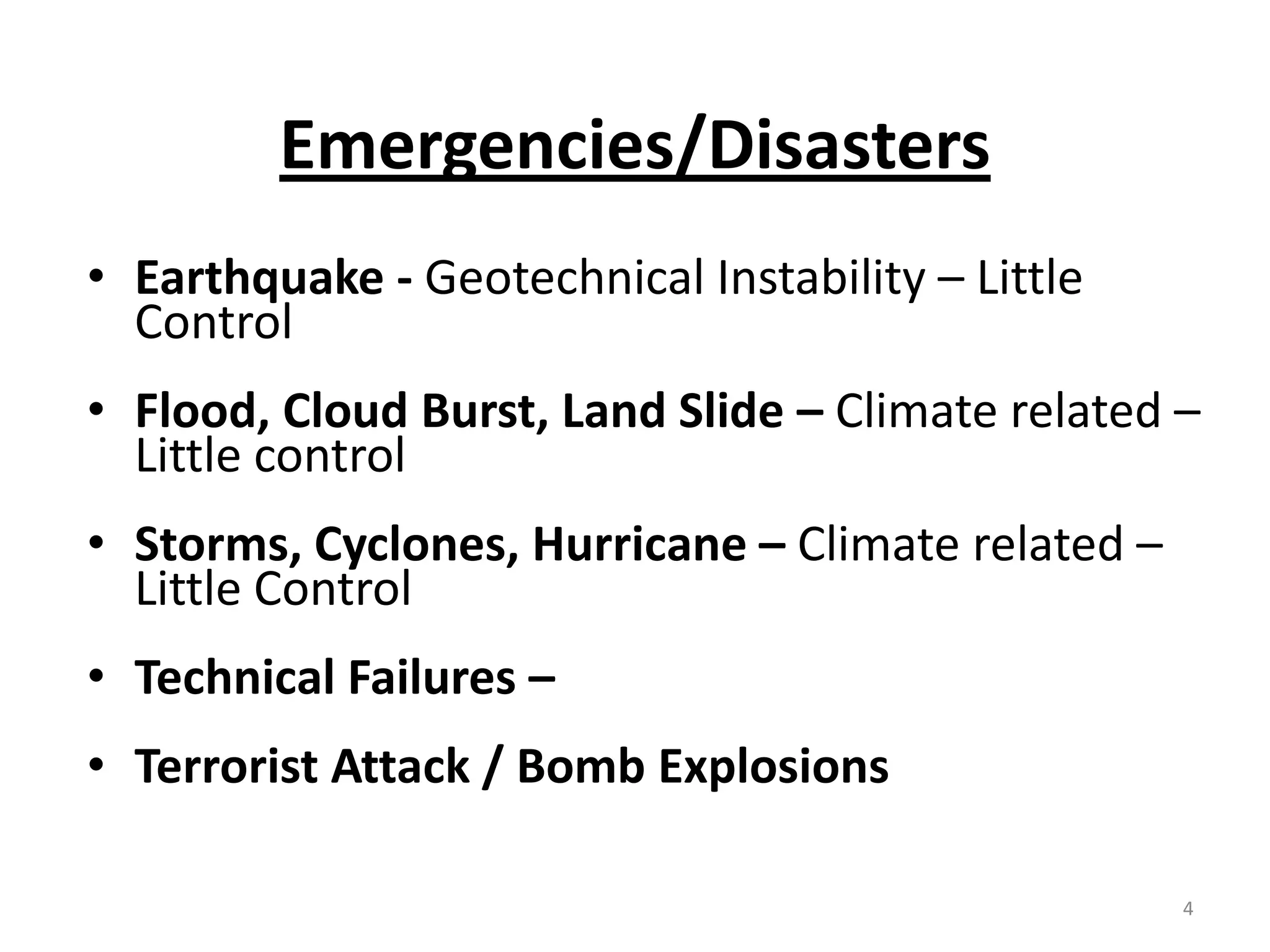
Emergencies/Disasters
• Earthquake - Geotechnical Instability – Little
  Control
• Flood, Cloud Burst, Land Slide – Climate related –
  Little control
• Storms, Cyclones, Hurricane – Climate related –
  Little Control
• Technical Failures –
• Terrorist Attack / Bomb Explosions

                                                    4
Risk Assessment
• Entire Response depends on this
  Anticipation & Assessment
• Cross Functional
• Continuous


                                    5
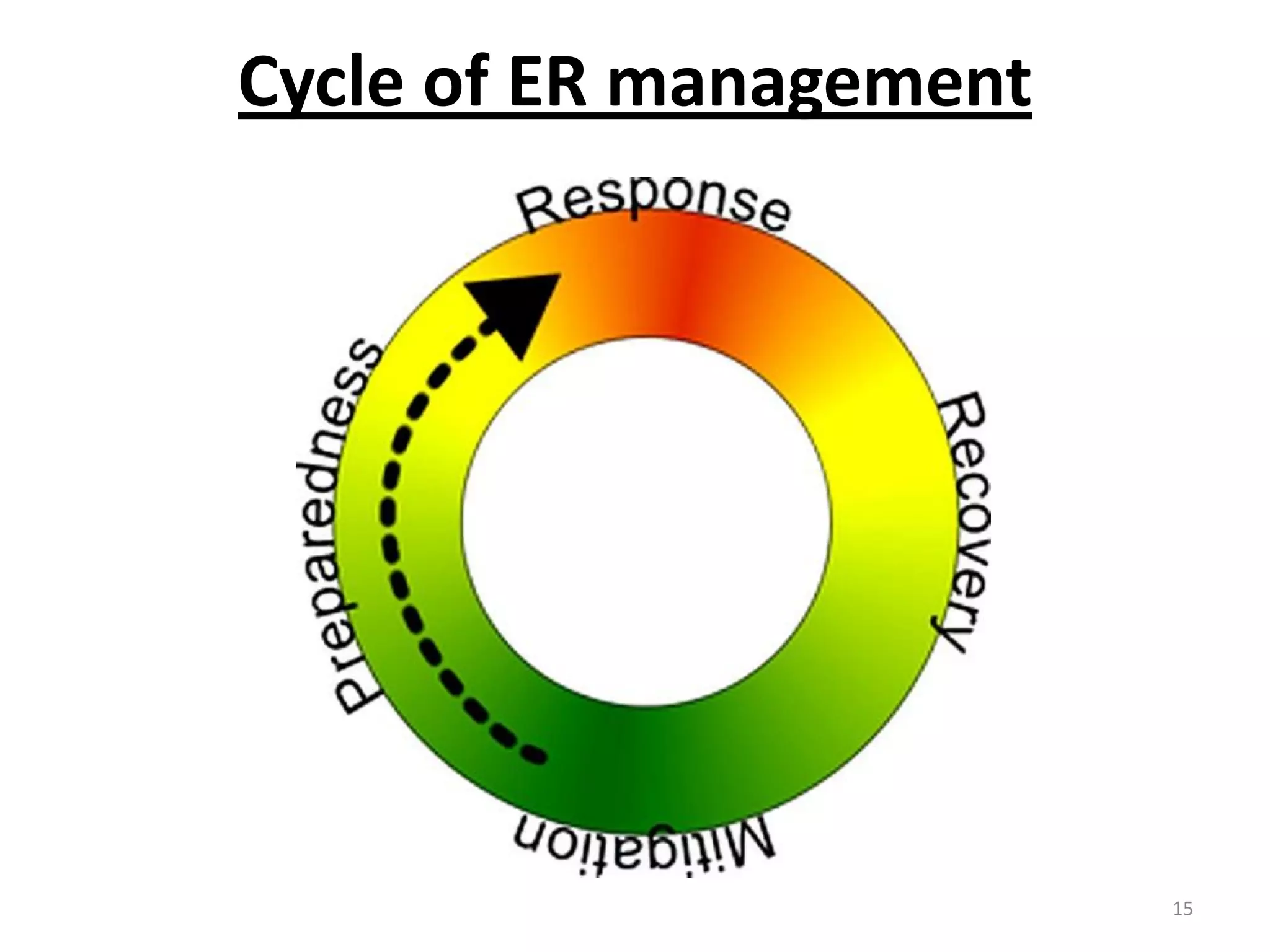
What is Emergency Management?
• The dynamic process of preparing for,
  mitigating, responding to and recovering from
  an emergency.
• Preparing for War During Peace.
• Success in War depends on your planning,
  preparing & training during peace.


                                              6
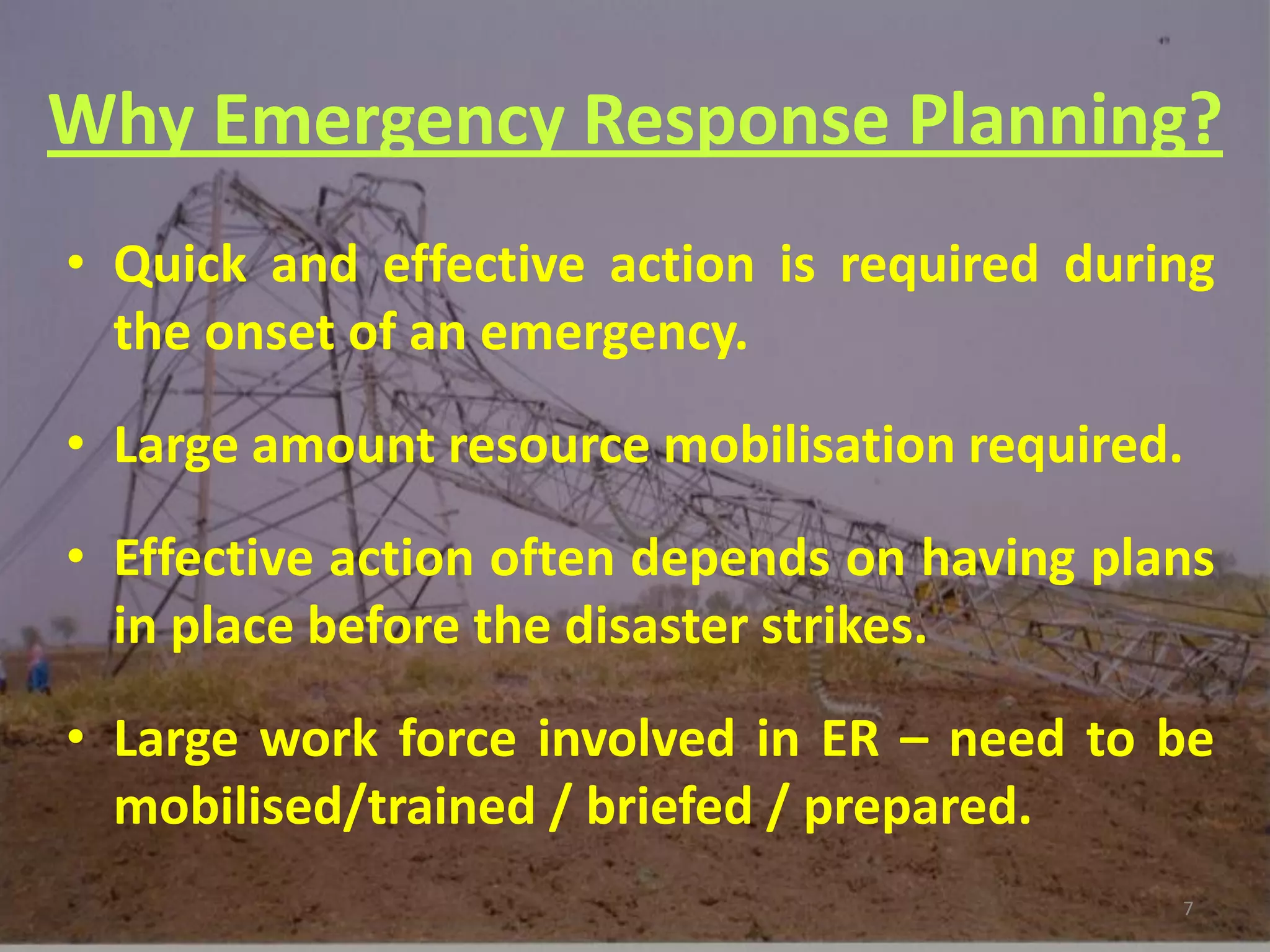
Why Emergency Response Planning?
• Quick and effective action is required during
  the onset of an emergency.

• Large amount resource mobilisation required.
• Effective action often depends on having plans
  in place before the disaster strikes.
• Large work force involved in ER – need to be
  mobilised/trained / briefed / prepared.
                                              7
Principal Elements of Preparedness
• Risks and Vulnerabilities Analysis (the broad profile
  of a projected emergency)
• External Preparedness (what other actors are
  capable of doing)
• Internal Capacity (what we are capable of doing)
• Preparedness Actions (results of the planning
  process)
• Identifying Resources – Human & Material
• Preparing Comprehensive Emergency Response
  Plans

                                                          8
Objectives of Emergency Response Plan (ERP)

• Improve state of preparedness for meeting
  contingency.
• Reduce response time in organizing the ER
• Identify major resources, manpower, material and
  equipment needed to make the ER operational.
• Optimum use of combined resources.
• Clearly define Roles & Responsibility
• Establish clear chain of command
                                                     9
Phases of Emergency Management
   •   Risk Anticipation / Assessment
   •   Prevention
   •   Preparedness
   •   Response
   •   Recovery
   •   Review & updation


                                        10
DM Act 2005
Section 36 :
   Onerous responsibility on the
Ministries to ensure that suitable
Disaster Management measures are
taken.


                                 11
DM Act 2005
   Has brought into being a Policy, Legal and
Institutional Framework, backed by effective
statutory and financial support and outlined
an integrated approach to prevention and
mitigation measures.


                                            12
Disaster Management
• In India
  – Apex body – NDMA
  – EMRI – improve community preparedness
  – DM Act 2005
  – UNDP funded disaster risk management
    programme
  – National disaster management framework

                                             13
• Mainstreaming of the
  Emergency Response
• Teams across functions &
  levels have to play critical role


                                  14
Cycle of ER management


                         15
Mitigation
• Preparedness
  – Prepare action plans
    • Evolve Processes for Prevention & Dealing with
    • Emergency response teams
    • Emergency warning methods
    • Resource Planning
    • Resources inventory building
    • Alternative Mechanisms

                                                   16
Mitigation
• Response
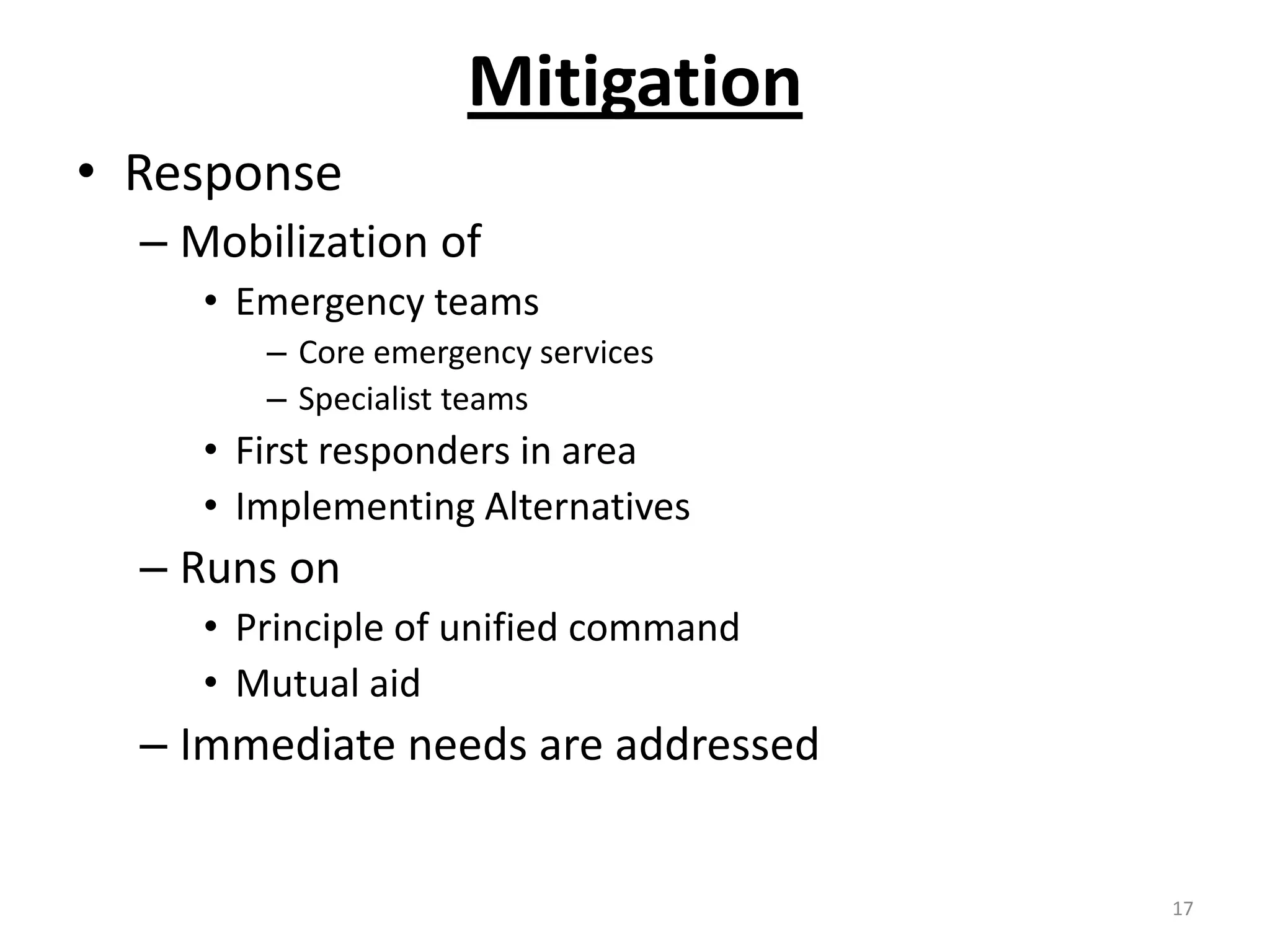
  – Mobilization of
     • Emergency teams
        – Core emergency services
        – Specialist teams
     • First responders in area
     • Implementing Alternatives
  – Runs on
     • Principle of unified command
     • Mutual aid
  – Immediate needs are addressed


                                      17
Mitigation
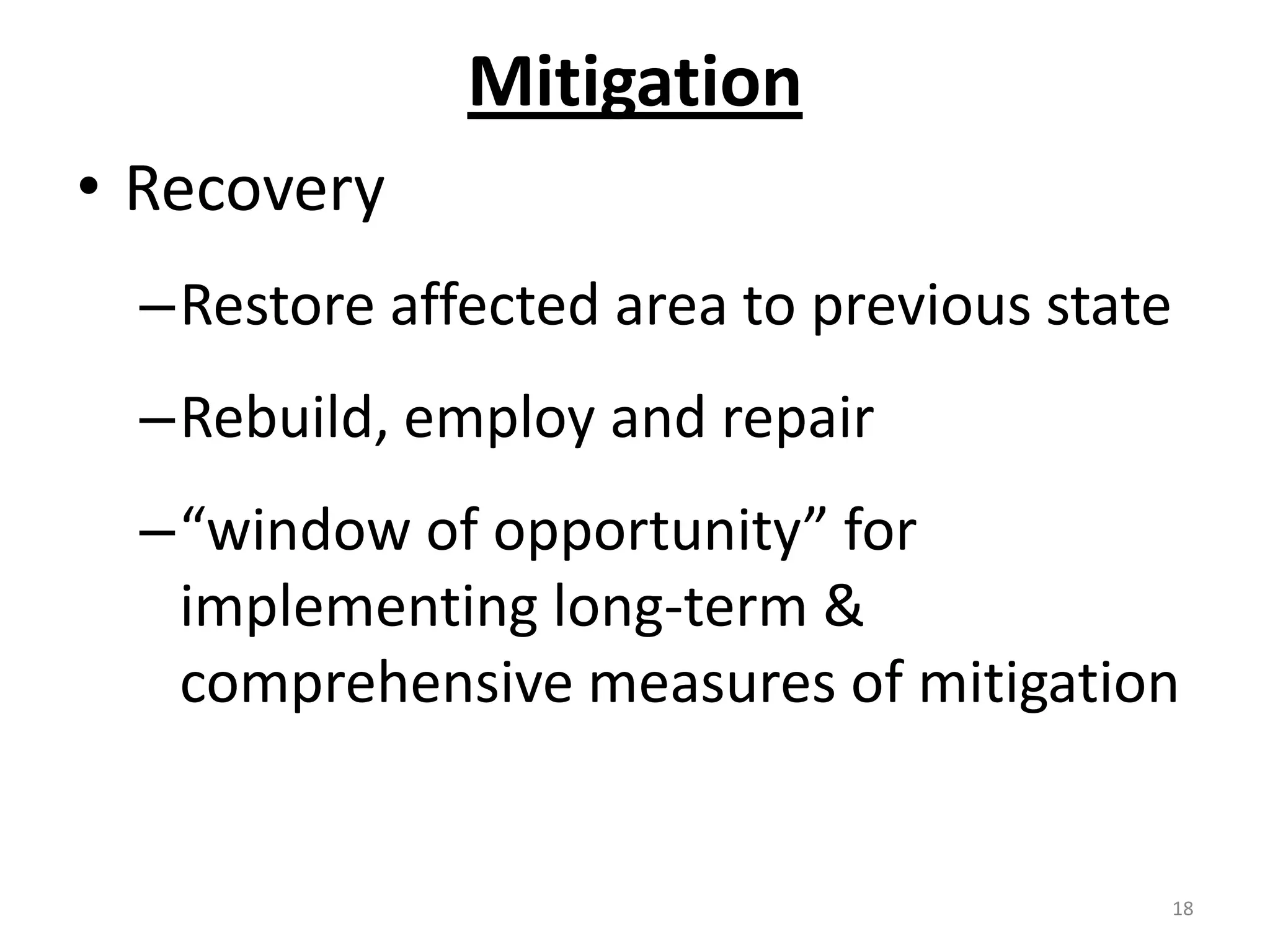
• Recovery
  –Restore affected area to previous state
  –Rebuild, employ and repair
  –“window of opportunity” for
   implementing long-term &
   comprehensive measures of mitigation


                                         18
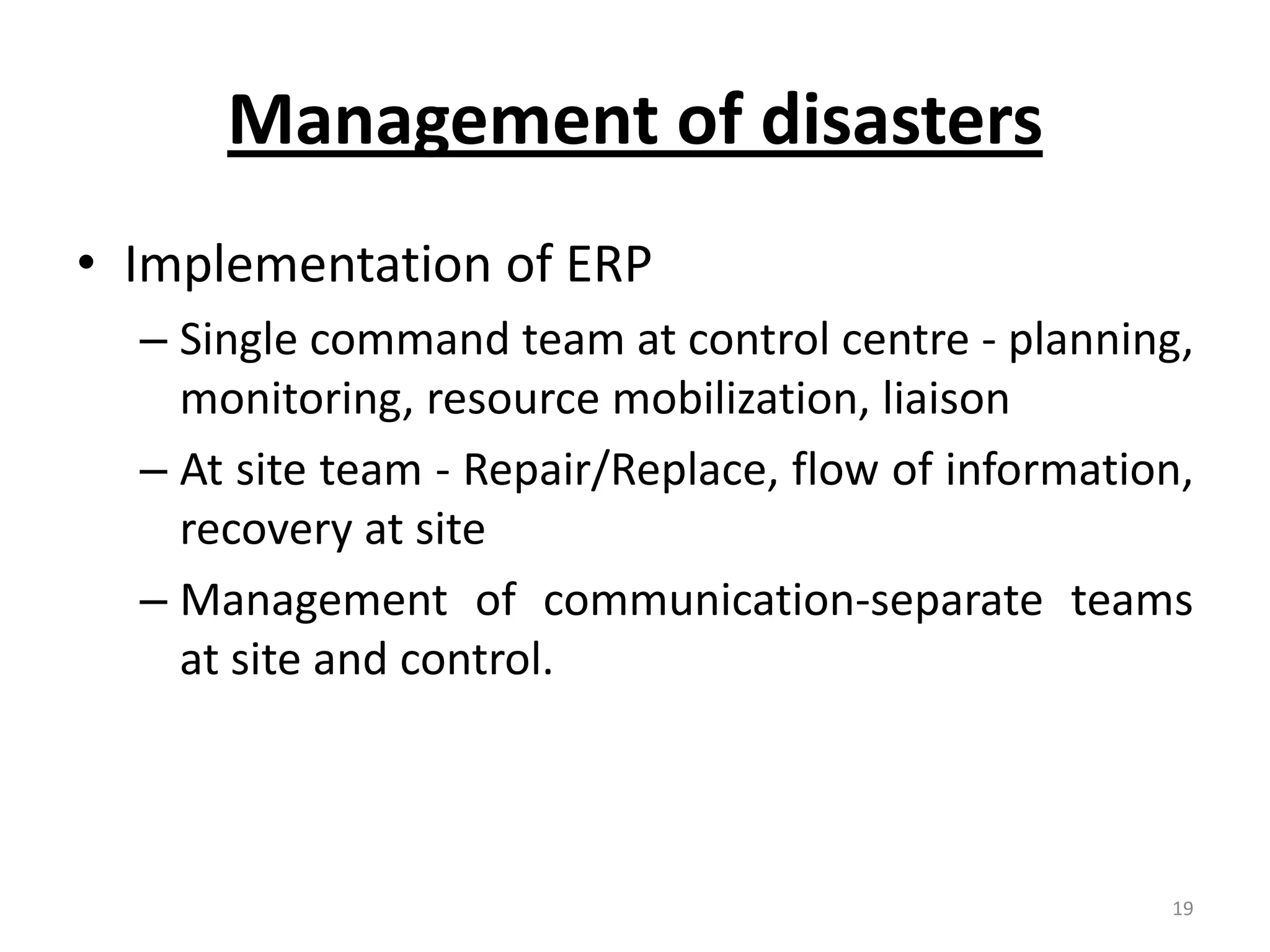
Management of disasters
• Implementation of ERP
  – Single command team at control centre - planning,
    monitoring, resource mobilization, liaison
  – At site team - Repair/Replace, flow of information,
    recovery at site
  – Management of communication-separate teams
    at site and control.


                                                     19
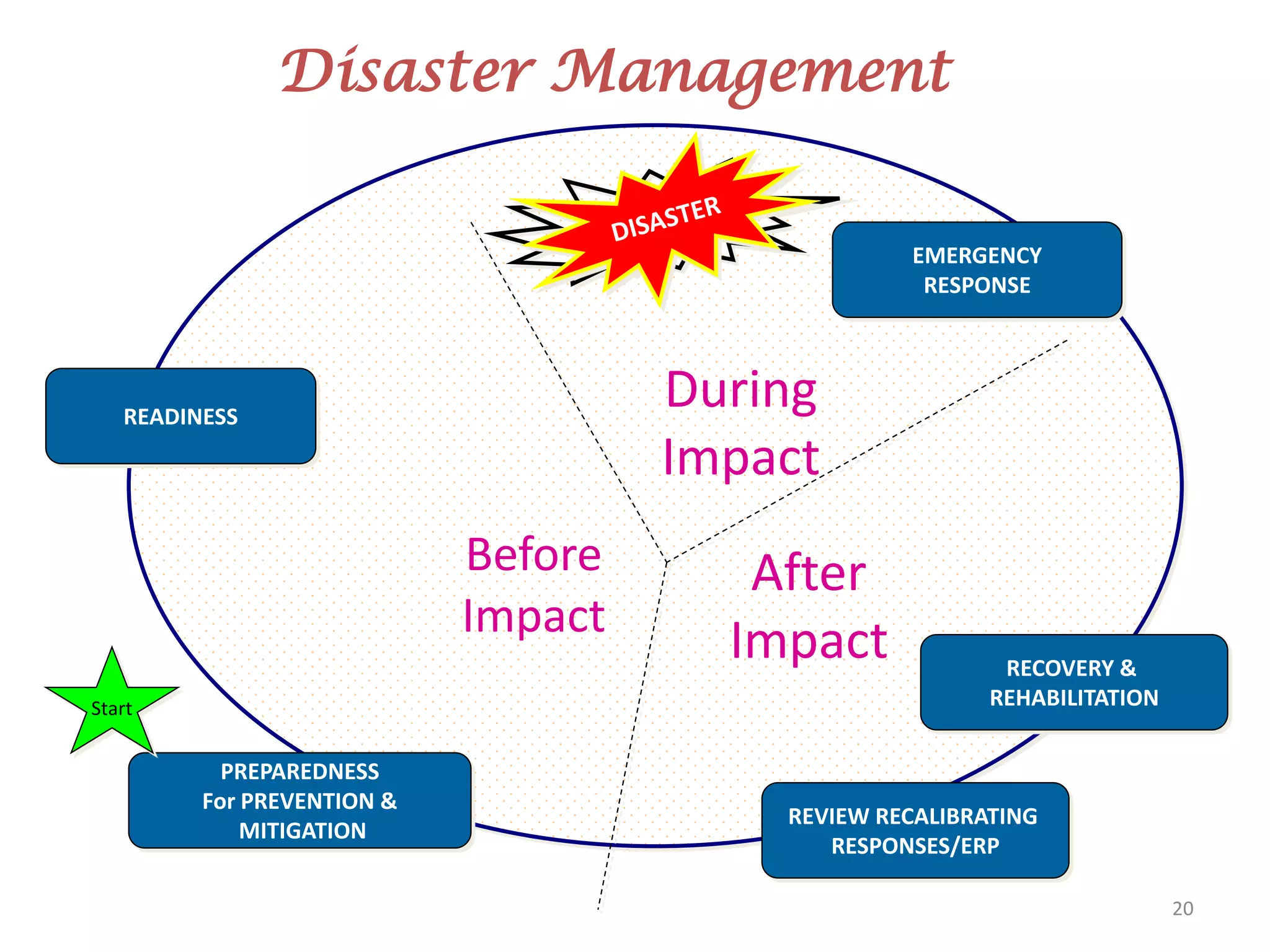
Disaster Management


                                                  EMERGENCY
                                                   RESPONSE


   READINESS
                                     During
                                     Impact
                            Before      After
                            Impact
                                       Impact             RECOVERY &
Start                                                    REHABILITATION

           PREPAREDNESS
         For PREVENTION &
                                         REVIEW RECALIBRATING
             MITIGATION
                                            RESPONSES/ERP

                                                                          20
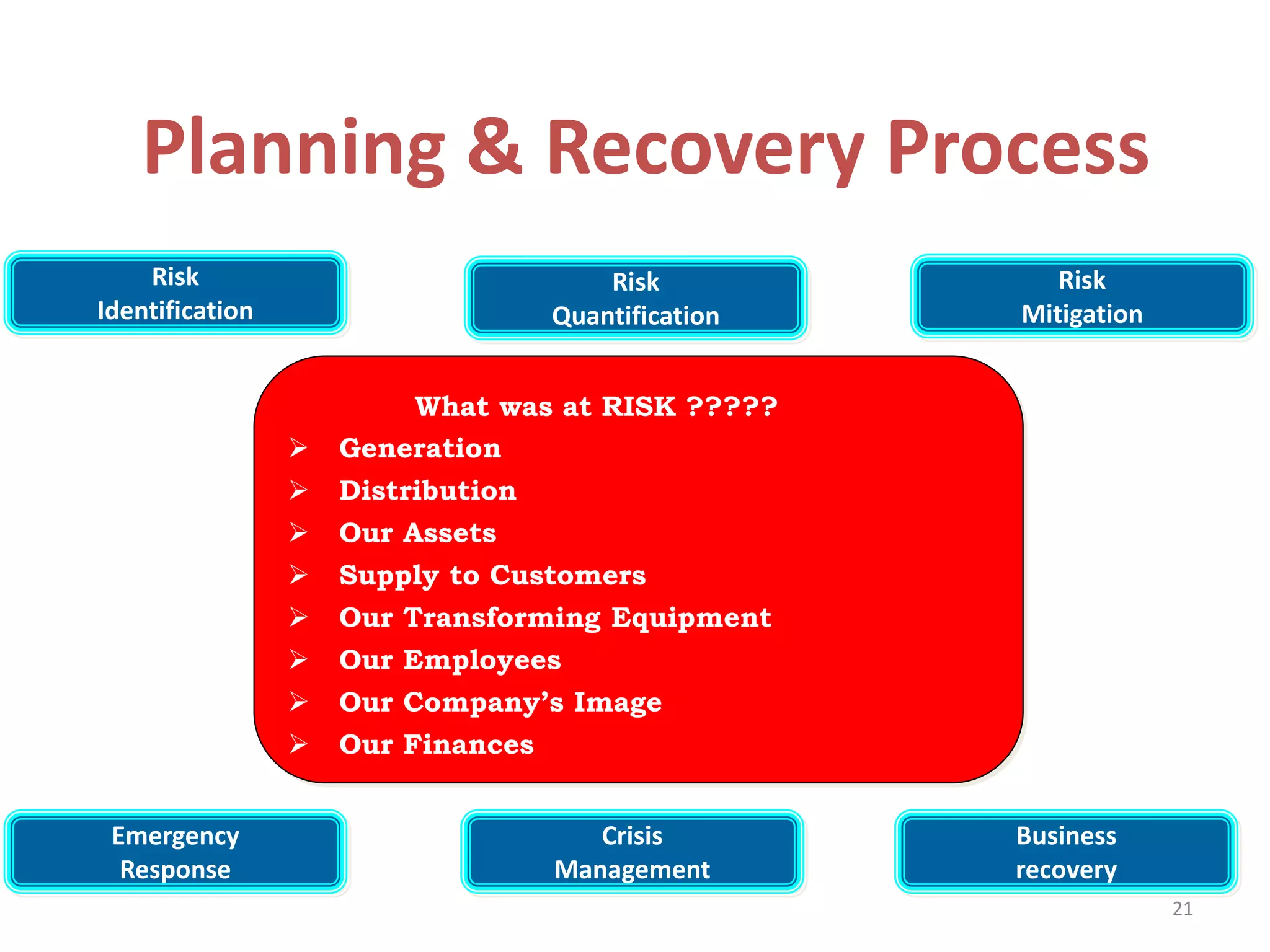
Planning & Recovery Process
    Risk                                Risk            Risk
Identification                      Quantification   Mitigation


                         What was at RISK ?????
                    Generation
                    Distribution
                    Our Assets    INCIDENT
                    Supply to Customers
                    Our Transforming Equipment
                    Our Employees
                    Our Company’s Image
                    Our Finances


 Emergency                             Crisis        Business
  Response                          Management       recovery
                                                                  21
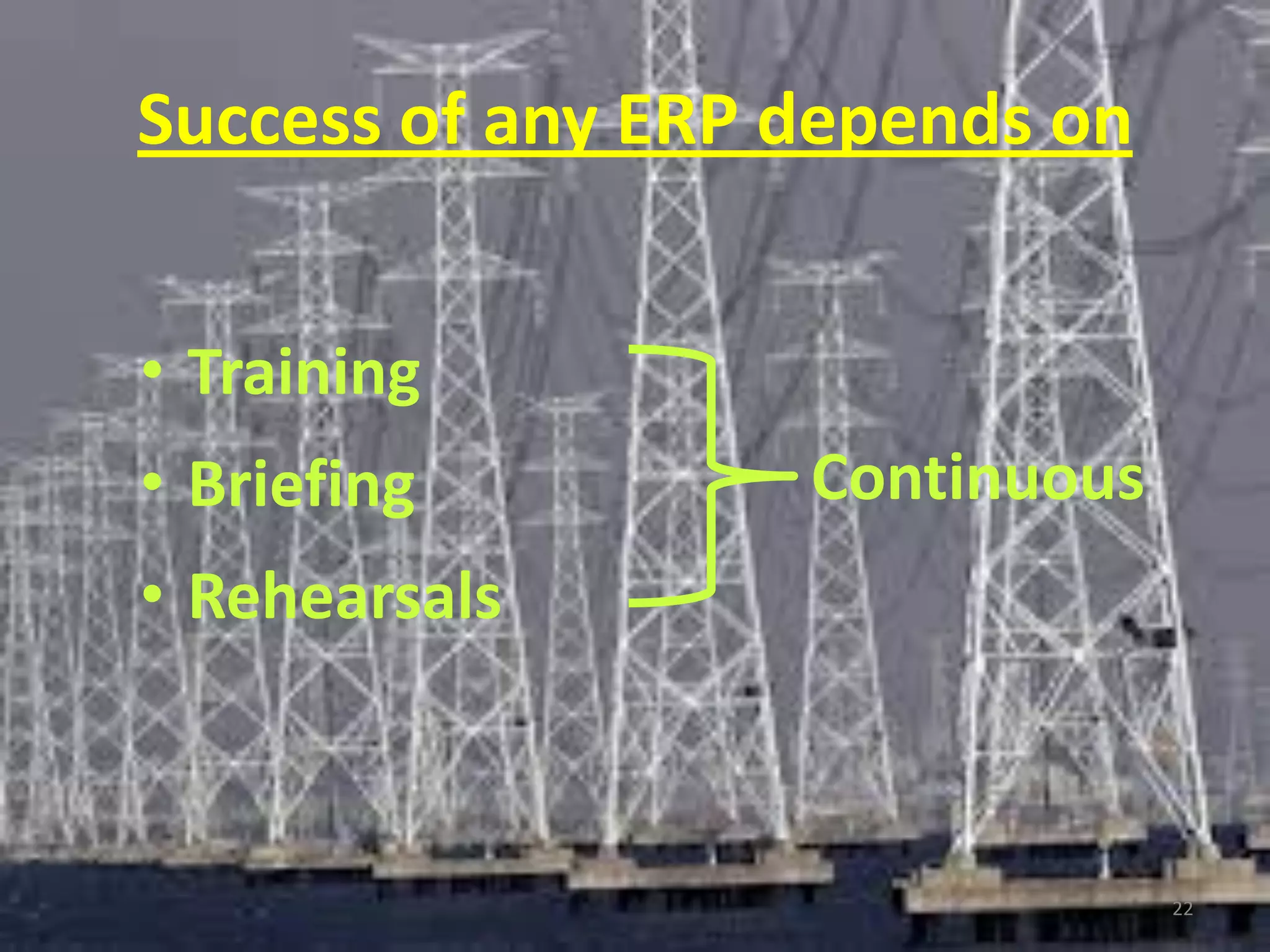
Success of any ERP depends on


• Training
• Briefing         Continuous
• Rehearsals


                                22
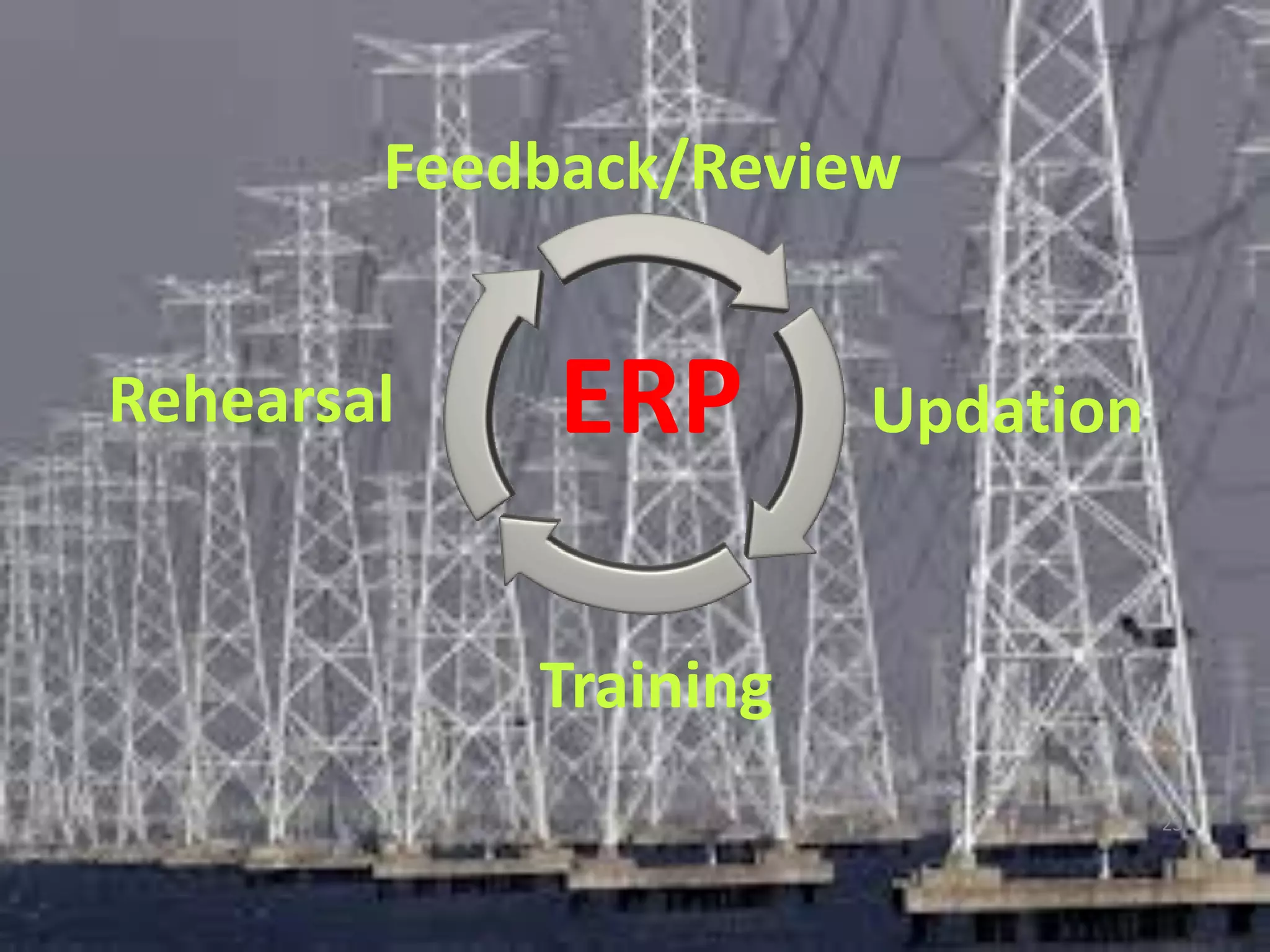
Feedback/Review


Rehearsal    ERP       Updation


            Training
                                  23
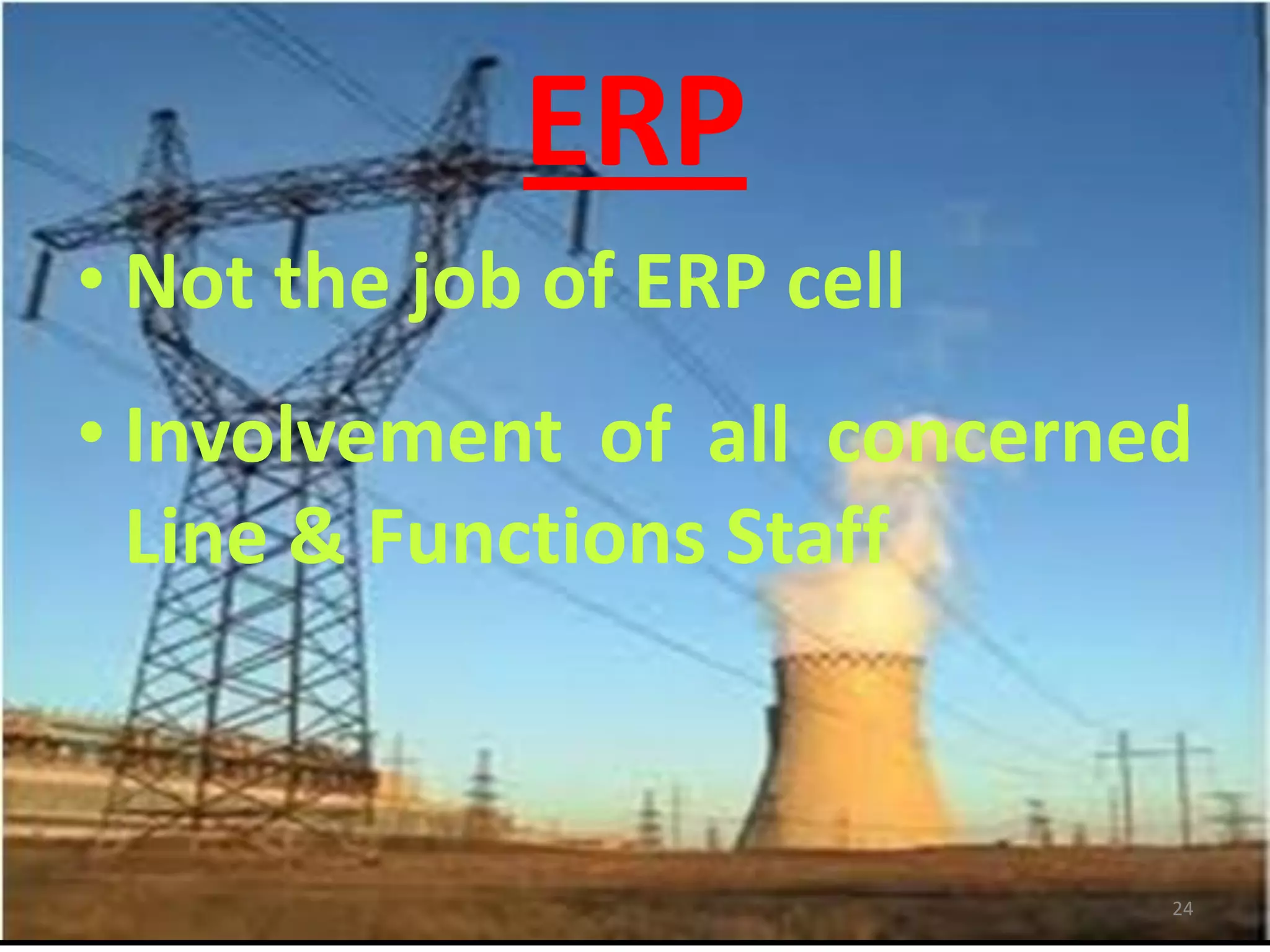
ERP
• Not the job of ERP cell
• Involvement of all concerned
  Line & Functions Staff


                             24
Training
Crucial to ER
• Institutional
• On the job
                  25
ER
• Has to become like a drill -
  Automatic


                                 26
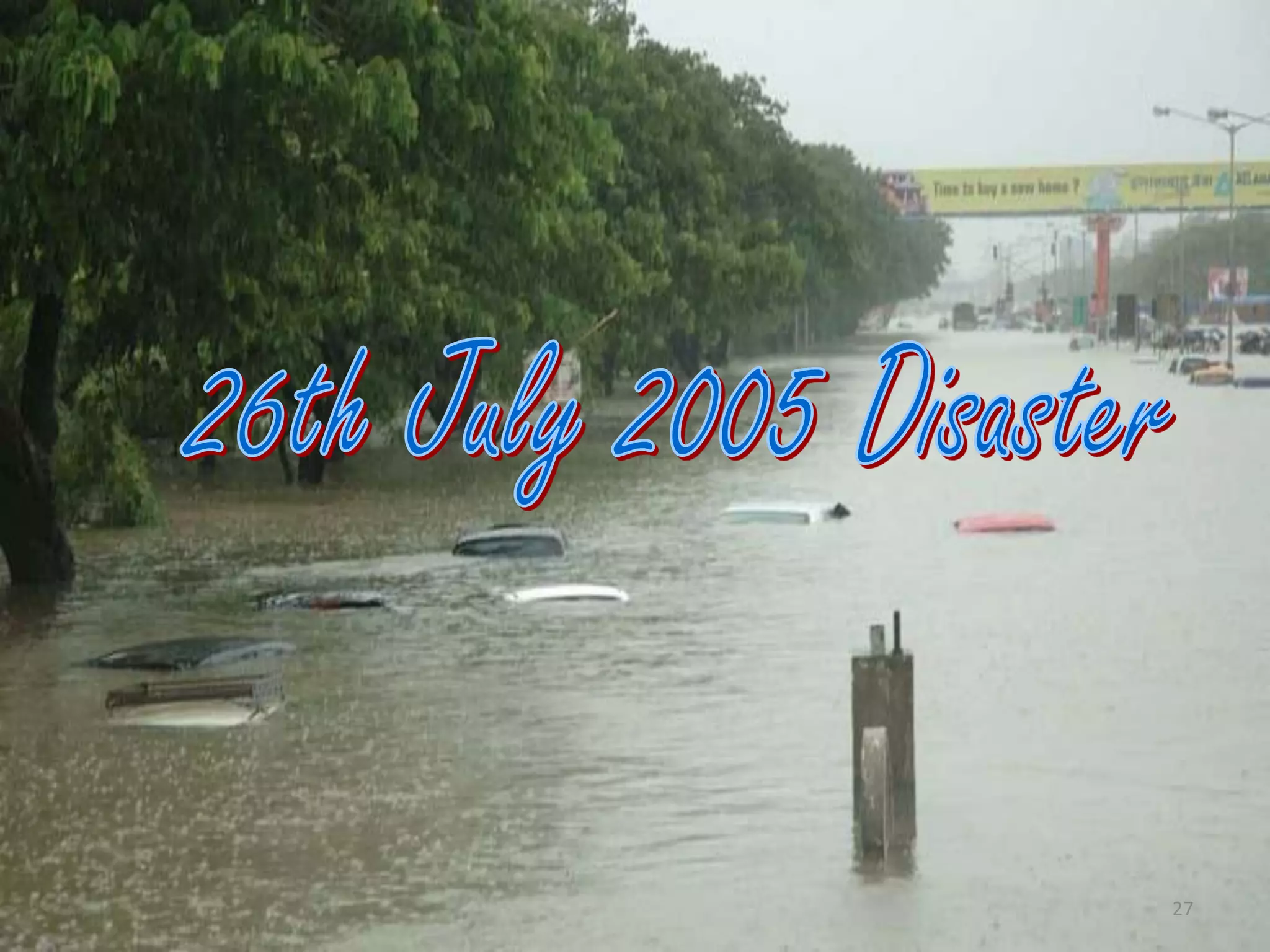
27
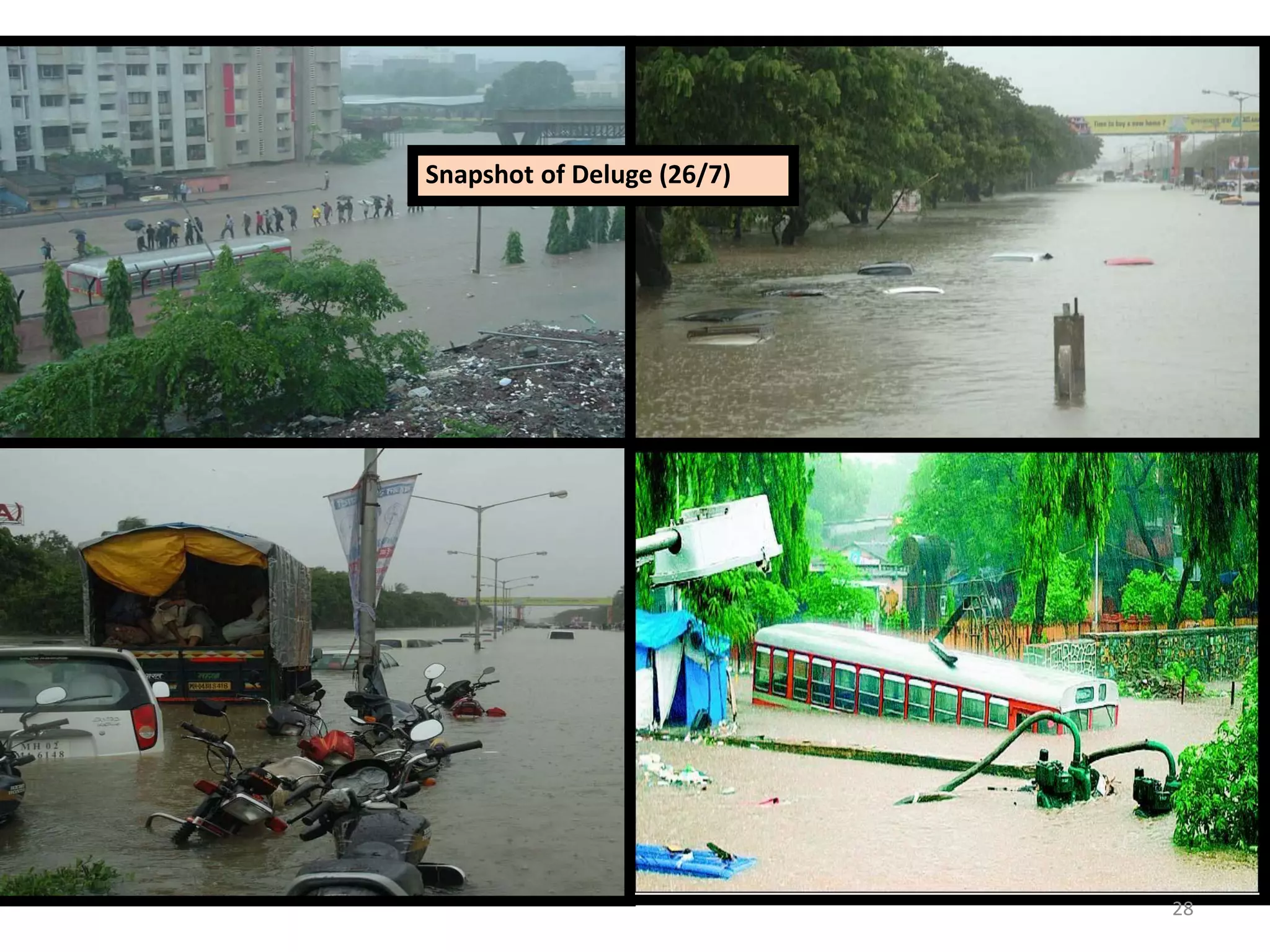
Snapshot of Deluge (26/7)


                            28
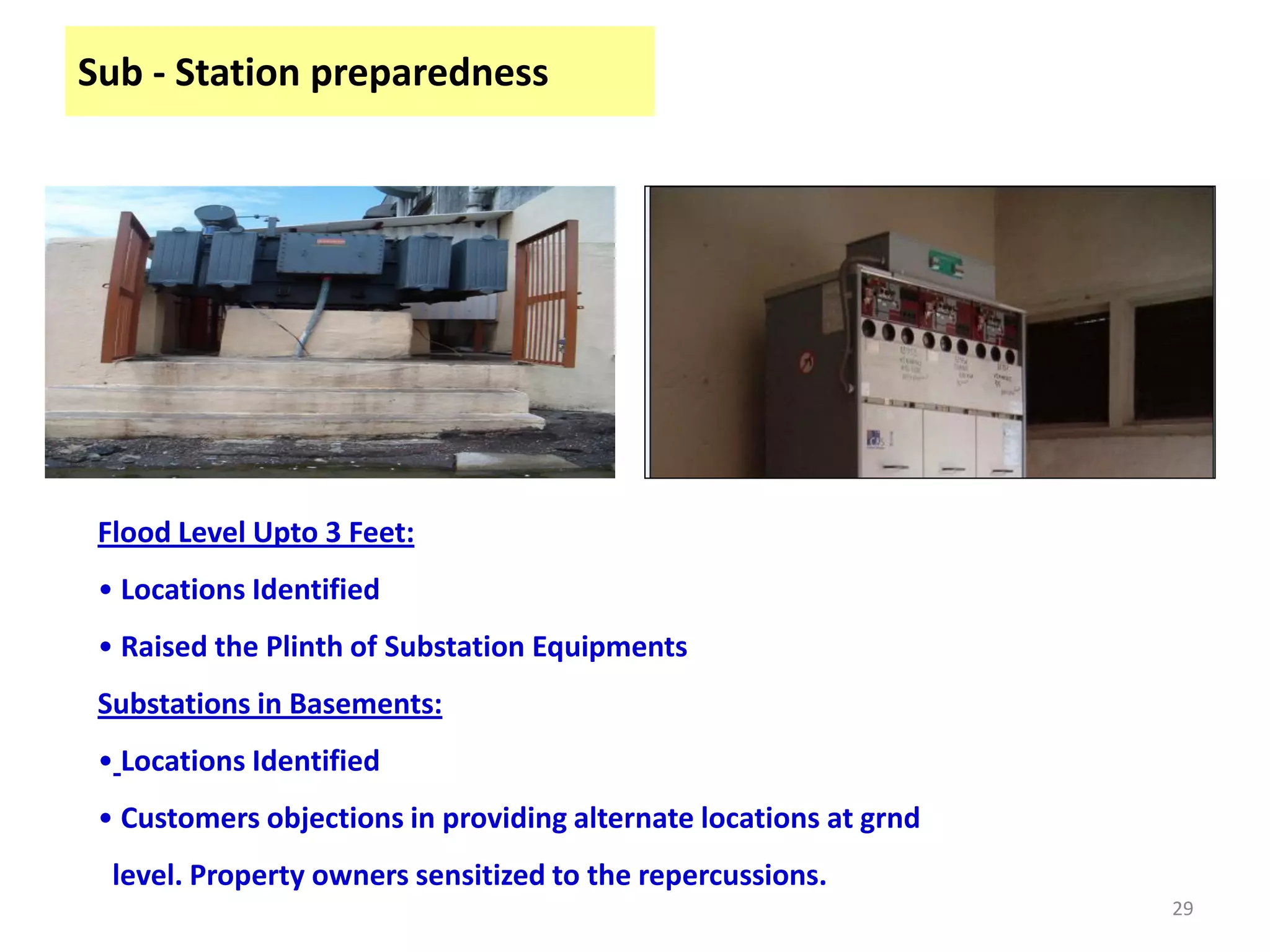
Sub - Station preparedness


 Flood Level Upto 3 Feet:
 • Locations Identified
 • Raised the Plinth of Substation Equipments
 Substations in Basements:
 • Locations Identified
 • Customers objections in providing alternate locations at grnd
  level. Property owners sensitized to the repercussions.
                                                                   29
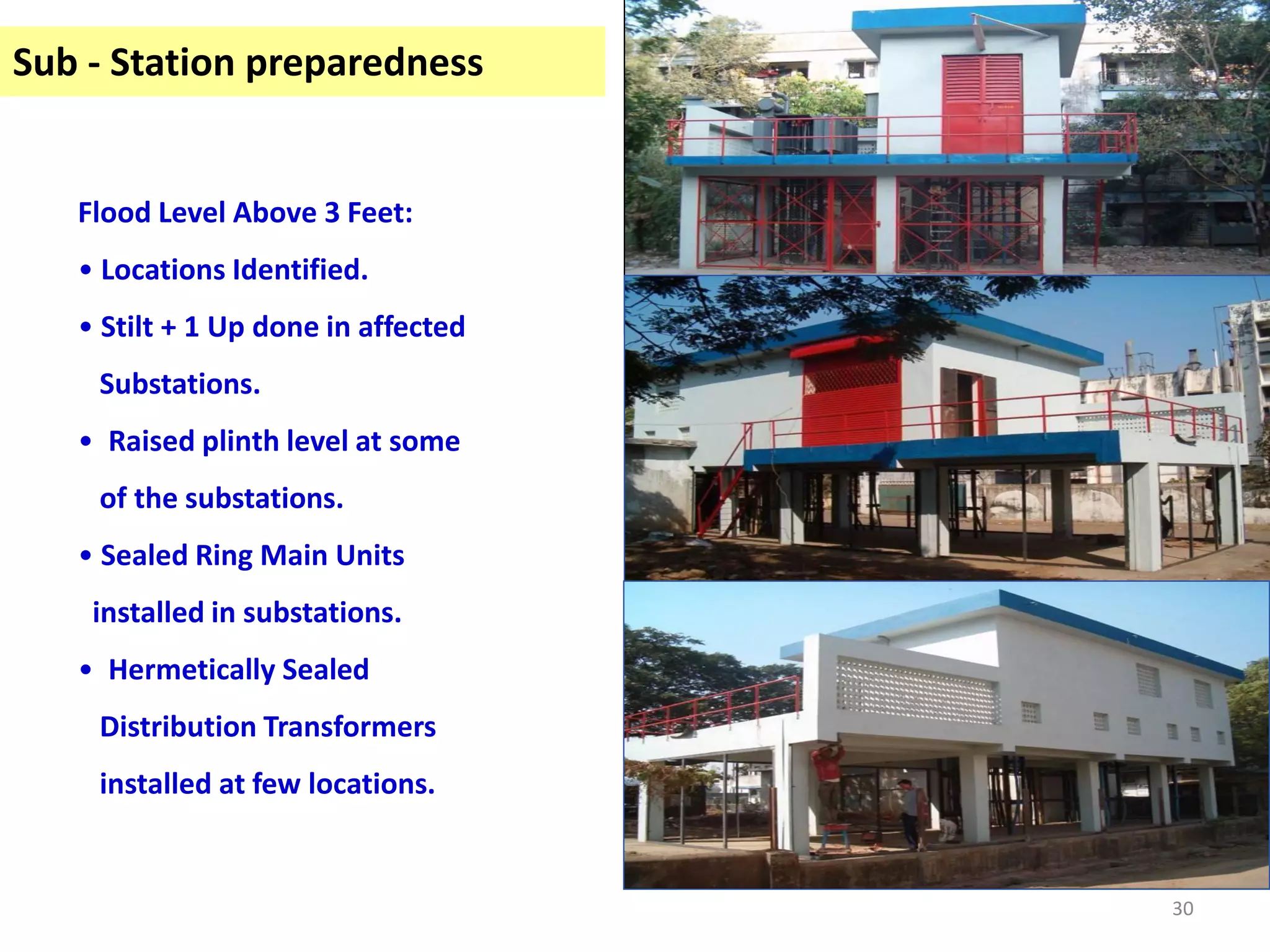
Sub - Station preparedness


   Flood Level Above 3 Feet:
   • Locations Identified.
   • Stilt + 1 Up done in affected
    Substations.
   • Raised plinth level at some
    of the substations.
   • Sealed Ring Main Units
    installed in substations.
   • Hermetically Sealed
    Distribution Transformers
    installed at few locations.


                                     30
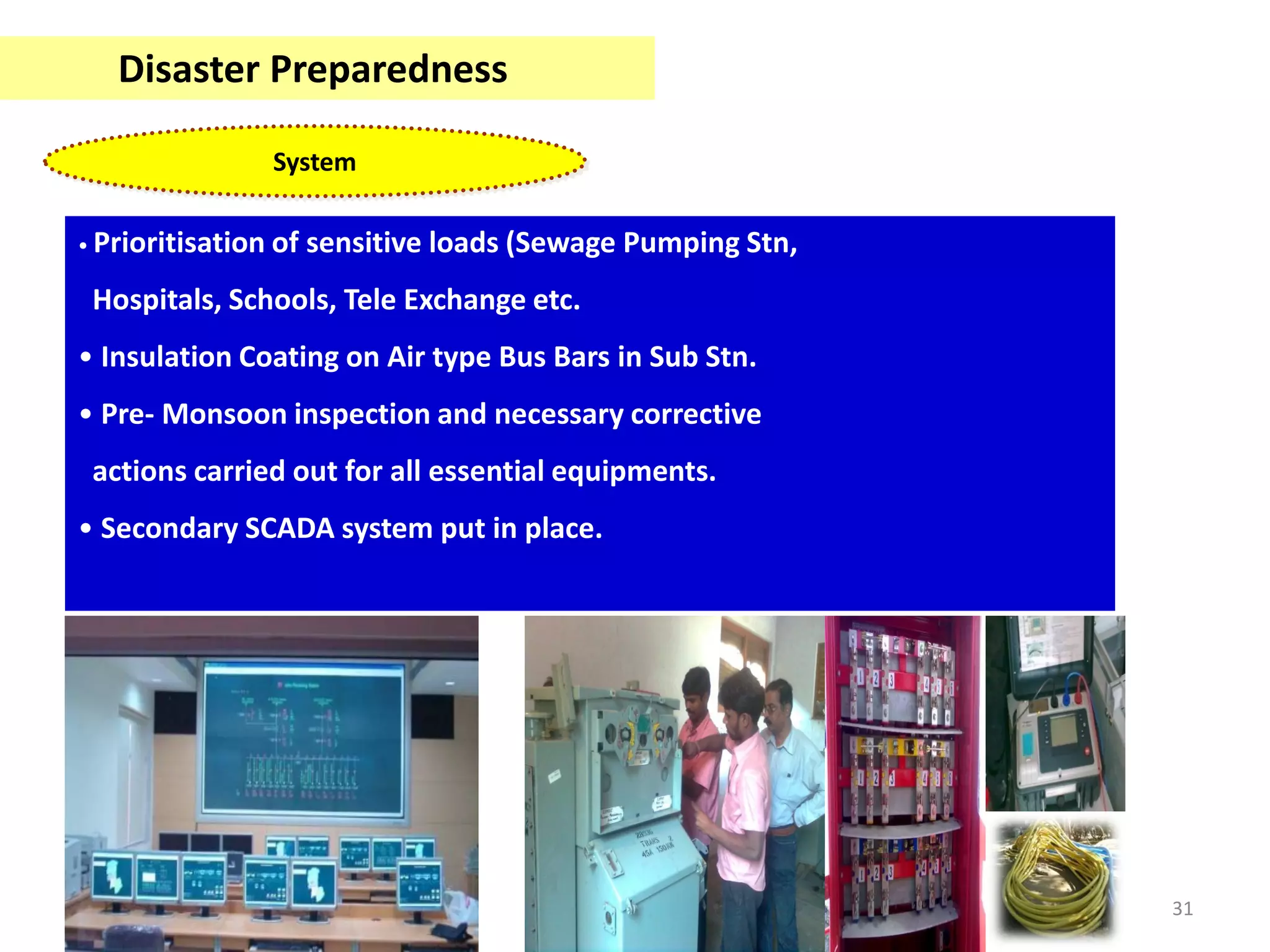
Disaster Preparedness

                   System

• Prioritisation   of sensitive loads (Sewage Pumping Stn,
 Hospitals, Schools, Tele Exchange etc.
• Insulation Coating on Air type Bus Bars in Sub Stn.
• Pre- Monsoon inspection and necessary corrective
 actions carried out for all essential equipments.
• Secondary SCADA system put in place.


                                                             31
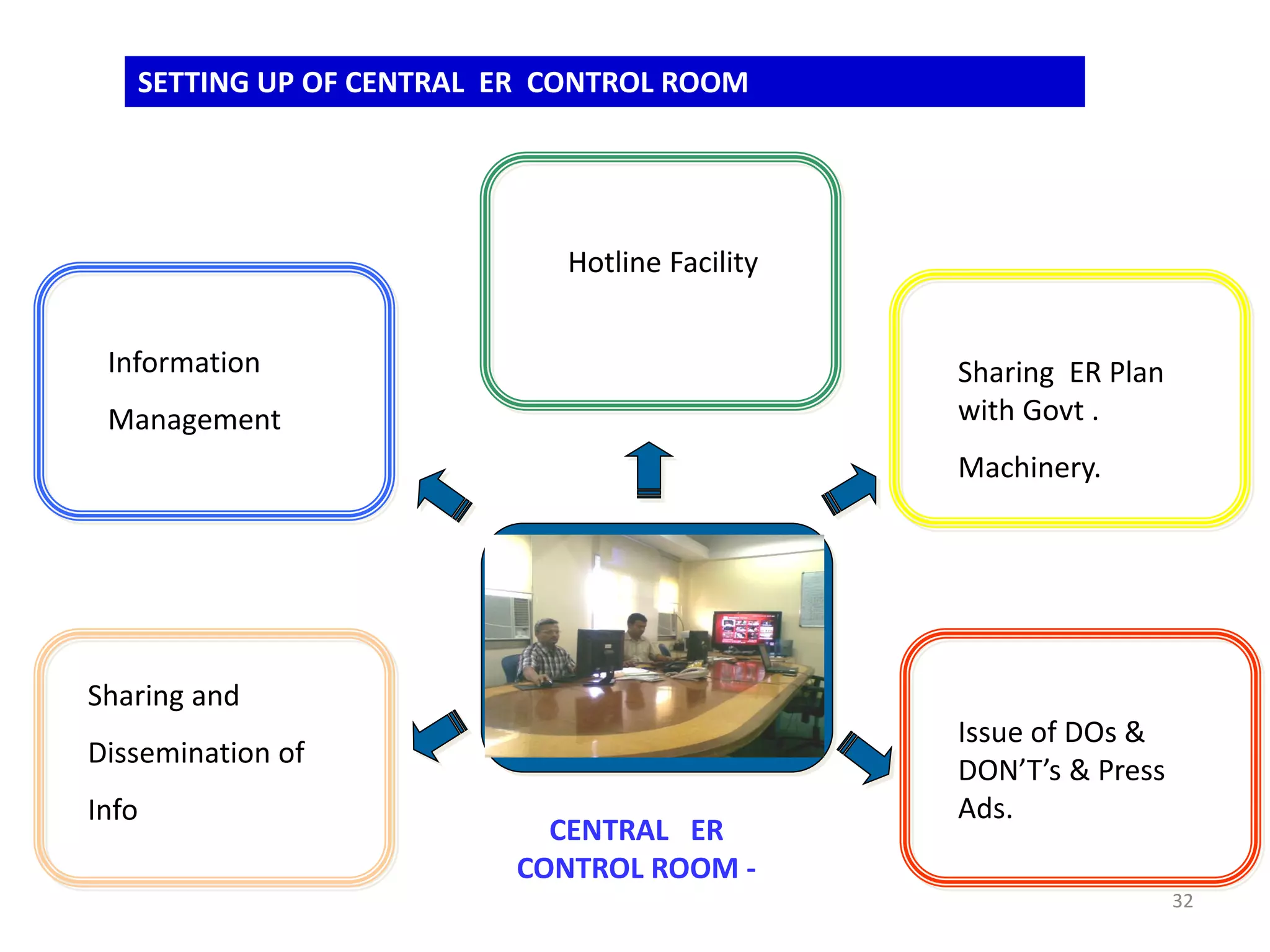
Disaster Control Room
   SETTING UP OF CENTRAL ER CONTROL ROOM


                             Hotline Facility


 Information                                    Sharing ER Plan
 Management                                     with Govt .
                                                Machinery.


Sharing and
                                                Issue of DOs &
Dissemination of
                                                DON’T’s & Press
Info                                            Ads.
                           CENTRAL ER
                         CONTROL ROOM -
                                                                  32
33
34
35

Impact of Any Emergency in the Critical Infrastructure

  • 1.
  • 2.
    Impact of Any Emergencyin the Critical Infrastructure POWER Immense 2
  • 3.
    Types of Emergencies earthquake terrorist Rapid onset attack vulcano flood Tech Failure cyclone war onset Slow civil unrest Natural Manmade 3
  • 4.
    Emergencies/Disasters • Earthquake -Geotechnical Instability – Little Control • Flood, Cloud Burst, Land Slide – Climate related – Little control • Storms, Cyclones, Hurricane – Climate related – Little Control • Technical Failures – • Terrorist Attack / Bomb Explosions 4
  • 5.
    Risk Assessment • EntireResponse depends on this Anticipation & Assessment • Cross Functional • Continuous 5
  • 6.
    What is EmergencyManagement? • The dynamic process of preparing for, mitigating, responding to and recovering from an emergency. • Preparing for War During Peace. • Success in War depends on your planning, preparing & training during peace. 6
  • 7.
    Why Emergency ResponsePlanning? • Quick and effective action is required during the onset of an emergency. • Large amount resource mobilisation required. • Effective action often depends on having plans in place before the disaster strikes. • Large work force involved in ER – need to be mobilised/trained / briefed / prepared. 7
  • 8.
    Principal Elements ofPreparedness • Risks and Vulnerabilities Analysis (the broad profile of a projected emergency) • External Preparedness (what other actors are capable of doing) • Internal Capacity (what we are capable of doing) • Preparedness Actions (results of the planning process) • Identifying Resources – Human & Material • Preparing Comprehensive Emergency Response Plans 8
  • 9.
    Objectives of EmergencyResponse Plan (ERP) • Improve state of preparedness for meeting contingency. • Reduce response time in organizing the ER • Identify major resources, manpower, material and equipment needed to make the ER operational. • Optimum use of combined resources. • Clearly define Roles & Responsibility • Establish clear chain of command 9
  • 10.
    Phases of EmergencyManagement • Risk Anticipation / Assessment • Prevention • Preparedness • Response • Recovery • Review & updation 10
  • 11.
    DM Act 2005 Section36 : Onerous responsibility on the Ministries to ensure that suitable Disaster Management measures are taken. 11
  • 12.
    DM Act 2005 Has brought into being a Policy, Legal and Institutional Framework, backed by effective statutory and financial support and outlined an integrated approach to prevention and mitigation measures. 12
  • 13.
    Disaster Management • InIndia – Apex body – NDMA – EMRI – improve community preparedness – DM Act 2005 – UNDP funded disaster risk management programme – National disaster management framework 13
  • 14.
    • Mainstreaming ofthe Emergency Response • Teams across functions & levels have to play critical role 14
  • 15.
    Cycle of ERmanagement 15
  • 16.
    Mitigation • Preparedness – Prepare action plans • Evolve Processes for Prevention & Dealing with • Emergency response teams • Emergency warning methods • Resource Planning • Resources inventory building • Alternative Mechanisms 16
  • 17.
    Mitigation • Response – Mobilization of • Emergency teams – Core emergency services – Specialist teams • First responders in area • Implementing Alternatives – Runs on • Principle of unified command • Mutual aid – Immediate needs are addressed 17
  • 18.
    Mitigation • Recovery –Restore affected area to previous state –Rebuild, employ and repair –“window of opportunity” for implementing long-term & comprehensive measures of mitigation 18
  • 19.
    Management of disasters •Implementation of ERP – Single command team at control centre - planning, monitoring, resource mobilization, liaison – At site team - Repair/Replace, flow of information, recovery at site – Management of communication-separate teams at site and control. 19
  • 20.
    Disaster Management EMERGENCY RESPONSE READINESS During Impact Before After Impact Impact RECOVERY & Start REHABILITATION PREPAREDNESS For PREVENTION & REVIEW RECALIBRATING MITIGATION RESPONSES/ERP 20
  • 21.
    Planning & RecoveryProcess Risk Risk Risk Identification Quantification Mitigation What was at RISK ?????  Generation  Distribution  Our Assets INCIDENT  Supply to Customers  Our Transforming Equipment  Our Employees  Our Company’s Image  Our Finances Emergency Crisis Business Response Management recovery 21
  • 22.
    Success of anyERP depends on • Training • Briefing Continuous • Rehearsals 22
  • 23.
    Feedback/Review Rehearsal ERP Updation Training 23
  • 24.
    ERP • Not thejob of ERP cell • Involvement of all concerned Line & Functions Staff 24
  • 25.
    Training Crucial to ER •Institutional • On the job 25
  • 26.
    ER • Has tobecome like a drill - Automatic 26
  • 27.
  • 28.
  • 29.
    Sub - Stationpreparedness Flood Level Upto 3 Feet: • Locations Identified • Raised the Plinth of Substation Equipments Substations in Basements: • Locations Identified • Customers objections in providing alternate locations at grnd level. Property owners sensitized to the repercussions. 29
  • 30.
    Sub - Stationpreparedness Flood Level Above 3 Feet: • Locations Identified. • Stilt + 1 Up done in affected Substations. • Raised plinth level at some of the substations. • Sealed Ring Main Units installed in substations. • Hermetically Sealed Distribution Transformers installed at few locations. 30
  • 31.
    Disaster Preparedness System • Prioritisation of sensitive loads (Sewage Pumping Stn, Hospitals, Schools, Tele Exchange etc. • Insulation Coating on Air type Bus Bars in Sub Stn. • Pre- Monsoon inspection and necessary corrective actions carried out for all essential equipments. • Secondary SCADA system put in place. 31
  • 32.
    Disaster Control Room SETTING UP OF CENTRAL ER CONTROL ROOM Hotline Facility Information Sharing ER Plan Management with Govt . Machinery. Sharing and Issue of DOs & Dissemination of DON’T’s & Press Info Ads. CENTRAL ER CONTROL ROOM - 32
  • 33.
  • 34.
  • 35.