Minimum Needs & 20
Point Programme
Mrs.D.Madhurima Gopinath,
Clinical Instructor
HMCON
Introduction
• India is a developing country comprised with major
part of rural areas.
• People in rural areas were not able to access to
many of the facilities after the independence
• Development of the rural areas can be done by
planning and assuring the basic/ minimum needs to
them.
Minimum Needs Program
Launched : 1974 - 1978 (Fifth Five Year Plan)
Goal:
• Growth with social justice
• Improve the living standards of people by providing
basic needs
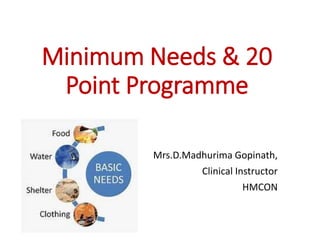
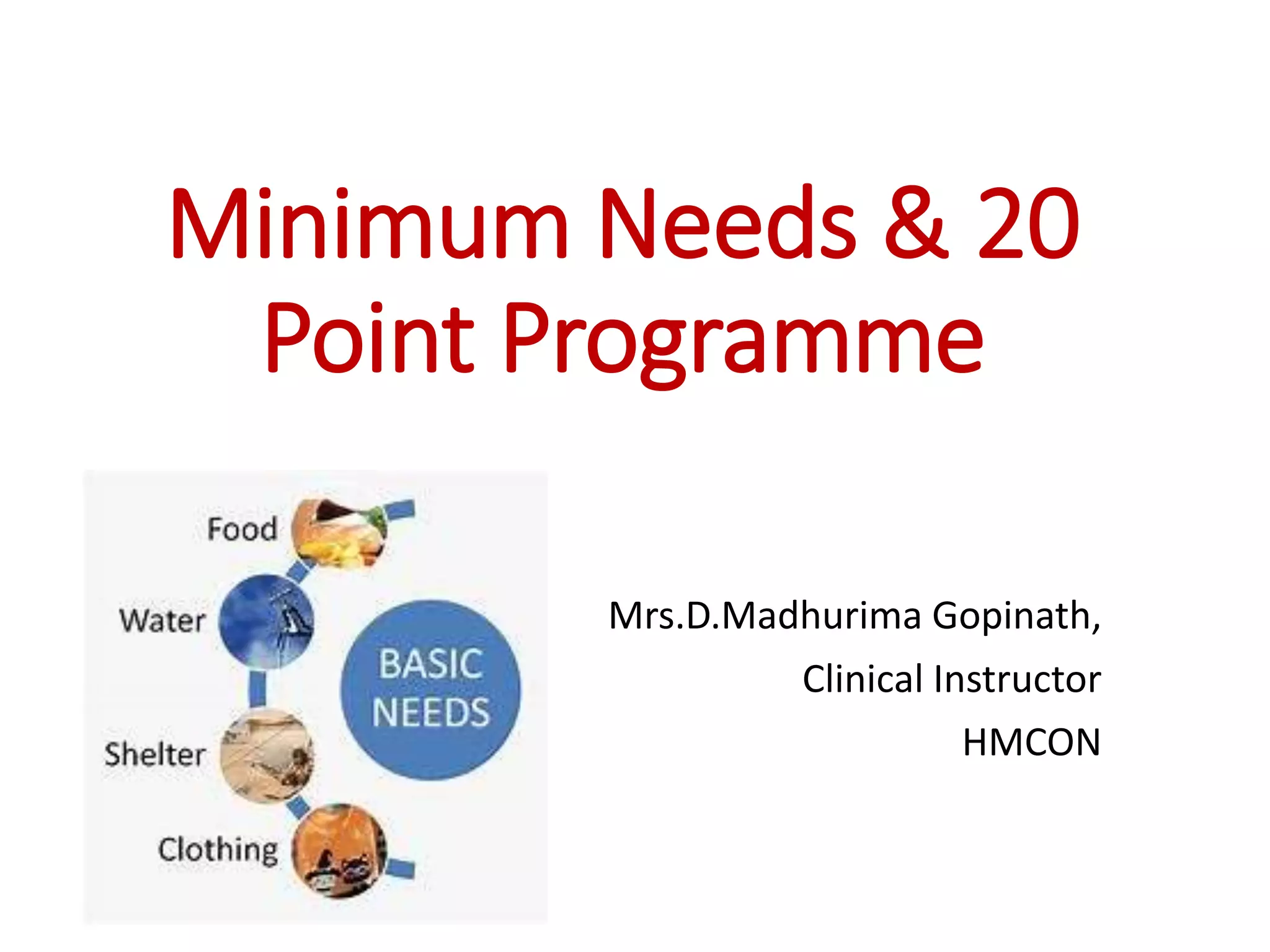
Basic Needs:
Health, Education, Nutrition, Water & sanitation
Electricity
Objectives
To be achieved by eighth five year plan
Rural Health
1 PHC for every 30,000 population in plains and for every
20,000 population in hilly areas
1 SC for every 5000 population in plains and for every
3000 population in hilly areas
1 CHC for every 1 lakh population
Nutrition
• To extend nutritional support to 11 million eligible
persons
• To consolidate mid day meal programme
• To provide portable water and adequate sanitation
facilities.
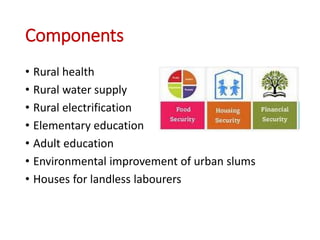
Components
• Rural health
• Rural water supply
• Rural electrification
• Elementary education
• Adult education
• Environmental improvement of urban slums
• Houses for landless labourers
Principles
• Facilities to be provided first for underserved areas
• Facilities should be provided as a package
20 Point Programme
• Launched : Prime Minister Indira Gandhi in 1975,
restructured in 1982 and again on 1986
• New policies were included in Twenty Point
Programme – 2006 (TPP-2006)
• Approved by the Cabinet on 5th October, 2006 and
operated
• Monitoring Authority : At the Centre, Ministry of
Statistics and Programme Implementation,
Government of India.
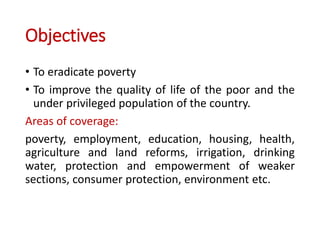
Objectives
• To eradicate poverty
• To improve the quality of life of the poor and the
under privileged population of the country.
Areas of coverage:
poverty, employment, education, housing, health,
agriculture and land reforms, irrigation, drinking
water, protection and empowerment of weaker
sections, consumer protection, environment etc.
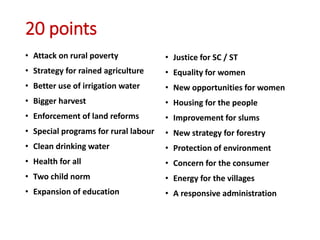
20 points
• Attack on rural poverty
• Strategy for rained agriculture
• Better use of irrigation water
• Bigger harvest
• Enforcement of land reforms
• Special programs for rural labour
• Clean drinking water
• Health for all
• Two child norm
• Expansion of education
• Justice for SC / ST
• Equality for women
• New opportunities for women
• Housing for the people
• Improvement for slums
• New strategy for forestry
• Protection of environment
• Concern for the consumer
• Energy for the villages
• A responsive administration
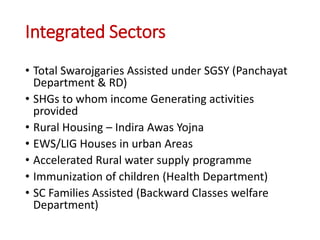
Integrated Sectors
• Total Swarojgaries Assisted under SGSY (Panchayat
Department & RD)
• SHGs to whom income Generating activities
provided
• Rural Housing – Indira Awas Yojna
• EWS/LIG Houses in urban Areas
• Accelerated Rural water supply programme
• Immunization of children (Health Department)
• SC Families Assisted (Backward Classes welfare
Department)
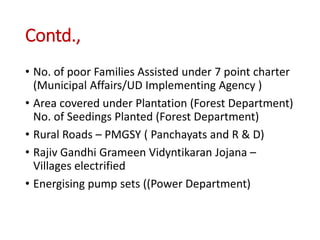
Contd.,
• No. of poor Families Assisted under 7 point charter
(Municipal Affairs/UD Implementing Agency )
• Area covered under Plantation (Forest Department)
No. of Seedings Planted (Forest Department)
• Rural Roads – PMGSY ( Panchayats and R & D)
• Rajiv Gandhi Grameen Vidyntikaran Jojana –
Villages electrified
• Energising pump sets ((Power Department)
Minimum needs p wps office

Minimum needs p wps office

  • 1.
    Minimum Needs &20 Point Programme Mrs.D.Madhurima Gopinath, Clinical Instructor HMCON
  • 2.
    Introduction • India isa developing country comprised with major part of rural areas. • People in rural areas were not able to access to many of the facilities after the independence • Development of the rural areas can be done by planning and assuring the basic/ minimum needs to them.
  • 3.
    Minimum Needs Program Launched: 1974 - 1978 (Fifth Five Year Plan) Goal: • Growth with social justice • Improve the living standards of people by providing basic needs Basic Needs: Health, Education, Nutrition, Water & sanitation Electricity
  • 4.
    Objectives To be achievedby eighth five year plan Rural Health 1 PHC for every 30,000 population in plains and for every 20,000 population in hilly areas 1 SC for every 5000 population in plains and for every 3000 population in hilly areas 1 CHC for every 1 lakh population Nutrition • To extend nutritional support to 11 million eligible persons • To consolidate mid day meal programme • To provide portable water and adequate sanitation facilities.
  • 5.
    Components • Rural health •Rural water supply • Rural electrification • Elementary education • Adult education • Environmental improvement of urban slums • Houses for landless labourers
  • 6.
    Principles • Facilities tobe provided first for underserved areas • Facilities should be provided as a package
  • 7.
    20 Point Programme •Launched : Prime Minister Indira Gandhi in 1975, restructured in 1982 and again on 1986 • New policies were included in Twenty Point Programme – 2006 (TPP-2006) • Approved by the Cabinet on 5th October, 2006 and operated • Monitoring Authority : At the Centre, Ministry of Statistics and Programme Implementation, Government of India.
  • 8.
    Objectives • To eradicatepoverty • To improve the quality of life of the poor and the under privileged population of the country. Areas of coverage: poverty, employment, education, housing, health, agriculture and land reforms, irrigation, drinking water, protection and empowerment of weaker sections, consumer protection, environment etc.
  • 9.
    20 points • Attackon rural poverty • Strategy for rained agriculture • Better use of irrigation water • Bigger harvest • Enforcement of land reforms • Special programs for rural labour • Clean drinking water • Health for all • Two child norm • Expansion of education • Justice for SC / ST • Equality for women • New opportunities for women • Housing for the people • Improvement for slums • New strategy for forestry • Protection of environment • Concern for the consumer • Energy for the villages • A responsive administration
  • 10.
    Integrated Sectors • TotalSwarojgaries Assisted under SGSY (Panchayat Department & RD) • SHGs to whom income Generating activities provided • Rural Housing – Indira Awas Yojna • EWS/LIG Houses in urban Areas • Accelerated Rural water supply programme • Immunization of children (Health Department) • SC Families Assisted (Backward Classes welfare Department)
  • 11.
    Contd., • No. ofpoor Families Assisted under 7 point charter (Municipal Affairs/UD Implementing Agency ) • Area covered under Plantation (Forest Department) No. of Seedings Planted (Forest Department) • Rural Roads – PMGSY ( Panchayats and R & D) • Rajiv Gandhi Grameen Vidyntikaran Jojana – Villages electrified • Energising pump sets ((Power Department)