“
Class Room Management
”
Mrs.Madhurima.D
Assistant Professor
Shri Sathya Sai College of Nursing
Sri Balaji Vidyapeeth University
DEFINITION
• Classroom management refers to the wide
variety of skills and techniques that
teachers use to keep students organized,
orderly, focused, attentive, on task, and
academically productive during a class.
• It is an ongoing process of managing
students’ behaviour.
• It is a multi-factor process.
What are the benefits of
managing the classroom well?
1.Learners learn best in a safe and secure
environment.
2. It saves time and effort for the teacher.
3. It is easier to engage students and get
them on task.
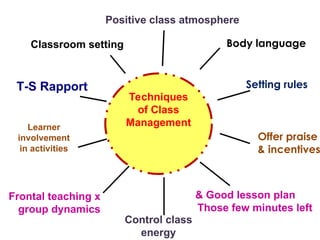
Techniques
of Class
Management
Offer praise
& incentives
Classroom setting Body language
T-S Rapport Setting rules
Frontal teaching x
group dynamics
Good lesson plan
&
Those few minutes left
Learner
involvement
in activities
Positive class atmosphere
Control class
energy
1- Body language & physical
proximity:
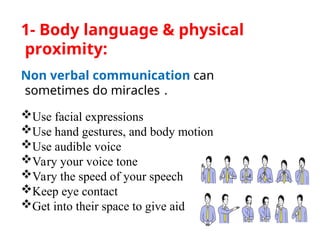
Non verbal communication can
sometimes do miracles .
Use facial expressions
Use hand gestures, and body motion
Use audible voice
Vary your voice tone
Vary the speed of your speech
Keep eye contact
Get into their space to give aid
2- Setting rules & routines:
Teachers need to establish some class rules of
discipline.
Power Teaching Classroom Rules:
1- Follow directions quickly
2- Raise your hand for permission to speak
3- Raise your hand for permission to leave your seat
4- Make smart choices
5- Keep your dear teacher happy
Maintain the students’ dignity and self- esteem and
encourage them to be responsible for their own
behaviour
.
3- Offer praise and give
incentives
Praising learners or giving them incentives when
they do good things means that you expect them to
do this behavior more and more.
When ss. misbehave use verbal punishment with
words of disappointment that lead them to behave
well in the future. Avoid using physical punishment.
4 - A good lesson plan:
Planning a lesson which is suitable to the
level , interests , learning styles and age
group of learners can save time , effort and
guarantee learning .
Those few minutes left:
Teacher must always be prepared with
some extra activities (extension) that
reinforce a certain skill on one hand and
keep learners busy on the other hand.
Good time management, Transition time
Decrease transition time.
5- Control class energy
Teachers use energizers ( stirrers ) and settlers
to keep control over the learners and achieve
good class management.
To activate learners, teachers play energetic
games with them , then the teacher calm learners
down by using settling activities like telling a
story , listening to a song , drawing or writing
activities.
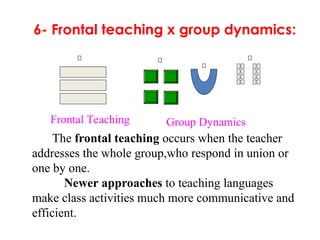
6- Frontal teaching x group dynamics:
The frontal teaching occurs when the teacher
addresses the whole group,who respond in union or
one by one.
Newer approaches to teaching languages
make class activities much more communicative and
efficient.
Frontal Teaching Group Dynamics
a. Arrange the seating of learners in a way that
enables p ∕ p interaction.
b. Give effective, clear instructions.
c. Relate material to students’ lives, experiences and
current events.
d. Pace of instruction is best if it is fast.
e. Engage students in group work and role playing as
misbehaviour happens because students find “acting out “
more interesting than a boring lesson.
7- Learner’s involvement in
activities:
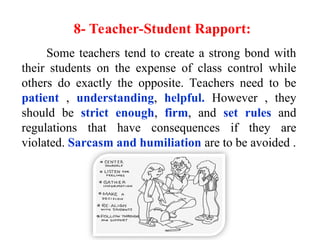
8- Teacher-Student Rapport:
Some teachers tend to create a strong bond with
their students on the expense of class control while
others do exactly the opposite. Teachers need to be
patient , understanding, helpful. However , they
should be strict enough, firm, and set rules and
regulations that have consequences if they are
violated. Sarcasm and humiliation are to be avoided .
Some Tips for Rapport-Building
1. Call your students by name.
2. Repeat and paraphrase student’s answers. This
shows that you were attentively listening.
3. Use eye contact, non-verbal cues such as a nod,
and facial expressions to indicate that you're
interested.
4. Reward students with verbal praise.
5. If you are not sure of what a student is asking about, ask
some questions which will help you clarify. Don't say,
"I don't understand what you mean.“
6. Let students know you care about them by attending an
outside class activity that they are in, like sporting
events, a play , ..etc.
More Tips for Rapport-Building
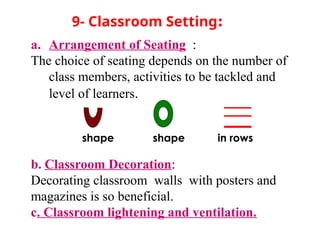
9- Classroom Setting:
a. Arrangement of Seating :
The choice of seating depends on the number of
class members, activities to be tackled and
level of learners.
shape shape in rows
b. Classroom Decoration:
Decorating classroom walls with posters and
magazines is so beneficial.
c. Classroom lightening and ventilation.
a. Maintain a safe and secure class
atmosphere.
b. Use games and attractive activities.
c. Relate activities to pupils’ interests and
needs .
d. Show learners your care , interest ,
support and love.
e. Minimize fear and stress.
f. Set high expectations of all your students.
10- Creating a positive class
atmosphere
Good classroom management is
also
an important factor related to
dealing with disruptive behaviour
effectively.
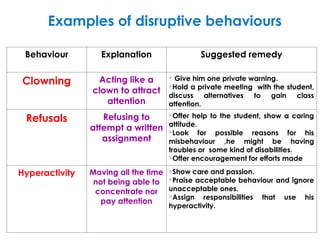
Examples of disruptive behaviours
Behaviour Explanation Suggested remedy
Clowning Acting like a
clown to attract
attention
 Give him one private warning.
Hold a private meeting with the student,
discuss alternatives to gain class
attention.
Refusals Refusing to
attempt a written
assignment
Offer help to the student, show a caring
attitude.
Look for possible reasons for his
misbehaviour ,he might be having
troubles or some kind of disabilities.
Offer encouragement for efforts made
Hyperactivity Moving all the time
not being able to
concentrate nor
pay attention
Show care and passion.
Praise acceptable behaviour and ignore
unacceptable ones.
Assign responsibilities that use his
hyperactivity.
classroom management - Communication Education and Technology.ppt

classroom management - Communication Education and Technology.ppt

  • 1.
    “ Class Room Management ” Mrs.Madhurima.D AssistantProfessor Shri Sathya Sai College of Nursing Sri Balaji Vidyapeeth University
  • 2.
    DEFINITION • Classroom managementrefers to the wide variety of skills and techniques that teachers use to keep students organized, orderly, focused, attentive, on task, and academically productive during a class. • It is an ongoing process of managing students’ behaviour. • It is a multi-factor process.
  • 3.
    What are thebenefits of managing the classroom well? 1.Learners learn best in a safe and secure environment. 2. It saves time and effort for the teacher. 3. It is easier to engage students and get them on task.
  • 4.
    Techniques of Class Management Offer praise &incentives Classroom setting Body language T-S Rapport Setting rules Frontal teaching x group dynamics Good lesson plan & Those few minutes left Learner involvement in activities Positive class atmosphere Control class energy
  • 5.
    1- Body language& physical proximity: Non verbal communication can sometimes do miracles . Use facial expressions Use hand gestures, and body motion Use audible voice Vary your voice tone Vary the speed of your speech Keep eye contact Get into their space to give aid
  • 6.
    2- Setting rules& routines: Teachers need to establish some class rules of discipline. Power Teaching Classroom Rules: 1- Follow directions quickly 2- Raise your hand for permission to speak 3- Raise your hand for permission to leave your seat 4- Make smart choices 5- Keep your dear teacher happy Maintain the students’ dignity and self- esteem and encourage them to be responsible for their own behaviour .
  • 7.
    3- Offer praiseand give incentives Praising learners or giving them incentives when they do good things means that you expect them to do this behavior more and more. When ss. misbehave use verbal punishment with words of disappointment that lead them to behave well in the future. Avoid using physical punishment.
  • 8.
    4 - Agood lesson plan: Planning a lesson which is suitable to the level , interests , learning styles and age group of learners can save time , effort and guarantee learning . Those few minutes left: Teacher must always be prepared with some extra activities (extension) that reinforce a certain skill on one hand and keep learners busy on the other hand. Good time management, Transition time Decrease transition time.
  • 9.
    5- Control classenergy 5- Control class energy Teachers use energizers ( stirrers ) and settlers to keep control over the learners and achieve good class management. To activate learners, teachers play energetic games with them , then the teacher calm learners down by using settling activities like telling a story , listening to a song , drawing or writing activities.
  • 10.
    6- Frontal teachingx group dynamics: The frontal teaching occurs when the teacher addresses the whole group,who respond in union or one by one. Newer approaches to teaching languages make class activities much more communicative and efficient. Frontal Teaching Group Dynamics
  • 11.
    a. Arrange theseating of learners in a way that enables p ∕ p interaction. b. Give effective, clear instructions. c. Relate material to students’ lives, experiences and current events. d. Pace of instruction is best if it is fast. e. Engage students in group work and role playing as misbehaviour happens because students find “acting out “ more interesting than a boring lesson. 7- Learner’s involvement in activities:
  • 12.
    8- Teacher-Student Rapport: Someteachers tend to create a strong bond with their students on the expense of class control while others do exactly the opposite. Teachers need to be patient , understanding, helpful. However , they should be strict enough, firm, and set rules and regulations that have consequences if they are violated. Sarcasm and humiliation are to be avoided .
  • 13.
    Some Tips forRapport-Building 1. Call your students by name. 2. Repeat and paraphrase student’s answers. This shows that you were attentively listening. 3. Use eye contact, non-verbal cues such as a nod, and facial expressions to indicate that you're interested. 4. Reward students with verbal praise.
  • 14.
    5. If youare not sure of what a student is asking about, ask some questions which will help you clarify. Don't say, "I don't understand what you mean.“ 6. Let students know you care about them by attending an outside class activity that they are in, like sporting events, a play , ..etc. More Tips for Rapport-Building
  • 15.
    9- Classroom Setting: a.Arrangement of Seating : The choice of seating depends on the number of class members, activities to be tackled and level of learners. shape shape in rows b. Classroom Decoration: Decorating classroom walls with posters and magazines is so beneficial. c. Classroom lightening and ventilation.
  • 16.
    a. Maintain asafe and secure class atmosphere. b. Use games and attractive activities. c. Relate activities to pupils’ interests and needs . d. Show learners your care , interest , support and love. e. Minimize fear and stress. f. Set high expectations of all your students. 10- Creating a positive class atmosphere
  • 17.
    Good classroom managementis also an important factor related to dealing with disruptive behaviour effectively.
  • 18.
    Examples of disruptivebehaviours Behaviour Explanation Suggested remedy Clowning Acting like a clown to attract attention  Give him one private warning. Hold a private meeting with the student, discuss alternatives to gain class attention. Refusals Refusing to attempt a written assignment Offer help to the student, show a caring attitude. Look for possible reasons for his misbehaviour ,he might be having troubles or some kind of disabilities. Offer encouragement for efforts made Hyperactivity Moving all the time not being able to concentrate nor pay attention Show care and passion. Praise acceptable behaviour and ignore unacceptable ones. Assign responsibilities that use his hyperactivity.