

TRINITY INSTITUTE OF PROFESSIONAL STUDIES
Sector – 9, Dwarka Institutional Area, New Delhi-75
Affiliated Institution of G.G.S.IP.U,
Delhi
Paper Id: 20207
Paper Code: BCA207
Principles of accounting
TRINITY INSTITUTE OF PROFESSIONAL STUDIES
Sector – 9, Dwarka Institutional Area, New Delhi-75
Financial Accounting
The Language
of Business
TRINITY INSTITUTE OF PROFESSIONAL STUDIES
Sector – 9, Dwarka Institutional Area, New Delhi-75
Combination of two words……
Financial + Accounting
 Combination of two words……
Financial + Accounting
 Accounting
A process of identifying, recording, summarizing,
and reporting economic information to decision
makers in the form of financial statement
TRINITY INSTITUTE OF PROFESSIONAL STUDIES
Sector – 9, Dwarka Institutional Area, New Delhi-75
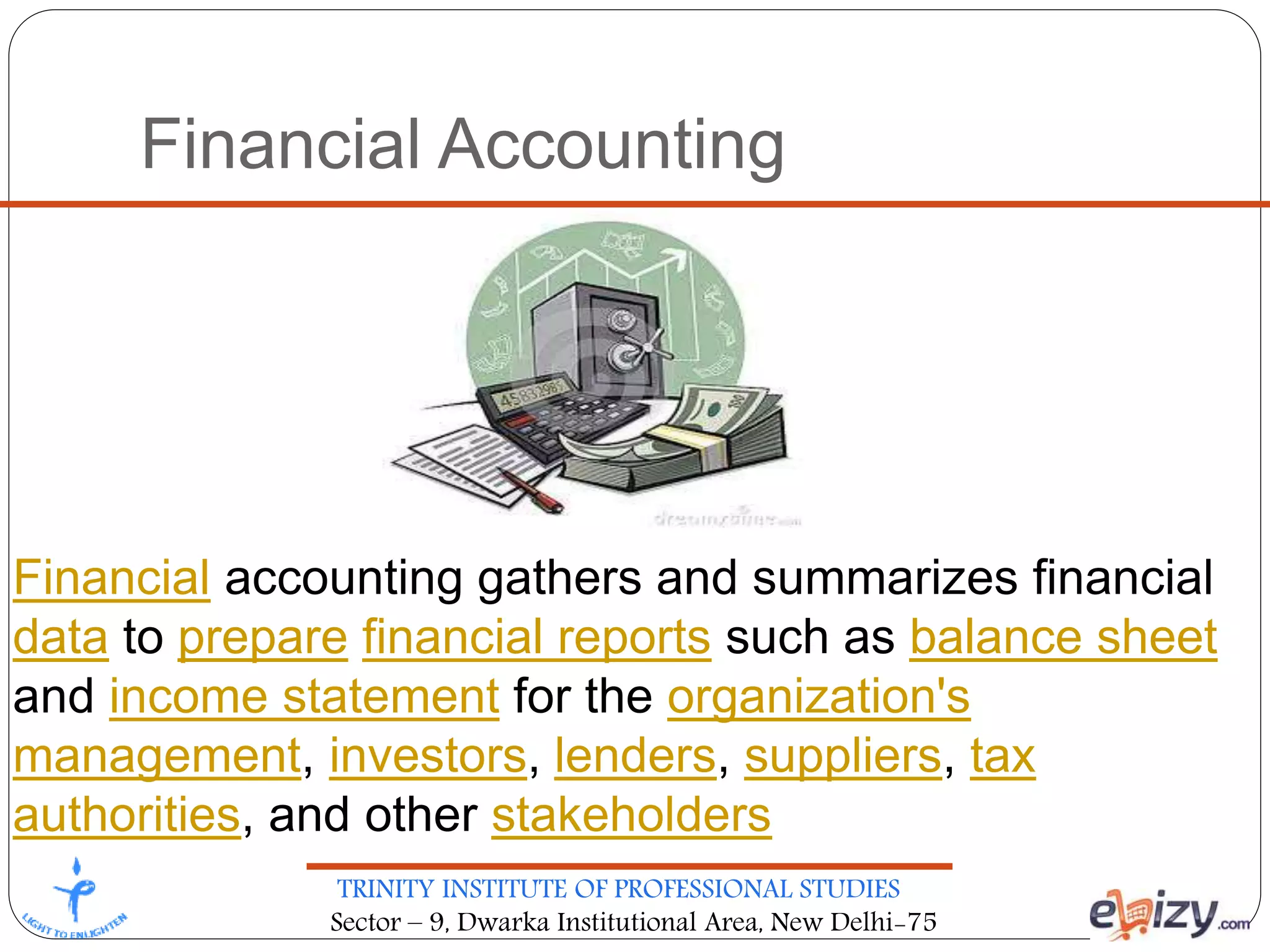
Financial Accounting
Financial accounting gathers and summarizes financial
data to prepare financial reports such as balance sheet
and income statement for the organization's
management, investors, lenders, suppliers, tax
authorities, and other stakeholders
TRINITY INSTITUTE OF PROFESSIONAL STUDIES
Sector – 9, Dwarka Institutional Area, New Delhi-75
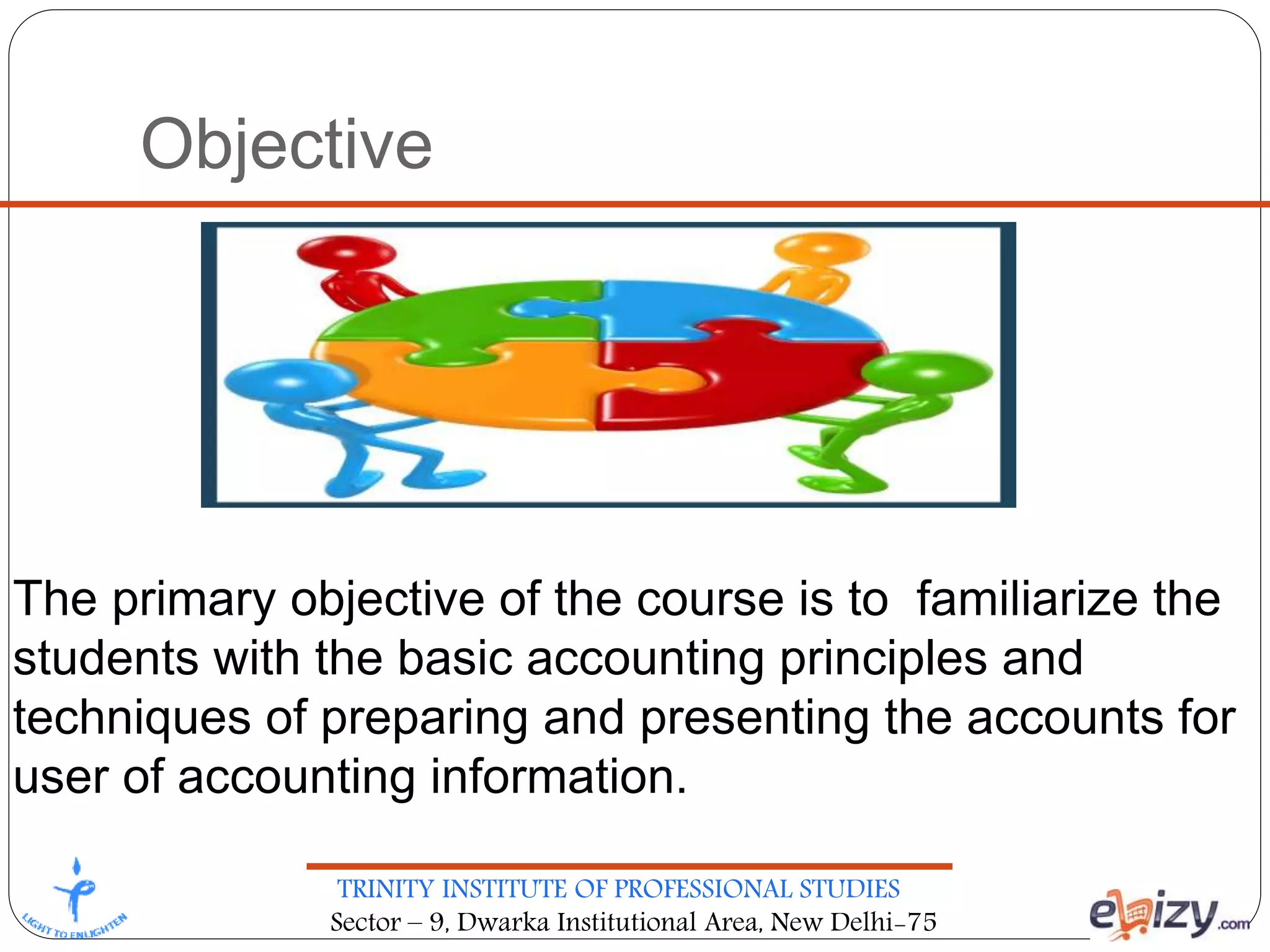
Objective
The primary objective of the course is to familiarize the
students with the basic accounting principles and
techniques of preparing and presenting the accounts for
user of accounting information.
TRINITY INSTITUTE OF PROFESSIONAL STUDIES
Sector – 9, Dwarka Institutional Area, New Delhi-75
Scope of Subject
1) Accounting has a wide scope in all sphere of society and in all
professions.
2) In social or professional activities the financial transactions may
take place. so the need of recording and summarising these
transactions may arises to find the net result
TRINITY INSTITUTE OF PROFESSIONAL STUDIES
Sector – 9, Dwarka Institutional Area, New Delhi-75
Cont………….
3) In todays world the accounting is practiced not
only in financial institutions but also in many non-
trading institutes like schools, hospital, charitable
trust, etc. As a matter of fact it is used by all who
are involved in financial transactions.
4) In recent time the application of accounting
policies and principles emerged , like in National
Accounting, Human resource Accounting, and
Social Accounting.
TRINITY INSTITUTE OF PROFESSIONAL STUDIES
Sector – 9, Dwarka Institutional Area, New Delhi-75
Accounting as an Aid to
Decision Making
 Accounting information is useful to anyone
who makes decisions that have economic
results.
• Managers want to know if a new product will be profitable.
• Owners want to know which employees are productive.
• Investors want to know if a company is a good investment.
• Creditors want to know if they should extend credit, how much
to extend, and for how long.
• Government regulators want to know if financial statements
conform to requirements.
TRINITY INSTITUTE OF PROFESSIONAL STUDIES
Sector – 9, Dwarka Institutional Area, New Delhi-75
Accounting as an Aid to
Decision Making
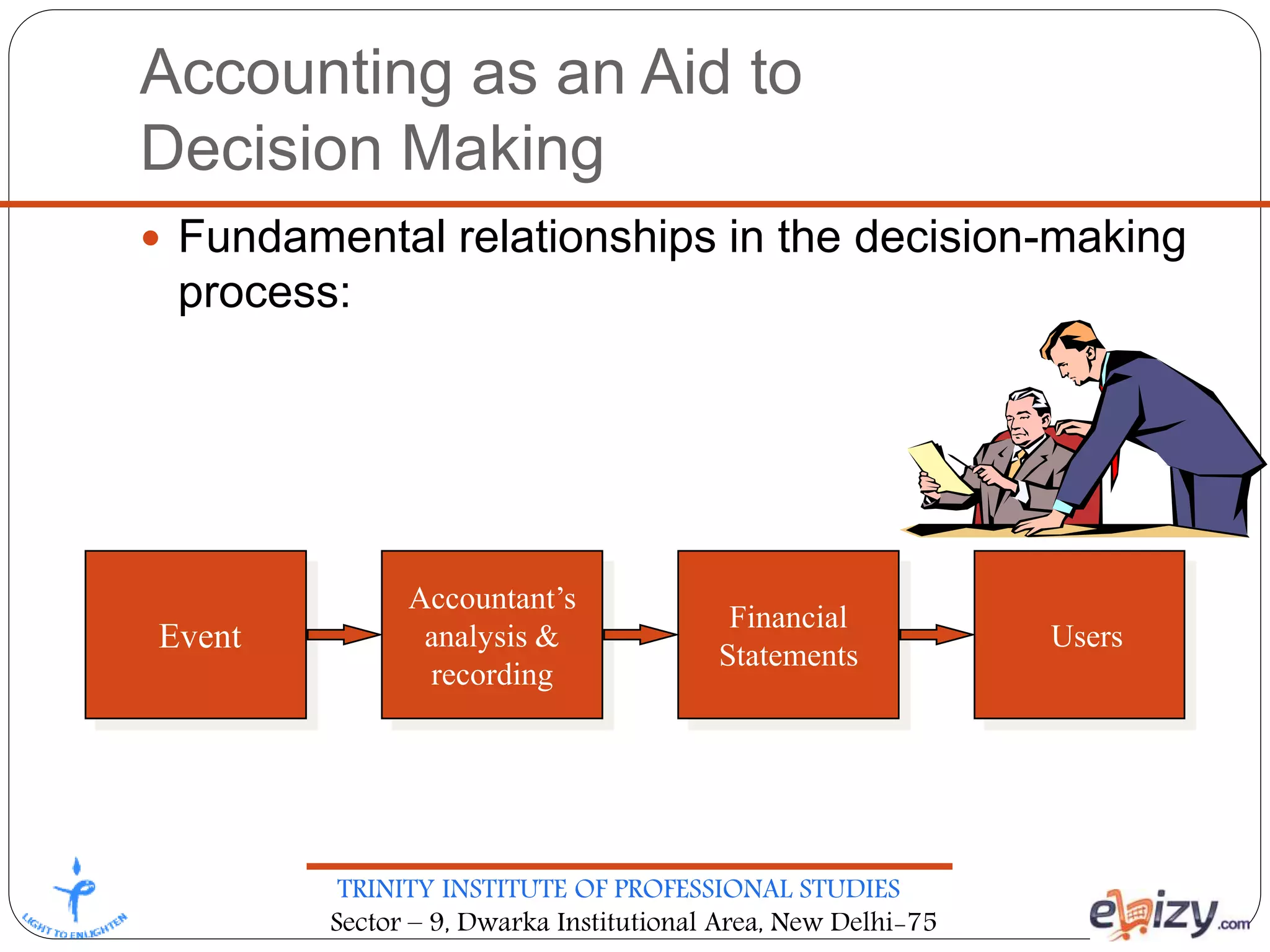
 Fundamental relationships in the decision-making
process:
Event
Accountant’s
analysis &
recording
Accountant
’s
analysis &
recording
Accountant’s
analysis &
recording
Accountant’s
analysis &
recording
Financial
Statements
Users
TRINITY INSTITUTE OF PROFESSIONAL STUDIES
Sector – 9, Dwarka Institutional Area, New Delhi-75
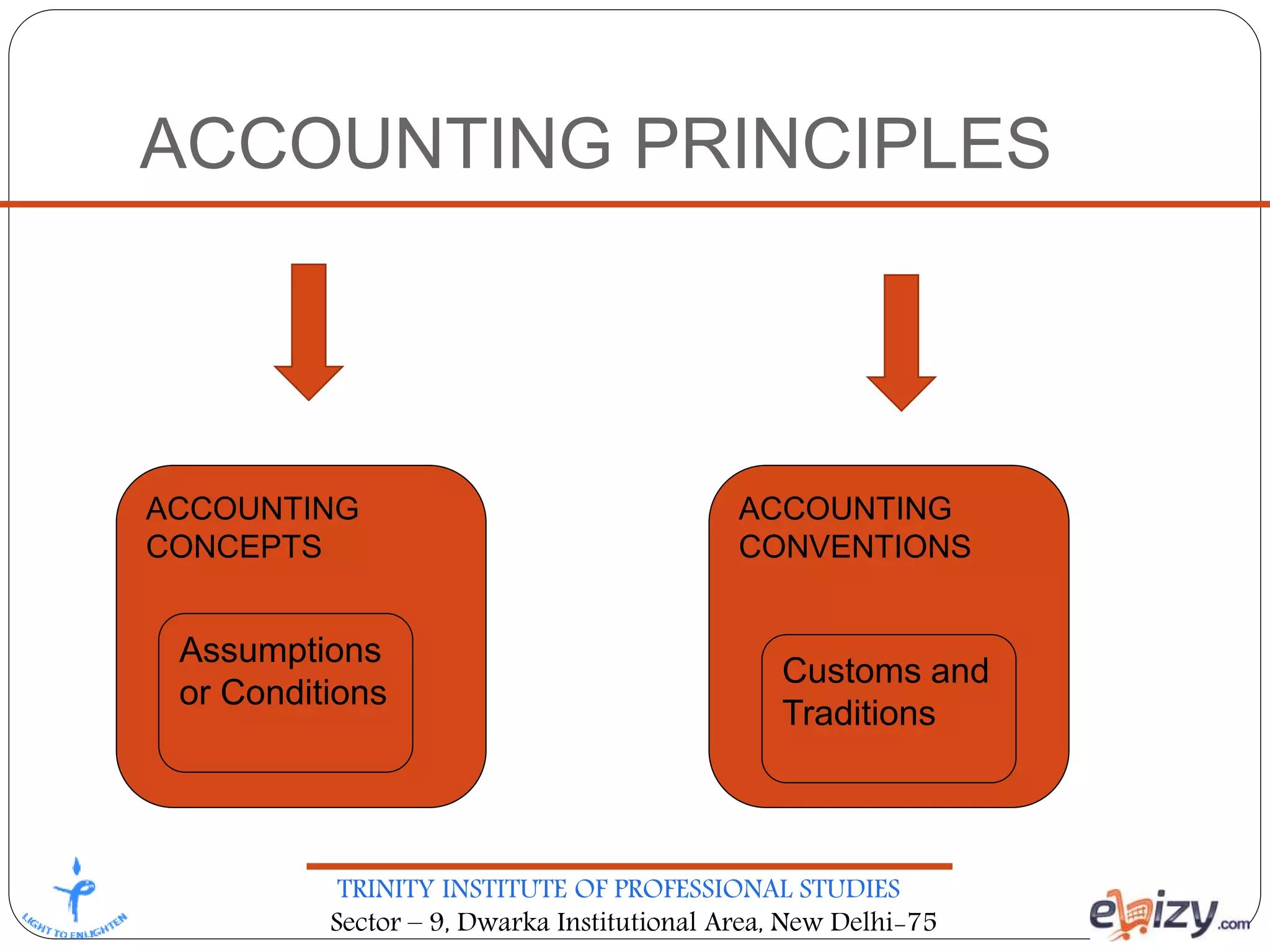
ACCOUNTING PRINCIPLES
ACCOUNTING
CONCEPTS
ACCOUNTING
CONVENTIONS
Assumptions
or Conditions
Customs and
Traditions
TRINITY INSTITUTE OF PROFESSIONAL STUDIES
Sector – 9, Dwarka Institutional Area, New Delhi-75
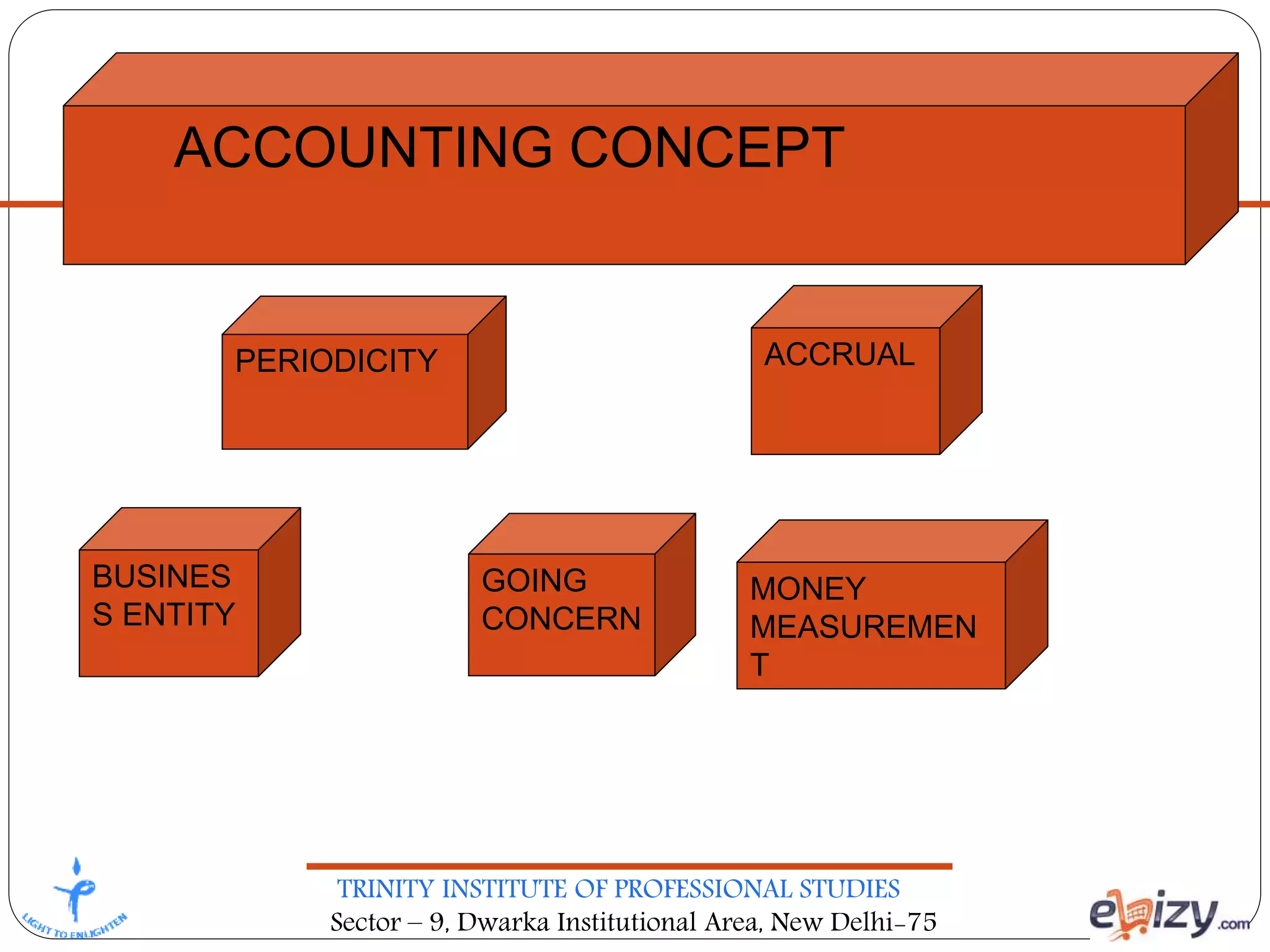
 ACCOUNTING CONCEPT
BUSINES
S ENTITY
GOING
CONCERN
MONEY
MEASUREMEN
T
PERIODICITY ACCRUAL
TRINITY INSTITUTE OF PROFESSIONAL STUDIES
Sector – 9, Dwarka Institutional Area, New Delhi-75
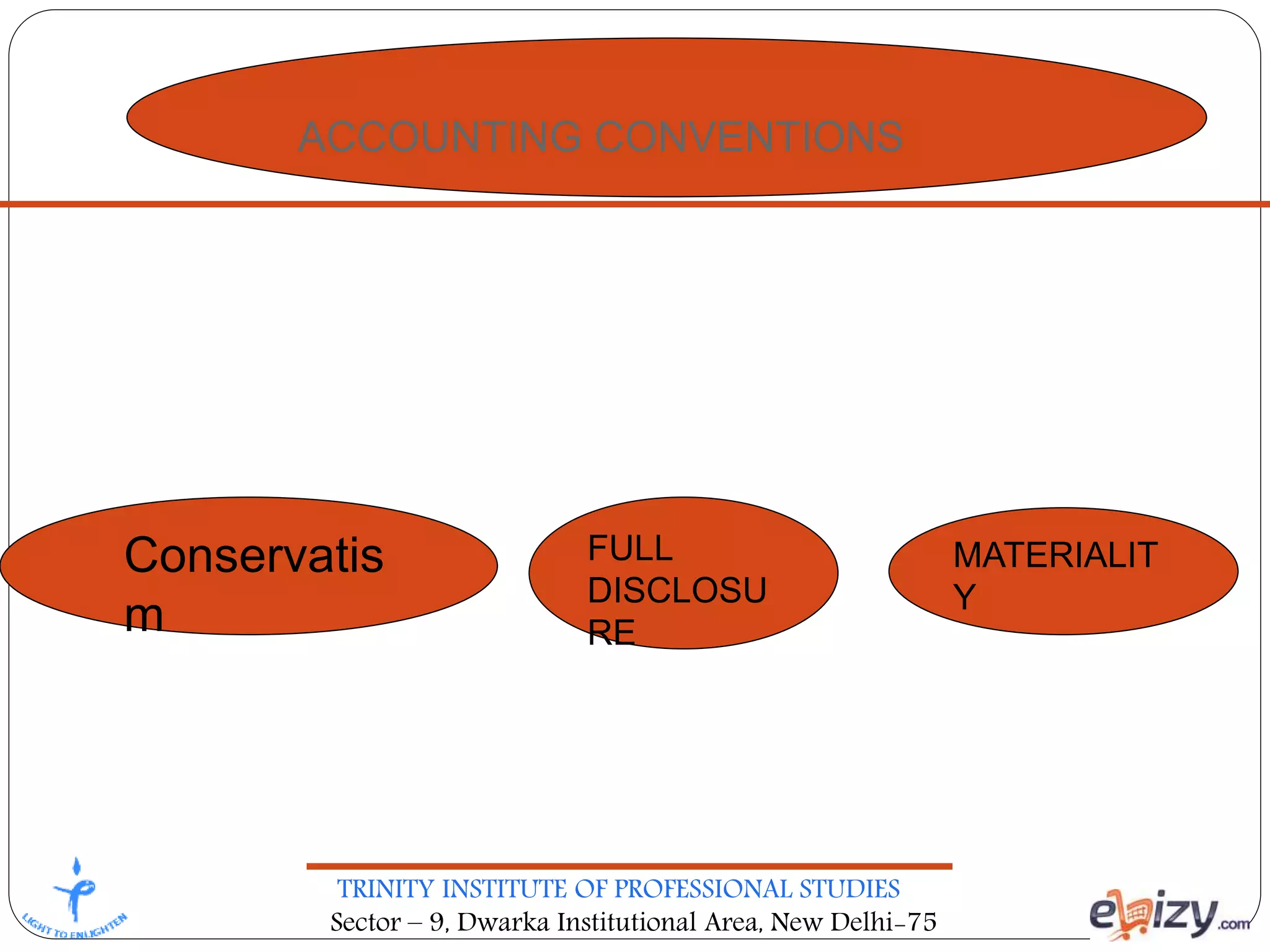
ACCOUNTING CONVENTIONS
 Conservatis
m
FULL
DISCLOSU
RE
MATERIALIT
Y
TRINITY INSTITUTE OF PROFESSIONAL STUDIES
Sector – 9, Dwarka Institutional Area, New Delhi-75
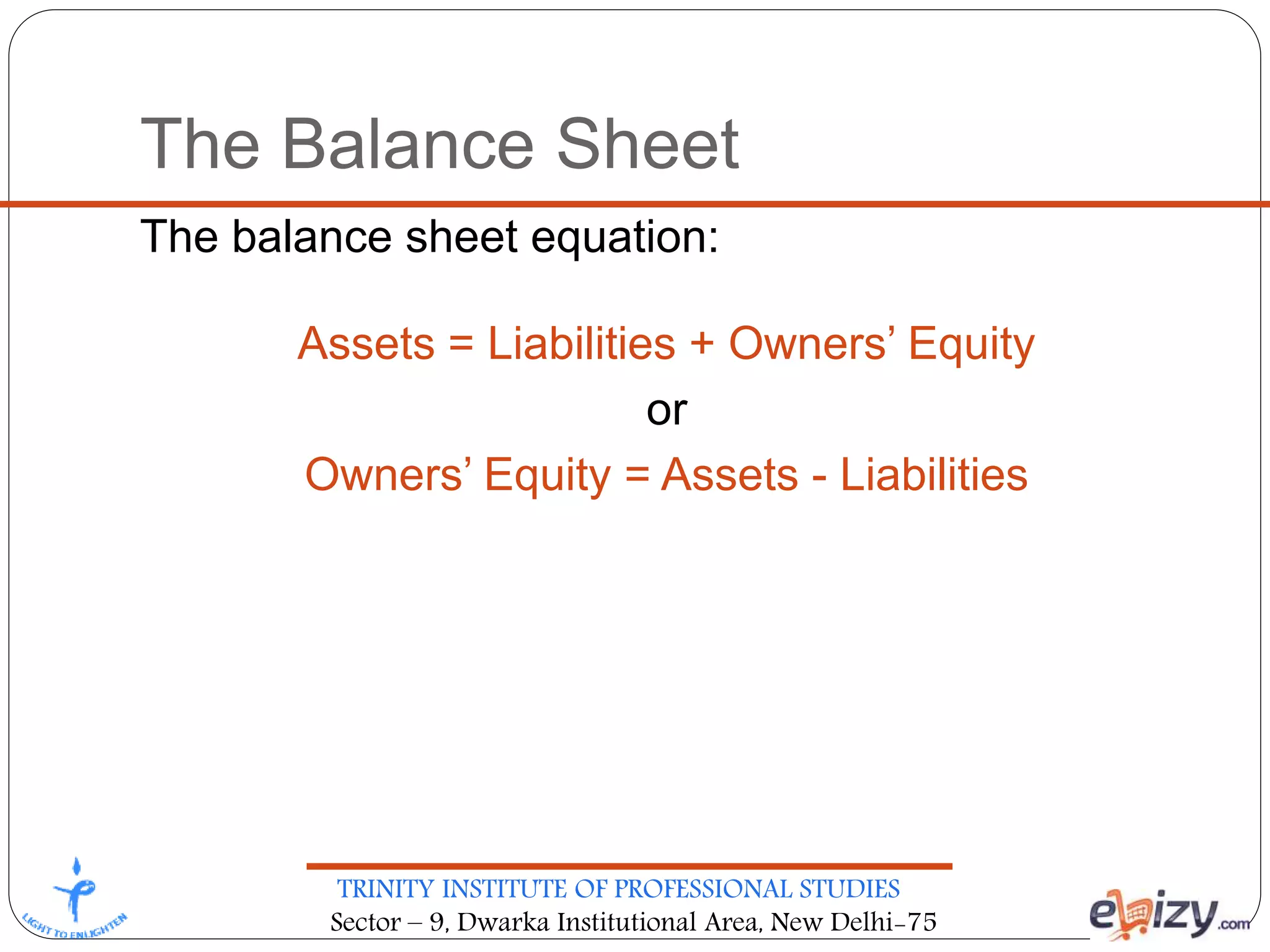
The Balance Sheet
The balance sheet equation:
Assets = Liabilities + Owners’ Equity
or
Owners’ Equity = Assets - Liabilities
TRINITY INSTITUTE OF PROFESSIONAL STUDIES
Sector – 9, Dwarka Institutional Area, New Delhi-75
The Balance Sheet
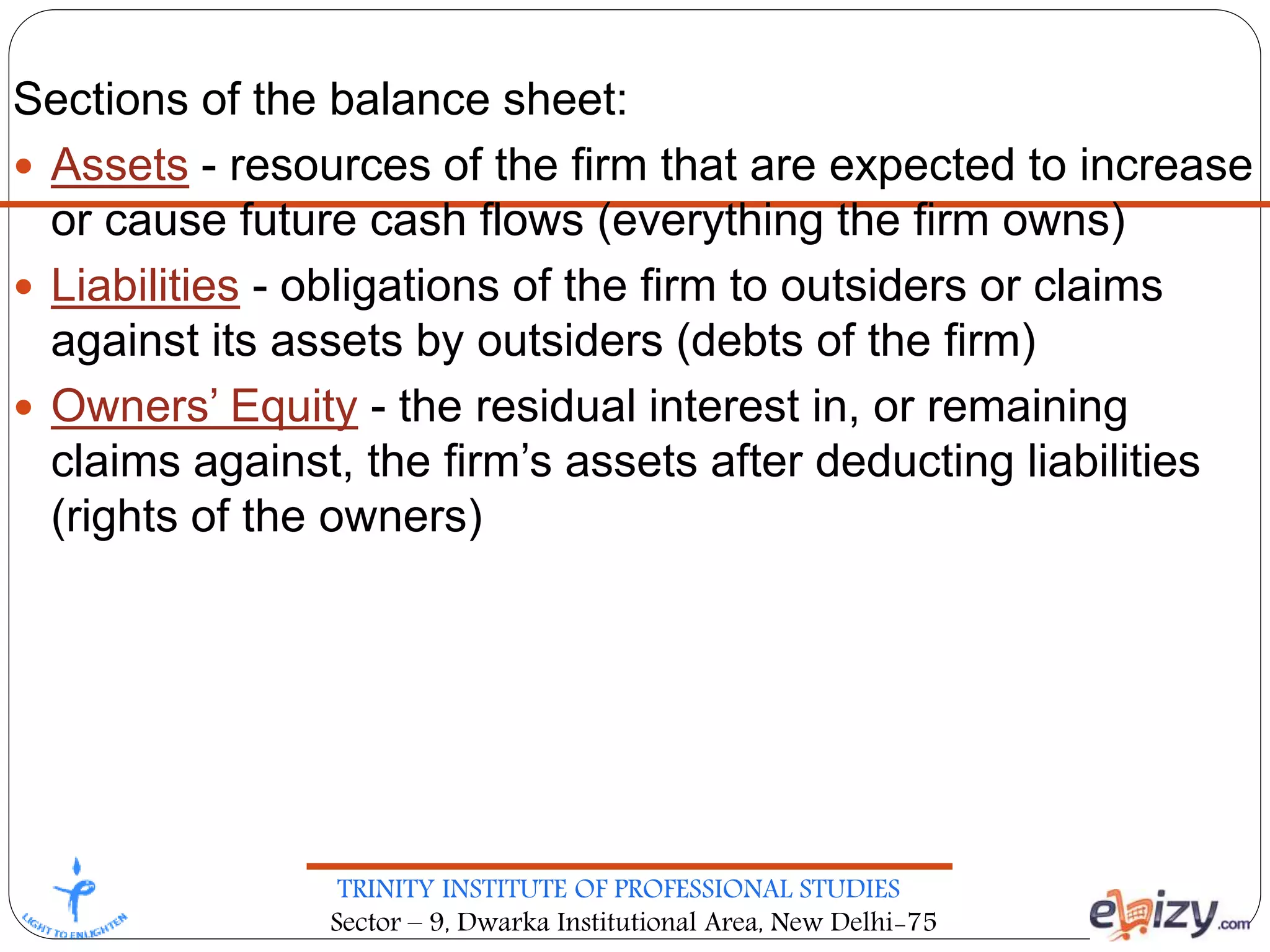
 What are the different sections of the Balance
Sheet?
TRINITY INSTITUTE OF PROFESSIONAL STUDIES
Sector – 9, Dwarka Institutional Area, New Delhi-75
Sections of the balance sheet:
 Assets - resources of the firm that are expected to increase
or cause future cash flows (everything the firm owns)
 Liabilities - obligations of the firm to outsiders or claims
against its assets by outsiders (debts of the firm)
 Owners’ Equity - the residual interest in, or remaining
claims against, the firm’s assets after deducting liabilities
(rights of the owners)
TRINITY INSTITUTE OF PROFESSIONAL STUDIES
Sector – 9, Dwarka Institutional Area, New Delhi-75
Balance Sheet Transactions
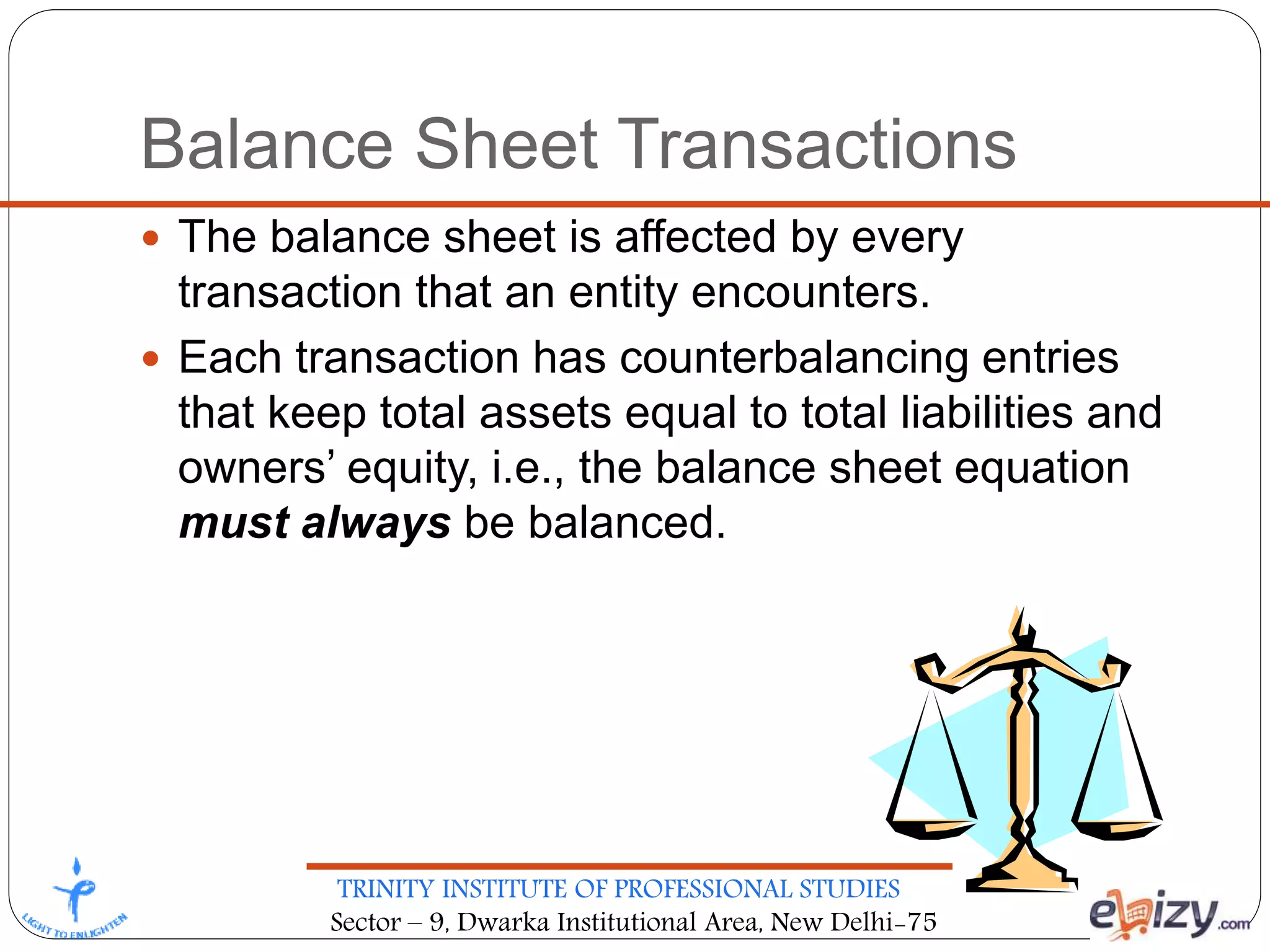
 The balance sheet is affected by every
transaction that an entity encounters.
 Each transaction has counterbalancing entries
that keep total assets equal to total liabilities and
owners’ equity, i.e., the balance sheet equation
must always be balanced.
TRINITY INSTITUTE OF PROFESSIONAL STUDIES
Sector – 9, Dwarka Institutional Area, New Delhi-75
Transaction Analysis
 For each transaction, the accountant must
determine:
 which specific accounts are affected
 whether the account balances are increased or
decreased
 the amount of the change
in each account
TRINITY INSTITUTE OF PROFESSIONAL STUDIES
Sector – 9, Dwarka Institutional Area, New Delhi-75
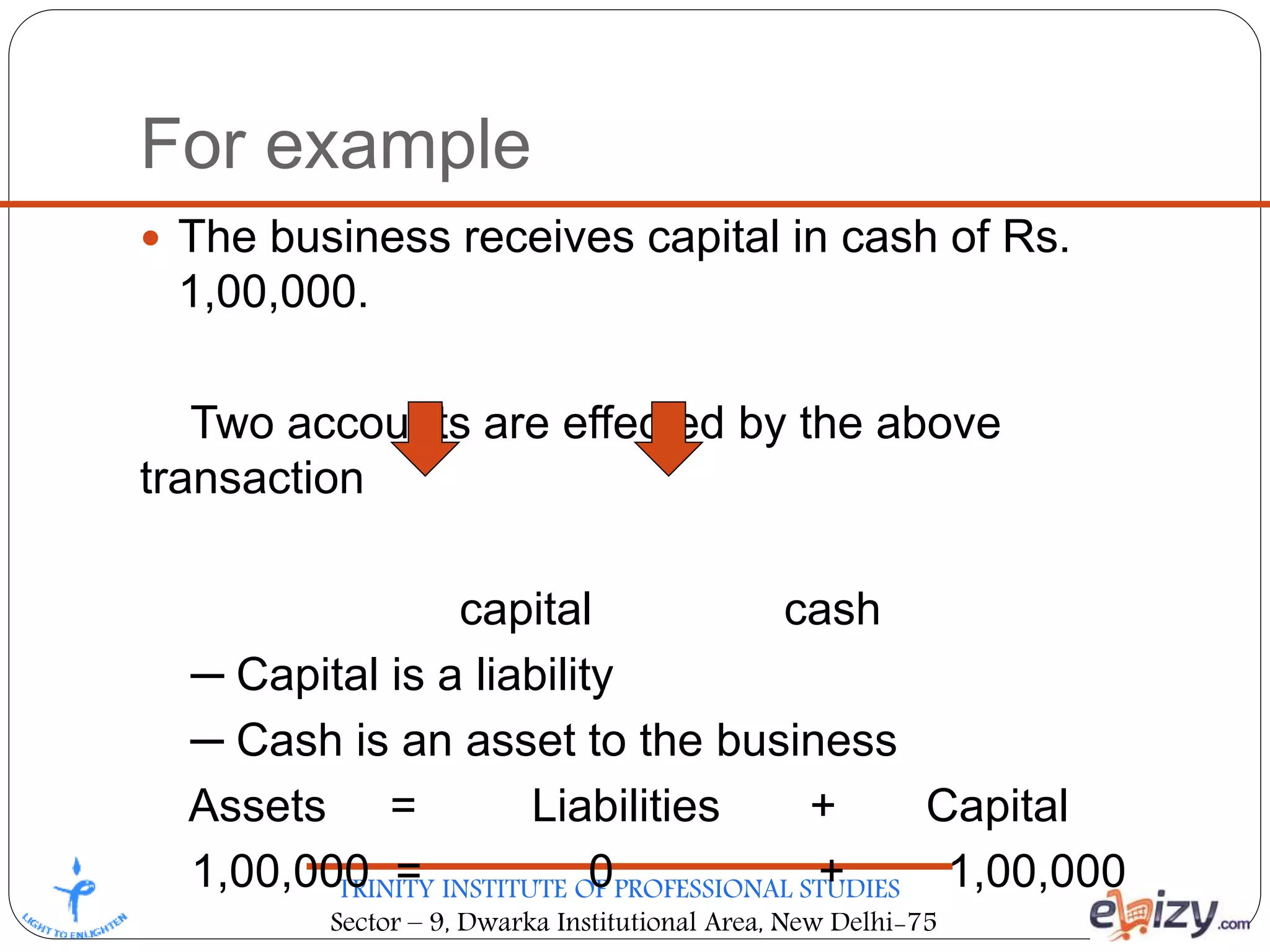
For example
 The business receives capital in cash of Rs.
1,00,000.
Two accounts are effected by the above
transaction
capital cash
─ Capital is a liability
─ Cash is an asset to the business
Assets = Liabilities + Capital
1,00,000 = 0 + 1,00,000
TRINITY INSTITUTE OF PROFESSIONAL STUDIES
Sector – 9, Dwarka Institutional Area, New Delhi-75
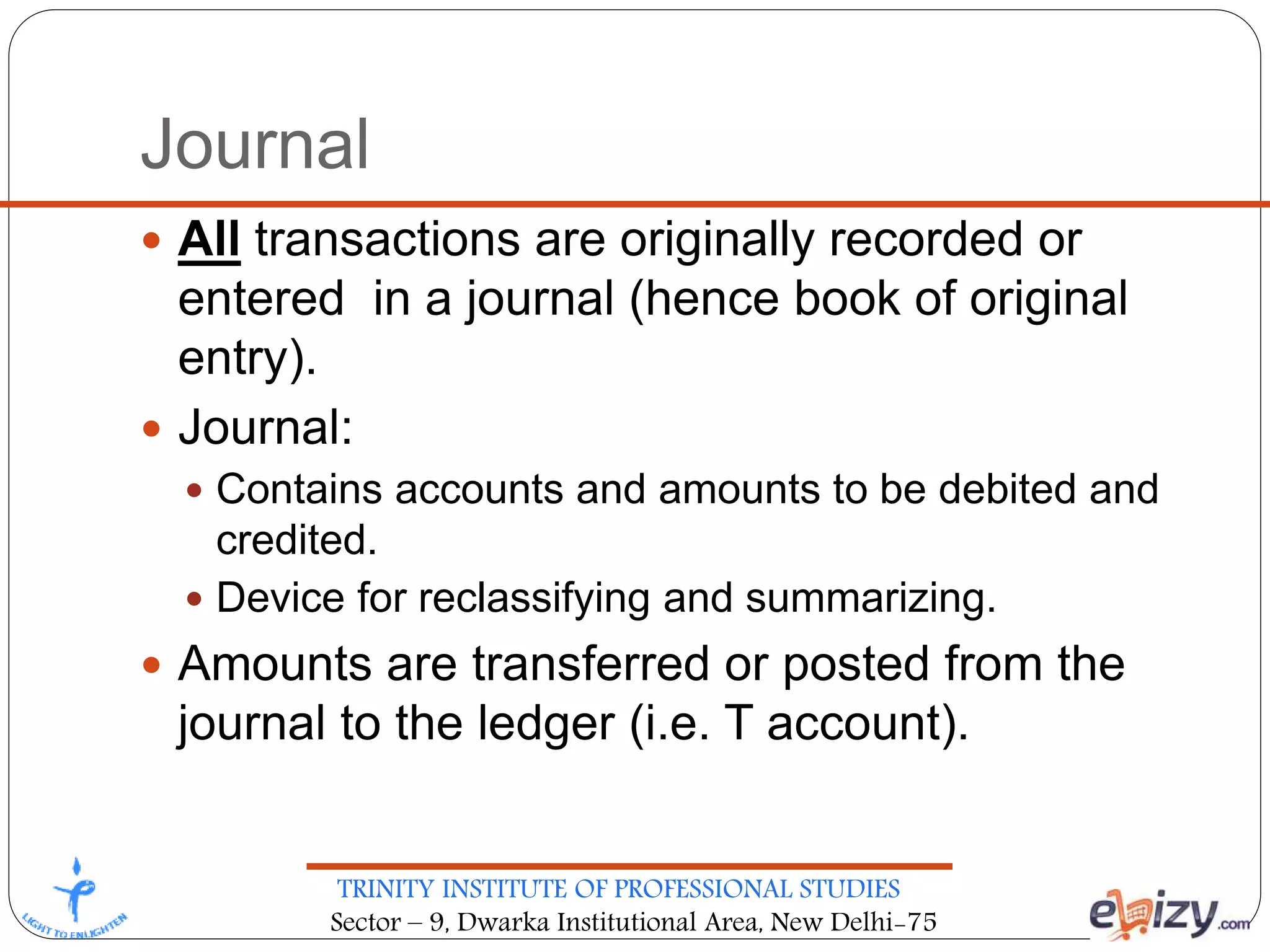
Journal
 All transactions are originally recorded or
entered in a journal (hence book of original
entry).
 Journal:
 Contains accounts and amounts to be debited and
credited.
 Device for reclassifying and summarizing.
 Amounts are transferred or posted from the
journal to the ledger (i.e. T account).
TRINITY INSTITUTE OF PROFESSIONAL STUDIES
Sector – 9, Dwarka Institutional Area, New Delhi-75
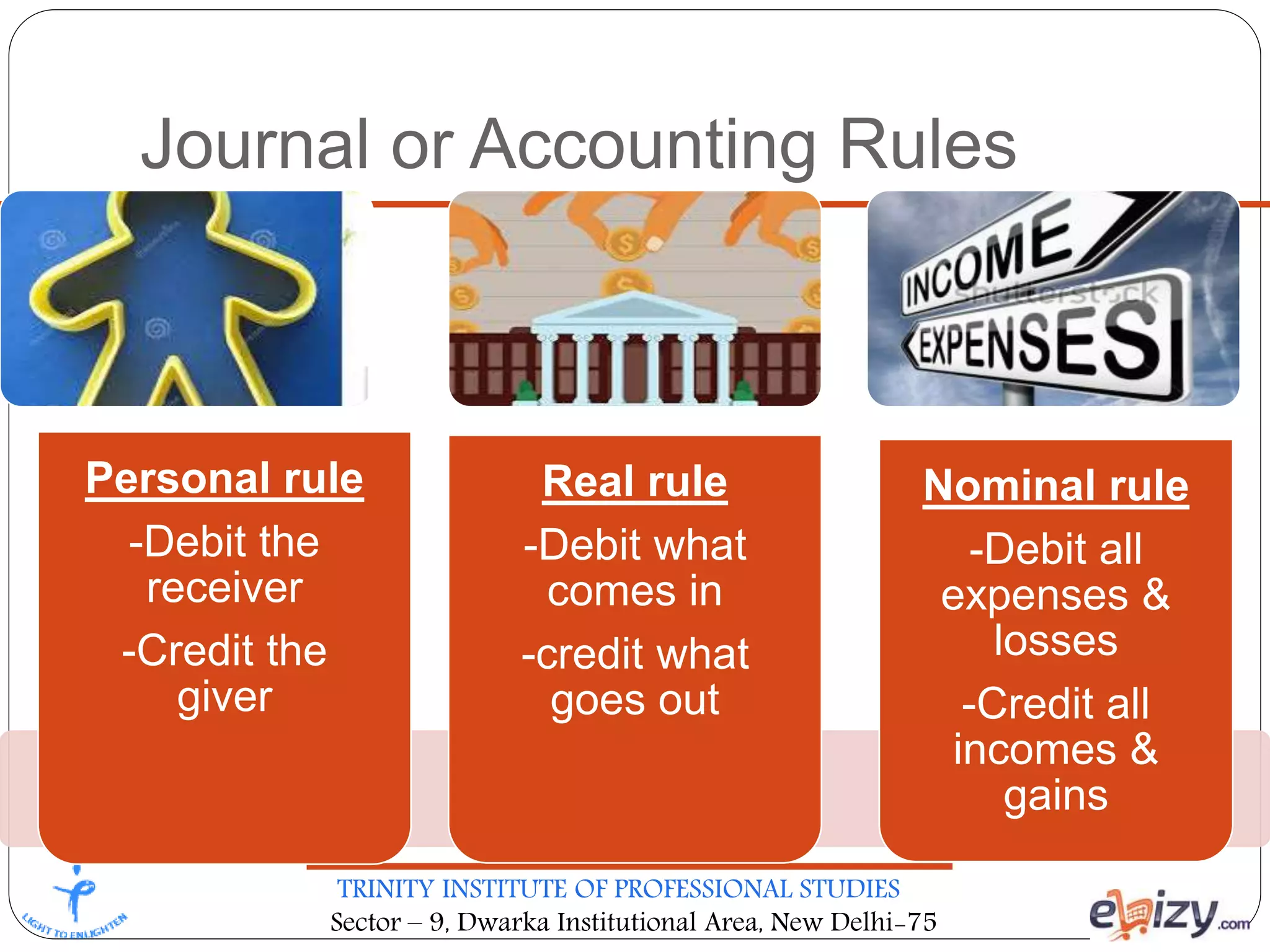
Journal or Accounting Rules
Personal rule
-Debit the
receiver
-Credit the
giver
Real rule
-Debit what
comes in
-credit what
goes out
Nominal rule
-Debit all
expenses &
losses
-Credit all
incomes &
gains
TRINITY INSTITUTE OF PROFESSIONAL STUDIES
Sector – 9, Dwarka Institutional Area, New Delhi-75

Principles of accounting

  • 1.
    TRINITY INSTITUTE OFPROFESSIONAL STUDIES Sector – 9, Dwarka Institutional Area, New Delhi-75 Affiliated Institution of G.G.S.IP.U, Delhi Paper Id: 20207 Paper Code: BCA207 Principles of accounting
  • 2.
    TRINITY INSTITUTE OFPROFESSIONAL STUDIES Sector – 9, Dwarka Institutional Area, New Delhi-75 Financial Accounting The Language of Business
  • 3.
    TRINITY INSTITUTE OFPROFESSIONAL STUDIES Sector – 9, Dwarka Institutional Area, New Delhi-75 Combination of two words…… Financial + Accounting  Combination of two words…… Financial + Accounting  Accounting A process of identifying, recording, summarizing, and reporting economic information to decision makers in the form of financial statement
  • 4.
    TRINITY INSTITUTE OFPROFESSIONAL STUDIES Sector – 9, Dwarka Institutional Area, New Delhi-75 Financial Accounting Financial accounting gathers and summarizes financial data to prepare financial reports such as balance sheet and income statement for the organization's management, investors, lenders, suppliers, tax authorities, and other stakeholders
  • 5.
    TRINITY INSTITUTE OFPROFESSIONAL STUDIES Sector – 9, Dwarka Institutional Area, New Delhi-75 Objective The primary objective of the course is to familiarize the students with the basic accounting principles and techniques of preparing and presenting the accounts for user of accounting information.
  • 6.
    TRINITY INSTITUTE OFPROFESSIONAL STUDIES Sector – 9, Dwarka Institutional Area, New Delhi-75 Scope of Subject 1) Accounting has a wide scope in all sphere of society and in all professions. 2) In social or professional activities the financial transactions may take place. so the need of recording and summarising these transactions may arises to find the net result
  • 7.
    TRINITY INSTITUTE OFPROFESSIONAL STUDIES Sector – 9, Dwarka Institutional Area, New Delhi-75 Cont…………. 3) In todays world the accounting is practiced not only in financial institutions but also in many non- trading institutes like schools, hospital, charitable trust, etc. As a matter of fact it is used by all who are involved in financial transactions. 4) In recent time the application of accounting policies and principles emerged , like in National Accounting, Human resource Accounting, and Social Accounting.
  • 8.
    TRINITY INSTITUTE OFPROFESSIONAL STUDIES Sector – 9, Dwarka Institutional Area, New Delhi-75 Accounting as an Aid to Decision Making  Accounting information is useful to anyone who makes decisions that have economic results. • Managers want to know if a new product will be profitable. • Owners want to know which employees are productive. • Investors want to know if a company is a good investment. • Creditors want to know if they should extend credit, how much to extend, and for how long. • Government regulators want to know if financial statements conform to requirements.
  • 9.
    TRINITY INSTITUTE OFPROFESSIONAL STUDIES Sector – 9, Dwarka Institutional Area, New Delhi-75 Accounting as an Aid to Decision Making  Fundamental relationships in the decision-making process: Event Accountant’s analysis & recording Accountant ’s analysis & recording Accountant’s analysis & recording Accountant’s analysis & recording Financial Statements Users
  • 10.
    TRINITY INSTITUTE OFPROFESSIONAL STUDIES Sector – 9, Dwarka Institutional Area, New Delhi-75 ACCOUNTING PRINCIPLES ACCOUNTING CONCEPTS ACCOUNTING CONVENTIONS Assumptions or Conditions Customs and Traditions
  • 11.
    TRINITY INSTITUTE OFPROFESSIONAL STUDIES Sector – 9, Dwarka Institutional Area, New Delhi-75  ACCOUNTING CONCEPT BUSINES S ENTITY GOING CONCERN MONEY MEASUREMEN T PERIODICITY ACCRUAL
  • 12.
    TRINITY INSTITUTE OFPROFESSIONAL STUDIES Sector – 9, Dwarka Institutional Area, New Delhi-75 ACCOUNTING CONVENTIONS  Conservatis m FULL DISCLOSU RE MATERIALIT Y
  • 13.
    TRINITY INSTITUTE OFPROFESSIONAL STUDIES Sector – 9, Dwarka Institutional Area, New Delhi-75 The Balance Sheet The balance sheet equation: Assets = Liabilities + Owners’ Equity or Owners’ Equity = Assets - Liabilities
  • 14.
    TRINITY INSTITUTE OFPROFESSIONAL STUDIES Sector – 9, Dwarka Institutional Area, New Delhi-75 The Balance Sheet  What are the different sections of the Balance Sheet?
  • 15.
    TRINITY INSTITUTE OFPROFESSIONAL STUDIES Sector – 9, Dwarka Institutional Area, New Delhi-75 Sections of the balance sheet:  Assets - resources of the firm that are expected to increase or cause future cash flows (everything the firm owns)  Liabilities - obligations of the firm to outsiders or claims against its assets by outsiders (debts of the firm)  Owners’ Equity - the residual interest in, or remaining claims against, the firm’s assets after deducting liabilities (rights of the owners)
  • 16.
    TRINITY INSTITUTE OFPROFESSIONAL STUDIES Sector – 9, Dwarka Institutional Area, New Delhi-75 Balance Sheet Transactions  The balance sheet is affected by every transaction that an entity encounters.  Each transaction has counterbalancing entries that keep total assets equal to total liabilities and owners’ equity, i.e., the balance sheet equation must always be balanced.
  • 17.
    TRINITY INSTITUTE OFPROFESSIONAL STUDIES Sector – 9, Dwarka Institutional Area, New Delhi-75 Transaction Analysis  For each transaction, the accountant must determine:  which specific accounts are affected  whether the account balances are increased or decreased  the amount of the change in each account
  • 18.
    TRINITY INSTITUTE OFPROFESSIONAL STUDIES Sector – 9, Dwarka Institutional Area, New Delhi-75 For example  The business receives capital in cash of Rs. 1,00,000. Two accounts are effected by the above transaction capital cash ─ Capital is a liability ─ Cash is an asset to the business Assets = Liabilities + Capital 1,00,000 = 0 + 1,00,000
  • 19.
    TRINITY INSTITUTE OFPROFESSIONAL STUDIES Sector – 9, Dwarka Institutional Area, New Delhi-75 Journal  All transactions are originally recorded or entered in a journal (hence book of original entry).  Journal:  Contains accounts and amounts to be debited and credited.  Device for reclassifying and summarizing.  Amounts are transferred or posted from the journal to the ledger (i.e. T account).
  • 20.
    TRINITY INSTITUTE OFPROFESSIONAL STUDIES Sector – 9, Dwarka Institutional Area, New Delhi-75 Journal or Accounting Rules Personal rule -Debit the receiver -Credit the giver Real rule -Debit what comes in -credit what goes out Nominal rule -Debit all expenses & losses -Credit all incomes & gains
  • 21.
    TRINITY INSTITUTE OFPROFESSIONAL STUDIES Sector – 9, Dwarka Institutional Area, New Delhi-75