Business Accounting
By
HARISHKUMAR M
Assistant Professor
Department of Management
Kristu Jayanti College, Bengaluru
Business Accounting
Unit 1: Introduction to Accounting and Accounting Systems Introduction, Need and Role of
Accounting, Systems of Accounting, Branches of Accounting, Objectives of Accounting,
Generally Accepted Accounting Principles: Accounting Concepts & Accounting Conventions,
Documents in Accounting.
Unit 2: Bookkeeping Double Entry System, Accounting Cycle, Preparation of Journal,
Posting to Ledger, Preparation of Trial Balance.
Unit 3: Subsidiary books Introduction to Subsidiary books, Preparation of Cash Book –
Simple Cash Book, Double Column Cash Book, Triple Column Cash Book, Petty cash book –
Simple Petty cash, Analytical Petty cash book – Fixed Advance system and Imprest system.
Unit 4: Final Accounts of a Sole Trader Preparation of Income statement – Trading Account
and Profit and Loss Account; Preparation of Balance Sheet; Treatment of adjustments -
Closing Stock, Outstanding Expenses, Prepaid or Unexpired Expenses, Accrued Income,
Unearned Income, Income Received in Advance, Depreciation, Interest on Capital, Interest
on Drawings, Interest on Loan, Bad Debt, Provision for Bad and Doubtful Debts.
Unit 5: Introduction to IFRS IFRS Vs GAAP; meaning of IFRS, Role of IASB in developing
IFRS, Roles and structures of key bodies involved in regulation; the scope of IFRS and
development of IFRSs; Role of an auditor in incorporated entities and the different types
of audit reports; Recent trends and developments in accounting.
Unit 6: Emerging trends in accounting
Introduction to Accounting
Content
1.Meaning and Types of business firm
2.Economic events
3.Definition of accounting and concept
4. 0bjectives of accounting information
5.Advantages and limitations of accounting information
6.Types of accounting information
7.Users of accounting information and their needs
8. Generally Accepted Accounting Principles:
9 Accounting Concepts & Accounting Conventions,
10.Documents in Accounting
Module-1
Meaning of business:
Exchange of goods and services between person to person and from place to place
with money value is known as business.
Definition of business
Business refers to those economic activities, which are connected with the
production or purchase and sale of goods and services with main object of earning
profit
Types of business firm
Business firm can be classified in to two.
i)Profit Trading organisation: It is established only to earn profit.
Ex: Sole Proprietor ship , Partner ship firm, Joint Hindu family business ,
Co operative societies , Company
ii)Not-for- Profit Trading organisation: These organisations are established only to
do welfare oriented services, not to earn profit
Ex: Hospitals , charitable trust, Educational Institution, libraries etc.
Meaning and Definition of Accounting
Accounting is the systematic process of identifying,
measuring, recording, classifying, summarising,
interpreting and communicating financial
information
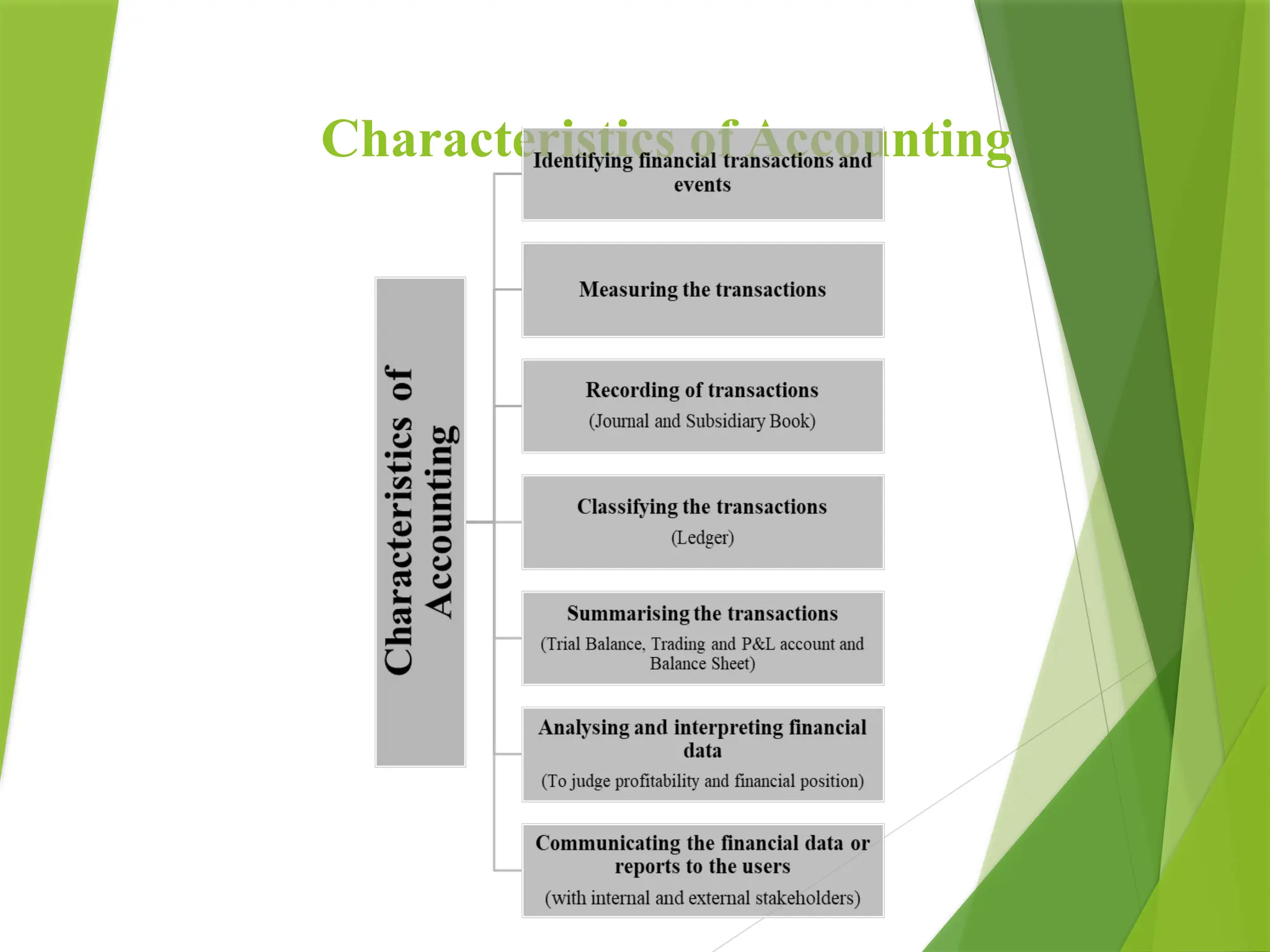
Characteristics of Accounting
1. Identifying financial transactions and events: Accounting records only those transactions and events which are
of financial nature. So, first, such transactions and events are identified.
2. Measuring the transactions: Accounting measures the transactions and events in terms of money which are
considered as a common unit.
3. Recording of transactions: Accounting involves recording the financial transactions inappropriate book of
accounts such as Journal or Subsidiary Books.
4. Classifying the transactions: Transactions recorded in the books of original entry – Journal or Subsidiary books
are classified and grouped according to nature and posted in separate accounts known as ‘Ledger Accounts’.
5. Summarising the transactions: It involves presenting the classified data in a manner and in the form of
statements, which are understandable by the users. It includes Trial balance, Trading Account, Profit and Loss
Account and Balance Sheet.
6. Analysing and interpreting financial data: Results of the business are analysed and interpreted so that users of
financial statements can make a meaningful and sound judgment.
7. Communicating the financial data or reports to the users: Communicating the financial data to the users on
time is the final step of accounting so that they can make appropriate decisions.
Objectives of accounting
1. To maintain the systematic records of the business
2. To ascertain the profit or loss of the business
3. To present the financial position of the business
4. To provide the financial information to the various
users
5. For Decision Making
Functions of Accounting
The main functions of accounting are as follows:
1. Measurement: The main function of accounting is to keep systematic record of transactions, post them to the ledger
and ultimately prepare the final accounts. Accounting works as a tool for measuring the performance of the business
enterprises. It also shows the financial position of the business enterprises.
2. Forecasting: With the help of the various tools of accounting, future performance and financial position of the
business enterprises can be forecasted.
3. Comparison: Accounting helps to compare the actual performance with the planned performance. It is also possible
to compare with the accounting policies. Through comparison of the actual financial results of the business enterprises
with projected figures and standards, effective measures can be taken to enhance the efficiency of various operations.
4. Decision making: Accounting provides relevant information to the management for planning, evaluation of
performance and control. This will help them to take various decisions concerning cost, price, sales, level of activity,
etc.
5. Control: As accounting works as a tool of control, the strengths and weaknesses are identified to provide feedback
on various measures adopted. It serves as a tool for evaluating compliance of business policies and programmes.
6. Assistance to government: Government needs full information on the financial aspects of the business for various
purposes such as taxation, grant of subsidy, etc. Accounting provides relevant information about the business to
exercise government control on business enterprises.
Importance of Accounting
1. Systematic records
2. Preparation of financial statements
3. Assessment of progress
4. Aid to decision making:
5. Satisfies legal requirements
6. Information to interested groups
7. Legal evidence
8. Computation of tax:
9. Settlement during merger
Advantages of Accounting
1. Replaces memory
2. Meets the information requirements
3. Assists the management in many other ways
4. Facilitates a comparative study: With
5. Acts as reliable evidence
6. Tax matters
7. Ascertaining value of business
Disadvantages of Accounting
1. Financial accounting permits alternative
treatment
2. Financial accounting is influenced by personal
judgments
3. Financial accounting ignores non-monetary
information
4. Financial accounting does not provide timely
information
Role of accounting
1. It helps to Maintenance of systematic records
2. It Assistance to management
3. It Facilitates comparative study
4. It Act as a Evidence in court
5. Proper accounting records obviates the necessity to
remember business transactions.
6. It helps to raising Facilitates raising loans.
7. It Facilitates sale of business by ascertaining the proper
purchase price.
8. It Facilitates settlement of tax liabilities
Role of an accountant
1. Record keeper
2. Provider of information to the management
3. Protector of business assets
4. Financial advisor
5. Tax manager
6. Public relation officer
Accounting information and User Needs
Users Classification Information the user want
Internal 1. Owner Return on investment, financial
position of their company
2. Management To evaluate the performance to
take various decisions.
3. Employees Profitability to claim higher
wages and bonus , and also to
see whether the firm able to
(PF, ESI ,etc ) deposit regularly.
External Users
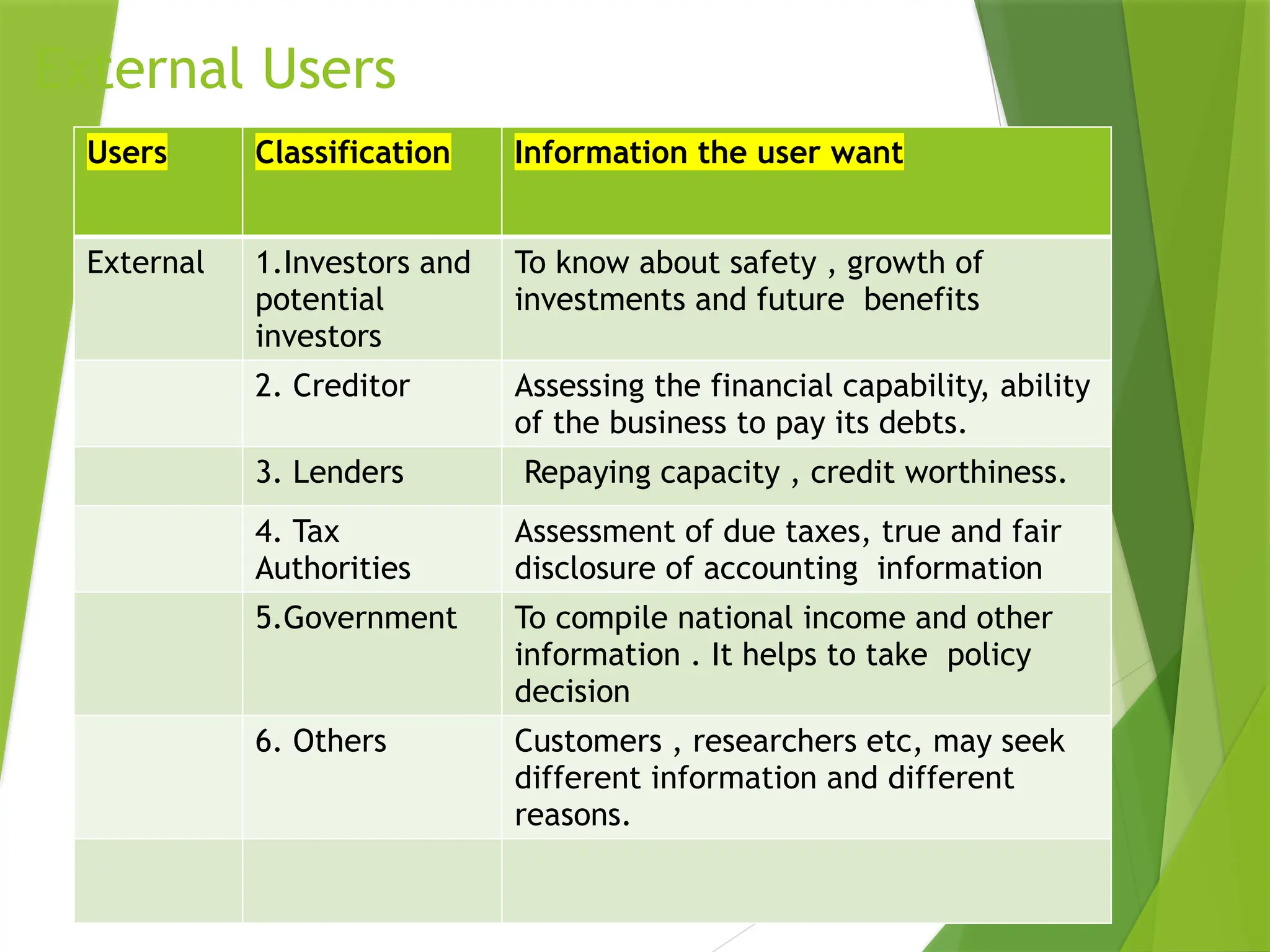
Users Classification Information the user want
External 1.Investors and
potential
investors
To know about safety , growth of
investments and future benefits
2. Creditor Assessing the financial capability, ability
of the business to pay its debts.
3. Lenders Repaying capacity , credit worthiness.
4. Tax
Authorities
Assessment of due taxes, true and fair
disclosure of accounting information
5.Government To compile national income and other
information . It helps to take policy
decision
6. Others Customers , researchers etc, may seek
different information and different
reasons.
Branches of Accounting
1. Financial Accounting: It involves recording of financial transactions and events. It is historical in nature and
records are maintained for transactions and events which have already occurred. It provides financial information
to the users for taking decisions. It is concerned with identification, recording, classifying and summarising of
financial transactions and events and ends up with the preparation of financial statements, namely, trading and
profit and loss account or income statement and balance sheet and communication of the same to the interested
users. Trading and profit and loss account shows the profit or loss made during an accounting period and the
balance sheet shows the financial position of the business as on a particular date.
2. Cost Accounting: It involves the collection, recording, classification and appropriate allocation of expenditure for
the determination of the costs of products or services and for the presentation of data for the purposes of cost
control and managerial decision making.
3. Management Accounting: It is concerned with the presentation of accounting information in such a way as to
assist management in decision making and in the day-to-day operations of an enterprise. The information collected
from financial accounting, cost accounting, etc. are grouped, modified and presented as per the requirements of
management for discharging their functions and for decision making.
Branches of Accounting
4. Social Responsibility Accounting: It is concerned with presentation of accounting
information by business entities and other organisations from the viewpoint of the
society by showing the social costs incurred such as environmental pollution by the
enterprise and social benefits such as infrastructure development and employment
opportunities created by them. It arises because of corporate social responsibility.
5. Human Resources Accounting: It is concerned with identification, quantification and
reporting of investments made in human resources of an enterprise.
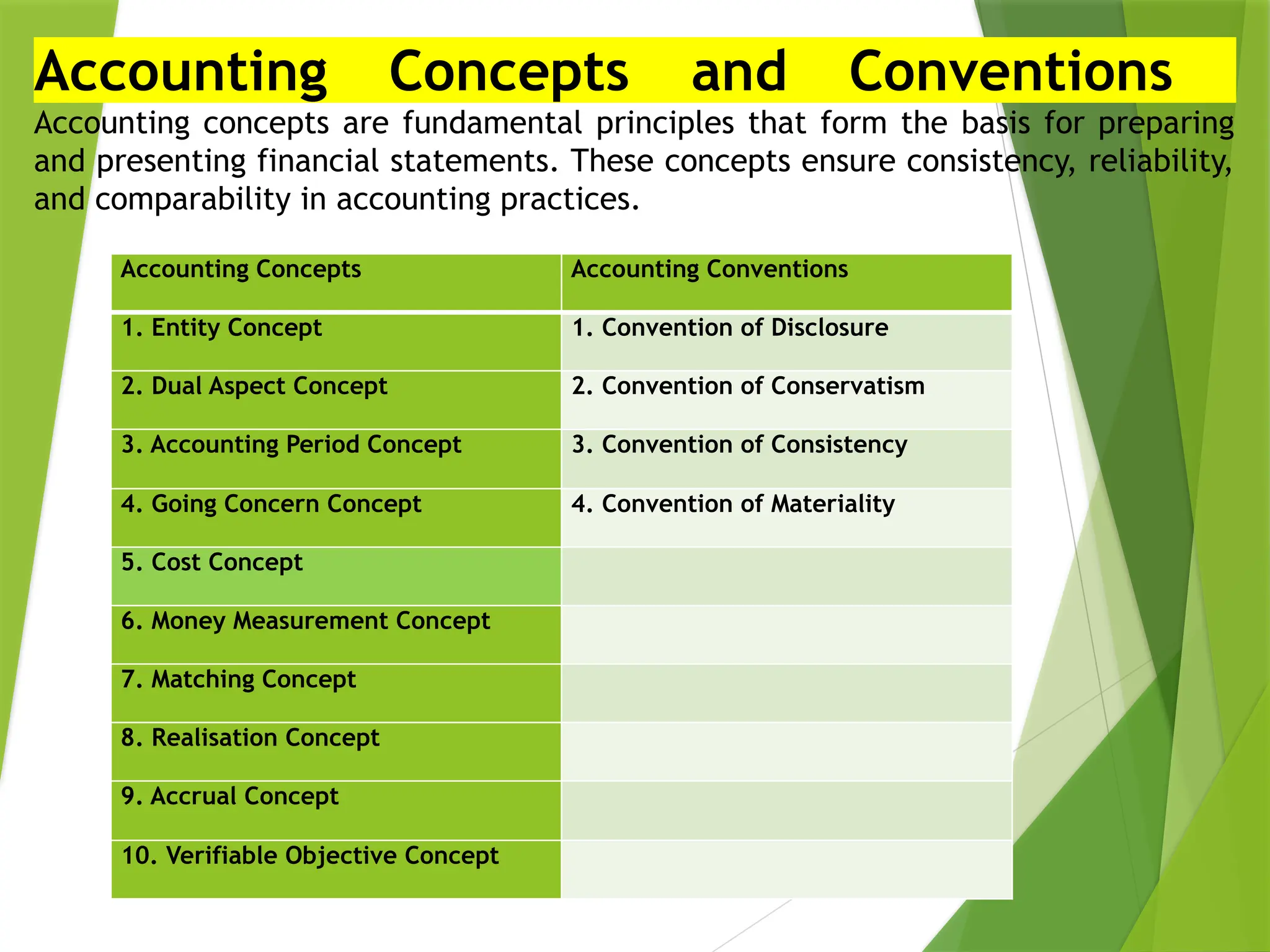
Accounting Concepts and Conventions
Accounting concepts are fundamental principles that form the basis for preparing
and presenting financial statements. These concepts ensure consistency, reliability,
and comparability in accounting practices.
Accounting Concepts Accounting Conventions
1. Entity Concept 1. Convention of Disclosure
2. Dual Aspect Concept 2. Convention of Conservatism
3. Accounting Period Concept 3. Convention of Consistency
4. Going Concern Concept 4. Convention of Materiality
5. Cost Concept
6. Money Measurement Concept
7. Matching Concept
8. Realisation Concept
9. Accrual Concept
10. Verifiable Objective Concept
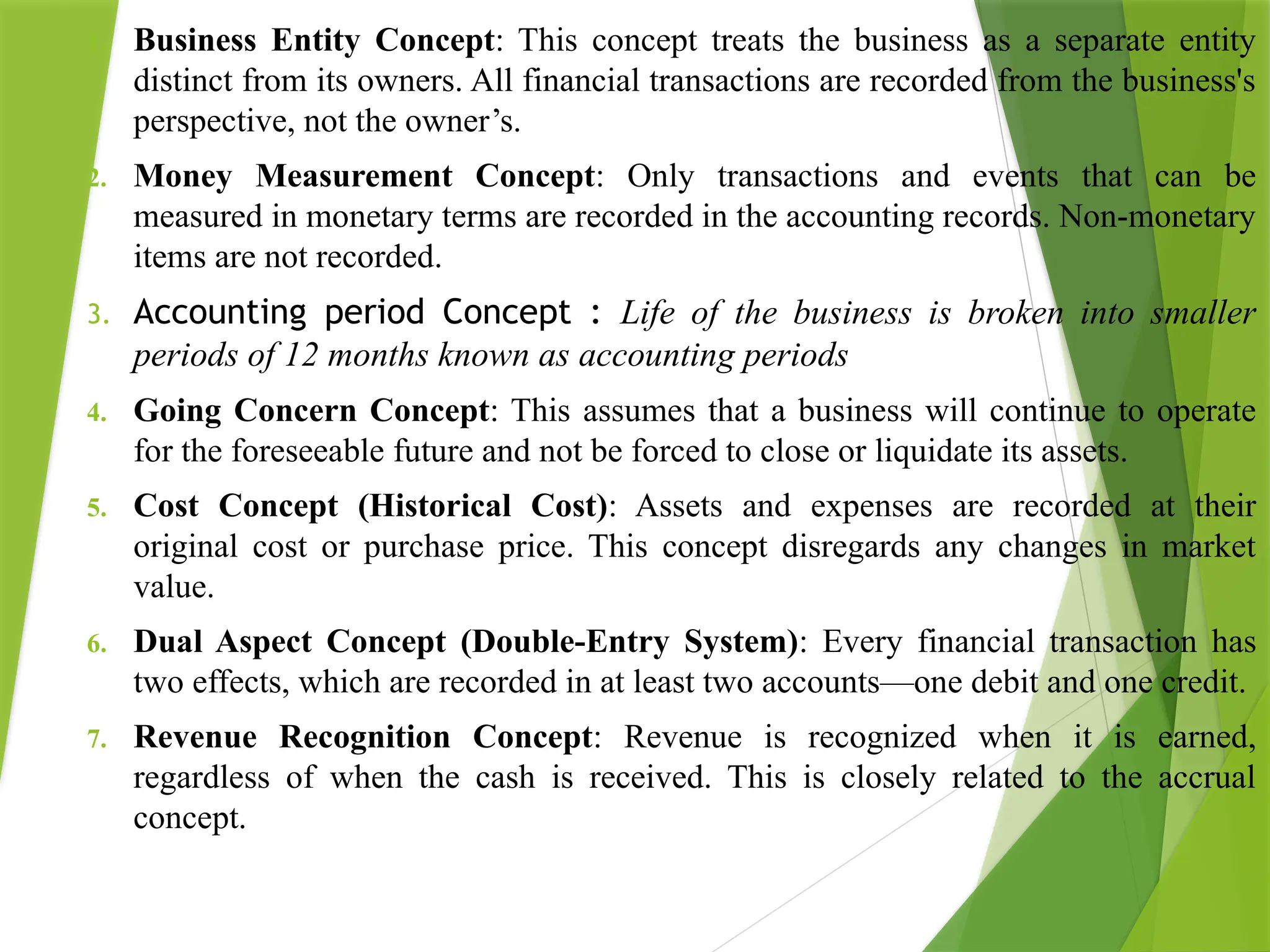
1. Business Entity Concept: This concept treats the business as a separate entity
distinct from its owners. All financial transactions are recorded from the business's
perspective, not the owner’s.
2. Money Measurement Concept: Only transactions and events that can be
measured in monetary terms are recorded in the accounting records. Non-monetary
items are not recorded.
3. Accounting period Concept : Life of the business is broken into smaller
periods of 12 months known as accounting periods
4. Going Concern Concept: This assumes that a business will continue to operate
for the foreseeable future and not be forced to close or liquidate its assets.
5. Cost Concept (Historical Cost): Assets and expenses are recorded at their
original cost or purchase price. This concept disregards any changes in market
value.
6. Dual Aspect Concept (Double-Entry System): Every financial transaction has
two effects, which are recorded in at least two accounts—one debit and one credit.
7. Revenue Recognition Concept: Revenue is recognized when it is earned,
regardless of when the cash is received. This is closely related to the accrual
concept.
9. Accrual Concept: Revenues and expenses are recognized when they are earned or
incurred, not when the cash is received or paid. This ensures that financial
statements reflect the true financial position of a business.
10. Verifiable Objective Concept: The verifiable Objective Concept holds that
accounting should be free from personal bias. Measurements that are based on
verifiable evidence are regarded as objective. It means all accounting transactions
should be evidenced and supported by business documents. These supporting
documents are cash memos, invoices, sales bills, etc.,
Consistency Convention: This convention emphasizes that once a business adopts an
accounting method, it should consistently apply it in all subsequent periods. This allows for
comparison of financial statements over time. If there is a change in method, it must be
disclosed along with the reason for the change.
Disclosure Convention: This convention requires that all material information related to the
financial statements should be fully disclosed to ensure that users have a complete
understanding of the financial position of the business. This includes any significant
accounting policies or practices that could affect the interpretation of the financial data.
Conservatism (Prudence) Convention: Under this convention, accountants should exercise
caution when making estimates and judgments. It suggests that potential expenses and
liabilities should be recognized as soon as they are anticipated, but revenues should only be
recognized when they are assured. The aim is to prevent overstatement of financial position
and ensure that the business is prepared for potential losses.
Materiality Convention: This convention suggests that financial statements should only
include information that is significant enough to influence the decisions of users. Insignificant
details, which do not affect the decision-making process, can be omitted. The materiality
threshold can vary depending on the size and nature of the business.
II. Accounting Conventions
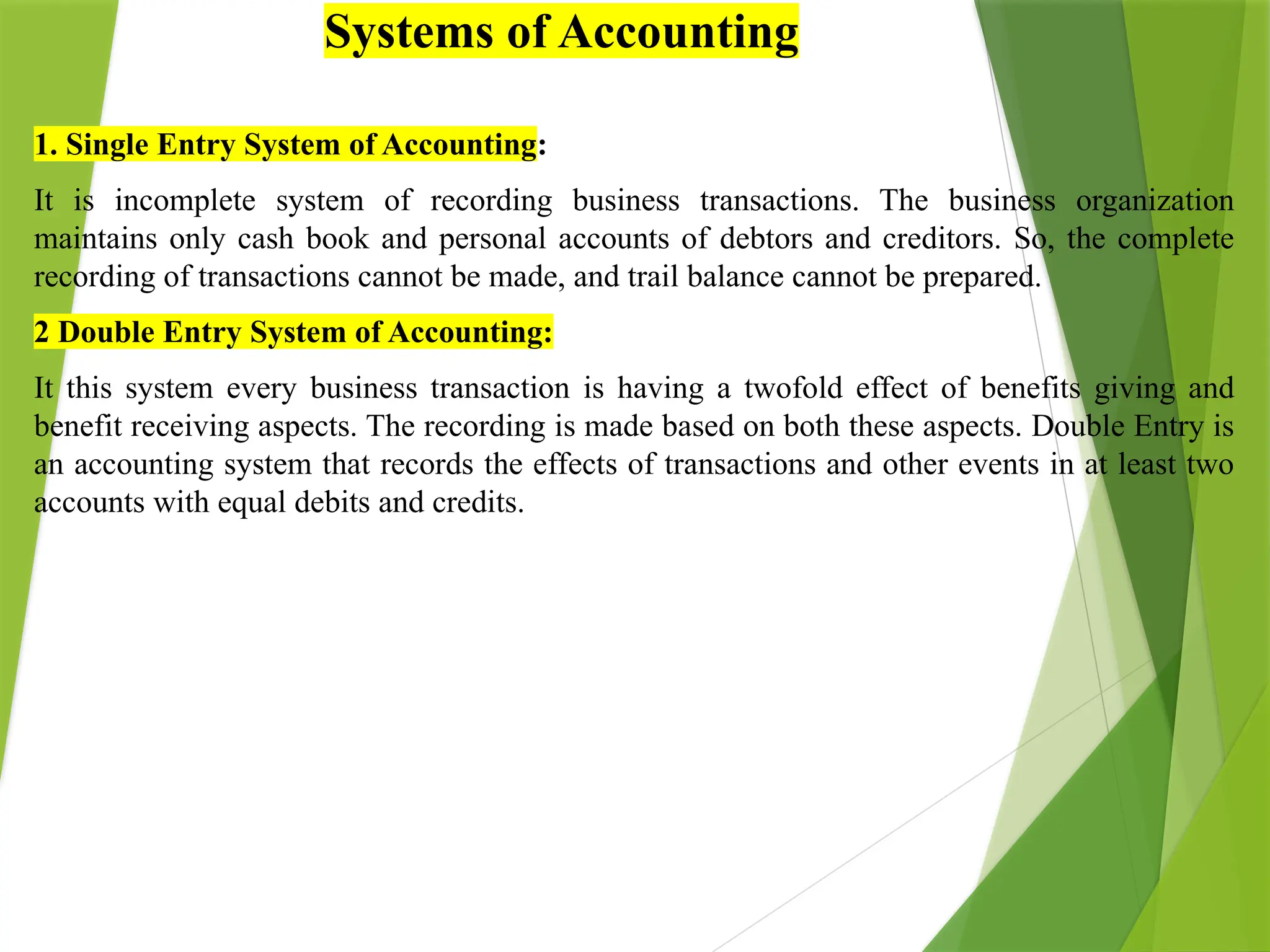
1. Single Entry System of Accounting:
It is incomplete system of recording business transactions. The business organization
maintains only cash book and personal accounts of debtors and creditors. So, the complete
recording of transactions cannot be made, and trail balance cannot be prepared.
2 Double Entry System of Accounting:
It this system every business transaction is having a twofold effect of benefits giving and
benefit receiving aspects. The recording is made based on both these aspects. Double Entry is
an accounting system that records the effects of transactions and other events in at least two
accounts with equal debits and credits.
Systems of Accounting
1. Cash basis
Under cash basis of accounting, actual cash receipts and actual cash payments are recorded.
In this basis, revenue is recognised when cash is received, and expenses are recognised when
cash is paid.
2. Accrual or mercantile basis
Under accrual basis of accounting, the revenue whether received or not, but has been earned
or accrued during the accounting period and expenses incurred whether paid or not are
recorded. In other words, revenue is recognised when it is earned or accrued, and expenses
are recognised when these are incurred. Under this basis,
(a) Any income earned whether received or not
(b) Any expenditure incurred whether paid or not.
3. Hybrid or mixed basis
This basis is a combination of cash basis and accrual basis of accounting. Under mixed basis
of accounting, both cash basis and accrual basis are followed. Revenues and assets are
generally recorded on cash basis whereas expenses and liabilities are generally taken on
accrual basis.
Bases of Accounting
1. Cash basis
Under cash basis of accounting, actual cash receipts and actual cash payments are recorded.
In this basis, revenue is recognised when cash is received, and expenses are recognised when
cash is paid.
2. Accrual or mercantile basis
Under accrual basis of accounting, the revenue whether received or not, but has been earned
or accrued during the accounting period and expenses incurred whether paid or not are
recorded. In other words, revenue is recognised when it is earned or accrued, and expenses
are recognised when these are incurred. Under this basis,
(a) Any income earned whether received or not
(b) Any expenditure incurred whether paid or not.
3. Hybrid or mixed basis
This basis is a combination of cash basis and accrual basis of accounting. Under mixed basis
of accounting, both cash basis and accrual basis are followed. Revenues and assets are
generally recorded on cash basis whereas expenses and liabilities are generally taken on
accrual basis.
Bases of Accounting
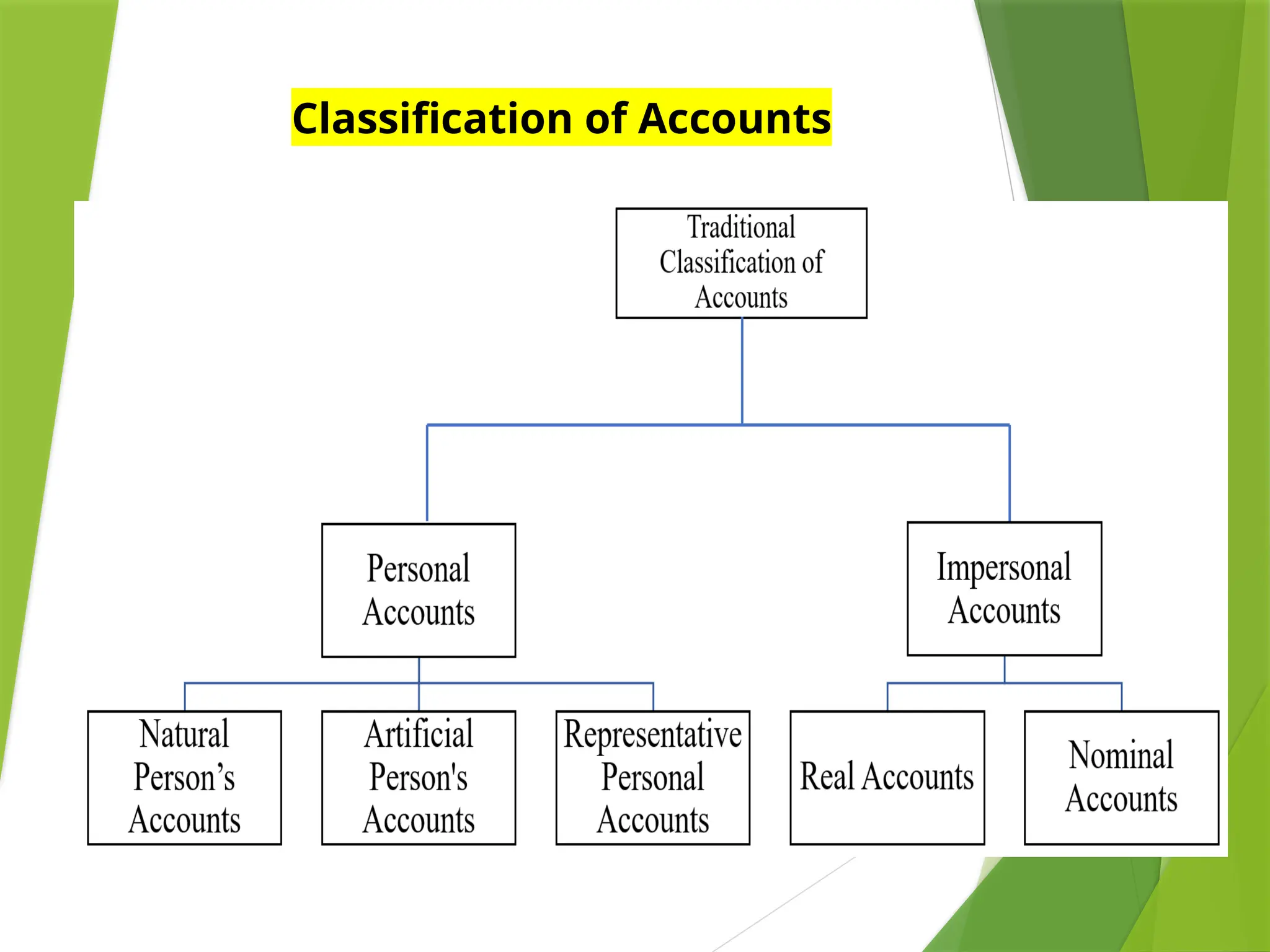
Classification of Accounts
Rules of Debit and Credit
(Traditional Approach) (Golden
rules)
Types of Account Account to be Debited Account to be Credited
1. Personal Account Receiver Giver
2. Real Account What comes in What goes out
3. Nominal Account Expenses and Loss Income and Gain
Illustration 1:
Classify the following accounts into Personal, Real and Nominal Accounts:
1. Cash 7. Drawings 13. Capital
2. Bank 8. Discount Received 14. Interest (Paid)
3. Outstanding Salaries 9. Bad Debts Written off 15. Bank Overdraft
4. Sales 10. Purchases 16. Prepaid Rent
5. Accrued Interest 11. Bad Debts Recovered 17. Carriage Inward
6. Leasehold Property 12. Plant and Machinery 18. Goodwill
Personal Account Real Account Nominal Account
Illustration 2:
Classify the following accounts into Personal, Real and Nominal Accounts:
Personal Account Real Account Nominal Account
1. Rent Received 6. Interest Received
2. Machinery Purchased 7. Building sold
3. Goods Purchased 8. Discount allowed
4. Capital Introduced 9. Goods sold
5. Rent Paid
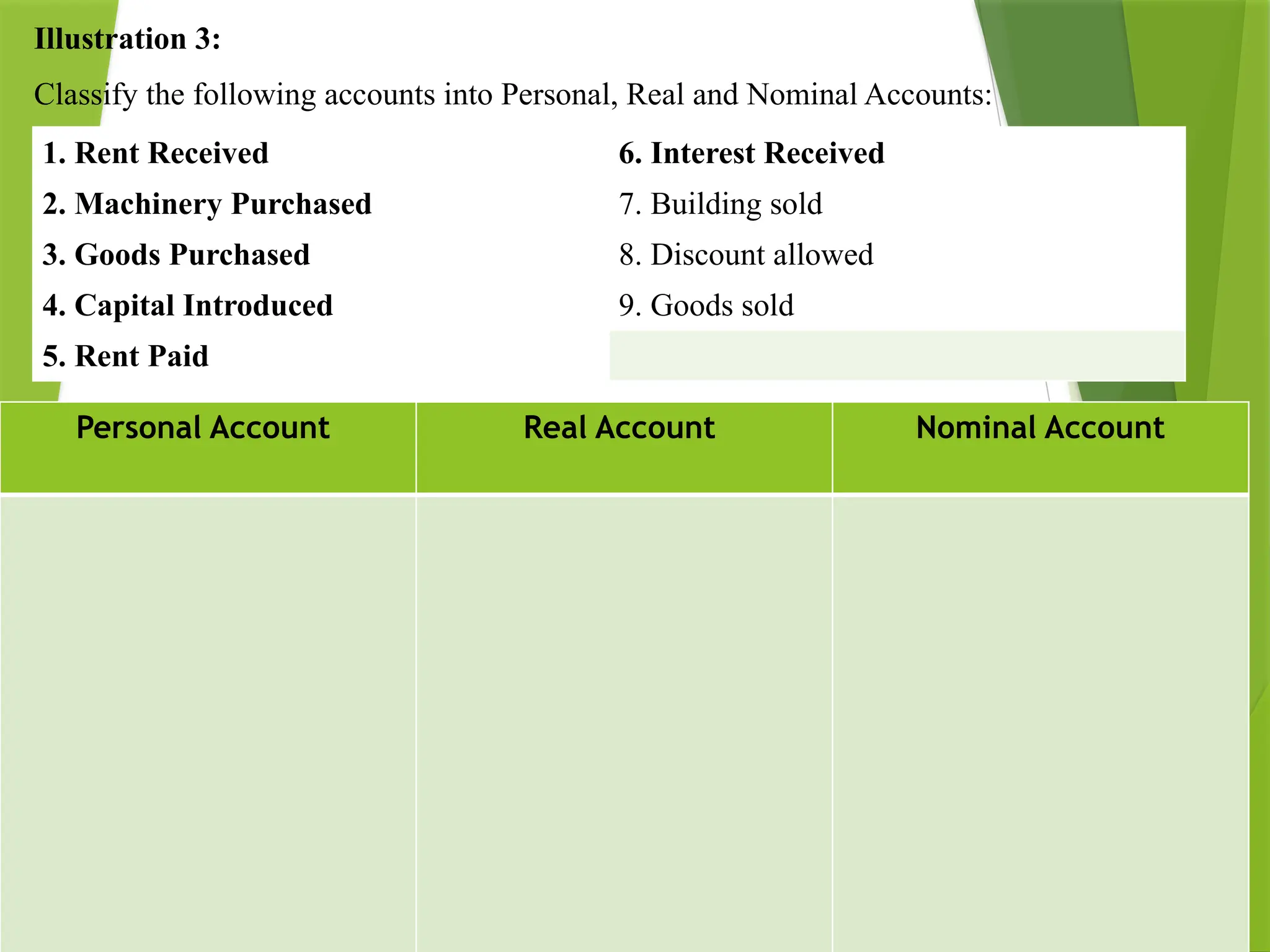
Illustration 3:
Classify the following accounts into Personal, Real and Nominal Accounts:
Personal Account Real Account Nominal Account
1. Rent Received 6. Interest Received
2. Machinery Purchased 7. Building sold
3. Goods Purchased 8. Discount allowed
4. Capital Introduced 9. Goods sold
5. Rent Paid
Modern Approach
Rules of Debit and Credit (Modern Approach)
Types of Account
Increase Decrease
1. Asset Accounts Debit Credit
2. Liability Accounts Credit Debit
3. Capital Accounts Credit Debit
4. Revenue Accounts
(Incomes/Gains)
Credit Debit
5. Expenses Accounts
(Expenses/Losses)
Debit Credit
6. Drawings/Withdrawals* Debit Credit
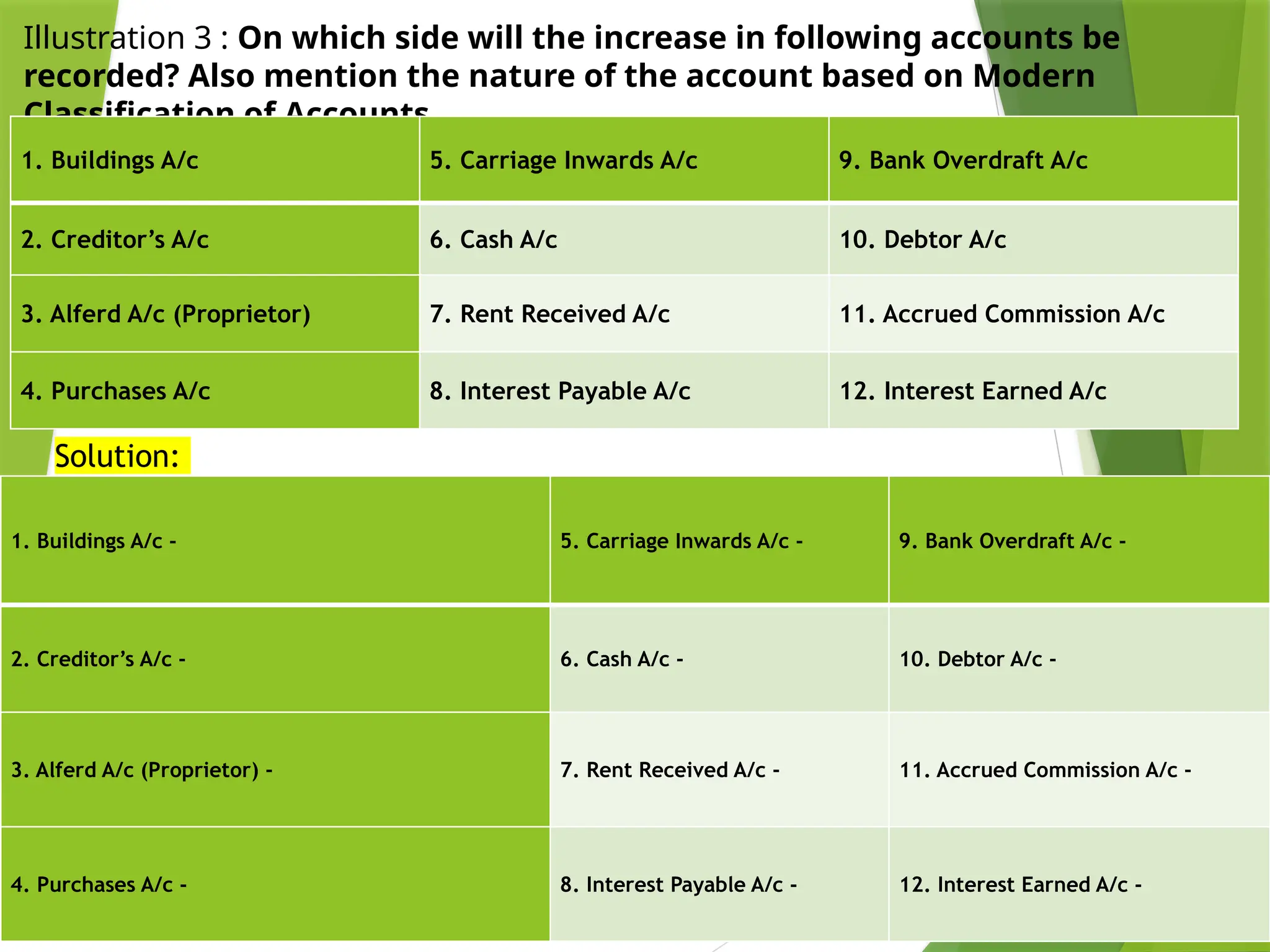
Illustration 3 : On which side will the increase in following accounts be
recorded? Also mention the nature of the account based on Modern
Classification of Accounts.
1. Buildings A/c 5. Carriage Inwards A/c 9. Bank Overdraft A/c
2. Creditor’s A/c 6. Cash A/c 10. Debtor A/c
3. Alferd A/c (Proprietor) 7. Rent Received A/c 11. Accrued Commission A/c
4. Purchases A/c 8. Interest Payable A/c 12. Interest Earned A/c
1. Buildings A/c - 5. Carriage Inwards A/c - 9. Bank Overdraft A/c -
2. Creditor’s A/c - 6. Cash A/c - 10. Debtor A/c -
3. Alferd A/c (Proprietor) - 7. Rent Received A/c - 11. Accrued Commission A/c -
4. Purchases A/c - 8. Interest Payable A/c - 12. Interest Earned A/c -
Solution:
Illustration 3 : On which side will the increase in following accounts be
recorded? Also mention the nature of the account based on Modern
Classification of Accounts.
1. Buildings A/c 5. Carriage Inwards A/c 9. Bank Overdraft A/c
2. Creditor’s A/c 6. Cash A/c 10. Debtor A/c
3. Alferd A/c (Proprietor) 7. Rent Received A/c 11. Accrued Commission A/c
4. Purchases A/c 8. Interest Payable A/c 12. Interest Earned A/c
1. Buildings A/c - 5. Carriage Inwards A/c - 9. Bank Overdraft A/c -
2. Creditor’s A/c - 6. Cash A/c - 10. Debtor A/c -
3. Alferd A/c (Proprietor) - 7. Rent Received A/c - 11. Accrued Commission A/c -
4. Purchases A/c - 8. Interest Payable A/c - 12. Interest Earned A/c -
Solution:
Illustration 4:
1. Rohit Purchased Furniture for 80,000.
₹
2. Purchased Machinery for ₹60,000 on credit from M.B. Machinery Mart
3. Cash of ₹50,000 introduced in business as Capital by Suman Sharma.
4. Paid ₹6,000 to the employees as Salary.
5. Received interest for the month ₹4,000
Illustration 4:
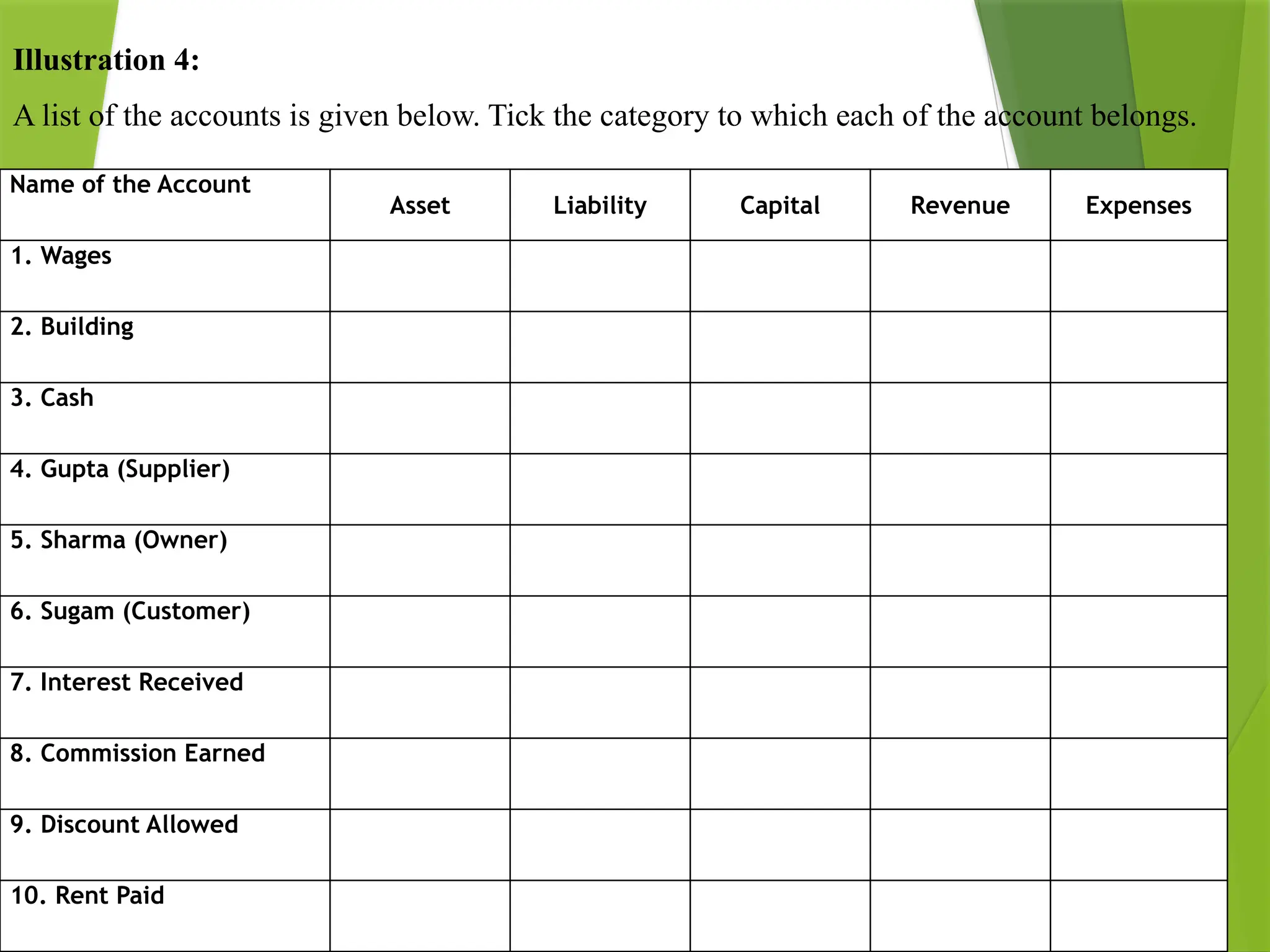
A list of the accounts is given below. Tick the category to which each of the account belongs.
Name of the Account
Asset Liability Capital Revenue Expenses
1. Wages
2. Building
3. Cash
4. Gupta (Supplier)
5. Sharma (Owner)
6. Sugam (Customer)
7. Interest Received
8. Commission Earned
9. Discount Allowed
10. Rent Paid
Fundamentals of Accounting for B.Com.pptx

Fundamentals of Accounting for B.Com.pptx

  • 1.
    Business Accounting By HARISHKUMAR M AssistantProfessor Department of Management Kristu Jayanti College, Bengaluru
  • 2.
    Business Accounting Unit 1:Introduction to Accounting and Accounting Systems Introduction, Need and Role of Accounting, Systems of Accounting, Branches of Accounting, Objectives of Accounting, Generally Accepted Accounting Principles: Accounting Concepts & Accounting Conventions, Documents in Accounting. Unit 2: Bookkeeping Double Entry System, Accounting Cycle, Preparation of Journal, Posting to Ledger, Preparation of Trial Balance. Unit 3: Subsidiary books Introduction to Subsidiary books, Preparation of Cash Book – Simple Cash Book, Double Column Cash Book, Triple Column Cash Book, Petty cash book – Simple Petty cash, Analytical Petty cash book – Fixed Advance system and Imprest system. Unit 4: Final Accounts of a Sole Trader Preparation of Income statement – Trading Account and Profit and Loss Account; Preparation of Balance Sheet; Treatment of adjustments - Closing Stock, Outstanding Expenses, Prepaid or Unexpired Expenses, Accrued Income, Unearned Income, Income Received in Advance, Depreciation, Interest on Capital, Interest on Drawings, Interest on Loan, Bad Debt, Provision for Bad and Doubtful Debts. Unit 5: Introduction to IFRS IFRS Vs GAAP; meaning of IFRS, Role of IASB in developing IFRS, Roles and structures of key bodies involved in regulation; the scope of IFRS and development of IFRSs; Role of an auditor in incorporated entities and the different types of audit reports; Recent trends and developments in accounting. Unit 6: Emerging trends in accounting
  • 3.
    Introduction to Accounting Content 1.Meaningand Types of business firm 2.Economic events 3.Definition of accounting and concept 4. 0bjectives of accounting information 5.Advantages and limitations of accounting information 6.Types of accounting information 7.Users of accounting information and their needs 8. Generally Accepted Accounting Principles: 9 Accounting Concepts & Accounting Conventions, 10.Documents in Accounting Module-1
  • 4.
    Meaning of business: Exchangeof goods and services between person to person and from place to place with money value is known as business. Definition of business Business refers to those economic activities, which are connected with the production or purchase and sale of goods and services with main object of earning profit Types of business firm Business firm can be classified in to two. i)Profit Trading organisation: It is established only to earn profit. Ex: Sole Proprietor ship , Partner ship firm, Joint Hindu family business , Co operative societies , Company ii)Not-for- Profit Trading organisation: These organisations are established only to do welfare oriented services, not to earn profit Ex: Hospitals , charitable trust, Educational Institution, libraries etc.
  • 5.
    Meaning and Definitionof Accounting Accounting is the systematic process of identifying, measuring, recording, classifying, summarising, interpreting and communicating financial information
  • 6.
  • 7.
    1. Identifying financialtransactions and events: Accounting records only those transactions and events which are of financial nature. So, first, such transactions and events are identified. 2. Measuring the transactions: Accounting measures the transactions and events in terms of money which are considered as a common unit. 3. Recording of transactions: Accounting involves recording the financial transactions inappropriate book of accounts such as Journal or Subsidiary Books. 4. Classifying the transactions: Transactions recorded in the books of original entry – Journal or Subsidiary books are classified and grouped according to nature and posted in separate accounts known as ‘Ledger Accounts’. 5. Summarising the transactions: It involves presenting the classified data in a manner and in the form of statements, which are understandable by the users. It includes Trial balance, Trading Account, Profit and Loss Account and Balance Sheet. 6. Analysing and interpreting financial data: Results of the business are analysed and interpreted so that users of financial statements can make a meaningful and sound judgment. 7. Communicating the financial data or reports to the users: Communicating the financial data to the users on time is the final step of accounting so that they can make appropriate decisions.
  • 8.
    Objectives of accounting 1.To maintain the systematic records of the business 2. To ascertain the profit or loss of the business 3. To present the financial position of the business 4. To provide the financial information to the various users 5. For Decision Making
  • 9.
    Functions of Accounting Themain functions of accounting are as follows: 1. Measurement: The main function of accounting is to keep systematic record of transactions, post them to the ledger and ultimately prepare the final accounts. Accounting works as a tool for measuring the performance of the business enterprises. It also shows the financial position of the business enterprises. 2. Forecasting: With the help of the various tools of accounting, future performance and financial position of the business enterprises can be forecasted. 3. Comparison: Accounting helps to compare the actual performance with the planned performance. It is also possible to compare with the accounting policies. Through comparison of the actual financial results of the business enterprises with projected figures and standards, effective measures can be taken to enhance the efficiency of various operations. 4. Decision making: Accounting provides relevant information to the management for planning, evaluation of performance and control. This will help them to take various decisions concerning cost, price, sales, level of activity, etc. 5. Control: As accounting works as a tool of control, the strengths and weaknesses are identified to provide feedback on various measures adopted. It serves as a tool for evaluating compliance of business policies and programmes. 6. Assistance to government: Government needs full information on the financial aspects of the business for various purposes such as taxation, grant of subsidy, etc. Accounting provides relevant information about the business to exercise government control on business enterprises.
  • 10.
    Importance of Accounting 1.Systematic records 2. Preparation of financial statements 3. Assessment of progress 4. Aid to decision making: 5. Satisfies legal requirements 6. Information to interested groups 7. Legal evidence 8. Computation of tax: 9. Settlement during merger
  • 11.
    Advantages of Accounting 1.Replaces memory 2. Meets the information requirements 3. Assists the management in many other ways 4. Facilitates a comparative study: With 5. Acts as reliable evidence 6. Tax matters 7. Ascertaining value of business
  • 12.
    Disadvantages of Accounting 1.Financial accounting permits alternative treatment 2. Financial accounting is influenced by personal judgments 3. Financial accounting ignores non-monetary information 4. Financial accounting does not provide timely information
  • 13.
    Role of accounting 1.It helps to Maintenance of systematic records 2. It Assistance to management 3. It Facilitates comparative study 4. It Act as a Evidence in court 5. Proper accounting records obviates the necessity to remember business transactions. 6. It helps to raising Facilitates raising loans. 7. It Facilitates sale of business by ascertaining the proper purchase price. 8. It Facilitates settlement of tax liabilities
  • 14.
    Role of anaccountant 1. Record keeper 2. Provider of information to the management 3. Protector of business assets 4. Financial advisor 5. Tax manager 6. Public relation officer
  • 15.
    Accounting information andUser Needs Users Classification Information the user want Internal 1. Owner Return on investment, financial position of their company 2. Management To evaluate the performance to take various decisions. 3. Employees Profitability to claim higher wages and bonus , and also to see whether the firm able to (PF, ESI ,etc ) deposit regularly.
  • 16.
    External Users Users ClassificationInformation the user want External 1.Investors and potential investors To know about safety , growth of investments and future benefits 2. Creditor Assessing the financial capability, ability of the business to pay its debts. 3. Lenders Repaying capacity , credit worthiness. 4. Tax Authorities Assessment of due taxes, true and fair disclosure of accounting information 5.Government To compile national income and other information . It helps to take policy decision 6. Others Customers , researchers etc, may seek different information and different reasons.
  • 17.
  • 18.
    Branches of Accounting 1.Financial Accounting: It involves recording of financial transactions and events. It is historical in nature and records are maintained for transactions and events which have already occurred. It provides financial information to the users for taking decisions. It is concerned with identification, recording, classifying and summarising of financial transactions and events and ends up with the preparation of financial statements, namely, trading and profit and loss account or income statement and balance sheet and communication of the same to the interested users. Trading and profit and loss account shows the profit or loss made during an accounting period and the balance sheet shows the financial position of the business as on a particular date. 2. Cost Accounting: It involves the collection, recording, classification and appropriate allocation of expenditure for the determination of the costs of products or services and for the presentation of data for the purposes of cost control and managerial decision making. 3. Management Accounting: It is concerned with the presentation of accounting information in such a way as to assist management in decision making and in the day-to-day operations of an enterprise. The information collected from financial accounting, cost accounting, etc. are grouped, modified and presented as per the requirements of management for discharging their functions and for decision making.
  • 19.
    Branches of Accounting 4.Social Responsibility Accounting: It is concerned with presentation of accounting information by business entities and other organisations from the viewpoint of the society by showing the social costs incurred such as environmental pollution by the enterprise and social benefits such as infrastructure development and employment opportunities created by them. It arises because of corporate social responsibility. 5. Human Resources Accounting: It is concerned with identification, quantification and reporting of investments made in human resources of an enterprise.
  • 20.
    Accounting Concepts andConventions Accounting concepts are fundamental principles that form the basis for preparing and presenting financial statements. These concepts ensure consistency, reliability, and comparability in accounting practices. Accounting Concepts Accounting Conventions 1. Entity Concept 1. Convention of Disclosure 2. Dual Aspect Concept 2. Convention of Conservatism 3. Accounting Period Concept 3. Convention of Consistency 4. Going Concern Concept 4. Convention of Materiality 5. Cost Concept 6. Money Measurement Concept 7. Matching Concept 8. Realisation Concept 9. Accrual Concept 10. Verifiable Objective Concept
  • 21.
    1. Business EntityConcept: This concept treats the business as a separate entity distinct from its owners. All financial transactions are recorded from the business's perspective, not the owner’s. 2. Money Measurement Concept: Only transactions and events that can be measured in monetary terms are recorded in the accounting records. Non-monetary items are not recorded. 3. Accounting period Concept : Life of the business is broken into smaller periods of 12 months known as accounting periods 4. Going Concern Concept: This assumes that a business will continue to operate for the foreseeable future and not be forced to close or liquidate its assets. 5. Cost Concept (Historical Cost): Assets and expenses are recorded at their original cost or purchase price. This concept disregards any changes in market value. 6. Dual Aspect Concept (Double-Entry System): Every financial transaction has two effects, which are recorded in at least two accounts—one debit and one credit. 7. Revenue Recognition Concept: Revenue is recognized when it is earned, regardless of when the cash is received. This is closely related to the accrual concept.
  • 22.
    9. Accrual Concept:Revenues and expenses are recognized when they are earned or incurred, not when the cash is received or paid. This ensures that financial statements reflect the true financial position of a business. 10. Verifiable Objective Concept: The verifiable Objective Concept holds that accounting should be free from personal bias. Measurements that are based on verifiable evidence are regarded as objective. It means all accounting transactions should be evidenced and supported by business documents. These supporting documents are cash memos, invoices, sales bills, etc.,
  • 23.
    Consistency Convention: Thisconvention emphasizes that once a business adopts an accounting method, it should consistently apply it in all subsequent periods. This allows for comparison of financial statements over time. If there is a change in method, it must be disclosed along with the reason for the change. Disclosure Convention: This convention requires that all material information related to the financial statements should be fully disclosed to ensure that users have a complete understanding of the financial position of the business. This includes any significant accounting policies or practices that could affect the interpretation of the financial data. Conservatism (Prudence) Convention: Under this convention, accountants should exercise caution when making estimates and judgments. It suggests that potential expenses and liabilities should be recognized as soon as they are anticipated, but revenues should only be recognized when they are assured. The aim is to prevent overstatement of financial position and ensure that the business is prepared for potential losses. Materiality Convention: This convention suggests that financial statements should only include information that is significant enough to influence the decisions of users. Insignificant details, which do not affect the decision-making process, can be omitted. The materiality threshold can vary depending on the size and nature of the business. II. Accounting Conventions
  • 24.
    1. Single EntrySystem of Accounting: It is incomplete system of recording business transactions. The business organization maintains only cash book and personal accounts of debtors and creditors. So, the complete recording of transactions cannot be made, and trail balance cannot be prepared. 2 Double Entry System of Accounting: It this system every business transaction is having a twofold effect of benefits giving and benefit receiving aspects. The recording is made based on both these aspects. Double Entry is an accounting system that records the effects of transactions and other events in at least two accounts with equal debits and credits. Systems of Accounting
  • 25.
    1. Cash basis Undercash basis of accounting, actual cash receipts and actual cash payments are recorded. In this basis, revenue is recognised when cash is received, and expenses are recognised when cash is paid. 2. Accrual or mercantile basis Under accrual basis of accounting, the revenue whether received or not, but has been earned or accrued during the accounting period and expenses incurred whether paid or not are recorded. In other words, revenue is recognised when it is earned or accrued, and expenses are recognised when these are incurred. Under this basis, (a) Any income earned whether received or not (b) Any expenditure incurred whether paid or not. 3. Hybrid or mixed basis This basis is a combination of cash basis and accrual basis of accounting. Under mixed basis of accounting, both cash basis and accrual basis are followed. Revenues and assets are generally recorded on cash basis whereas expenses and liabilities are generally taken on accrual basis. Bases of Accounting
  • 26.
    1. Cash basis Undercash basis of accounting, actual cash receipts and actual cash payments are recorded. In this basis, revenue is recognised when cash is received, and expenses are recognised when cash is paid. 2. Accrual or mercantile basis Under accrual basis of accounting, the revenue whether received or not, but has been earned or accrued during the accounting period and expenses incurred whether paid or not are recorded. In other words, revenue is recognised when it is earned or accrued, and expenses are recognised when these are incurred. Under this basis, (a) Any income earned whether received or not (b) Any expenditure incurred whether paid or not. 3. Hybrid or mixed basis This basis is a combination of cash basis and accrual basis of accounting. Under mixed basis of accounting, both cash basis and accrual basis are followed. Revenues and assets are generally recorded on cash basis whereas expenses and liabilities are generally taken on accrual basis. Bases of Accounting
  • 27.
  • 28.
    Rules of Debitand Credit (Traditional Approach) (Golden rules) Types of Account Account to be Debited Account to be Credited 1. Personal Account Receiver Giver 2. Real Account What comes in What goes out 3. Nominal Account Expenses and Loss Income and Gain
  • 29.
    Illustration 1: Classify thefollowing accounts into Personal, Real and Nominal Accounts: 1. Cash 7. Drawings 13. Capital 2. Bank 8. Discount Received 14. Interest (Paid) 3. Outstanding Salaries 9. Bad Debts Written off 15. Bank Overdraft 4. Sales 10. Purchases 16. Prepaid Rent 5. Accrued Interest 11. Bad Debts Recovered 17. Carriage Inward 6. Leasehold Property 12. Plant and Machinery 18. Goodwill Personal Account Real Account Nominal Account
  • 30.
    Illustration 2: Classify thefollowing accounts into Personal, Real and Nominal Accounts: Personal Account Real Account Nominal Account 1. Rent Received 6. Interest Received 2. Machinery Purchased 7. Building sold 3. Goods Purchased 8. Discount allowed 4. Capital Introduced 9. Goods sold 5. Rent Paid
  • 31.
    Illustration 3: Classify thefollowing accounts into Personal, Real and Nominal Accounts: Personal Account Real Account Nominal Account 1. Rent Received 6. Interest Received 2. Machinery Purchased 7. Building sold 3. Goods Purchased 8. Discount allowed 4. Capital Introduced 9. Goods sold 5. Rent Paid
  • 32.
    Modern Approach Rules ofDebit and Credit (Modern Approach) Types of Account Increase Decrease 1. Asset Accounts Debit Credit 2. Liability Accounts Credit Debit 3. Capital Accounts Credit Debit 4. Revenue Accounts (Incomes/Gains) Credit Debit 5. Expenses Accounts (Expenses/Losses) Debit Credit 6. Drawings/Withdrawals* Debit Credit
  • 33.
    Illustration 3 :On which side will the increase in following accounts be recorded? Also mention the nature of the account based on Modern Classification of Accounts. 1. Buildings A/c 5. Carriage Inwards A/c 9. Bank Overdraft A/c 2. Creditor’s A/c 6. Cash A/c 10. Debtor A/c 3. Alferd A/c (Proprietor) 7. Rent Received A/c 11. Accrued Commission A/c 4. Purchases A/c 8. Interest Payable A/c 12. Interest Earned A/c 1. Buildings A/c - 5. Carriage Inwards A/c - 9. Bank Overdraft A/c - 2. Creditor’s A/c - 6. Cash A/c - 10. Debtor A/c - 3. Alferd A/c (Proprietor) - 7. Rent Received A/c - 11. Accrued Commission A/c - 4. Purchases A/c - 8. Interest Payable A/c - 12. Interest Earned A/c - Solution:
  • 34.
    Illustration 3 :On which side will the increase in following accounts be recorded? Also mention the nature of the account based on Modern Classification of Accounts. 1. Buildings A/c 5. Carriage Inwards A/c 9. Bank Overdraft A/c 2. Creditor’s A/c 6. Cash A/c 10. Debtor A/c 3. Alferd A/c (Proprietor) 7. Rent Received A/c 11. Accrued Commission A/c 4. Purchases A/c 8. Interest Payable A/c 12. Interest Earned A/c 1. Buildings A/c - 5. Carriage Inwards A/c - 9. Bank Overdraft A/c - 2. Creditor’s A/c - 6. Cash A/c - 10. Debtor A/c - 3. Alferd A/c (Proprietor) - 7. Rent Received A/c - 11. Accrued Commission A/c - 4. Purchases A/c - 8. Interest Payable A/c - 12. Interest Earned A/c - Solution:
  • 35.
    Illustration 4: 1. RohitPurchased Furniture for 80,000. ₹ 2. Purchased Machinery for ₹60,000 on credit from M.B. Machinery Mart 3. Cash of ₹50,000 introduced in business as Capital by Suman Sharma. 4. Paid ₹6,000 to the employees as Salary. 5. Received interest for the month ₹4,000
  • 36.
    Illustration 4: A listof the accounts is given below. Tick the category to which each of the account belongs. Name of the Account Asset Liability Capital Revenue Expenses 1. Wages 2. Building 3. Cash 4. Gupta (Supplier) 5. Sharma (Owner) 6. Sugam (Customer) 7. Interest Received 8. Commission Earned 9. Discount Allowed 10. Rent Paid