
By-
Sanjeet Yadav
Komal
Talat Hassan
Generally accepted accounting
principles ( GAAP )
It may be expressed as those rules , guidelines and
principles which are derived from experience and
practice and when they are useful to accounting
practice they , then become accepted as
accounting principle .
If any principle possess all the
above characteristics , and they are accepted by
all ( Professional Accountants , courts ,
government , business executives , taxation
experts ) then they are known as accounting
principles .
Accounting Conventions
Accountancy is based on usage and customs which is
in use since long . Naturally accountants have to adopt
that usage or customs . These are termed as
conventions in accounting . Major conventions are
used in preparation of final accounts also .
1. Conservatism – Every sincere businessman makes an
estimate of future losses and then some provision for it
is made . Businessman mostly ignore the items of
future profit . In Nutshell , conservatism states as
“anticipate no profit , and provide for all possible
losses” .
2. Discloser – While making accounting records , care
should be taken to disclose all material information
and not to conceal information and facts . Here
emphasis is only on material information and not on
immaterial information .
3. Consistency – Continuance of one practice in number
of year indicates consistency .Whatever accounting
practice has been adopted in one accounting year ,
same should be continued in other future years also .
4. Materiality – Accounting record should be made of
all material facts and immaterial items may either be
mixed with material items and then recorded or these
may be ignored. It has a key position in accounting but
forms a base for accounting .
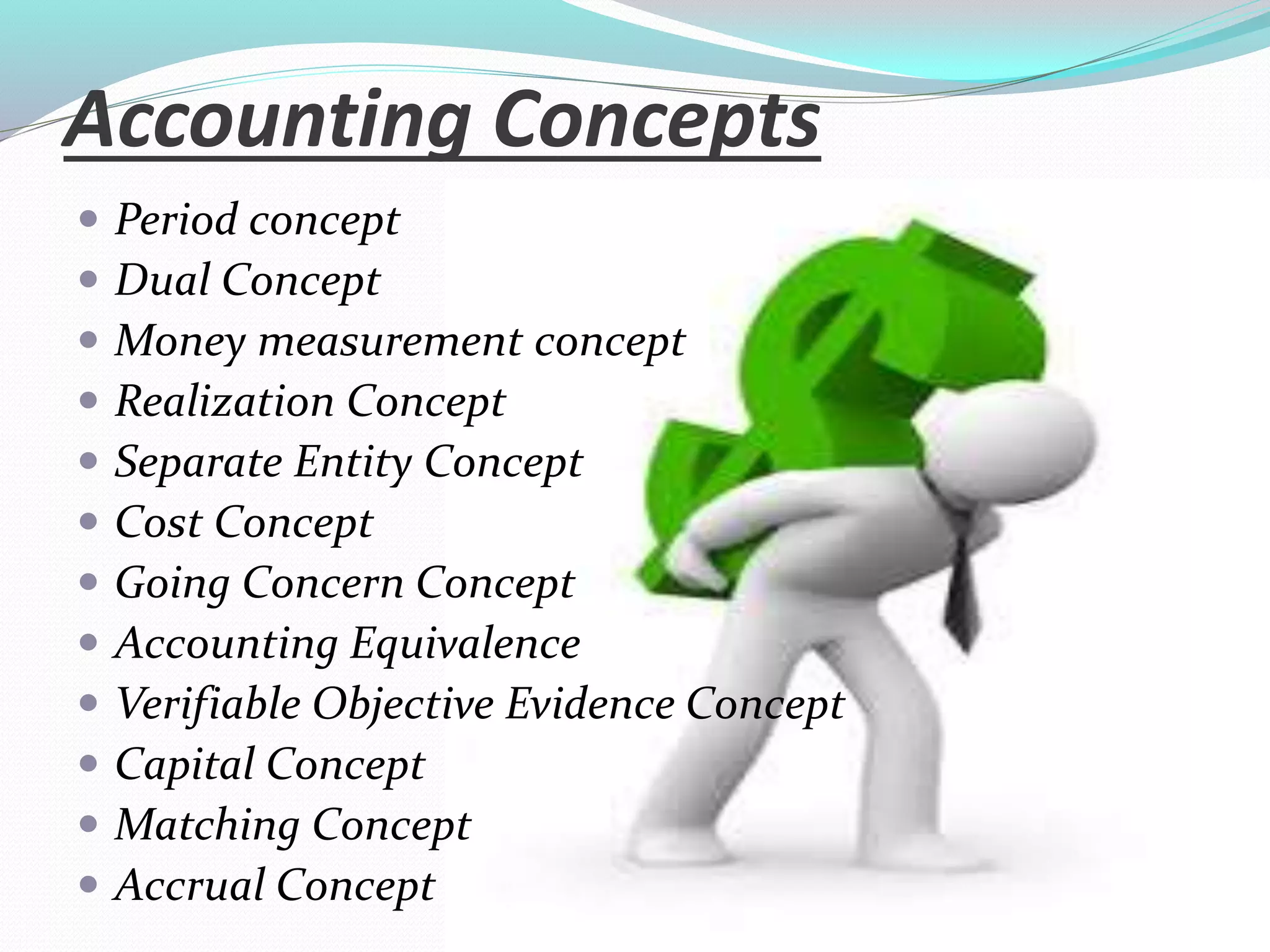
Accounting Concepts
 Period concept
 Dual Concept
 Money measurement concept
 Realization Concept
 Separate Entity Concept
 Cost Concept
 Going Concern Concept
 Accounting Equivalence
 Verifiable Objective Evidence Concept
 Capital Concept
 Matching Concept
 Accrual Concept
1. Period Concept - Every Businessman wants to know
the result of his investment and efforts after a certain
period . Usually one year period is regarded as an ideal
for this purpose . It may be of 2 years 6 months or 3
months also. This period is called accounting period.
2. Dual Aspect – Accounting concept is that every
transaction affects two ACCOUNTS . This is why
double entry system of book – keeping came into
existence . This concept is the foundation on which the
entire system if book-keeping and accountancy is
based.
3. Money Measurement – Only those transactions are
recorded in the books of accounts which can be
expressed in money .Those transactions which cannot
be expressed in money fall beyond the scope of
accounting .
4. Realization Concept – According to this concept ,
revenue is considered as being earned on the date at
which it is realized i.e on the date when the property
in goods passes to the buyer and he becomes liable to
pay.
5. Separate Entity Concept – Business is treated
separate from its owners . All the transactions are
recorded in the books of business and not in the
books of proprietor . On the basis of this concept the
proprietor is treated as a creditor to the business.
6. Cost Concept – Accounting to this concept , fixed
assets are recorded at the price or which they are
acquired, i.e. cost less depreciation . This value is called
book value .
7. Going Concern – According to this concept , the
business shall continue to exist until it is liquidated and
transactions are recorded from this point of view .
8. Equivalence Concept – The proprietor provides the
funds for acquisition of assets , hence the assets owned
by the business must be equal to the funds provided by
the proprietor which is technically called “Equity”
i.e. Assets =Equity
9. Verifiable Objective Evidence – The concept relates
with the verification of accounting record with the
outside evidence . This concept means that there is
some evidence in ascertaining the correctness of the
information reported.
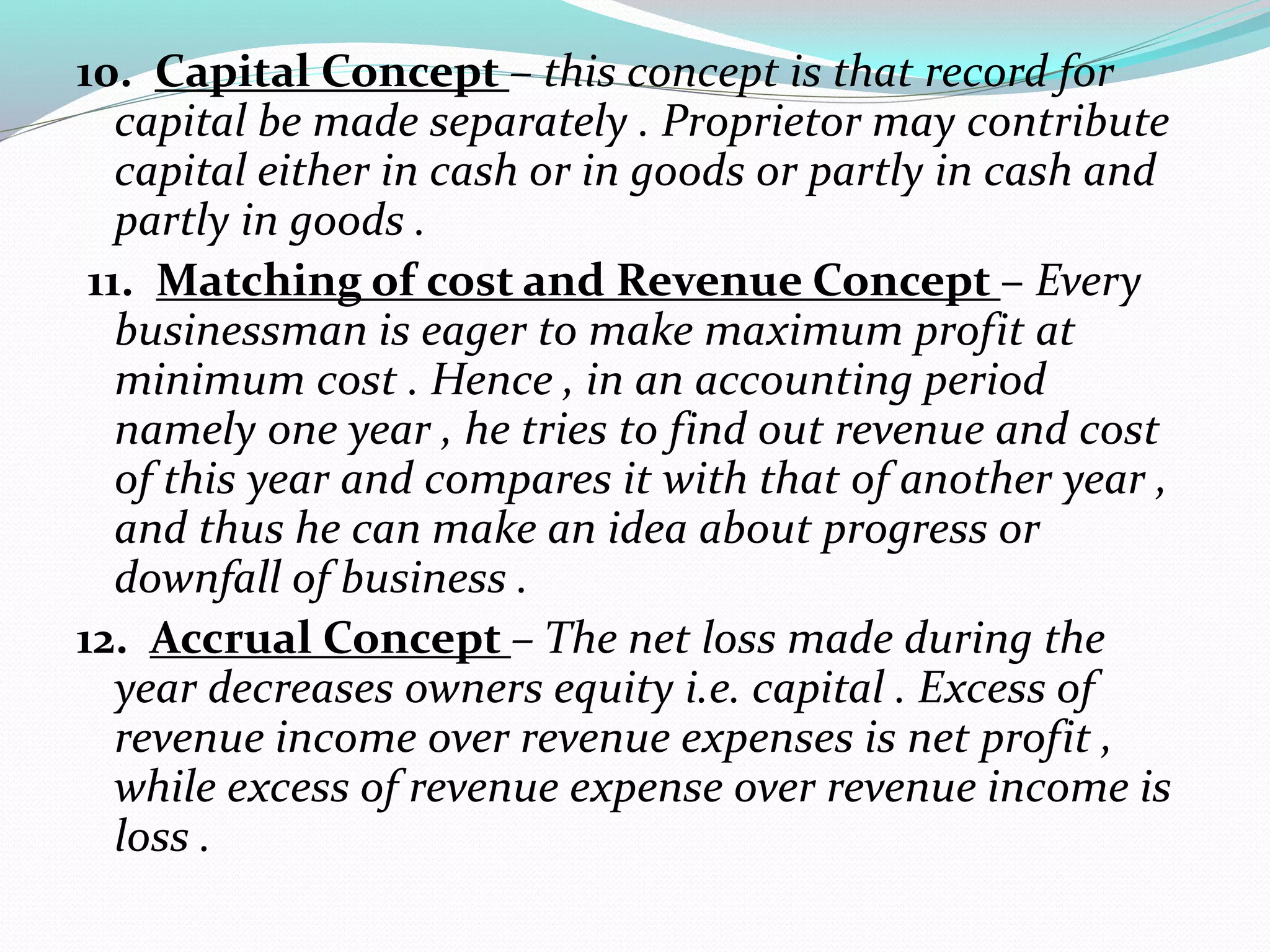
10. Capital Concept – this concept is that record for
capital be made separately . Proprietor may contribute
capital either in cash or in goods or partly in cash and
partly in goods .
11. Matching of cost and Revenue Concept – Every
businessman is eager to make maximum profit at
minimum cost . Hence , in an accounting period
namely one year , he tries to find out revenue and cost
of this year and compares it with that of another year ,
and thus he can make an idea about progress or
downfall of business .
12. Accrual Concept – The net loss made during the
year decreases owners equity i.e. capital . Excess of
revenue income over revenue expenses is net profit ,
while excess of revenue expense over revenue income is
loss .
Accounting principles , conventions and concepts

Accounting principles , conventions and concepts

  • 1.
  • 2.
    Generally accepted accounting principles( GAAP ) It may be expressed as those rules , guidelines and principles which are derived from experience and practice and when they are useful to accounting practice they , then become accepted as accounting principle . If any principle possess all the above characteristics , and they are accepted by all ( Professional Accountants , courts , government , business executives , taxation experts ) then they are known as accounting principles .
  • 3.
    Accounting Conventions Accountancy isbased on usage and customs which is in use since long . Naturally accountants have to adopt that usage or customs . These are termed as conventions in accounting . Major conventions are used in preparation of final accounts also . 1. Conservatism – Every sincere businessman makes an estimate of future losses and then some provision for it is made . Businessman mostly ignore the items of future profit . In Nutshell , conservatism states as “anticipate no profit , and provide for all possible losses” .
  • 4.
    2. Discloser –While making accounting records , care should be taken to disclose all material information and not to conceal information and facts . Here emphasis is only on material information and not on immaterial information . 3. Consistency – Continuance of one practice in number of year indicates consistency .Whatever accounting practice has been adopted in one accounting year , same should be continued in other future years also . 4. Materiality – Accounting record should be made of all material facts and immaterial items may either be mixed with material items and then recorded or these may be ignored. It has a key position in accounting but forms a base for accounting .
  • 5.
    Accounting Concepts  Periodconcept  Dual Concept  Money measurement concept  Realization Concept  Separate Entity Concept  Cost Concept  Going Concern Concept  Accounting Equivalence  Verifiable Objective Evidence Concept  Capital Concept  Matching Concept  Accrual Concept
  • 6.
    1. Period Concept- Every Businessman wants to know the result of his investment and efforts after a certain period . Usually one year period is regarded as an ideal for this purpose . It may be of 2 years 6 months or 3 months also. This period is called accounting period. 2. Dual Aspect – Accounting concept is that every transaction affects two ACCOUNTS . This is why double entry system of book – keeping came into existence . This concept is the foundation on which the entire system if book-keeping and accountancy is based. 3. Money Measurement – Only those transactions are recorded in the books of accounts which can be expressed in money .Those transactions which cannot be expressed in money fall beyond the scope of accounting .
  • 7.
    4. Realization Concept– According to this concept , revenue is considered as being earned on the date at which it is realized i.e on the date when the property in goods passes to the buyer and he becomes liable to pay. 5. Separate Entity Concept – Business is treated separate from its owners . All the transactions are recorded in the books of business and not in the books of proprietor . On the basis of this concept the proprietor is treated as a creditor to the business. 6. Cost Concept – Accounting to this concept , fixed assets are recorded at the price or which they are acquired, i.e. cost less depreciation . This value is called book value .
  • 8.
    7. Going Concern– According to this concept , the business shall continue to exist until it is liquidated and transactions are recorded from this point of view . 8. Equivalence Concept – The proprietor provides the funds for acquisition of assets , hence the assets owned by the business must be equal to the funds provided by the proprietor which is technically called “Equity” i.e. Assets =Equity 9. Verifiable Objective Evidence – The concept relates with the verification of accounting record with the outside evidence . This concept means that there is some evidence in ascertaining the correctness of the information reported.
  • 9.
    10. Capital Concept– this concept is that record for capital be made separately . Proprietor may contribute capital either in cash or in goods or partly in cash and partly in goods . 11. Matching of cost and Revenue Concept – Every businessman is eager to make maximum profit at minimum cost . Hence , in an accounting period namely one year , he tries to find out revenue and cost of this year and compares it with that of another year , and thus he can make an idea about progress or downfall of business . 12. Accrual Concept – The net loss made during the year decreases owners equity i.e. capital . Excess of revenue income over revenue expenses is net profit , while excess of revenue expense over revenue income is loss .