Module: Introduction to Financial Accounting
Accounting Analysis Of The Company
SUBMITTED TO: MRS. DHAARNA SINGH RATHORE
1 | P a g e C a n d i d a t e s : A . I s h a n J u n e j a . B . J u h i P r e m j a n i
Module: Introduction to Financial Accounting
I take this opportunity to express gratitude and deep regards to my
guide (respected professor DHAARNA SINGH RATHOD) for her
exemplary guidance, monitoring and constant encouragement
throughout the course of this thesis. The blessings, help and
guidance given by her carry us a long way in the journey of life on
which I am about to embark. I am obliged to staff members of Auro
University, for the valuable information provided by them in their
respective fields. I am grateful for their cooperation during the
period of my review paper. Lastly, I thank the almighty, my parents
and financial accounting module leader for their constant
encouragement without which the review paper would not be
possible.
2 | P a g e C a n d i d a t e s : A . I s h a n J u n e j a . B . J u h i P r e m j a n i
Module: Introduction to Financial Accounting
3 | P a g e C a n d i d a t e s : A . I s h a n J u n e j a . B . J u h i P r e m j a n i
Serial number Topic Page number
1. Company profile 4
2. Introduction of Infosys 5
3. Summary of the report 6
4. Accounting Principles 7
5. Balance sheet of Infosys 11
6. Capital Structure 15
7. Ratio Analysis 18
8. Accounting Standards 22
9. Accounting Software
used
25
10. Credibility of Infosys 27
11. Conclusion 31
12. References 32
Module: Introduction to Financial Accounting
Name of the Company: INFOSYS
Names Age Current Position
N.R Narayana Murthy 69 Founder of the board
Dr. Vishal Sikka 58 Chief executive officer and
managing director
Pravin Rao 49 Chief Operating Officer
R. Seshasayee 46 Chairman of the board
Carol. M browner 51 Independent Director
Prof. John W.
Etchemendy
58 Independent Director
Roopa Kudva 54 Independent Director
Jeffrey Sean Lehman 43 Independent Director
Ravi Venkatesan 48 Independent Director
Kiran Mazumder-Shaw 52 Independent director
4 | P a g e C a n d i d a t e s : A . I s h a n J u n e j a . B . J u h i P r e m j a n i
Module: Introduction to Financial Accounting
Infosys is a global leader in consulting, technology, and
outsourcing and next-generation services. It enables clients in
more than 50 countries to outperform the competition and stay
ahead of the innovation curve. With US$8.83 billion in LTM Q1
FY16 revenues and 179,000+ employees, it is helping
enterprises to renew themselves while also creating new
avenues to generate value. It provides enterprises with
strategic insights on what lies ahead. It helps enterprises to
transform and thrive in a changing world through strategic
consulting, operational leadership, and the co-creation of
breakthrough solutions, including those in mobility,
sustainability, big data, and cloud computing.
Infosys has a growing global presence with more than
179,000+ employees. Globally, it has 85 sales and marketing
offices and 100 development centres as at March 31, 2015.
Milestones
 Board decides to increase the dividend pay-out ratio to up
to 50% of post-tax profits.
 Infosys announces USD 250 million ‘Innovate in India
Fund’ to support Indian start-ups.
 Infosys acquired Panaya, Inc., a leading provider of
automation technology for large scale enterprise software
management.
The Report of Infosys includes:
5 | P a g e C a n d i d a t e s : A . I s h a n J u n e j a . B . J u h i P r e m j a n i
Module: Introduction to Financial Accounting
 Accounting principles followed by INFOSYS.
 Accounting standards followed- and methods under
each standard.
 Accounting software followed (Computer and
accounting) by INFOSYS.
 Capital structure of the company and fluctuations if any
in last five years.
 Personal comments on company’s credibility and
market position.
Accounting Principles:
6 | P a g e C a n d i d a t e s : A . I s h a n J u n e j a . B . J u h i P r e m j a n i
Module: Introduction to Financial Accounting
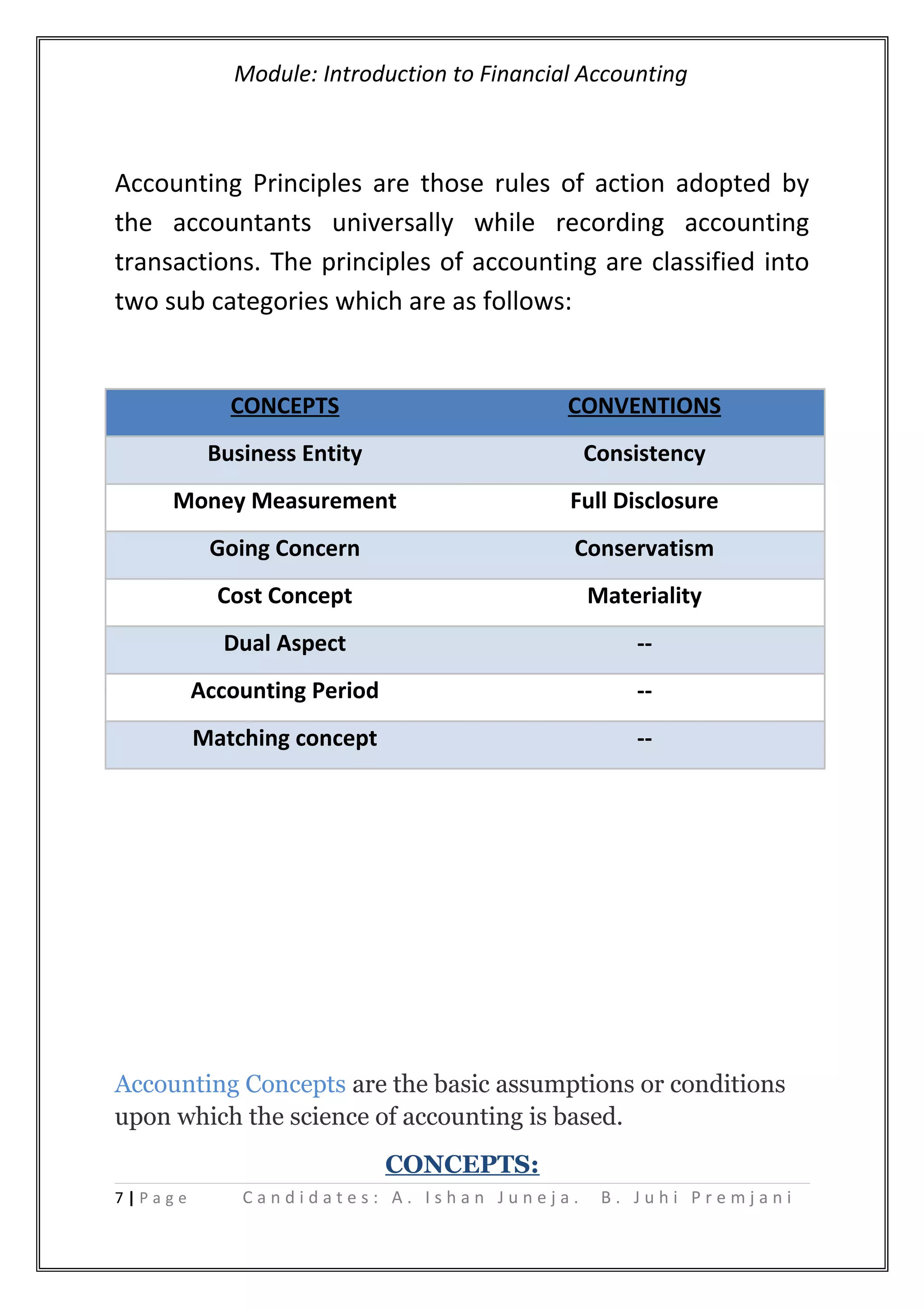
Accounting Principles are those rules of action adopted by
the accountants universally while recording accounting
transactions. The principles of accounting are classified into
two sub categories which are as follows:
CONCEPTS CONVENTIONS
Business Entity Consistency
Money Measurement Full Disclosure
Going Concern Conservatism
Cost Concept Materiality
Dual Aspect --
Accounting Period --
Matching concept --
Accounting Concepts are the basic assumptions or conditions
upon which the science of accounting is based.
CONCEPTS:
7 | P a g e C a n d i d a t e s : A . I s h a n J u n e j a . B . J u h i P r e m j a n i
Module: Introduction to Financial Accounting
Business Entity:
This concept implies that a business unit is separate and distinct from
the persons who supplies capital to it. Irrespective of the form of
organization, a business unit has got its own individuality as
distinguished from the persons who own or control it. The accounting
equation (i.e. Assets= Liabilities + Capital) is the best example.
Money measurement:
Money is the only practical unit of measurement that can be employed
to achieve homogeneity of financial data, so accounting records have
only those transactions which can be expressed in terms of money.
Example: sales, purchases and so on.
Going Concern:
It is assumed that a business unit has a reasonable expectation of
continuing business at a profit for an indefinite period of time. Due to
this concept the suppliers supply goods on credit and the fixed assets are
recorded at original cost and not at liquidation value; depreciation is
also charged on original cost without concern to realization value.
Cost concept:
Cost concept means that the amount where any asset is bought is to be
written in the financial statement. The marked price is not to be written
here but exact the amount in which the asset is bought should be
written. Hence the assets are recorded at the cost incurred in acquiring
them. It will reduce the scope for subjectivity and personal bias.
Dual Aspect:
This is the basic concept of accounting. According to this concept, every
financial transaction involves a two-fold aspect: yielding of that benefit
and giving of that benefit. So there must be two effects one receiving
8 | P a g e C a n d i d a t e s : A . I s h a n J u n e j a . B . J u h i P r e m j a n i
Module: Introduction to Financial Accounting
effect and the other giving effect. That’s why every debit has a
corresponding credit.
Accounting Period:
The measurement of business income or a loss on a whole life basis is
very simple. But for that purpose the company has to be liquidated to
find the performance. To get out of this, the final accounts are prepared
on periodical basis normal for a year.
Matching:
This concept is based on the accounting period concept. The most
important objective of running a business is to ascertain profit
periodically. The determination of profit of a particular accounting
period is essentially a process of matching the revenue recognized
during the period and the costs to be allocated to the period to obtain
the revenue.
CONVENTIONS:
Accounting conventions:
The term convention denotes circumstances or traditions which guide
the accountants while preparing the accounting statements.
Consistency:
Accounting rules, practices and conventions should be continuously
observed and applied i.e., they should not change from one year to
another. The results of different years will be comparable only when
accounting rules are continuously adhered to from year to year.
Full Disclosure:
According to this convention, all accounting statements should be
honestly prepared and to that end full disclosure of all significant
information should be made. All information which is of material
9 | P a g e C a n d i d a t e s : A . I s h a n J u n e j a . B . J u h i P r e m j a n i
Module: Introduction to Financial Accounting
interest to proprietors, creditors and investors should be disclosed in
accounting statements.
Conservatism:
Conservatism means taking the gloomy view of a situation. It is a policy
of caution or playing safe. With this, the businessmen take into account
all the possible losses which may occur and ignore the possible gains in
future while recording the accounts. The closing stock is valued at
market price or cost price whichever is less.
Materiality:
Whether something should be disclosed in the accounts or not in the
financial statements will depend on whether it is material or not.
Materiality depends on the amount involved in the transaction. For
example, the expense incurred in purchasing a waste basket worth Rs.50
is termed as expense for the year rather than an asset. Customs also
drives the materiality only round figures have to be recorded to make
the figures manageable without affecting the accuracy.
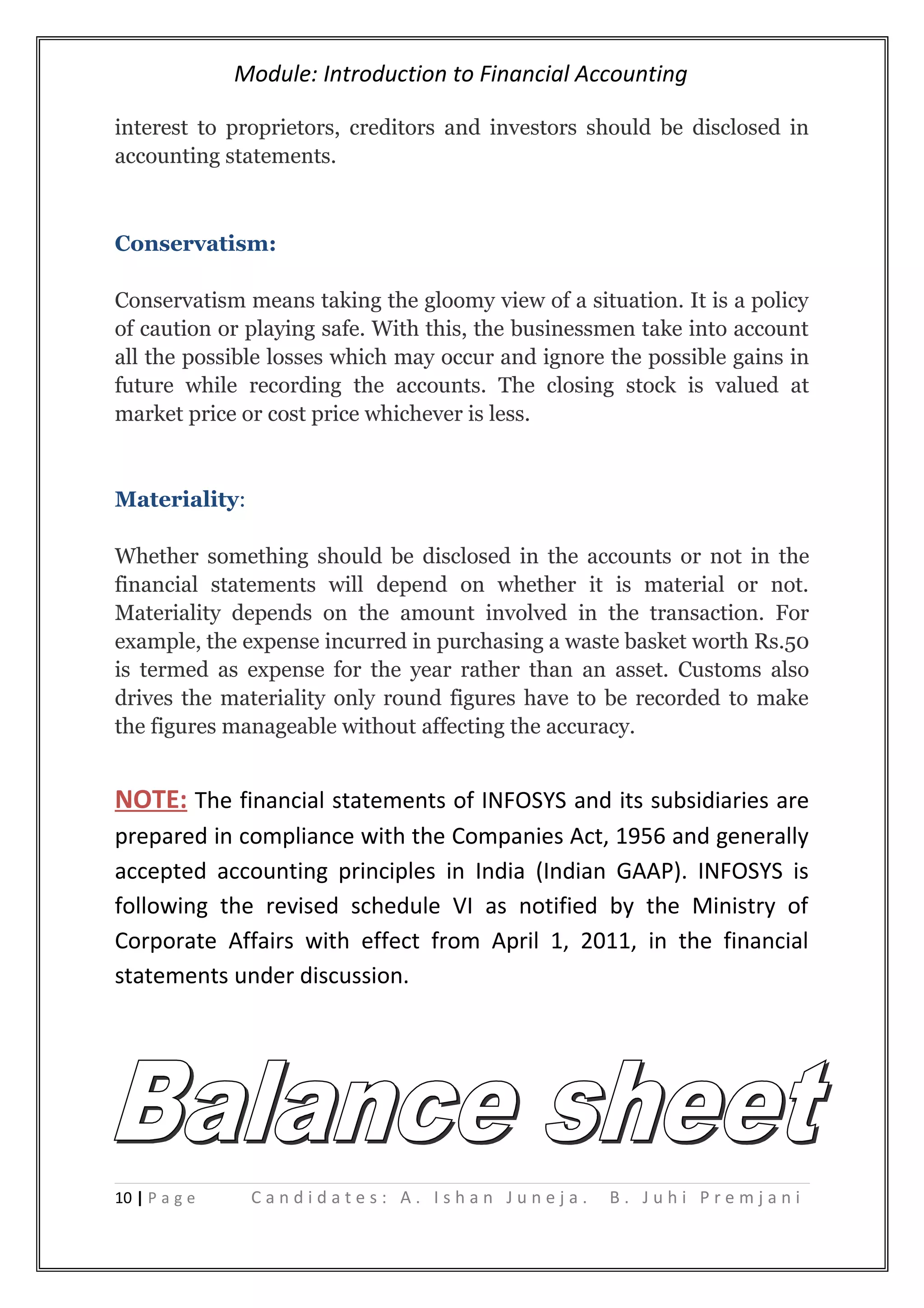
NOTE: The financial statements of INFOSYS and its subsidiaries are
prepared in compliance with the Companies Act, 1956 and generally
accepted accounting principles in India (Indian GAAP). INFOSYS is
following the revised schedule VI as notified by the Ministry of
Corporate Affairs with effect from April 1, 2011, in the financial
statements under discussion.
10 | P a g e C a n d i d a t e s : A . I s h a n J u n e j a . B . J u h i P r e m j a n i
Module: Introduction to Financial Accounting
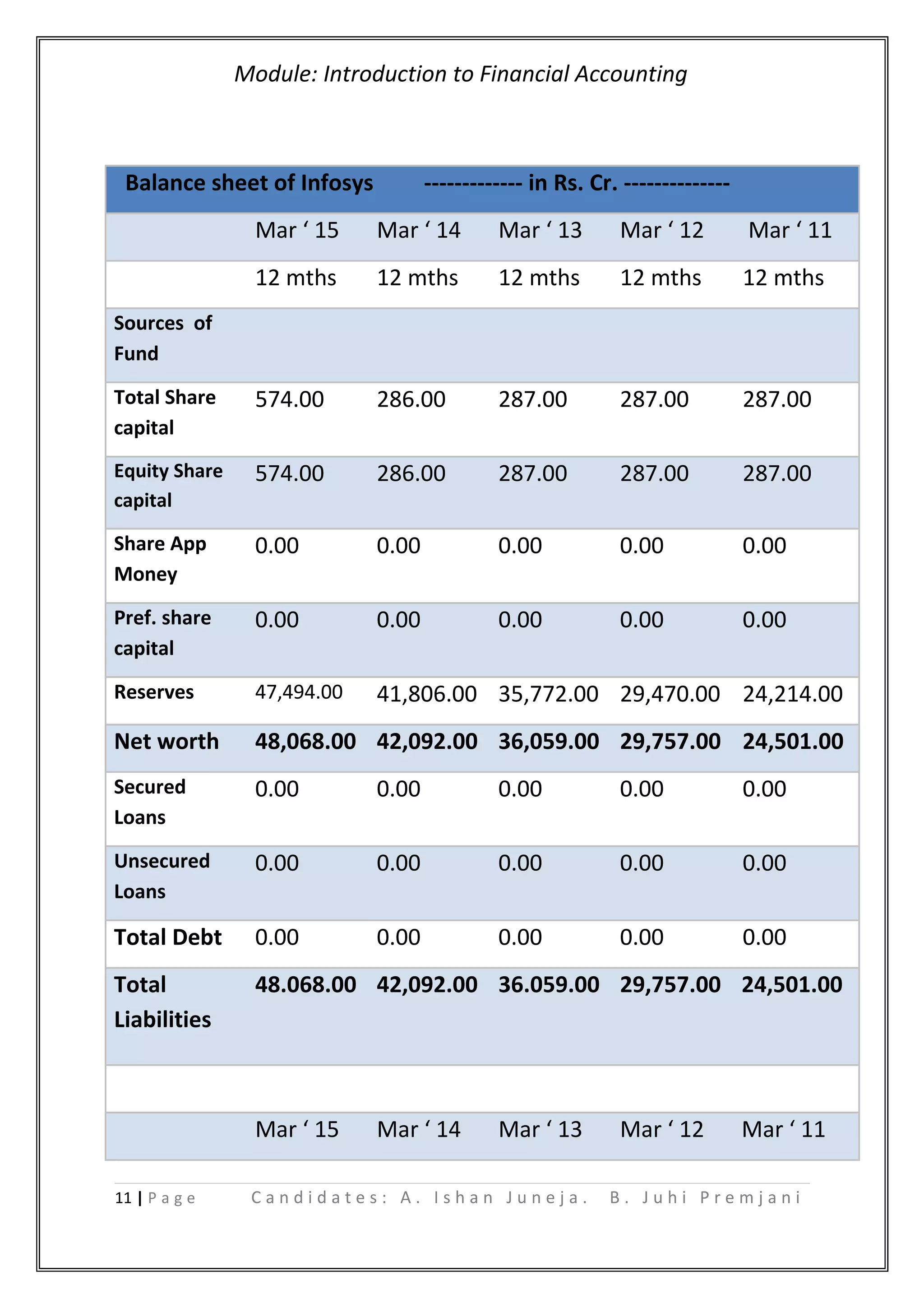
Balance sheet of Infosys ------------- in Rs. Cr. --------------
Mar ‘ 15 Mar ‘ 14 Mar ‘ 13 Mar ‘ 12 Mar ‘ 11
12 mths 12 mths 12 mths 12 mths 12 mths
Sources of
Fund
Total Share
capital
574.00 286.00 287.00 287.00 287.00
Equity Share
capital
574.00 286.00 287.00 287.00 287.00
Share App
Money
0.00 0.00 0.00 0.00 0.00
Pref. share
capital
0.00 0.00 0.00 0.00 0.00
Reserves 47,494.00 41,806.00 35,772.00 29,470.00 24,214.00
Net worth 48,068.00 42,092.00 36,059.00 29,757.00 24,501.00
Secured
Loans
0.00 0.00 0.00 0.00 0.00
Unsecured
Loans
0.00 0.00 0.00 0.00 0.00
Total Debt 0.00 0.00 0.00 0.00 0.00
Total
Liabilities
48.068.00 42,092.00 36.059.00 29,757.00 24,501.00
Mar ‘ 15 Mar ‘ 14 Mar ‘ 13 Mar ‘ 12 Mar ‘ 11
11 | P a g e C a n d i d a t e s : A . I s h a n J u n e j a . B . J u h i P r e m j a n i
Module: Introduction to Financial Accounting
12 mths 12 mths 12 mths 12 mths 12 mths
Application
Of funds
Gross Block 12,827.00 10,374.00 8,029.00 4,061.00 4,056.00
Less:
Revaluation
Reserves
0.00 0.00 0.00 0.00 0.00
Less: Accum.
Depreciation
5,480.00 4,642.00 3,576.00 0.00 0.00
Net Block 7,347.00 5,732.00 4,453.00 4,061.00 4,056.00
Capital work
in progress
769.00 954.00 1,135.00 588.00 249.00
Investments 6,857.00 6,717.00 4,344.00 1,409.00 1,325.00
Inventories 0.00 0.00 0.00 0.00 0.00
Sundry
Debtors
8,627.00 7,336.00 6,365.00 5,404.00 4,212.00
Cash and
Bank Bal.
27,722.00 24,100.00 20,401.00 18,057.00 13,665.00
Total Current
Assets
36,349.00 31,436.00 26,766.00 23,461.00 17,877.00
Loans and
advances
10,491.00 7,873.00 6,330.00 6,296.00 5,347.00
Fixed
deposits
0.00 0.00 0.00 0.00 0.00
12 | P a g e C a n d i d a t e s : A . I s h a n J u n e j a . B . J u h i P r e m j a n i
Module: Introduction to Financial Accounting
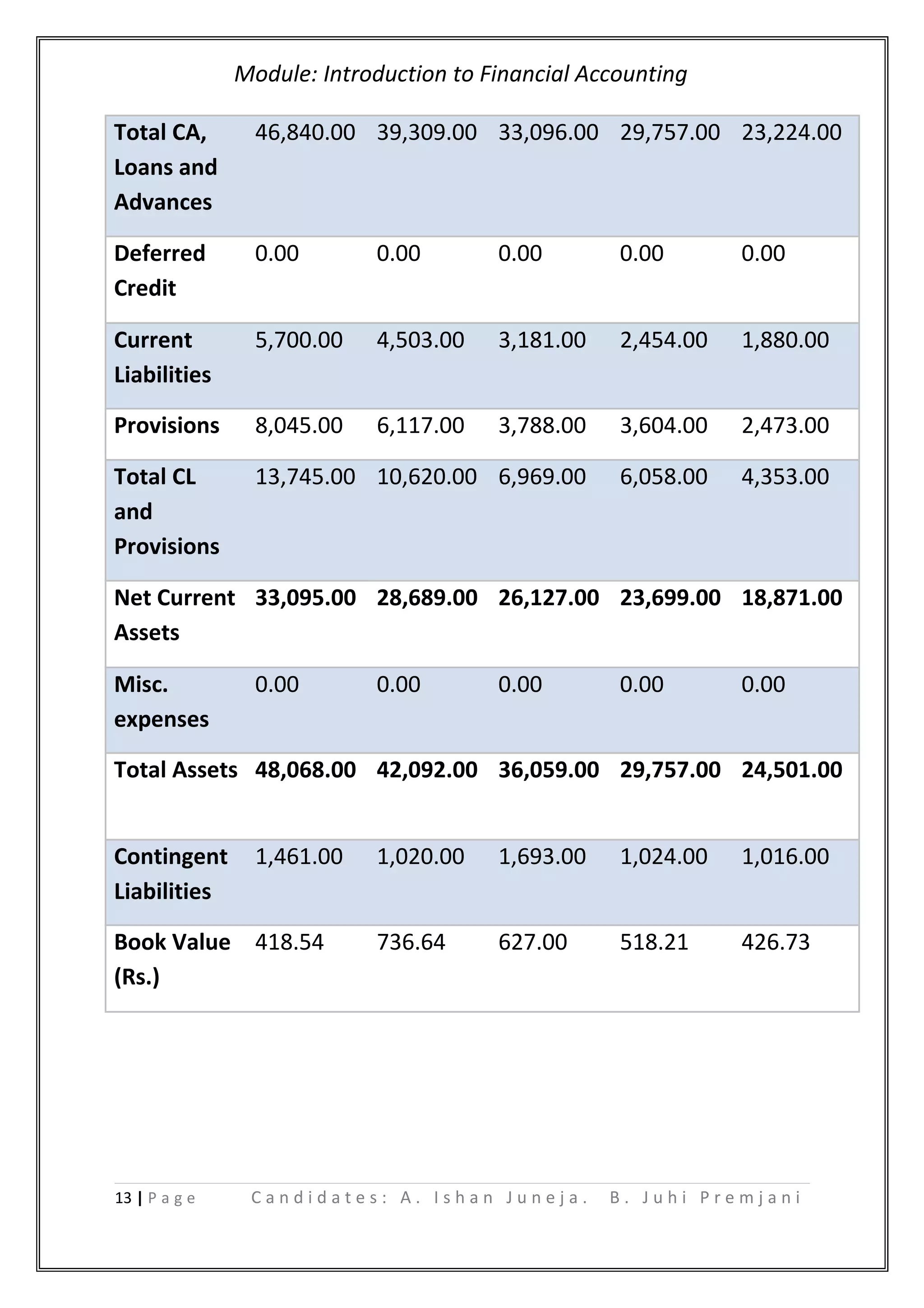
Total CA,
Loans and
Advances
46,840.00 39,309.00 33,096.00 29,757.00 23,224.00
Deferred
Credit
0.00 0.00 0.00 0.00 0.00
Current
Liabilities
5,700.00 4,503.00 3,181.00 2,454.00 1,880.00
Provisions 8,045.00 6,117.00 3,788.00 3,604.00 2,473.00
Total CL
and
Provisions
13,745.00 10,620.00 6,969.00 6,058.00 4,353.00
Net Current
Assets
33,095.00 28,689.00 26,127.00 23,699.00 18,871.00
Misc.
expenses
0.00 0.00 0.00 0.00 0.00
Total Assets 48,068.00 42,092.00 36,059.00 29,757.00 24,501.00
Contingent
Liabilities
1,461.00 1,020.00 1,693.00 1,024.00 1,016.00
Book Value
(Rs.)
418.54 736.64 627.00 518.21 426.73
13 | P a g e C a n d i d a t e s : A . I s h a n J u n e j a . B . J u h i P r e m j a n i
Module: Introduction to Financial Accounting
Period Instrument Authorized
Capital
Issued
Capital
PAID-UP
From To ( In Rs. ) ( In Rs. ) Shares
(nos)
Face
Value
Capital
2014 2015 Equity
Share
600 574.24 1,14,84,
72,332
5 574.24
2013 2014 Equity
share
300 285.7 57,14,02
,566
5 285.7
2012 2013 Equity
Share
300 287.08 57,41,51
,559
5 287.08
2011 2012 Equity
Share
300 287.08 57,41,51
,559
5 287.08
2010 2011 Equity
Share
300 287.08 57,41,51
,559
5 287.08
14 | P a g e C a n d i d a t e s : A . I s h a n J u n e j a . B . J u h i P r e m j a n i
Module: Introduction to Financial Accounting
0
100
200
300
400
500
600
2014-
15
2013-
14
2012-
13
2011-
12
2010-
11
Authorized Capital
Issued Capital
Different tools which can be considered for determining the
position of the company:
15 | P a g e C a n d i d a t e s : A . I s h a n J u n e j a . B . J u h i P r e m j a n i
Module: Introduction to Financial Accounting
1. Payback Period
2. Accounting Rate of Return
3. Net Present Value
4. Working Capital
5. Cash Flow Forecast
6. Variance Analysis
7. Net Assets
8. Owners’ Equity
9. Depreciation
10. Intangible Assets
11. Stock Valuation
12. Ratio Analysis
a. Gross Profit Margin g. Debtors Days
b. Net Profit Margin h. Creditor Days
c. Current Ratio i. Earnings per Share
d. Quick Ratio j. Dividend Yield
e. Stock Turnover k. Gearing Ratio
f. Return on Investment
16 | P a g e C a n d i d a t e s : A . I s h a n J u n e j a . B . J u h i P r e m j a n i
Module: Introduction to Financial Accounting
Mar ‘ 15 Mar ‘ 14 Mar ‘ 13 Mar ‘ 12 Mar ‘ 11
Investment
valuation
Ratios
Face Value 5.00 5.00 5.00 5.00 5.00
Dividend per
Share
59.50 63.00 42.00 47.00 60.00
Operation
Profit per
Share (Rs)
121.57 219.23 191.82 175.21 146.55
Net Operating
Profit per
Share (Rs)
411.85 776.00 640.24 544.28 442.13
Bonus in
Equity Capital
96.63 93.58 93.26 93.26 93.26
Profitability
Ratios
Adjusted Cash
Margin (%)
25.01 24.07 25.62 26.53 27.07
Net Profit 25.71 22.99 24.79 27.10 25.38
17 | P a g e C a n d i d a t e s : A . I s h a n J u n e j a . B . J u h i P r e m j a n i
Module: Introduction to Financial Accounting
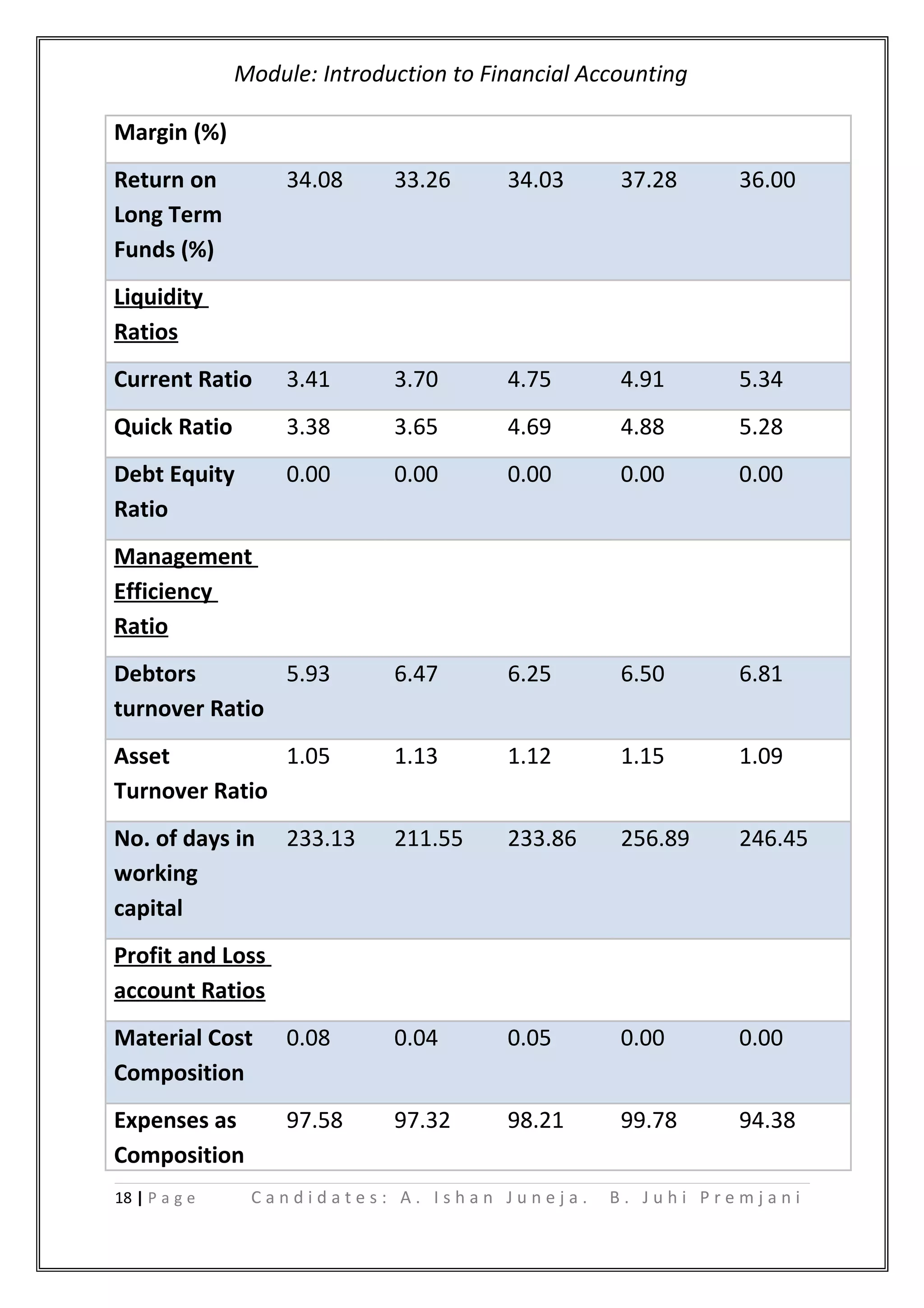
Margin (%)
Return on
Long Term
Funds (%)
34.08 33.26 34.03 37.28 36.00
Liquidity
Ratios
Current Ratio 3.41 3.70 4.75 4.91 5.34
Quick Ratio 3.38 3.65 4.69 4.88 5.28
Debt Equity
Ratio
0.00 0.00 0.00 0.00 0.00
Management
Efficiency
Ratio
Debtors
turnover Ratio
5.93 6.47 6.25 6.50 6.81
Asset
Turnover Ratio
1.05 1.13 1.12 1.15 1.09
No. of days in
working
capital
233.13 211.55 233.86 256.89 246.45
Profit and Loss
account Ratios
Material Cost
Composition
0.08 0.04 0.05 0.00 0.00
Expenses as
Composition
97.58 97.32 98.21 99.78 94.38
18 | P a g e C a n d i d a t e s : A . I s h a n J u n e j a . B . J u h i P r e m j a n i
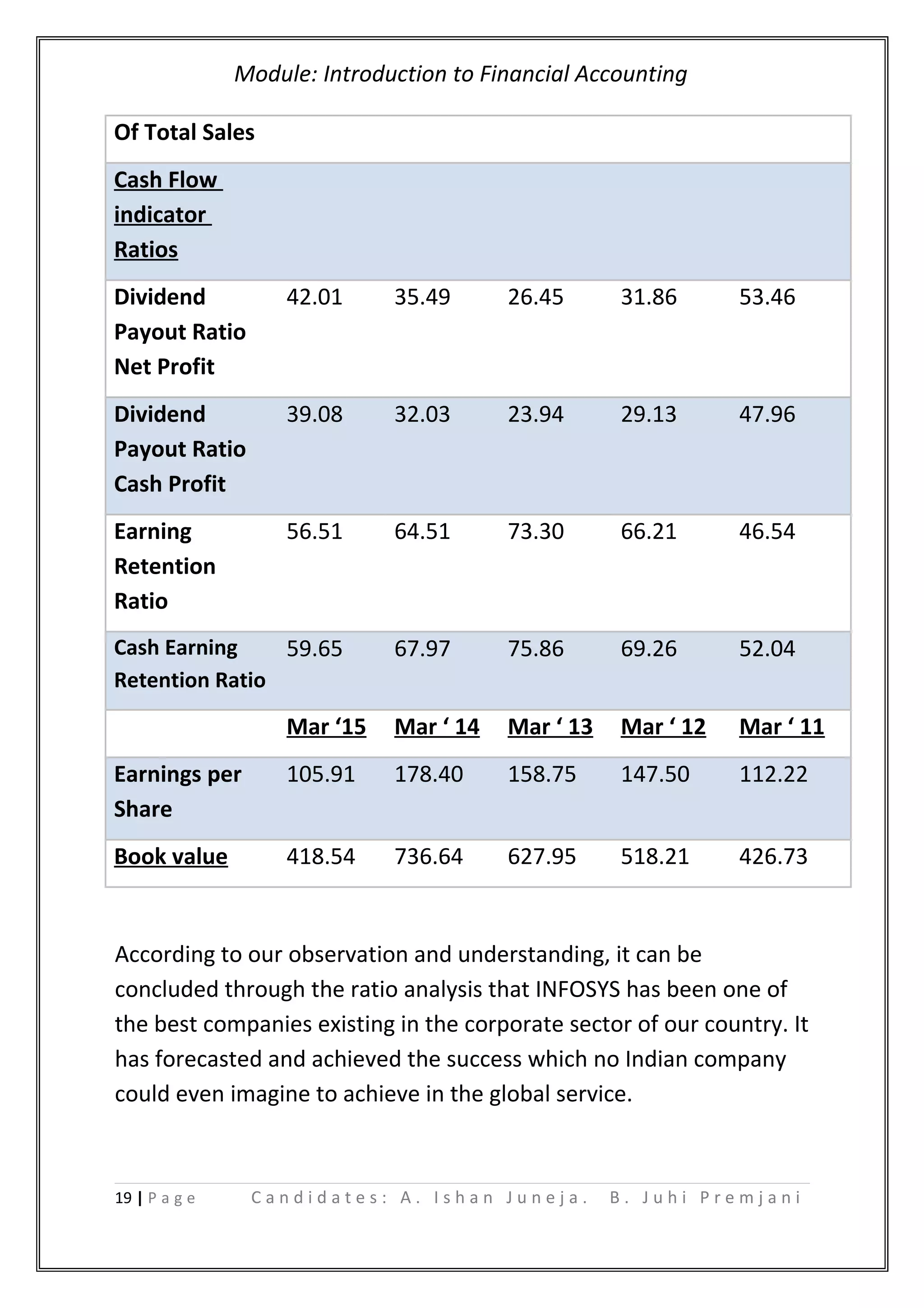
Module: Introduction to Financial Accounting
Of Total Sales
Cash Flow
indicator
Ratios
Dividend
Payout Ratio
Net Profit
42.01 35.49 26.45 31.86 53.46
Dividend
Payout Ratio
Cash Profit
39.08 32.03 23.94 29.13 47.96
Earning
Retention
Ratio
56.51 64.51 73.30 66.21 46.54
Cash Earning
Retention Ratio
59.65 67.97 75.86 69.26 52.04
Mar ‘15 Mar ‘ 14 Mar ‘ 13 Mar ‘ 12 Mar ‘ 11
Earnings per
Share
105.91 178.40 158.75 147.50 112.22
Book value 418.54 736.64 627.95 518.21 426.73
According to our observation and understanding, it can be
concluded through the ratio analysis that INFOSYS has been one of
the best companies existing in the corporate sector of our country. It
has forecasted and achieved the success which no Indian company
could even imagine to achieve in the global service.
19 | P a g e C a n d i d a t e s : A . I s h a n J u n e j a . B . J u h i P r e m j a n i
Module: Introduction to Financial Accounting
Where does INFOSYS invest:
• Automation
• Machine Learning
• Artificial Intelligence (AI)
• Analytics & Big Data
• Learning, Collaboration & Design
Number Title
Period beginning on or after
Mandatory for
accounting
20 | P a g e C a n d i d a t e s : A . I s h a n J u n e j a . B . J u h i P r e m j a n i
Module: Introduction to Financial Accounting
AS 1 Disclosure of accounting
policies
1.4.1991
AS 2 (Revised) Valuation of Inventories 1.4.1999
AS 3 (Revised) Cash Flow Statements 1.4.2001
AS 4 (Revised) Contingencies and events
occurring after the balance
sheet Date
1.4.1995
AS 5 (Revised) Prior Period and Extra ordinary
Items and Changes in
Accounting Policies
1.4.1996
AS 6 (Revised) Depreciation Accounting 1.4.1995
AS 7 (Revised) Accounting for Construction
Contracts
1.4.2003
AS 8 Accounting for Research and
Developments
1.4.1991
AS 9 Revenue Recognition 1.4.1991
AS 10 Accounting for Fixed Assets 1.4.1991
AS 11 (Revised
2003)
Accounting for the effect of
Changes in Foreign Rates
1.4.2004
AS 12 Accounting for Government
Grants
1.4.1995
AS 13 Accounting for Investments 1.4.1995
AS 14 Accounting for Amalgamations 1.4.1994
AS 15 (Revised) Employee Benefits 7.12.2006
AS 16 Borrowing Costs 1.4.2000
21 | P a g e C a n d i d a t e s : A . I s h a n J u n e j a . B . J u h i P r e m j a n i
Module: Introduction to Financial Accounting
AS 17 Segment Reporting 1.4.2001
AS 18 Related party Disclosures 1.4.2001
AS 19 Leases 1.4.2001
AS 20 Earnings per Share 1.4.2001
AS 21 Accounting for Investments in
Subsidiaries
1.4.2001
AS 22 Accounting for Taxes on Income 1.4.2001
AS 23 Accounting for Investments in
Associates
1.4.2002
AS 24 Discontinuing Operations 1.4.2004
AS 25 Interim Financial Reporting 1.4.2002
AS 26 Intangible Assets 1.4.2003
AS 27 Financial Reporting of Interest
in Joint Ventures
1.4.2002
AS 28 Impairment of Assets 1.4.2004
AS 29 Provisions, Contingent
Liabilities and Contingent
Assets
1.4.2004
AS 30 Financial Instruments:
Recognition and Measurements
1.4.2011
AS 31 Financial Instruments:
Presentations
1.4.2011
AS 32 Financial Instruments:
Disclosures
1.4.2011
22 | P a g e C a n d i d a t e s : A . I s h a n J u n e j a . B . J u h i P r e m j a n i
Module: Introduction to Financial Accounting
*Mandatory:
1. For enterprises whose debts or securities are listed on a
recognised stock exchange in India, and
2. All other commercial or industrial enterprises whose turnover for
the accounting period exceeds Rs 50 crores.
Accounting software describes a type of application
software that records and processes accounting transactions
within functional modules such as accounts payable, accounts
receivable, payroll, and trial balance. It functions as
an accounting information system.
1. Oracle Accounting Software:
23 | P a g e C a n d i d a t e s : A . I s h a n J u n e j a . B . J u h i P r e m j a n i
Module: Introduction to Financial Accounting
Oracle's JD Edwards EnterpriseOne Accounts Receivable
streamlines and accelerates the process of applying receipts,
giving you real-time accounts receivable information. Handle
complex transactions quickly and automatically, minimize the
need for manual processing, improve your customer
relationships, and enhance your organization's ability to
respond to credit and collections issues.
JD Edwards EnterpriseOne Accounts Receivable is part of
Oracle's JD Edwards EnterpriseOne financial management
family of applications.
Advantages of Oracle Software as compared to other
accounting softwares:
1. Workflow tailored to your business processes.
24 | P a g e C a n d i d a t e s : A . I s h a n J u n e j a . B . J u h i P r e m j a n i
Module: Introduction to Financial Accounting
2. Detailed account visibility that allows you to see when
and how customers are paying, and the discounts they
are taking advantage of.
3. Multinational functionality, including multi-currency
processing and international tax management.
4. User-definable collections criteria from a combination
of variables.
5. Simplified handling of nonstandard customer
deductions.
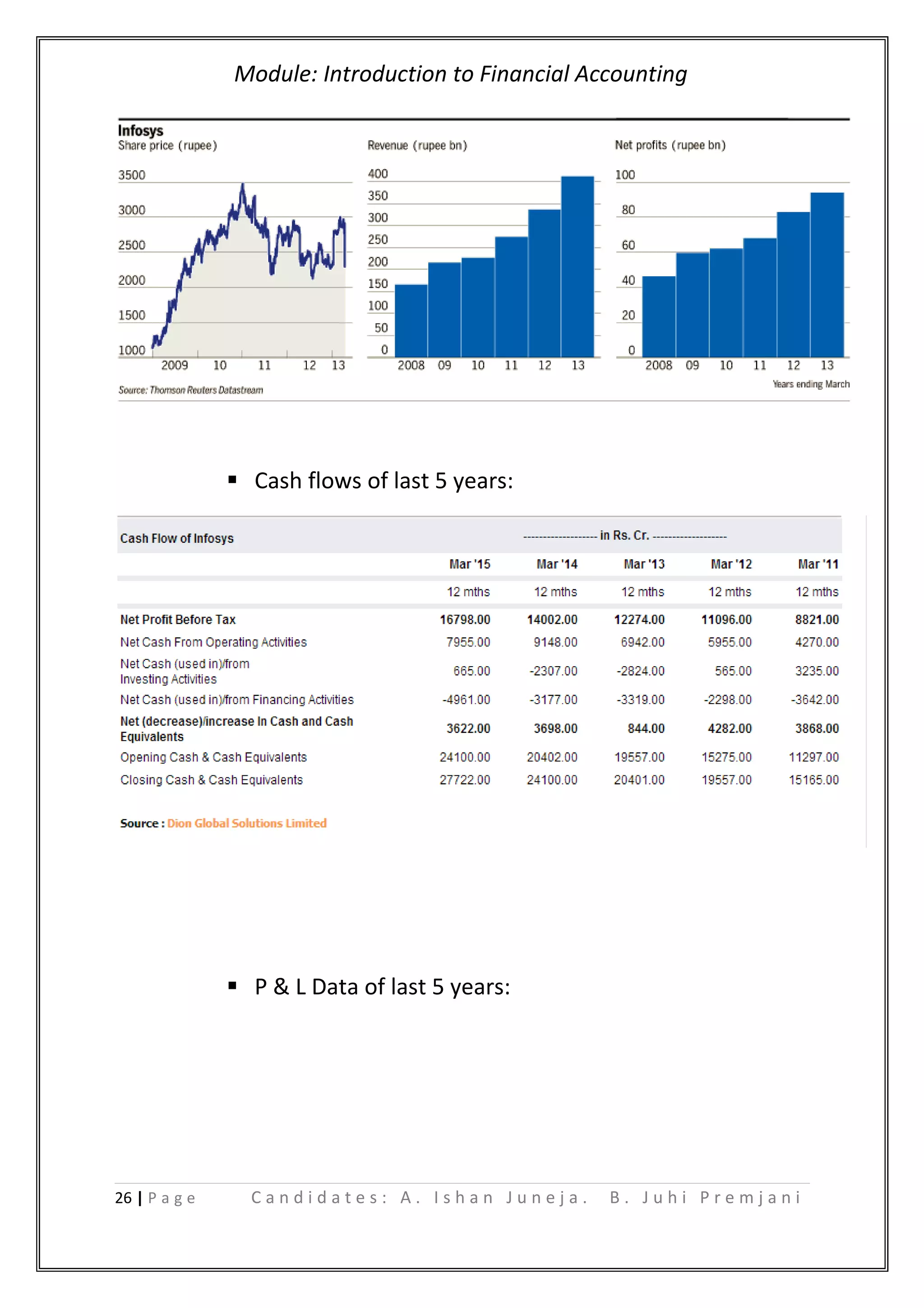
 Share prices, revenue and net profit to support
Infosys:
25 | P a g e C a n d i d a t e s : A . I s h a n J u n e j a . B . J u h i P r e m j a n i
Module: Introduction to Financial Accounting
 Cash flows of last 5 years:
 P & L Data of last 5 years:
26 | P a g e C a n d i d a t e s : A . I s h a n J u n e j a . B . J u h i P r e m j a n i
Module: Introduction to Financial Accounting
 Growth Ratios of last 5 years:
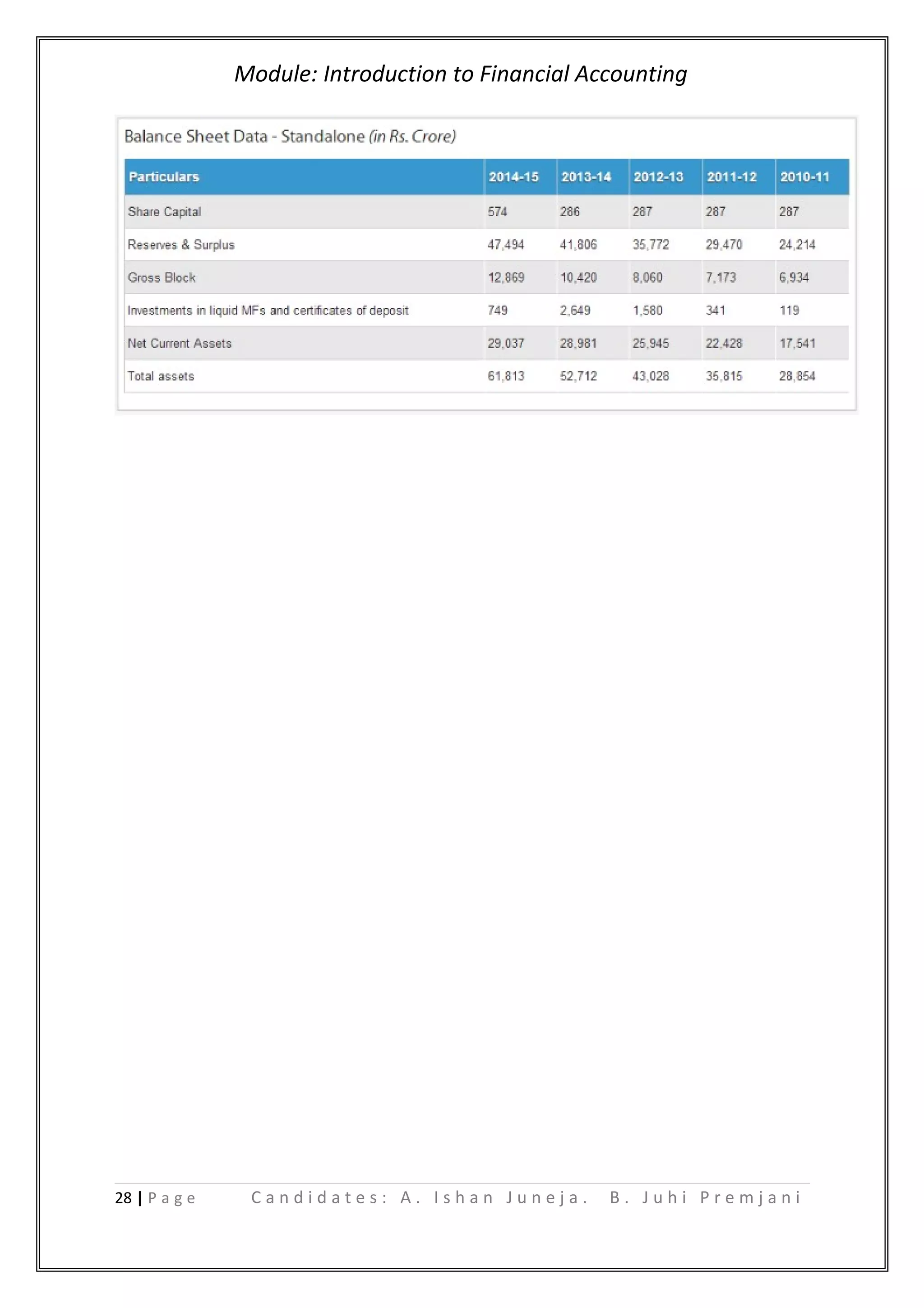
 Standalone Balance sheet to show the increase in total
assets of Infosys:
27 | P a g e C a n d i d a t e s : A . I s h a n J u n e j a . B . J u h i P r e m j a n i
Module: Introduction to Financial Accounting
28 | P a g e C a n d i d a t e s : A . I s h a n J u n e j a . B . J u h i P r e m j a n i
Module: Introduction to Financial Accounting
Finally in conclusion we would like to explain the
future options of Infosys with the help of ‘AIKIDO’
which is launched by the CEO of INFOSYS.
Aim: Next-Generation Services in Design Thinking, Platforms
and Knowledge-Based IT.
Its Services aims at helping their clients address three key
aspects of their business: a non-disruptive renewal and
simplification of their existing landscapes; introduction of new
offerings and business models in a dynamic business
environment, and creating a culture of innovation in their
organizations.
29 | P a g e C a n d i d a t e s : A . I s h a n J u n e j a . B . J u h i P r e m j a n i
Module: Introduction to Financial Accounting
 http://www.infosys.com/about/management-
profiles/Pages/index.aspx
 http://www.infosys.com/investors/reports-
filings/annual-report/Pages/index.aspx
 http://www.moneycontrol.com/financials/infosys/bala
nce-sheet/IT#IT
 http://www.moneycontrol.com/financials/infosys/ratio
s/IT#IT
 http://www.moneycontrol.com/financials/infosys/capit
al-structure/IT#IT
 https://www.google.co.in/search?
q=infosys&biw=1093&bih=534&source=lnms&tbm=isch
&sa=X&ved=0CAgQ_AUoA2oVChMI97Wgq6rWxwIVyQi
OCh19WQQp
 http://www.moneyworks4me.com/indianstocks/large-
cap/it-ites/it-software/infosys/company-info
30 | P a g e C a n d i d a t e s : A . I s h a n J u n e j a . B . J u h i P r e m j a n i

Accounting report infosys company

  • 1.
    Module: Introduction toFinancial Accounting Accounting Analysis Of The Company SUBMITTED TO: MRS. DHAARNA SINGH RATHORE 1 | P a g e C a n d i d a t e s : A . I s h a n J u n e j a . B . J u h i P r e m j a n i
  • 2.
    Module: Introduction toFinancial Accounting I take this opportunity to express gratitude and deep regards to my guide (respected professor DHAARNA SINGH RATHOD) for her exemplary guidance, monitoring and constant encouragement throughout the course of this thesis. The blessings, help and guidance given by her carry us a long way in the journey of life on which I am about to embark. I am obliged to staff members of Auro University, for the valuable information provided by them in their respective fields. I am grateful for their cooperation during the period of my review paper. Lastly, I thank the almighty, my parents and financial accounting module leader for their constant encouragement without which the review paper would not be possible. 2 | P a g e C a n d i d a t e s : A . I s h a n J u n e j a . B . J u h i P r e m j a n i
  • 3.
    Module: Introduction toFinancial Accounting 3 | P a g e C a n d i d a t e s : A . I s h a n J u n e j a . B . J u h i P r e m j a n i Serial number Topic Page number 1. Company profile 4 2. Introduction of Infosys 5 3. Summary of the report 6 4. Accounting Principles 7 5. Balance sheet of Infosys 11 6. Capital Structure 15 7. Ratio Analysis 18 8. Accounting Standards 22 9. Accounting Software used 25 10. Credibility of Infosys 27 11. Conclusion 31 12. References 32
  • 4.
    Module: Introduction toFinancial Accounting Name of the Company: INFOSYS Names Age Current Position N.R Narayana Murthy 69 Founder of the board Dr. Vishal Sikka 58 Chief executive officer and managing director Pravin Rao 49 Chief Operating Officer R. Seshasayee 46 Chairman of the board Carol. M browner 51 Independent Director Prof. John W. Etchemendy 58 Independent Director Roopa Kudva 54 Independent Director Jeffrey Sean Lehman 43 Independent Director Ravi Venkatesan 48 Independent Director Kiran Mazumder-Shaw 52 Independent director 4 | P a g e C a n d i d a t e s : A . I s h a n J u n e j a . B . J u h i P r e m j a n i
  • 5.
    Module: Introduction toFinancial Accounting Infosys is a global leader in consulting, technology, and outsourcing and next-generation services. It enables clients in more than 50 countries to outperform the competition and stay ahead of the innovation curve. With US$8.83 billion in LTM Q1 FY16 revenues and 179,000+ employees, it is helping enterprises to renew themselves while also creating new avenues to generate value. It provides enterprises with strategic insights on what lies ahead. It helps enterprises to transform and thrive in a changing world through strategic consulting, operational leadership, and the co-creation of breakthrough solutions, including those in mobility, sustainability, big data, and cloud computing. Infosys has a growing global presence with more than 179,000+ employees. Globally, it has 85 sales and marketing offices and 100 development centres as at March 31, 2015. Milestones  Board decides to increase the dividend pay-out ratio to up to 50% of post-tax profits.  Infosys announces USD 250 million ‘Innovate in India Fund’ to support Indian start-ups.  Infosys acquired Panaya, Inc., a leading provider of automation technology for large scale enterprise software management. The Report of Infosys includes: 5 | P a g e C a n d i d a t e s : A . I s h a n J u n e j a . B . J u h i P r e m j a n i
  • 6.
    Module: Introduction toFinancial Accounting  Accounting principles followed by INFOSYS.  Accounting standards followed- and methods under each standard.  Accounting software followed (Computer and accounting) by INFOSYS.  Capital structure of the company and fluctuations if any in last five years.  Personal comments on company’s credibility and market position. Accounting Principles: 6 | P a g e C a n d i d a t e s : A . I s h a n J u n e j a . B . J u h i P r e m j a n i
  • 7.
    Module: Introduction toFinancial Accounting Accounting Principles are those rules of action adopted by the accountants universally while recording accounting transactions. The principles of accounting are classified into two sub categories which are as follows: CONCEPTS CONVENTIONS Business Entity Consistency Money Measurement Full Disclosure Going Concern Conservatism Cost Concept Materiality Dual Aspect -- Accounting Period -- Matching concept -- Accounting Concepts are the basic assumptions or conditions upon which the science of accounting is based. CONCEPTS: 7 | P a g e C a n d i d a t e s : A . I s h a n J u n e j a . B . J u h i P r e m j a n i
  • 8.
    Module: Introduction toFinancial Accounting Business Entity: This concept implies that a business unit is separate and distinct from the persons who supplies capital to it. Irrespective of the form of organization, a business unit has got its own individuality as distinguished from the persons who own or control it. The accounting equation (i.e. Assets= Liabilities + Capital) is the best example. Money measurement: Money is the only practical unit of measurement that can be employed to achieve homogeneity of financial data, so accounting records have only those transactions which can be expressed in terms of money. Example: sales, purchases and so on. Going Concern: It is assumed that a business unit has a reasonable expectation of continuing business at a profit for an indefinite period of time. Due to this concept the suppliers supply goods on credit and the fixed assets are recorded at original cost and not at liquidation value; depreciation is also charged on original cost without concern to realization value. Cost concept: Cost concept means that the amount where any asset is bought is to be written in the financial statement. The marked price is not to be written here but exact the amount in which the asset is bought should be written. Hence the assets are recorded at the cost incurred in acquiring them. It will reduce the scope for subjectivity and personal bias. Dual Aspect: This is the basic concept of accounting. According to this concept, every financial transaction involves a two-fold aspect: yielding of that benefit and giving of that benefit. So there must be two effects one receiving 8 | P a g e C a n d i d a t e s : A . I s h a n J u n e j a . B . J u h i P r e m j a n i
  • 9.
    Module: Introduction toFinancial Accounting effect and the other giving effect. That’s why every debit has a corresponding credit. Accounting Period: The measurement of business income or a loss on a whole life basis is very simple. But for that purpose the company has to be liquidated to find the performance. To get out of this, the final accounts are prepared on periodical basis normal for a year. Matching: This concept is based on the accounting period concept. The most important objective of running a business is to ascertain profit periodically. The determination of profit of a particular accounting period is essentially a process of matching the revenue recognized during the period and the costs to be allocated to the period to obtain the revenue. CONVENTIONS: Accounting conventions: The term convention denotes circumstances or traditions which guide the accountants while preparing the accounting statements. Consistency: Accounting rules, practices and conventions should be continuously observed and applied i.e., they should not change from one year to another. The results of different years will be comparable only when accounting rules are continuously adhered to from year to year. Full Disclosure: According to this convention, all accounting statements should be honestly prepared and to that end full disclosure of all significant information should be made. All information which is of material 9 | P a g e C a n d i d a t e s : A . I s h a n J u n e j a . B . J u h i P r e m j a n i
  • 10.
    Module: Introduction toFinancial Accounting interest to proprietors, creditors and investors should be disclosed in accounting statements. Conservatism: Conservatism means taking the gloomy view of a situation. It is a policy of caution or playing safe. With this, the businessmen take into account all the possible losses which may occur and ignore the possible gains in future while recording the accounts. The closing stock is valued at market price or cost price whichever is less. Materiality: Whether something should be disclosed in the accounts or not in the financial statements will depend on whether it is material or not. Materiality depends on the amount involved in the transaction. For example, the expense incurred in purchasing a waste basket worth Rs.50 is termed as expense for the year rather than an asset. Customs also drives the materiality only round figures have to be recorded to make the figures manageable without affecting the accuracy. NOTE: The financial statements of INFOSYS and its subsidiaries are prepared in compliance with the Companies Act, 1956 and generally accepted accounting principles in India (Indian GAAP). INFOSYS is following the revised schedule VI as notified by the Ministry of Corporate Affairs with effect from April 1, 2011, in the financial statements under discussion. 10 | P a g e C a n d i d a t e s : A . I s h a n J u n e j a . B . J u h i P r e m j a n i
  • 11.
    Module: Introduction toFinancial Accounting Balance sheet of Infosys ------------- in Rs. Cr. -------------- Mar ‘ 15 Mar ‘ 14 Mar ‘ 13 Mar ‘ 12 Mar ‘ 11 12 mths 12 mths 12 mths 12 mths 12 mths Sources of Fund Total Share capital 574.00 286.00 287.00 287.00 287.00 Equity Share capital 574.00 286.00 287.00 287.00 287.00 Share App Money 0.00 0.00 0.00 0.00 0.00 Pref. share capital 0.00 0.00 0.00 0.00 0.00 Reserves 47,494.00 41,806.00 35,772.00 29,470.00 24,214.00 Net worth 48,068.00 42,092.00 36,059.00 29,757.00 24,501.00 Secured Loans 0.00 0.00 0.00 0.00 0.00 Unsecured Loans 0.00 0.00 0.00 0.00 0.00 Total Debt 0.00 0.00 0.00 0.00 0.00 Total Liabilities 48.068.00 42,092.00 36.059.00 29,757.00 24,501.00 Mar ‘ 15 Mar ‘ 14 Mar ‘ 13 Mar ‘ 12 Mar ‘ 11 11 | P a g e C a n d i d a t e s : A . I s h a n J u n e j a . B . J u h i P r e m j a n i
  • 12.
    Module: Introduction toFinancial Accounting 12 mths 12 mths 12 mths 12 mths 12 mths Application Of funds Gross Block 12,827.00 10,374.00 8,029.00 4,061.00 4,056.00 Less: Revaluation Reserves 0.00 0.00 0.00 0.00 0.00 Less: Accum. Depreciation 5,480.00 4,642.00 3,576.00 0.00 0.00 Net Block 7,347.00 5,732.00 4,453.00 4,061.00 4,056.00 Capital work in progress 769.00 954.00 1,135.00 588.00 249.00 Investments 6,857.00 6,717.00 4,344.00 1,409.00 1,325.00 Inventories 0.00 0.00 0.00 0.00 0.00 Sundry Debtors 8,627.00 7,336.00 6,365.00 5,404.00 4,212.00 Cash and Bank Bal. 27,722.00 24,100.00 20,401.00 18,057.00 13,665.00 Total Current Assets 36,349.00 31,436.00 26,766.00 23,461.00 17,877.00 Loans and advances 10,491.00 7,873.00 6,330.00 6,296.00 5,347.00 Fixed deposits 0.00 0.00 0.00 0.00 0.00 12 | P a g e C a n d i d a t e s : A . I s h a n J u n e j a . B . J u h i P r e m j a n i
  • 13.
    Module: Introduction toFinancial Accounting Total CA, Loans and Advances 46,840.00 39,309.00 33,096.00 29,757.00 23,224.00 Deferred Credit 0.00 0.00 0.00 0.00 0.00 Current Liabilities 5,700.00 4,503.00 3,181.00 2,454.00 1,880.00 Provisions 8,045.00 6,117.00 3,788.00 3,604.00 2,473.00 Total CL and Provisions 13,745.00 10,620.00 6,969.00 6,058.00 4,353.00 Net Current Assets 33,095.00 28,689.00 26,127.00 23,699.00 18,871.00 Misc. expenses 0.00 0.00 0.00 0.00 0.00 Total Assets 48,068.00 42,092.00 36,059.00 29,757.00 24,501.00 Contingent Liabilities 1,461.00 1,020.00 1,693.00 1,024.00 1,016.00 Book Value (Rs.) 418.54 736.64 627.00 518.21 426.73 13 | P a g e C a n d i d a t e s : A . I s h a n J u n e j a . B . J u h i P r e m j a n i
  • 14.
    Module: Introduction toFinancial Accounting Period Instrument Authorized Capital Issued Capital PAID-UP From To ( In Rs. ) ( In Rs. ) Shares (nos) Face Value Capital 2014 2015 Equity Share 600 574.24 1,14,84, 72,332 5 574.24 2013 2014 Equity share 300 285.7 57,14,02 ,566 5 285.7 2012 2013 Equity Share 300 287.08 57,41,51 ,559 5 287.08 2011 2012 Equity Share 300 287.08 57,41,51 ,559 5 287.08 2010 2011 Equity Share 300 287.08 57,41,51 ,559 5 287.08 14 | P a g e C a n d i d a t e s : A . I s h a n J u n e j a . B . J u h i P r e m j a n i
  • 15.
    Module: Introduction toFinancial Accounting 0 100 200 300 400 500 600 2014- 15 2013- 14 2012- 13 2011- 12 2010- 11 Authorized Capital Issued Capital Different tools which can be considered for determining the position of the company: 15 | P a g e C a n d i d a t e s : A . I s h a n J u n e j a . B . J u h i P r e m j a n i
  • 16.
    Module: Introduction toFinancial Accounting 1. Payback Period 2. Accounting Rate of Return 3. Net Present Value 4. Working Capital 5. Cash Flow Forecast 6. Variance Analysis 7. Net Assets 8. Owners’ Equity 9. Depreciation 10. Intangible Assets 11. Stock Valuation 12. Ratio Analysis a. Gross Profit Margin g. Debtors Days b. Net Profit Margin h. Creditor Days c. Current Ratio i. Earnings per Share d. Quick Ratio j. Dividend Yield e. Stock Turnover k. Gearing Ratio f. Return on Investment 16 | P a g e C a n d i d a t e s : A . I s h a n J u n e j a . B . J u h i P r e m j a n i
  • 17.
    Module: Introduction toFinancial Accounting Mar ‘ 15 Mar ‘ 14 Mar ‘ 13 Mar ‘ 12 Mar ‘ 11 Investment valuation Ratios Face Value 5.00 5.00 5.00 5.00 5.00 Dividend per Share 59.50 63.00 42.00 47.00 60.00 Operation Profit per Share (Rs) 121.57 219.23 191.82 175.21 146.55 Net Operating Profit per Share (Rs) 411.85 776.00 640.24 544.28 442.13 Bonus in Equity Capital 96.63 93.58 93.26 93.26 93.26 Profitability Ratios Adjusted Cash Margin (%) 25.01 24.07 25.62 26.53 27.07 Net Profit 25.71 22.99 24.79 27.10 25.38 17 | P a g e C a n d i d a t e s : A . I s h a n J u n e j a . B . J u h i P r e m j a n i
  • 18.
    Module: Introduction toFinancial Accounting Margin (%) Return on Long Term Funds (%) 34.08 33.26 34.03 37.28 36.00 Liquidity Ratios Current Ratio 3.41 3.70 4.75 4.91 5.34 Quick Ratio 3.38 3.65 4.69 4.88 5.28 Debt Equity Ratio 0.00 0.00 0.00 0.00 0.00 Management Efficiency Ratio Debtors turnover Ratio 5.93 6.47 6.25 6.50 6.81 Asset Turnover Ratio 1.05 1.13 1.12 1.15 1.09 No. of days in working capital 233.13 211.55 233.86 256.89 246.45 Profit and Loss account Ratios Material Cost Composition 0.08 0.04 0.05 0.00 0.00 Expenses as Composition 97.58 97.32 98.21 99.78 94.38 18 | P a g e C a n d i d a t e s : A . I s h a n J u n e j a . B . J u h i P r e m j a n i
  • 19.
    Module: Introduction toFinancial Accounting Of Total Sales Cash Flow indicator Ratios Dividend Payout Ratio Net Profit 42.01 35.49 26.45 31.86 53.46 Dividend Payout Ratio Cash Profit 39.08 32.03 23.94 29.13 47.96 Earning Retention Ratio 56.51 64.51 73.30 66.21 46.54 Cash Earning Retention Ratio 59.65 67.97 75.86 69.26 52.04 Mar ‘15 Mar ‘ 14 Mar ‘ 13 Mar ‘ 12 Mar ‘ 11 Earnings per Share 105.91 178.40 158.75 147.50 112.22 Book value 418.54 736.64 627.95 518.21 426.73 According to our observation and understanding, it can be concluded through the ratio analysis that INFOSYS has been one of the best companies existing in the corporate sector of our country. It has forecasted and achieved the success which no Indian company could even imagine to achieve in the global service. 19 | P a g e C a n d i d a t e s : A . I s h a n J u n e j a . B . J u h i P r e m j a n i
  • 20.
    Module: Introduction toFinancial Accounting Where does INFOSYS invest: • Automation • Machine Learning • Artificial Intelligence (AI) • Analytics & Big Data • Learning, Collaboration & Design Number Title Period beginning on or after Mandatory for accounting 20 | P a g e C a n d i d a t e s : A . I s h a n J u n e j a . B . J u h i P r e m j a n i
  • 21.
    Module: Introduction toFinancial Accounting AS 1 Disclosure of accounting policies 1.4.1991 AS 2 (Revised) Valuation of Inventories 1.4.1999 AS 3 (Revised) Cash Flow Statements 1.4.2001 AS 4 (Revised) Contingencies and events occurring after the balance sheet Date 1.4.1995 AS 5 (Revised) Prior Period and Extra ordinary Items and Changes in Accounting Policies 1.4.1996 AS 6 (Revised) Depreciation Accounting 1.4.1995 AS 7 (Revised) Accounting for Construction Contracts 1.4.2003 AS 8 Accounting for Research and Developments 1.4.1991 AS 9 Revenue Recognition 1.4.1991 AS 10 Accounting for Fixed Assets 1.4.1991 AS 11 (Revised 2003) Accounting for the effect of Changes in Foreign Rates 1.4.2004 AS 12 Accounting for Government Grants 1.4.1995 AS 13 Accounting for Investments 1.4.1995 AS 14 Accounting for Amalgamations 1.4.1994 AS 15 (Revised) Employee Benefits 7.12.2006 AS 16 Borrowing Costs 1.4.2000 21 | P a g e C a n d i d a t e s : A . I s h a n J u n e j a . B . J u h i P r e m j a n i
  • 22.
    Module: Introduction toFinancial Accounting AS 17 Segment Reporting 1.4.2001 AS 18 Related party Disclosures 1.4.2001 AS 19 Leases 1.4.2001 AS 20 Earnings per Share 1.4.2001 AS 21 Accounting for Investments in Subsidiaries 1.4.2001 AS 22 Accounting for Taxes on Income 1.4.2001 AS 23 Accounting for Investments in Associates 1.4.2002 AS 24 Discontinuing Operations 1.4.2004 AS 25 Interim Financial Reporting 1.4.2002 AS 26 Intangible Assets 1.4.2003 AS 27 Financial Reporting of Interest in Joint Ventures 1.4.2002 AS 28 Impairment of Assets 1.4.2004 AS 29 Provisions, Contingent Liabilities and Contingent Assets 1.4.2004 AS 30 Financial Instruments: Recognition and Measurements 1.4.2011 AS 31 Financial Instruments: Presentations 1.4.2011 AS 32 Financial Instruments: Disclosures 1.4.2011 22 | P a g e C a n d i d a t e s : A . I s h a n J u n e j a . B . J u h i P r e m j a n i
  • 23.
    Module: Introduction toFinancial Accounting *Mandatory: 1. For enterprises whose debts or securities are listed on a recognised stock exchange in India, and 2. All other commercial or industrial enterprises whose turnover for the accounting period exceeds Rs 50 crores. Accounting software describes a type of application software that records and processes accounting transactions within functional modules such as accounts payable, accounts receivable, payroll, and trial balance. It functions as an accounting information system. 1. Oracle Accounting Software: 23 | P a g e C a n d i d a t e s : A . I s h a n J u n e j a . B . J u h i P r e m j a n i
  • 24.
    Module: Introduction toFinancial Accounting Oracle's JD Edwards EnterpriseOne Accounts Receivable streamlines and accelerates the process of applying receipts, giving you real-time accounts receivable information. Handle complex transactions quickly and automatically, minimize the need for manual processing, improve your customer relationships, and enhance your organization's ability to respond to credit and collections issues. JD Edwards EnterpriseOne Accounts Receivable is part of Oracle's JD Edwards EnterpriseOne financial management family of applications. Advantages of Oracle Software as compared to other accounting softwares: 1. Workflow tailored to your business processes. 24 | P a g e C a n d i d a t e s : A . I s h a n J u n e j a . B . J u h i P r e m j a n i
  • 25.
    Module: Introduction toFinancial Accounting 2. Detailed account visibility that allows you to see when and how customers are paying, and the discounts they are taking advantage of. 3. Multinational functionality, including multi-currency processing and international tax management. 4. User-definable collections criteria from a combination of variables. 5. Simplified handling of nonstandard customer deductions.  Share prices, revenue and net profit to support Infosys: 25 | P a g e C a n d i d a t e s : A . I s h a n J u n e j a . B . J u h i P r e m j a n i
  • 26.
    Module: Introduction toFinancial Accounting  Cash flows of last 5 years:  P & L Data of last 5 years: 26 | P a g e C a n d i d a t e s : A . I s h a n J u n e j a . B . J u h i P r e m j a n i
  • 27.
    Module: Introduction toFinancial Accounting  Growth Ratios of last 5 years:  Standalone Balance sheet to show the increase in total assets of Infosys: 27 | P a g e C a n d i d a t e s : A . I s h a n J u n e j a . B . J u h i P r e m j a n i
  • 28.
    Module: Introduction toFinancial Accounting 28 | P a g e C a n d i d a t e s : A . I s h a n J u n e j a . B . J u h i P r e m j a n i
  • 29.
    Module: Introduction toFinancial Accounting Finally in conclusion we would like to explain the future options of Infosys with the help of ‘AIKIDO’ which is launched by the CEO of INFOSYS. Aim: Next-Generation Services in Design Thinking, Platforms and Knowledge-Based IT. Its Services aims at helping their clients address three key aspects of their business: a non-disruptive renewal and simplification of their existing landscapes; introduction of new offerings and business models in a dynamic business environment, and creating a culture of innovation in their organizations. 29 | P a g e C a n d i d a t e s : A . I s h a n J u n e j a . B . J u h i P r e m j a n i
  • 30.
    Module: Introduction toFinancial Accounting  http://www.infosys.com/about/management- profiles/Pages/index.aspx  http://www.infosys.com/investors/reports- filings/annual-report/Pages/index.aspx  http://www.moneycontrol.com/financials/infosys/bala nce-sheet/IT#IT  http://www.moneycontrol.com/financials/infosys/ratio s/IT#IT  http://www.moneycontrol.com/financials/infosys/capit al-structure/IT#IT  https://www.google.co.in/search? q=infosys&biw=1093&bih=534&source=lnms&tbm=isch &sa=X&ved=0CAgQ_AUoA2oVChMI97Wgq6rWxwIVyQi OCh19WQQp  http://www.moneyworks4me.com/indianstocks/large- cap/it-ites/it-software/infosys/company-info 30 | P a g e C a n d i d a t e s : A . I s h a n J u n e j a . B . J u h i P r e m j a n i