
TRINITY INSTITUTE OF PROFESSIONAL STUDIES
Sector – 9, Dwarka Institutional Area, New Delhi-75
Affiliated Institution of G.G.S.IP.U, Delhi
FINANCIAL ACCOUNTING
888101
B.COM(H)
BY: NAMRATA YADAV
TRINITY INSTITUTE OF PROFESSIONAL STUDIES
Sector – 9, Dwarka Institutional Area, New Delhi-75
ACCOUNTING
• “Accounting is the art of recording, classifying and summarizing in a
significant manner, and in terms of money, transactions and events which
are, in part at least, of financial character and interpreting the results
thereof.”
- the American Institute of Certified public Accountants (AICPA)
“Accounting is the process of identifying, measuring and communicating
economic information to permit informed judgments and decisions by
users of the information.”
-American Accounting Association
TRINITY INSTITUTE OF PROFESSIONAL STUDIES
Sector – 9, Dwarka Institutional Area, New Delhi-75
Financial Accounting
• Accounting and financial accounting are used interchangeably.
• Accounting is a tree while financial accounting is one of its
branch.
• Accounting that provides financial information to persons
outside the business entity is called financial accounting.
TRINITY INSTITUTE OF PROFESSIONAL STUDIES
Sector – 9, Dwarka Institutional Area, New Delhi-75
Features of Accounting
• Identifying: selecting transactions and events of separate nature
• Measuring: expressing the business transaction in terms of money
• Recording: recording in books of accounts
• Classifying: grouping of transactions of same type in separate accounts
• Summarizing: to bring together a number of classified account under one
single account. For example, the accounts of various
customers are grouped under as “Debtor’s Account”
• Significant: accounting information is presented in a significant manner
• for making decision
• Interpretation: explaining the meaning and significance of the
relationship so established
• Communication: communicating the results of interpretation of financial
statements to the end - users
TRINITY INSTITUTE OF PROFESSIONAL STUDIES
Sector – 9, Dwarka Institutional Area, New Delhi-75
OBJECTIVES OF ACCOUNTING
• Maintaining proper records
• Knowing the profit or loss of the business
• Ascertaining the source of items of revenue and expenses
• Ascertainment of financial position of the business
• Ascertaining the cash flows
• Communicating financial information to various groups of
users
• Ascertaining the financial position of debtors and creditors
TRINITY INSTITUTE OF PROFESSIONAL STUDIES
Sector – 9, Dwarka Institutional Area, New Delhi-75
OBECTIVES OF FINANCIAL ACCOUNTING
• Facilitating research in business operations
• Controlling the performance of the business
• Meeting legal requirements
TRINITY INSTITUTE OF PROFESSIONAL STUDIES
Sector – 9, Dwarka Institutional Area, New Delhi-75
ACOUNTING AS AN INFORMATION SYSTEM
• Accounting is often referred to as the language of business.
Accounting is used to communicate financial and other
information to people, organizations, governments etc, about
various aspects of business and non-business enterprises. The
accounting is, therefore, also an information system. Simply
stated accounting system converts inputs(financial
transactions) into outputs (financial statements) .
TRINITY INSTITUTE OF PROFESSIONAL STUDIES
Sector – 9, Dwarka Institutional Area, New Delhi-75
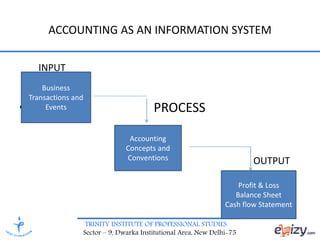
ACCOUNTING AS AN INFORMATION SYSTEM
INPUT
• PROCESS
OUTPUT
Business
Transactions and
Events
Accounting
Concepts and
Conventions
Profit & Loss
Balance Sheet
Cash flow Statement
TRINITY INSTITUTE OF PROFESSIONAL STUDIES
Sector – 9, Dwarka Institutional Area, New Delhi-75
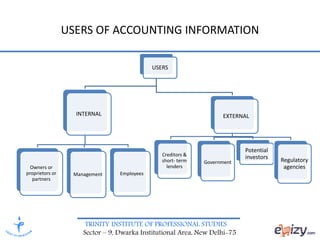
USERS OF ACCOUNTING INFORMATION
USERS
INTERNAL
Owners or
proprietors or
partners
Management Employees
EXTERNAL
Creditors &
short- term
lenders
Government
Potential
investors Regulatory
agencies
TRINITY INSTITUTE OF PROFESSIONAL STUDIES
Sector – 9, Dwarka Institutional Area, New Delhi-75
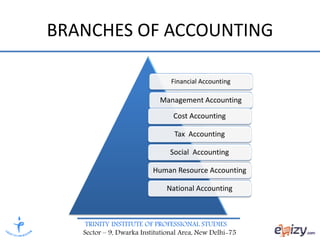
BRANCHES OF ACCOUNTING
Financial Accounting
Management Accounting
Cost Accounting
Tax Accounting
Social Accounting
Human Resource Accounting
National Accounting
TRINITY INSTITUTE OF PROFESSIONAL STUDIES
Sector – 9, Dwarka Institutional Area, New Delhi-75
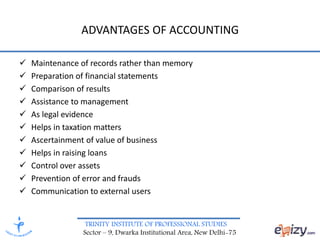
ADVANTAGES OF ACCOUNTING
 Maintenance of records rather than memory
 Preparation of financial statements
 Comparison of results
 Assistance to management
 As legal evidence
 Helps in taxation matters
 Ascertainment of value of business
 Helps in raising loans
 Control over assets
 Prevention of error and frauds
 Communication to external users
TRINITY INSTITUTE OF PROFESSIONAL STUDIES
Sector – 9, Dwarka Institutional Area, New Delhi-75
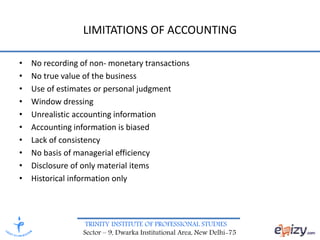
LIMITATIONS OF ACCOUNTING
• No recording of non- monetary transactions
• No true value of the business
• Use of estimates or personal judgment
• Window dressing
• Unrealistic accounting information
• Accounting information is biased
• Lack of consistency
• No basis of managerial efficiency
• Disclosure of only material items
• Historical information only

Financial accounting

  • 1.
    TRINITY INSTITUTE OFPROFESSIONAL STUDIES Sector – 9, Dwarka Institutional Area, New Delhi-75 Affiliated Institution of G.G.S.IP.U, Delhi FINANCIAL ACCOUNTING 888101 B.COM(H) BY: NAMRATA YADAV
  • 2.
    TRINITY INSTITUTE OFPROFESSIONAL STUDIES Sector – 9, Dwarka Institutional Area, New Delhi-75 ACCOUNTING • “Accounting is the art of recording, classifying and summarizing in a significant manner, and in terms of money, transactions and events which are, in part at least, of financial character and interpreting the results thereof.” - the American Institute of Certified public Accountants (AICPA) “Accounting is the process of identifying, measuring and communicating economic information to permit informed judgments and decisions by users of the information.” -American Accounting Association
  • 3.
    TRINITY INSTITUTE OFPROFESSIONAL STUDIES Sector – 9, Dwarka Institutional Area, New Delhi-75 Financial Accounting • Accounting and financial accounting are used interchangeably. • Accounting is a tree while financial accounting is one of its branch. • Accounting that provides financial information to persons outside the business entity is called financial accounting.
  • 4.
    TRINITY INSTITUTE OFPROFESSIONAL STUDIES Sector – 9, Dwarka Institutional Area, New Delhi-75 Features of Accounting • Identifying: selecting transactions and events of separate nature • Measuring: expressing the business transaction in terms of money • Recording: recording in books of accounts • Classifying: grouping of transactions of same type in separate accounts • Summarizing: to bring together a number of classified account under one single account. For example, the accounts of various customers are grouped under as “Debtor’s Account” • Significant: accounting information is presented in a significant manner • for making decision • Interpretation: explaining the meaning and significance of the relationship so established • Communication: communicating the results of interpretation of financial statements to the end - users
  • 5.
    TRINITY INSTITUTE OFPROFESSIONAL STUDIES Sector – 9, Dwarka Institutional Area, New Delhi-75 OBJECTIVES OF ACCOUNTING • Maintaining proper records • Knowing the profit or loss of the business • Ascertaining the source of items of revenue and expenses • Ascertainment of financial position of the business • Ascertaining the cash flows • Communicating financial information to various groups of users • Ascertaining the financial position of debtors and creditors
  • 6.
    TRINITY INSTITUTE OFPROFESSIONAL STUDIES Sector – 9, Dwarka Institutional Area, New Delhi-75 OBECTIVES OF FINANCIAL ACCOUNTING • Facilitating research in business operations • Controlling the performance of the business • Meeting legal requirements
  • 7.
    TRINITY INSTITUTE OFPROFESSIONAL STUDIES Sector – 9, Dwarka Institutional Area, New Delhi-75 ACOUNTING AS AN INFORMATION SYSTEM • Accounting is often referred to as the language of business. Accounting is used to communicate financial and other information to people, organizations, governments etc, about various aspects of business and non-business enterprises. The accounting is, therefore, also an information system. Simply stated accounting system converts inputs(financial transactions) into outputs (financial statements) .
  • 8.
    TRINITY INSTITUTE OFPROFESSIONAL STUDIES Sector – 9, Dwarka Institutional Area, New Delhi-75 ACCOUNTING AS AN INFORMATION SYSTEM INPUT • PROCESS OUTPUT Business Transactions and Events Accounting Concepts and Conventions Profit & Loss Balance Sheet Cash flow Statement
  • 9.
    TRINITY INSTITUTE OFPROFESSIONAL STUDIES Sector – 9, Dwarka Institutional Area, New Delhi-75 USERS OF ACCOUNTING INFORMATION USERS INTERNAL Owners or proprietors or partners Management Employees EXTERNAL Creditors & short- term lenders Government Potential investors Regulatory agencies
  • 10.
    TRINITY INSTITUTE OFPROFESSIONAL STUDIES Sector – 9, Dwarka Institutional Area, New Delhi-75 BRANCHES OF ACCOUNTING Financial Accounting Management Accounting Cost Accounting Tax Accounting Social Accounting Human Resource Accounting National Accounting
  • 11.
    TRINITY INSTITUTE OFPROFESSIONAL STUDIES Sector – 9, Dwarka Institutional Area, New Delhi-75 ADVANTAGES OF ACCOUNTING  Maintenance of records rather than memory  Preparation of financial statements  Comparison of results  Assistance to management  As legal evidence  Helps in taxation matters  Ascertainment of value of business  Helps in raising loans  Control over assets  Prevention of error and frauds  Communication to external users
  • 12.
    TRINITY INSTITUTE OFPROFESSIONAL STUDIES Sector – 9, Dwarka Institutional Area, New Delhi-75 LIMITATIONS OF ACCOUNTING • No recording of non- monetary transactions • No true value of the business • Use of estimates or personal judgment • Window dressing • Unrealistic accounting information • Accounting information is biased • Lack of consistency • No basis of managerial efficiency • Disclosure of only material items • Historical information only