BALANC
   E
   A
 DESIGN
PRINCIPLE
BALANCE
• The distribution of the visual weight
  of objects,colours, texture and space.
• A composition should be balanced and
  feel stable
BALANCE
• can be FORMAL
 i.e. symmetrical and
 radial
• or INFORMAL
 i.e. asymmetrical
American Gothic by Grant Wood
Balance is both Formal and
  Symmetrical

i.e.The figures are similar in size
    and positioned equally at either
    side of the central axis.
    Small area of the light tone
    of the woman’s collar balances
    with the larger slightly more
    subdued tone area of the man’s
    shirt
The Great Wave by Hokusai
                   Balance is
                     informal and
                     assymmetrical
                   i.e.the size and
                       texture of the
                       wave (positive
                       shape) is balanced
                       by the similar size
                       and contrasting
                       texture of the
                       negative shape
                       (the sky)
The Bar at the Folies Bergere
by Manet            Formal balance is
                      achieved by
                    • position - central
                      large figure and the
                      smaller objects
                      placed towards the
                      outer edges.
                    • shape – smaller
                      complicated shapes
                      Champagne bottles
                      and the larger simple
                      shape of the
                      reflected figure
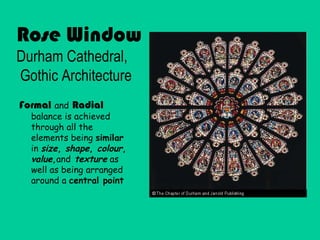
Rose Window
Durham Cathedral,
Gothic Architecture
Formal and Radial
  balance is achieved
  through all the
  elements being similar
  in size, shape, colour,
  value,and texture as
  well as being arranged
  around a central point
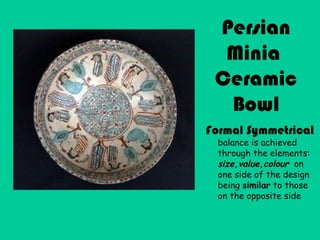
Persian
  Minia
 Ceramic
  Bowl
Formal Symmetrical
 balance is achieved
 through the elements:
 size,value,colour on
 one side of the design
 being similar to those
 on the opposite side
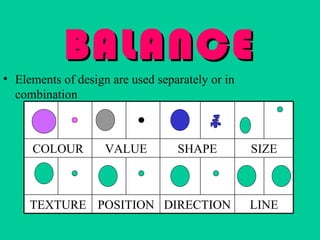
BALANCE
• Elements of design are used separately or in
  combination


     COLOUR         VALUE         SHAPE          SIZE


     TEXTURE POSITION DIRECTION                  LINE

Balance: an Element of Art

  • 1.
    BALANC E A DESIGN PRINCIPLE
  • 2.
    BALANCE • The distributionof the visual weight of objects,colours, texture and space. • A composition should be balanced and feel stable
  • 3.
    BALANCE • can beFORMAL i.e. symmetrical and radial • or INFORMAL i.e. asymmetrical
  • 4.
    American Gothic byGrant Wood Balance is both Formal and Symmetrical i.e.The figures are similar in size and positioned equally at either side of the central axis. Small area of the light tone of the woman’s collar balances with the larger slightly more subdued tone area of the man’s shirt
  • 5.
    The Great Waveby Hokusai Balance is informal and assymmetrical i.e.the size and texture of the wave (positive shape) is balanced by the similar size and contrasting texture of the negative shape (the sky)
  • 6.
    The Bar atthe Folies Bergere by Manet Formal balance is achieved by • position - central large figure and the smaller objects placed towards the outer edges. • shape – smaller complicated shapes Champagne bottles and the larger simple shape of the reflected figure
  • 7.
    Rose Window Durham Cathedral, GothicArchitecture Formal and Radial balance is achieved through all the elements being similar in size, shape, colour, value,and texture as well as being arranged around a central point
  • 8.
    Persian Minia Ceramic Bowl Formal Symmetrical balance is achieved through the elements: size,value,colour on one side of the design being similar to those on the opposite side
  • 9.
    BALANCE • Elements ofdesign are used separately or in combination COLOUR VALUE SHAPE SIZE TEXTURE POSITION DIRECTION LINE