Vertical Collaborative Teams

  ISD 191 Administrative Meeting
        September 15, 2011
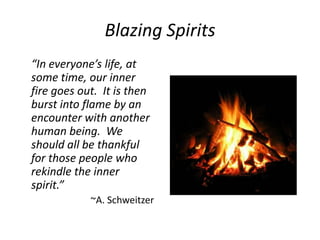
Blazing Spirits
“In everyone’s life, at
some time, our inner
fire goes out. It is then
burst into flame by an
encounter with another
human being. We
should all be thankful
for those people who
rekindle the inner
spirit.”
            ~A. Schweitzer
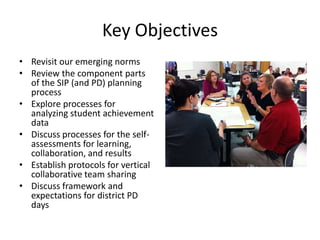
Key Objectives
• Revisit our emerging norms
• Review the component parts
  of the SIP (and PD) planning
  process
• Explore processes for
  analyzing student achievement
  data
• Discuss processes for the self-
  assessments for learning,
  collaboration, and results
• Establish protocols for vertical
  collaborative team sharing
• Discuss framework and
  expectations for district PD
  days
Trial and Error…
“The growth of any craft depends on shared
practices and honest dialogue among the
people who do it. We grow by private trial
and error, to be sure…but our willingness to
try, and fail, as individuals is severely limited
when we are not supported by a community
that encourages such risks.”
                         From The Courage to Teach, P. Palmer
Constructivist Listening Dyad
• Join a colleague from a
  different vertical
  collaborative team and
  from a different level
  (where possible).
• Use the constructivist
  listening dyad protocol to
  discuss the focus of the
  passage.
• Discuss the concepts of
  trial and error, risk, and
  community.
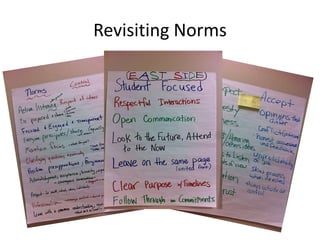
Revisiting Norms
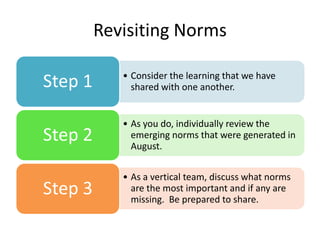
Revisiting Norms

            • Consider the learning that we have
Step 1        shared with one another.


            • As you do, individually review the
Step 2        emerging norms that were generated in
              August.


            • As a vertical team, discuss what norms
Step 3        are the most important and if any are
              missing. Be prepared to share.
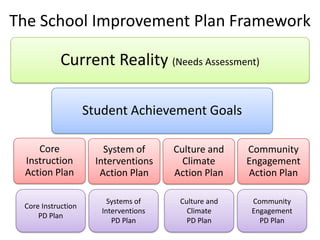
The School Improvement Plan Framework

            Current Reality (Needs Assessment)

                    Student Achievement Goals

    Core                System of      Culture and    Community
 Instruction          Interventions      Climate      Engagement
 Action Plan           Action Plan     Action Plan    Action Plan

                         Systems of     Culture and    Community
 Core Instruction
                       Interventions      Climate      Engagement
     PD Plan
                          PD Plan         PD Plan        PD Plan
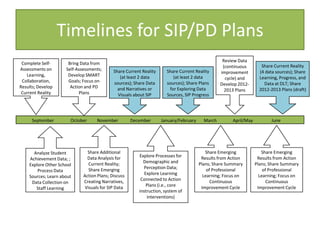
Timelines for SIP/PD Plans
                                                                                                  Review Data
 Complete Self-       Bring Data from
                                                                                                  (continuous        Share Current Reality
Assessments on       Self-Assessments;      Share Current Reality     Share Current Reality      improvement        (4 data sources); Share
   Learning,          Develop SMART            (at least 2 data          (at least 2 data          cycle) and       Learning, Progress, and
 Collaboration,       Goals; Focus on       sources); Share Data      sources); Share Plans      Develop 2012-        Data at DLT; Share
Results; Develop       Action and PD          and Narratives or        for Exploring Data          2013 Plans       2012-2013 Plans (draft)
 Current Reality           Plans              Visuals about SIP       Sources, SIP Progress


      September        October     November          December       January/February     March        April/May           June


      Analyze Student          Share Additional                                           Share Emerging             Share Emerging
                               Data Analysis for        Explore Processes for           Results from Action        Results from Action
    Achievement Data; ;
                                Current Reality;          Demographic and              Plans; Share Summary       Plans; Share Summary
    Explore Other School
                                Share Emerging             Perception Data;                of Professional            of Professional
        Process Data
                             Action Plans; Discuss         Explore Learning              Learning; Focus on         Learning; Focus on
    Sources; Learn about
                             Creating Narratives,        Connected to Action                 Continuous                 Continuous
     Data Collection on
                              Visuals for SIP Data          Plans (i.e., core           Improvement Cycle          Improvement Cycle
       Staff Learning
                                                        instruction, system of
                                                            interventions)
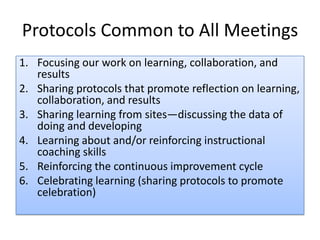
Protocols Common to All Meetings
1. Focusing our work on learning, collaboration, and
   results
2. Sharing protocols that promote reflection on learning,
   collaboration, and results
3. Sharing learning from sites—discussing the data of
   doing and developing
4. Learning about and/or reinforcing instructional
   coaching skills
5. Reinforcing the continuous improvement cycle
6. Celebrating learning (sharing protocols to promote
   celebration)
Got Questions?
• As your vertical team
  reviews the timeline for
  developing, implementing,
  and monitoring the work
  of your SIP and PD plans,
  what questions emerge?
• Generate each question on
  a separate post-it note.
Protocol for On-Site Vertical CT Sharing
• Principal and DLT
  members/teachers
  present some of the
  following:
   – Findings and narrative
     statements from data
     analysis
   – Emerging current reality
   – Emerging action plans
   – Emerging PD plans
   – Emerging results (narrative
     about collective learning)
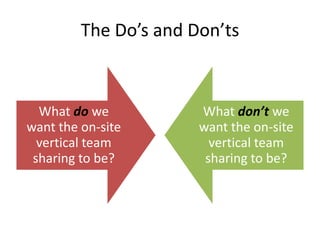
The Do’s and Don’ts


  What do we           What don’t we
want the on-site       want the on-site
  vertical team          vertical team
 sharing to be?         sharing to be?
Be back to
continue our
learning in
10 minutes!
On Professional Learning…
             “An empowered teacher is a
             reflective decision maker
             who finds joy in learning
             and in investigating the
             teaching/learning process—
             one who views learning as
             construction and teaching
             as a facilitating process to
             enhance and enrich
             development.”
                      —Fosnot
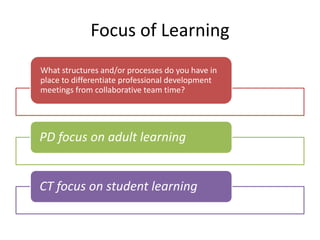
Focus of Learning
What structures and/or processes do you have in
place to differentiate professional development
meetings from collaborative team time?


PD focus on adult learning


CT focus on student learning
Focus on Learning
         • Individually record what you
           have done to differentiate
           the purpose of the
           meetings.
         • Individually read the excerpt
           from Learning by Doing and
           highlight processes to
           support collaborative team
           time.
         • As a vertical collaborative
           team, generate a combined
           list of processes or strategies
           used to differentiate and/or
           reinforce the purpose of the
           meetings.
Deepening Our Understanding
• Go the Ning site for ISD 191    Ning for ISD 191 Admin
  administrators and access the   • http://isd191.ning.com/?show
  following blog post:               AddContent=1&xg_source=ms
• Bringing the Updated               g_wel_network
  Standards for Professional
  Learning from Learn Forward
  (NSDC) to Life
• As you review the blog post     Learning Forward (NSDC)
  and access the more detailed    • http://www.learningforward.o
  version of the standards on        rg/standards/standards.cfm
  Learning Forward’s website,
  add a comment about how the
  standards will guide your
  decision-making about PD at
  your building.
District PD Days
• ½ days focused on first question: what do we
  want students to know, understand, and do?
• Intended to introduce or support concepts that
  are part of district curriculum development
  process
• TLT will develop a structured agenda & processes
• Principals, supervisors, and TLT will lead sessions
• Training sessions available October 11 from 9:00
  a.m. to 11:00 a.m. or October 12 from 3:30 p.m.
  to 5:30 p.m.
Data Dig: Student Achievement Data
• Review and discuss 3
  different data sets related
  to student achievement gap
• Write narrative statements
  based on each set.


  1.   The gap between white students and students of color is sometimes
       up to 25 points.
  2.   In 2010, the gap is beginning to close at the elementary level.
5 Whys: The What and the How
What is it:                                How to use it:
  The 5 Whys is a question asking          • Write down the specific problem.
  method used to explore the                 Writing the issue helps you to
  cause/effect relationships underlying      formalize the problem and describe it
  a particular problem. Ultimately, the      completely. It also helps a team focus
  goal of applying the 5 Whys method         on the same problem.
  is to determine a root cause of a        • Ask "Why" the problem happens and
  defect or problem. By repeatedly           write the answer down below the
  asking the question "Why" (five is a       problem.
  good rule of thumb), you can peel        • If the answer you just provided
  away the layers of symptoms which          doesn't identify the root cause of the
  can lead to the root cause of a            problem that you wrote down in step
  problem. Very often the underlying         1, ask “Why” again and write that
  reason for a problem will lead you to      answer down.
  another question. Although this
  technique is called "5 Whys," you        • Loop back to step 3 until the team is
  may find that you will need to ask the     in agreement that the problem's root
  question more or less than five times      cause is identified. Again, this may
  before you find the root cause of the      take more or less than five “Whys”.
  problem.
Stop and Think
      • In what ways might the
        data dig, the narrative
        statements, and the 5
        Whys process help
        clarify the goal writing
        process?
      • Find a colleague from a
        different vertical
        collaborative team and
        share your thinking.
Learning For All Mission
• According to the         • If ISD 191 were to focus
  Effective Schools          its efforts on a learning
  research, schools need     for all mission, what
  to operate with a          would that require?
  “learning for all        • What policies, practices,
  mission” not just in       and procedures would
  words, but in actions.     need to be examined,
                             tweaked, and/or
                             changed?
Next Steps in Data Dig
• At September 22 meeting,
  use Cognos and MDE to
  explore student
  achievement data related
  to…
   –   Proficiency
   –   Trend
   –   Growth
   –   Racial Disparity
   –   Bubble Kids
• Write narrative statements
  to deepen development of
  current reality
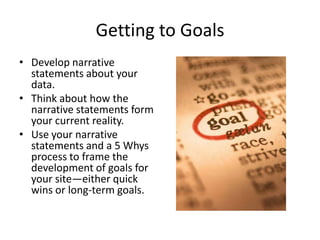
Getting to Goals
• Develop narrative
  statements about your
  data.
• Think about how the
  narrative statements form
  your current reality.
• Use your narrative
  statements and a 5 Whys
  process to frame the
  development of goals for
  your site—either quick
  wins or long-term goals.
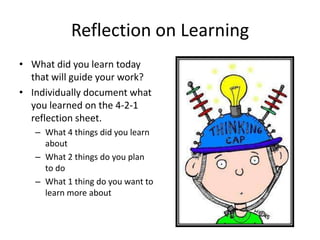
Reflection on Learning
• What did you learn today
  that will guide your work?
• Individually document what
  you learned on the 4-2-1
  reflection sheet.
   – What 4 things did you learn
     about
   – What 2 things do you plan
     to do
   – What 1 thing do you want to
     learn more about
Purpose & Power of Collaborative Teams

“What distinguishes professional learning
communities from support groups where
teachers mainly share ideas and offer
encouragement is their critical stance and
commitment to inquiry…Teachers ask probing
questions, invite colleagues to observe and
review their teaching and their students’
learning, and hold out ideas for discussion and
debate.”
                                      –J. Saphier
Announcements & Updates
• Communications from
  TLT
• BEA Executive Board
  Vote
• PLCs for Math and
  Reading Interventionists
  (system of
  interventions)

Principal VT September 15

  • 1.
    Vertical Collaborative Teams ISD 191 Administrative Meeting September 15, 2011
  • 2.
    Blazing Spirits “In everyone’slife, at some time, our inner fire goes out. It is then burst into flame by an encounter with another human being. We should all be thankful for those people who rekindle the inner spirit.” ~A. Schweitzer
  • 3.
    Key Objectives • Revisitour emerging norms • Review the component parts of the SIP (and PD) planning process • Explore processes for analyzing student achievement data • Discuss processes for the self- assessments for learning, collaboration, and results • Establish protocols for vertical collaborative team sharing • Discuss framework and expectations for district PD days
  • 4.
    Trial and Error… “Thegrowth of any craft depends on shared practices and honest dialogue among the people who do it. We grow by private trial and error, to be sure…but our willingness to try, and fail, as individuals is severely limited when we are not supported by a community that encourages such risks.” From The Courage to Teach, P. Palmer
  • 5.
    Constructivist Listening Dyad •Join a colleague from a different vertical collaborative team and from a different level (where possible). • Use the constructivist listening dyad protocol to discuss the focus of the passage. • Discuss the concepts of trial and error, risk, and community.
  • 6.
  • 7.
    Revisiting Norms • Consider the learning that we have Step 1 shared with one another. • As you do, individually review the Step 2 emerging norms that were generated in August. • As a vertical team, discuss what norms Step 3 are the most important and if any are missing. Be prepared to share.
  • 8.
    The School ImprovementPlan Framework Current Reality (Needs Assessment) Student Achievement Goals Core System of Culture and Community Instruction Interventions Climate Engagement Action Plan Action Plan Action Plan Action Plan Systems of Culture and Community Core Instruction Interventions Climate Engagement PD Plan PD Plan PD Plan PD Plan
  • 9.
    Timelines for SIP/PDPlans Review Data Complete Self- Bring Data from (continuous Share Current Reality Assessments on Self-Assessments; Share Current Reality Share Current Reality improvement (4 data sources); Share Learning, Develop SMART (at least 2 data (at least 2 data cycle) and Learning, Progress, and Collaboration, Goals; Focus on sources); Share Data sources); Share Plans Develop 2012- Data at DLT; Share Results; Develop Action and PD and Narratives or for Exploring Data 2013 Plans 2012-2013 Plans (draft) Current Reality Plans Visuals about SIP Sources, SIP Progress September October November December January/February March April/May June Analyze Student Share Additional Share Emerging Share Emerging Data Analysis for Explore Processes for Results from Action Results from Action Achievement Data; ; Current Reality; Demographic and Plans; Share Summary Plans; Share Summary Explore Other School Share Emerging Perception Data; of Professional of Professional Process Data Action Plans; Discuss Explore Learning Learning; Focus on Learning; Focus on Sources; Learn about Creating Narratives, Connected to Action Continuous Continuous Data Collection on Visuals for SIP Data Plans (i.e., core Improvement Cycle Improvement Cycle Staff Learning instruction, system of interventions)
  • 10.
    Protocols Common toAll Meetings 1. Focusing our work on learning, collaboration, and results 2. Sharing protocols that promote reflection on learning, collaboration, and results 3. Sharing learning from sites—discussing the data of doing and developing 4. Learning about and/or reinforcing instructional coaching skills 5. Reinforcing the continuous improvement cycle 6. Celebrating learning (sharing protocols to promote celebration)
  • 11.
    Got Questions? • Asyour vertical team reviews the timeline for developing, implementing, and monitoring the work of your SIP and PD plans, what questions emerge? • Generate each question on a separate post-it note.
  • 12.
    Protocol for On-SiteVertical CT Sharing • Principal and DLT members/teachers present some of the following: – Findings and narrative statements from data analysis – Emerging current reality – Emerging action plans – Emerging PD plans – Emerging results (narrative about collective learning)
  • 13.
    The Do’s andDon’ts What do we What don’t we want the on-site want the on-site vertical team vertical team sharing to be? sharing to be?
  • 14.
    Be back to continueour learning in 10 minutes!
  • 15.
    On Professional Learning… “An empowered teacher is a reflective decision maker who finds joy in learning and in investigating the teaching/learning process— one who views learning as construction and teaching as a facilitating process to enhance and enrich development.” —Fosnot
  • 16.
    Focus of Learning Whatstructures and/or processes do you have in place to differentiate professional development meetings from collaborative team time? PD focus on adult learning CT focus on student learning
  • 17.
    Focus on Learning • Individually record what you have done to differentiate the purpose of the meetings. • Individually read the excerpt from Learning by Doing and highlight processes to support collaborative team time. • As a vertical collaborative team, generate a combined list of processes or strategies used to differentiate and/or reinforce the purpose of the meetings.
  • 18.
    Deepening Our Understanding •Go the Ning site for ISD 191 Ning for ISD 191 Admin administrators and access the • http://isd191.ning.com/?show following blog post: AddContent=1&xg_source=ms • Bringing the Updated g_wel_network Standards for Professional Learning from Learn Forward (NSDC) to Life • As you review the blog post Learning Forward (NSDC) and access the more detailed • http://www.learningforward.o version of the standards on rg/standards/standards.cfm Learning Forward’s website, add a comment about how the standards will guide your decision-making about PD at your building.
  • 19.
    District PD Days •½ days focused on first question: what do we want students to know, understand, and do? • Intended to introduce or support concepts that are part of district curriculum development process • TLT will develop a structured agenda & processes • Principals, supervisors, and TLT will lead sessions • Training sessions available October 11 from 9:00 a.m. to 11:00 a.m. or October 12 from 3:30 p.m. to 5:30 p.m.
  • 20.
    Data Dig: StudentAchievement Data • Review and discuss 3 different data sets related to student achievement gap • Write narrative statements based on each set. 1. The gap between white students and students of color is sometimes up to 25 points. 2. In 2010, the gap is beginning to close at the elementary level.
  • 22.
    5 Whys: TheWhat and the How What is it: How to use it: The 5 Whys is a question asking • Write down the specific problem. method used to explore the Writing the issue helps you to cause/effect relationships underlying formalize the problem and describe it a particular problem. Ultimately, the completely. It also helps a team focus goal of applying the 5 Whys method on the same problem. is to determine a root cause of a • Ask "Why" the problem happens and defect or problem. By repeatedly write the answer down below the asking the question "Why" (five is a problem. good rule of thumb), you can peel • If the answer you just provided away the layers of symptoms which doesn't identify the root cause of the can lead to the root cause of a problem that you wrote down in step problem. Very often the underlying 1, ask “Why” again and write that reason for a problem will lead you to answer down. another question. Although this technique is called "5 Whys," you • Loop back to step 3 until the team is may find that you will need to ask the in agreement that the problem's root question more or less than five times cause is identified. Again, this may before you find the root cause of the take more or less than five “Whys”. problem.
  • 23.
    Stop and Think • In what ways might the data dig, the narrative statements, and the 5 Whys process help clarify the goal writing process? • Find a colleague from a different vertical collaborative team and share your thinking.
  • 24.
    Learning For AllMission • According to the • If ISD 191 were to focus Effective Schools its efforts on a learning research, schools need for all mission, what to operate with a would that require? “learning for all • What policies, practices, mission” not just in and procedures would words, but in actions. need to be examined, tweaked, and/or changed?
  • 25.
    Next Steps inData Dig • At September 22 meeting, use Cognos and MDE to explore student achievement data related to… – Proficiency – Trend – Growth – Racial Disparity – Bubble Kids • Write narrative statements to deepen development of current reality
  • 26.
    Getting to Goals •Develop narrative statements about your data. • Think about how the narrative statements form your current reality. • Use your narrative statements and a 5 Whys process to frame the development of goals for your site—either quick wins or long-term goals.
  • 27.
    Reflection on Learning •What did you learn today that will guide your work? • Individually document what you learned on the 4-2-1 reflection sheet. – What 4 things did you learn about – What 2 things do you plan to do – What 1 thing do you want to learn more about
  • 28.
    Purpose & Powerof Collaborative Teams “What distinguishes professional learning communities from support groups where teachers mainly share ideas and offer encouragement is their critical stance and commitment to inquiry…Teachers ask probing questions, invite colleagues to observe and review their teaching and their students’ learning, and hold out ideas for discussion and debate.” –J. Saphier
  • 29.
    Announcements & Updates •Communications from TLT • BEA Executive Board Vote • PLCs for Math and Reading Interventionists (system of interventions)

Editor's Notes