Our Schools will
                        Empower Learning,
                      Energize Achievement,
                       Embrace Community

                 Each Student Real-World-Ready


Annual Teaching & Learning Report
       September 20, 2012
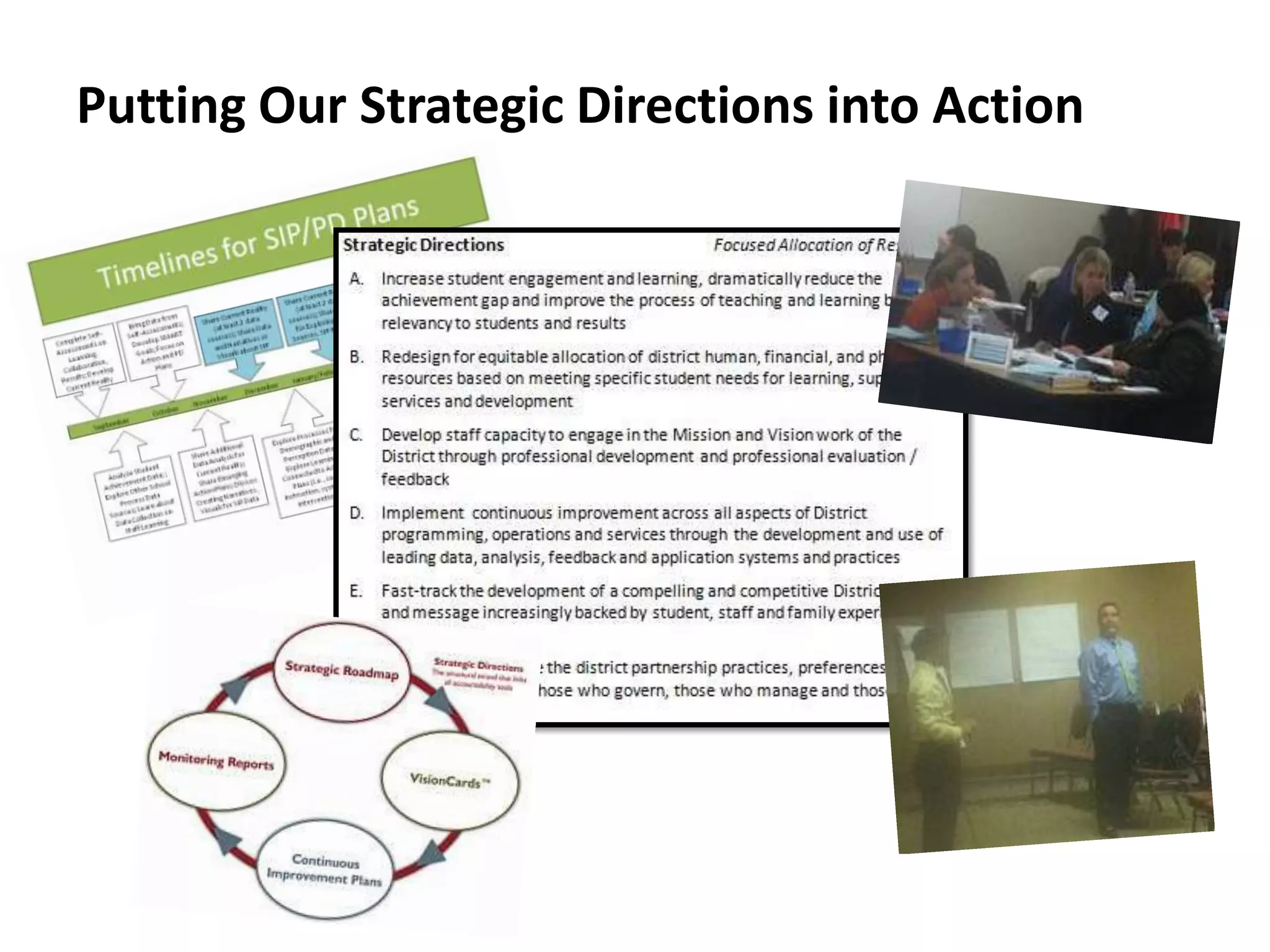
Putting Our Strategic Directions into Action


                                               2
3
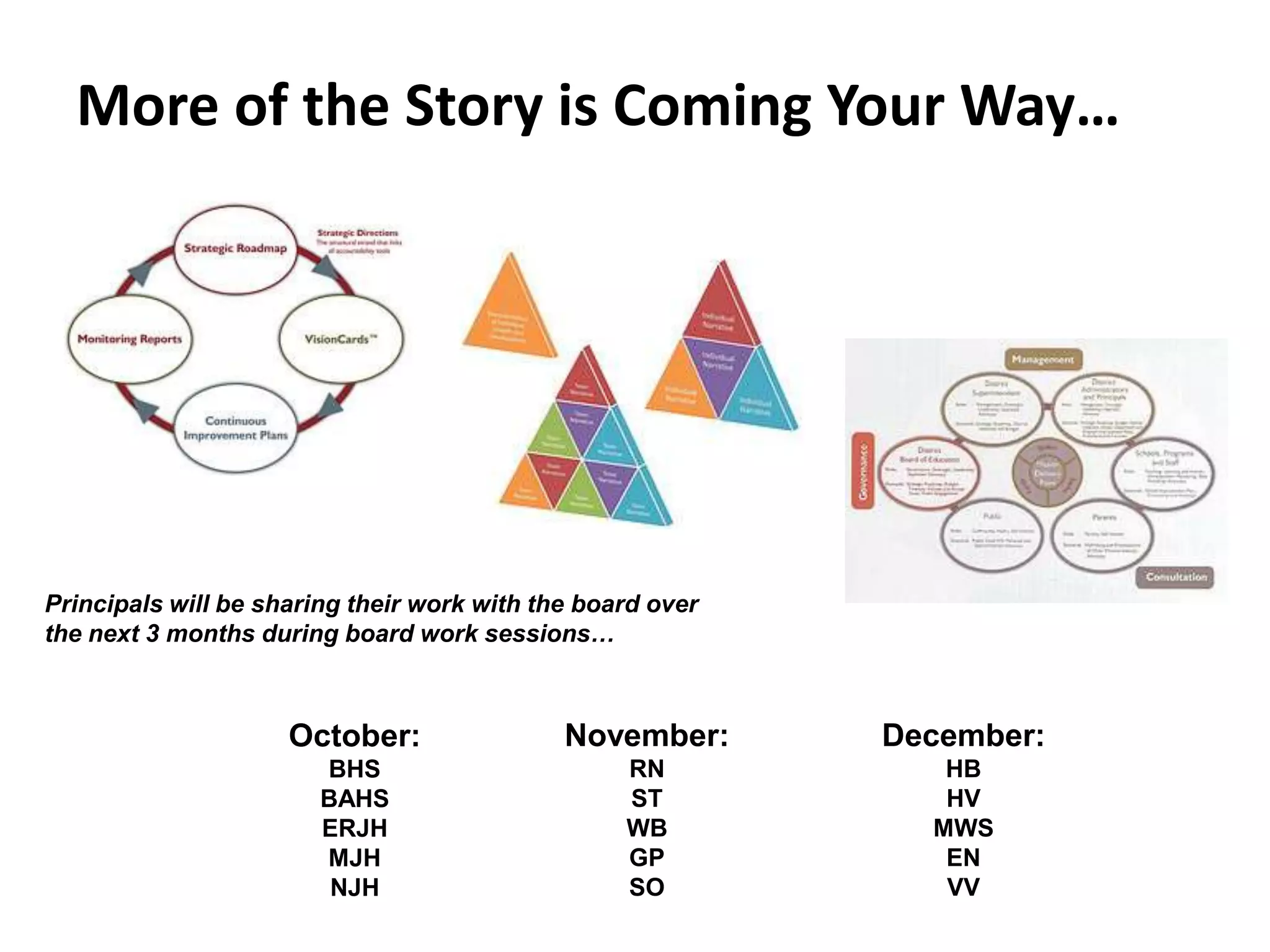
More of the Story is Coming Your Way…


Principals will be sharing their work with the
board over the next 3 months during board work
sessions…

                 October:           November:    December:
                   BHS                   RN         HB
                   BAHS                  ST         HV
                   ERJH                  WB        MWS
                   MJH                   GP         EN
                    NJH                  SO         VV
                                                             4
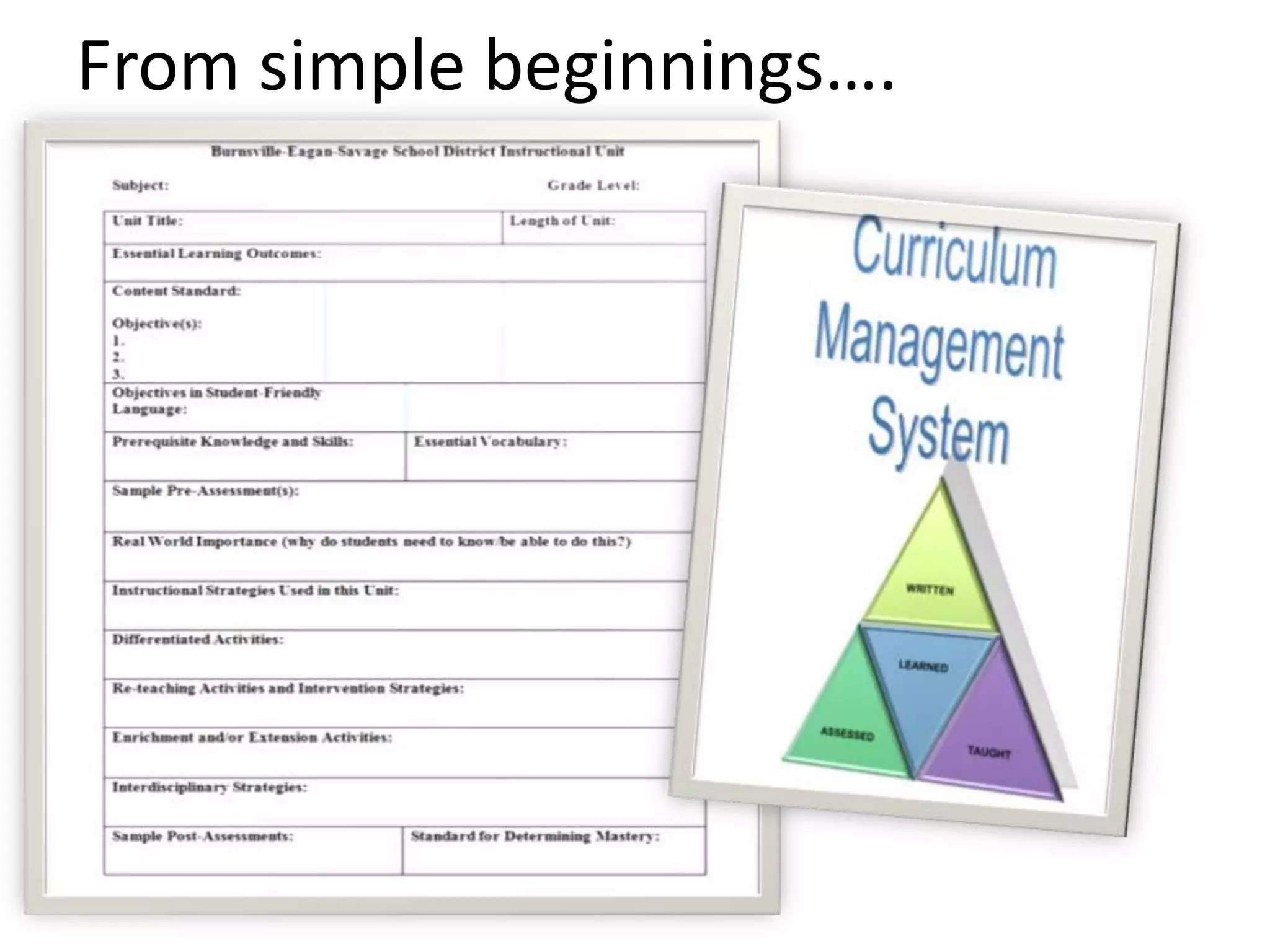
From simple beginnings….


                           5
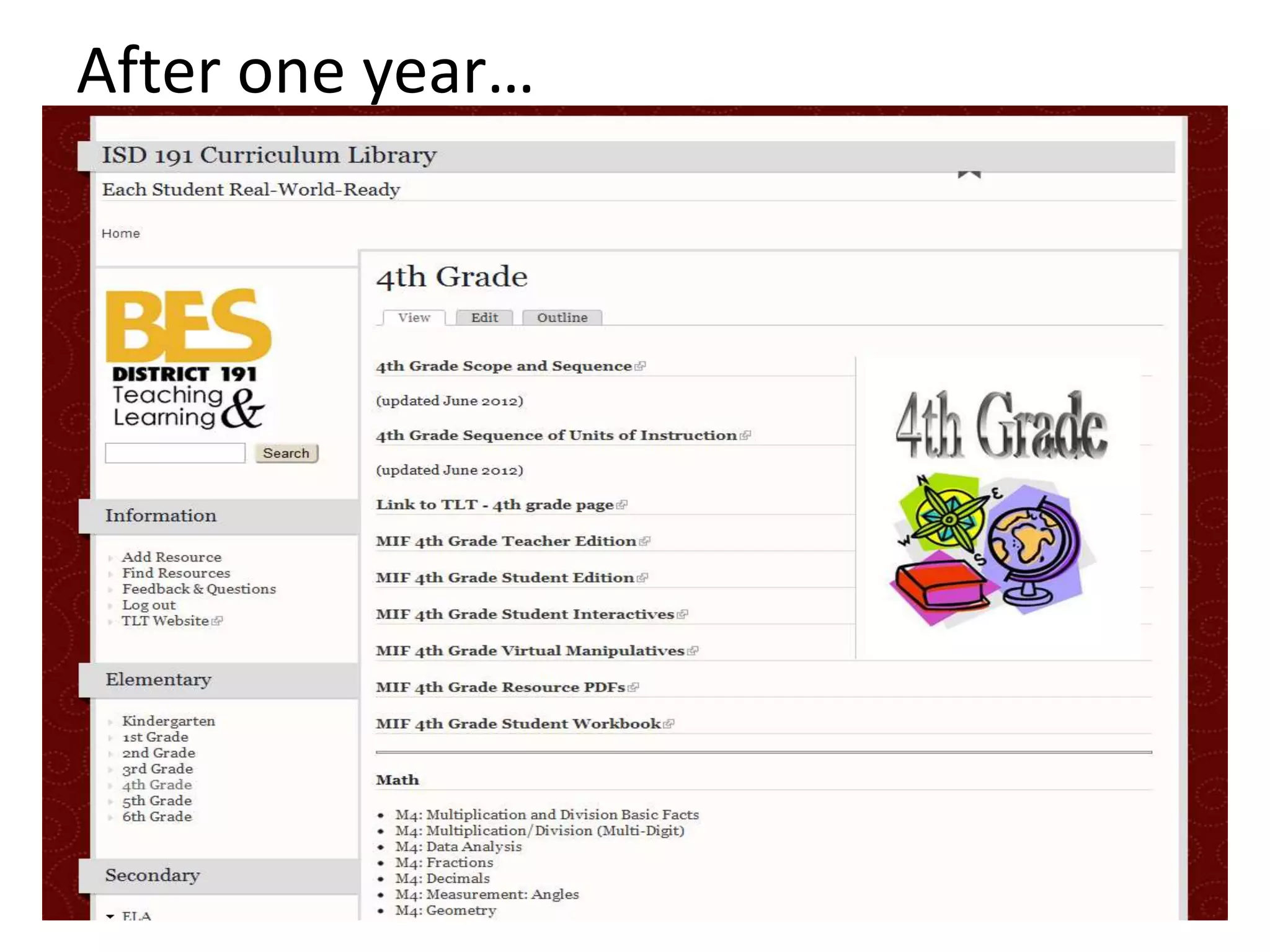
After one year…


                  6
7
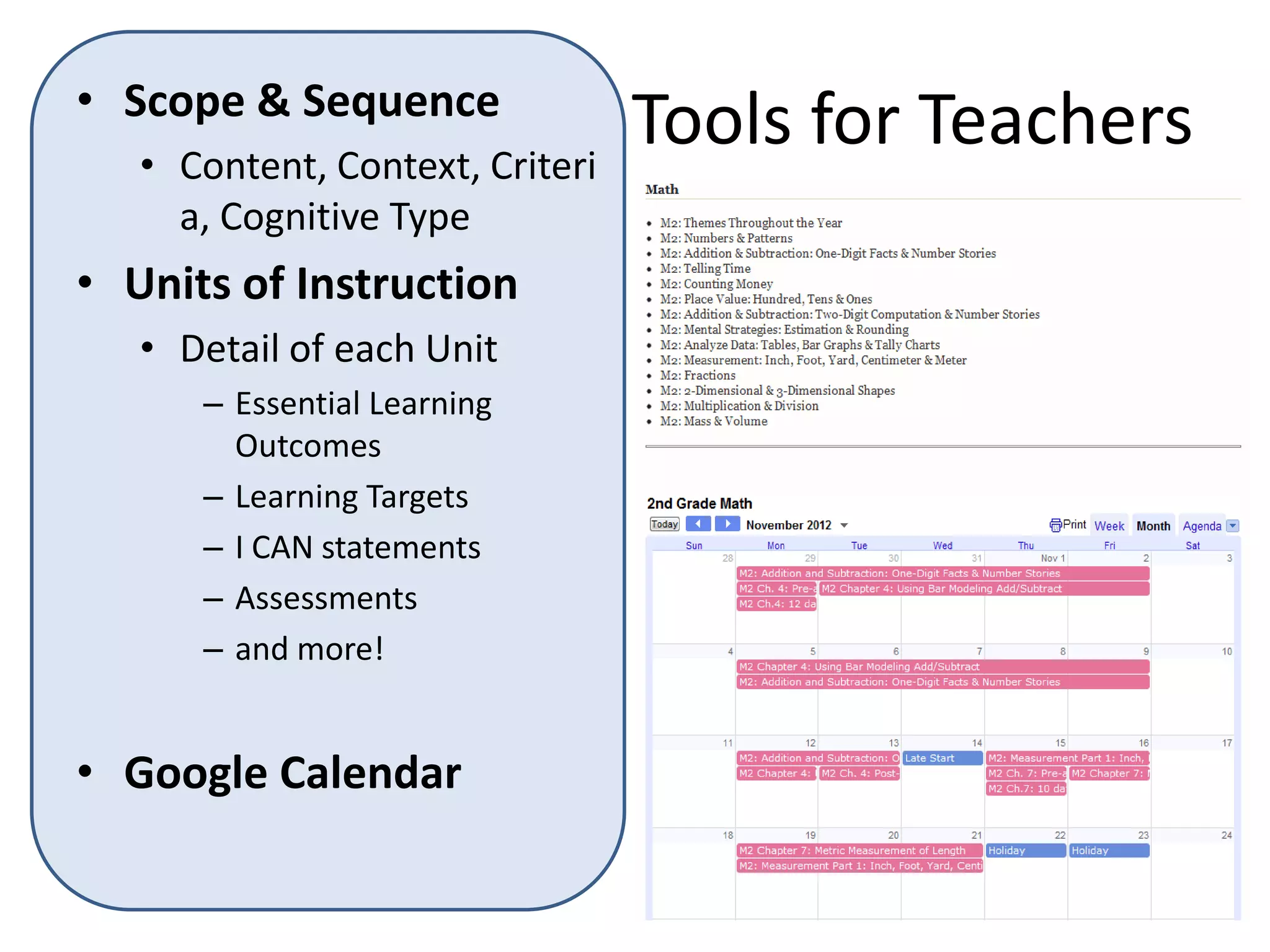
• Scope & Sequence
   • Content, Context,
                                Tools for Teachers
     Criteria, Cognitive Type
• Units of Instruction
   • Detail of each Unit
      – Essential Learning
        Outcomes
      – Learning Targets
      – I CAN statements
      – Assessments
      – and more!


• Google Calendar

                                                 8
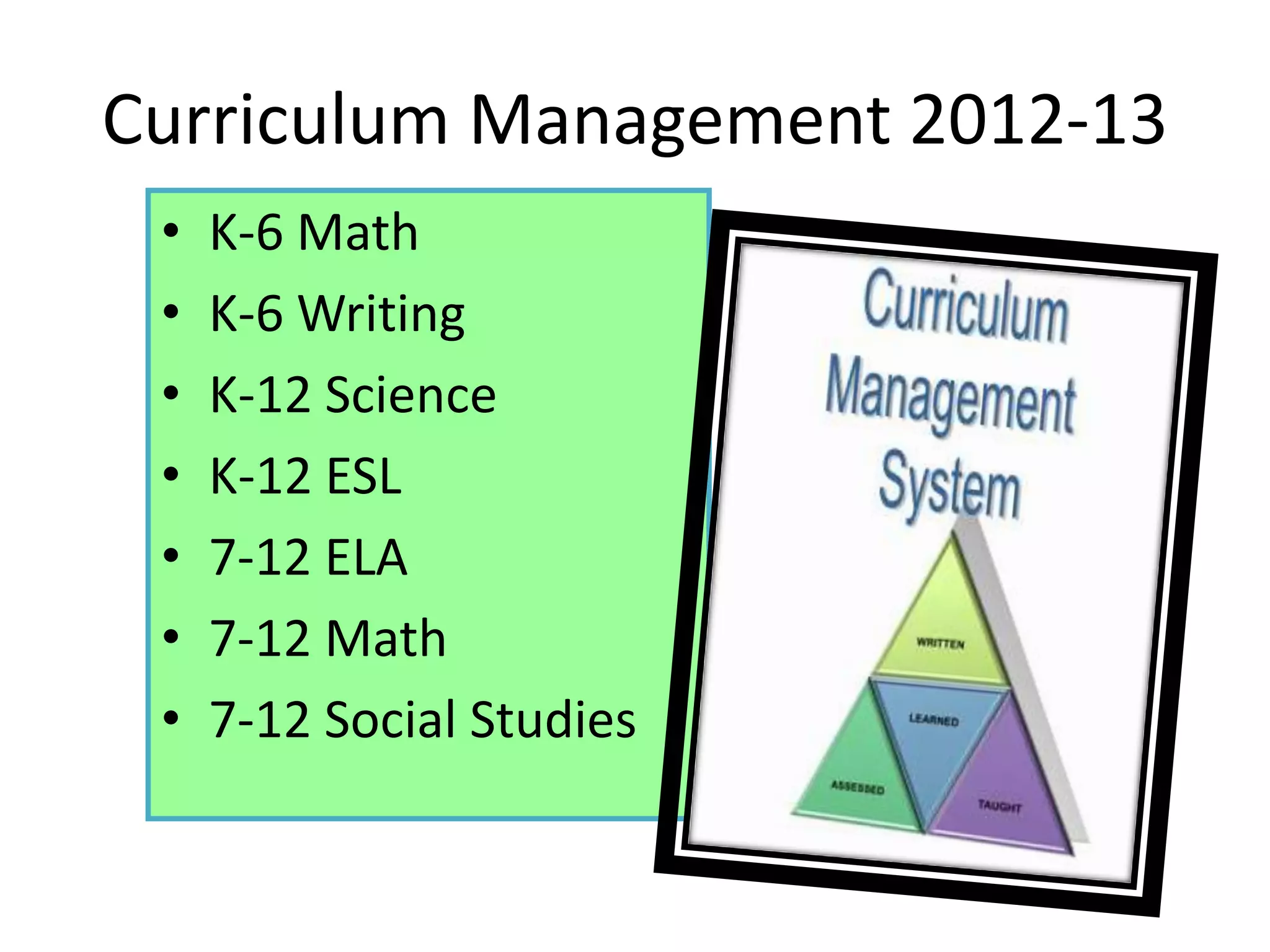
Curriculum Management 2012-13
 •   K-6 Math
 •   K-6 Writing
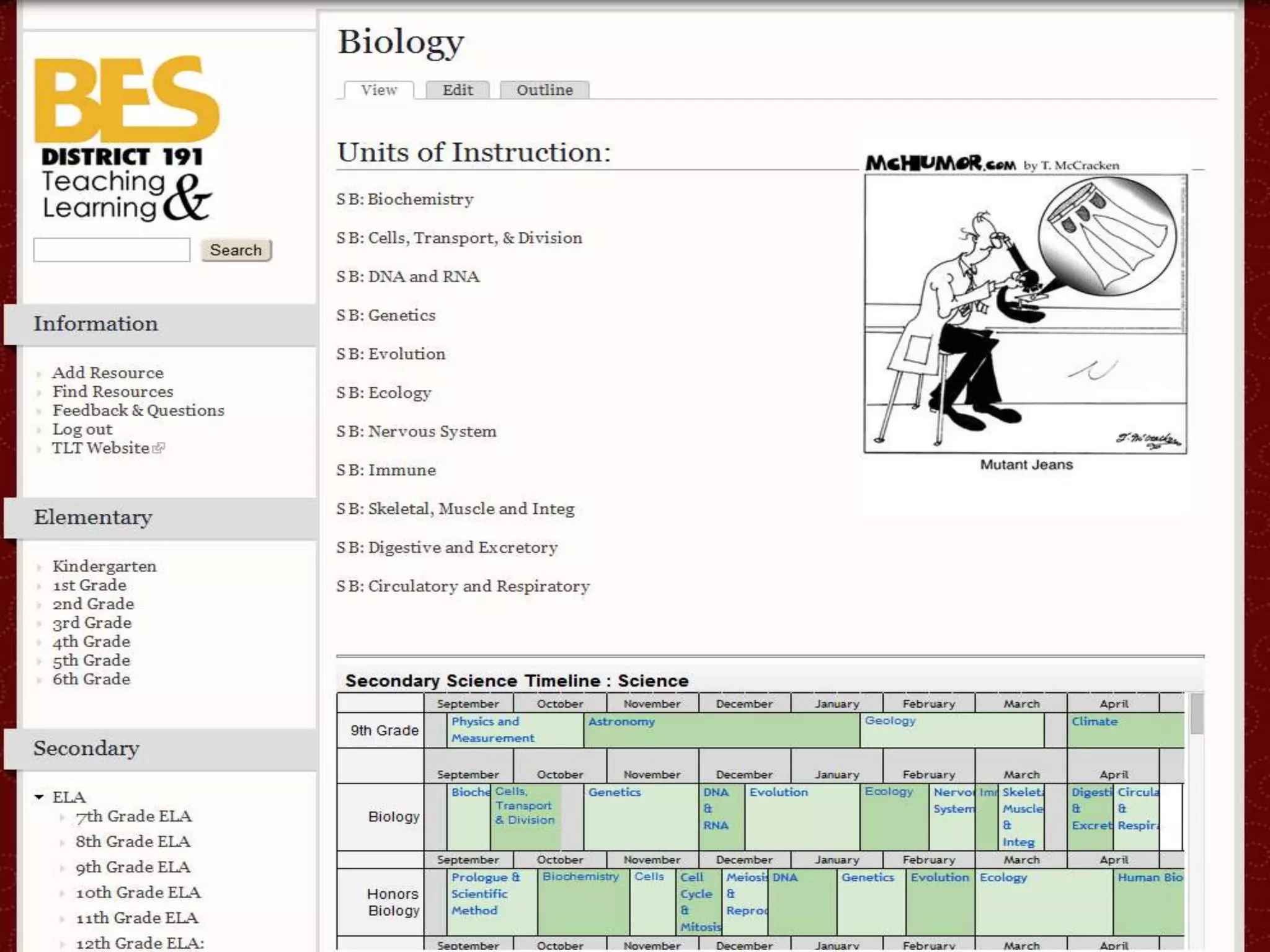
 •   K-12 Science
 •   K-12 ESL
 •   7-12 ELA
 •   7-12 Math
 •   7-12 Social Studies


                                9
Developing a System:
      Intervention and Enrichment
• A system of intervention
  and enrichment is being
  developed so that our
  district responds in a
  comprehensive and
  systematic way for
  students who need either
  additional academic
  support or challenge.

                                    10
What Happens When Students Don't Learn?
  Providing Additional Academic Support

• When students don’t
  learn, students will
  receive tiered level
  of intervention to
  meet their academic
  needs.


                                           11
What Happens When Students Don't Learn?
Providing Additional Academic Support
             • Core Instruction (traditional classroom
 Tier 1        setting) where 80 % of student needs
               are generally met


             • More strategic academic intervention
 Tier 2        delivered for 10-15% of students who
               require additional academic guidance


             • For 5-10% of students who need more
 Tier 3        intensive research-based academic
               interventions

                                                         12
At the Classroom Level:
        Instructional Intervention
• Support at the classroom level is addressed
  through instructional interventions either
  proactively or in response to instruction.
• Instructional intervention occurs through:
  –Pre-teaching
  –Re-teaching (remediation)
  –Differentiation

                                                13
Additional Instructional Support:
  Strategic or Intensive Intervention
• An academic interventionist
  provides research-based
  strategic or intensive
  academic interventions for
  students who need
  additional support beyond
  what their classroom
  teacher does and/or can
  provide.


                                        14
What Happens When Students Already Know?
    Providing Extension or Enrichment

• Students who
  demonstrate an
  understanding of
  the most essential
  concepts may
  receive some level
  of enrichment.


                                            15
What Happens When Students Already Know?
    Providing Extension or Enrichment
• Extension and enrichment occur at the
  classroom level through differentiation,
  inquiry, and/or problem-based learning.
• K-6 enrichment specialists provide additional
  extension or enrichment to support the core
  curriculum.


                                                  16
System of Intervention and Enrichment:
        2012-2013 Areas of Concentration
• Refine role of K-6 math & reading interventionists
• Clarify role of interventionists & classroom teachers, ESL, SPED
• Identify research-based Tier 3 instructional interventions (K-6)
• Support implementation of co-teaching
• Provide professional development to refine approach to co-teaching
• Continue development of data protocols
• Develop proactive instructional interventions for Tier 1 and Tier 2
• Provide professional learning to support development of proactive
  instructional interventions
• Clarify role of 7-12 interventionists
• Complete comprehensive study of gifted and talented (enrichment)
• Clarify SAT/TAT (student assistance team or teacher assistance team)
  processes and procedures


                                                                    17
ADSIS Program
   Alternative Delivery of Specialized
       Individual Services (ADSIS)
The program’s goal is to reduce the number
  of students who are referred for special
education services by delivering innovative
 instructional services to support students
  who need additional academic support.

                                          18
Features of the ADSIS Program
• Innovative educational programming through
  the use of:
  – Co-Teaching
  – Instructional Technology (iPads)
  – Data Collection and Monitoring
  – Collaborative Action Research
  – Other Strategic or Intensive Academic Support


                                                    19
Students and Schools Served
• Students who require additional academic
  support in math and reading will participate and
  are identified through multiple measures.

• Currently, three of our elementary schools will
  participate:
  – Edward Neill
  – Sky Oaks
  – Vista View
                                                     20
About ADSIS in ISD 191
• ISD 191 was awarded an additional $492,000 in state
  aid.
• The maximum request through the application
  process is $500,000.
• Our district can apply for the additional funding for
  the 2013-2014 school year.
• The intent is to develop innovative instructional
  programs that can be replicated for all of our
  elementary schools.

                                                      21
Annual Report Assessment Data
The testing data for the Annual
Report represents 191 student
achievement on the state
tests including:

•GRAD Mathematics, Reading
 and Writing
•MCA-III Mathematics
•MCA-II Reading
•MCA-III Science

As well as 191 student achievement on
                                        EACH OF THESE TESTS ARE
the fall and spring MAP (Measures of    SUMMATIVE ASSESSMENTS
Academic Progress) assessment
Reading Achievement Highlights
• MAP scores ahead of National Norms
  – Grades 1-3 slightly behind National Norms
  – Grades 4-9 make gains


• MCA scores remain behind the State
  – Grades 5 and 6 ahead of State
  – Gains in grades 3, 6, and 8 over 2011
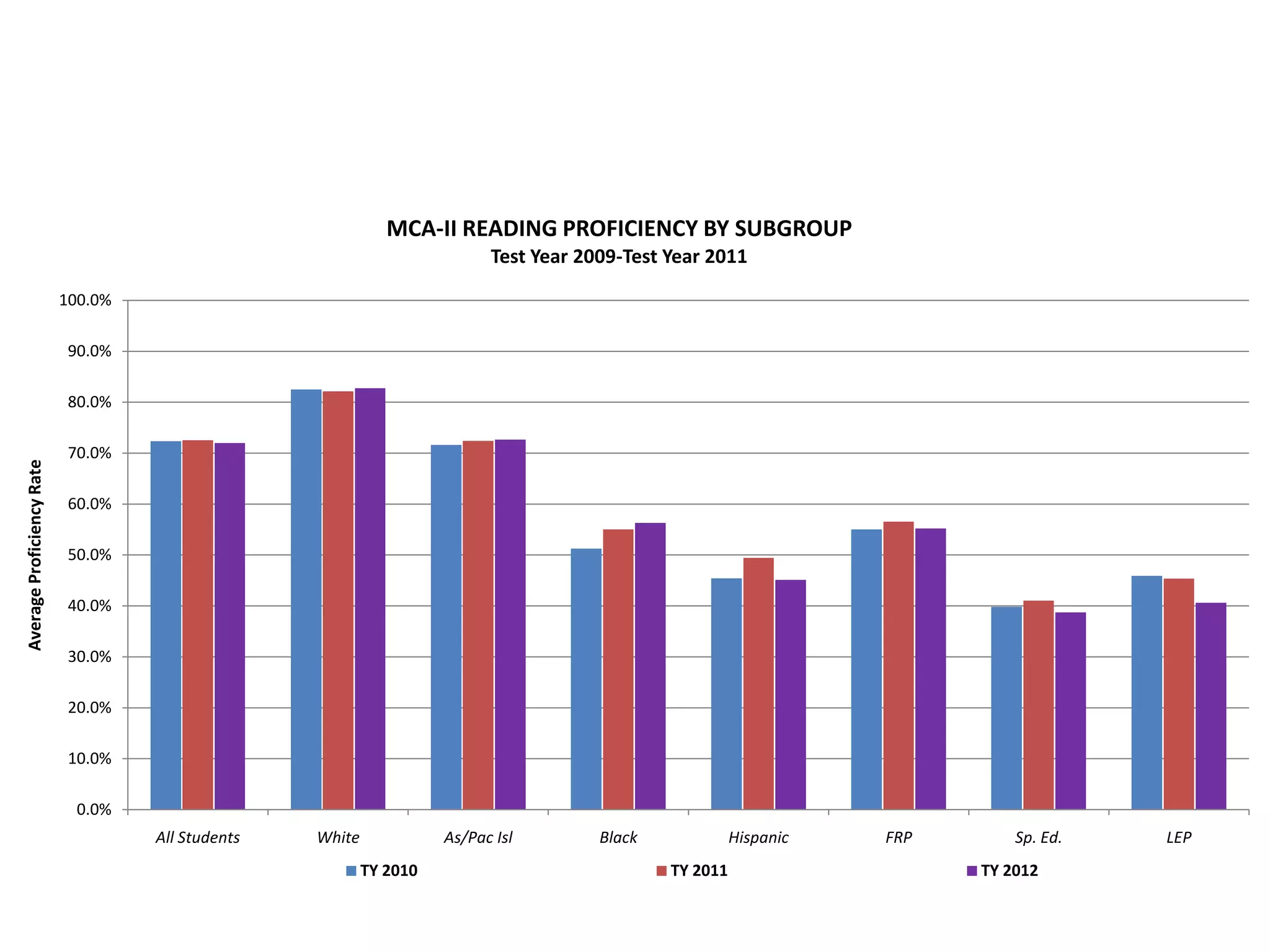
  – Black student group makes gains
Reading Student Group Highlights
                                                              MCA-II READING PROFICIENCY BY SUBGROUP
                                                                           Test Year 2009-Test Year 2011

                           100.0%

                            90.0%

                            80.0%

                            70.0%
Average Proficiency Rate


                            60.0%

                            50.0%

                            40.0%

                            30.0%

                            20.0%

                            10.0%

                             0.0%
                                    All Students   White             As/Pac Isl        Black             Hispanic   FRP       Sp. Ed.   LEP
                                                           TY 2010                             TY 2011                    TY 2012
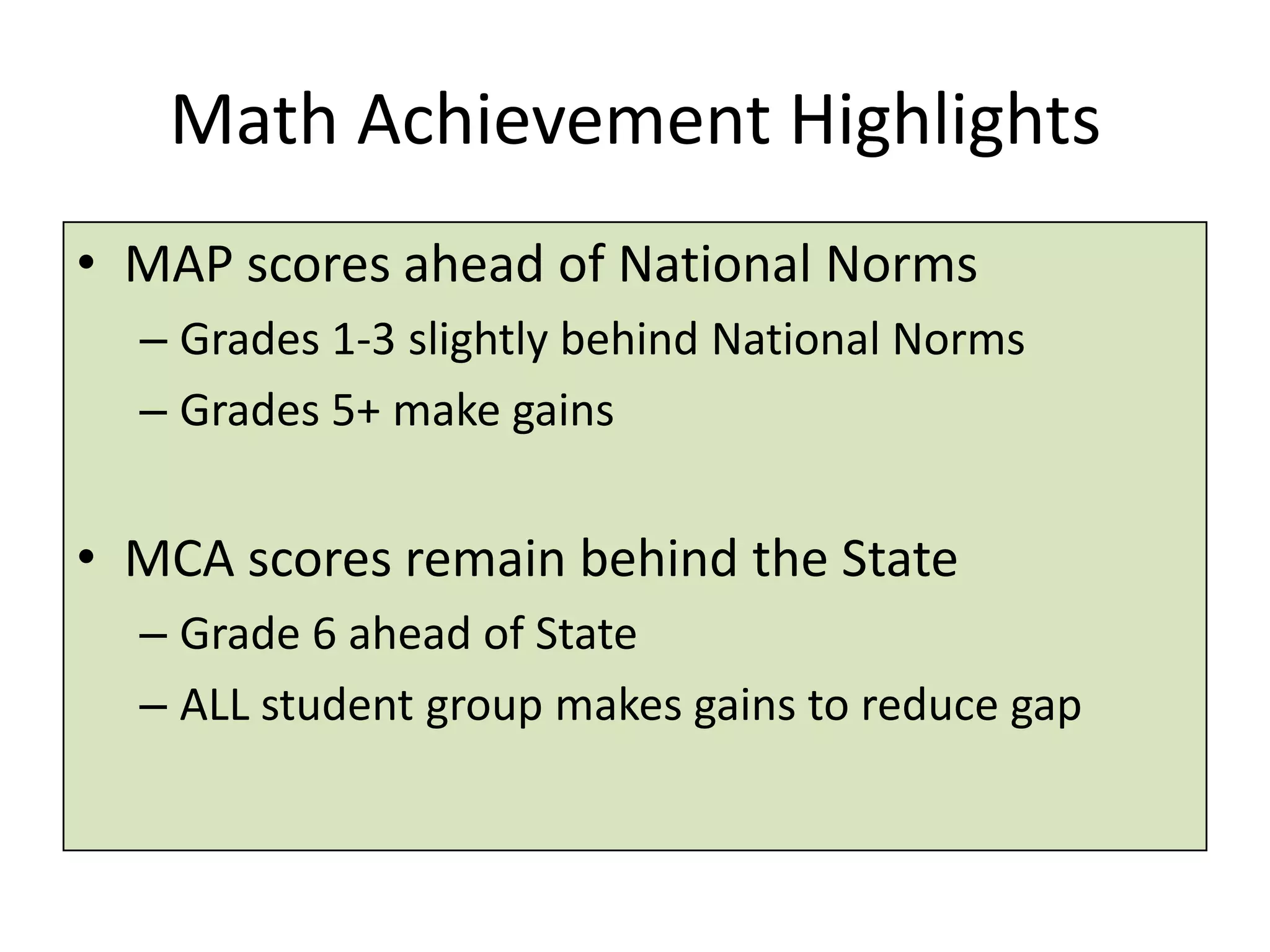
Math Achievement Highlights
• MAP scores ahead of National Norms
  – Grades 1-3 slightly behind National Norms
  – Grades 5-9 make gains from 2011


• MCA scores remain behind the State
  – Grade 6 ahead of State
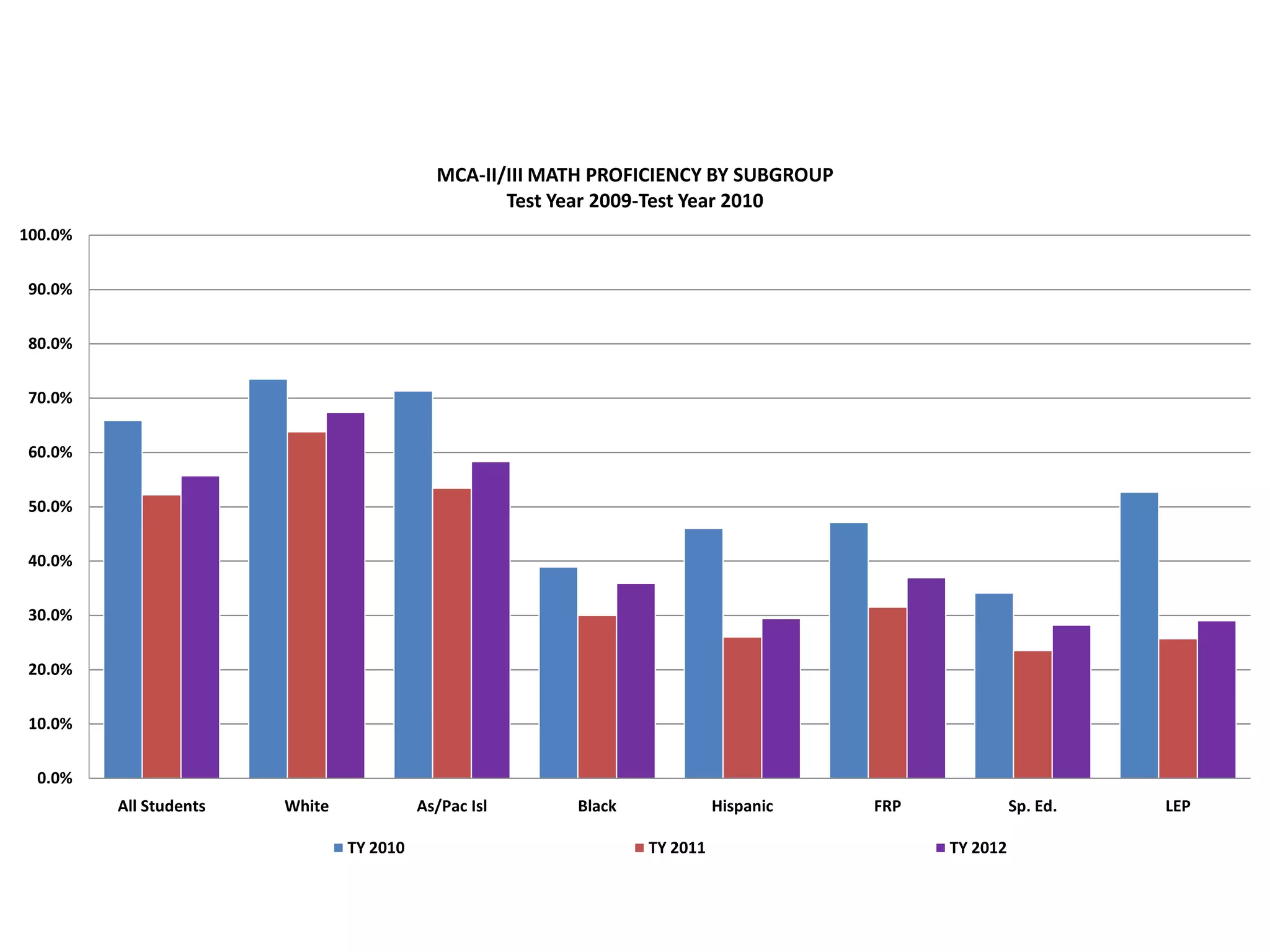
  – Gains in grades 3, 6, 7 and 8 from 2011
  – ALL student group makes gains to reduce gap
Math Student Group Highlights
                                            MCA-II/III MATH PROFICIENCY BY SUBGROUP
                                                   Test Year 2009-Test Year 2010
100.0%


 90.0%


 80.0%


 70.0%


 60.0%


 50.0%


 40.0%


 30.0%


 20.0%


 10.0%


  0.0%
         All Students   White             As/Pac Isl     Black             Hispanic   FRP             Sp. Ed.   LEP

                                TY 2010                          TY 2011                    TY 2012
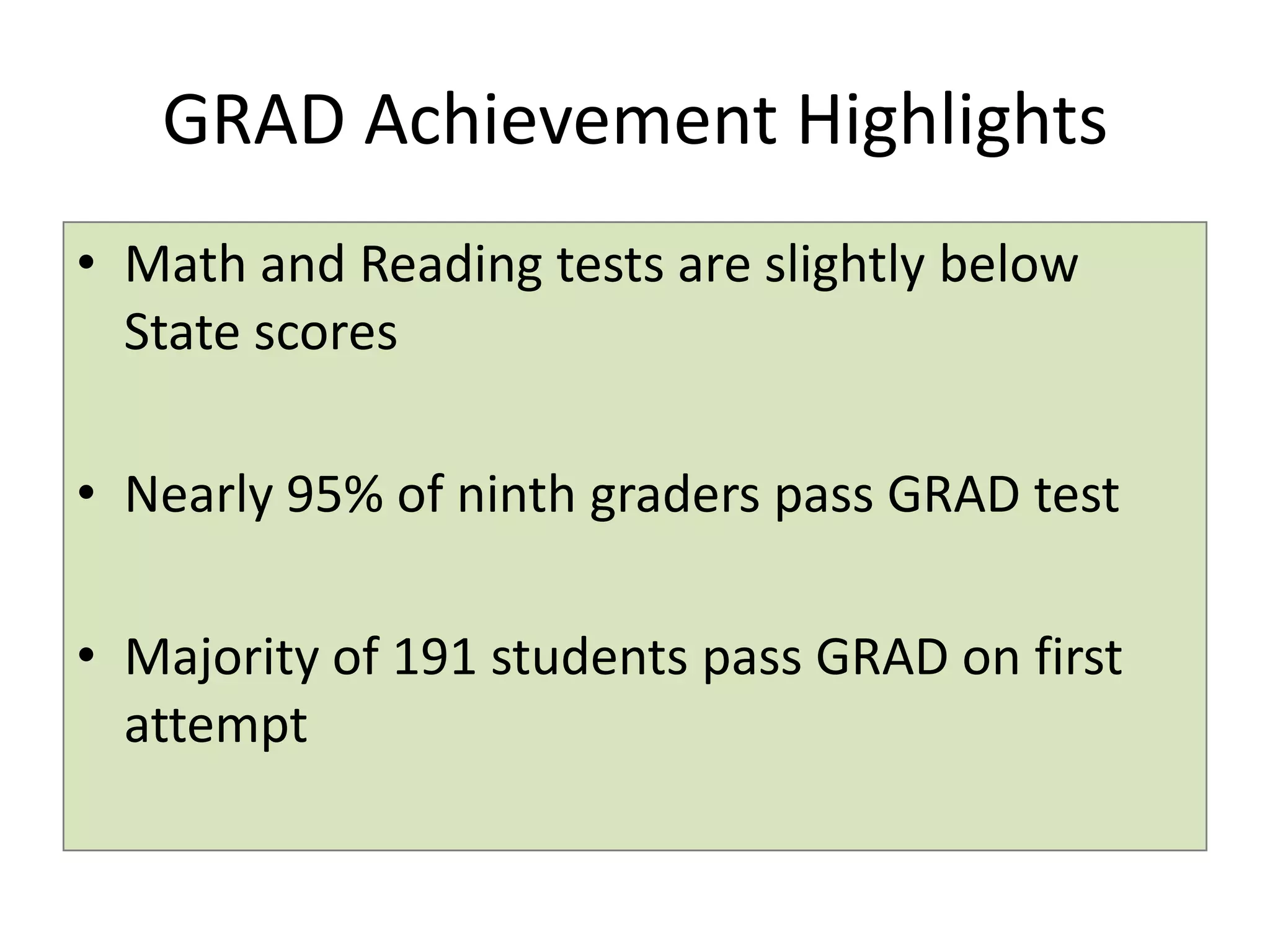
GRAD Achievement Highlights
• Math and Reading tests are slightly below
  State scores

• Nearly 95% of ninth graders pass GRAD
  Writing test

• Majority of 191 students pass GRAD on first
  attempt
Assessment & Data Updates
• Kindergarten Inventory:
  – Literacy Measures
  – Mathematics Measures
  – Parent Survey Data Collection


• School Level Reports:
  – Standard reports of student achievement
  – Shows trend and student group results
  – Posted on district & school website
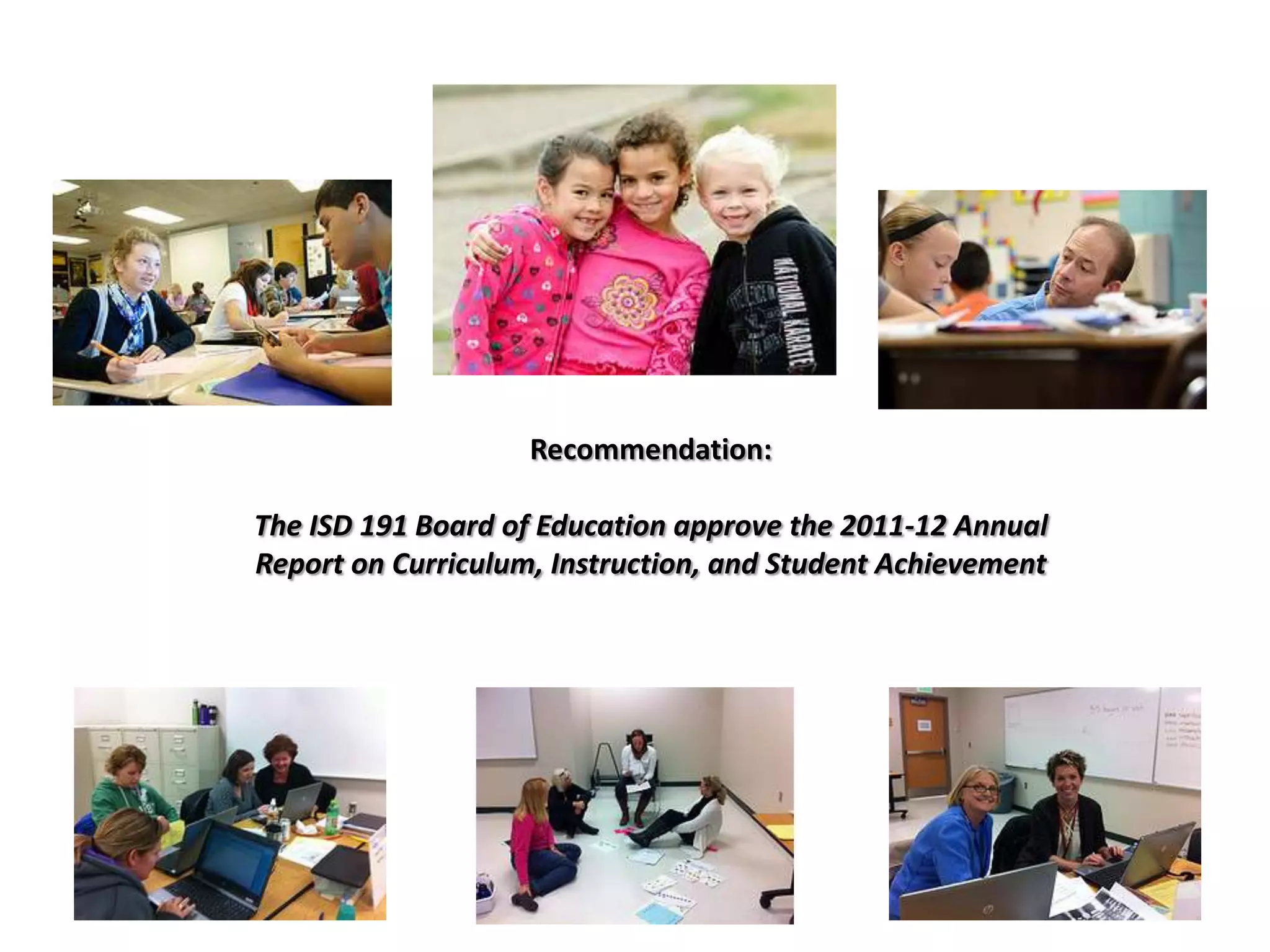
Recommendation:

The ISD 191 Board of Education approve the 2011-12 Annual
Report on Curriculum, Instruction, and Student Achievement


                                                             29

Fall TLT board report 9 2012

  • 1.
    Our Schools will Empower Learning, Energize Achievement, Embrace Community Each Student Real-World-Ready Annual Teaching & Learning Report September 20, 2012
  • 2.
    Putting Our StrategicDirections into Action 2
  • 3.
  • 4.
    More of theStory is Coming Your Way… Principals will be sharing their work with the board over the next 3 months during board work sessions… October: November: December: BHS RN HB BAHS ST HV ERJH WB MWS MJH GP EN NJH SO VV 4
  • 5.
  • 6.
  • 7.
  • 8.
    • Scope &Sequence • Content, Context, Tools for Teachers Criteria, Cognitive Type • Units of Instruction • Detail of each Unit – Essential Learning Outcomes – Learning Targets – I CAN statements – Assessments – and more! • Google Calendar 8
  • 9.
    Curriculum Management 2012-13 • K-6 Math • K-6 Writing • K-12 Science • K-12 ESL • 7-12 ELA • 7-12 Math • 7-12 Social Studies 9
  • 10.
    Developing a System: Intervention and Enrichment • A system of intervention and enrichment is being developed so that our district responds in a comprehensive and systematic way for students who need either additional academic support or challenge. 10
  • 11.
    What Happens WhenStudents Don't Learn? Providing Additional Academic Support • When students don’t learn, students will receive tiered level of intervention to meet their academic needs. 11
  • 12.
    What Happens WhenStudents Don't Learn? Providing Additional Academic Support • Core Instruction (traditional classroom Tier 1 setting) where 80 % of student needs are generally met • More strategic academic intervention Tier 2 delivered for 10-15% of students who require additional academic guidance • For 5-10% of students who need more Tier 3 intensive research-based academic interventions 12
  • 13.
    At the ClassroomLevel: Instructional Intervention • Support at the classroom level is addressed through instructional interventions either proactively or in response to instruction. • Instructional intervention occurs through: –Pre-teaching –Re-teaching (remediation) –Differentiation 13
  • 14.
    Additional Instructional Support: Strategic or Intensive Intervention • An academic interventionist provides research-based strategic or intensive academic interventions for students who need additional support beyond what their classroom teacher does and/or can provide. 14
  • 15.
    What Happens WhenStudents Already Know? Providing Extension or Enrichment • Students who demonstrate an understanding of the most essential concepts may receive some level of enrichment. 15
  • 16.
    What Happens WhenStudents Already Know? Providing Extension or Enrichment • Extension and enrichment occur at the classroom level through differentiation, inquiry, and/or problem-based learning. • K-6 enrichment specialists provide additional extension or enrichment to support the core curriculum. 16
  • 17.
    System of Interventionand Enrichment: 2012-2013 Areas of Concentration • Refine role of K-6 math & reading interventionists • Clarify role of interventionists & classroom teachers, ESL, SPED • Identify research-based Tier 3 instructional interventions (K-6) • Support implementation of co-teaching • Provide professional development to refine approach to co-teaching • Continue development of data protocols • Develop proactive instructional interventions for Tier 1 and Tier 2 • Provide professional learning to support development of proactive instructional interventions • Clarify role of 7-12 interventionists • Complete comprehensive study of gifted and talented (enrichment) • Clarify SAT/TAT (student assistance team or teacher assistance team) processes and procedures 17
  • 18.
    ADSIS Program Alternative Delivery of Specialized Individual Services (ADSIS) The program’s goal is to reduce the number of students who are referred for special education services by delivering innovative instructional services to support students who need additional academic support. 18
  • 19.
    Features of theADSIS Program • Innovative educational programming through the use of: – Co-Teaching – Instructional Technology (iPads) – Data Collection and Monitoring – Collaborative Action Research – Other Strategic or Intensive Academic Support 19
  • 20.
    Students and SchoolsServed • Students who require additional academic support in math and reading will participate and are identified through multiple measures. • Currently, three of our elementary schools will participate: – Edward Neill – Sky Oaks – Vista View 20
  • 21.
    About ADSIS inISD 191 • ISD 191 was awarded an additional $492,000 in state aid. • The maximum request through the application process is $500,000. • Our district can apply for the additional funding for the 2013-2014 school year. • The intent is to develop innovative instructional programs that can be replicated for all of our elementary schools. 21
  • 22.
    Annual Report AssessmentData The testing data for the Annual Report represents 191 student achievement on the state tests including: •GRAD Mathematics, Reading and Writing •MCA-III Mathematics •MCA-II Reading •MCA-III Science As well as 191 student achievement on EACH OF THESE TESTS ARE the fall and spring MAP (Measures of SUMMATIVE ASSESSMENTS Academic Progress) assessment
  • 23.
    Reading Achievement Highlights •MAP scores ahead of National Norms – Grades 1-3 slightly behind National Norms – Grades 4-9 make gains • MCA scores remain behind the State – Grades 5 and 6 ahead of State – Gains in grades 3, 6, and 8 over 2011 – Black student group makes gains
  • 24.
    Reading Student GroupHighlights MCA-II READING PROFICIENCY BY SUBGROUP Test Year 2009-Test Year 2011 100.0% 90.0% 80.0% 70.0% Average Proficiency Rate 60.0% 50.0% 40.0% 30.0% 20.0% 10.0% 0.0% All Students White As/Pac Isl Black Hispanic FRP Sp. Ed. LEP TY 2010 TY 2011 TY 2012
  • 25.
    Math Achievement Highlights •MAP scores ahead of National Norms – Grades 1-3 slightly behind National Norms – Grades 5-9 make gains from 2011 • MCA scores remain behind the State – Grade 6 ahead of State – Gains in grades 3, 6, 7 and 8 from 2011 – ALL student group makes gains to reduce gap
  • 26.
    Math Student GroupHighlights MCA-II/III MATH PROFICIENCY BY SUBGROUP Test Year 2009-Test Year 2010 100.0% 90.0% 80.0% 70.0% 60.0% 50.0% 40.0% 30.0% 20.0% 10.0% 0.0% All Students White As/Pac Isl Black Hispanic FRP Sp. Ed. LEP TY 2010 TY 2011 TY 2012
  • 27.
    GRAD Achievement Highlights •Math and Reading tests are slightly below State scores • Nearly 95% of ninth graders pass GRAD Writing test • Majority of 191 students pass GRAD on first attempt
  • 28.
    Assessment & DataUpdates • Kindergarten Inventory: – Literacy Measures – Mathematics Measures – Parent Survey Data Collection • School Level Reports: – Standard reports of student achievement – Shows trend and student group results – Posted on district & school website
  • 29.
    Recommendation: The ISD 191Board of Education approve the 2011-12 Annual Report on Curriculum, Instruction, and Student Achievement 29

Editor's Notes

  • #12 When more strategic or intensive academic support is needed, research-based instructional interventions, provided by interventionists, are available for students.