Horizontal Collaborative Teams

   ISD 191 Administrative Meeting
         September 22, 2011
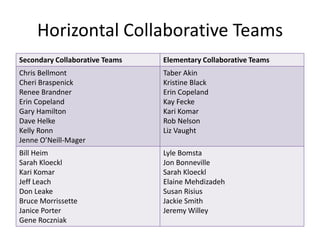
Horizontal Collaborative Teams
Secondary Collaborative Teams   Elementary Collaborative Teams
Chris Bellmont                  Taber Akin
Cheri Braspenick                Kristine Black
Renee Brandner                  Erin Copeland
Erin Copeland                   Kay Fecke
Gary Hamilton                   Kari Komar
Dave Helke                      Rob Nelson
Kelly Ronn                      Liz Vaught
Jenne O’Neill-Mager
Bill Heim                       Lyle Bomsta
Sarah Kloeckl                   Jon Bonneville
Kari Komar                      Sarah Kloeckl
Jeff Leach                      Elaine Mehdizadeh
Don Leake                       Susan Risius
Bruce Morrissette               Jackie Smith
Janice Porter                   Jeremy Willey
Gene Roczniak
What’s One Thing…
• Individually think about the
  emerging current reality
  and action plans for your
  SIP.
• What’s one thing that you
  want to celebrate about
  your journey so far?
• Be prepared to share when
  prompted.
Key Objectives
• Learn about documenting
  your SIP
• Link the doing of
  collaborative team work
  to continuous
  improvement
• Determine common
  processes and structures
  for consistency for PBIS
• Differentiate between PD
  and PLC time
SIP: Where Have You Been?
                      • Use the timeline to
                        document the steps you
                        have taken to develop
                        your SIP plan.


• What work have
  you done on your
  SIP plan to date?
Sharing with Proposed Protocol
                              •   Collaborative problem solving
                              •   Student perspective
• Share the highlights from   •   Concise sharing of data—what are the
  your emerging narrative.        components
   – What has been the        •   Safe, learning-focused environment (especially
                                  with teachers there), not judgmental (supportive,
     most rewarding part?         encouraging, positive, honest, open, flexible, place for risk-taking)

   – What has been the        •   Reflective, real, authentic
     most challenging         •   Based on the current reality, topics that
                                  emerge become the focus of our work
     part?                        (future agenda)
   – What have you            •   Genuine, honest, transparent picture of the
     learned?                     data, process
                              •   Spirit of encouragement, recognition of
   – What more do you             moving forward
     want to learn about?     •   Outcome is positive, builds trust
                              •   Feel comfortable share successes, challenges
                              •   Positive presuppositions—assume positive
                                  intent
                              •   The protocol is shared with all teachers
Creating a Narrative
• Creating a narrative—or telling your story of your
  learning and doing—is an essential part of
  developing and monitoring your SIP plan.
• As your site monitors and documents your
  progress, you will need to systematically record
  the processes for developing your SIP, the impact
  of adult learning, and the results from
  collaborative teams.
• Here’s an option that will be studied further:
  http://sksssip.blogspot.com/
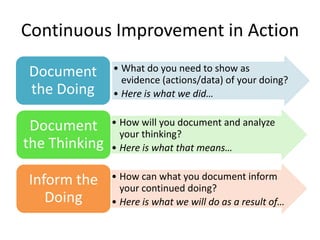
Continuous Improvement in Action

Document       • What do you need to show as
                 evidence (actions/data) of your doing?
the Doing      • Here is what we did…


 Document      • How will you document and analyze
                 your thinking?
the Thinking   • Here is what that means…


Inform the     • How can what you document inform
                 your continued doing?
   Doing       • Here is what we will do as a result of…
Application: Essential Questions for CTs

    How will teams         What do teams need to
 document the doing of       show as evidence of
their collaborative team   their work—to monitor
   work at your site?      and inform their work?


                              In what ways can
  Why do teams and         individuals inform their
  individuals need to       own work by using the
 show their work and       documentation of their
    their thinking?             team’s work?
What Did You Learn…
…That will inform your work
 on the SIP?
                              1. Individually record
…Where you can or might          your responses to
 deepen your work on
 certain components of your      the reflective
 SIP?                            questions .
…Where you can make           2. When prompted,
 connections between what
 you have done and what          share your what you
 could/should be                 learned.
 documented?
Be back to
continue our
learning in
5.75
minutes!
PBIS: Documenting Discipline Referrals
• How should discipline
  referrals be documented?
   – What is addressed verbally
     with students?
   – What is documented on
     TIES?
   – What (and when is)
     information sent home?
• Discuss questions with
  your collaborative team.
• Generate agreed upon
  responses and examples
  to share.
PBIS Data: Acting Consistently
• How do you plan to get consistent “buy-
  in” from your staff members?
• Think how teachers and all other staff
  groups will document data in a consistent
  manner.
• How do you involve parents in the
  process?
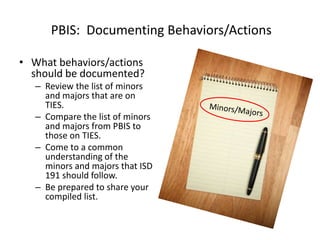
PBIS: Documenting Behaviors/Actions

• What behaviors/actions
  should be documented?
   – Review the list of minors
     and majors that are on
     TIES.
   – Compare the list of minors
     and majors from PBIS to
     those on TIES.
   – Come to a common
     understanding of the
     minors and majors that ISD
     191 should follow.
   – Be prepared to share your
     compiled list.
On Professional Learning…
             “An empowered teacher is a
             reflective decision maker
             who finds joy in learning
             and in investigating the
             teaching/learning process—
             one who views learning as
             construction and teaching
             as a facilitating process to
             enhance and enrich
             development.”
                      —Fosnot
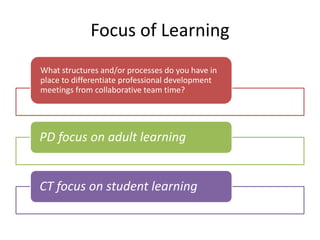
Focus of Learning
What structures and/or processes do you have in
place to differentiate professional development
meetings from collaborative team time?


PD focus on adult learning


CT focus on student learning
Focus on Learning
• What will your staff be
  learning about during
  your PD time?
• What will your staff be
  doing during their
  collaborative team
  time?
Focus on Learning
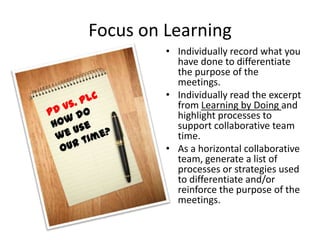
         • Individually record what you
           have done to differentiate
           the purpose of the
           meetings.
         • Individually read the excerpt
           from Learning by Doing and
           highlight processes to
           support collaborative team
           time.
         • As a horizontal collaborative
           team, generate a list of
           processes or strategies used
           to differentiate and/or
           reinforce the purpose of the
           meetings.
Deepening Our Understanding
• Go the Ning site for ISD 191    Ning for ISD 191 Admin
  administrators and access the   • http://isd191.ning.com/?show
  following blog post:               AddContent=1&xg_source=ms
• Bringing the Updated               g_wel_network
  Standards for Professional
  Learning from Learn Forward
  (NSDC) to Life
• As you review the blog post     Learning Forward (NSDC)
  and access the more detailed    • http://www.learningforward.o
  version of the standards on        rg/standards/standards.cfm
  Learning Forward’s website,
  add a comment about how the
  standards will guide your
  decision-making about PD at
  your building.
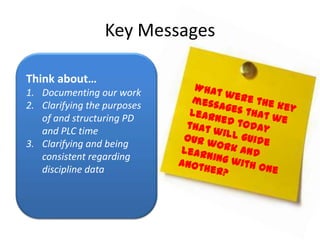
Key Messages

Think about…
1. Documenting our work
2. Clarifying the purposes
   of and structuring PD
   and PLC time
3. Clarifying and being
   consistent regarding
   discipline data
Housekeeping Items…
• Other things you need to know or
  that need to be shared…
   – Q-Comp/Pro-Pay
   – Elementary math and reading
     interventionists
   – Specialists—late start and ½ day PD

Principal HT September 22

  • 1.
    Horizontal Collaborative Teams ISD 191 Administrative Meeting September 22, 2011
  • 2.
    Horizontal Collaborative Teams SecondaryCollaborative Teams Elementary Collaborative Teams Chris Bellmont Taber Akin Cheri Braspenick Kristine Black Renee Brandner Erin Copeland Erin Copeland Kay Fecke Gary Hamilton Kari Komar Dave Helke Rob Nelson Kelly Ronn Liz Vaught Jenne O’Neill-Mager Bill Heim Lyle Bomsta Sarah Kloeckl Jon Bonneville Kari Komar Sarah Kloeckl Jeff Leach Elaine Mehdizadeh Don Leake Susan Risius Bruce Morrissette Jackie Smith Janice Porter Jeremy Willey Gene Roczniak
  • 3.
    What’s One Thing… •Individually think about the emerging current reality and action plans for your SIP. • What’s one thing that you want to celebrate about your journey so far? • Be prepared to share when prompted.
  • 4.
    Key Objectives • Learnabout documenting your SIP • Link the doing of collaborative team work to continuous improvement • Determine common processes and structures for consistency for PBIS • Differentiate between PD and PLC time
  • 5.
    SIP: Where HaveYou Been? • Use the timeline to document the steps you have taken to develop your SIP plan. • What work have you done on your SIP plan to date?
  • 6.
    Sharing with ProposedProtocol • Collaborative problem solving • Student perspective • Share the highlights from • Concise sharing of data—what are the your emerging narrative. components – What has been the • Safe, learning-focused environment (especially with teachers there), not judgmental (supportive, most rewarding part? encouraging, positive, honest, open, flexible, place for risk-taking) – What has been the • Reflective, real, authentic most challenging • Based on the current reality, topics that emerge become the focus of our work part? (future agenda) – What have you • Genuine, honest, transparent picture of the learned? data, process • Spirit of encouragement, recognition of – What more do you moving forward want to learn about? • Outcome is positive, builds trust • Feel comfortable share successes, challenges • Positive presuppositions—assume positive intent • The protocol is shared with all teachers
  • 7.
    Creating a Narrative •Creating a narrative—or telling your story of your learning and doing—is an essential part of developing and monitoring your SIP plan. • As your site monitors and documents your progress, you will need to systematically record the processes for developing your SIP, the impact of adult learning, and the results from collaborative teams. • Here’s an option that will be studied further: http://sksssip.blogspot.com/
  • 8.
    Continuous Improvement inAction Document • What do you need to show as evidence (actions/data) of your doing? the Doing • Here is what we did… Document • How will you document and analyze your thinking? the Thinking • Here is what that means… Inform the • How can what you document inform your continued doing? Doing • Here is what we will do as a result of…
  • 9.
    Application: Essential Questionsfor CTs How will teams What do teams need to document the doing of show as evidence of their collaborative team their work—to monitor work at your site? and inform their work? In what ways can Why do teams and individuals inform their individuals need to own work by using the show their work and documentation of their their thinking? team’s work?
  • 10.
    What Did YouLearn… …That will inform your work on the SIP? 1. Individually record …Where you can or might your responses to deepen your work on certain components of your the reflective SIP? questions . …Where you can make 2. When prompted, connections between what you have done and what share your what you could/should be learned. documented?
  • 11.
    Be back to continueour learning in 5.75 minutes!
  • 12.
    PBIS: Documenting DisciplineReferrals • How should discipline referrals be documented? – What is addressed verbally with students? – What is documented on TIES? – What (and when is) information sent home? • Discuss questions with your collaborative team. • Generate agreed upon responses and examples to share.
  • 13.
    PBIS Data: ActingConsistently • How do you plan to get consistent “buy- in” from your staff members? • Think how teachers and all other staff groups will document data in a consistent manner. • How do you involve parents in the process?
  • 14.
    PBIS: Documenting Behaviors/Actions •What behaviors/actions should be documented? – Review the list of minors and majors that are on TIES. – Compare the list of minors and majors from PBIS to those on TIES. – Come to a common understanding of the minors and majors that ISD 191 should follow. – Be prepared to share your compiled list.
  • 15.
    On Professional Learning… “An empowered teacher is a reflective decision maker who finds joy in learning and in investigating the teaching/learning process— one who views learning as construction and teaching as a facilitating process to enhance and enrich development.” —Fosnot
  • 16.
    Focus of Learning Whatstructures and/or processes do you have in place to differentiate professional development meetings from collaborative team time? PD focus on adult learning CT focus on student learning
  • 17.
    Focus on Learning •What will your staff be learning about during your PD time? • What will your staff be doing during their collaborative team time?
  • 18.
    Focus on Learning • Individually record what you have done to differentiate the purpose of the meetings. • Individually read the excerpt from Learning by Doing and highlight processes to support collaborative team time. • As a horizontal collaborative team, generate a list of processes or strategies used to differentiate and/or reinforce the purpose of the meetings.
  • 19.
    Deepening Our Understanding •Go the Ning site for ISD 191 Ning for ISD 191 Admin administrators and access the • http://isd191.ning.com/?show following blog post: AddContent=1&xg_source=ms • Bringing the Updated g_wel_network Standards for Professional Learning from Learn Forward (NSDC) to Life • As you review the blog post Learning Forward (NSDC) and access the more detailed • http://www.learningforward.o version of the standards on rg/standards/standards.cfm Learning Forward’s website, add a comment about how the standards will guide your decision-making about PD at your building.
  • 20.
    Key Messages Think about… 1.Documenting our work 2. Clarifying the purposes of and structuring PD and PLC time 3. Clarifying and being consistent regarding discipline data
  • 21.
    Housekeeping Items… • Otherthings you need to know or that need to be shared… – Q-Comp/Pro-Pay – Elementary math and reading interventionists – Specialists—late start and ½ day PD

Editor's Notes

  • #3 Did you want SPED coordinators double scheduled?