District Professional Development

         October 17, 2011
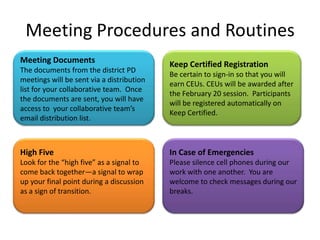
Meeting Procedures and Routines
Meeting Documents                          Keep Certified Registration
The documents from the district PD
                                           Be certain to sign-in so that you will
meetings will be sent via a distribution
                                           earn CEUs. CEUs will be awarded after
list for your collaborative team. Once
                                           the February 20 session. Participants
the documents are sent, you will have
                                           will be registered automatically on
access to your collaborative team’s
                                           Keep Certified.
email distribution list.


High Five                                  In Case of Emergencies
Look for the “high five” as a signal to    Please silence cell phones during our
come back together—a signal to wrap        work with one another. You are
up your final point during a discussion    welcome to check messages during our
as a sign of transition.                   breaks.
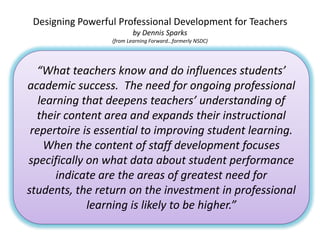
Designing Powerful Professional Development for Teachers
                         by Dennis Sparks
                  (from Learning Forward…formerly NSDC)


  “What teachers know and do influences students’
academic success. The need for ongoing professional
   learning that deepens teachers’ understanding of
  their content area and expands their instructional
 repertoire is essential to improving student learning.
    When the content of staff development focuses
specifically on what data about student performance
       indicate are the areas of greatest need for
students, the return on the investment in professional
             learning is likely to be higher.”
Triad Talk: Key Words or Phrases
• Individually underline or
  highlight key words or
  phrases that connect to
  you.
• When prompted…
   – Join two other people,
   – Share who you are and
     where you teach,
   – Share what and why you
     highlighted the key words
     or phrases from the
     passage
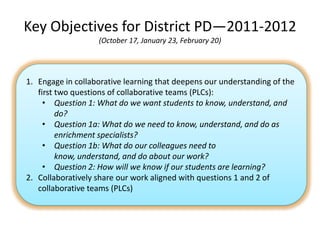
Key Objectives for District PD—2011-2012
                   (October 17, January 23, February 20)


1. Engage in collaborative learning that deepens our understanding of the
   first two questions of collaborative teams (PLCs):
     • Question 1: What do we want students to know, understand, and
         do?
     • Question 1a: What do we need to know, understand, and do as
         enrichment specialists?
     • Question 1b: What do our colleagues need to
         know, understand, and do about our work?
     • Question 2: How will we know if our students are learning?
2. Collaboratively share our work aligned with questions 1 and 2 of
   collaborative teams (PLCs)
Elbow Partner Conversation
• With a colleague next to
  you, discuss how the
  key objectives support
  your professional
  learning.
• Then discuss why they
  are important for
  improving your
  students’ learning.
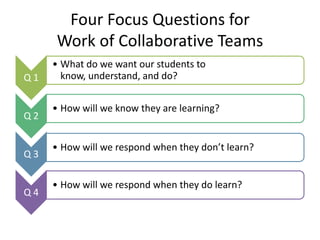
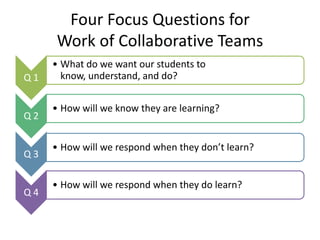
Four Focus Questions for
      Work of Collaborative Teams
     • What do we want our students to
Q1     know, understand, and do?


     • How will we know they are learning?
Q2

     • How will we respond when they don’t learn?
Q3

     • How will we respond when they do learn?
Q4
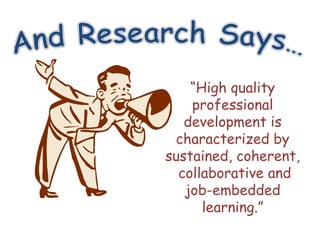
“High quality
    professional
   development is
 characterized by
sustained, coherent,
  collaborative and
   job-embedded
      learning.”
Collaborative Journey
• Support for high-quality PD related to collaborative teams and
  the focus questions is built into our professional learning:
   – In our buildings—
       • Regularly scheduled collaborative team meeting time
         focused on student learning
   – Across the district—
       • District PD dates for 2011-2012 (October 17, January
         23, February 20, and June TBD)
       • District PD dates for 2012-2013 (August, October
         15, January 21, April 15, and June TBD)
       • New PD classes aligned to our work will be part of the
         district’s new Staff Development Academy
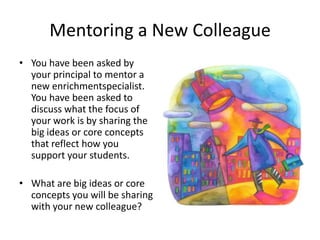
Mentoring a New Colleague
• You have been asked by
  your principal to mentor a
  new enrichmentspecialist.
  You have been asked to
  discuss what the focus of
  your work is by sharing the
  big ideas or core concepts
  that reflect how you
  support your students.

• What are big ideas or core
  concepts you will be sharing
  with your new colleague?
Sharing Essential Learning Outcomes
                              • Sharing Protocol:
Process:
With a partner from
                                 – Partner A shares for 3
across the room—does               minutes. Partner B listens.
not have to be a                 – Partner B shares for 3
enrichment specialist—             minutes. Partner A listens.
                                 – When prompted, discuss
share your reflections with        what you heard and
them as if they are the            learned for 1 minute.
new reading teacher or           – Be sure not to interject or
                                   comment when your
media specialist.                  partner is speaking.
Hmmm…

• While you were sharing
  or listening, what did
  you learn about what
  you shared and/or what
  you heard being
  shared?
Four Focus Questions for
      Work of Collaborative Teams
     • What do we want our students to
Q1     know, understand, and do?


     • How will we know they are learning?
Q2

     • How will we respond when they don’t learn?
Q3

     • How will we respond when they do learn?
Q4
About Our Teaching Time
• Create a group of four by
  joining another elbow
  partners pair.
• Generate a list of the things
  that will interfere with your
  responsibilities (setting
  routines at the beginning of
  the year/quarter, testing
  prep or
  testing, school/special
  assemblies).
• Be prepared to share the
  number of lost instructional
  days with the whole
  group…when prompted.
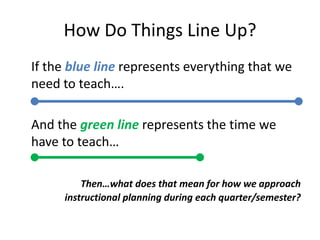
How Do Things Line Up?
If the blue line represents everything that we
need to teach….

And the green line represents the time we
have to teach…

         Then…what does that mean for how we approach
     instructional planning during each quarter/semester?
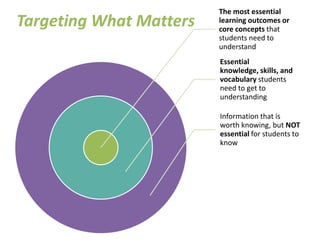
The most essential
Targeting What Matters   learning outcomes or
                         core concepts that
                         students need to
                         understand
                         Essential
                         knowledge, skills, and
                         vocabulary students
                         need to get to
                         understanding

                         Information that is
                         worth knowing, but NOT
                         essential for students to
                         know
Getting to Essential Learning Outcomes…
…involves an ongoing process of—
  –   Collaborating
  –   Thinking
  –   Doing
  –   Collaborating
  –   Thinking
  –   Doing
  –   Collaborating
  –   Thinking
  –   Doing
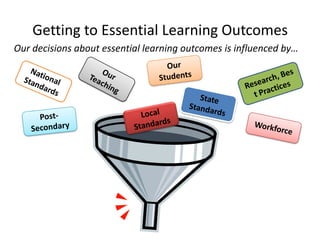
Getting to Essential Learning Outcomes
Our decisions about essential learning outcomes is influenced by…
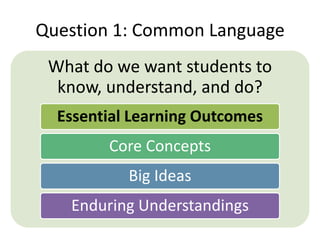
Question 1: Common Language
 What do we want students to
  know, understand, and do?
  Essential Learning Outcomes
        Core Concepts
           Big Ideas
   Enduring Understandings
Essential Learning Outcomes Defined
• Essential learning outcomes are…
  – The indicators, by grade level, course, or content
    area, that all students will have access to regardless of
    their building or classroom assignment
  – The top priorities in a grade level, course, or content
    area that students need to know, understand, and do
  – The concepts that provide focus to the curriculum—
    defining a guaranteed, viable curriculum
  – The framework that guides collaborative instructional
    planning both horizontally and vertically
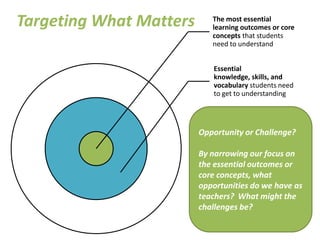
Targeting What Matters      The most essential
                            learning outcomes or core
                            concepts that students
                            need to understand


                            Essential
                            knowledge, skills, and
                            vocabulary students need
                            to get to understanding


                         Opportunity or Challenge?

                         By narrowing our focus on
                         the essential outcomes or
                         core concepts, what
                         opportunities do we have as
                         teachers? What might the
                         challenges be?
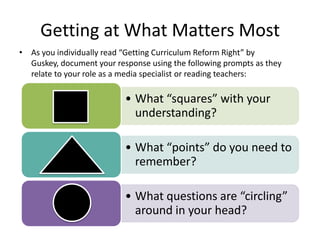
Getting at What Matters Most
• As you individually read “Getting Curriculum Reform Right” by
  Guskey, document your response using the following prompts as they
  relate to your role as a media specialist or reading teachers:

                           • What “squares” with your
                             understanding?

                           • What “points” do you need to
                             remember?

                           • What questions are “circling”
                             around in your head?
Be back to
continue our
learning in
7 minutes!
On Using Standards to Guide Practice…
 “I always approach the standards with my students in
 mind. I try to come up with a lesson that I think will be
 interesting for students. Then I’ll sit down and
 say, which standards am I covering, which should I be
 covering that I’m not covering? I see part of my job as
 trying to get the kids that aren’t interested to be
 interested. The whole point is to help the kids, that’s
 the whole reason I do it. You have to continue to try
 new things, to be comfortable with what you’re
 doing, and to try to reach as many kids as possible.
 That’s the sole purpose of what I do. I’ll do it any way I
 can.”
                            —Steve Bodnar, High School English Teacher
Reflective Prompts to Develop Question 1

1. What are 8-10 essential learning outcomes you
   want students to understand?
2. What do you need to know, understand, and do
   as media specialists? As reading teachers?
3. What are the essential knowledge and skills
   students need to support their learning?
4. What is the essential academic vocabulary
   students need to support their learning?
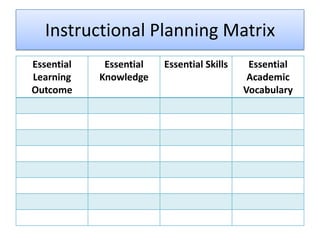
Instructional Planning Matrix
Essential    Essential   Essential Skills    Essential
Learning    Knowledge                        Academic
Outcome                                     Vocabulary
Focus on Question 1:
  What do we need students to know, understand, and do?

                                1. Look for the 8-10
As you think about the             essential learning
course or focus of what            outcomes or big ideas
students need to                   that students should
learn, use the standards           leave your classroom
and benchmarks related             understanding
to your work to identify        2. Consider the language
the essential learning             being used in the
outcomes that will guide           standards—what
your instructional                 actions are core?
planning.                          What concepts emerge
                                   as core?
Checking for Understanding
             • When prompted, form
               collaborative teams of 4-5
               and share the essential
               learning outcomes that
               you have identified.
             • During the sharing, make
               notes and/or document
               your colleagues’ thinking.
             • As a group, generate a
               master copy of essential
               learning outcomes.
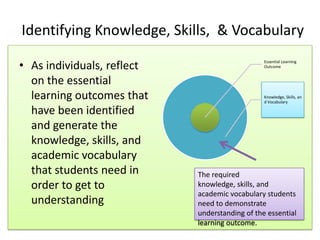
Identifying Knowledge, Skills, & Vocabulary

• As individuals, reflect                       Essential Learning
                                                Outcome


  on the essential
  learning outcomes that                        Knowledge, Skills, an
                                                d Vocabulary

  have been identified
  and generate the
  knowledge, skills, and
  academic vocabulary
  that students need in     The required
  order to get to           knowledge, skills, and
                            academic vocabulary students
  understanding             need to demonstrate
                            understanding of the essential
                            learning outcome.
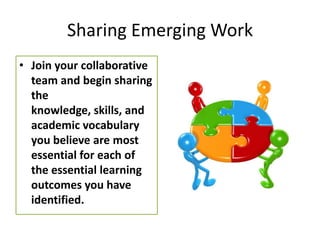
Sharing Emerging Work
• Join your collaborative
  team and begin sharing
  the
  knowledge, skills, and
  academic vocabulary
  you believe are most
  essential for each of
  the essential learning
  outcomes you have
  identified.
Looking Ahead
• As part of your collaborative team meetings in your
  buildings and at subsequent district PD sessions, you will
  continue your collaboration to identify and document the
  following:
   –   Essential Learning Outcomes
   –   Essential Knowledge
   –   Essential Skills
   –   Essential Academic Vocabulary
• Share a copy of your collaborative team’s emerging work
  (NOTE: only one copy per collaborative team needs to be
  submitted so that we can use the information to guide our
  planning processes for January and February).
• Copies will be scanned and emailed to all participants in
  the group.
Key Messages
• What were the key messages that we learned
  today that will guide our work and learning
  with one another?
 Think about…
 The instructional time you have and/or don’t have
 The use of standards and benchmarks to guide your
 instructional planning
 The identification of essential learning outcomes, essential
 knowledge, essential skills, and essential academic
 vocabulary
 The process of being collaborative
When I Think About Question 1…

I am most excited by…
I am most concerned about…
I wish I knew…
I expect that…
I am committed to…
Teachers Are the Key
If there is one thing we have learned over the past three decades of
    reform and research, it’s that teachers matter most in schools.
Standards and assessments are part of the puzzle, as are the
    availability of quality resources, a strong school/community
    partnership, and safe facilities.
But teachers and teaching have a significant effect on student
    achievement. Tests don’t improve student learning, teachers do.
A curriculum alone doesn’t improve student learning.
But teacher-guided student interactions with the curriculum and
    teacher selections of elements for discussion, expansion, and
    emphasis do.
High standards alone don’t improve student learning.
But teachers who communicate high expectations by providing
    intellectually challenging learning activities and materials do.

              From Teaching to the Core – Reading, Writing, and Mathematics, MCREL 2001

District PD October 17

  • 1.
  • 2.
    Meeting Procedures andRoutines Meeting Documents Keep Certified Registration The documents from the district PD Be certain to sign-in so that you will meetings will be sent via a distribution earn CEUs. CEUs will be awarded after list for your collaborative team. Once the February 20 session. Participants the documents are sent, you will have will be registered automatically on access to your collaborative team’s Keep Certified. email distribution list. High Five In Case of Emergencies Look for the “high five” as a signal to Please silence cell phones during our come back together—a signal to wrap work with one another. You are up your final point during a discussion welcome to check messages during our as a sign of transition. breaks.
  • 3.
    Designing Powerful ProfessionalDevelopment for Teachers by Dennis Sparks (from Learning Forward…formerly NSDC) “What teachers know and do influences students’ academic success. The need for ongoing professional learning that deepens teachers’ understanding of their content area and expands their instructional repertoire is essential to improving student learning. When the content of staff development focuses specifically on what data about student performance indicate are the areas of greatest need for students, the return on the investment in professional learning is likely to be higher.”
  • 4.
    Triad Talk: KeyWords or Phrases • Individually underline or highlight key words or phrases that connect to you. • When prompted… – Join two other people, – Share who you are and where you teach, – Share what and why you highlighted the key words or phrases from the passage
  • 5.
    Key Objectives forDistrict PD—2011-2012 (October 17, January 23, February 20) 1. Engage in collaborative learning that deepens our understanding of the first two questions of collaborative teams (PLCs): • Question 1: What do we want students to know, understand, and do? • Question 1a: What do we need to know, understand, and do as enrichment specialists? • Question 1b: What do our colleagues need to know, understand, and do about our work? • Question 2: How will we know if our students are learning? 2. Collaboratively share our work aligned with questions 1 and 2 of collaborative teams (PLCs)
  • 6.
    Elbow Partner Conversation •With a colleague next to you, discuss how the key objectives support your professional learning. • Then discuss why they are important for improving your students’ learning.
  • 7.
    Four Focus Questionsfor Work of Collaborative Teams • What do we want our students to Q1 know, understand, and do? • How will we know they are learning? Q2 • How will we respond when they don’t learn? Q3 • How will we respond when they do learn? Q4
  • 8.
    “High quality professional development is characterized by sustained, coherent, collaborative and job-embedded learning.”
  • 9.
    Collaborative Journey • Supportfor high-quality PD related to collaborative teams and the focus questions is built into our professional learning: – In our buildings— • Regularly scheduled collaborative team meeting time focused on student learning – Across the district— • District PD dates for 2011-2012 (October 17, January 23, February 20, and June TBD) • District PD dates for 2012-2013 (August, October 15, January 21, April 15, and June TBD) • New PD classes aligned to our work will be part of the district’s new Staff Development Academy
  • 10.
    Mentoring a NewColleague • You have been asked by your principal to mentor a new enrichmentspecialist. You have been asked to discuss what the focus of your work is by sharing the big ideas or core concepts that reflect how you support your students. • What are big ideas or core concepts you will be sharing with your new colleague?
  • 11.
    Sharing Essential LearningOutcomes • Sharing Protocol: Process: With a partner from – Partner A shares for 3 across the room—does minutes. Partner B listens. not have to be a – Partner B shares for 3 enrichment specialist— minutes. Partner A listens. – When prompted, discuss share your reflections with what you heard and them as if they are the learned for 1 minute. new reading teacher or – Be sure not to interject or comment when your media specialist. partner is speaking.
  • 12.
    Hmmm… • While youwere sharing or listening, what did you learn about what you shared and/or what you heard being shared?
  • 13.
    Four Focus Questionsfor Work of Collaborative Teams • What do we want our students to Q1 know, understand, and do? • How will we know they are learning? Q2 • How will we respond when they don’t learn? Q3 • How will we respond when they do learn? Q4
  • 14.
    About Our TeachingTime • Create a group of four by joining another elbow partners pair. • Generate a list of the things that will interfere with your responsibilities (setting routines at the beginning of the year/quarter, testing prep or testing, school/special assemblies). • Be prepared to share the number of lost instructional days with the whole group…when prompted.
  • 15.
    How Do ThingsLine Up? If the blue line represents everything that we need to teach…. And the green line represents the time we have to teach… Then…what does that mean for how we approach instructional planning during each quarter/semester?
  • 16.
    The most essential TargetingWhat Matters learning outcomes or core concepts that students need to understand Essential knowledge, skills, and vocabulary students need to get to understanding Information that is worth knowing, but NOT essential for students to know
  • 17.
    Getting to EssentialLearning Outcomes… …involves an ongoing process of— – Collaborating – Thinking – Doing – Collaborating – Thinking – Doing – Collaborating – Thinking – Doing
  • 18.
    Getting to EssentialLearning Outcomes Our decisions about essential learning outcomes is influenced by…
  • 19.
    Question 1: CommonLanguage What do we want students to know, understand, and do? Essential Learning Outcomes Core Concepts Big Ideas Enduring Understandings
  • 20.
    Essential Learning OutcomesDefined • Essential learning outcomes are… – The indicators, by grade level, course, or content area, that all students will have access to regardless of their building or classroom assignment – The top priorities in a grade level, course, or content area that students need to know, understand, and do – The concepts that provide focus to the curriculum— defining a guaranteed, viable curriculum – The framework that guides collaborative instructional planning both horizontally and vertically
  • 21.
    Targeting What Matters The most essential learning outcomes or core concepts that students need to understand Essential knowledge, skills, and vocabulary students need to get to understanding Opportunity or Challenge? By narrowing our focus on the essential outcomes or core concepts, what opportunities do we have as teachers? What might the challenges be?
  • 22.
    Getting at WhatMatters Most • As you individually read “Getting Curriculum Reform Right” by Guskey, document your response using the following prompts as they relate to your role as a media specialist or reading teachers: • What “squares” with your understanding? • What “points” do you need to remember? • What questions are “circling” around in your head?
  • 23.
    Be back to continueour learning in 7 minutes!
  • 24.
    On Using Standardsto Guide Practice… “I always approach the standards with my students in mind. I try to come up with a lesson that I think will be interesting for students. Then I’ll sit down and say, which standards am I covering, which should I be covering that I’m not covering? I see part of my job as trying to get the kids that aren’t interested to be interested. The whole point is to help the kids, that’s the whole reason I do it. You have to continue to try new things, to be comfortable with what you’re doing, and to try to reach as many kids as possible. That’s the sole purpose of what I do. I’ll do it any way I can.” —Steve Bodnar, High School English Teacher
  • 25.
    Reflective Prompts toDevelop Question 1 1. What are 8-10 essential learning outcomes you want students to understand? 2. What do you need to know, understand, and do as media specialists? As reading teachers? 3. What are the essential knowledge and skills students need to support their learning? 4. What is the essential academic vocabulary students need to support their learning?
  • 26.
    Instructional Planning Matrix Essential Essential Essential Skills Essential Learning Knowledge Academic Outcome Vocabulary
  • 27.
    Focus on Question1: What do we need students to know, understand, and do? 1. Look for the 8-10 As you think about the essential learning course or focus of what outcomes or big ideas students need to that students should learn, use the standards leave your classroom and benchmarks related understanding to your work to identify 2. Consider the language the essential learning being used in the outcomes that will guide standards—what your instructional actions are core? planning. What concepts emerge as core?
  • 28.
    Checking for Understanding • When prompted, form collaborative teams of 4-5 and share the essential learning outcomes that you have identified. • During the sharing, make notes and/or document your colleagues’ thinking. • As a group, generate a master copy of essential learning outcomes.
  • 29.
    Identifying Knowledge, Skills,& Vocabulary • As individuals, reflect Essential Learning Outcome on the essential learning outcomes that Knowledge, Skills, an d Vocabulary have been identified and generate the knowledge, skills, and academic vocabulary that students need in The required order to get to knowledge, skills, and academic vocabulary students understanding need to demonstrate understanding of the essential learning outcome.
  • 30.
    Sharing Emerging Work •Join your collaborative team and begin sharing the knowledge, skills, and academic vocabulary you believe are most essential for each of the essential learning outcomes you have identified.
  • 31.
    Looking Ahead • Aspart of your collaborative team meetings in your buildings and at subsequent district PD sessions, you will continue your collaboration to identify and document the following: – Essential Learning Outcomes – Essential Knowledge – Essential Skills – Essential Academic Vocabulary • Share a copy of your collaborative team’s emerging work (NOTE: only one copy per collaborative team needs to be submitted so that we can use the information to guide our planning processes for January and February). • Copies will be scanned and emailed to all participants in the group.
  • 32.
    Key Messages • Whatwere the key messages that we learned today that will guide our work and learning with one another? Think about… The instructional time you have and/or don’t have The use of standards and benchmarks to guide your instructional planning The identification of essential learning outcomes, essential knowledge, essential skills, and essential academic vocabulary The process of being collaborative
  • 33.
    When I ThinkAbout Question 1… I am most excited by… I am most concerned about… I wish I knew… I expect that… I am committed to…
  • 34.
    Teachers Are theKey If there is one thing we have learned over the past three decades of reform and research, it’s that teachers matter most in schools. Standards and assessments are part of the puzzle, as are the availability of quality resources, a strong school/community partnership, and safe facilities. But teachers and teaching have a significant effect on student achievement. Tests don’t improve student learning, teachers do. A curriculum alone doesn’t improve student learning. But teacher-guided student interactions with the curriculum and teacher selections of elements for discussion, expansion, and emphasis do. High standards alone don’t improve student learning. But teachers who communicate high expectations by providing intellectually challenging learning activities and materials do. From Teaching to the Core – Reading, Writing, and Mathematics, MCREL 2001

Editor's Notes

  • #3 5 minutes:After you greet your participants, share the routines and procedures that will be part of our district PD days. One routine involves bringing our group back together when we are engaged in collaborative learning. When we need to come back together, look for the “high five.” When you see it, know we will be coming back together—raise your hand. Another procedure is related to information that we share at our meetings. Participants will be sent to an email so that they can access all of the materials/documents from the district PD sessions. A third procedure deals with cell phones. Teaching and Learning will be registering participants on Keep Certified once all staff member assignments have been updated. Hours will be assigned after the February 20 session.
  • #4 5-7 minutes (1 of 2 slides)Distribute handout with the passage by Sparks and the key objectives (copied on both sides). Read the passage by Sparks to your group and invite them to underline or circle words or phrases that are important to them and that speak to their beliefs, professional learning needs, and/or hopes/expectations.
  • #5 5-7 minutes (2 of 2 slides)After participants have discussed the passage for a few minutes, invite 3-4 people to share some of what was discussed in their triad. The purpose of the passage and the sharing is to reinforce the importance of deepening their understanding about their content area/profession and to engage in learning collaboratively.
  • #6 5-7 minutesAfter sharing the key objectives for the morning, have elbow partners talk about the prompts for a couple of minutes. Invite 3-4 people who didn’t share during the quote to share which of the objectives are going to be critical for their professional learning and which will impact their students’ learning. REINFORCE THE CONCEPT THAT OUR FOCUS ON QUESTIONS 1 AND 2 WILL BE SUSTAINED—BOTH IN OUR WORK DURING DISTRICT PD AND AT SITES WITH COLLABORATIVE TEAMS—IT’S A PROCESS…A COLLABORATIVE JOURNEY.
  • #7 5-7 minutesInvite 3-4 people to share which of the objectives are going to be critical for their professional learning and which will impact their students’ learning. Reinforce that the emphasis for district PD days this year will be on questions one and two related to collaborative teams (PLCs)—question 1: what do we need our students to know, understand, and do? And question 2: how will we know if they know it (assessment of and for learning)?
  • #8 5 minutesThe focus of PLC work is for teams to focus on processing the four questions that guide PLC work:What do we want our students to know?How will we know they are learning?How will we respond when they don't learn?How will we respond when they do learn?
  • #9 Sustained PD is on-going. Coherent PD is connected to our work—a focus on teaching and learning. Collaborative PD is about learning from and with one another. Job-embedded PD is linked directly to our daily work.NEW SLIDE FOR PRINCIPALS WHO ATTENDED TUESDAY’S SESSION!
  • #10 Our focus on the PLC questions will be sustained, coherent, collaborative, and job-embedded!!!!!!!!NEW SLIDE FOR PRINCIPALS WHO ATTENDED TUESDAY’S SESSION!
  • #11 10-15 minutes (slide 1 of 3) (TEACHERS)Share the scenario with the group. Allow individuals to reflect individually and quietly for 5 minutes. Have them record their initial thinking on scratch paper so that they can use their notes for a conversation.
  • #12 Language accommodates either elementary or secondary (slide 2 of 3)
  • #13 Slide 3 of 3Invite feedback and comments from the whole group.
  • #14 5 minutesThe focus of PLC work is for teams to focus on processing the four questions that guide PLC work:What do we want our students to know?How will we know they are learning?How will we respond when they don't learn?How will we respond when they do learn?
  • #15 OPTIONAL FOR K-6 MATH, SECONDARY ELA, MATH, SCIENCE.5 minutesHave groups of 4 generate list and then share # of days—make the connection to question 1—as teachers, we need to know and use our instructional time effectively to help our students learn the essential outcomes for our class, course, or content area.
  • #16 1-2 minutesThis slide reinforces the idea that we often have more to teach and not enough time to teach the essential outcomes, knowledge, skills, and academic vocabulary that our students need.You do not need to provide discussion time for this slide…it is intended to visually reinforce that we COULD teach MORE CONTENT than WE HAVE time to teach the content. Therefore, we need to be purposeful in determining what and when to teach the essential outcomes for our class, course, or content area.
  • #17 5 minutesThis slide is for you to share with your participants, as well. If the whole circle represents the content that could be taught, the center circle would represent the most essential outcomes or core concepts that students need to understand. It represents the concepts we want our students to leave our classrooms “UNDERSTANDING.” The middle (teal colored) circle represents the essential knowledge, skills and academic vocabulary students have to have so that they can understand the essential outcomes. The outer circle represents the “nice or interesting to know” information, but it is NOT essential.
  • #18 We want teachers to know their work will continue and the district is supporting that through curriculum development, district PD and building level PLC work. The work requires thought, implementation, and collaboration—part of an ongoing process. This is part of the continuous improvement process…we informally experience this as part of our practice on regular basis. The processes we are working on to get to the essential learning outcomes are more formal.NEW SLIDE FOR PRINCIPALS WHO ATTENDED TUESDAY’S SESSION!
  • #19 To get to the essential learning outcomes, a number of items factor into decision-making about what students need to know, understand, and do. We have to consider how national, state, local standards, our teaching, our students, research-best practices, etc. factor influence and/or guide our decision-making.NEW SLIDE FOR PRINCIPALS WHO ATTENDED TUESDAY’S SESSION!
  • #20 1-2 minutesThis slide references core concepts, essential learning outcomes, big ideas, enduring understandings—all terms from best practices in relation to curriculum and instruction that essentially mean the same thing…so as we focus on question one, we are narrowing our focus on the center circle from the graphic and trying to have teachers identify—and name—the 8-10 big ideas, essential learning outcomes, or core concepts that students need to understand. Using any of the terms on the slide is acceptable…the idea is to think big, core, essential, or enduring. In ISD 191, we will be using essential learning outcomes.
  • #21 3-5 minutesLet your participants read the descriptors for the definition for essential learning outcomes before discussing it with the larger group. Invite feedback from the room about the definition. The intent of the district is to have a common language and develop a common understanding for our work on curriculum and instruction.This slide was missing from the Friday morning session.
  • #22 5-7 minutesAsk participants to find someone across the room with whom they have not visited to discuss the diagram and the intent of it. After a few minutes, invite a few participants to share their responses. Guide the conversation to focus on our work as educators should be to collaborate to determine what students REALLY need to know, understand, and do. We should use standards and benchmarks (national and state—professional organizations) and local expectations to guide our decision-making. We need to use standards and benchmarks to guide our decision-making, not the materials we have to teach.
  • #23 20-25 minutesAs participants transition back to their seats, distribute “Getting Curriculum Reform Right” from Thomas Guskey and the corresponding reflection form. Have participants individually read the Guskey article and document their responses to the 3 reflective prompts on the “shape” sheet. When participants finish reading and reflecting, have them join four other people to summarize and record their thinking/commonly shared responses. Provide the shape sheet copied on colored paper. When prompted, have one group share what SQUARES with their understanding and then invite others to add other comments. Then invite a different group to share the POINTS they need to remember…and again have other groups add. Finally, have a third group share what questions are CIRCLING in their heads about the article. The focus of the article is on the importance of using standards and benchmarks to guide our decision-making as instructional planners. We use the skeleton or foundation from standards and benchmarks to determine the essential outcomes and then as teachers we can use materials, processes, and resources—from our craft—to add “flesh to the bones.”When the sharing is completed, have groups share their collaboratively generated responses on the colored shape sheets.
  • #24 Allow no more than 10 minutesYou should be about 1 hour and 30 minutes into the process.
  • #25 SecondaryInstead of thinking about teaching the American Revolution, think about the concepts of freedom and independence, conflict (war—as a country, as individuals). Instead of thinking about teaching a specific novel (The Scarlet Letter), think about themes of persecution, faith, isolation and literary concepts like exposition, historical context, character development, plot, etc.
  • #26 90 minutes (see next slides for how time is allotted)3-5 minutes to distribute standards and matrixDistribute the standards/benchmarks and/or respective documents participants will need to individually and then collaboratively document their responses to questions 1-3. Distribute the INDIVIDUAL instructional planning matrix that individuals and groups will need to document their work. NOTE—NOTE—NOTE—NOTE—NOTE—NOTE: For grades K-6 and other subject areas that have worked with Kathy Funston and Rachel Gorton, there are additional planning documents that need to be consulted. K-6 math groups have the units of study to serve as a critical guide in fleshing out essential learning outcomes, essential knowledge, essential skills, and essential academic vocabulary. Other subject areas that have worked with Kathy and Rachel can use their preliminary work to facilitate their work.
  • #27 The template will be used to reflect individually and then collaboratively.
  • #28 15 of 90 minutesHave participants INDIVIDUALLY reflect on the documents and then document the essential learning outcomes on the planning matrix—Allow 15 minutes to individually record the core concepts. FILL IN ONLY THE COLUMN ON THE LEFT.
  • #29 Additional 15-20 minutes of 90 minutesOrganize into groups…limit 5 participants per group to make the sharing and collaboration more doable. For 7-12 and specialized focus area groups for special education, determine the most appropriate groups that should be formed. Have groups share and add to/modify the list of essential learning outcomes that they have documented. Have each group generate a master copy. A second copy is available for individuals to record the collaborative team’s work. THE FORM IS LABELED FOR COLLABORATIVE TEAMS. The list they are generating is not a final list…as they engage in further collaboration and learning, the lists may change.
  • #30 Allow an additional 15-20 minutes for individuals to shift from identifying the essential learning outcomes to determining and documenting the essential knowledge, skills, and academic vocabulary related to the concept. Allow individuals to work independently before sharing.After 15-20 minutes of individual reflection and documentation, have the groups come together again. As a group, participants need to record the essential knowledge, skills, and academic vocabulary on a master copy of the planning matrix for the essential learning outcomes they have identified.
  • #31 15-20 minutesAllow teams to share their emerging work. Be certain teams are documenting their collaborative work. As teams finish, have them submit a master copy that will be copied, scanned and returned via email to the teams. Their work serves as a formative assessment that will inform and guide planning for subsequent PD days.
  • #32 3-5 minutesNOTE: this is one form of evaluating the professional development session. We are using “student work” (teacher work here) to inform and guide our planning—a formative assessment…just like we expect to see in classrooms. An electronic version of the instructional planning matrix will be sent to all teachers so that they can document their individual or collaborative work and share it with their assigned facilitator and collaborative learning teams at their grade level, content area, focus area.
  • #33 5-7 minutesAllow participants to individually reflect on their learning and then generate a common list of key messages that can be shared with the whole group. A reflection sheet for key messages is available for each group and should be collected as one form of evaluation. This process is another form of evaluating the professional development session. The insights gained will inform our planning for our next PD session. As one team shares, others can determine what new messages need to be shared.
  • #34 5 minutesProvide a couple of minutes for individuals to use one of the sentence frames/stems to respond to their learning during the session. Have people share out their responses using a WHIP—without hesitation inviting participation process…only people rapid firing their responses, no feedback or dialogue about what people share. This is a third formative assessment that can be instructive, as well, if you can record a representation of the responses, the informal formative assessment will be beneficial for our planning purposes, as well. This is a more informal approach to gathering feedback or evaluating professional development.
  • #35 Wrap up the session by sharing the passage from Teaching to the Core. Remind folks to sign in and submit their draft copies of their instructional planning matrix…again, it will be used as a formative assessment to inform and guide our planning for subsequent district PD days.