Digital Learning
 for All, NOW!
      Systems Reflection and
Continuous Improvement Framework
         Jonathan P. Costa, Sr.


                                  © Corwin Press - 2011
Goals for
                                                 Learning
                           Teaching &                                Assessment
                           Instruction                                 & Data


                                                 Leadership
                         Curriculum &
                                                   Focus
                                                                             Resource
                        Communication                                       Deployment


                                        Professional         Professional
                                         Evaluation            Support


© Corwin Press - 2011
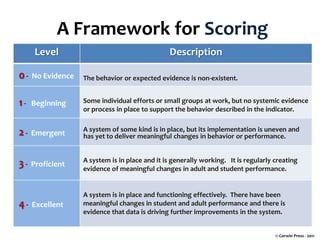
A Framework for Scoring
      Level                                     Description

0-   No Evidence   The behavior or expected evidence is non-existent.


1-   Beginning     Some individual efforts or small groups at work, but no systemic evidence
                   or process in place to support the behavior described in the indicator.

                   A system of some kind is in place, but its implementation is uneven and
2-   Emergent      has yet to deliver meaningful changes in behavior or performance.


                   A system is in place and it is generally working. It is regularly creating
3-   Proficient
                   evidence of meaningful changes in adult and student performance.


                   A system is in place and functioning effectively. There have been
4-   Excellent     meaningful changes in student and adult performance and there is
                   evidence that data is driving further improvements in the system.


                                                                                     © Corwin Press - 2011
Leadership
     & Focus
  The degree to which
 leadership supports a
  coherent movement
toward a digital vision
        of instruction.


                  © Corwin Press - 2011
1.1 Vision and Focus
 A compelling vision for the attainment of 21st century skills for all students in a digital, one-to-one environment has been
     developed and implemented. This vision is focused on ensuring that all students have the most critical skills and
      attributes needed for life, learning, and work beyond school. This focused vision is grounded on the values of
  meaningful engagement, collaboration, inquiry and higher-order thinking for all members of the learning community.


        0                             1                          2                             3                                 4
  No statement of vision                                                                               Complete and descriptive
  Unarticulated beliefs                                                                                  Concise and compelling
  Disjointed or non-existent plans                                                           Interconnected and driving decisions
  Technical, mechanical – purchasing and deployment                                                          Focused on learning
  Dozens of skills to track                                                                                       Vital Few skills
  Exclusive                                                                                            Inclusive – Skills 21 for all

Rationale and Supporting Evidence:


Areas of District Strength:                                              Areas Where Growth is Needed:


If you rated yourself a 2 or lower:

   ◦    Immerse the staff in the literature related to digital learning and 21st century skills. Explore the realities of a digital
        future and what adequate preparation for this environment looks like.
   ◦    With that background knowledge, retreat for the purpose of vision building, transition to one-to-one planning, or
        some other process that will begin to forge a consensus on these critical issues.

                                                                                                                           © Corwin Press - 2011
1.4 Culture and Modeling
       The culture of your district and schools support and celebrate authentic use of digital tools for learning across the
      curriculum. These tools are used to advance both administrative and curricular applications. District, building, and
      instructional leaders have a shared vision of a 21st century school system, are conversant regarding the opportunity
               and challenge of one-to-one learning, and are consistently working toward realizing its potential.

  0                                 1                           2                             3                                4
No systematic applications                                                                     Systemic technology applications
Innovation derided                                                                                        Innovation celebrated
Haphazard examples                                                                               Comprehensive use in all areas
No vision or inconsistent articulation                                                               Vision clear and consistent
Leader’s modeling absent                                                           Thoughtful and abundant modeling by leaders
Do As I say, Not as I do                                                                                           Come join me

Rationale for Score:


Areas of District Strength:                                             Areas Where Growth is Needed:


If you rated 2 or lower:

    ◦     Look in the mirror – how have you modeled or not modeled these expectations?
    ◦     Initiate a Professional Learning Community process to explore the rationale for Digital Learning for All, NOW! that
          is described in Chapter One. Have administrative leaders work through the book’s reflection questions.
    ◦     Encourage and motivate leaders to demonstrate their ability to live the digital learning vision of the district.

                                                                                                                       © Corwin Press - 2011
Goals for
       Learning
  The commitment you
  have made to a small
and focused number of
     essential skills and
    learning outcomes.


                   © Corwin Press - 2011
2.1 Commitment to Rigor and Understanding
      The culture of curriculum and supervision in your district supports a focus and value on deep learning, rigorous
     application, and long-term retention of key concepts. Mastery of a few is more important than coverage of many.
    There is an explicit understanding that all content is not created equally and curriculum design represents this value.


    0                             1                            2                            3                               4
    Coverage                                                                                     Retention and understanding
    “Where are you?”                                                                                “What are they learning?”
    Value on how much is taught                                                                  Value on how much is learned
    No impact                                                                                                 Drives decisions
    Pacing Guides                                                                               Shared Evidence of Attainment


Rationale for Score:


Areas of District Strength:                                          Areas Where Growth is Needed:


If you rated 2 or lower:
   ◦    Practice prioritization and research the impact of the Vital Few.
   ◦    Explore the foundations of Understanding by Design.
   ◦    Identify the CRITICAL learning outcomes that the district wants to support in each of the curricular areas and focus
        district curriculum and instructional resources on the successful teaching and learning of just those outcomes.


                                                                                                                    © Corwin Press - 2011
2.2 Articulation of 21st Century Skills
The district has articulated and/or committed to a focused set of 21st century skills that define what students (and adults)
 should be able to do in a digital learning and work environment. Those standards have been articulated in such a way
           that they are grounded in authentic contexts and are clearly everyone’s instructional responsibility.

0                             1                             2                             3                                4

No standards                                                                                    Clearly articulated evidence
No connection to classroom                                                                        Standards drive decisions
More is more                                                                                Focused and vital, True North 21
No review process                                                                          Updated and reviewed frequently
Technology dependent                                                                                          Device neutral
Subject by subject                                                                                     Universal application

Rationale for Score:


Areas of District Strength:                                           Areas Where Growth is Needed:


If you rated 2 or lower:

    ◦   Review the literature from NCREL, ISTE and the Partnership for 21st Century Skills. What does it mean to be
        prepared for life, learning and work in the 21st century?
    ◦   Explore what how different content topics are applied in authentic settings. What is the underlying skill set that
        enable the effective use of this content outside of the classroom?

                                                                                                                   © Corwin Press - 2011
What is the Goal?
                                        Communicate
                                         Effectively


                    Independent &                         Adaptable
                        Collaborative                     & Creative
                                          21st
                                        Century
                                         Skills
                        Information                      Higher-Order
                          Literacy                         Thinking


                                          Personal
                                        Responsibility


© Corwin Press - 2011
Teaching &
Instruction
     The alignment of
instructional practice
  with the articulated
   goals for learning.


                 © Corwin Press - 2011
Preparing Students For a Knowledge Economy
                                   Subject Area                        Everyone’s
                                  Responsibilities                    Responsibility
 Type of            Content                   Content Skills              21st Cent. Skills
Knowledge         (Declarative)                (Procedural)                (Contextual)
                     Facts                    Discrete Skills         Applied Understandings
 Desired

  Type of        Lecture, video,           Classroom or textbook          Complex projects,
                 films, assigned          problems, experiments,        real time explorations,
Instruction       readings and            discussions, practice and     authentic and relevant
                memory activities.
 Required                                        repetition.               skill applications.


               Recall & recognition               Checklists,
  Type of      based quizzes, tests,           analytic rubrics,
                                                                              Holistic and,
                                                                            analytic rubrics,
Assessment    and activities. Multiple      or other agreed upon         or other agreed upon
              choice, matching, etc.            skill standards           standards of rigor
 Required        (SAT/AP/Exams)             (AP/CMT/CAPT/Exams)       (Portfolios, Exhibitions, Etc)


Amount of          Discrete units,            Discrete units,            Ongoing, systemic and
   Time             spiraled and               spiraled and                 without a finite
                    predictable.               predictable.               or predictable end.
 Required
              Align Your Systems With Your Goals for Learning
Expanding Our Thinking
Think about the Information Diet http://www.informationdiet.com/

Ken Robinson – 11 minute video on changing the paradigm of education
http://www.youtube.com/watch?v=zDZFcDGpL4U

Along the same lines, this organization is dedicated to helping teachers reimagine what their classrooms could look like in a
digitally supported environment
http://newclassrooms.org/reimagine.html

Very interesting article about how the grass is greener on the other side of the fence – the Chinese chase greater creativity, we
chase better test scores
http://chronicle.com/article/US-Education-in-Chinese/130669/

This article from Lawrence Summers – Harvard President – about the changes – or lack of changes – needed at the university
level driven by technology and 21st century skills.
http://www.nytimes.com/2012/01/22/education/edlife/the-21st-century-education.html?pagewanted=all

More evidence of the shifts in the undergraduate education market – this organization is dedicated to the idea that everyone
should have access to high quality higher education at low cost.
http://www.udacity.com/

A great article that is a bit of a mind-bender about where our current capacity to collect and analyze data might take schools in
the not-so-distant future
http://mindshift.kqed.org/2012/01/what-does-your-school-know-about-you/

This organization is dedicated to reinventing teaching in light of the influence of digital learning and 21st century skills.
http://www.teachingquality.org/
3.1 Purposeful Alignment
   Teaching practices are focused and aligned with the goals for learning. From awareness to deep understanding, instructional design is
   purposefully directed to achieve the level of rigor, retention, and skill mastery called for in the curriculum and the teacher can articulate
                                  how the strategies being employed are suited to obtain these outcomes.


   0                                1                                   2                                 3                                  4
  Information delivery                                                                                          Progression of complexity
  Lesson plan template                                                                                           Understanding by design
  Activity as the focus                                                                                              Evidence as the focus
  Point to point                                                                     Connections between goals, activities and assessments
  Focused on management                                                                                              Focused on outcomes
  Time as constant                                                                                                    Learning as constant


Rationale for Score:


Areas of District Strength:                                                     Areas Where Growth is Needed:


If you rated 2 or lower:

   ◦    Create discussion or work groups to explore the connections between goals for learning at various levels of
            complexity and the strategies most suited for helping students obtain that knowledge.
   ◦    Explore the Understanding by Design framework or any other schema that seeks to connect strategies with evidence
            of obtainment.

                                                                                                                                  © Corwin Press - 2011
3.2 Higher-Order Engagement in Learning
    Instructional practices support the movement toward meaningful, hands-on, student engagement in the learning
       process. This engagement is designed to prepare the learner for the appropriate accessing, processing, and
  communication of knowledge and skills in authentic settings. Digital learning makes it possible for learners to engage
         in practices that encourage new ways of thinking, understanding, constructing and sharing knowledge.

  0                           1                       2                                 3                                4

 Teacher centered                                                                                         Learner centered
 Demonstration of teacher competency                                                Demonstrations of student competency
 High % of passive learning                                                                       High % of active learning
 No authenticity                                                                                     Rigorous authenticity
 Application only                                                                       Access, process, and communicate
 Factual recall only                                                                                 Higher order thinking
 The big test                                                                                      The big demonstration
 Memory challenge                                                                                   Intellectual challenge

Rationale for Score:


Areas of District Strength:                                                    Areas Where Growth is Needed:


If you rated 2 or lower:

      ◦   Create discussion or work groups to explore the benefits, processes required, and tools needed to create active
            learning environments.
      ◦   Build an effective professional development continuum to help professionals acquire the confidence
            and skills required to create active learning environments.
                                                                                                                  © Corwin Press - 2011
3.3 Rigor, Relevance and Self Direction
     The district is dedicated to rigorous standards of performance and allows students to take advantage of appropriate
     opportunities to take ownership of learning that meets these standards as well as student needs and interests both
                                  within and outside of the prescribed curriculum of the district.
 0                              1                       2                                 3                                4

 Classroom centered, fractured focus                                                             Life centered and coherent
 Superficial                                                                                            Deep understanding
 Textbook based                                                                                       Authentic applications
 Classroom environments                                                                                 Varied environments
 Extrinsic motivations                                                                                  Intrinsic motivations
 Busy work                                                                                           Intense and purposeful
 Teacher to student                                                                                           Student to life

  Rationale for Score:


  Areas of District Strength:                                     Areas Where Growth is Needed:


If you rated 2 or lower:

          Review assessments for appropriate levels of rigor and challenge.
          Review the instructional planning template in Chapter 5. How can assignment RAFTs help build a framework to
              increase self-direction among learners in the existing curriculum?
          Identify criteria for allowing students to engage in self-directed learning opportunities both within and outside
              of the formal curriculum.
                                                                                                                  © Corwin Press - 2011
Professional
    Support
    How the culture of
 professional learning
  will support the shift
        to a truly digital
learning environment.


                    © Corwin Press - 2011
6.2 Multiple Pathways
The professional learning culture expects and celebrates the importance and role of self-directed learning for the
 long-term health of the organization. Beyond the formal program, there is abundant evidence of professionals
  exploring, learning and sharing their progress with peers. This self-directed dynamic helps power continuous
                       improvement and the establishment of a true learning organization.

0                             1                       2                                 3                                4

 Three days a year                                                                                              Just in time
 Haphazard                                                                                            Integrated with goals
 Always the audience                                                                                      Internal resources
 That’s their job                                                                      Learning is everyone’s responsibility
 Not in the contract                                                                                       Whatever it takes
 Why don’t they…                                                                                               Why don’t I…


Rationale for Score:


Areas of District Strength:                                         Areas Where Growth is Needed:


If you rated 2 or lower:
    ◦    Examine how individualized personal learning is either recognized or supported within the professional learning
             plan of the district.
    ◦    Determine how to best model, encourage, and reward the efforts of individuals to bring external expertise and
             resources into the district.
                                                                                                                 © Corwin Press - 2011
Professional
  Evaluation
    How the evaluation
process of professional
 staff reflects the most
critical elements of 21st
        century learning
                 success.

                   © Corwin Press - 2011
7.1 Engagement and Rigor
  The focus of the professional evaluation tools and process are grounded on the value of meaningful student
engagement in rigorous and relevant 21st century skill learning activities. Students working to employ these skills
   is the ultimate goal of learning for life and work beyond school and should be the most important factor in
        determining evaluative professional feedback for both teachers and administrators in the system.

0                                 1                    2                                 3                                 4

No underlying rationale                                                                                        Coherent focus
Everything under the sun                                                                                             Vital few
Unclear definitions & standards                                                                 Clearly articulated standards
Surprise!                                                                                             Predictable and known
Diffused                                                                                                                Laser


Rationale for Score:


Areas of District Strength:                                          Areas Where Growth is Needed:


If you rated 2 or lower:

    ◦   Reexamine the value of the Pareto Principle and the law of the Vital Few.
    ◦   Collaboratively define the indicators of effective meaningful engagement in higher-order 21st century skills.
    ◦   Work to create measures and observable evidence claims that support the presence of these items in an
             instructional environment.
                                                                                                                    © Corwin Press - 2011
7.2 Student Performances
    On the most fundamental level, student performance is impacted by the quality of instruction received and
 instruction is impacted by the quality of leadership and support received. A valid professional evaluation model
  must recognize these two realities and incorporate data and evidence of these factors as part of the process of
                                        feedback, growth and accountability.
0                             1                      2                                 3                               4

Adult action only                                                                          Student performance included
Perception                                                                                                         Data
Gotcha                                                                                                          Growth
Teachers only                                                                                Teachers and administrators
Paranoia                                                                                      Professional accountability

Rationale for Score:


Areas of District Strength:                                        Areas Where Growth is Needed:


If you rated 2 or lower:

    ◦   Explore evaluation models that have successfully integrated student performance data as a consideration factor.
    ◦   Discuss and examine the connections between leadership, instruction and student performance. How are they
            linked and what evidence can we collect to demonstrate those connections?


                                                                                                                © Corwin Press - 2011

Bethel systems analysis sample

  • 1.
    Digital Learning forAll, NOW! Systems Reflection and Continuous Improvement Framework Jonathan P. Costa, Sr. © Corwin Press - 2011
  • 2.
    Goals for Learning Teaching & Assessment Instruction & Data Leadership Curriculum & Focus Resource Communication Deployment Professional Professional Evaluation Support © Corwin Press - 2011
  • 3.
    A Framework forScoring Level Description 0- No Evidence The behavior or expected evidence is non-existent. 1- Beginning Some individual efforts or small groups at work, but no systemic evidence or process in place to support the behavior described in the indicator. A system of some kind is in place, but its implementation is uneven and 2- Emergent has yet to deliver meaningful changes in behavior or performance. A system is in place and it is generally working. It is regularly creating 3- Proficient evidence of meaningful changes in adult and student performance. A system is in place and functioning effectively. There have been 4- Excellent meaningful changes in student and adult performance and there is evidence that data is driving further improvements in the system. © Corwin Press - 2011
  • 4.
    Leadership & Focus The degree to which leadership supports a coherent movement toward a digital vision of instruction. © Corwin Press - 2011
  • 5.
    1.1 Vision andFocus A compelling vision for the attainment of 21st century skills for all students in a digital, one-to-one environment has been developed and implemented. This vision is focused on ensuring that all students have the most critical skills and attributes needed for life, learning, and work beyond school. This focused vision is grounded on the values of meaningful engagement, collaboration, inquiry and higher-order thinking for all members of the learning community. 0 1 2 3 4 No statement of vision Complete and descriptive Unarticulated beliefs Concise and compelling Disjointed or non-existent plans Interconnected and driving decisions Technical, mechanical – purchasing and deployment Focused on learning Dozens of skills to track Vital Few skills Exclusive Inclusive – Skills 21 for all Rationale and Supporting Evidence: Areas of District Strength: Areas Where Growth is Needed: If you rated yourself a 2 or lower: ◦ Immerse the staff in the literature related to digital learning and 21st century skills. Explore the realities of a digital future and what adequate preparation for this environment looks like. ◦ With that background knowledge, retreat for the purpose of vision building, transition to one-to-one planning, or some other process that will begin to forge a consensus on these critical issues. © Corwin Press - 2011
  • 6.
    1.4 Culture andModeling The culture of your district and schools support and celebrate authentic use of digital tools for learning across the curriculum. These tools are used to advance both administrative and curricular applications. District, building, and instructional leaders have a shared vision of a 21st century school system, are conversant regarding the opportunity and challenge of one-to-one learning, and are consistently working toward realizing its potential. 0 1 2 3 4 No systematic applications Systemic technology applications Innovation derided Innovation celebrated Haphazard examples Comprehensive use in all areas No vision or inconsistent articulation Vision clear and consistent Leader’s modeling absent Thoughtful and abundant modeling by leaders Do As I say, Not as I do Come join me Rationale for Score: Areas of District Strength: Areas Where Growth is Needed: If you rated 2 or lower: ◦ Look in the mirror – how have you modeled or not modeled these expectations? ◦ Initiate a Professional Learning Community process to explore the rationale for Digital Learning for All, NOW! that is described in Chapter One. Have administrative leaders work through the book’s reflection questions. ◦ Encourage and motivate leaders to demonstrate their ability to live the digital learning vision of the district. © Corwin Press - 2011
  • 7.
    Goals for Learning The commitment you have made to a small and focused number of essential skills and learning outcomes. © Corwin Press - 2011
  • 8.
    2.1 Commitment toRigor and Understanding The culture of curriculum and supervision in your district supports a focus and value on deep learning, rigorous application, and long-term retention of key concepts. Mastery of a few is more important than coverage of many. There is an explicit understanding that all content is not created equally and curriculum design represents this value. 0 1 2 3 4 Coverage Retention and understanding “Where are you?” “What are they learning?” Value on how much is taught Value on how much is learned No impact Drives decisions Pacing Guides Shared Evidence of Attainment Rationale for Score: Areas of District Strength: Areas Where Growth is Needed: If you rated 2 or lower: ◦ Practice prioritization and research the impact of the Vital Few. ◦ Explore the foundations of Understanding by Design. ◦ Identify the CRITICAL learning outcomes that the district wants to support in each of the curricular areas and focus district curriculum and instructional resources on the successful teaching and learning of just those outcomes. © Corwin Press - 2011
  • 9.
    2.2 Articulation of21st Century Skills The district has articulated and/or committed to a focused set of 21st century skills that define what students (and adults) should be able to do in a digital learning and work environment. Those standards have been articulated in such a way that they are grounded in authentic contexts and are clearly everyone’s instructional responsibility. 0 1 2 3 4 No standards Clearly articulated evidence No connection to classroom Standards drive decisions More is more Focused and vital, True North 21 No review process Updated and reviewed frequently Technology dependent Device neutral Subject by subject Universal application Rationale for Score: Areas of District Strength: Areas Where Growth is Needed: If you rated 2 or lower: ◦ Review the literature from NCREL, ISTE and the Partnership for 21st Century Skills. What does it mean to be prepared for life, learning and work in the 21st century? ◦ Explore what how different content topics are applied in authentic settings. What is the underlying skill set that enable the effective use of this content outside of the classroom? © Corwin Press - 2011
  • 10.
    What is theGoal? Communicate Effectively Independent & Adaptable Collaborative & Creative 21st Century Skills Information Higher-Order Literacy Thinking Personal Responsibility © Corwin Press - 2011
  • 11.
    Teaching & Instruction The alignment of instructional practice with the articulated goals for learning. © Corwin Press - 2011
  • 12.
    Preparing Students Fora Knowledge Economy Subject Area Everyone’s Responsibilities Responsibility Type of Content Content Skills 21st Cent. Skills Knowledge (Declarative) (Procedural) (Contextual) Facts Discrete Skills Applied Understandings Desired Type of Lecture, video, Classroom or textbook Complex projects, films, assigned problems, experiments, real time explorations, Instruction readings and discussions, practice and authentic and relevant memory activities. Required repetition. skill applications. Recall & recognition Checklists, Type of based quizzes, tests, analytic rubrics, Holistic and, analytic rubrics, Assessment and activities. Multiple or other agreed upon or other agreed upon choice, matching, etc. skill standards standards of rigor Required (SAT/AP/Exams) (AP/CMT/CAPT/Exams) (Portfolios, Exhibitions, Etc) Amount of Discrete units, Discrete units, Ongoing, systemic and Time spiraled and spiraled and without a finite predictable. predictable. or predictable end. Required Align Your Systems With Your Goals for Learning
  • 13.
    Expanding Our Thinking Thinkabout the Information Diet http://www.informationdiet.com/ Ken Robinson – 11 minute video on changing the paradigm of education http://www.youtube.com/watch?v=zDZFcDGpL4U Along the same lines, this organization is dedicated to helping teachers reimagine what their classrooms could look like in a digitally supported environment http://newclassrooms.org/reimagine.html Very interesting article about how the grass is greener on the other side of the fence – the Chinese chase greater creativity, we chase better test scores http://chronicle.com/article/US-Education-in-Chinese/130669/ This article from Lawrence Summers – Harvard President – about the changes – or lack of changes – needed at the university level driven by technology and 21st century skills. http://www.nytimes.com/2012/01/22/education/edlife/the-21st-century-education.html?pagewanted=all More evidence of the shifts in the undergraduate education market – this organization is dedicated to the idea that everyone should have access to high quality higher education at low cost. http://www.udacity.com/ A great article that is a bit of a mind-bender about where our current capacity to collect and analyze data might take schools in the not-so-distant future http://mindshift.kqed.org/2012/01/what-does-your-school-know-about-you/ This organization is dedicated to reinventing teaching in light of the influence of digital learning and 21st century skills. http://www.teachingquality.org/
  • 14.
    3.1 Purposeful Alignment Teaching practices are focused and aligned with the goals for learning. From awareness to deep understanding, instructional design is purposefully directed to achieve the level of rigor, retention, and skill mastery called for in the curriculum and the teacher can articulate how the strategies being employed are suited to obtain these outcomes. 0 1 2 3 4 Information delivery Progression of complexity Lesson plan template Understanding by design Activity as the focus Evidence as the focus Point to point Connections between goals, activities and assessments Focused on management Focused on outcomes Time as constant Learning as constant Rationale for Score: Areas of District Strength: Areas Where Growth is Needed: If you rated 2 or lower: ◦ Create discussion or work groups to explore the connections between goals for learning at various levels of complexity and the strategies most suited for helping students obtain that knowledge. ◦ Explore the Understanding by Design framework or any other schema that seeks to connect strategies with evidence of obtainment. © Corwin Press - 2011
  • 15.
    3.2 Higher-Order Engagementin Learning Instructional practices support the movement toward meaningful, hands-on, student engagement in the learning process. This engagement is designed to prepare the learner for the appropriate accessing, processing, and communication of knowledge and skills in authentic settings. Digital learning makes it possible for learners to engage in practices that encourage new ways of thinking, understanding, constructing and sharing knowledge. 0 1 2 3 4 Teacher centered Learner centered Demonstration of teacher competency Demonstrations of student competency High % of passive learning High % of active learning No authenticity Rigorous authenticity Application only Access, process, and communicate Factual recall only Higher order thinking The big test The big demonstration Memory challenge Intellectual challenge Rationale for Score: Areas of District Strength: Areas Where Growth is Needed: If you rated 2 or lower: ◦ Create discussion or work groups to explore the benefits, processes required, and tools needed to create active learning environments. ◦ Build an effective professional development continuum to help professionals acquire the confidence and skills required to create active learning environments. © Corwin Press - 2011
  • 16.
    3.3 Rigor, Relevanceand Self Direction The district is dedicated to rigorous standards of performance and allows students to take advantage of appropriate opportunities to take ownership of learning that meets these standards as well as student needs and interests both within and outside of the prescribed curriculum of the district. 0 1 2 3 4 Classroom centered, fractured focus Life centered and coherent Superficial Deep understanding Textbook based Authentic applications Classroom environments Varied environments Extrinsic motivations Intrinsic motivations Busy work Intense and purposeful Teacher to student Student to life Rationale for Score: Areas of District Strength: Areas Where Growth is Needed: If you rated 2 or lower:  Review assessments for appropriate levels of rigor and challenge.  Review the instructional planning template in Chapter 5. How can assignment RAFTs help build a framework to increase self-direction among learners in the existing curriculum?  Identify criteria for allowing students to engage in self-directed learning opportunities both within and outside of the formal curriculum. © Corwin Press - 2011
  • 17.
    Professional Support How the culture of professional learning will support the shift to a truly digital learning environment. © Corwin Press - 2011
  • 18.
    6.2 Multiple Pathways Theprofessional learning culture expects and celebrates the importance and role of self-directed learning for the long-term health of the organization. Beyond the formal program, there is abundant evidence of professionals exploring, learning and sharing their progress with peers. This self-directed dynamic helps power continuous improvement and the establishment of a true learning organization. 0 1 2 3 4 Three days a year Just in time Haphazard Integrated with goals Always the audience Internal resources That’s their job Learning is everyone’s responsibility Not in the contract Whatever it takes Why don’t they… Why don’t I… Rationale for Score: Areas of District Strength: Areas Where Growth is Needed: If you rated 2 or lower: ◦ Examine how individualized personal learning is either recognized or supported within the professional learning plan of the district. ◦ Determine how to best model, encourage, and reward the efforts of individuals to bring external expertise and resources into the district. © Corwin Press - 2011
  • 19.
    Professional Evaluation How the evaluation process of professional staff reflects the most critical elements of 21st century learning success. © Corwin Press - 2011
  • 20.
    7.1 Engagement andRigor The focus of the professional evaluation tools and process are grounded on the value of meaningful student engagement in rigorous and relevant 21st century skill learning activities. Students working to employ these skills is the ultimate goal of learning for life and work beyond school and should be the most important factor in determining evaluative professional feedback for both teachers and administrators in the system. 0 1 2 3 4 No underlying rationale Coherent focus Everything under the sun Vital few Unclear definitions & standards Clearly articulated standards Surprise! Predictable and known Diffused Laser Rationale for Score: Areas of District Strength: Areas Where Growth is Needed: If you rated 2 or lower: ◦ Reexamine the value of the Pareto Principle and the law of the Vital Few. ◦ Collaboratively define the indicators of effective meaningful engagement in higher-order 21st century skills. ◦ Work to create measures and observable evidence claims that support the presence of these items in an instructional environment. © Corwin Press - 2011
  • 21.
    7.2 Student Performances On the most fundamental level, student performance is impacted by the quality of instruction received and instruction is impacted by the quality of leadership and support received. A valid professional evaluation model must recognize these two realities and incorporate data and evidence of these factors as part of the process of feedback, growth and accountability. 0 1 2 3 4 Adult action only Student performance included Perception Data Gotcha Growth Teachers only Teachers and administrators Paranoia Professional accountability Rationale for Score: Areas of District Strength: Areas Where Growth is Needed: If you rated 2 or lower: ◦ Explore evaluation models that have successfully integrated student performance data as a consideration factor. ◦ Discuss and examine the connections between leadership, instruction and student performance. How are they linked and what evidence can we collect to demonstrate those connections? © Corwin Press - 2011