Continuous Improvement Cycle

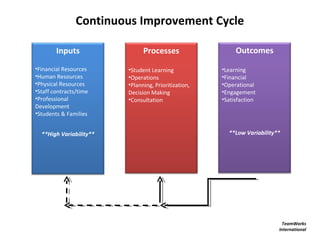
        Inputs                 Processes                   Outcomes
•Financial Resources     •Student Learning            •Learning
•Human Resources         •Operations                  •Financial
•Physical Resources      •Planning, Prioritization,   •Operational
•Staff contracts/time    Decision Making              •Engagement
•Professional            •Consultation                •Satisfaction
Development
•Students & Families


  **High Variability**                                  **Low Variability**


                                                                           TeamWorks
                                                                          International
Pro-Pay: At-A-Glance
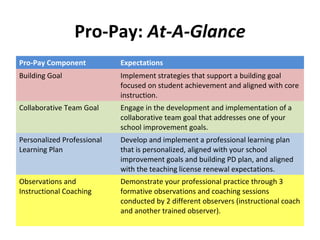
Pro-Pay Component           Expectations
Building Goal               Implement strategies that support a building goal
                            focused on student achievement and aligned with core
                            instruction.
Collaborative Team Goal     Engage in the development and implementation of a
                            collaborative team goal that addresses one of your
                            school improvement goals.
Personalized Professional   Develop and implement a professional learning plan
Learning Plan               that is personalized, aligned with your school
                            improvement goals and building PD plan, and aligned
                            with the teaching license renewal expectations.
Observations and            Demonstrate your professional practice through 3
Instructional Coaching      formative observations and coaching sessions
                            conducted by 2 different observers (instructional coach
                            and another trained observer).
Alignment of Effort
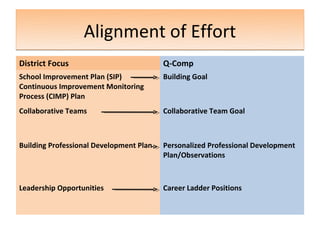
District Focus                           Q-Comp
School Improvement Plan (SIP)            Building Goal
Continuous Improvement Monitoring
Process (CIMP) Plan
Collaborative Teams                      Collaborative Team Goal


Building Professional Development Plan   Personalized Professional Development
                                         Plan/Observations


Leadership Opportunities                 Career Ladder Positions
Career Ladder Positions
Clear to Partly Cloudy
• What became clearer as a   • What is still partly cloudy?
  result of our learning
  yesterday?
The Role of Norm(s)
“Teams improve their ability
to grapple with the critical
questions when they clarify
the norms that will guide
their work. These collective
commitments represent the
‘promises we make to
ourselves and others,
promises that underpin two
critical aspects of teams—
commitment and trust.’”
       ~Katzenbach & Smith, 1995
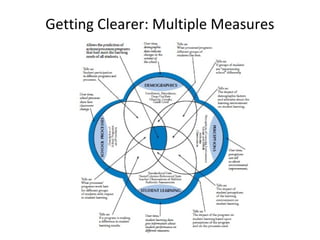
Getting Clearer: Multiple Measures
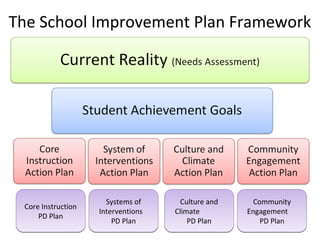
The School Improvement Plan Framework


                      Systems of     Culture and     Community
 Core Instruction
                    Interventions   Climate        Engagement
     PD Plan
                        PD Plan         PD Plan        PD Plan
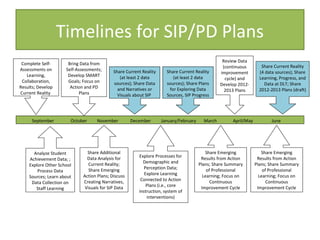
Timelines for SIP/PD Plans
                                                                                                  Review Data
 Complete Self-       Bring Data from
                                                                                                  (continuous        Share Current Reality
Assessments on       Self-Assessments;      Share Current Reality     Share Current Reality      improvement        (4 data sources); Share
   Learning,          Develop SMART            (at least 2 data          (at least 2 data          cycle) and       Learning, Progress, and
 Collaboration,       Goals; Focus on       sources); Share Data      sources); Share Plans      Develop 2012-        Data at DLT; Share
Results; Develop       Action and PD          and Narratives or        for Exploring Data          2013 Plans       2012-2013 Plans (draft)
Current Reality            Plans              Visuals about SIP       Sources, SIP Progress


      September        October      November         December       January/February     March        April/May           June


      Analyze Student          Share Additional                                           Share Emerging             Share Emerging
                               Data Analysis for        Explore Processes for           Results from Action        Results from Action
    Achievement Data; ;
                                Current Reality;          Demographic and              Plans; Share Summary       Plans; Share Summary
    Explore Other School
                                Share Emerging             Perception Data;                of Professional            of Professional
        Process Data
                             Action Plans; Discuss         Explore Learning              Learning; Focus on         Learning; Focus on
    Sources; Learn about
                             Creating Narratives,        Connected to Action                 Continuous                 Continuous
     Data Collection on
                              Visuals for SIP Data          Plans (i.e., core           Improvement Cycle          Improvement Cycle
       Staff Learning
                                                        instruction, system of
                                                            interventions)
Constructivist Listening Dyad
• Join a colleague from a
  different vertical
  collaborative team and
  from a different level
  (where possible).
• Use the constructivist
  listening dyad protocol to
  discuss the focus of the
  passage.
• Discuss the concepts of
  trial and error, risk, and
  community.
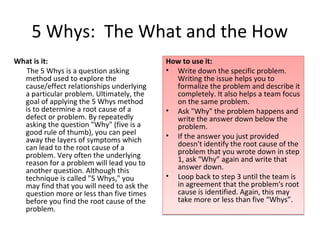
5 Whys: The What and the How
What is it:                                How to use it:
  The 5 Whys is a question asking          • Write down the specific problem.
  method used to explore the                 Writing the issue helps you to
  cause/effect relationships underlying      formalize the problem and describe it
  a particular problem. Ultimately, the      completely. It also helps a team focus
  goal of applying the 5 Whys method         on the same problem.
  is to determine a root cause of a        • Ask "Why" the problem happens and
  defect or problem. By repeatedly           write the answer down below the
  asking the question "Why" (five is a       problem.
  good rule of thumb), you can peel        • If the answer you just provided
  away the layers of symptoms which
  can lead to the root cause of a            doesn't identify the root cause of the
  problem. Very often the underlying         problem that you wrote down in step
  reason for a problem will lead you to      1, ask “Why” again and write that
  another question. Although this            answer down.
  technique is called "5 Whys," you        • Loop back to step 3 until the team is
  may find that you will need to ask the     in agreement that the problem's root
  question more or less than five times      cause is identified. Again, this may
  before you find the root cause of the      take more or less than five “Whys”.
  problem.
SIP: Where Have You Been?
                      • Use the timeline to
                        document the steps you
                        have taken to develop
                        your SIP plan.


• What work have
  you done on your
  SIP plan to date?
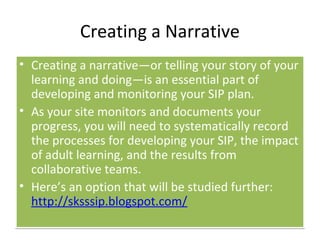
Creating a Narrative
• Creating a narrative—or telling your story of your
  learning and doing—is an essential part of
  developing and monitoring your SIP plan.
• As your site monitors and documents your
  progress, you will need to systematically record
  the processes for developing your SIP, the impact
  of adult learning, and the results from
  collaborative teams.
• Here’s an option that will be studied further:
  http://sksssip.blogspot.com/
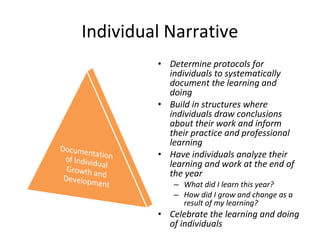
Individual Narrative
         • Determine protocols for
           individuals to systematically
           document the learning and
           doing
         • Build in structures where
           individuals draw conclusions
           about their work and inform
           their practice and professional
           learning
         • Have individuals analyze their
           learning and work at the end of
           the year
            – What did I learn this year?
            – How did I grow and change as a
              result of my learning?
         • Celebrate the learning and doing
           of individuals
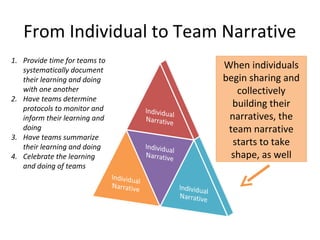
From Individual to Team Narrative
1. Provide time for teams to
   systematically document
                               When individuals
   their learning and doing    begin sharing and
   with one another               collectively
2. Have teams determine
   protocols to monitor and
                                 building their
   inform their learning and    narratives, the
   doing                        team narrative
3. Have teams summarize
   their learning and doing
                                 starts to take
4. Celebrate the learning        shape, as well
   and doing of teams
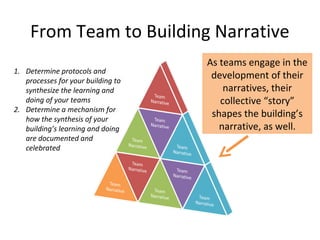
From Team to Building Narrative
                                    As teams engage in the
1. Determine protocols and
   processes for your building to
                                     development of their
   synthesize the learning and          narratives, their
   doing of your teams                 collective “story”
2. Determine a mechanism for
   how the synthesis of your
                                     shapes the building’s
   building’s learning and doing       narrative, as well.
   are documented and
   celebrated
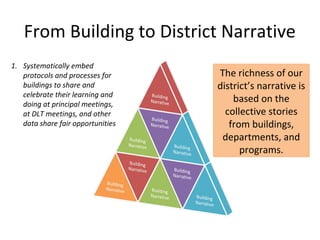
From Building to District Narrative
1. Systematically embed
   protocols and processes for     The richness of our
   buildings to share and          district’s narrative is
   celebrate their learning and
   doing at principal meetings,
                                       based on the
   at DLT meetings, and other        collective stories
   data share fair opportunities      from buildings,
                                    departments, and
                                         programs.
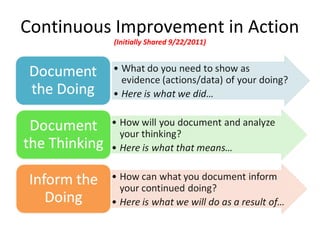
Continuous Improvement in Action
          (Initially Shared 9/22/2011)
Walk & Talk: Processing the Protocol
• Join a colleague from your
  vertical collaborative team
  and discuss the following
  two questions during a 10
  minute walk and talk.
   – How does what you
     experienced today inform
     and/or shape your work
     leading collaborative
     teams?
   – What did we hear or learn
     that impacts our work with
     the SIP and PD plans?
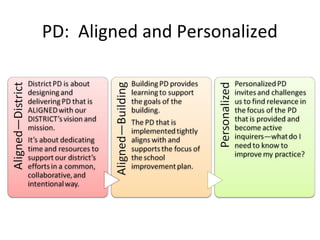
PD: Aligned and Personalized
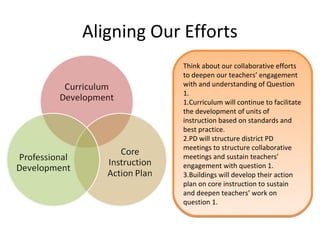
Aligning Our Efforts
             Think about our collaborative efforts
             to deepen our teachers’ engagement
             with and understanding of Question
             1.
             1.Curriculum will continue to facilitate
             the development of units of
             instruction based on standards and
             best practice.
             2.PD will structure district PD
             meetings to structure collaborative
             meetings and sustain teachers’
             engagement with question 1.
             3.Buildings will develop their action
             plan on core instruction to sustain
             and deepen teachers’ work on
             question 1.
Looking Ahead: November 17
• Process Core Instruction
  Action Plans
• Provide feedback about
  MCA IIIs testing
• Provide feedback about
  the District AYP plan
• Engage in reflection
  protocol regarding work
  of TLT
Triad Sharing Learning
• Form a triad by joining
  two colleagues from
  different clusters.
• Share insights you
  gained about
  developing,
  implementing, and/or
  monitoring your SIP’s
  work.
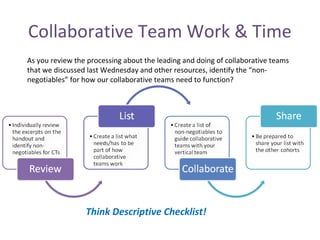
Collaborative Team Work & Time
As you review the processing about the leading and doing of collaborative teams
that we discussed last Wednesday and other resources, identify the “non-
negotiables” for how our collaborative teams need to function?


                 Think Descriptive Checklist!
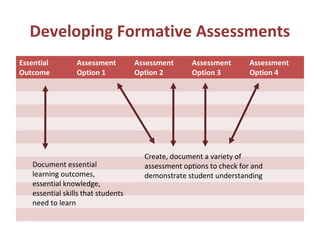
Developing Formative Assessments
Essential        Assessment         Assessment      Assessment       Assessment
Outcome          Option 1           Option 2        Option 3         Option 4


                                      Create, document a variety of
   Document essential                 assessment options to check for and
   learning outcomes,                 demonstrate student understanding
   essential knowledge,
   essential skills that students
   need to learn
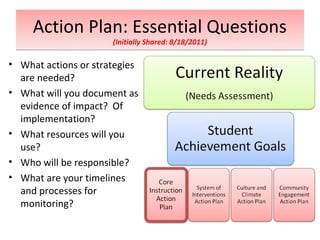
Action Plan: Essential Questions
                      (Initially Shared: 8/18/2011)

• What actions or strategies
  are needed?
• What will you document as
  evidence of impact? Of
  implementation?
• What resources will you
  use?
• Who will be responsible?
• What are your timelines
  and processes for
  monitoring?
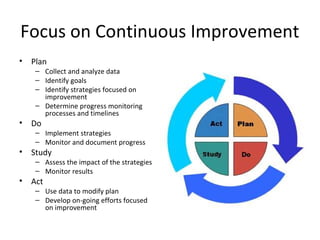
Focus on Continuous Improvement
•   Plan
     – Collect and analyze data
     – Identify goals
     – Identify strategies focused on
       improvement
     – Determine progress monitoring
       processes and timelines
•   Do
     – Implement strategies
     – Monitor and document progress
•   Study
     – Assess the impact of the strategies
     – Monitor results
•   Act
     – Use data to modify plan
     – Develop on-going efforts focused
       on improvement
A Moment For…
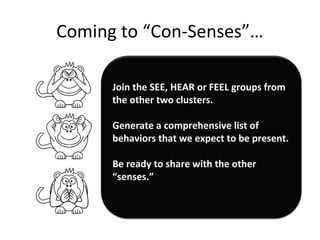
Coming to “Con-Senses”…

      Join the SEE, HEAR or FEEL groups from
      the other two clusters.

      Generate a comprehensive list of
      behaviors that we expect to be present.

      Be ready to share with the other
      “senses.”
60 Second Lecture

1. Identify one of the big
   ideas about which you
   would like to share
   with the whole group.
2. Using the “60 Second
   Lecture” protocol,
   share what your site
                December 7,   2011
   has done and what
   you plan to do next
   regarding learning,
   collaboration, or
   results.
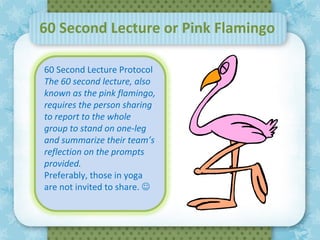
60 Second Lecture or Pink Flamingo

60 Second Lecture Protocol
The 60 second lecture, also
known as the pink flamingo,
requires the person sharing
to report to the whole
group to stand on one-leg
and summarize their team’s
reflection on theDecember
                  prompts     7, 2011
provided.
Preferably, those in yoga
are not invited to share. 

11-12 favorites

  • 1.
    Continuous Improvement Cycle Inputs Processes Outcomes •Financial Resources •Student Learning •Learning •Human Resources •Operations •Financial •Physical Resources •Planning, Prioritization, •Operational •Staff contracts/time Decision Making •Engagement •Professional •Consultation •Satisfaction Development •Students & Families **High Variability** **Low Variability** TeamWorks International
  • 2.
    Pro-Pay: At-A-Glance Pro-Pay Component Expectations Building Goal Implement strategies that support a building goal focused on student achievement and aligned with core instruction. Collaborative Team Goal Engage in the development and implementation of a collaborative team goal that addresses one of your school improvement goals. Personalized Professional Develop and implement a professional learning plan Learning Plan that is personalized, aligned with your school improvement goals and building PD plan, and aligned with the teaching license renewal expectations. Observations and Demonstrate your professional practice through 3 Instructional Coaching formative observations and coaching sessions conducted by 2 different observers (instructional coach and another trained observer).
  • 3.
    Alignment of Effort DistrictFocus Q-Comp School Improvement Plan (SIP) Building Goal Continuous Improvement Monitoring Process (CIMP) Plan Collaborative Teams Collaborative Team Goal Building Professional Development Plan Personalized Professional Development Plan/Observations Leadership Opportunities Career Ladder Positions
  • 4.
  • 5.
    Clear to PartlyCloudy • What became clearer as a • What is still partly cloudy? result of our learning yesterday?
  • 6.
    The Role ofNorm(s) “Teams improve their ability to grapple with the critical questions when they clarify the norms that will guide their work. These collective commitments represent the ‘promises we make to ourselves and others, promises that underpin two critical aspects of teams— commitment and trust.’” ~Katzenbach & Smith, 1995
  • 7.
  • 8.
    The School ImprovementPlan Framework Systems of Culture and Community Core Instruction Interventions Climate Engagement PD Plan PD Plan PD Plan PD Plan
  • 9.
    Timelines for SIP/PDPlans Review Data Complete Self- Bring Data from (continuous Share Current Reality Assessments on Self-Assessments; Share Current Reality Share Current Reality improvement (4 data sources); Share Learning, Develop SMART (at least 2 data (at least 2 data cycle) and Learning, Progress, and Collaboration, Goals; Focus on sources); Share Data sources); Share Plans Develop 2012- Data at DLT; Share Results; Develop Action and PD and Narratives or for Exploring Data 2013 Plans 2012-2013 Plans (draft) Current Reality Plans Visuals about SIP Sources, SIP Progress September October November December January/February March April/May June Analyze Student Share Additional Share Emerging Share Emerging Data Analysis for Explore Processes for Results from Action Results from Action Achievement Data; ; Current Reality; Demographic and Plans; Share Summary Plans; Share Summary Explore Other School Share Emerging Perception Data; of Professional of Professional Process Data Action Plans; Discuss Explore Learning Learning; Focus on Learning; Focus on Sources; Learn about Creating Narratives, Connected to Action Continuous Continuous Data Collection on Visuals for SIP Data Plans (i.e., core Improvement Cycle Improvement Cycle Staff Learning instruction, system of interventions)
  • 10.
    Constructivist Listening Dyad •Join a colleague from a different vertical collaborative team and from a different level (where possible). • Use the constructivist listening dyad protocol to discuss the focus of the passage. • Discuss the concepts of trial and error, risk, and community.
  • 11.
    5 Whys: TheWhat and the How What is it: How to use it: The 5 Whys is a question asking • Write down the specific problem. method used to explore the Writing the issue helps you to cause/effect relationships underlying formalize the problem and describe it a particular problem. Ultimately, the completely. It also helps a team focus goal of applying the 5 Whys method on the same problem. is to determine a root cause of a • Ask "Why" the problem happens and defect or problem. By repeatedly write the answer down below the asking the question "Why" (five is a problem. good rule of thumb), you can peel • If the answer you just provided away the layers of symptoms which can lead to the root cause of a doesn't identify the root cause of the problem. Very often the underlying problem that you wrote down in step reason for a problem will lead you to 1, ask “Why” again and write that another question. Although this answer down. technique is called "5 Whys," you • Loop back to step 3 until the team is may find that you will need to ask the in agreement that the problem's root question more or less than five times cause is identified. Again, this may before you find the root cause of the take more or less than five “Whys”. problem.
  • 12.
    SIP: Where HaveYou Been? • Use the timeline to document the steps you have taken to develop your SIP plan. • What work have you done on your SIP plan to date?
  • 13.
    Creating a Narrative •Creating a narrative—or telling your story of your learning and doing—is an essential part of developing and monitoring your SIP plan. • As your site monitors and documents your progress, you will need to systematically record the processes for developing your SIP, the impact of adult learning, and the results from collaborative teams. • Here’s an option that will be studied further: http://sksssip.blogspot.com/
  • 14.
    Individual Narrative • Determine protocols for individuals to systematically document the learning and doing • Build in structures where individuals draw conclusions about their work and inform their practice and professional learning • Have individuals analyze their learning and work at the end of the year – What did I learn this year? – How did I grow and change as a result of my learning? • Celebrate the learning and doing of individuals
  • 15.
    From Individual toTeam Narrative 1. Provide time for teams to systematically document When individuals their learning and doing begin sharing and with one another collectively 2. Have teams determine protocols to monitor and building their inform their learning and narratives, the doing team narrative 3. Have teams summarize their learning and doing starts to take 4. Celebrate the learning shape, as well and doing of teams
  • 16.
    From Team toBuilding Narrative As teams engage in the 1. Determine protocols and processes for your building to development of their synthesize the learning and narratives, their doing of your teams collective “story” 2. Determine a mechanism for how the synthesis of your shapes the building’s building’s learning and doing narrative, as well. are documented and celebrated
  • 17.
    From Building toDistrict Narrative 1. Systematically embed protocols and processes for The richness of our buildings to share and district’s narrative is celebrate their learning and doing at principal meetings, based on the at DLT meetings, and other collective stories data share fair opportunities from buildings, departments, and programs.
  • 18.
    Continuous Improvement inAction (Initially Shared 9/22/2011)
  • 19.
    Walk & Talk:Processing the Protocol • Join a colleague from your vertical collaborative team and discuss the following two questions during a 10 minute walk and talk. – How does what you experienced today inform and/or shape your work leading collaborative teams? – What did we hear or learn that impacts our work with the SIP and PD plans?
  • 20.
    PD: Aligned andPersonalized
  • 21.
    Aligning Our Efforts Think about our collaborative efforts to deepen our teachers’ engagement with and understanding of Question 1. 1.Curriculum will continue to facilitate the development of units of instruction based on standards and best practice. 2.PD will structure district PD meetings to structure collaborative meetings and sustain teachers’ engagement with question 1. 3.Buildings will develop their action plan on core instruction to sustain and deepen teachers’ work on question 1.
  • 22.
    Looking Ahead: November17 • Process Core Instruction Action Plans • Provide feedback about MCA IIIs testing • Provide feedback about the District AYP plan • Engage in reflection protocol regarding work of TLT
  • 23.
    Triad Sharing Learning •Form a triad by joining two colleagues from different clusters. • Share insights you gained about developing, implementing, and/or monitoring your SIP’s work.
  • 24.
    Collaborative Team Work& Time As you review the processing about the leading and doing of collaborative teams that we discussed last Wednesday and other resources, identify the “non- negotiables” for how our collaborative teams need to function? Think Descriptive Checklist!
  • 25.
    Developing Formative Assessments Essential Assessment Assessment Assessment Assessment Outcome Option 1 Option 2 Option 3 Option 4 Create, document a variety of Document essential assessment options to check for and learning outcomes, demonstrate student understanding essential knowledge, essential skills that students need to learn
  • 26.
    Action Plan: EssentialQuestions (Initially Shared: 8/18/2011) • What actions or strategies are needed? • What will you document as evidence of impact? Of implementation? • What resources will you use? • Who will be responsible? • What are your timelines and processes for monitoring?
  • 27.
    Focus on ContinuousImprovement • Plan – Collect and analyze data – Identify goals – Identify strategies focused on improvement – Determine progress monitoring processes and timelines • Do – Implement strategies – Monitor and document progress • Study – Assess the impact of the strategies – Monitor results • Act – Use data to modify plan – Develop on-going efforts focused on improvement
  • 28.
  • 29.
    Coming to “Con-Senses”… Join the SEE, HEAR or FEEL groups from the other two clusters. Generate a comprehensive list of behaviors that we expect to be present. Be ready to share with the other “senses.”
  • 30.
    60 Second Lecture 1.Identify one of the big ideas about which you would like to share with the whole group. 2. Using the “60 Second Lecture” protocol, share what your site December 7, 2011 has done and what you plan to do next regarding learning, collaboration, or results.
  • 31.
    60 Second Lectureor Pink Flamingo 60 Second Lecture Protocol The 60 second lecture, also known as the pink flamingo, requires the person sharing to report to the whole group to stand on one-leg and summarize their team’s reflection on theDecember prompts 7, 2011 provided. Preferably, those in yoga are not invited to share. 

Editor's Notes

  • #2 “ Smart goals on outcomes will never change the outcomes” “ Boards want to see what you’re doing (results) in the first two columns.”
  • #4 The “District Focus” remains the same regardless of the outcome of Q-Comp vote
  • #7 One of the processes and protocols that will be used during our meetings is “Numbered Heads.” The person at the farthest left of the table is number 1, the next person is number 2, etc. We will invite a number from each table to share perspectives, etc. that were generated at your table. For the interpretation of the quote, have #3 share.
  • #9 Discuss
  • #28 Insert text and graphic about continuous improvement