District Leadership Team

     August 17-18, 2011
On Teacher Leadership…
“In common with
other leaders,
teacher leaders
seek challenge,
change, and
growth.”
       —M. Wilson
Meeting Procedures and Routines
    Meeting                                  In Case of
                         High Five
   Documents                                Emergencies
• Go to subfolder    • Look for the       • For meetings at
  “DLT Meetings”       “high five” as a     DEC, have your
  in shared folder     signal to come       building’s
  for “Continuous      back                 administrative
  Improvement”         together—a           assistant
  –look for            signal to wrap       contact Judy
  meeting date to      up your final        Sherin in
  locate materials     point during a       Teaching and
  and processes        discussion as a      Learning at ext.
  and protocols        sign of              6279.
                       transition
Key Objectives for August 17-18
Review purposes and functions of DLT, BLT
Develop a collaborative culture
Deepen our understanding of continuous
     improvement processes
Deepen our understanding of and extend our
     work on the SIP and PD plans
Draft SMART goals
Identify progress monitoring processes
Discuss revisions to q-comp
Engage in shared learning
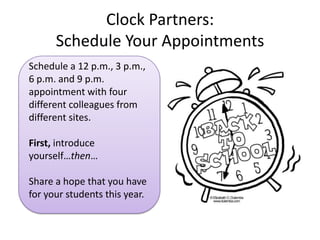
Clock Partners:
      Schedule Your Appointments
Schedule a 12 p.m., 3 p.m.,
6 p.m. and 9 p.m.
appointment with four
different colleagues from
different sites.

First, introduce
yourself…then…

Share a hope that you have
for your students this year.
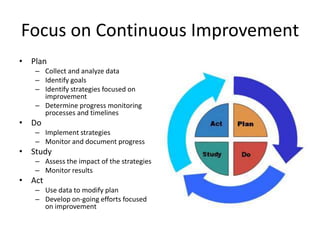
Focus on Continuous Improvement
• Plan
   – Collect and analyze data
   – Identify goals
   – Identify strategies focused on
     improvement
   – Determine progress monitoring
     processes and timelines
• Do
   – Implement strategies
   – Monitor and document progress
• Study
   – Assess the impact of the strategies
   – Monitor results
• Act
   – Use data to modify plan
   – Develop on-going efforts focused
     on improvement
The Continuous Improvement Cycle…

The continuous improvement cycle is heart of being a results
oriented learning organization. The cycle is an ongoing process
focused on determining specific measurable outcomes aligned to
the District Strategic Goals. On an established cycle (usually an
annual cycle), outcomes are established based upon a needs
assessment, evaluation procedures and action plans are
determined, plans are implemented, and the work is
assessed/measured. The cycle is continuous and revolutions

around the cycle often overlap.
About the DLT…

…provides system-wide leadership and coordination
of processes and procedures related to professional
development, curriculum, instruction, assessment,
and school and organizational improvement
planning.

…meets throughout the year to engage in planning
and provide site-level support in the above areas.
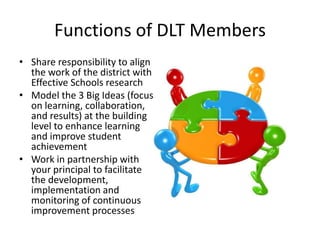
Functions of DLT Members
• Share responsibility to align
  the work of the district with
  Effective Schools research
• Model the 3 Big Ideas (focus
  on learning, collaboration,
  and results) at the building
  level to enhance learning
  and improve student
  achievement
• Work in partnership with
  your principal to facilitate
  the development,
  implementation and
  monitoring of continuous
  improvement processes
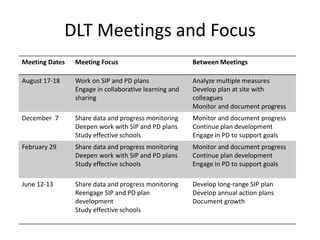
DLT Meetings and Focus
Meeting Dates   Meeting Focus                          Between Meetings

August 17-18    Work on SIP and PD plans               Analyze multiple measures
                Engage in collaborative learning and   Develop plan at site with
                sharing                                colleagues
                                                       Monitor and document progress
December 7      Share data and progress monitoring     Monitor and document progress
                Deepen work with SIP and PD plans      Continue plan development
                Study effective schools                Engage in PD to support goals
February 29     Share data and progress monitoring     Monitor and document progress
                Deepen work with SIP and PD plans      Continue plan development
                Study effective schools                Engage in PD to support goals

June 12-13      Share data and progress monitoring     Develop long-range SIP plan
                Reengage SIP and PD plan               Develop annual action plans
                development                            Document growth
                Study effective schools
Purposes of BLT
Work with principal to…
• Develop, implement and
  monitor continuous
  improvement processes
  (SIP, PD)
• Focus building’s efforts on
  enhancing learning and
  improving student
  achievement
• Foster a collaborative,
  results-oriented culture
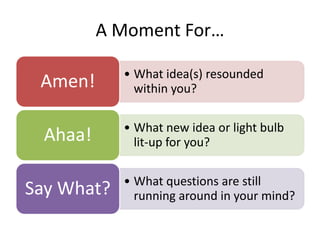
A Moment For…

            • What idea(s) resounded
 Amen!        within you?

            • What new idea or light bulb
 Ahaa!        lit-up for you?

            • What questions are still
Say What?     running around in your mind?
That’s What “They” Say…
• Individually read the quote
  at the top of the page and
  respond to the reflective
  question.

• When prompted, find your
  colleagues who have the
  same quote as you do (look
  for same color paper),
  introduce yourself, and
  then generate an agreed
  upon understanding of the
  quote. (Chart paper provided)
What We Said…
• Record a summary
  statement about
  continuous
  improvement on
  chart paper that
  can be shared.

Appointment Reminder
• Join your 9:00 p.m.

  appointment and
  discuss how the role of
  the DLT and BLT will
  positively impact our
  effectiveness with
  regard to student
  learning.
Guiding Our Efforts
“If alignment is the
compass by which school
leaders guide the school
district’s journey to
becoming a professional
learning community, then
the destination is best
represented by the three
big ideas of a PLC.”
    —Van Clay, Soldwedel, Many, 2011
The 3 Big Ideas of PLCs


–Ensuring that all students can learn
–Building a collaborative culture
–Establishing a focus on results
From Excerpts to Experts

1. Read the excerpts from
   Aligning School Districts
   as PLCs about learning,
   collaboration, or results.
2. Document your responses
   on the reflection sheet.
3. Join your group when
   prompted and share what
   you learned and what
   implications your learning
   may have for DLT.
Appointment Reminder
• Please join your 12 p.m.
  appointment to discuss
  a summary of what you
  learned.
• Take turns sharing what
  you learned.
• Be prepared to share a
  key concept with our
  whole group.
Break—Be Back in 5!
3 Big Ideas of PLCs: Self-Assessment
• Individually complete
  the self-assessments for   FOCUS ON…
  collaboration, learning,
  and results.               Collaboration
                             Learning
                             Results
What Did You Discover?
• As a site DLT, discuss the
  self-assessments for
  each of the 3 Big Ideas.
• Identify an agreed upon
  list of areas that need
  to be studied at your
  site for each of the
  ideas.
• Record your lists on the
  school process data
  analysis form.
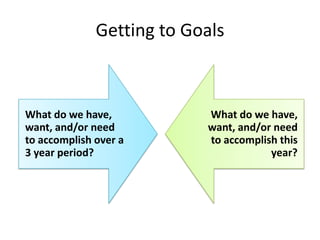
Getting to Goals


What do we have,           What do we have,
want, and/or need          want, and/or need
to accomplish over a       to accomplish this
3 year period?                         year?
Monitoring Our Work: DLT & BLT
• Complete self-assessments as DLT in August
• Have all collaborative teams complete in
  September
• Have teams share results with principal/BLT
• Bring tabulated results to October 13 principals’
  meeting
• Complete self-assessments in December at DLT
• Administer (collaborative teams)in May for
  processing in June at DLT
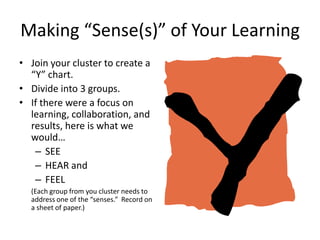
Making “Sense(s)” of Your Learning
• Join your cluster to create a
  “Y” chart.
• Divide into 3 groups.
• If there were a focus on
  learning, collaboration, and
  results, here is what we
  would…
   – SEE
   – HEAR and
   – FEEL
  (Each group from you cluster needs to
  address one of the “senses.” Record on
  a sheet of paper.)
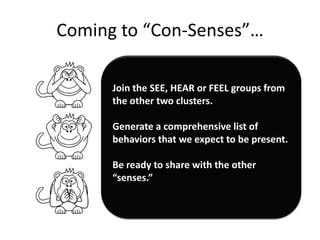
Coming to “Con-Senses”…

      Join the SEE, HEAR or FEEL groups from
      the other two clusters.

      Generate a comprehensive list of
      behaviors that we expect to be present.

      Be ready to share with the other
      “senses.”
Appointment Reminder
• Join your 3:00 p.m.
  appointment and
  discuss your
  commitment to making
  the behaviors on the
  “Y” chart a focus of
  your leadership.
Focusing in on Results


http://www.photocourse.com/itext/CMYK/
Lunch Break
Be back and
 ready to
 continue our
 learning at…
On Collaboration…

"When groups, rather than individuals, are
seen as the main units for implementing
curriculum, instruction, and assessment,
they facilitate the development of shared
purpose for student learning and collective
responsibility to achieve it."
                      ~ Newmann & Wehlage, 1995
Appointment Reminder
• Join your 6:00 p.m.
  appointment and
  discuss what you
  learned and/or
  discovered during the
  collaboration activity.


                            Sorry, wrong time zone!
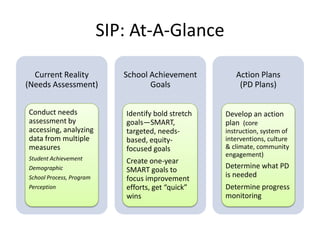
SIP: At-A-Glance

  Current Reality            School Achievement         Action Plans
(Needs Assessment)                  Goals                (PD Plans)


Conduct needs                Identify bold stretch   Develop an action
assessment by                goals—SMART,            plan (core
accessing, analyzing         targeted, needs-        instruction, system of
data from multiple           based, equity-          interventions, culture
measures                     focused goals           & climate, community
                                                     engagement)
Student Achievement          Create one-year
Demographic                  SMART goals to          Determine what PD
School Process, Program      focus improvement       is needed
Perception                   efforts, get “quick”    Determine progress
                             wins                    monitoring
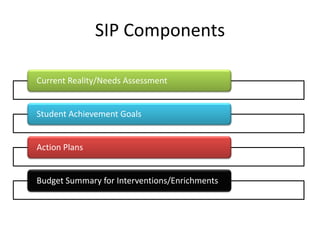
SIP Components

Current Reality/Needs Assessment


Student Achievement Goals


Action Plans


Budget Summary for Interventions/Enrichments
Current Reality
• Read the bite-sized
  selections in the
  article, “Multiple
  Measures.”
• Summarize and
  document the most
  essential learning from
  each bite.
• When prompted, form
  two lines.
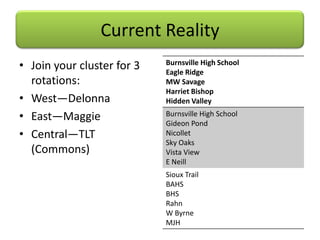
Current Reality
• Join your cluster for 3   Burnsville High School
                            Eagle Ridge
  rotations:                MW Savage
                            Harriet Bishop
• West—Delonna              Hidden Valley

• East—Maggie               Burnsville High School
                            Gideon Pond
• Central—TLT               Nicollet
                            Sky Oaks
  (Commons)                 Vista View
                            E Neill
                            Sioux Trail
                            BAHS
                            BHS
                            Rahn
                            W Byrne
                            MJH
If We Only Studied…
Student Achievement Data
If We Only Studied…
   Perception Data
If We Only Studied…
 Demographic Data
If We Only Studied…
School Process Data
When We Study…
Multiple Measures
How Do We Measure Up?
          “…the simple act of
          measuring and
          monitoring causes
          people to pay
          attention to what is
          measured.”
                 —Kaplan & Miyake, 2010
Checking In…
• Given our learning as a
  DLT today, what more
  do you need to know
  about your roles for our
  work tomorrow?

• Generate your feedback
  on a post-it note and
  leave with a member of
  the TLT.
Reminder…
• Elementary principals
  meet immediately after
  our closing.
Key Messages

Think about…
Creating collaborative
culture
Deepening our
understanding of needs
assessment
Deepening our
understanding of data
Clarifying our DLT work

DLT August 2011 Retreat

  • 1.
    District Leadership Team August 17-18, 2011
  • 2.
    On Teacher Leadership… “Incommon with other leaders, teacher leaders seek challenge, change, and growth.” —M. Wilson
  • 3.
    Meeting Procedures andRoutines Meeting In Case of High Five Documents Emergencies • Go to subfolder • Look for the • For meetings at “DLT Meetings” “high five” as a DEC, have your in shared folder signal to come building’s for “Continuous back administrative Improvement” together—a assistant –look for signal to wrap contact Judy meeting date to up your final Sherin in locate materials point during a Teaching and and processes discussion as a Learning at ext. and protocols sign of 6279. transition
  • 4.
    Key Objectives forAugust 17-18 Review purposes and functions of DLT, BLT Develop a collaborative culture Deepen our understanding of continuous improvement processes Deepen our understanding of and extend our work on the SIP and PD plans Draft SMART goals Identify progress monitoring processes Discuss revisions to q-comp Engage in shared learning
  • 5.
    Clock Partners: Schedule Your Appointments Schedule a 12 p.m., 3 p.m., 6 p.m. and 9 p.m. appointment with four different colleagues from different sites. First, introduce yourself…then… Share a hope that you have for your students this year.
  • 6.
    Focus on ContinuousImprovement • Plan – Collect and analyze data – Identify goals – Identify strategies focused on improvement – Determine progress monitoring processes and timelines • Do – Implement strategies – Monitor and document progress • Study – Assess the impact of the strategies – Monitor results • Act – Use data to modify plan – Develop on-going efforts focused on improvement
  • 7.
    The Continuous ImprovementCycle… The continuous improvement cycle is heart of being a results oriented learning organization. The cycle is an ongoing process focused on determining specific measurable outcomes aligned to the District Strategic Goals. On an established cycle (usually an annual cycle), outcomes are established based upon a needs assessment, evaluation procedures and action plans are determined, plans are implemented, and the work is assessed/measured. The cycle is continuous and revolutions around the cycle often overlap.
  • 8.
    About the DLT… …providessystem-wide leadership and coordination of processes and procedures related to professional development, curriculum, instruction, assessment, and school and organizational improvement planning. …meets throughout the year to engage in planning and provide site-level support in the above areas.
  • 9.
    Functions of DLTMembers • Share responsibility to align the work of the district with Effective Schools research • Model the 3 Big Ideas (focus on learning, collaboration, and results) at the building level to enhance learning and improve student achievement • Work in partnership with your principal to facilitate the development, implementation and monitoring of continuous improvement processes
  • 10.
    DLT Meetings andFocus Meeting Dates Meeting Focus Between Meetings August 17-18 Work on SIP and PD plans Analyze multiple measures Engage in collaborative learning and Develop plan at site with sharing colleagues Monitor and document progress December 7 Share data and progress monitoring Monitor and document progress Deepen work with SIP and PD plans Continue plan development Study effective schools Engage in PD to support goals February 29 Share data and progress monitoring Monitor and document progress Deepen work with SIP and PD plans Continue plan development Study effective schools Engage in PD to support goals June 12-13 Share data and progress monitoring Develop long-range SIP plan Reengage SIP and PD plan Develop annual action plans development Document growth Study effective schools
  • 11.
    Purposes of BLT Workwith principal to… • Develop, implement and monitor continuous improvement processes (SIP, PD) • Focus building’s efforts on enhancing learning and improving student achievement • Foster a collaborative, results-oriented culture
  • 12.
    A Moment For… • What idea(s) resounded Amen! within you? • What new idea or light bulb Ahaa! lit-up for you? • What questions are still Say What? running around in your mind?
  • 13.
    That’s What “They”Say… • Individually read the quote at the top of the page and respond to the reflective question. • When prompted, find your colleagues who have the same quote as you do (look for same color paper), introduce yourself, and then generate an agreed upon understanding of the quote. (Chart paper provided)
  • 14.
    What We Said… •Record a summary statement about continuous improvement on chart paper that can be shared.
  • 15.
    Appointment Reminder • Joinyour 9:00 p.m. appointment and discuss how the role of the DLT and BLT will positively impact our effectiveness with regard to student learning.
  • 16.
    Guiding Our Efforts “Ifalignment is the compass by which school leaders guide the school district’s journey to becoming a professional learning community, then the destination is best represented by the three big ideas of a PLC.” —Van Clay, Soldwedel, Many, 2011
  • 17.
    The 3 BigIdeas of PLCs –Ensuring that all students can learn –Building a collaborative culture –Establishing a focus on results
  • 18.
    From Excerpts toExperts 1. Read the excerpts from Aligning School Districts as PLCs about learning, collaboration, or results. 2. Document your responses on the reflection sheet. 3. Join your group when prompted and share what you learned and what implications your learning may have for DLT.
  • 19.
    Appointment Reminder • Pleasejoin your 12 p.m. appointment to discuss a summary of what you learned. • Take turns sharing what you learned. • Be prepared to share a key concept with our whole group.
  • 20.
  • 21.
    3 Big Ideasof PLCs: Self-Assessment • Individually complete the self-assessments for FOCUS ON… collaboration, learning, and results. Collaboration Learning Results
  • 22.
    What Did YouDiscover? • As a site DLT, discuss the self-assessments for each of the 3 Big Ideas. • Identify an agreed upon list of areas that need to be studied at your site for each of the ideas. • Record your lists on the school process data analysis form.
  • 23.
    Getting to Goals Whatdo we have, What do we have, want, and/or need want, and/or need to accomplish over a to accomplish this 3 year period? year?
  • 24.
    Monitoring Our Work:DLT & BLT • Complete self-assessments as DLT in August • Have all collaborative teams complete in September • Have teams share results with principal/BLT • Bring tabulated results to October 13 principals’ meeting • Complete self-assessments in December at DLT • Administer (collaborative teams)in May for processing in June at DLT
  • 25.
    Making “Sense(s)” ofYour Learning • Join your cluster to create a “Y” chart. • Divide into 3 groups. • If there were a focus on learning, collaboration, and results, here is what we would… – SEE – HEAR and – FEEL (Each group from you cluster needs to address one of the “senses.” Record on a sheet of paper.)
  • 26.
    Coming to “Con-Senses”… Join the SEE, HEAR or FEEL groups from the other two clusters. Generate a comprehensive list of behaviors that we expect to be present. Be ready to share with the other “senses.”
  • 27.
    Appointment Reminder • Joinyour 3:00 p.m. appointment and discuss your commitment to making the behaviors on the “Y” chart a focus of your leadership.
  • 28.
    Focusing in onResults http://www.photocourse.com/itext/CMYK/
  • 29.
    Lunch Break Be backand ready to continue our learning at…
  • 30.
    On Collaboration… "When groups,rather than individuals, are seen as the main units for implementing curriculum, instruction, and assessment, they facilitate the development of shared purpose for student learning and collective responsibility to achieve it." ~ Newmann & Wehlage, 1995
  • 31.
    Appointment Reminder • Joinyour 6:00 p.m. appointment and discuss what you learned and/or discovered during the collaboration activity. Sorry, wrong time zone!
  • 32.
    SIP: At-A-Glance Current Reality School Achievement Action Plans (Needs Assessment) Goals (PD Plans) Conduct needs Identify bold stretch Develop an action assessment by goals—SMART, plan (core accessing, analyzing targeted, needs- instruction, system of data from multiple based, equity- interventions, culture measures focused goals & climate, community engagement) Student Achievement Create one-year Demographic SMART goals to Determine what PD School Process, Program focus improvement is needed Perception efforts, get “quick” Determine progress wins monitoring
  • 33.
    SIP Components Current Reality/NeedsAssessment Student Achievement Goals Action Plans Budget Summary for Interventions/Enrichments
  • 34.
    Current Reality • Readthe bite-sized selections in the article, “Multiple Measures.” • Summarize and document the most essential learning from each bite. • When prompted, form two lines.
  • 35.
    Current Reality • Joinyour cluster for 3 Burnsville High School Eagle Ridge rotations: MW Savage Harriet Bishop • West—Delonna Hidden Valley • East—Maggie Burnsville High School Gideon Pond • Central—TLT Nicollet Sky Oaks (Commons) Vista View E Neill Sioux Trail BAHS BHS Rahn W Byrne MJH
  • 36.
    If We OnlyStudied… Student Achievement Data
  • 37.
    If We OnlyStudied… Perception Data
  • 38.
    If We OnlyStudied… Demographic Data
  • 39.
    If We OnlyStudied… School Process Data
  • 40.
  • 41.
    How Do WeMeasure Up? “…the simple act of measuring and monitoring causes people to pay attention to what is measured.” —Kaplan & Miyake, 2010
  • 42.
    Checking In… • Givenour learning as a DLT today, what more do you need to know about your roles for our work tomorrow? • Generate your feedback on a post-it note and leave with a member of the TLT.
  • 43.
    Reminder… • Elementary principals meet immediately after our closing.
  • 44.
    Key Messages Think about… Creatingcollaborative culture Deepening our understanding of needs assessment Deepening our understanding of data Clarifying our DLT work

Editor's Notes

  • #3 Have posted as DLT members gather.
  • #4 Share that while we will be developing norms today, there are some routines and procedures that will be part of our meetings. One routine involves bringing our group back together when we are engaged in collaborative learning. When we need to come back together, look for the “high five.” When you see it, know we will be coming back together—raise your hand. Another procedure is related to information that we share at our meetings. There is a shared folder in the continuous improvement file for administrative meetings. Look for the presentations, handouts, and notes from the meeting in dated sub-folders. A third procedure deals with cell phones and laptops. We will remind you of when and where meetings are, so if someone from your building needs to reach you by phone, have them call Judy Sherin at 707-62XX (when meetings are at DEC). She will let you or us know if you are needed during our meeting times. Have them call Jan Larsen at 707-XXXX when meetings are at ASC. Introduce number heads.
  • #6 Use the appointments to develop relationships, gain multiple (varying) perspectives, promote movement, and encourage metacognition.
  • #7 Insert text and graphic about continuous improvement
  • #10 Chris
  • #12 Any questions????
  • #14 Make copies of quotes on different colors of paper.Robert Frost—every poem is figurative in two senses: a figure in itself and a figure for our time. The literal and the relevant.Click to each quote. Have someone record the key themes learned.
  • #19 Copy excerpts from pages 30-31, 34 and 37, 39-40 (learning); 62, 66, and 71 (collaboration); and 93-94, 103 and 108
  • #23 Provide list for each DLT
  • #26 Chart paper needed for Y chart…provide mixed cluster groups with post-its/paper to document SEE, HEAR, or FEEL
  • #36 TLT will work through defining data types—getting to the look fors for data sources…beginning the development of a rubric for the needs assessment