Auxiliary Verbs

   By Mehwish Ali Khan
taken from thelecturette.com
presented with amendments
What is an auxiliary verb?
• An auxiliary verb is also called a helper
  verb
• A verb used in forming the tenses, moods,
  and voices of other verbs
• It comes before some verbs
• Not all sentences have an auxiliary
Sentences with no auxiliary verb

• I played football last night
• I walk this way to school every day
• I like chocolate


Can you identify the verbs in these sentences?
• Auxilary verbs are divided into two
  categories principal Auxiliaries and
  Modals(secondary auxiliaries)
• "The auxiliary verbs of English are the
  following:
  can,,could, may,might will,would
  shall,should, must, ought, need, dare used
  to[modals]
  – be, have, do, [non-modals
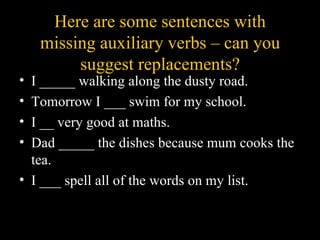
Here are some sentences with
    missing auxiliary verbs – can you
         suggest replacements?
• I _____ walking along the dusty road.
• Tomorrow I ___ swim for my school.
• I __ very good at maths.
• Dad _____ the dishes because mum cooks the
  tea.
• I ___ spell all of the words on my list.
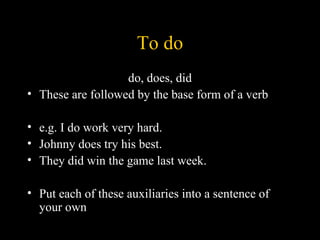
To do
                   do, does, did
• These are followed by the base form of a verb

• e.g. I do work very hard.
• Johnny does try his best.
• They did win the game last week.

• Put each of these auxiliaries into a sentence of
  your own
To have
                Have, has, had
• These are followed by the past participle of
  the next verb

•   e.g.
•   I have eaten all of my food.
•   John has climbed Ben Nevis.
•   Debbie had hidden all of Paul’s pencils.
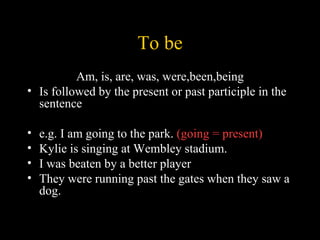
To be
          Am, is, are, was, were,been,being
• Is followed by the present or past participle in the
  sentence

•   e.g. I am going to the park. (going = present)
•   Kylie is singing at Wembley stadium.
•   I was beaten by a better player
•   They were running past the gates when they saw a
    dog.
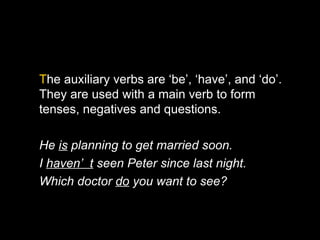
The auxiliary verbs are ‘be’, ‘have’, and ‘do’.
They are used with a main verb to form
tenses, negatives and questions.

He is planning to get married soon.
I haven’ t seen Peter since last night.
Which doctor do you want to see?
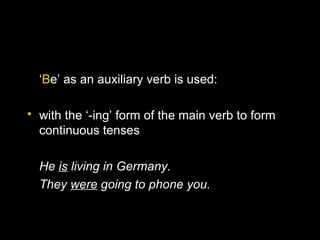
‘Be’ as an auxiliary verb is used:

• with the ‘-ing’ form of the main verb to form
  continuous tenses

  He is living in Germany.
  They were going to phone you.
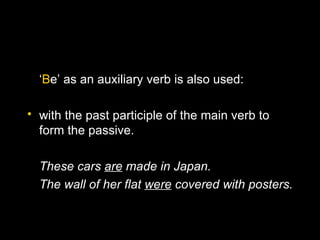
‘Be’ as an auxiliary verb is also used:

• with the past participle of the main verb to
  form the passive.

  These cars are made in Japan.
  The wall of her flat were covered with posters.
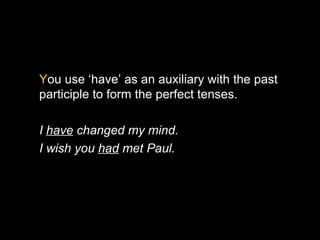
You use ‘have’ as an auxiliary with the past
participle to form the perfect tenses.

I have changed my mind.
I wish you had met Paul.
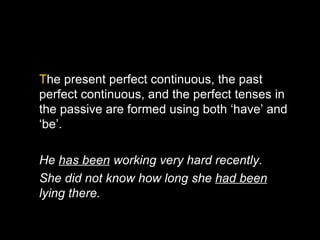
The present perfect continuous, the past
perfect continuous, and the perfect tenses in
the passive are formed using both ‘have’ and
‘be’.

He has been working very hard recently.
She did not know how long she had been
lying there.
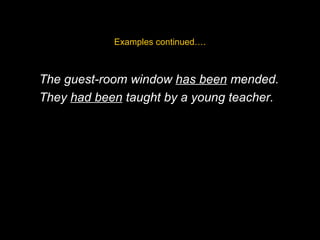
Examples continued….


The guest-room window has been mended.
They had been taught by a young teacher.
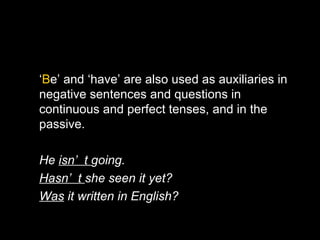
‘Be’ and ‘have’ are also used as auxiliaries in
negative sentences and questions in
continuous and perfect tenses, and in the
passive.

He isn’ t going.
Hasn’ t she seen it yet?
Was it written in English?
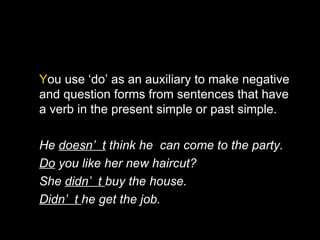
You use ‘do’ as an auxiliary to make negative
and question forms from sentences that have
a verb in the present simple or past simple.

He doesn’ t think he can come to the party.
Do you like her new haircut?
She didn’ t buy the house.
Didn’ t he get the job.
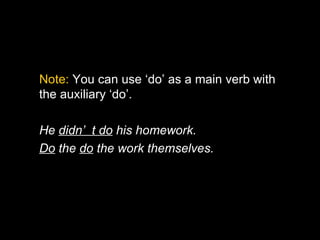
Note: You can use ‘do’ as a main verb with
the auxiliary ‘do’.

He didn’ t do his homework.
Do the do the work themselves.
You can also use the auxiliary ‘do’ with have
as a main verb.

He doesn’ t have any money.
Does anyone have a question?
You only use ‘do’ in affirmative sentences for
emphasis or contrast.

I do feel sorry for Roger.
WARNING: You never use the auxiliary ‘do’
with ‘be’ except in the imperative.

Don’ t be stupid.
Do be a good boy and sit still.
Some grammars include modals among the
auxiliary verbs. When there is a modal in the
verb group, it is always the first word in the
verb group, and comes before the auxiliaries
‘be’ and ‘have’.

She might be going to Switzerland for
Christmas.
I would have liked to see her.
Note: You never use the auxiliary ‘do’ with a
modal.

Principal auxiliaries

  • 1.
    Auxiliary Verbs By Mehwish Ali Khan taken from thelecturette.com presented with amendments
  • 2.
    What is anauxiliary verb? • An auxiliary verb is also called a helper verb • A verb used in forming the tenses, moods, and voices of other verbs • It comes before some verbs • Not all sentences have an auxiliary
  • 3.
    Sentences with noauxiliary verb • I played football last night • I walk this way to school every day • I like chocolate Can you identify the verbs in these sentences?
  • 4.
    • Auxilary verbsare divided into two categories principal Auxiliaries and Modals(secondary auxiliaries) • "The auxiliary verbs of English are the following: can,,could, may,might will,would shall,should, must, ought, need, dare used to[modals] – be, have, do, [non-modals
  • 5.
    Here are somesentences with missing auxiliary verbs – can you suggest replacements? • I _____ walking along the dusty road. • Tomorrow I ___ swim for my school. • I __ very good at maths. • Dad _____ the dishes because mum cooks the tea. • I ___ spell all of the words on my list.
  • 6.
    To do do, does, did • These are followed by the base form of a verb • e.g. I do work very hard. • Johnny does try his best. • They did win the game last week. • Put each of these auxiliaries into a sentence of your own
  • 7.
    To have Have, has, had • These are followed by the past participle of the next verb • e.g. • I have eaten all of my food. • John has climbed Ben Nevis. • Debbie had hidden all of Paul’s pencils.
  • 8.
    To be Am, is, are, was, were,been,being • Is followed by the present or past participle in the sentence • e.g. I am going to the park. (going = present) • Kylie is singing at Wembley stadium. • I was beaten by a better player • They were running past the gates when they saw a dog.
  • 9.
    The auxiliary verbsare ‘be’, ‘have’, and ‘do’. They are used with a main verb to form tenses, negatives and questions. He is planning to get married soon. I haven’ t seen Peter since last night. Which doctor do you want to see?
  • 10.
    ‘Be’ as anauxiliary verb is used: • with the ‘-ing’ form of the main verb to form continuous tenses He is living in Germany. They were going to phone you.
  • 11.
    ‘Be’ as anauxiliary verb is also used: • with the past participle of the main verb to form the passive. These cars are made in Japan. The wall of her flat were covered with posters.
  • 12.
    You use ‘have’as an auxiliary with the past participle to form the perfect tenses. I have changed my mind. I wish you had met Paul.
  • 13.
    The present perfectcontinuous, the past perfect continuous, and the perfect tenses in the passive are formed using both ‘have’ and ‘be’. He has been working very hard recently. She did not know how long she had been lying there.
  • 14.
    Examples continued…. The guest-roomwindow has been mended. They had been taught by a young teacher.
  • 15.
    ‘Be’ and ‘have’are also used as auxiliaries in negative sentences and questions in continuous and perfect tenses, and in the passive. He isn’ t going. Hasn’ t she seen it yet? Was it written in English?
  • 16.
    You use ‘do’as an auxiliary to make negative and question forms from sentences that have a verb in the present simple or past simple. He doesn’ t think he can come to the party. Do you like her new haircut? She didn’ t buy the house. Didn’ t he get the job.
  • 17.
    Note: You canuse ‘do’ as a main verb with the auxiliary ‘do’. He didn’ t do his homework. Do the do the work themselves.
  • 18.
    You can alsouse the auxiliary ‘do’ with have as a main verb. He doesn’ t have any money. Does anyone have a question?
  • 19.
    You only use‘do’ in affirmative sentences for emphasis or contrast. I do feel sorry for Roger.
  • 20.
    WARNING: You neveruse the auxiliary ‘do’ with ‘be’ except in the imperative. Don’ t be stupid. Do be a good boy and sit still.
  • 21.
    Some grammars includemodals among the auxiliary verbs. When there is a modal in the verb group, it is always the first word in the verb group, and comes before the auxiliaries ‘be’ and ‘have’. She might be going to Switzerland for Christmas. I would have liked to see her.
  • 22.
    Note: You neveruse the auxiliary ‘do’ with a modal.