ESSAY WRITING
By Mehwish Ali Khan
THE OXFORD ENGLISH DICTIONARY
 Defines “Essay as a composition of
moderate length on any particular subject”
 French word “essai” which means “attempt”
SEVEN GENRES OR KINDS
 Discussion essay(argumentative) or article-
looking at the pros and cons of an issue
 Explanation essay or article: how things work
 Instruction essay or article: how to do something
 Report essay or article: factual information on a
topic
 Recount essay:a retelling of a personal
experience
 Book review:what the reader thinks about the
book
 Narrative essay or short story
 Four features that essays have in common
 Overall structure
 Paragraph structures
 Cohesive devices
 languages
OVERALL STRUCTURE
Beginning Middle End
Discussion orientation argument conclusion
Explanation orientation phenomenon explanation
Instruction orientation materials instruction
Report orientation procedure outcome
Recount orientation events sequel
Book review orientation description evaluation
Narrative orientation complication resolution
ESSAY A: LIVING IN CANBERRA
 I’ve roamed in every continent---- except the Polar ones----and lived in
three. By chance, I’ve made my present home in Australia and here
among all the localities in all the states and territories I’ve made my
present home 9n Canberra
 The place may seem dull to outsiders,but it does have its
excitements.There is the excitement of frost on a winter’s morning, the
view of the hills from my kitchen window, and the splash of colours from
a million trees .Who needs the excitement of king’s cross? But Canberra
isn’t all sweetness and beauty.
 The roads do go round and round a bit much, and the city buildings do
go up and up a bit much. somethings even go down: for instance, the
population in summer months, when the number of people in Canberra
dwindles and, as if by magic, the number in the south coast resorts goes
up by the same proportion
 All in all, though, this is as good a place to live in as any in the world—
and better than most. Anyway, I guess it is. But I won’t know for sure
until I’ve paid at least one visit to the south pole.
 Essay begins with an orientation
 scene is set outside Canberra but the first
paragraph is ended in Canberra
 It is often advisable not to leap straight into
essay topic but to lead into it.
THERE ARE SEVERAL WAYS OF DOING IT
 With a question Do real people actually live in
Canberra?
 From the outside: I have roamed in every
continent except the polar ones
 With a quotation “Canberra is a city without a
soul” Prince Philip
 Something catchy and provocative
 With a characteristic instance : I was in the city
at 6:00 pm one evening,and the place was
deserted.
 With a definition: Canberra is the capital of
Australia. It lies inland, between the coastal
cities of Melbourne and Sydney.
THE MIDDLE IS AN ARGUMENT OF THE PROS
AND CONS
 Essential to all discussion essays : an
attempt to present more than one side of
picture
 Essay A second paragraph: advantages of
living in Canberra
 Third Paragraph: disadvantages of living in
Canberra
 Another way is to look critically at what
others have said on a topic before you.
 Often used in scientific writing
 The end reaches a conclusion on the
balance of the pros and cons argument
PRAGRAPH STRUCTURES
 Beginning ,Middle and end paragraphs have
different structures
 Beginning paragraph starts with lead-in and
ends with a thesis sentence
 The lead in sets the scene for the discussion
 The thesis sentence tells the reader what the
essay is all about
 A dialectical paragraph usually begins with a
topic sentence-that sets the topic for that
paragraph
 And elaborates sentences to expand the
topic sentence ,with details and supporting
argumnt
 The end paragraph finishes with conclusion
that is the first sentence and a lead out in the
last.
COHESIVE DEVICES
 Railway carriages
 Cohesive can be anaphoric or cataphoric
 Anaphor is a cohesive device in which a
reference in a later paragraph refers
backward and therefore links it to something
in an earlier paragraph
 Cataphor in which a reference at the end of
an earlier paragraph refers forward and
therefore links it to something in later para.
LANGUAGE
 If your essay isn’t a pleasure to write,nobody
will bother to read it ,unless they have to as
an assignment or for work.
 are sentences, on average. short?
 Is the language appropriate for normal
readers?
 Is the text free of passives?
 Have you written it in natural voice?
FEATURES OF AN EXPLANATION ESSAY
 Tells you how things work
FEATURES OF AN INSTRUCTION ESSAY
 How to do or make something
FEATURS OF A REPORT ESSAY
 Factual information
FEATURES OF A RECOUNT ESSAY
 Writer’s personal experience
 Can be confessional, inspirational, sad,
funny
FEATURES OF A NARRATIVE ESSAY
 Story telling facts
 Built round a plot
 Overall structure : some features of non
narrative essays do not apply
 For example : topic sentences
 The thing that is important here is to keep the
story moving to its climax
 Paragraph structures
 First paragraph has a topic sentence followed
by elaboration,
 Otherwise story flows from event to event
 Cohesive devices cataphor and anaphor
 Language
 Dialogue
 descriptions
 A light tone
KINDS
 Expository
 Narrative
 Persuasive
 Descriptive
EXPOSITORY ESSAY
 Involve investigating idea Evaluating the
evidence Through comparison and contrast
 Descriptive essay Describes
 Narrative Essays ,Short stories and book
reports
 Persuasive essay is also called
argumentative essay .
 Persuasive essay will be similar to an
expository essay in that you will be exploring
a topic and collecting and evaluating
evidence. However, unlike an expository
essay, you will be taking a stand for or
against this topic
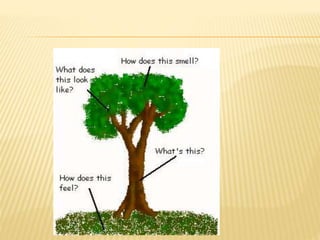
A descriptive essay could describe . . .
 * a tree in my backyard;
 * a visit to the children's ward of a
hospital;
 * a hot fudge sundae;*
 what an athlete did in order to make it to
the Olympics.
THE DESCRIPTIVE ESSAY
 provides details about how something looks,
feels, tastes, smells, makes one feel, or sounds.
 It can also describe what something is, or how
something happened.
 These essays generally use a lot of sensory
details.
 The essay could be a list-like description that
provides point by point details.
 Or, it could function as a story, keeping the
reader interested in the plot and theme of the
event described.
A DEFINITION ESSAY MAY TRY AND DEFINE . . .
 * the meaning of an abstract concept,
like love;
 * the true meaning and importance
of honesty;
 * how the meaning of family goes deeper
than just your blood relatives.
A DEFINITION ESSAY
 attempts to define a specific term. It could try to
pin down the meaning of a specific word, or
define an abstract concept.
 The analysis goes deeper than a simple
dictionary definition; it should attempt to
explain why the term is defined as such.
 It could define the term directly, giving no
information other than the explanation of the
term. Or, it could imply the definition of the term,
telling a story that requires the reader to infer
the meaning.
A COMPARE/CONTRAST ESSAY MAY DISCUSS . .
.
 * the likenesses and differences between two places, like New
York City and Los Angeles;
 * the similarities and differences between two religions, like
Christianity and Judaism;
 * two people, like my brother and myself.
 The compare/contrast essay discusses the similarities and
differences between two things, people, concepts, places, etc.
The essay could be an unbiased discussion, or an attempt to
convince the reader of the benefits of one thing, person, or
concept.
 It could also be written simply to entertain the reader, or to arrive
at an insight into human nature. The essay could discuss both
similarities and differences, or it could just focus on one or the
other.
A comparison essay usually discusses the similarities between two things, while
the contrast essay discusses the differences.
CAUSE/EFFECT:
A cause/effect essay may explain . . .
• why a volcano erupts, and what happens afterwards;
• * what happens after a loved one's death.
• The cause/effect essay explains why or how some
event happened, and what resulted from the event.
• The essay could discuss both causes and effects, or
it could simply address one or the other. A cause
essay usually discusses the reasons why something
happened. An effect essay discusses what happens
after a specific event or circumstance.
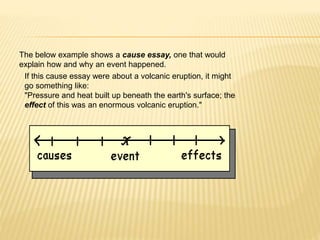
The below example shows a cause essay, one that would
explain how and why an event happened.
If this cause essay were about a volcanic eruption, it might
go something like:
"Pressure and heat built up beneath the earth's surface; the
effect of this was an enormous volcanic eruption."
The next example shows an effect essay, one
that would explain all the effects that happened
after a specific event, like a volcanic eruption.
If this effect essay were about a volcanic
eruption again, it might go something like:
"The eruption caused many terrible things to
happen; it destroyed homes, forests, and
polluted the atmosphere."
A NARRATIVE ESSAY COULD TELL OF . . .
 * my brother's and my fishing trips;*
 a boring trip to the grocery store;*
 my near-death experience at the beach.
 The narrative essay tells a story. It can also be
called a "short story." Generally the narrative essay is
conversational in style, and tells of a personal
experience. It is most commonly written in the first
person (uses I). This essay could tell of a single, life-
shaping event, or simply a mundane daily
experience.

A PROCESS ESSAY MAY EXPLAIN . . .
 * how to properly re-pot a plant;*
 how an individual came to appreciate hard
work.
 A process essay describes how something is
done. It generally explains actions that should
be performed in a series.
 It can explain in detail how to accomplish a
specific task, or it can show how an individual
came to a certain personal awareness.

The essay could be in the form of step-by-step instructions, or
in story form, with the instructions/explanations subtly given
along the way.
AN ARGUMENTATIVE ESSAY MAY PERSUADE A
READER THAT . . .
 * he or she should use public transportation
instead of driving.
 * cats are better than dogs.
 An argumentative essay is one that
attempts to persuade the reader to the
writer's point of view. The writer can either be
serious or funny, but always tries to convince
the reader of the validity of his or her opinion.
The essay may argue openly, or it may attempt to subtly
persuade the reader by using irony or sarcasm.
A CRITICAL ESSAY MAY ANALYZE . . .
 * how Shakespeare presents the character,
Othello, in his play, Othello;
 * the strengths and weaknesses of the
movie,Children of a Lesser God;*
 the use of color in Monet's
painting, Sunflowers.
 A critical essay analyzes the strengths,
weaknesses and methods of someone else's
work.
 Generally these essays begin with a brief
overview of the main points of the text,
movie, or piece of art, followed by an
analysis of the work's meaning. It should
then discuss how well the author/creator
accomplishes his/her goals and makes
his/her points.
 A critical essay can be written about another
essay, story, book, poem, movie, or work of
art.
 What is the hardest thing you ever had to do
and how did it change you?
 "Sports is an important part of any
educational program for it develops
leadership and independent thinking."
Explain whether you agree with this
statement based upon your own experience.
 Write a biographical sketch of one of your
grandparents
 Have you recently seen a movie, a play or
concert, attended a meeting, or read a book that
stimulated some change in the way you think
about things? Describe it as a critic, establishing
what it was intended to be or do, complimenting
what was good, poking fun at what was bad or
tasteless or ineffective. Stretch your mind by
questioning what you didn't understand.

Essay writing (2)

  • 1.
  • 3.
    THE OXFORD ENGLISHDICTIONARY  Defines “Essay as a composition of moderate length on any particular subject”  French word “essai” which means “attempt”
  • 4.
    SEVEN GENRES ORKINDS  Discussion essay(argumentative) or article- looking at the pros and cons of an issue  Explanation essay or article: how things work  Instruction essay or article: how to do something  Report essay or article: factual information on a topic  Recount essay:a retelling of a personal experience  Book review:what the reader thinks about the book  Narrative essay or short story
  • 5.
     Four featuresthat essays have in common  Overall structure  Paragraph structures  Cohesive devices  languages
  • 6.
    OVERALL STRUCTURE Beginning MiddleEnd Discussion orientation argument conclusion Explanation orientation phenomenon explanation Instruction orientation materials instruction Report orientation procedure outcome Recount orientation events sequel Book review orientation description evaluation Narrative orientation complication resolution
  • 7.
    ESSAY A: LIVINGIN CANBERRA  I’ve roamed in every continent---- except the Polar ones----and lived in three. By chance, I’ve made my present home in Australia and here among all the localities in all the states and territories I’ve made my present home 9n Canberra  The place may seem dull to outsiders,but it does have its excitements.There is the excitement of frost on a winter’s morning, the view of the hills from my kitchen window, and the splash of colours from a million trees .Who needs the excitement of king’s cross? But Canberra isn’t all sweetness and beauty.  The roads do go round and round a bit much, and the city buildings do go up and up a bit much. somethings even go down: for instance, the population in summer months, when the number of people in Canberra dwindles and, as if by magic, the number in the south coast resorts goes up by the same proportion  All in all, though, this is as good a place to live in as any in the world— and better than most. Anyway, I guess it is. But I won’t know for sure until I’ve paid at least one visit to the south pole.
  • 8.
     Essay beginswith an orientation  scene is set outside Canberra but the first paragraph is ended in Canberra  It is often advisable not to leap straight into essay topic but to lead into it.
  • 9.
    THERE ARE SEVERALWAYS OF DOING IT  With a question Do real people actually live in Canberra?  From the outside: I have roamed in every continent except the polar ones  With a quotation “Canberra is a city without a soul” Prince Philip  Something catchy and provocative  With a characteristic instance : I was in the city at 6:00 pm one evening,and the place was deserted.
  • 10.
     With adefinition: Canberra is the capital of Australia. It lies inland, between the coastal cities of Melbourne and Sydney.
  • 11.
    THE MIDDLE ISAN ARGUMENT OF THE PROS AND CONS  Essential to all discussion essays : an attempt to present more than one side of picture  Essay A second paragraph: advantages of living in Canberra  Third Paragraph: disadvantages of living in Canberra
  • 12.
     Another wayis to look critically at what others have said on a topic before you.  Often used in scientific writing
  • 13.
     The endreaches a conclusion on the balance of the pros and cons argument
  • 14.
    PRAGRAPH STRUCTURES  Beginning,Middle and end paragraphs have different structures  Beginning paragraph starts with lead-in and ends with a thesis sentence  The lead in sets the scene for the discussion  The thesis sentence tells the reader what the essay is all about
  • 15.
     A dialecticalparagraph usually begins with a topic sentence-that sets the topic for that paragraph  And elaborates sentences to expand the topic sentence ,with details and supporting argumnt
  • 16.
     The endparagraph finishes with conclusion that is the first sentence and a lead out in the last.
  • 17.
    COHESIVE DEVICES  Railwaycarriages  Cohesive can be anaphoric or cataphoric  Anaphor is a cohesive device in which a reference in a later paragraph refers backward and therefore links it to something in an earlier paragraph
  • 18.
     Cataphor inwhich a reference at the end of an earlier paragraph refers forward and therefore links it to something in later para.
  • 19.
    LANGUAGE  If youressay isn’t a pleasure to write,nobody will bother to read it ,unless they have to as an assignment or for work.  are sentences, on average. short?  Is the language appropriate for normal readers?  Is the text free of passives?  Have you written it in natural voice?
  • 20.
    FEATURES OF ANEXPLANATION ESSAY  Tells you how things work
  • 21.
    FEATURES OF ANINSTRUCTION ESSAY  How to do or make something
  • 22.
    FEATURS OF AREPORT ESSAY  Factual information
  • 23.
    FEATURES OF ARECOUNT ESSAY  Writer’s personal experience  Can be confessional, inspirational, sad, funny
  • 24.
    FEATURES OF ANARRATIVE ESSAY  Story telling facts  Built round a plot  Overall structure : some features of non narrative essays do not apply  For example : topic sentences  The thing that is important here is to keep the story moving to its climax
  • 25.
     Paragraph structures First paragraph has a topic sentence followed by elaboration,  Otherwise story flows from event to event  Cohesive devices cataphor and anaphor  Language  Dialogue  descriptions  A light tone
  • 26.
    KINDS  Expository  Narrative Persuasive  Descriptive
  • 27.
    EXPOSITORY ESSAY  Involveinvestigating idea Evaluating the evidence Through comparison and contrast  Descriptive essay Describes  Narrative Essays ,Short stories and book reports  Persuasive essay is also called argumentative essay .
  • 28.
     Persuasive essaywill be similar to an expository essay in that you will be exploring a topic and collecting and evaluating evidence. However, unlike an expository essay, you will be taking a stand for or against this topic
  • 29.
    A descriptive essaycould describe . . .  * a tree in my backyard;  * a visit to the children's ward of a hospital;  * a hot fudge sundae;*  what an athlete did in order to make it to the Olympics.
  • 31.
    THE DESCRIPTIVE ESSAY provides details about how something looks, feels, tastes, smells, makes one feel, or sounds.  It can also describe what something is, or how something happened.  These essays generally use a lot of sensory details.  The essay could be a list-like description that provides point by point details.  Or, it could function as a story, keeping the reader interested in the plot and theme of the event described.
  • 32.
    A DEFINITION ESSAYMAY TRY AND DEFINE . . .  * the meaning of an abstract concept, like love;  * the true meaning and importance of honesty;  * how the meaning of family goes deeper than just your blood relatives.
  • 33.
    A DEFINITION ESSAY attempts to define a specific term. It could try to pin down the meaning of a specific word, or define an abstract concept.  The analysis goes deeper than a simple dictionary definition; it should attempt to explain why the term is defined as such.  It could define the term directly, giving no information other than the explanation of the term. Or, it could imply the definition of the term, telling a story that requires the reader to infer the meaning.
  • 35.
    A COMPARE/CONTRAST ESSAYMAY DISCUSS . . .  * the likenesses and differences between two places, like New York City and Los Angeles;  * the similarities and differences between two religions, like Christianity and Judaism;  * two people, like my brother and myself.  The compare/contrast essay discusses the similarities and differences between two things, people, concepts, places, etc. The essay could be an unbiased discussion, or an attempt to convince the reader of the benefits of one thing, person, or concept.  It could also be written simply to entertain the reader, or to arrive at an insight into human nature. The essay could discuss both similarities and differences, or it could just focus on one or the other.
  • 36.
    A comparison essayusually discusses the similarities between two things, while the contrast essay discusses the differences.
  • 37.
    CAUSE/EFFECT: A cause/effect essaymay explain . . . • why a volcano erupts, and what happens afterwards; • * what happens after a loved one's death. • The cause/effect essay explains why or how some event happened, and what resulted from the event. • The essay could discuss both causes and effects, or it could simply address one or the other. A cause essay usually discusses the reasons why something happened. An effect essay discusses what happens after a specific event or circumstance.
  • 38.
    The below exampleshows a cause essay, one that would explain how and why an event happened. If this cause essay were about a volcanic eruption, it might go something like: "Pressure and heat built up beneath the earth's surface; the effect of this was an enormous volcanic eruption."
  • 39.
    The next exampleshows an effect essay, one that would explain all the effects that happened after a specific event, like a volcanic eruption. If this effect essay were about a volcanic eruption again, it might go something like: "The eruption caused many terrible things to happen; it destroyed homes, forests, and polluted the atmosphere."
  • 40.
    A NARRATIVE ESSAYCOULD TELL OF . . .  * my brother's and my fishing trips;*  a boring trip to the grocery store;*  my near-death experience at the beach.  The narrative essay tells a story. It can also be called a "short story." Generally the narrative essay is conversational in style, and tells of a personal experience. It is most commonly written in the first person (uses I). This essay could tell of a single, life- shaping event, or simply a mundane daily experience. 
  • 42.
    A PROCESS ESSAYMAY EXPLAIN . . .  * how to properly re-pot a plant;*  how an individual came to appreciate hard work.  A process essay describes how something is done. It generally explains actions that should be performed in a series.  It can explain in detail how to accomplish a specific task, or it can show how an individual came to a certain personal awareness. 
  • 43.
    The essay couldbe in the form of step-by-step instructions, or in story form, with the instructions/explanations subtly given along the way.
  • 44.
    AN ARGUMENTATIVE ESSAYMAY PERSUADE A READER THAT . . .  * he or she should use public transportation instead of driving.  * cats are better than dogs.  An argumentative essay is one that attempts to persuade the reader to the writer's point of view. The writer can either be serious or funny, but always tries to convince the reader of the validity of his or her opinion.
  • 45.
    The essay mayargue openly, or it may attempt to subtly persuade the reader by using irony or sarcasm.
  • 46.
    A CRITICAL ESSAYMAY ANALYZE . . .  * how Shakespeare presents the character, Othello, in his play, Othello;  * the strengths and weaknesses of the movie,Children of a Lesser God;*  the use of color in Monet's painting, Sunflowers.  A critical essay analyzes the strengths, weaknesses and methods of someone else's work.
  • 47.
     Generally theseessays begin with a brief overview of the main points of the text, movie, or piece of art, followed by an analysis of the work's meaning. It should then discuss how well the author/creator accomplishes his/her goals and makes his/her points.  A critical essay can be written about another essay, story, book, poem, movie, or work of art.
  • 49.
     What isthe hardest thing you ever had to do and how did it change you?  "Sports is an important part of any educational program for it develops leadership and independent thinking." Explain whether you agree with this statement based upon your own experience.
  • 50.
     Write abiographical sketch of one of your grandparents  Have you recently seen a movie, a play or concert, attended a meeting, or read a book that stimulated some change in the way you think about things? Describe it as a critic, establishing what it was intended to be or do, complimenting what was good, poking fun at what was bad or tasteless or ineffective. Stretch your mind by questioning what you didn't understand.