EXCEPTIONS TO
LAW OF DEMAND

     Submitted by
       Deepa.m.k
          P11118
DEMAND
    www.slideshare.com


 Demand is desire/ want, backed by ability to pay.
 It is the amount of buyers who are willing to purchase the products and services at
  a given price over a given period of time

LAW OF DEMAND

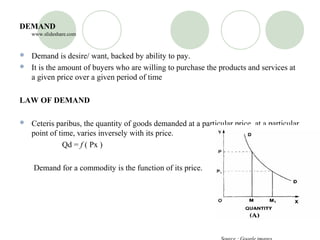
   Ceteris paribus, the quantity of goods demanded at a particular price, at a particular
    point of time, varies inversely with its price.
               Qd = f ( Px )

    Demand for a commodity is the function of its price.
Exceptions

   Goods that obey the law of demand are normal goods.

   There are goods which doesn’t obey the law of demand

   Such goods are either superior goods or inferior goods

   Named as Veblen and Giffin goods respectively
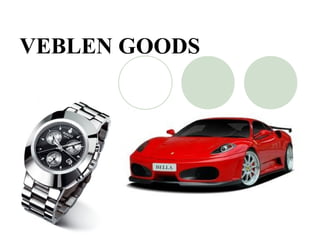
VEBLEN GOODS
source:www.tutor2u.net


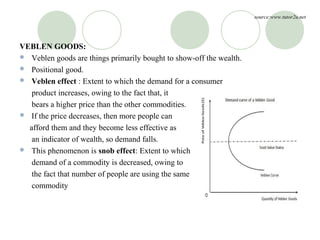
VEBLEN GOODS:
 Veblen goods are things primarily bought to show-off the wealth.
 Positional good.
 Veblen effect : Extent to which the demand for a consumer

   product increases, owing to the fact that, it
   bears a higher price than the other commodities.
 If the price decreases, then more people can

  afford them and they become less effective as
   an indicator of wealth, so demand falls.
 This phenomenon is snob effect: Extent to which

   demand of a commodity is decreased, owing to
   the fact that number of people are using the same
   commodity
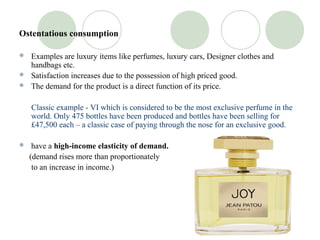
Ostentatious consumption

 Examples are luxury items like perfumes, luxury cars, Designer clothes and
  handbags etc.
 Satisfaction increases due to the possession of high priced good.
 The demand for the product is a direct function of its price.


    Classic example - VI which is considered to be the most exclusive perfume in the
    world. Only 475 bottles have been produced and bottles have been selling for
    £47,500 each – a classic case of paying through the nose for an exclusive good.

    have a high-income elasticity of demand.
    (demand rises more than proportionately
     to an increase in income.)
Income elasticity of Veblen goods.

   Normal goods have a positive income elasticity of demand, (income rises, demand also rises.)


                                           NORMAL GOODS


                                Necessities                    Luxuries.
                            Elasticity btw 0 and 1       Elasticity greater than 1
                             Slower rate of inc:            Faster rate of inc:

   For example (luxury) a 8% increase in income might lead to a 16% rise in the demand for
    restaurant meals. The income elasticity of demand in this example +2.0. Demand is highly
    sensitive to (inc: or dec: in) income.

    www.marketwatch.com

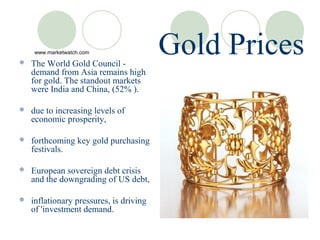
    The World Gold Council -
                                         Gold Prices
    demand from Asia remains high
    for gold. The standout markets
    were India and China, (52% ).

   due to increasing levels of
    economic prosperity,

   forthcoming key gold purchasing
    festivals.

   European sovereign debt crisis
    and the downgrading of US debt,

   inflationary pressures, is driving
    of 'investment demand.
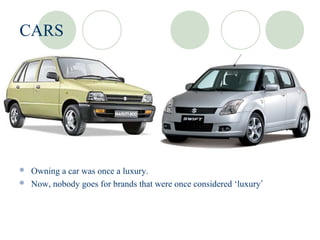
CARS


 Owning a car was once a luxury.
 Now, nobody goes for brands that were once considered ‘luxury’
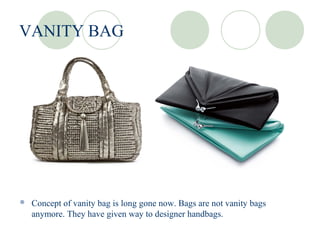
VANITY BAG


   Concept of vanity bag is long gone now. Bags are not vanity bags
    anymore. They have given way to designer handbags.
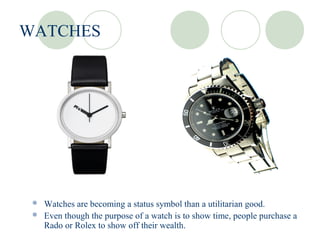
WATCHES


  Watches are becoming a status symbol than a utilitarian good.
  Even though the purpose of a watch is to show time, people purchase a
   Rado or Rolex to show off their wealth.
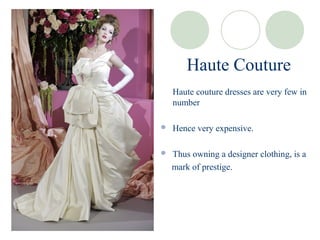
Haute Couture
    Haute couture dresses are very few in
    number

   Hence very expensive.

   Thus owning a designer clothing, is a
    mark of prestige.
STATISTICS – 2011                                       www.bloomberg.com,www.online.wsj.com


8% rise :

 Sales of luxury goods may rise 8 percent this year, matching 2010’s pace. in
  October a growth of 3 percent to 5 percent will be seen
 Spending on luxury apparel, accessories, watches, jewellery, perfume etc may
  climb to 185 billion euros in 2011 from 172 billion euros last year.

15% inc - Asia-Pacific

 Annual luxury sales in japan will decline to 17 billion euros from 18 billion euros,
  as it is only recovering from the recent calamities.
 Mainland China will remain the fastest-growing market for luxury goods in 2011 as
  sales rise 25 percent to 11.5 billion euros, Bain predicted. The country is on course
  to become the world’s third-largest luxury market in five years.
Europe (7 %) and the Americas (8%)

 Europe and the Americas, which together account for more than two-thirds of
  global luxury consumption
 The U.S. is the largest market, accounting for 48.1 billion euros in 2010, according
  to Bain.
 Lifestyle changes are driving sales increases in Russia and new stores will fuel
  growth in the Middle East and Brazil, Bain said.

By 2014, global luxury sales may rise to as much as 221 billion euros.
SUMMARY


   When Price inc: demand dec:

   Called Goods of conspicuous consumption.

   Gives psychic satisfaction. not material satisfaction.

   In case of some Veblen goods (paintings, antiquities etc.), supply is not controlled
    by demand.

   in boom times, demand for luxury goods grow faster than the growth of economies
    (as measured by GDP).

   slowdowns can cause sales to retreat rapidly, as consumers buy fewer high-priced
    luxury goods.
GIFFEN GOODS
www.buzzle.com


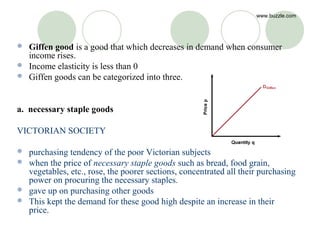
 Giffen good is a good that which decreases in demand when consumer
  income rises.
 Income elasticity is less than 0
 Giffen goods can be categorized into three.


a. necessary staple goods

VICTORIAN SOCIETY

 purchasing tendency of the poor Victorian subjects
 when the price of necessary staple goods such as bread, food grain,
  vegetables, etc., rose, the poorer sections, concentrated all their purchasing
  power on procuring the necessary staples.
 gave up on purchasing other goods
 This kept the demand for these good high despite an increase in their
  price.
IRISH SOCIETY

 people were so poor
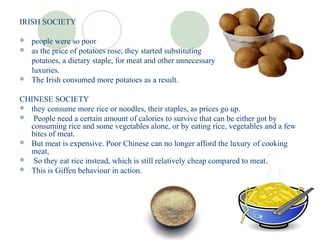
 as the price of potatoes rose, they started substituting
  potatoes, a dietary staple, for meat and other unnecessary
  luxuries.
 The Irish consumed more potatoes as a result.


CHINESE SOCIETY
 they consume more rice or noodles, their staples, as prices go up.
 People need a certain amount of calories to survive that can be either got by
  consuming rice and some vegetables alone, or by eating rice, vegetables and a few
  bites of meat.
 But meat is expensive. Poor Chinese can no longer afford the luxury of cooking
  meat,
 So they eat rice instead, which is still relatively cheap compared to meat.
 This is Giffen behaviour in action.
b. inferior goods
   those for which the demand rises when the price to procure them forms a relatively
    substantial part of the buyer's income without eating into the amount of income set
    aside for the consumption of other regular items.

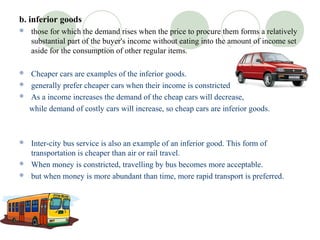
 Cheaper cars are examples of the inferior goods.
 generally prefer cheaper cars when their income is constricted.
 As a income increases the demand of the cheap cars will decrease,

  while demand of costly cars will increase, so cheap cars are inferior goods.


 Inter-city bus service is also an example of an inferior good. This form of
  transportation is cheaper than air or rail travel.
 When money is constricted, travelling by bus becomes more acceptable.
 but when money is more abundant than time, more rapid transport is preferred.
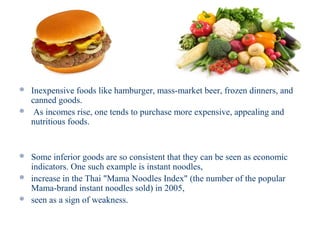
 Inexpensive foods like hamburger, mass-market beer, frozen dinners, and
  canned goods.
 As incomes rise, one tends to purchase more expensive, appealing and
  nutritious foods.


 Some inferior goods are so consistent that they can be seen as economic
  indicators. One such example is instant noodles,
 increase in the Thai "Mama Noodles Index" (the number of the popular
  Mama-brand instant noodles sold) in 2005,
 seen as a sign of weakness.
c. experience goods


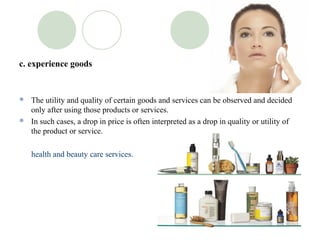
 The utility and quality of certain goods and services can be observed and decided
  only after using those products or services.
 In such cases, a drop in price is often interpreted as a drop in quality or utility of
  the product or service.

    health and beauty care services.

Giffin and Veblin goods

  • 1.
    EXCEPTIONS TO LAW OFDEMAND Submitted by Deepa.m.k P11118
  • 2.
    DEMAND www.slideshare.com  Demand is desire/ want, backed by ability to pay.  It is the amount of buyers who are willing to purchase the products and services at a given price over a given period of time LAW OF DEMAND  Ceteris paribus, the quantity of goods demanded at a particular price, at a particular point of time, varies inversely with its price. Qd = f ( Px ) Demand for a commodity is the function of its price.
  • 3.
    Exceptions  Goods that obey the law of demand are normal goods.  There are goods which doesn’t obey the law of demand  Such goods are either superior goods or inferior goods  Named as Veblen and Giffin goods respectively
  • 4.
  • 5.
    source:www.tutor2u.net VEBLEN GOODS:  Veblengoods are things primarily bought to show-off the wealth.  Positional good.  Veblen effect : Extent to which the demand for a consumer product increases, owing to the fact that, it bears a higher price than the other commodities.  If the price decreases, then more people can afford them and they become less effective as an indicator of wealth, so demand falls.  This phenomenon is snob effect: Extent to which demand of a commodity is decreased, owing to the fact that number of people are using the same commodity
  • 6.
    Ostentatious consumption  Examplesare luxury items like perfumes, luxury cars, Designer clothes and handbags etc.  Satisfaction increases due to the possession of high priced good.  The demand for the product is a direct function of its price. Classic example - VI which is considered to be the most exclusive perfume in the world. Only 475 bottles have been produced and bottles have been selling for £47,500 each – a classic case of paying through the nose for an exclusive good.  have a high-income elasticity of demand. (demand rises more than proportionately to an increase in income.)
  • 7.
    Income elasticity ofVeblen goods.  Normal goods have a positive income elasticity of demand, (income rises, demand also rises.) NORMAL GOODS Necessities Luxuries. Elasticity btw 0 and 1 Elasticity greater than 1 Slower rate of inc: Faster rate of inc:  For example (luxury) a 8% increase in income might lead to a 16% rise in the demand for restaurant meals. The income elasticity of demand in this example +2.0. Demand is highly sensitive to (inc: or dec: in) income.
  • 8.
    www.marketwatch.com The World Gold Council - Gold Prices demand from Asia remains high for gold. The standout markets were India and China, (52% ).  due to increasing levels of economic prosperity,  forthcoming key gold purchasing festivals.  European sovereign debt crisis and the downgrading of US debt,  inflationary pressures, is driving of 'investment demand.
  • 9.
    CARS  Owning acar was once a luxury.  Now, nobody goes for brands that were once considered ‘luxury’
  • 10.
    VANITY BAG  Concept of vanity bag is long gone now. Bags are not vanity bags anymore. They have given way to designer handbags.
  • 11.
    WATCHES  Watchesare becoming a status symbol than a utilitarian good.  Even though the purpose of a watch is to show time, people purchase a Rado or Rolex to show off their wealth.
  • 12.
    Haute Couture Haute couture dresses are very few in number  Hence very expensive.  Thus owning a designer clothing, is a mark of prestige.
  • 13.
    STATISTICS – 2011 www.bloomberg.com,www.online.wsj.com 8% rise :  Sales of luxury goods may rise 8 percent this year, matching 2010’s pace. in October a growth of 3 percent to 5 percent will be seen  Spending on luxury apparel, accessories, watches, jewellery, perfume etc may climb to 185 billion euros in 2011 from 172 billion euros last year. 15% inc - Asia-Pacific  Annual luxury sales in japan will decline to 17 billion euros from 18 billion euros, as it is only recovering from the recent calamities.  Mainland China will remain the fastest-growing market for luxury goods in 2011 as sales rise 25 percent to 11.5 billion euros, Bain predicted. The country is on course to become the world’s third-largest luxury market in five years.
  • 14.
    Europe (7 %)and the Americas (8%)  Europe and the Americas, which together account for more than two-thirds of global luxury consumption  The U.S. is the largest market, accounting for 48.1 billion euros in 2010, according to Bain.  Lifestyle changes are driving sales increases in Russia and new stores will fuel growth in the Middle East and Brazil, Bain said. By 2014, global luxury sales may rise to as much as 221 billion euros.
  • 15.
    SUMMARY  When Price inc: demand dec:  Called Goods of conspicuous consumption.  Gives psychic satisfaction. not material satisfaction.  In case of some Veblen goods (paintings, antiquities etc.), supply is not controlled by demand.  in boom times, demand for luxury goods grow faster than the growth of economies (as measured by GDP).  slowdowns can cause sales to retreat rapidly, as consumers buy fewer high-priced luxury goods.
  • 16.
  • 17.
    www.buzzle.com  Giffen goodis a good that which decreases in demand when consumer income rises.  Income elasticity is less than 0  Giffen goods can be categorized into three. a. necessary staple goods VICTORIAN SOCIETY  purchasing tendency of the poor Victorian subjects  when the price of necessary staple goods such as bread, food grain, vegetables, etc., rose, the poorer sections, concentrated all their purchasing power on procuring the necessary staples.  gave up on purchasing other goods  This kept the demand for these good high despite an increase in their price.
  • 18.
    IRISH SOCIETY  peoplewere so poor  as the price of potatoes rose, they started substituting potatoes, a dietary staple, for meat and other unnecessary luxuries.  The Irish consumed more potatoes as a result. CHINESE SOCIETY  they consume more rice or noodles, their staples, as prices go up.  People need a certain amount of calories to survive that can be either got by consuming rice and some vegetables alone, or by eating rice, vegetables and a few bites of meat.  But meat is expensive. Poor Chinese can no longer afford the luxury of cooking meat,  So they eat rice instead, which is still relatively cheap compared to meat.  This is Giffen behaviour in action.
  • 19.
    b. inferior goods  those for which the demand rises when the price to procure them forms a relatively substantial part of the buyer's income without eating into the amount of income set aside for the consumption of other regular items.  Cheaper cars are examples of the inferior goods.  generally prefer cheaper cars when their income is constricted.  As a income increases the demand of the cheap cars will decrease, while demand of costly cars will increase, so cheap cars are inferior goods.  Inter-city bus service is also an example of an inferior good. This form of transportation is cheaper than air or rail travel.  When money is constricted, travelling by bus becomes more acceptable.  but when money is more abundant than time, more rapid transport is preferred.
  • 20.
     Inexpensive foodslike hamburger, mass-market beer, frozen dinners, and canned goods.  As incomes rise, one tends to purchase more expensive, appealing and nutritious foods.  Some inferior goods are so consistent that they can be seen as economic indicators. One such example is instant noodles,  increase in the Thai "Mama Noodles Index" (the number of the popular Mama-brand instant noodles sold) in 2005,  seen as a sign of weakness.
  • 21.
    c. experience goods The utility and quality of certain goods and services can be observed and decided only after using those products or services.  In such cases, a drop in price is often interpreted as a drop in quality or utility of the product or service. health and beauty care services.