By
JYOTHI S.
Asst. Professor,
GFGCW, Holenarasipur
UNION BUDGET
2019-2020
Meaning
P.E.Taylor
‘Budget is the master financial plan of the
government. It brings together estimates of
anticipated revenue and proposed
expenditure for the budget years’.
Three sets of figures
Actual figures of revenue and expenditure of the previous
financial year (2018-2019)
The revised estimates of revenue and expenditure of the
current financial year (2019-2020)
The estimates of revenue and expenditure for the coming
financial year (2020-2021)
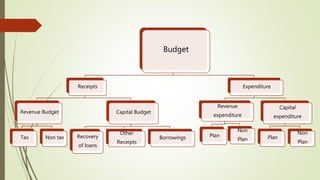
Budget
Receipts
Revenue Budget
Tax Non tax
Capital Budget
Recovery
of loans
Other
Receipts
Borrowings
Expenditure
Revenue
expenditure
Plan
Non
Plan
Capital
expenditure
Plan
Non
Plan
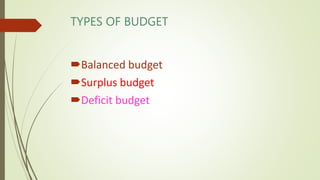
TYPES OF BUDGET
Balanced budget
Surplus budget
Deficit budget
Other types of budget
1.Annual Budget, Supplement Budget, Interim
Budget or Long Term Budget.
2. Single or Multiple Budget.
3. Conventional or Cash Budget.
4. Departmental Budget, Performance Budget or
Programme Budget.
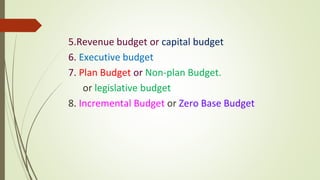
5.Revenue budget or capital budget
6. Executive budget
7. Plan Budget or Non-plan Budget.
or legislative budget
8. Incremental Budget or Zero Base Budget
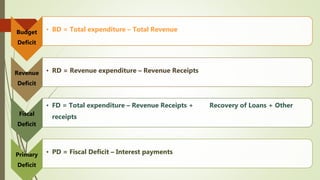
Budget
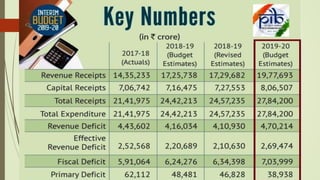
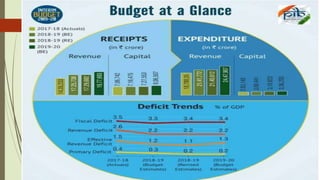
Deficit
• BD = Total expenditure – Total Revenue
Revenue
Deficit
• RD = Revenue expenditure – Revenue Receipts
Fiscal
Deficit
• FD = Total expenditure – Revenue Receipts + Recovery of Loans + Other
receipts
Primary
Deficit
• PD = Fiscal Deficit – Interest payments
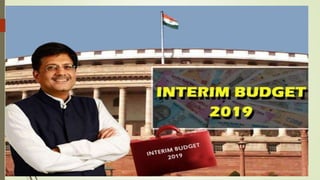
Interim Budget 2019-2020
State of the Economy:
 India was 11th largest economy in the world in
2013-14, now, the 6th largest in the world.
Inflation
 The average rate of inflation during 2009-
2014 was 10.1%.
The average inflation now brought down to
4.6%.
Banking Reforms and Insolvency and Bankruptcy
Code (IBC)
 non-performing assets (NPAs) amounting to
5.4 lakh crore in 2014.
 stopped the culture of “phone banking”.
 The 4Rs approach of recognition, resolution, re-
capitalisation and reforms has been followed.
 An amount of close to 3 lakh crore has already
been recovered in favour of banks and
creditors.
Saubhagya Yojana
free electricity connection to almost every
household.
approximately 50,000 crore per year in electricity bills
of poor and middle class families.
Farmer's progress and Increase in Income
 fixed the minimum support price (MSP) of all 22 crops at
minimum 50% more than the cost.
Pradhan Mantri KIsan SAmman Nidhi (PM-KISAN)
Under this programme, vulnerable landholding farmer families,
having cultivable land upto 2 hectares, will be provided direct
income support at the rate of 6,000 per year. This income support
will be transferred directly into the bank accounts of beneficiary
farmers, in three equal instalments of 2,000 each.
 Kisan Credit Card scheme (KCC)
 the crop loans are rescheduled for natural affected farmers
and they get benefit of interest subvention of 2% only for
the first year of the rescheduled loan.
Pradhan Mantri Shram-Yogi Maandhan
 the unorganised sector workers with monthly income upto
15,000. This pension yojana shall provide them an assured
monthly pension of 3,000 from the age of 60 years
Women’s development
 More than 70% of the beneficiaries of Pradhan Mantri
MUDRA Yojana are women.
 benefits of Maternity leave of 26 weeks.
 Pradhan Mantri Matru Vandana Yojana for pregnant women
have provided financial support to women while empowering
them to participate in work.
Strengthening Defence and National
Security
 to implement One Rank One Pension (OROP).
 Defence Budget will be crossing 3,00,000 crore for
the first time in 2019-20..
Infrastructure development
 UDAAN Scheme
 Arunachal Pradesh came on the air map recently and
Meghalaya, Tripura and Mizoram have come on India’s rail
map for the first time.
Jan Dhan-Aadhaar-Mobile (JAM)
 In the last five years, nearly 34 crore Jan Dhan bank accounts
were opened. Aadhaar is now near universally implemented
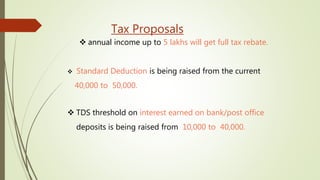
Tax Proposals
 annual income up to 5 lakhs will get full tax rebate.
 Standard Deduction is being raised from the current
40,000 to 50,000.
 TDS threshold on interest earned on bank/post office
deposits is being raised from 10,000 to 40,000.
Budget 2019 20
Budget 2019 20
Budget 2019 20
Budget 2019 20
Budget 2019 20
Budget 2019 20
Budget 2019 20

Budget 2019 20

  • 1.
    By JYOTHI S. Asst. Professor, GFGCW,Holenarasipur UNION BUDGET 2019-2020
  • 3.
    Meaning P.E.Taylor ‘Budget is themaster financial plan of the government. It brings together estimates of anticipated revenue and proposed expenditure for the budget years’.
  • 4.
    Three sets offigures Actual figures of revenue and expenditure of the previous financial year (2018-2019) The revised estimates of revenue and expenditure of the current financial year (2019-2020) The estimates of revenue and expenditure for the coming financial year (2020-2021)
  • 5.
    Budget Receipts Revenue Budget Tax Nontax Capital Budget Recovery of loans Other Receipts Borrowings Expenditure Revenue expenditure Plan Non Plan Capital expenditure Plan Non Plan
  • 8.
    TYPES OF BUDGET Balancedbudget Surplus budget Deficit budget
  • 9.
    Other types ofbudget 1.Annual Budget, Supplement Budget, Interim Budget or Long Term Budget. 2. Single or Multiple Budget. 3. Conventional or Cash Budget. 4. Departmental Budget, Performance Budget or Programme Budget.
  • 10.
    5.Revenue budget orcapital budget 6. Executive budget 7. Plan Budget or Non-plan Budget. or legislative budget 8. Incremental Budget or Zero Base Budget
  • 11.
    Budget Deficit • BD =Total expenditure – Total Revenue Revenue Deficit • RD = Revenue expenditure – Revenue Receipts Fiscal Deficit • FD = Total expenditure – Revenue Receipts + Recovery of Loans + Other receipts Primary Deficit • PD = Fiscal Deficit – Interest payments
  • 13.
    Interim Budget 2019-2020 Stateof the Economy:  India was 11th largest economy in the world in 2013-14, now, the 6th largest in the world.
  • 15.
    Inflation  The averagerate of inflation during 2009- 2014 was 10.1%. The average inflation now brought down to 4.6%.
  • 16.
    Banking Reforms andInsolvency and Bankruptcy Code (IBC)  non-performing assets (NPAs) amounting to 5.4 lakh crore in 2014.  stopped the culture of “phone banking”.  The 4Rs approach of recognition, resolution, re- capitalisation and reforms has been followed.  An amount of close to 3 lakh crore has already been recovered in favour of banks and creditors.
  • 17.
    Saubhagya Yojana free electricityconnection to almost every household. approximately 50,000 crore per year in electricity bills of poor and middle class families.
  • 18.
    Farmer's progress andIncrease in Income  fixed the minimum support price (MSP) of all 22 crops at minimum 50% more than the cost. Pradhan Mantri KIsan SAmman Nidhi (PM-KISAN) Under this programme, vulnerable landholding farmer families, having cultivable land upto 2 hectares, will be provided direct income support at the rate of 6,000 per year. This income support will be transferred directly into the bank accounts of beneficiary farmers, in three equal instalments of 2,000 each.
  • 19.
     Kisan CreditCard scheme (KCC)  the crop loans are rescheduled for natural affected farmers and they get benefit of interest subvention of 2% only for the first year of the rescheduled loan.
  • 20.
    Pradhan Mantri Shram-YogiMaandhan  the unorganised sector workers with monthly income upto 15,000. This pension yojana shall provide them an assured monthly pension of 3,000 from the age of 60 years
  • 21.
    Women’s development  Morethan 70% of the beneficiaries of Pradhan Mantri MUDRA Yojana are women.  benefits of Maternity leave of 26 weeks.  Pradhan Mantri Matru Vandana Yojana for pregnant women have provided financial support to women while empowering them to participate in work.
  • 22.
    Strengthening Defence andNational Security  to implement One Rank One Pension (OROP).  Defence Budget will be crossing 3,00,000 crore for the first time in 2019-20..
  • 23.
    Infrastructure development  UDAANScheme  Arunachal Pradesh came on the air map recently and Meghalaya, Tripura and Mizoram have come on India’s rail map for the first time.
  • 24.
    Jan Dhan-Aadhaar-Mobile (JAM) In the last five years, nearly 34 crore Jan Dhan bank accounts were opened. Aadhaar is now near universally implemented
  • 25.
    Tax Proposals  annualincome up to 5 lakhs will get full tax rebate.  Standard Deduction is being raised from the current 40,000 to 50,000.  TDS threshold on interest earned on bank/post office deposits is being raised from 10,000 to 40,000.