Pricing in
Practice
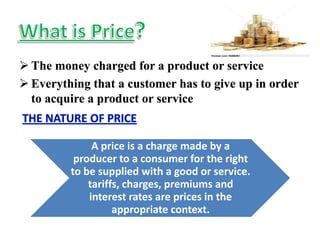
 The money charged for a product or service
 Everything that a customer has to give up in order
to acquire a product or service
A price is a charge made by a
producer to a consumer for the right
to be supplied with a good or service.
tariffs, charges, premiums and
interest rates are prices in the
appropriate context.
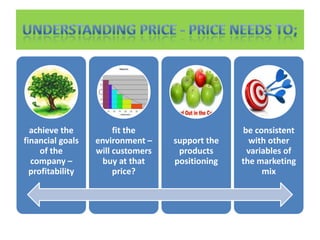
achieve the
financial goals
of the
company –
profitability
fit the
environment –
will customers
buy at that
price?
support the
products
positioning
be consistent
with other
variables of
the marketing
mix
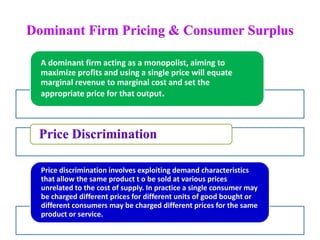
Dominant Firm Pricing & Consumer Surplus
A dominant firm acting as a monopolist, aiming to
maximize profits and using a single price will equate
marginal revenue to marginal cost and set the
appropriate price for that output.
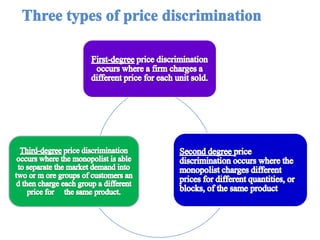
Price Discrimination
Price discrimination involves exploiting demand characteristics
that allow the same product t o be sold at various prices
unrelated to the cost of supply. In practice a single consumer may
be charged different prices for different units of good bought or
different consumers may be charged different prices for the same
product or service.
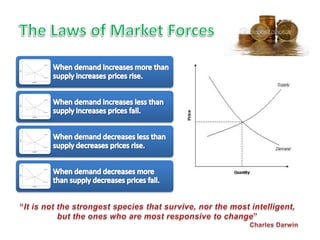
“It is not the strongest species that survive, nor the most intelligent, but
the ones who are most responsive to change”
Charles Darwin
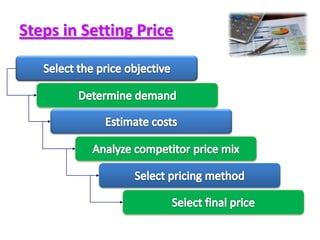
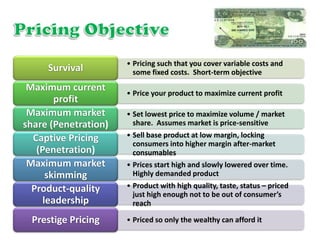
Select the price objective
Steps in Setting Price
• Pricing such that you cover variable costs and
some fixed costs. Short-term objectiveSurvival
• Price your product to maximize current profit
Maximum current
profit
• Set lowest price to maximize volume / market
share. Assumes market is price-sensitive
Maximum market
share (Penetration)
• Sell base product at low margin, locking
consumers into higher margin after-market
consumables
Captive Pricing
(Penetration)
• Prices start high and slowly lowered over time.
Highly demanded product
Maximum market
skimming
• Product with high quality, taste, status – priced
just high enough not to be out of consumer’s
reach
Product-quality
leadership
• Priced so only the wealthy can afford itPrestige Pricing
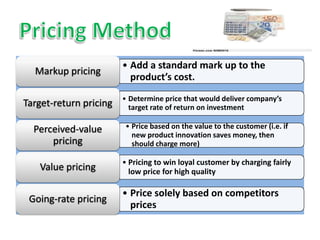
• Add a standard mark up to the
product’s cost.
Markup pricing
• Determine price that would deliver company’s
target rate of return on investmentTarget-return pricing
• Price based on the value to the customer (i.e. if
new product innovation saves money, then
should charge more)
Perceived-value
pricing
• Pricing to win loyal customer by charging fairly
low price for high qualityValue pricing
• Price solely based on competitors
prices
Going-rate pricing
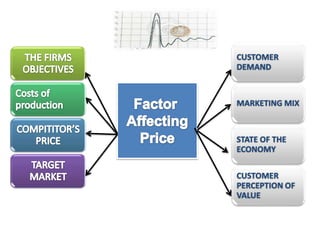
CUSTOMER
DEMAND
MARKETING MIX
STATE OF THE
ECONOMY
CUSTOMER
PERCEPTION OF
VALUE
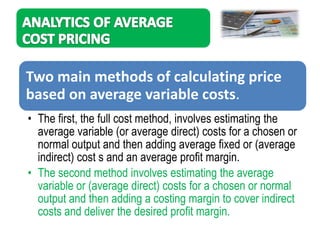
Two main methods of calculating price
based on average variable costs.
• The first, the full cost method, involves estimating the
average variable (or average direct) costs for a chosen or
normal output and then adding average fixed or (average
indirect) cost s and an average profit margin.
• The second method involves estimating the average
variable or (average direct) costs for a chosen or normal
output and then adding a costing margin to cover indirect
costs and deliver the desired profit margin.
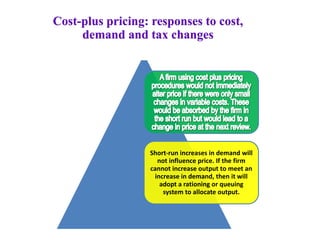
Short-run increases in demand will
not influence price. If the firm
cannot increase output to meet an
increase in demand, then it will
adopt a rationing or queuing
system to allocate output.
Cost-plus pricing: responses to cost,
demand and tax changes
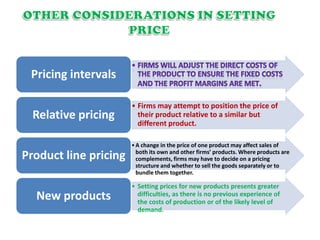
Pricing intervals
• Firms may attempt to position the price of
their product relative to a similar but
different product.
Relative pricing
•A change in the price of one product may affect sales of
both its own and other firms’ products. Where products are
complements, firms may have to decide on a pricing
structure and whether to sell the goods separately or to
bundle them together.
Product line pricing
• Setting prices for new products presents greater
difficulties, as there is no previous experience of
the costs of production or of the likely level of
demand.
New products
Pricing in Practice
Pricing in Practice

Pricing in Practice

  • 1.
  • 2.
     The moneycharged for a product or service  Everything that a customer has to give up in order to acquire a product or service A price is a charge made by a producer to a consumer for the right to be supplied with a good or service. tariffs, charges, premiums and interest rates are prices in the appropriate context.
  • 3.
    achieve the financial goals ofthe company – profitability fit the environment – will customers buy at that price? support the products positioning be consistent with other variables of the marketing mix
  • 4.
    Dominant Firm Pricing& Consumer Surplus A dominant firm acting as a monopolist, aiming to maximize profits and using a single price will equate marginal revenue to marginal cost and set the appropriate price for that output. Price Discrimination Price discrimination involves exploiting demand characteristics that allow the same product t o be sold at various prices unrelated to the cost of supply. In practice a single consumer may be charged different prices for different units of good bought or different consumers may be charged different prices for the same product or service.
  • 6.
    “It is notthe strongest species that survive, nor the most intelligent, but the ones who are most responsive to change” Charles Darwin
  • 7.
    Select the priceobjective Steps in Setting Price
  • 9.
    • Pricing suchthat you cover variable costs and some fixed costs. Short-term objectiveSurvival • Price your product to maximize current profit Maximum current profit • Set lowest price to maximize volume / market share. Assumes market is price-sensitive Maximum market share (Penetration) • Sell base product at low margin, locking consumers into higher margin after-market consumables Captive Pricing (Penetration) • Prices start high and slowly lowered over time. Highly demanded product Maximum market skimming • Product with high quality, taste, status – priced just high enough not to be out of consumer’s reach Product-quality leadership • Priced so only the wealthy can afford itPrestige Pricing
  • 10.
    • Add astandard mark up to the product’s cost. Markup pricing • Determine price that would deliver company’s target rate of return on investmentTarget-return pricing • Price based on the value to the customer (i.e. if new product innovation saves money, then should charge more) Perceived-value pricing • Pricing to win loyal customer by charging fairly low price for high qualityValue pricing • Price solely based on competitors prices Going-rate pricing
  • 11.
    CUSTOMER DEMAND MARKETING MIX STATE OFTHE ECONOMY CUSTOMER PERCEPTION OF VALUE
  • 12.
    Two main methodsof calculating price based on average variable costs. • The first, the full cost method, involves estimating the average variable (or average direct) costs for a chosen or normal output and then adding average fixed or (average indirect) cost s and an average profit margin. • The second method involves estimating the average variable or (average direct) costs for a chosen or normal output and then adding a costing margin to cover indirect costs and deliver the desired profit margin.
  • 13.
    Short-run increases indemand will not influence price. If the firm cannot increase output to meet an increase in demand, then it will adopt a rationing or queuing system to allocate output. Cost-plus pricing: responses to cost, demand and tax changes
  • 14.
    Pricing intervals • Firmsmay attempt to position the price of their product relative to a similar but different product. Relative pricing •A change in the price of one product may affect sales of both its own and other firms’ products. Where products are complements, firms may have to decide on a pricing structure and whether to sell the goods separately or to bundle them together. Product line pricing • Setting prices for new products presents greater difficulties, as there is no previous experience of the costs of production or of the likely level of demand. New products