Chapter 5   PRICING Price  may be defined as the value of product attributes expressed in monetary terms which a consumer pays or is expected to pay in exchange & anticipation of the expected or offered utility  Pricing  is the function of determine product value in monetary terms by the marketing management of a company before it is offered to the target consumer for sale
Objectives/ or Advantages of Pricing decisions   1. To maximize the profits 2. Price stability  3. Competitive situation 4. Achieving a Target-return 5. Capturing the market 6. Ability to pay 7. Long-run welfare of the firm 8. Margin of profit to middlemen
Factors influencing of price decision INTERNAL & EXTERNAL FORCES 1. Objectives of the business 2. Cost of the product 3. Market position 4. Competitors prices 5. Distribution channels policy 6. Price elasticity & Demand elasticity  7. Products stage in the Life cycle of the product  8. Product Differentiation 9. Buying patterns of the consumers 10. Economic environment  11. Government policy  12. Social & ethical consideration 13. Fear of labor leaders 14. Consumers reactions towards rising prices
Methods of pricing polices/ Basic pricing polices 1. Cost-oriented pricing 2. Demand-oriented pricing  3. Competition-oriented pricing
1. Cost-oriented pricing Following are some of the methods based on cost   Cost-plus pricing Rate of return or target pricing methods Break-even pricing  Marginal cost or Incremental pricing  Cost-plus pricing In this method assumes that no product is sold at a loss since the price covers the full cost incurred  Fixing tentative pricing is easier in this method  The price under this method is determined by adding a desired percentage profit on the cost to the total cost of the product   taking into account, the margins for middlemen
The de-merits is that it ignores completely the influence of competition & market demand Merits 1. Where it is difficult to forecast the future demand this method is appropriate  2. If there are only few buyers for the product, then pricing can be justified 3. Public utility services like railways, post offices, electricity are priced through this method   De-merits 1. The two important factors i.e. demand & supply are ignored  2. Method totally based on cost concept but in reality cost don’t influence the prices where as price influence the cost  3. Correct cost can’t be calculated
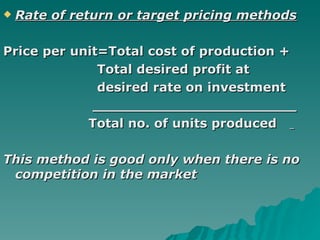
Rate of return or target pricing methods Price per unit=Total cost of production + Total desired profit at  desired rate on investment _______________________  Total no. of units produced   This method is good only when there is no competition in the market
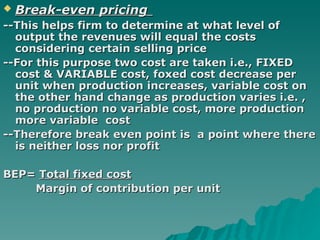
Break-even pricing   --This helps firm to determine at what level of output the revenues will equal the costs considering certain selling price --For this purpose two cost are taken i.e., FIXED cost & VARIABLE cost, foxed cost decrease per unit when production increases, variable cost on the other hand change as production varies i.e. , no production no variable cost, more production more variable  cost --Therefore break even point is  a point where there is neither loss nor profit BEP=  Total fixed cost Margin of contribution per unit
Marginal cost or Incremental pricing   --- In this method the price fixed on the basis of additional variable cost associated with an additional unit of output
2. Demand-oriented pricing  --- In this method of pricing DEMAND is considered as pivotal factor ---  PRICE is fixed by simply adjusting it to the market conditions ---  A high price is charged when or where the demand is intense & low price is charged when the demand is low
3. Competition-oriented pricing   1. Parity pricing or going rate pricing 2. Pricing above competitive level or Discount pricing  3. Pricing above competitive level or Premium pricing  1. Parity pricing or going rate pricing Price is fixed on the basis of competitors price, this method is used when the firm is new in the market or existing firm introduces a new product in the market or when there is tough competition in the market
2. Pricing above competitive level or  Discount pricing  Means when the price is fixed below the competitive level i.e., below the competitors product. This method is used only by new firms entering the market   3. Pricing above competitive level or Premium pricing   Where the firm determines the price of its product above the price of the same products of the competitors
PRICING STRTERGY   1. SKIM THE CREAM PRICING 2. MARKET- PENETRATION  PRICING 3. FOLLOW THE LEADER PRICING
1. Skim the cream pricing strategy or A high Initial pricing strategy   --This strategy uses a very high introductory price to skim the cream of demand at a very outset  --It is used when thee is no competition in the market or the new product has some exclusive characteristics --It continues to be high till the competitors begin to enter the market, as soon the competitors enter the market the producer reduces the price
2. Market Penetration pricing --This is just opposite of skimming pricing; it offers a very low introductory price to speed up its sales & therefore widening the market base --Basically low price is used as a major tool for rapid penetration of a mass market & is based on a long-term view point, also aims at capturing the market share
3. Follow the leader Pricing -- It fixes the prices near about their prices which are generally lower than those of their leader’s means they follow the company leader policy  -- Has no scientific & rational basis for fixing the prices
Kinds of pricing 1. ODD pricing Ending in odd number e.g. Bata shoe  company pricing like 399.95 2. PSYCHOLOGICAL pricing Prices are fixed at a full number Positively inclined   3. CUSTOMARY pricing Prices are fixed by the custom. Soft drinks are priced by their customary basis
4. Pricing at PREVAILING prices Undertaken to meet the competition 5. PRESTIGE pricing Luxury goods are priced in this type   6. Price LINING   This type usually found among retailers, it is related to both psychological & customary pricing   7. GEOGRPHIC pricing Petrol is priced depending upon the distance from the storage area to the retail outlet   8. F.O.B (Free on Board) First the buyer will incur the cost of transit & in the latter the quoted is inclusive of transit chargers
9. DUAL pricing When the manufacturer sells the product at two or more different prices in the same market. E.g. In railways where the passengers are charged differently for the same journey & traveling in different classes  10. ADMINSTERED pricing Pricing is fixed on the basis of policy decisions of sellers

Chapter 5

  • 1.
    Chapter 5 PRICING Price may be defined as the value of product attributes expressed in monetary terms which a consumer pays or is expected to pay in exchange & anticipation of the expected or offered utility Pricing is the function of determine product value in monetary terms by the marketing management of a company before it is offered to the target consumer for sale
  • 2.
    Objectives/ or Advantagesof Pricing decisions 1. To maximize the profits 2. Price stability 3. Competitive situation 4. Achieving a Target-return 5. Capturing the market 6. Ability to pay 7. Long-run welfare of the firm 8. Margin of profit to middlemen
  • 3.
    Factors influencing ofprice decision INTERNAL & EXTERNAL FORCES 1. Objectives of the business 2. Cost of the product 3. Market position 4. Competitors prices 5. Distribution channels policy 6. Price elasticity & Demand elasticity 7. Products stage in the Life cycle of the product 8. Product Differentiation 9. Buying patterns of the consumers 10. Economic environment 11. Government policy 12. Social & ethical consideration 13. Fear of labor leaders 14. Consumers reactions towards rising prices
  • 4.
    Methods of pricingpolices/ Basic pricing polices 1. Cost-oriented pricing 2. Demand-oriented pricing 3. Competition-oriented pricing
  • 5.
    1. Cost-oriented pricingFollowing are some of the methods based on cost Cost-plus pricing Rate of return or target pricing methods Break-even pricing Marginal cost or Incremental pricing Cost-plus pricing In this method assumes that no product is sold at a loss since the price covers the full cost incurred Fixing tentative pricing is easier in this method The price under this method is determined by adding a desired percentage profit on the cost to the total cost of the product taking into account, the margins for middlemen
  • 6.
    The de-merits isthat it ignores completely the influence of competition & market demand Merits 1. Where it is difficult to forecast the future demand this method is appropriate 2. If there are only few buyers for the product, then pricing can be justified 3. Public utility services like railways, post offices, electricity are priced through this method De-merits 1. The two important factors i.e. demand & supply are ignored 2. Method totally based on cost concept but in reality cost don’t influence the prices where as price influence the cost 3. Correct cost can’t be calculated
  • 7.
    Rate of returnor target pricing methods Price per unit=Total cost of production + Total desired profit at desired rate on investment _______________________ Total no. of units produced This method is good only when there is no competition in the market
  • 8.
    Break-even pricing --This helps firm to determine at what level of output the revenues will equal the costs considering certain selling price --For this purpose two cost are taken i.e., FIXED cost & VARIABLE cost, foxed cost decrease per unit when production increases, variable cost on the other hand change as production varies i.e. , no production no variable cost, more production more variable cost --Therefore break even point is a point where there is neither loss nor profit BEP= Total fixed cost Margin of contribution per unit
  • 9.
    Marginal cost orIncremental pricing --- In this method the price fixed on the basis of additional variable cost associated with an additional unit of output
  • 10.
    2. Demand-oriented pricing --- In this method of pricing DEMAND is considered as pivotal factor --- PRICE is fixed by simply adjusting it to the market conditions --- A high price is charged when or where the demand is intense & low price is charged when the demand is low
  • 11.
    3. Competition-oriented pricing 1. Parity pricing or going rate pricing 2. Pricing above competitive level or Discount pricing 3. Pricing above competitive level or Premium pricing 1. Parity pricing or going rate pricing Price is fixed on the basis of competitors price, this method is used when the firm is new in the market or existing firm introduces a new product in the market or when there is tough competition in the market
  • 12.
    2. Pricing abovecompetitive level or Discount pricing Means when the price is fixed below the competitive level i.e., below the competitors product. This method is used only by new firms entering the market 3. Pricing above competitive level or Premium pricing Where the firm determines the price of its product above the price of the same products of the competitors
  • 13.
    PRICING STRTERGY 1. SKIM THE CREAM PRICING 2. MARKET- PENETRATION PRICING 3. FOLLOW THE LEADER PRICING
  • 14.
    1. Skim thecream pricing strategy or A high Initial pricing strategy --This strategy uses a very high introductory price to skim the cream of demand at a very outset --It is used when thee is no competition in the market or the new product has some exclusive characteristics --It continues to be high till the competitors begin to enter the market, as soon the competitors enter the market the producer reduces the price
  • 15.
    2. Market Penetrationpricing --This is just opposite of skimming pricing; it offers a very low introductory price to speed up its sales & therefore widening the market base --Basically low price is used as a major tool for rapid penetration of a mass market & is based on a long-term view point, also aims at capturing the market share
  • 16.
    3. Follow theleader Pricing -- It fixes the prices near about their prices which are generally lower than those of their leader’s means they follow the company leader policy -- Has no scientific & rational basis for fixing the prices
  • 17.
    Kinds of pricing1. ODD pricing Ending in odd number e.g. Bata shoe company pricing like 399.95 2. PSYCHOLOGICAL pricing Prices are fixed at a full number Positively inclined 3. CUSTOMARY pricing Prices are fixed by the custom. Soft drinks are priced by their customary basis
  • 18.
    4. Pricing atPREVAILING prices Undertaken to meet the competition 5. PRESTIGE pricing Luxury goods are priced in this type 6. Price LINING This type usually found among retailers, it is related to both psychological & customary pricing 7. GEOGRPHIC pricing Petrol is priced depending upon the distance from the storage area to the retail outlet 8. F.O.B (Free on Board) First the buyer will incur the cost of transit & in the latter the quoted is inclusive of transit chargers
  • 19.
    9. DUAL pricingWhen the manufacturer sells the product at two or more different prices in the same market. E.g. In railways where the passengers are charged differently for the same journey & traveling in different classes 10. ADMINSTERED pricing Pricing is fixed on the basis of policy decisions of sellers