Pricing Policy
Lecture 4:Methods of pricing
policy
Azerbaijan State University
of Economics - UNEC
Content
 Preface
 Levels of price management
 Methodology of pricing
 Methods of pricing
 Cost-based pricing
 Demand-based pricing
 Other methods of pricing
 Conclusion
Preface
 In the world market prevail various methods
of price setting.
 In this respect, one of the major issues is
becoming analyzing of pricing methods in
order to evaluate one’s decision and take
appropriate actions.
Levels of price management
 There are three levels of price management:
 Industry strategy;
 Product/market strategy;
 Transaction.
Price level: Industry strategy
 Industry strategy is the first level in the price
management. It considers the influence of supply,
demand and cost dynamics to the overall industry
price level.
 Excellence in industry requires not only in-depth
knowledge of your own company and how your
actions will affect market prices, but also the feature
of competition.
 Capacities, cost structures, capital investments,
research and development expenditures and growth
aspirations of other companies are the key part of
this overall strategy.
Price level: Industry strategy
 Bringing all this knowledge together, companies
can anticipate industry price trends and become
proactive with regard to its operations rather than
just a pawn of the market “invisible hand”.
 They can adjust their tactics to take advantage of
this superior understanding.
Price level: product/market strategy
 At the second level of price management, a
primary issue is price positioning relative to
competitors. That is, within each market
segment that one serves, what price level
positions he or she occupies in customer’s
eyes.
 Price actions at this level tends to be quite
visible to the market, both to customers and
competitors.
Price level: product/market strategy
 At this level one is setting the following prices:
 “List prices” – is a basic published price or
advertised price;
 “Base prices” – is the initial price of something
(goods and services) without the additional
changes that may be added, such as handling
or transportation costs, sales tax and so on;
 “Target prices” – is a price that would result in
the best possible outcome for one’s investment.
It is the price at which a stockholder is willing to
sell his or her stock.
Price level: transaction
 Transaction – is the process based on which
goods, services, or money are passed from
one person, account to another one.
 At this level, a critical issue is how to manage
the exact price charged for each transaction.
 The objective of transaction management is
to achieve the right and best realized price for
each transaction.
Transaction: off-invoice and
pocket price
 Invoice price - is the price that appears on
the invoice that a manufacturer sends to a
dealer when a dealer receives a car from the
factory.
 Pocket price – the revenues that are actually
left in a company’s pocket from a transaction
to cover costs and contribute to profit.
 Pocket price = invoice price-invoice off price.
Transaction: off-invoice prices
 Annual volume discount-an end year bonus paid to customers.
 Cash discount-a deduction from the price if payment is made quickly.
 Online order discount-a discount offered to customers ordering over the
internet.
 Consignment costs-the costs of funds when a supplier provides consigned
inventory to a retailer and wholesaler. Consignment is a business arrangement,
in which a business, also referred to as a consignee, agrees to pay a seller, or
consignor, for merchandise after the item sells.
 Market-development funds-a discount to promote sales to a specific market
segment.
 Stocking allowance-a discount paid to wholesalers or retailers to make large
purchases into inventory.
Methodology of pricing
 Methodology of pricing - is the sum of
common rules, principles and methods. It
involves elaboration of pricing concept,
definition and assessment of pricing,
formulating of a price system, management of
prices.
 Through the methodology is developed a
pricing strategy, whereas methods include
recommendations and instruments for the
realization on this strategy in the practice.
Methods of pricing
 Currently, there are
different kinds of
price methods used
by firms. Based on
these methods firms
compare their costs
and profits.
Methods of pricing
 Pricing methods - are
the various tools of price
formation.
 Prices are based on three
dimensions that are costs,
demand and competition.
 The organization can use
any of the dimensions,
whereas combination of
dimensions in order to set
the price of product.
Pricing methods
 Cost-based pricing;
 Demand-based pricing;
 Value pricing;
 Target return pricing;
 Transfer pricing;
 Going-rate pricing;
 Competition-based pricing;
 Other pricing methods.
Pricing methods
 In order to set relevant
price the seller should
analyze the prices of
competitors, internal and
external factors.
 Based on these factors
the seller should choose
the appropriate pricing
method.
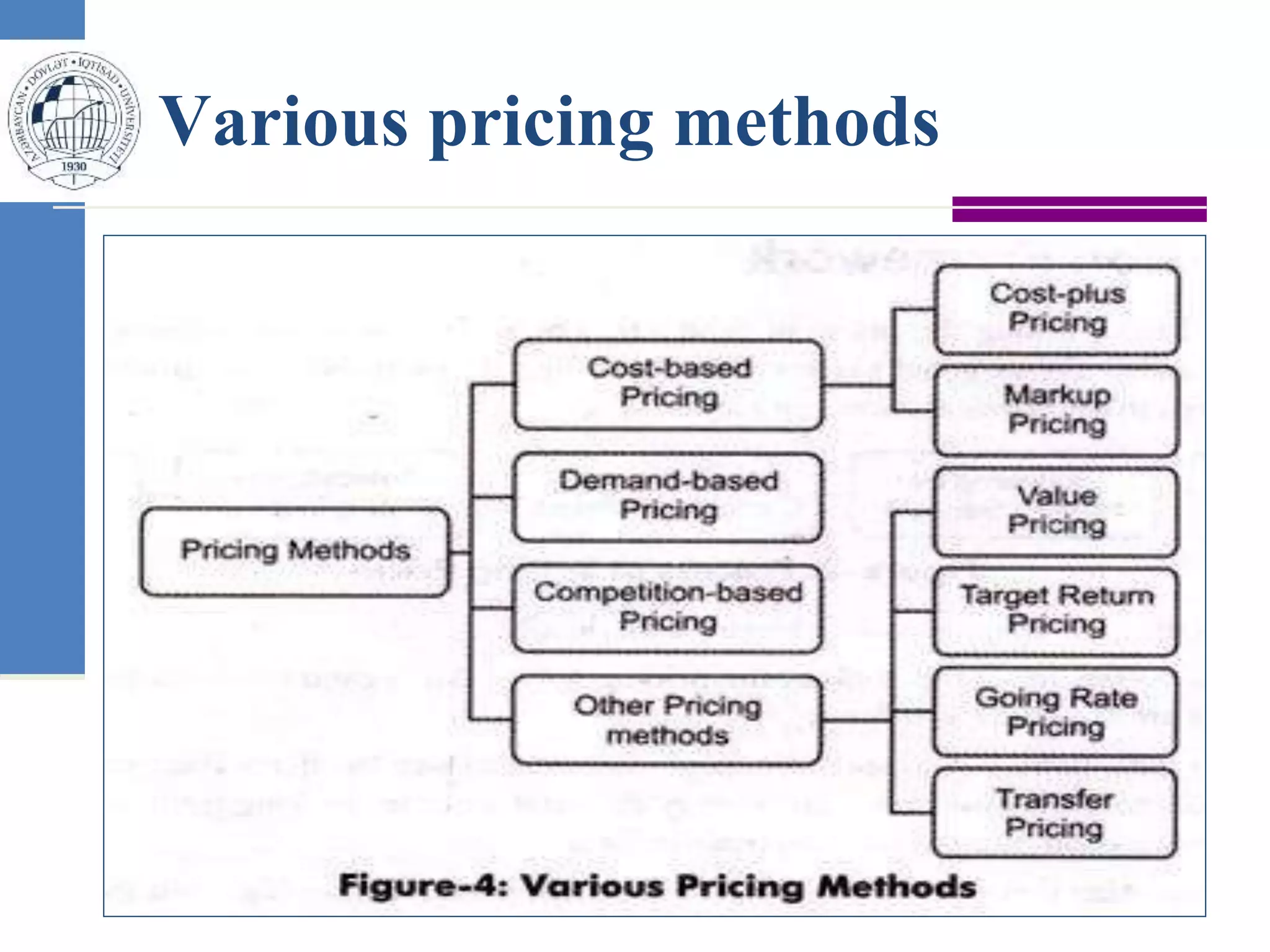
Various pricing methods
Cost-based pricing
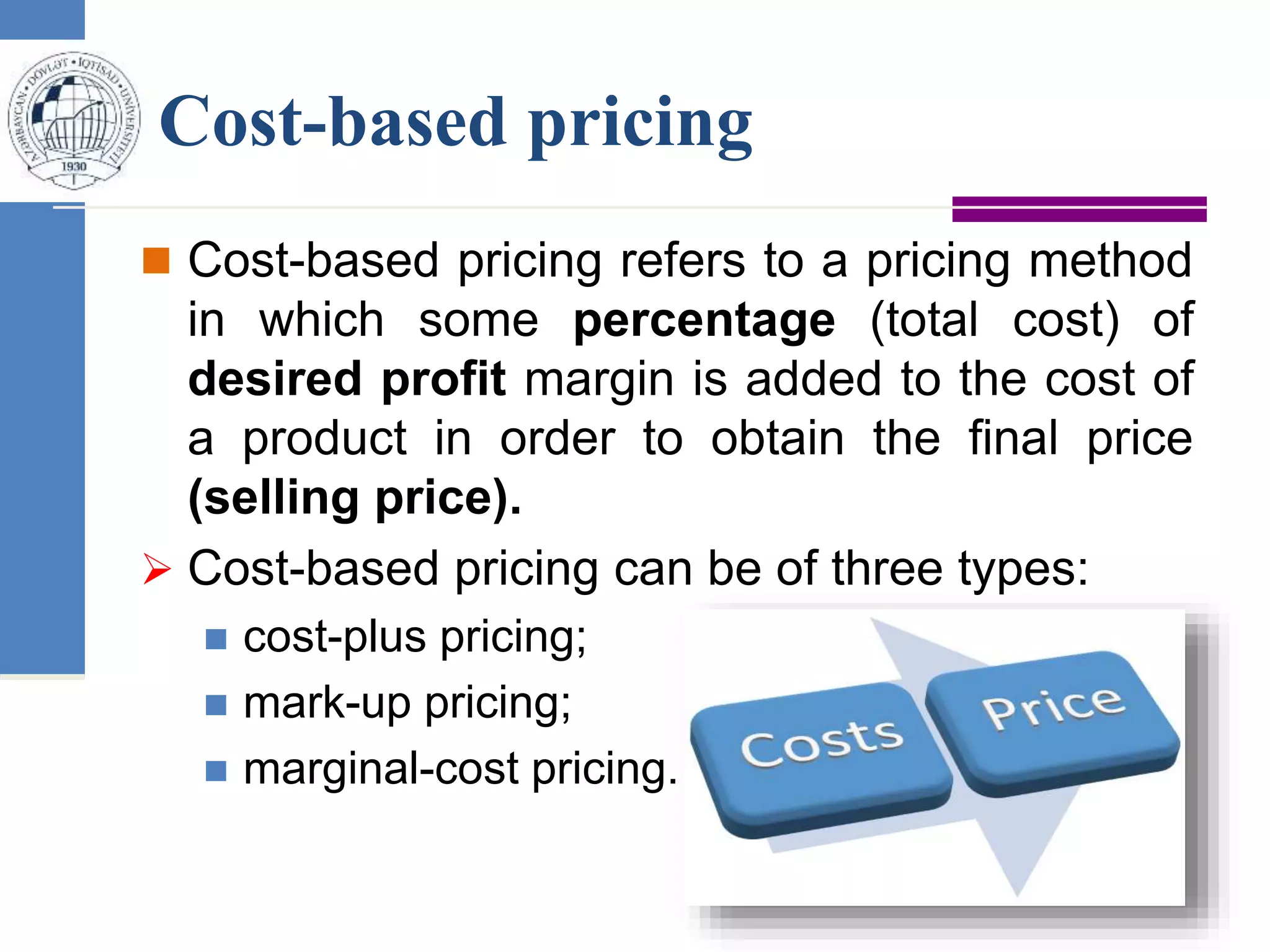
 Cost-based pricing refers to a pricing method
in which some percentage (total cost) of
desired profit margin is added to the cost of
a product in order to obtain the final price
(selling price).
 Cost-based pricing can be of three types:
 cost-plus pricing;
 mark-up pricing;
 marginal-cost pricing.
Cost-plus pricing
 Cost-plus pricing method refers to the
simplest method of determining the price of a
product. In cost-plus pricing method, a fixed
percentage, also which is called a mark-up
percentage, of the total cost is added to the
total cost.
 Cost-plus pricing method is also known as an
average cost pricing.
 This is the most commonly used method in
manufacturing organizations.
Cost-plus pricing
 The pricing method based on full expenses
includes all expenses during the production a
commodity.
 This method allows one to set a price limit.
Cost-plus pricing
Advantages
 Requires minimum
information.
 Involves simplicity of
calculation.
 Insure sellers against
the unexpected
changes in costs.
Disadvantages
 Ignores price strategies of
competitors.
 Ignores the role of
customers.
 Much more oriented to
the production and less to
the market.
Mark up pricing
 Mark up pricing is
more common in the
retail industry in which
retailer sells a product
in order to earn profit.
 Mark up as a
percentage of
cost=(markup/cost)*1
00
 Mark up as
percentage of
selling
price=(Markup/selling
price)*100
Mark up pricing calculation
Mark up Selling price=$500
Cost =$400
Mark up as a % of selling price (100/500)*100=20
Mark up as a % to cost (100/400)*100=25
Marginal cost pricing
 Marginal cost pricing is the process of setting
an item's price at the same level as the extra
expense involved in producing another item.
 This method is useful in a specific situation
where a company can earn additional profits
from using up an excess production capacity.
Cost-based pricing: example 1
Company A Company B
Direct cost 370 340
Raw materials 55 45
Wage expenses 105 95
Other direct costs 210 200
Indirect costs 100 100
Total cost 470 440
Rentability (to expenses) 15% 12%
Profit 70 53
Price of product 540 493
Cost-based pricing: example 2
If the operational cost of the store accounts for 8 $, the net profit of
the wholesaler will be 2 $.
For example, if the wholesaler purchases a product for 20 $ and sells
it to for 30 $ he or she will gain 10 $ of profit
(50% addition to the price).
Cost based pricing
 The price OP is made up of three elements: average
fixed cost, average variable cost and a profit margin.
Demand-based pricing
 Demand-based pricing refers to a pricing
method in which the price of product is
finalized according to its demand.
 If the demand of a product is more, an
organization prefers to set high prices for
products to gain profit.
 Success of demand-based pricing depends
on the ability of marketers to investigate the
demand.
Demand-based pricing
 The named method
of pricing can be
used in the travelling
industry.
 To take an example,
airlines in a period of
low demand charge
less rates as
compared to a period
of high demand.
Competition-based pricing
 Competition-based pricing refers to a
method in which an organization considers
the price of competitors’ products to set the
prices of its own products.
 The organization may charge higher, lower,
or equal prices as compared to the prices of
its competitors.
 An aviation industry is the best example of
competition-based pricing, where airlines
charge the same or fewer prices for the same
routes as charged by their competitors.
Sealed bid pricing
 Sealed bid pricing is based on how the firm
considers competitors will price their products
rather than only on its own costs or demand.
 In this pricing method firms go for competitive
bidding through sealed tenders or quotations.
 Firms look for the best (lowest possible) price
consistent with minimum quality specification.
Value pricing
 Value pricing implies a method in which an
organization tries to win loyal customers by
charging low prices for their high quality
products.
 The organization aims to become a low cost
producer without sacrificing the quality.
Value pricing
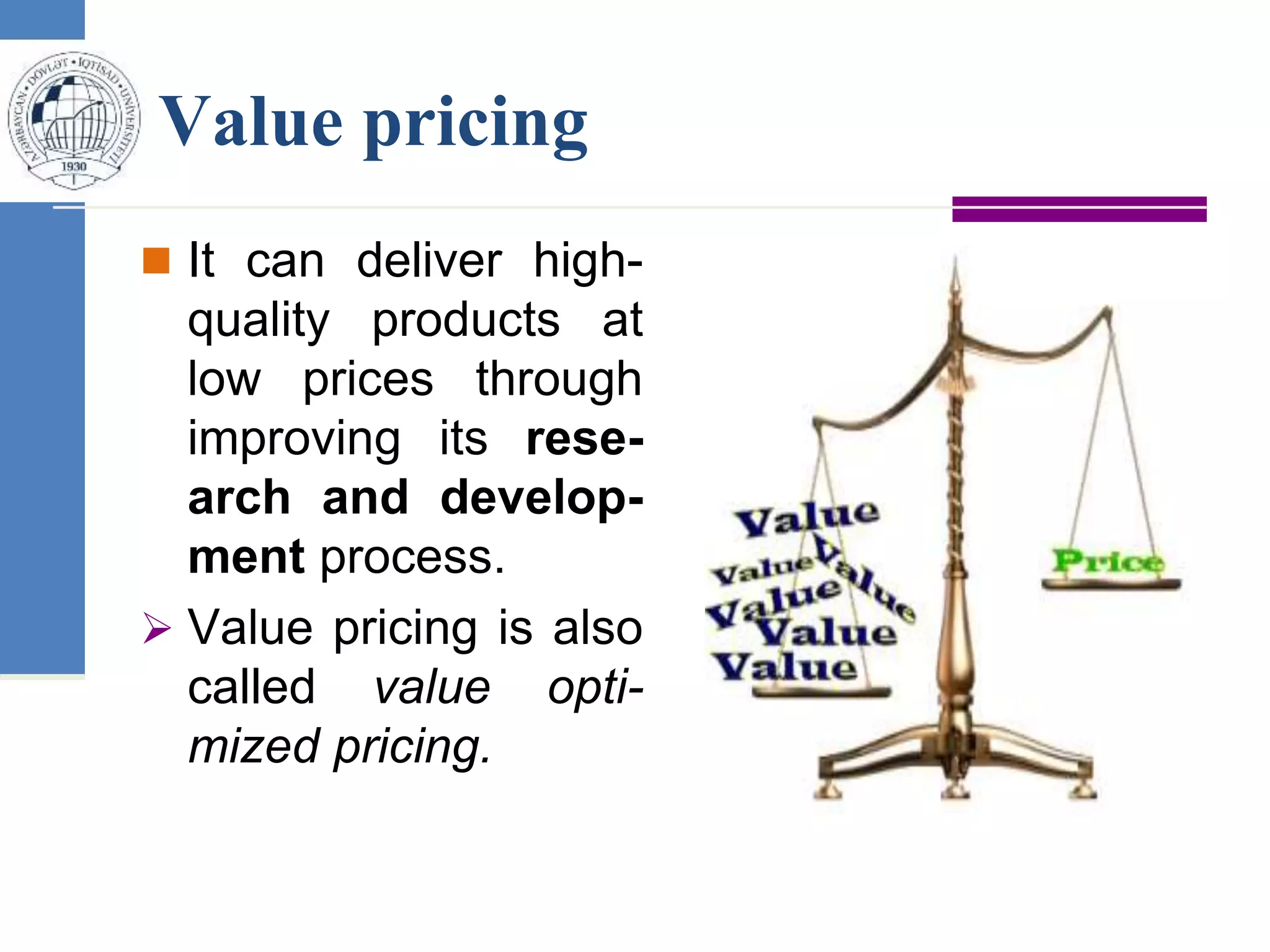
 It can deliver high-
quality products at
low prices through
improving its rese-
arch and develop-
ment process.
 Value pricing is also
called value opti-
mized pricing.
Perceived-Value Pricing
 In perceived-value pricing a firm sets price
based on a customer’s perception of goods
and services taking into account all the
elements such as advertising, promotional
tools, product quality and other that influence
a customer’s perception.
Perceived value vs Cost-based pricing
Target-return pricing
 Target return pricing helps in achieving the
required rate of return on investment done for
a product. In other words, a price of a product
is fixed on the basis of expected profit.
 The target return price can be calculated as:
 Target return price = unit cost + (desired
return * invested capital) / unit sale.
Return Investment
 Return on investment (ROI) is the benefit to
an investor resulting from an investment of
some resource.
Target-return pricing calculation
 Suppose a TV manufacturer invested 1 million
dollars in a business and wants to set a price
to earn a 30% ROI. The manufacturing cost of
per TV is 20$. Assuming that the sales can
reach 50,000 units.
 Target return price will be = 20 + (0.3 *
1000000)/ 50,000 = 26$
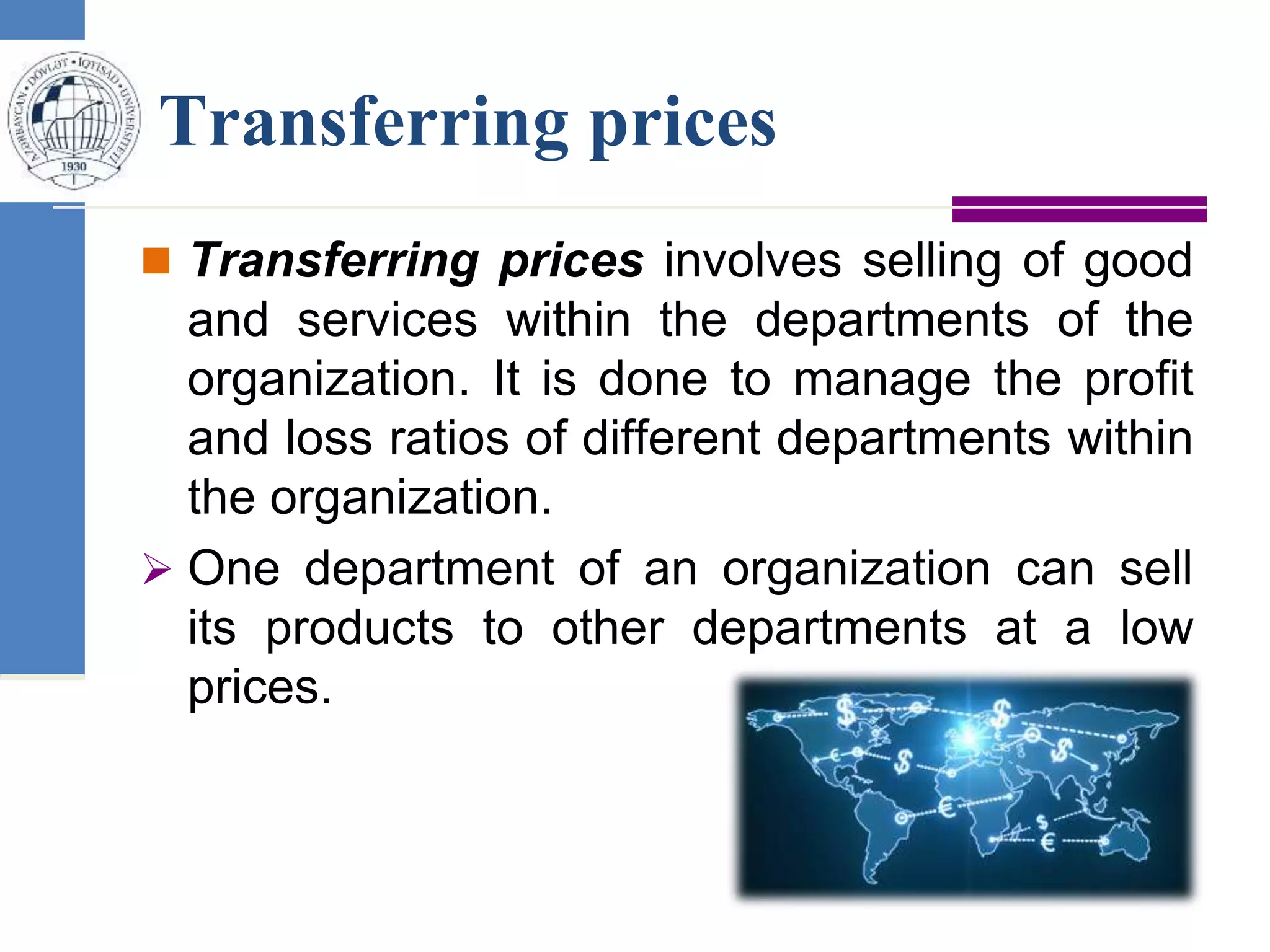
Transferring prices
 Transferring prices involves selling of good
and services within the departments of the
organization. It is done to manage the profit
and loss ratios of different departments within
the organization.
 One department of an organization can sell
its products to other departments at a low
prices.
Going-rate pricing
 Going-rate price implies a method in which
an organization sets the price of a product
according to the prevailing price trends in the
market.
 In most cases the pricing decisions adopted
by an organization can be the same or similar
to other organizations.
Breakeven pricing
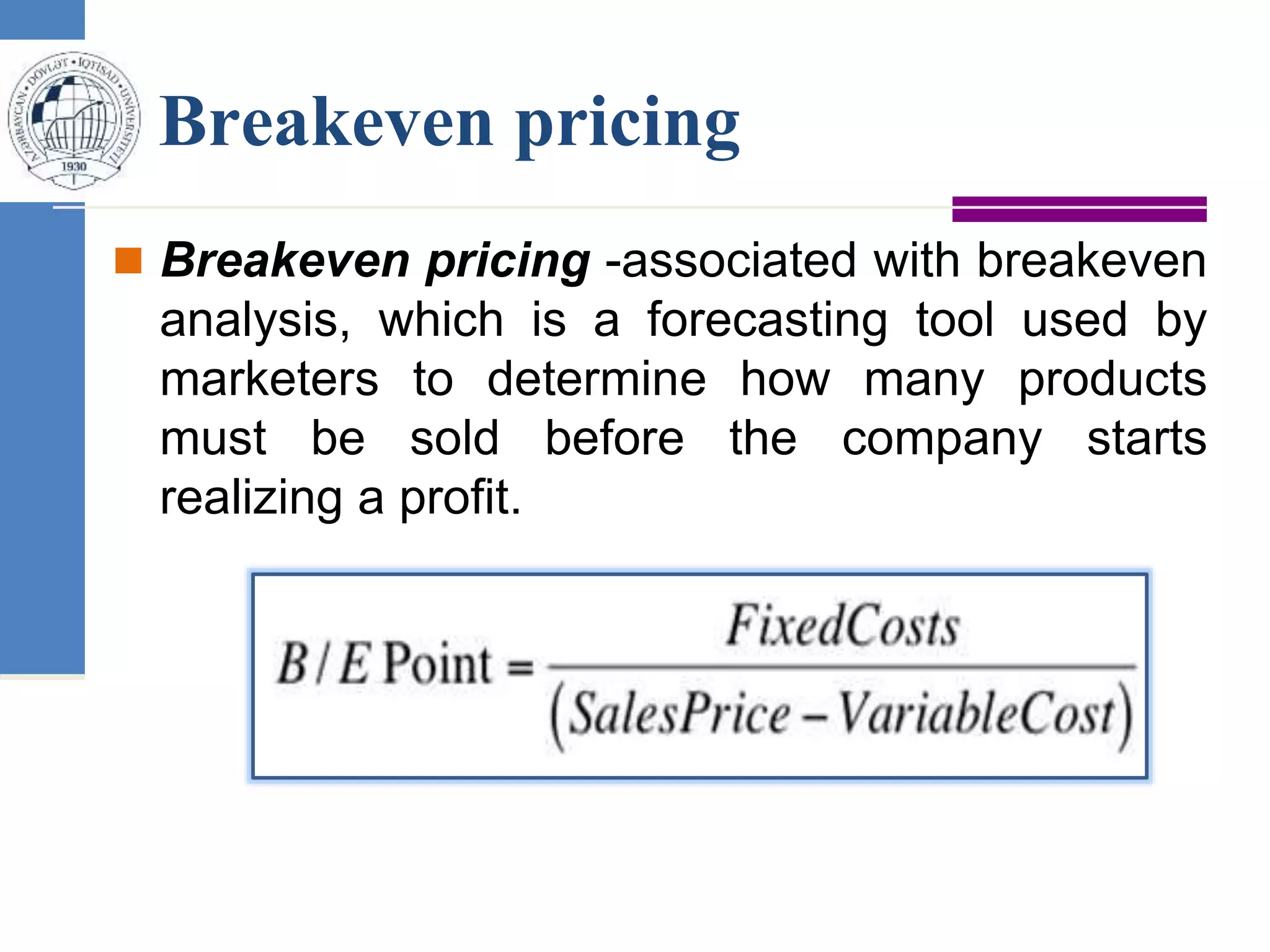
 Breakeven pricing -associated with breakeven
analysis, which is a forecasting tool used by
marketers to determine how many products
must be sold before the company starts
realizing a profit.
Breakeven pricing
 For instance, assume a company operates a single-
product manufacturing plant that has a total fixed cost
(e.g., purchase of equipment, mortgage, etc.) per
year of $3,000,000 and the variable cost (e.g., raw
materials, labor, electricity, etc.) is $45.00 per unit. If
the company sells the product directly to customers
for $120, it will require the company to sell 40,000
units to breakeven.
B/E pricing=
Breakeven pricing
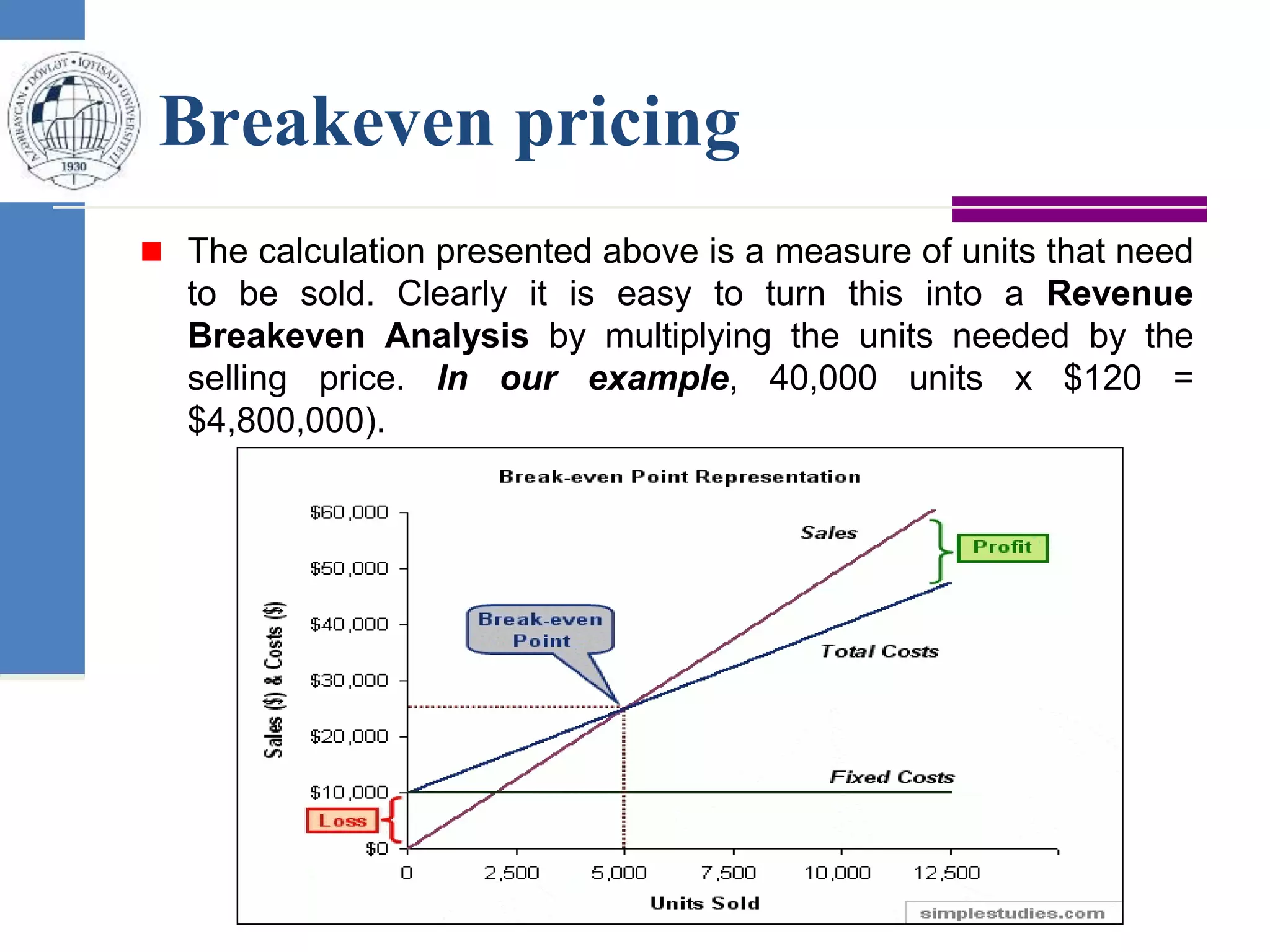
 The calculation presented above is a measure of units that need
to be sold. Clearly it is easy to turn this into a Revenue
Breakeven Analysis by multiplying the units needed by the
selling price. In our example, 40,000 units x $120 =
$4,800,000).
Price leadership method
 Price leadership prevail in the case when a
firm that is the leader in its sector determines
the price of goods or services and others
follow this price.
 These methods are practiced in the markets
where prevail several firms. The firm with
high market shares takes initiative.
Stackelberg price leadership
 Stackelberg price leadership assumes that
one firm has knowledge or foresight of its
competitor’s reaction to its price policies.
 As a result, the firm may credibly announce a
price in anticipation of competitor’s reaction.
 Stackelberg price leader benefits from this
foresight and is normally better off than in the
simultaneous game.
Tender price methods
 Tender usually refers to the process whereby
governments and financial institutions invite
bids for large projects that must be submitted
within a finite deadline.
 Tender price methods-are used in the cases
when several firms have serious competition
for obtaining contract.
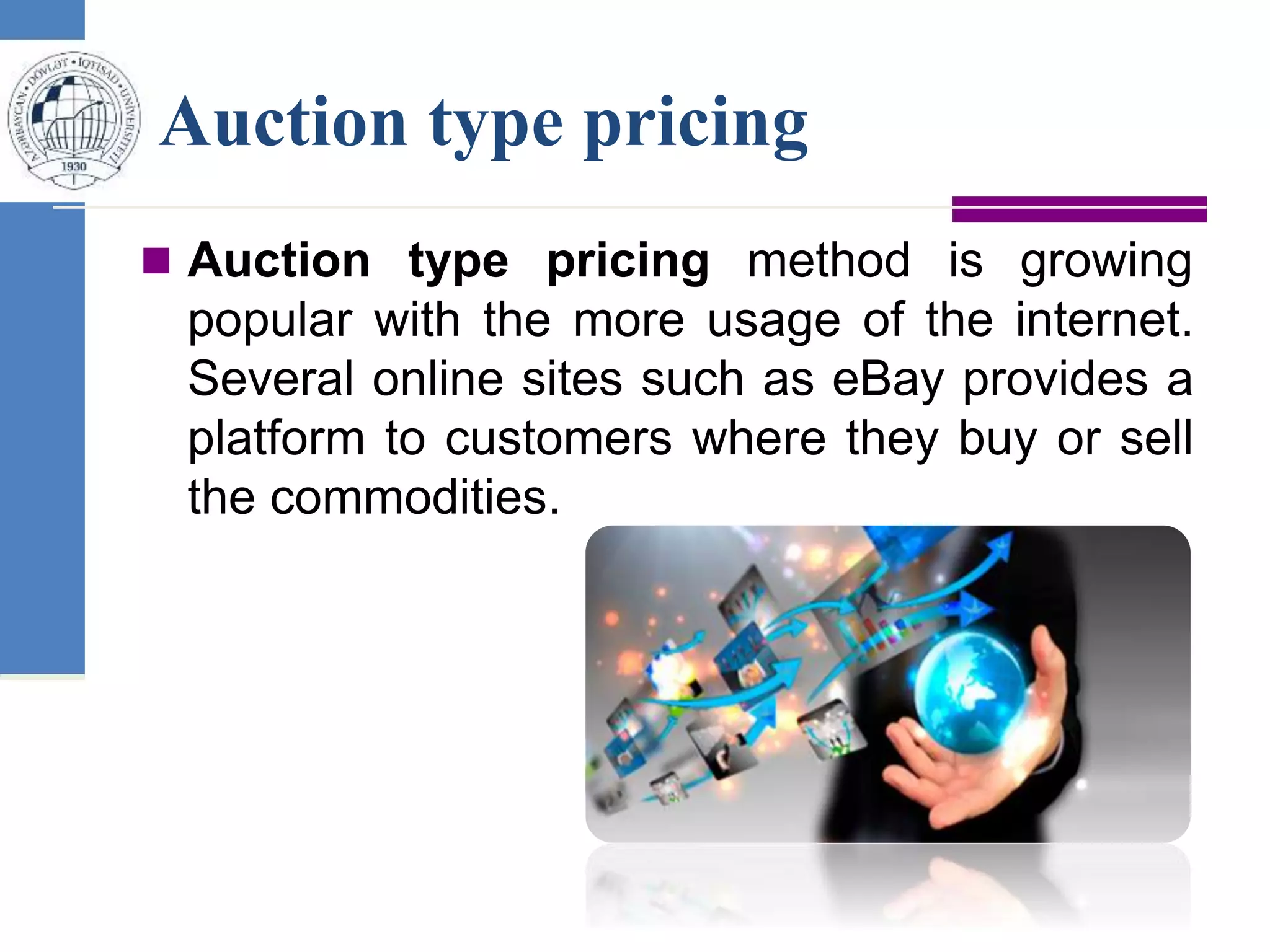
Auction type pricing
 Auction type pricing method is growing
popular with the more usage of the internet.
Several online sites such as eBay provides a
platform to customers where they buy or sell
the commodities.
Parametric methods of pricing
 Unit price method - price formation based on one of
the major quality characteristics of a commodity.
 Pricing method of bands - refers to the use of
expert valuations of the significance of products. It
involves using of bands in the process of basic
parameters of a product.
 Regressive analysis method - is based on the
technical-economic parameter of a product. One can
built here also correlation dependence.
 Aggregate methods - refers to the summing of
separate constructive parts of products.
Summary
 Pricing methods are common tools and
procedures used on the world market by
producers and manufacturers.
 Based on pricing methods entrepreneurs
formulate their tactics with regard to the
products and services.
UNEC__1681280374.pptx.ppt

UNEC__1681280374.pptx.ppt

  • 1.
    Pricing Policy Lecture 4:Methodsof pricing policy Azerbaijan State University of Economics - UNEC
  • 2.
    Content  Preface  Levelsof price management  Methodology of pricing  Methods of pricing  Cost-based pricing  Demand-based pricing  Other methods of pricing  Conclusion
  • 3.
    Preface  In theworld market prevail various methods of price setting.  In this respect, one of the major issues is becoming analyzing of pricing methods in order to evaluate one’s decision and take appropriate actions.
  • 4.
    Levels of pricemanagement  There are three levels of price management:  Industry strategy;  Product/market strategy;  Transaction.
  • 5.
    Price level: Industrystrategy  Industry strategy is the first level in the price management. It considers the influence of supply, demand and cost dynamics to the overall industry price level.  Excellence in industry requires not only in-depth knowledge of your own company and how your actions will affect market prices, but also the feature of competition.  Capacities, cost structures, capital investments, research and development expenditures and growth aspirations of other companies are the key part of this overall strategy.
  • 6.
    Price level: Industrystrategy  Bringing all this knowledge together, companies can anticipate industry price trends and become proactive with regard to its operations rather than just a pawn of the market “invisible hand”.  They can adjust their tactics to take advantage of this superior understanding.
  • 7.
    Price level: product/marketstrategy  At the second level of price management, a primary issue is price positioning relative to competitors. That is, within each market segment that one serves, what price level positions he or she occupies in customer’s eyes.  Price actions at this level tends to be quite visible to the market, both to customers and competitors.
  • 8.
    Price level: product/marketstrategy  At this level one is setting the following prices:  “List prices” – is a basic published price or advertised price;  “Base prices” – is the initial price of something (goods and services) without the additional changes that may be added, such as handling or transportation costs, sales tax and so on;  “Target prices” – is a price that would result in the best possible outcome for one’s investment. It is the price at which a stockholder is willing to sell his or her stock.
  • 9.
    Price level: transaction Transaction – is the process based on which goods, services, or money are passed from one person, account to another one.  At this level, a critical issue is how to manage the exact price charged for each transaction.  The objective of transaction management is to achieve the right and best realized price for each transaction.
  • 10.
    Transaction: off-invoice and pocketprice  Invoice price - is the price that appears on the invoice that a manufacturer sends to a dealer when a dealer receives a car from the factory.  Pocket price – the revenues that are actually left in a company’s pocket from a transaction to cover costs and contribute to profit.  Pocket price = invoice price-invoice off price.
  • 11.
    Transaction: off-invoice prices Annual volume discount-an end year bonus paid to customers.  Cash discount-a deduction from the price if payment is made quickly.  Online order discount-a discount offered to customers ordering over the internet.  Consignment costs-the costs of funds when a supplier provides consigned inventory to a retailer and wholesaler. Consignment is a business arrangement, in which a business, also referred to as a consignee, agrees to pay a seller, or consignor, for merchandise after the item sells.  Market-development funds-a discount to promote sales to a specific market segment.  Stocking allowance-a discount paid to wholesalers or retailers to make large purchases into inventory.
  • 12.
    Methodology of pricing Methodology of pricing - is the sum of common rules, principles and methods. It involves elaboration of pricing concept, definition and assessment of pricing, formulating of a price system, management of prices.  Through the methodology is developed a pricing strategy, whereas methods include recommendations and instruments for the realization on this strategy in the practice.
  • 13.
    Methods of pricing Currently, there are different kinds of price methods used by firms. Based on these methods firms compare their costs and profits.
  • 14.
    Methods of pricing Pricing methods - are the various tools of price formation.  Prices are based on three dimensions that are costs, demand and competition.  The organization can use any of the dimensions, whereas combination of dimensions in order to set the price of product.
  • 15.
    Pricing methods  Cost-basedpricing;  Demand-based pricing;  Value pricing;  Target return pricing;  Transfer pricing;  Going-rate pricing;  Competition-based pricing;  Other pricing methods.
  • 16.
    Pricing methods  Inorder to set relevant price the seller should analyze the prices of competitors, internal and external factors.  Based on these factors the seller should choose the appropriate pricing method.
  • 17.
  • 18.
    Cost-based pricing  Cost-basedpricing refers to a pricing method in which some percentage (total cost) of desired profit margin is added to the cost of a product in order to obtain the final price (selling price).  Cost-based pricing can be of three types:  cost-plus pricing;  mark-up pricing;  marginal-cost pricing.
  • 19.
    Cost-plus pricing  Cost-pluspricing method refers to the simplest method of determining the price of a product. In cost-plus pricing method, a fixed percentage, also which is called a mark-up percentage, of the total cost is added to the total cost.  Cost-plus pricing method is also known as an average cost pricing.  This is the most commonly used method in manufacturing organizations.
  • 20.
    Cost-plus pricing  Thepricing method based on full expenses includes all expenses during the production a commodity.  This method allows one to set a price limit.
  • 21.
    Cost-plus pricing Advantages  Requiresminimum information.  Involves simplicity of calculation.  Insure sellers against the unexpected changes in costs. Disadvantages  Ignores price strategies of competitors.  Ignores the role of customers.  Much more oriented to the production and less to the market.
  • 22.
    Mark up pricing Mark up pricing is more common in the retail industry in which retailer sells a product in order to earn profit.  Mark up as a percentage of cost=(markup/cost)*1 00  Mark up as percentage of selling price=(Markup/selling price)*100
  • 23.
    Mark up pricingcalculation Mark up Selling price=$500 Cost =$400 Mark up as a % of selling price (100/500)*100=20 Mark up as a % to cost (100/400)*100=25
  • 24.
    Marginal cost pricing Marginal cost pricing is the process of setting an item's price at the same level as the extra expense involved in producing another item.  This method is useful in a specific situation where a company can earn additional profits from using up an excess production capacity.
  • 25.
    Cost-based pricing: example1 Company A Company B Direct cost 370 340 Raw materials 55 45 Wage expenses 105 95 Other direct costs 210 200 Indirect costs 100 100 Total cost 470 440 Rentability (to expenses) 15% 12% Profit 70 53 Price of product 540 493
  • 26.
    Cost-based pricing: example2 If the operational cost of the store accounts for 8 $, the net profit of the wholesaler will be 2 $. For example, if the wholesaler purchases a product for 20 $ and sells it to for 30 $ he or she will gain 10 $ of profit (50% addition to the price).
  • 27.
    Cost based pricing The price OP is made up of three elements: average fixed cost, average variable cost and a profit margin.
  • 28.
    Demand-based pricing  Demand-basedpricing refers to a pricing method in which the price of product is finalized according to its demand.  If the demand of a product is more, an organization prefers to set high prices for products to gain profit.  Success of demand-based pricing depends on the ability of marketers to investigate the demand.
  • 29.
    Demand-based pricing  Thenamed method of pricing can be used in the travelling industry.  To take an example, airlines in a period of low demand charge less rates as compared to a period of high demand.
  • 30.
    Competition-based pricing  Competition-basedpricing refers to a method in which an organization considers the price of competitors’ products to set the prices of its own products.  The organization may charge higher, lower, or equal prices as compared to the prices of its competitors.  An aviation industry is the best example of competition-based pricing, where airlines charge the same or fewer prices for the same routes as charged by their competitors.
  • 31.
    Sealed bid pricing Sealed bid pricing is based on how the firm considers competitors will price their products rather than only on its own costs or demand.  In this pricing method firms go for competitive bidding through sealed tenders or quotations.  Firms look for the best (lowest possible) price consistent with minimum quality specification.
  • 32.
    Value pricing  Valuepricing implies a method in which an organization tries to win loyal customers by charging low prices for their high quality products.  The organization aims to become a low cost producer without sacrificing the quality.
  • 33.
    Value pricing  Itcan deliver high- quality products at low prices through improving its rese- arch and develop- ment process.  Value pricing is also called value opti- mized pricing.
  • 34.
    Perceived-Value Pricing  Inperceived-value pricing a firm sets price based on a customer’s perception of goods and services taking into account all the elements such as advertising, promotional tools, product quality and other that influence a customer’s perception.
  • 35.
    Perceived value vsCost-based pricing
  • 36.
    Target-return pricing  Targetreturn pricing helps in achieving the required rate of return on investment done for a product. In other words, a price of a product is fixed on the basis of expected profit.  The target return price can be calculated as:  Target return price = unit cost + (desired return * invested capital) / unit sale.
  • 37.
    Return Investment  Returnon investment (ROI) is the benefit to an investor resulting from an investment of some resource.
  • 38.
    Target-return pricing calculation Suppose a TV manufacturer invested 1 million dollars in a business and wants to set a price to earn a 30% ROI. The manufacturing cost of per TV is 20$. Assuming that the sales can reach 50,000 units.  Target return price will be = 20 + (0.3 * 1000000)/ 50,000 = 26$
  • 39.
    Transferring prices  Transferringprices involves selling of good and services within the departments of the organization. It is done to manage the profit and loss ratios of different departments within the organization.  One department of an organization can sell its products to other departments at a low prices.
  • 40.
    Going-rate pricing  Going-rateprice implies a method in which an organization sets the price of a product according to the prevailing price trends in the market.  In most cases the pricing decisions adopted by an organization can be the same or similar to other organizations.
  • 41.
    Breakeven pricing  Breakevenpricing -associated with breakeven analysis, which is a forecasting tool used by marketers to determine how many products must be sold before the company starts realizing a profit.
  • 42.
    Breakeven pricing  Forinstance, assume a company operates a single- product manufacturing plant that has a total fixed cost (e.g., purchase of equipment, mortgage, etc.) per year of $3,000,000 and the variable cost (e.g., raw materials, labor, electricity, etc.) is $45.00 per unit. If the company sells the product directly to customers for $120, it will require the company to sell 40,000 units to breakeven. B/E pricing=
  • 43.
    Breakeven pricing  Thecalculation presented above is a measure of units that need to be sold. Clearly it is easy to turn this into a Revenue Breakeven Analysis by multiplying the units needed by the selling price. In our example, 40,000 units x $120 = $4,800,000).
  • 44.
    Price leadership method Price leadership prevail in the case when a firm that is the leader in its sector determines the price of goods or services and others follow this price.  These methods are practiced in the markets where prevail several firms. The firm with high market shares takes initiative.
  • 45.
    Stackelberg price leadership Stackelberg price leadership assumes that one firm has knowledge or foresight of its competitor’s reaction to its price policies.  As a result, the firm may credibly announce a price in anticipation of competitor’s reaction.  Stackelberg price leader benefits from this foresight and is normally better off than in the simultaneous game.
  • 46.
    Tender price methods Tender usually refers to the process whereby governments and financial institutions invite bids for large projects that must be submitted within a finite deadline.  Tender price methods-are used in the cases when several firms have serious competition for obtaining contract.
  • 47.
    Auction type pricing Auction type pricing method is growing popular with the more usage of the internet. Several online sites such as eBay provides a platform to customers where they buy or sell the commodities.
  • 48.
    Parametric methods ofpricing  Unit price method - price formation based on one of the major quality characteristics of a commodity.  Pricing method of bands - refers to the use of expert valuations of the significance of products. It involves using of bands in the process of basic parameters of a product.  Regressive analysis method - is based on the technical-economic parameter of a product. One can built here also correlation dependence.  Aggregate methods - refers to the summing of separate constructive parts of products.
  • 49.
    Summary  Pricing methodsare common tools and procedures used on the world market by producers and manufacturers.  Based on pricing methods entrepreneurs formulate their tactics with regard to the products and services.